 Spiritual
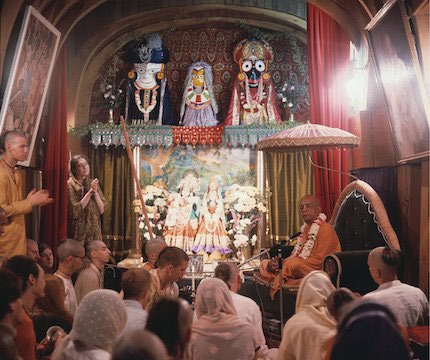
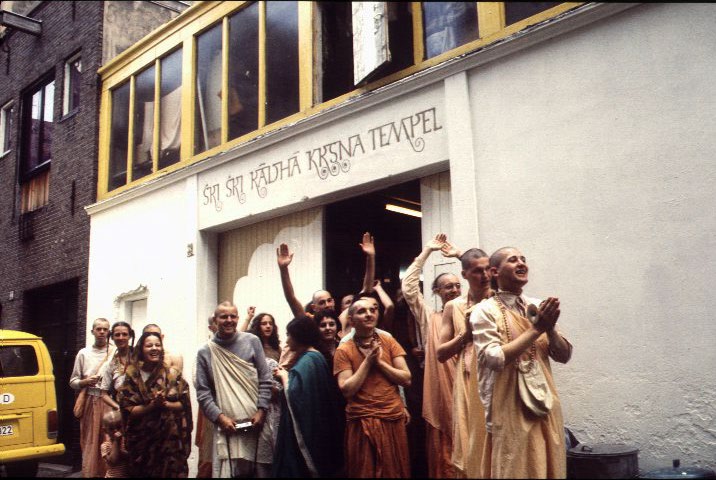
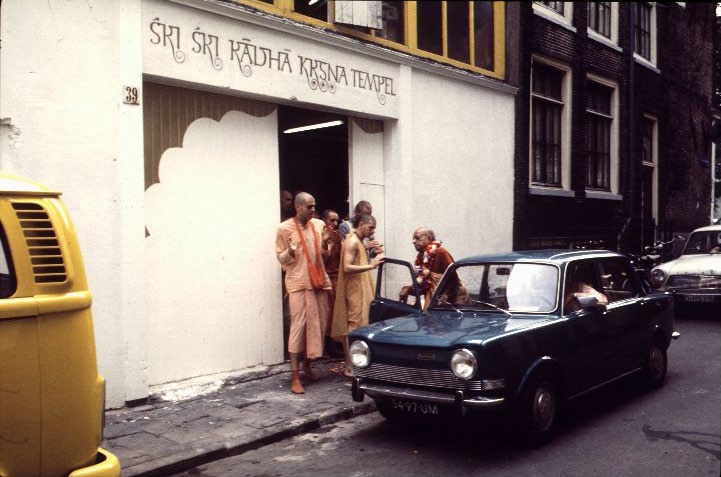
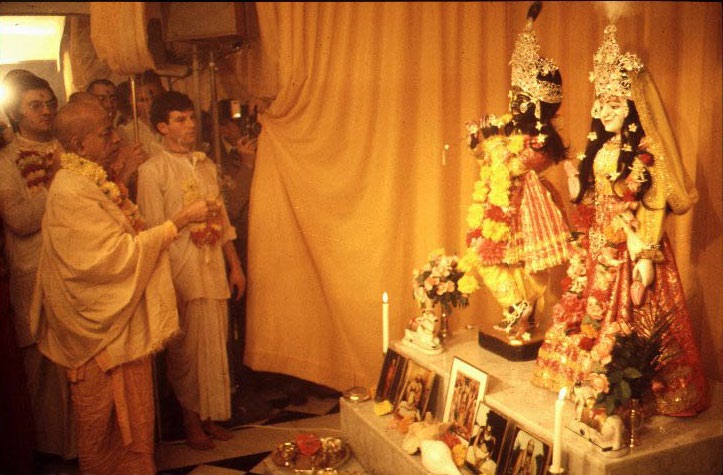
After a week in Paris, Śrīla Prabhupāda visited Amsterdam, where the Dutch devotees received him in their small temple on Bethanienstraat for the first time. Although the center was new and none of the devotees were experienced, they had asked Prabhupāda to install the Deities of Jagannātha, Baladeva, and Subhadrā.
The devotees from Germany wanted to be with their spiritual master for some days more, and because Amsterdam was only a few hours’ drive from Paris they all got into their vans and headed north.
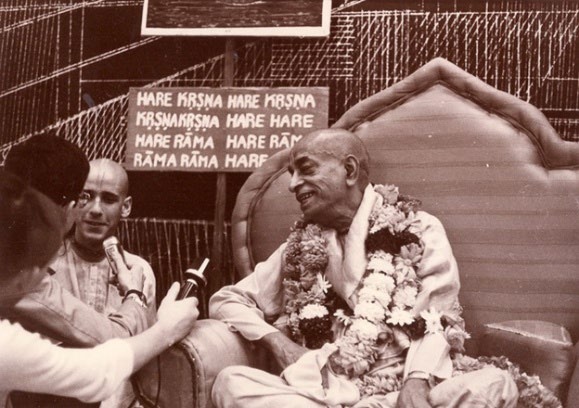
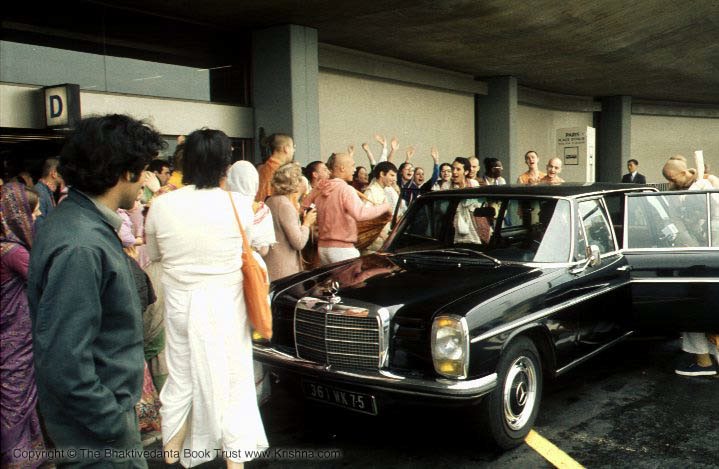
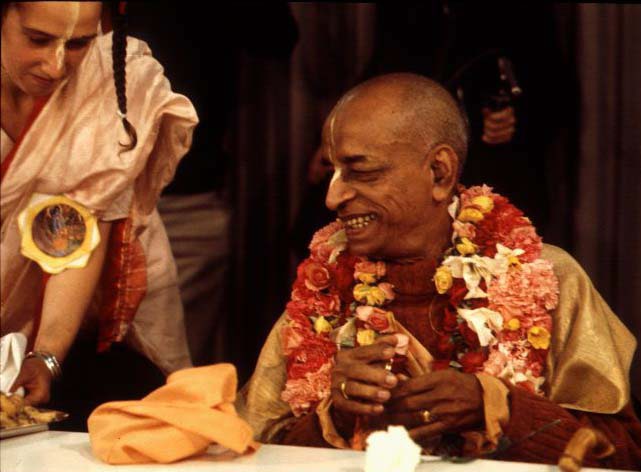
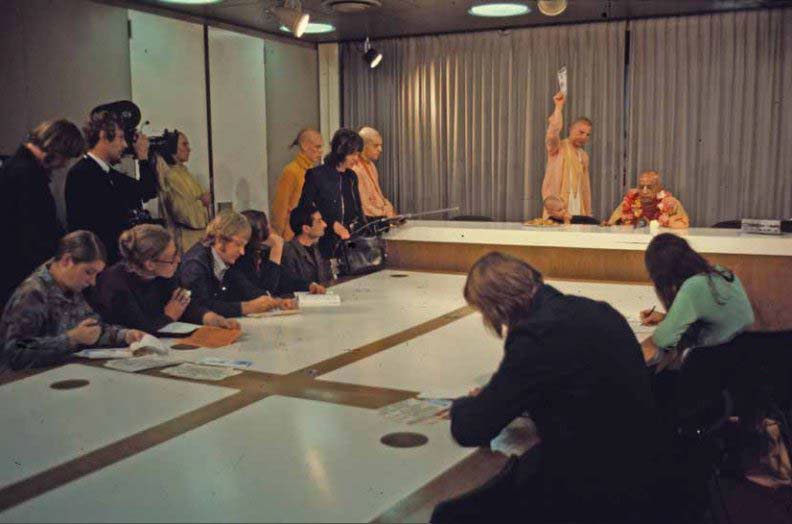
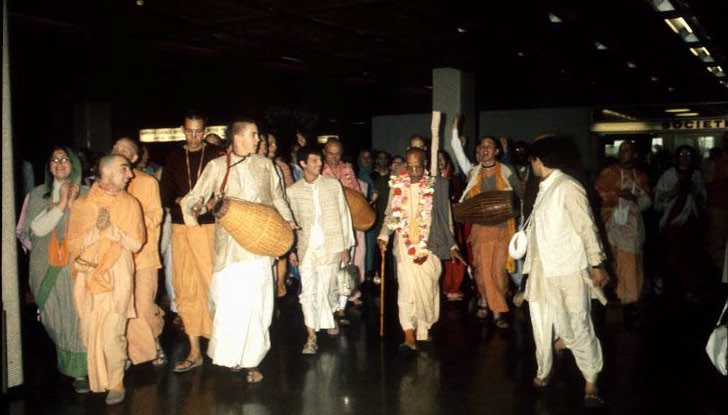
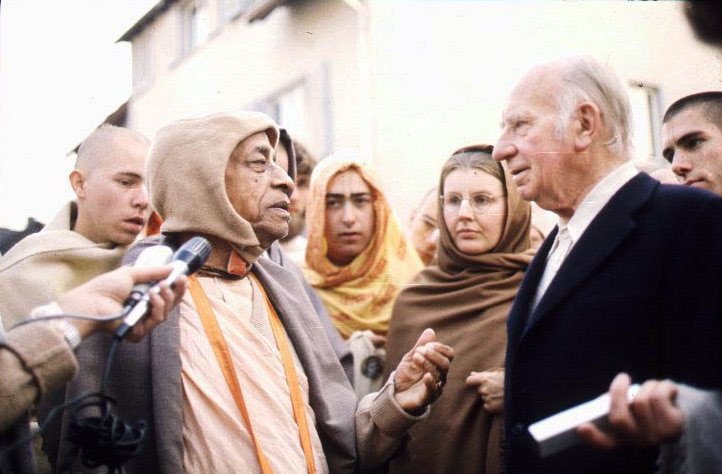
CAKRAVARTĪ DĀSA: We greeted Prabhupāda at the Amsterdam airport with an enthusiastic kīrtana and escorted him to the VIP lounge where he settled down behind a huge conference table in front of a crowd of reporters. The room had no air conditioning, and it was a very hot August day. The devotees had not brought fans. So after I watched the pearls of perspiration running down Prabhupāda’s face I finally grabbed a magazine and provided some cooling air. The next day one of the major newspapers published a photo of me standing next to Śrīla Prabhupāda. The caption said that one of the Swami’s young disciples was serving his spiritual master by fanning him with a magazine.
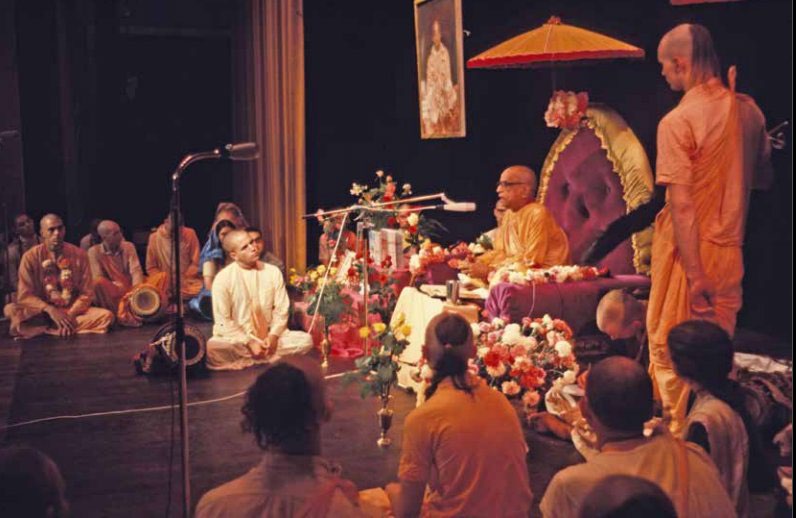
For Friday and Saturday evening, the devotees had rented a hall in the Krasnapolsky Hotel, near the Dam, the main square in Amsterdam’s downtown.
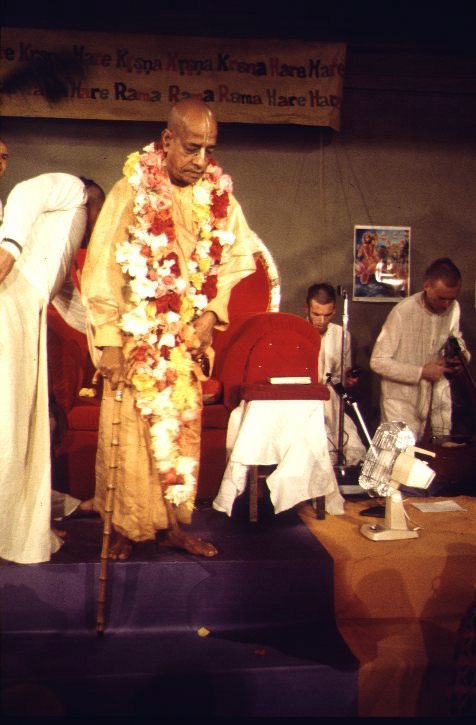
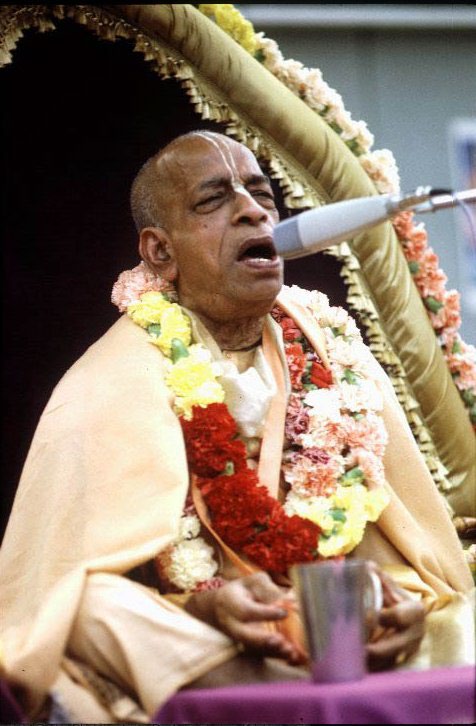
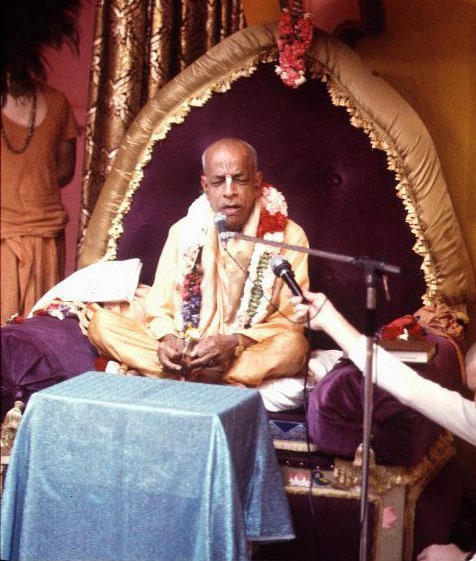
PṚTHU DĀSA: To attract people to Śrīla Prabhupāda’s lecture, Hansadutta and Revatīnandana Swami led a huge harināma through the center of Amsterdam and around Dam Square, and when they arrived at the hall, an immense crowd of hippies was following them. The kīrtana continued onstage for a good while until Prabhupāda came and sat on the vyāsāsana. He took his karatālas, chanted Jaya Rādhā-Mādhava, and gave a brief lecture. Then he called over Hansadutta, exchanged a few words with him, and got up and left.
Hansadutta told us that Prabhupāda had said these people were useless. Best was just to have kīrtana and give them prasādam; there was no use discussing philosophy—they were all intoxicated. So we had a festival program with nonstop kīrtana and distributed hundreds of plates of prasādam.
CAKRAVARTĪ DĀSA: One of my duties was to keep order. Four or five young men that nowadays we would call punks, started to smoke. I had them put out their cigarettes. Then, during Prabhupāda’s kīrtana, one of them began to mock the devotees’ dancing. We ignored him, and the rest of the evening passed without incident.
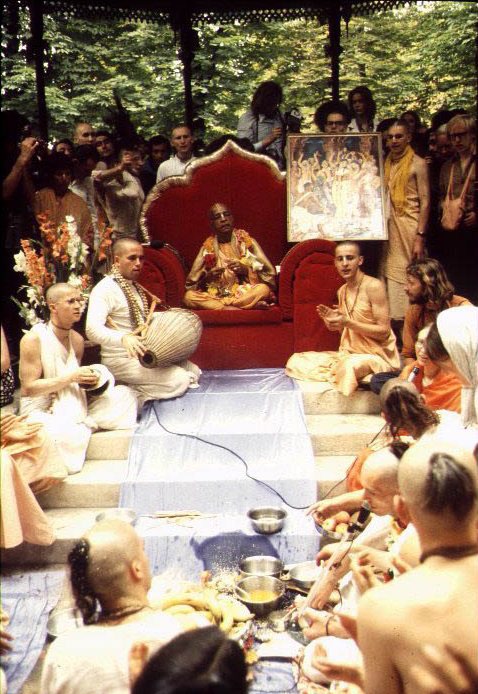
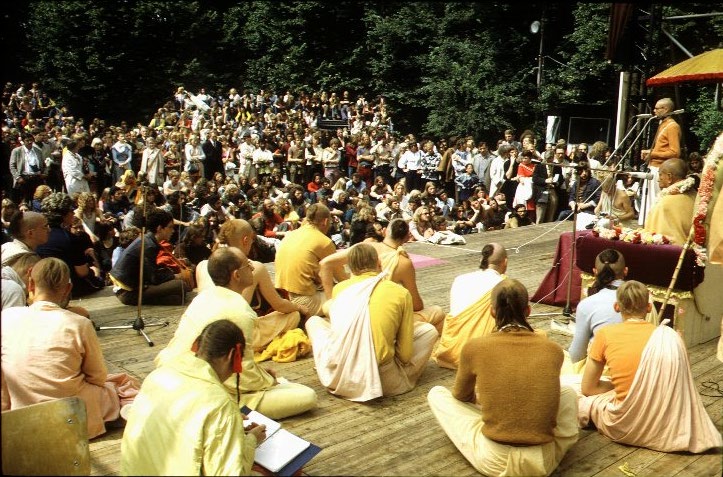
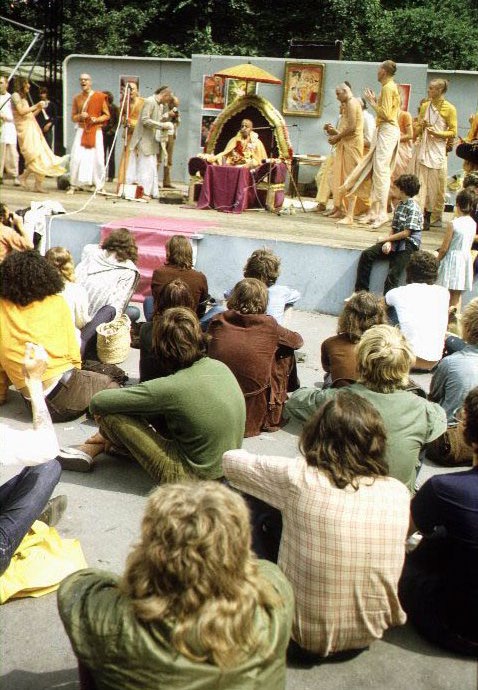
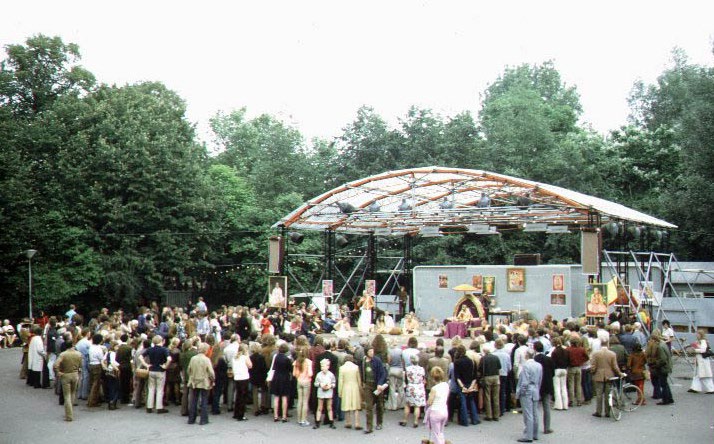
REVATĪNANDANA DĀSA: On Saturday we had an all-day program in Vondelpark. Śrīla Prabhupāda told us to just have kīrtana, because these people were degraded. He told us not to speak much because if we said the wrong thing, they might become agitated, even violent. I told him that I had experience with these kinds of people and that after ten or fifteen minutes they often became restless. “Yes,” Prabhupāda said, “ten, fifteen minutes maximum, and no questions.”
In the morning I began the program with kīrtanas and brief talks. Prabhupāda stayed in a nearby apartment. His front window faced the park. His servant later told me that Prabhupāda, hearing our program going on, came out on the balcony and stayed there for a good while. He obviously enjoyed hearing us preach by chanting and lecturing.
One devotee had picked up a chant in India: he kṛṣṇa govinda hari murāri/ he nātha nārāyāṇa vāsudeva. When Prabhupāda heard it he called us into his room and said, “This is not a Vedic mantra; this is a cinema song. An intelligent disciple just takes whatever his spiritual master provides for him, considering that to be sufficient. There are many names of God you can chant, but it’s best to take what comes in disciplic succession and what the spiritual master introduces.”
CAKRAVARTĪ DĀSA: So many hippies lived in that park that there must have been at least four or five thousand people present when Prabhupāda got on the vyāsāsana and began to speak. I was again a member of the security crew, and suddenly the same group of punks approached the stage. When Pradyumna, Prabhupāda’s Sanskrit editor, spotted them, he found me and advised me how to deal with the guy who had been mocking our dancing: “If he does any nonsense, do something!” I had been a devotee for less than a year, and the words of one of Prabhupāda’s personal staff were like the absolute truth for me. From that moment on I kept an eye on this guy, and I even warned him that if he dared to cause a disturbance, I would take action. Wherever he went I followed him like a shadow. He ended up right in front of the stage staring at Prabhupāda, who was speaking to a huge crowd of young people. Then this fool dared to thumb his nose at Śrīla Prabhupāda. I was onstage, so I jumped on him like a tiger. He lost his balance and we both fell to the ground. Three or four other devotees rushed to help me, and a crowd of people gathered around us. Angry voices could be heard.
Suddenly we heard the sound of cymbals. Prabhupāda had begun to chant Hare Kṛṣṇa. As the transcendental vibration of his voice filled the air, the tension diminished, and the situation calmed down.
After the program, Prabhupāda called us in and reprimanded us for our foolish action. He was disturbed and said that only the chanting of the holy name had prevented a disaster: five thousand hippies fighting with a hundred of us. He said that it was one of our Western diseases to become easily angered and start a fight over a trifle.
The next day this guy I had attacked came to the temple and apologized. To my amazement, he admitted being impressed by the decisive action taken against him. And he stayed and became a devotee.
*** The incident made Prabhupāda thoughtful. On several occasions, he had mentioned that the hippies were the best candidates for spiritual life because they had voluntarily rejected the materialistic life of their parents to search for a better life. In fact, most of Prabhupāda’s disciples came from the counterculture. But the counterculture’s initial ideals were rapidly degrading into hedonism and cynicism, as he witnessed in Amsterdam. The next day, he wrote to Hridayānanda Mahārāja, who was lecturing at American university campuses: We are observing here in Europe that many, many hippies have become disgusted with material life, but they are also now so much degraded that they will not hear our philosophy, simply mocking. So our devotees may become very much learned to remove their doubts and become very much fixed up in Krishna Consciousness, but so far preaching to the general public, especially the hippie class, it is better not to preach very much philosophy. Just somehow or other get them to chant Hare Krishna mantra, and if some of them are curious to learn something, they may purchase one of our books. Only if they chant with us, that will help them. Over the years, Prabhupāda sometimes referred back to this experience: “I saw in Amsterdam—simply full of hippies—lying down on the street, lying down in the park; no food, no shelter. It is going on. [...] They must be wanting something. They are in need of something. [...] You may be in need of food, I may be in need of some woman, he may be in need of some money. [...] In this way everyone is needy. Therefore, ultimately one should search after God. Then every need will be fulfilled.”
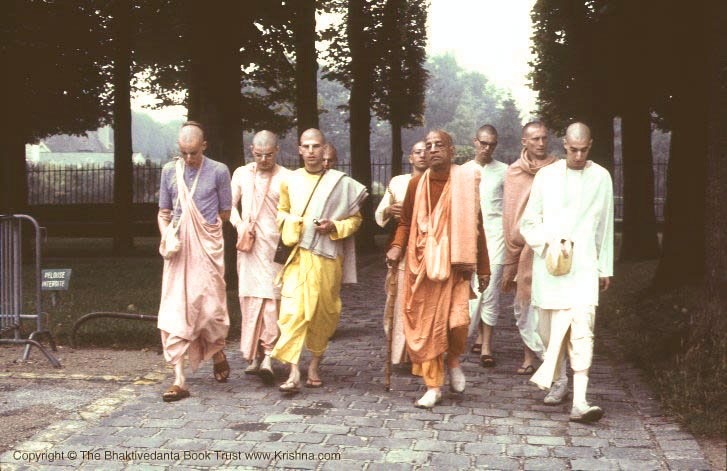
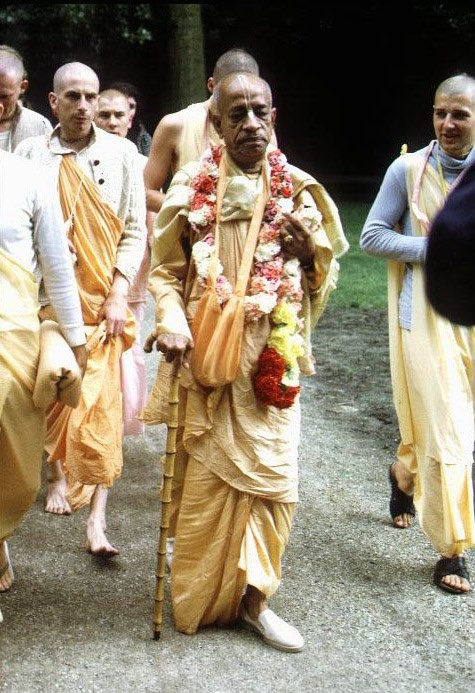
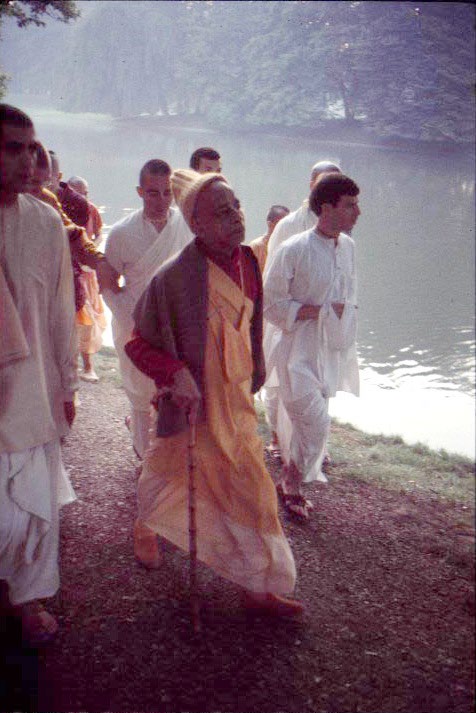
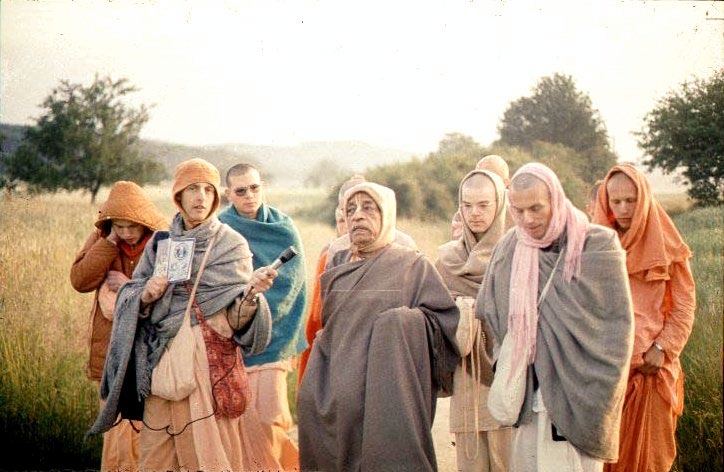
PṚTHU DĀSA: Early one morning we were strolling with Śrīla Prabhupāda through Vondelpark, where most of the hippies had spent the summer night in sleeping bags. My attention was drawn to a couple lying under a tree. They weren’t asleep anymore but were already pretty busy with each other. I was curious to see how Prabhupāda would react, so I observed him from the corner of my eye. But Prabhupāda had been observing me, and when our eyes met, he shook his head in disapproval, as if to say, “No, no, we don’t look! A devotee doesn’t watch people engaged in lusty affairs. REVATĪNANDANA DĀSA: When we passed the hippie couple Śrīla Prabhupāda remarked, “Just see! In the material world, it doesn’t matter whether one is rich or poor, there will always be some facility for sex life.” AṢṬARATHA DĀSA: We reached Amsterdam in the early morning on the day of Prabhupāda’s arrival. As soon as we entered the temple, an iṣṭagoṣṭhī was held to explain to everyone what to do. Preparations were still underway. Prabhupāda’s reception at the airport had to be organized, the newly constructed wooden arches in the temple room had to be painted light blue and pink, and clothes for Jagannātha, Baladeva, and Subhadrā had to be sewn.
When the question was asked, “Who knows how to sew?”, one of the Hamburg devotees, for whom I had once made a bead bag, pointed to me and said, “He knows.” Although I had only a little experience, on seeing the situation I thought, “Well, I’ve never made clothes, but somehow or other I’ll manage to come up with something.” So I agreed.
At noon on that Friday, we all assembled in front of the temple to greet Prabhupāda. Kiśorī Dāsī was struggling with her children. Her little daughter had been crying all morning and didn’t respond to any attempts to calm her down. And there was no way to tell Kiśorī to take her daughter and leave. She insisted on being there with her kids to receive Prabhupāda. As soon as Prabhupāda stepped out of the car and saw the screaming child in Kiśorī’s arms, he went up to Kiśorī, patted her daughter’s head, and said: “Everything is all right.” And immediately the child became quiet. I was amazed.
The temple consisted of a fairly large temple room, a kitchen, an office, and another small room for the women devotees. The brahmacārīs stayed in the attic. We divided the women’s ashram with a curtain, and in the front part I sat with Jagannātha, Baladeva, and Subhadrā—and the fabric. The sewing machine was broken, so I had to sew everything by hand. And because the installation was in two days I had to work through the nights. My only companions on those two nights were a few mice, which ran all over the place.
I pictured in my mind our Jagannātha Deities in Hamburg and tried to create similar outfits. The turbans were the most difficult part, and it was only by Kṛṣṇa’s mercy that I managed to make something that resembled a turban after numerous unsuccessful attempts at wrapping.
On Sunday morning I finished the last details, and being completely wiped out I went to rest in our VW bus because the installation was scheduled for that afternoon.
BHAKTI GAURAVANI GOSWAMI: On the morning of the installation I was asked to string garlands. Kiśorī Dāsī was in charge of the decorations and flowers, and she provided me with a needle and thread and buckets full of white, pink, and red carnations. This was the first time I had made a garland, and Kiśorī was too frazzled to give me detailed instructions or supervise my service. Akṣayānanda Dāsa, the temple president, had dumped all responsibility for the preparations on her head because he was busy preparing for his sannyāsa initiation, to be held that same afternoon right after the Deity installation. Kiśorī was sincerely trying to arrange everything, but the task was over her head. Disorder and confusion reigned.
How do you string a garland of carnations? I didn’t know, and it didn’t occur to me to do it lengthwise, by opening the flower petals and pushing the hard green part firmly into the previous flower so that at the end only petals would be visible. I pushed the needle through sideways and twisted the flowers so that the petals pointed in different directions. As long as the garlands were lying on a cloth on the floor, they looked all right. The awakening came when, as a reward for my efforts I was allowed to garland Prabhupāda. I felt proud and satisfied that His Divine Grace was wearing one of “my” garlands, visible to everybody present. Shortly, however, my artistic arrangement of carnations began to disintegrate. One flower after another turned its head sideways exposing its green base. Besides being an unpleasant sight, the hard green parts must have pricked Prabhupāda, but he seemed undisturbed. He wasn’t concerned with his own comfort. He was more concerned with the preparations for the ceremony, because not only wasn’t his garland up to standard, many of the installation ingredients were missing.
AṢṬARATHA DĀSA: I woke up at 3:30 p.m., anxious about whether the Deity clothes were still there, and after a quick shower I entered the temple room and made my way to the altar. This was not easy, because the temple was packed with people. There were so many guests that a lot of them had to stand on the sidewalk—there was just no room inside.
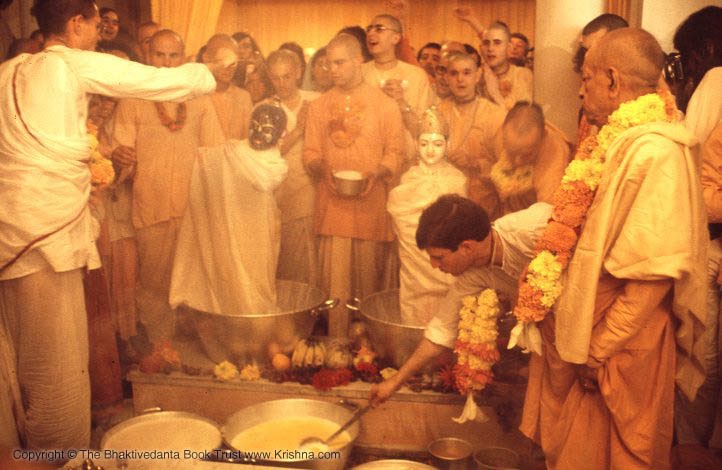
I peeped into the ladies’ ashram and felt relief—the clothes and the Deities were still there. But then I realized that hardly anything was prepared for the installation. Not that I knew exactly what was needed for the ceremony, but I had heard that the Deities would be bathed in milk and yogurt and then a fire sacrifice would be held. But I didn’t see any indication that these things were being prepared. I asked some devotees about it, but they didn’t even pay attention to what I said, because they were busy talking to guests and taking care of the press and the TV crew. So I thought, “What to do? I have to phone Prabhupāda. Something has to be done.” Nanda-kumāra, Prabhupāda’s servant, answered the phone. “I am not in charge here,” I said, “but from what I can see, nothing is being prepared for the installation.” He couldn’t believe his ears. Quickly, he gave me several instructions, especially that the Deities had to be wrapped in white cloth and that we needed big containers for the bathing. So we got a bedsheet from the neighbors, which we tore into three parts, and some big pots from a nearby hotel. Bit by bit some arrangements came together, but on the whole, they were less than paltry.
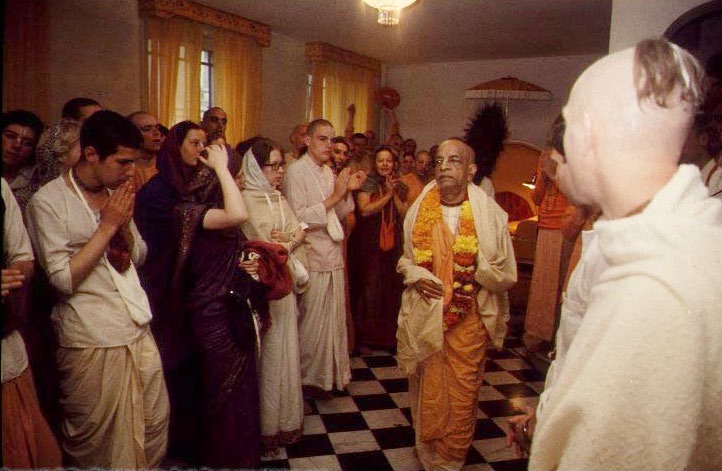
REVATĪNANDANA DĀSA: When we arrived with Prabhupāda at the temple we were greeted by an ecstatic kīrtana, and hundreds of curious onlookers were wondering what was going on. Prabhupāda smiled at the enthusiasm of his disciples, but his demeanor changed after he entered the temple room and looked around. “What is this? No fruits? No flowers? What are these pots that you want to bathe the Deities in?” The anger in his voice made everyone freeze. “I cannot bring the Lord of the universe here. This is a farce! How can you think that, with so little preparation, Lord Jagannātha will live in this place?” But after deliberating for a few seconds he relented. “All right, go ahead. But I don’t think this is very nice.”
BHAKTI GAURAVANI GOSWAMI: One new bhakta had been living in the temple for a couple of weeks, and whenever he’d gotten disturbed the devotees had instructed him to chant Hare Kṛṣṇa. So when he saw Śrīla Prabhupāda upset, he remarked to him, “Why don’t you just chant Hare Kṛṣṇa?” Without a word, Prabhupāda took his bead bag and began chanting japa. He continued on and off until the devotees had gathered the necessary paraphernalia and were ready to begin the ceremony. AṢṬARATHA DĀSA: Prabhupāda was frightening. When he saw the mess, he turned to his leaders and demanded, “Who is responsible for this? Who is the pūjārī?” Akṣayānanda summoned up his courage and said, “I told Kiśorī...”
“A woman?” Prabhupāda said, cutting him off and looking at him sternly, incredulity in his voice.
Icy silence. The atmosphere was so tense that you could cut it with a knife. I felt like disappearing into the earth. Such an embarrassing situation! My only thought was “I hope that at least the outfits will be all right.” Then Śyāmasundara, Prabhupāda’s secretary, lowered his head and asked shyly, “Shouldn’t we get some fruits?”
“Don’t tell me what to do!” Prabhupāda thundered.
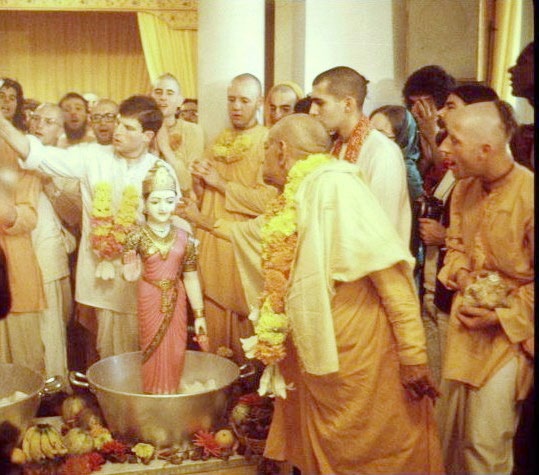
Eventually, Kiśorī came in with the fruits—an enormous plate of fruit salad—and was promptly sent back to the kitchen. Some unbroken fruits were quickly brought, and Nanda-kumāra began bathing the Deities. When he was finished, he took Their Lordships behind the curtains to be dressed. Kiśorī was supposed to do it, but she was a nervous wreck. So the first thing Nanda-kumāra did was to tell her she wasn’t needed. I was standing nearby, ready to jump in if necessary, and he called me to help dress the Deities».
NIKUÑJAVĀSIṆĪ DĀSĪ: My eldest brother was living near Bethanienstraat, and he visited the temple regularly to take prasādam. Sometimes he would even accompany the devotees on harināma. He was the first person to put me in touch with Kṛṣṇa consciousness. Unfortunately, he later got involved with Guru Maharaji, where he didn’t have to follow any principles. But my second brother became very serious about Kṛṣṇa consciousness and was initiated as Aṅga Dāsa.
When Prabhupāda came to Amsterdam, Aṅga invited my parents and me to the temple to meet him. My brother told us, “This is a pure devotee, and even if you don’t understand anything, whatever he says is pure sound vibration and has a beneficial effect.” I was impressed and thought, “Oh, this is very special. I’m going to see this holy man, a very spiritual person.” So I was really eager to go, and thus we went to the installation ceremony. A television crew was there, and the temple was packed with people. The preparations for the installation were so deficient that Prabhupāda was angry. He was shouting, and the devotees were timidly running around trying to follow his directions. Even before seeing Prabhupāda, I was in a respectful mood, but I never expected him to be like this. Because of my eldest brother’s involvement with Guru Maharaji, I had a certain concept of a guru. I had always seen pictures of Guru Maharaji with a big smile on his face—and his face was fatty and glowing—but here was Prabhupāda so angry. I thought, “Wow, this is serious business; this takes surrender. This is real spiritual life.” I suddenly realized that the other things were all simply an external show, whereas this was real. But I didn’t think I was ready for it. I had respect for the devotees because they took Prabhupāda’s chastisement so seriously. They were in anxiety, trying to rectify the mess. Of course, I didn’t understand what it was all about. There were some statues covered with cloth, and there was this area in the middle for fire, and Prabhupāda was yelling, and the devotees were running around, and it was all being filmed while we just stood there watching.
Another thing that amazed me was that Śrīla Prabhupāda didn’t seem to care at all about the TV cameras or guests. He was doing the needful for a proper installation ceremony, and this really impressed me. He didn’t care about making a good impression on the TV people by glossing over the whole affair. His only interest was to make the proper arrangements for Kṛṣṇa’s service.
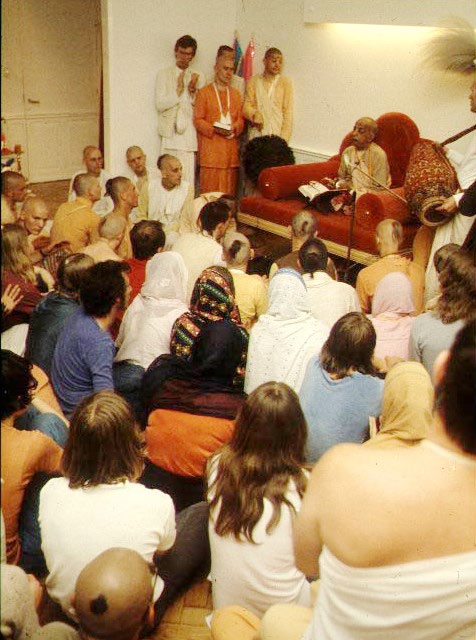
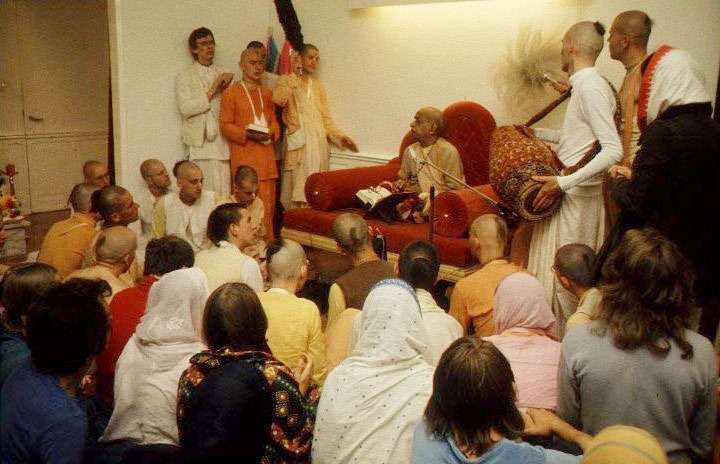
VAIDYANĀTHA DĀSA: I was surprised that such an elevated person, the leader of the Hare Kṛṣṇa movement, had become angry. In my mind, a transcendentalist always remained equipoised and serene. I didn’t know yet that a devotee could show anger in Kṛṣṇa’s service. I had been living with the devotees for less than a week. During the lecture, I was leaning against the wall, with my knees under my chin and my arms around them—the typical way you’re not supposed to sit in front of the Deities. Prabhupāda must have noticed me because suddenly he pulled his legs up and sat on the vyāsāsana in exactly the same way and said, “It is an offense to sit in front of the Deities like this. Sit properly!” This is the only personal instruction I ever received from Śrīla Prabhupāda, and I have been trying to apply it in its broadest sense: not only to sit properly in the temple but also to be always properly situated in devotional service.
REVATĪNANDANA DĀSA: Prabhupāda asked me to perform the fire sacrifice. While chanting the mantras I had difficulty separating the compound words properly, and each time I made a mistake Prabhupāda corrected me. I became so nervous that at the end I forgot to chant namo mahā-vadānyāya. Prabhupāda interrupted me. “You don’t chant namo mahā-vadānyāya? I will do it!”
When it was time to light the fire, I picked up the ladle for the ghee with my left hand, being left-handed, and the wood with my right hand. When I realized what I was doing, I tried to switch the two quickly without anyone noticing, but Prabhupāda had already looked at me disapprovingly, as if to say, “My disciples—just see!”
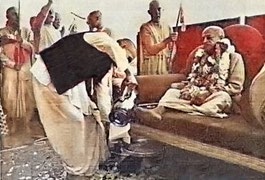
The only time I saw Prabhupāda smile that afternoon was when he handed Akṣayānanda his sannyāsa staff and made him Akṣayānanda Swami».
AṢṬARATHA DĀSA: While all this was going on, Nanda-kumāra and I were busy dressing the Deities behind the curtain of the altar room. When we finally put Their Lordships on the altar, we realized the canopy was too small, or rather, that the columns supporting it stood just in front of Jagannātha and Baladeva. Nanda-kumāra thought for a second and said, “We have to take it off.” So we lifted the canopy off the altar. But where to put it? There was no room. We had to take it out, and there was no other way than to carry it through the packed temple room over everyone’s heads. Prabhupāda, who was lecturing, looked on with surprise.
But now the Deity room looked pretty empty. There was only the altar and a bare wall in the back. On one side a large painting of the Pañca-tattva leaned against the wall, and while looking at it I had an idea. “Why don’t we put that behind the altar?” I suggested. “Great idea,” Nanda-kumāra said. But there was nothing to support the painting because the altar didn’t reach back to the wall. The only solution was to put something on the floor. So Nanda-kumāra stuck his head through the curtains and shouted, “Bring books!” Heads turned in surprise. Because quite a few books were needed, a human chain had to be formed to pass the books to the altar. When the curtains finally opened, the arrangement looked quite acceptable, and Nanda-kumāra performed the first ārati for the Deities. The atmosphere was by then relaxed and had even become festive, with a tremendous kīrtana shaking the entire building. After ārati huge quantities of halavā and Simply Wonderfuls were served to everyone. REVATĪNANDANA DĀSA: After the ceremony, Prabhupāda was about to get into the car when he asked his servant, “You brought some prasādam?” Nanda-kumāra looked at him with surprise. “I thought you would take your usual, simple meal instead of the feast,” he said. “No,” Prabhupāda replied, “this is a Deity installation. I want to take mahā-prasādam. Please go and get me a plate.” So Nanda-kumāra went back into the temple and came back with a big plate of prasādam.
The Amsterdam traffic made for a rough ride; several times the car stopped abruptly. When the driver had to brake again, the plate of prasādam slipped to the floor. Nanda-kumāra was in total anxiety. He hoped Prabhupāda would forget about the plate. But as soon as we arrived at the apartment Prabhupāda asked, “Where is the prasādam?” His servant explained what had happened, but Prabhupāda told him, “Bring it.” And he ate everything, just to show us how important prasādam is.
Prabhupāda’s anger had left a deep impression on the Amsterdam devotees, and they really felt sorry that their inexperience had evoked Prabhupāda’s displeasure. Akṣayānanda Swami came to apologize, but Prabhupāda’s mood had already changed..
REVATĪNANDANA DĀSA: I was surprised that after having shown so much anger, Prabhupada was now as serene as a lotus flower. I asked him about it, and he said: “It is for your education, not for me. A devotee does not get angry when he is offended, but when he sees that the Lord or a devotee is being offended, he shows anger.”
Then a question occurred to me. I knew from experience in India and elsewhere that I should never refer to Prabhupada as a pure devotee in front of him, because once I did so in India and he replied vehemently: “I am not a pure devotee, I am a rascal!” So I asked: “Srila Prabhupada, can you tell me something about the consciousness of a pure devotee?” “Yes,” he said, “ask.”
“At times it seems that a pure devotee can show a lot of anger, or be happy... how does it actually affect him?” I was thinking about how he now showed no trace of anger. Prabhupada replied: “The consciousness of a pure devotee is very deep, it is like the ocean. On the surface there may be many agitated waves, but when you descend a few meters, you find that everything is still.”
I understood what he meant instantly. He continued: “That is the consciousness of a pure devotee: so deep that nothing really disturbs it. There may be ripples on the surface, but underneath it remains very, very deep and serene.” I asked: “Is it like that even at the moment of death?” And he said: “Yes.”
Afterward, Srila Prabhupada reclined on a divan to rest for a while. Lying on his back, he pulled his knees to his chest with his hands and rocked gently while chanting in a low voice: “Haribol! Haribol!”
Photographs
Germany 1969-1973








Paris 1972





Amsterdam 1972





Paris 1973




Sweden 1973
















The First German Books