 Spiritual
Revealing one's mind Pleading for service and mercy
Kṛṣṇa tava puṇya habe bhāi 322
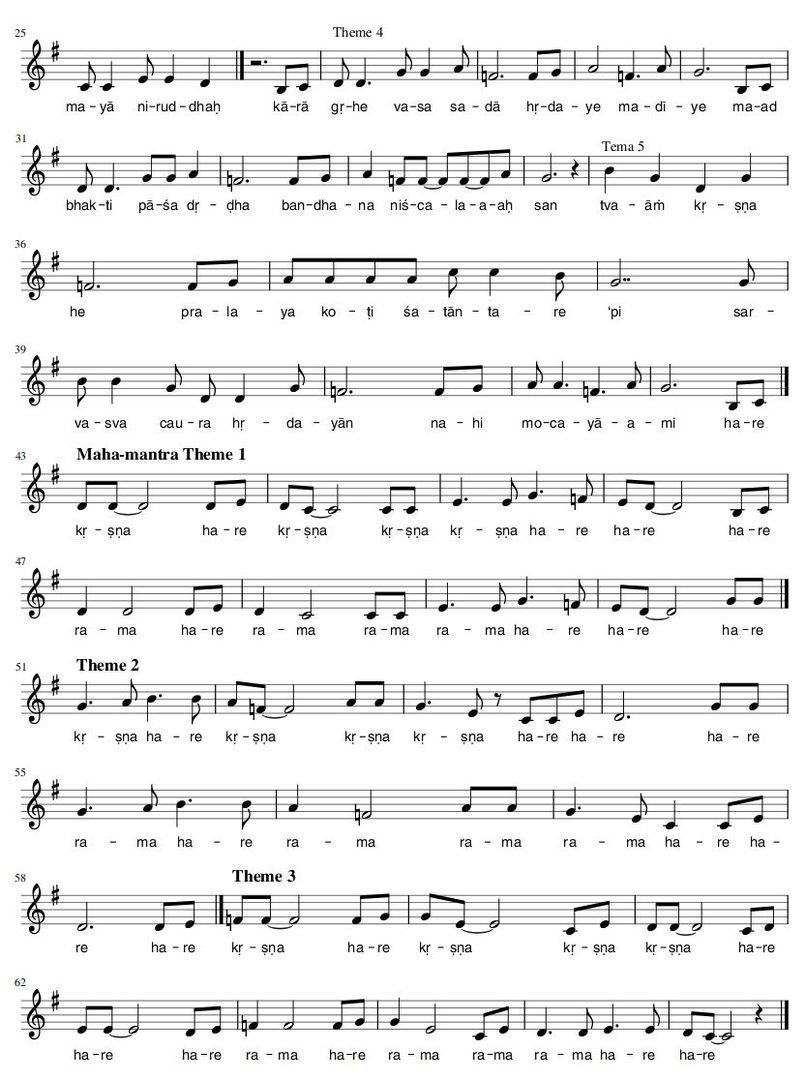
Markine bhagavata-dharma 326
Ṭhākura vaiṣṇava-gaṇa 333
Ei-bāra karuṇā kara 337
Kṛpa kara' vaiṣṇava ṭhākura 338
Gaurāṅga karuṇā kara 341
Jadi gaura nā haita 343
Prabhu tava pada-yuge 345
Kṛṣṇa! he 347
Kabe habe bala 349
E duṣṭa hṛdaye kāma 353
Oṁ namo bhagavate narasiṁhāya 355
Rādhā-kṛṣṇa prāṇa mora 356
Je ānila prema-dhana 359
Kṛṣṇa tava puṇya habe bhāi
(Prayer to the Lotus Feet of Lord Kṛṣṇa) His Divine Grace A. C. Bhaktivedanta Swami Prabhupāda
(Refrain) kṛṣṇa tava puṇya habe bhāi e-puṇya karibe jabe rādhārāṇī khusī habe dhruva ati bali tomā tāi kṛṣṇa—Lord Kṛṣṇa; tava—Your; puṇya—piety; habe—will be; bhāi—O brother; e puṇya—this pious act; karibe—You perform; jabe—when; rādhārāṇī—Śrīmatī Rādhārāṇī; khuśī habe—will be pleased; dhruva—surely; ati—emphatically; bali— I say; tomā—to You; tāi—just so.
I emphatically say to you, O brothers, you will obtain your good fortune from the Supreme Lord Kṛṣṇa only when Śrīmatī Rādhārāṇī becomes pleased with you.
1 śrī-siddhānta sarasvatī śacī-suta priya ati
kṛṣṇa-sevāya yāra tula nāi sei se mahānta-guru jagatera madhe uru kṛṣṇa-bhakti deya ṭhāi ṭhāi śrī-siddhānta sarasvatī—Śrīmad Bhaktisiddhānta Sarasvatī Ṭhākura; śacī-suta— to the son of Mother Śacī; priya ati—very dear; kṛṣṇa-sevāya—in Kṛṣṇa’s service; yāra—whose; tula—comparison; nāi—there is not; sei se—that person; mahānta- guru—great spiritual master; jagatera madhye—within the universe; uru—intense; kṛṣṇa-bhakti—devotional service to Kṛṣṇa; deya—gives; ṭhāi ṭhāi—in this place and that place.
Śrī Śrīmad Bhaktisiddhānta Sarasvatī Ṭhākura, who is very dear to Lord Gaurāṅga, the son of mother Śacī, is unparalleled in his service to the Supreme Lord Śrī Kṛṣṇa. He is that great saintly spiritual master who bestows intense devotion to Kṛṣṇa at different places throughout the world.
2 tāra icchā balavāna pāścātyete ṭhāna ṭhāna
haya jāte gaurāṅgera nāma pṛthivīte nagarādi āsamudra nada nadī sakalei bale kṛṣṇa nāma tāra—his; icchā—desire; balavāna—powerful; pāścātyete—to the Western world; ṭhāna ṭhāna—everywhere; haya—is; jāte—in which; gaurāṅgera nāma—the name of Gaurāṅga; pṛthivīte—on the earth; nagara-ādi—towns and so forth; āsamudra— extending out to the ocean; nada-nadī—rivers and streams; sakalei—verily all; bale—taking (chanting); kṛṣṇa nāma—the holy name of Kṛṣṇa.
By his strong desire, the holy name of Lord Gaurāṅga will spread throughout all the countries of the Western world. In all the cities, towns, and villages on the earth, from all the oceans, seas, rivers, and streams, everyone will chant the holy name of Kṛṣṇa.
3 tāhale ānanda haya tabe haya digvijaya
caitanyera kṛpā atiśaya māyā duṣṭa jata duḥkhī jagate sabāi sukhī vaiṣṇavera icchā pūrṇa haya tāhale—upon that; ānanda haya—there is bliss; tabe—then; haya—there is; dik- vijaya—conquering all directions; caitanyera kṛpā—the mercy of Lord Caitanya; atiśaya—excessive; māyā duṣṭa—corrupted by illusion (sinful); jata—whichever; duḥkhī—miserable souls; jagate—in the universe; sabāi—everyone; sukhī—happy people; vaiṣṇavera icchā—the desire of the devotees; pūrṇa haya—is fulfilled.
As the vast mercy of Śrī Caitanya Mahāprabhu conquers all directions, a flood of transcendental ecstasy will certainly cover the land. When all the sinful, miserable living entities become happy, the Vaiṣṇavas' desire is then fulfilled.
4 se kārya je karibāre ājñā yadi dila more
yogya nahi ati dīna hīna tāi se tomāra kṛpā māgitechi anurūpā āji tumi sabāra pravīṇa se kārya—that task; je—which; karibāre—to do; ājñā—command; yadi—if; dile— gave; more—to me; yogya nahi—not worthy; ati dīna—very fallen; hīna—destitute; tāi—just so; se—that; tomāra—Your; kṛpā—mercy; māgitechi—I am begging; anurūpā—accordingly; āji—today; tumi—You; sabāra—of everyone; pravīṇa—the wisest.
Although my Guru Mahārāja ordered me to accomplish this mission, I am not worthy or fit to do it. I am very fallen and insignificant. Therefore, O Lord, now I am begging for Your mercy so that I may become worthy, for You are the wisest and most experienced of all.
5 tomāra se śakti pele guru-sevāya vastu mile
jīvana sārthaka jadi haya sei se sevā pāile tāhale sukhī hale tava saṅga bhāgyate milaya tomāra—Your; se—that; śakti—potency; pele—obtaining; guru-sevā—service to the spiritual master; vastu—the real substance (the Absolute Truth); mile— receives; jīvana—life; sārthaka—successful; jadi haya—if it is; sei se—that particular; sevā—service; pele—obtaining; tāhale—upon that; sukhī—happy person; hale—becomes; tava saṅga—Your association; bhāgyete—by good fortune; milaya—meets.
If You bestow Your power, by serving the spiritual master one attains the Absolute Truth-one's life becomes successful. If that service is obtained, then one becomes happy and gets Your association due to good fortune.
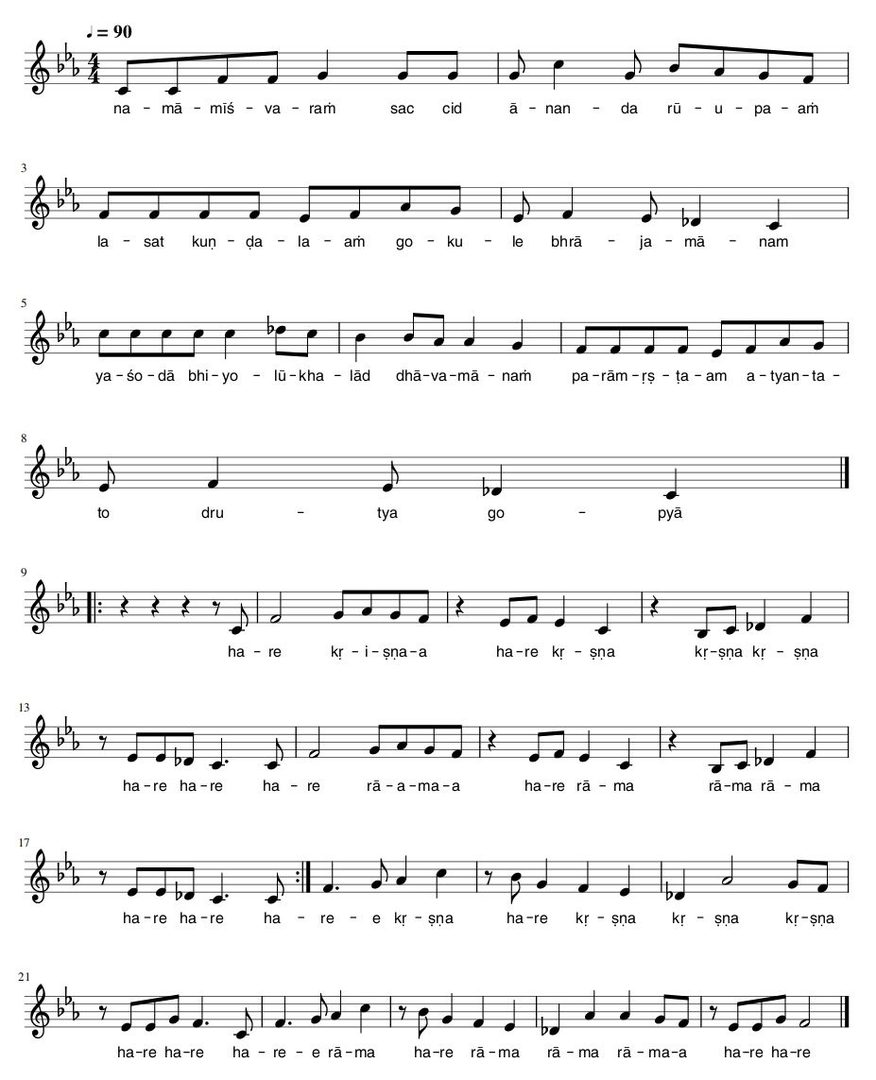
6 evaṁ janaṁ nipatitaṁ prabhavāhikūpe kāmābhikāmam anu yaḥ prapatan prasaṅgāt kṛtvātmasāt surarṣiṇā bhagavan gṛhītaḥ so 'haṁ kathaṁ nu visṛje tava bhṛtya-sevām evam—thus; janam—people in general; nipatitam—fallen; prabhava—of material existence; ahi-kūpe—in a blind well full of snakes; kāma-abhikāmam—desiring the sense objects; anu—following; yaḥ—the person who; prapatan—falling down (in this condition); prasaṅgāt—because of bad association or increased association with material desires; kṛtvā-ātmasāt—causing me (to acquire spiritual qualities like himself, Śrī Nārada); sura-ṛṣiṇā—by the great saintly person (Nārada); bhagavan—O my Lord; gṛhītaḥ—accepted; saḥ—that person; aham—I; katham— how; nu—indeed; visṛje—can give up; tava—Your; bhṛtya-sevām—the service of Your pure devotee.
My dear Lord, O Supreme Personality of Godhead, because of my association with material desires, one after another, I was gradually falling into a blind well full of snakes, following the general populace. But Your servant Nārada Muni kindly accepted me as his disciple and instructed me how to achieve this transcendental position. Therefore, my first duty is to serve him. How could I leave his service? (Prahlāda Mahārāja to Lord Nṛsiṁhadeva, SB 7.9.28)
7 tumi mora cira sāthī bhuliyā māyāra lāthi
khāiyāchi janma-janmāntare āji punaḥ e su-joga yadi haya jogāyoga tabe pāri tuhe milibāre tumi—You; mora—my; cira-sāthī—perpetual companion; bhuliyā—forgetting; māyāra—of illusion; lāthi—kicks; khāiyāchi—I am suffering; janma-janmāntare— birth after birth; āji—today; punaḥ—again; e—this; su-yoga—opportunity; yadi haya—if it is; yogāyoga—association; tabe—then; pāri—I am able; tuhe milibāre— to meet You.
O Lord Kṛṣṇa, You are my eternal companion. Forgetting You, I have suffered the kicks of māyā birth after birth. If today the chance to meet You occurs again, then I will surely be able to rejoin You.
8 tomāra milane bhāi ābāra se sukha pāi
go-cārane ghuri dina bhara kata vane chuṭāchuṭi vane khāi luṭāluṭi sei dina kabe habe mora tomāra—Your; milane—in the meeting; bhāi—O dear friend; ābāra—once more; se sukha—that happiness; pāi—I will experience; go-cāraṇe—tending the cows; ghuri—I will wander; dina bhara—all day long; kata vane—in so many forests; chuṭāluṭi—joking and frolicking; vane—in the forest; khāi—I relish; luṭāpuṭi—rolling on the ground; sei dina—that day; kabe—when; habe mora—it will be mine.
O dear friend, in Your company I will experience great joy once again. In the early morning I will wander about the cowherd pastures and fields. Running and frolicking in the many forests of Vraja, I will roll on the ground in spiritual ecstasy. Oh when will that day be mine?
9 āji se su-vidhāne hala tomāra smaraṇa bhela
bara āśā ḍākilāma tāi āmi tomāra nitya-dāsa tāi kari eta āśa tumi vinā anya gati nāi āji—today; se—that; su-vidhāne—in a nice way; tomāra—Your; smaraṇa— remembrance; bhela—happened; bara āśā—great longing; ḍākilāma—I called out; tāi—just so; āmi—I; tomāra—Your; nitya-dāsa—eternal servant; tāi—just so; kari—I maintain; eta āśa—such a desire; tumi vinā—other than You; anya gati— another refuge; nāi—there is not.
Today that remembrance of You came to me in a very nice way. Because I have a great longing I called to You. I am Your eternal servant and therefore I desire Your association so much. O Lord Kṛṣṇa, except for You there is no other shelter.
Commentary
This prayer, also known as Prayer to the Lotus Feet of Kṛṣṇa, was composed by His Divine Grace A. C. Bhaktivedanta Swami Prabhupāda on board of the ship Jaladuta, on September 13, 1965. In his diary, Prabhupāda writes as follows: MONDAY 13 Today is the 32nd day of our journey from Calcutta. After midnight yesterday the lurching decreased and I felt relief. In the morning also I could not take my breakfast properly. Then I cooked 'Bati-chachari(?).' It appeared to be delicious and I was able to take some food. Today I have disclosed my mind to my companion Lord Sri Krishna. There is a Bengali poem made by me today in this connection. At about eleven there is a little lurching. The captain tells that they had never such calmness of the Atlantic. I said it is Lord Krishna's mercy. His wife asked me to come back again with them so that they may have again a calm Atlantic Ocean. If Atlantic would have shown its usual face perhaps I would have died. But Lord Krishna has taken charge of the ship.
Five days later, after arriving at Boston harbor, Prabhupāda composed another poem where he discloses his mind about the prospects of preaching Kṛṣṇa consciousness in America.
Markine bhāgavata-dharma (Preaching Kṛṣṇa consciousness in America) His Divine Grace A. C. Bhaktivedanta Swami Prabhupada
1 bara-kṛpā kaile kṛṣṇa adhamera prati
ki lāgi ānile hethā kara ebe gati
bara-kṛpā—great mercy; kaile—showed; kṛṣṇa—O Lord Kṛṣṇa; adhamera prati— to this fallen soul; ki lāgi—for what reason; ānile—You have brought me; hethā— here; kara—please show; ebe—now; gati—Your purpose.
My dear Lord Kṛṣṇa, You are so kind upon this useless soul, but I do not know why You have brought me here. Now You can do whatever You like with me.
2 āche kichu kārya tava ei anumāne nahe kena ānibena ei ugra-sthāne āche—there is; kichu—some; kārya—work; tava—Your; ei—this; anumāne—by guessing; nahe—if not; kena—why; ānibena—You have brought; ei—in this; ugra- sthāne—terrible place.
But I guess You have some business here, otherwise why would You bring me to this terrible place?
3 rajas tamo gune erā sabāi ācchanna vāsudeva-kathā ruci nahe se prasanna rajaḥ—the mode of passion; tamaḥ—the mode of ignorance; gune—by the modes; erā—their; sabāi—all of them; ācchanna—covered; vāsudeva-kathā— topics about Lord Kṛṣṇa, the son of Vasudeva; ruci—taste; nahe—not; se—they; prasanna—are happy or jubilant.
Most of the population here is covered by the material modes of ignorance and passion. Absorbed in material life, they think themselves very happy and satisfied, and therefore they have no taste for the transcendental message of Vāsudeva. I do not know how they will be able to understand it.
4 tabe yadi tava kṛpā haya ahaitukī sakal-i sambhava haya tumi se kautukī tabe—then; yadi—if; tava—Your; kṛpā—mercy; haya—is shown; ahaitukī— causeless; sakala-i—all of them; sambhava haya—it is possible; tumi—You; se— that; kautukī—fond of amusements.
But I know Your causeless mercy can make everything possible because You are the most expert mystic.
5 ki bhāve bujhāle tārā bujhe sei rasa
eta kṛpā kara prabhu kari nija-vaśa
ki bhāve—in what manner; bujhāle—causing to understand; tārā—them; bujhe— comprehending; sei rasa—the mellows of devotional service; eta—such as this; kṛpā—mercy; kara—please display; prabhu—O Lord; kari—I am making; nija- vaśa—under Your controlling power.
How will they understand the mellows of devotional service? O Lord, I am simply praying for Your mercy so that I will be able to convince them about Your message.
6 tomāra icchāya saba haya māyā-vaśa
tomāra icchāya nāśa māyāra paraśa
tomāra icchāya—according to Your desire; saba—everyone; haya—is; māyā- vaśa—controlled by illusion; tomāra icchāya—according to Your desire; nāśa— destruction; māyāra paraśa—the touch of illusion.
All living entities have become under the control of the illusory energy by Your will, and therefore, if You like, by Your will they can also be released from the clutches of illusion.

7 tava icchā haya yadi tādera uddhāra bujhibe niścaya-i tabe kathā se tomāra tava icchā—Your desire; haya—is; yadi—if; tādera—their; uddhāra—deliverance; bujhibe—they will comprehend; niścaya-i—definitely; tabe—then; kathā— message; se—that; tomāra—Your.
I wish that You may deliver them. Therefore if You so desire their deliverance, then only will they be able to understand Your message.
8 bhāgavatera kathā se tava avatāra dhīra haiyā śune yadi kāne bāra bāra bhāgavatera kathā—the message of Śrīmad-Bhāgavatam; se—that; tava avatāra—Your incarnation; dhīra haiyā—becoming grave; śune—by hearing; yadi—if; kāne—by aural reception; bāra bāra—again and again.
The words of Śrīmad-Bhāgavatam are Your incarnation, and if a sober person repeatedly receives it with submissive aural reception, then he will be able to understand Your message.
It is said in the Śrīmad-Bhāgavatam (1.2.17-21):
śrnvatāṁ sva-kathāḥ kṛṣṇaḥ punya-śravaṇa-kīrtanaḥ
hṛdy antaḥ-stho hy abhadrāṇi vidhunoti suhṛt satām naṣṭa-prāyeṣv abhadreṣu nityaṁ bhāgavata-sevayā bhagavaty uttama-śloke bhaktir bhavati naiṣṭhikī tadā rajas-tamo-bhāvāḥ kāma-lobhādayaś ca ye ceta etair anāviddhaṁ sthitaṁ sattve prasīdati evaṁ prasanna-manaso bhagavad-bhakti-yogataḥ bhagavat-tattva-vijñānaṁ mukta-saṅgasya jāyate bhidyate hṛdaya-granthiś chidyante sarva-saṁśayāḥ kṣīyante cāsya karmāṇi dṛṣṭa evātmanīśvare śṛṇvatām—those who have developed the urge to hear the message of; sva- kathāḥ—His own words; kṛṣṇaḥ—the Personality of Godhead; puṇya—virtues; śravaṇa—hearing; kīrtanaḥ—chanting; hṛdi antaḥ sthaḥ—within one's heart; hi— certainly; abhadrāṇi—desire to enjoy matter; vidhunoti—cleanses; suhṛt— benefactor; satām—of the truthful; naṣṭa—destroyed; prāyeṣu—almost to nil; abhadreṣu—all that is inauspicious; nityam—regularly; bhāgavata—Śrīmad- Bhāgavatam or the pure devotee; sevayā—by serving; bhagavati—unto the Personality of Godhead; uttama—transcendental; śloke—prayers; bhaktiḥ—loving service; bhavati—comes into being; naiṣṭhikī—irrevocable; tadā—at that time; rajaḥ—in the mode of passion; tamaḥ—the mode of ignorance; bhāvāḥ—the situation; kāma—lust and desire; lobha—hankering; ādayaḥ—others; ca—and; ye—whatever they are; cetaḥ—the mind; etaiḥ—by these; anāviddham—without being affected; sthitam—being fixed; sattve—in the mode of goodness; prasīdati— thus becomes fully satisfied; evam—thus; prasanna—enlivened; manasaḥ—of the mind; bhagavat-bhakti—the devotional service of the Lord; yogataḥ—by contact of; bhagavat—regarding the Personality of Godhead; tattva—knowledge; vijñānam—scientific; mukta—liberated; saṅgasya—of the association; jāyate— becomes effective; bhidyate—pierced; hṛdaya—heart; granthiḥ—knots; chidyante—cut to pieces; sarva—all; saṁśayāḥ—misgivings; kṣīyante— terminated; ca—and; asya—his; karmāṇi—chain of fruitive actions; dṛṣṭe—having seen; eva—certainly; ātmani—unto the self; īśvare—the dominating factor.
"Śrī Kṛṣṇa, the Personality of Godhead, who is the Paramātmā [Supersoul] in everyone's heart and the benefactor of the truthful devotee, cleanses desire for material enjoyment from the heart of the devotee who has developed the urge to hear His messages, which are in themselves virtuous when properly heard and chanted. By regular attendance in classes on the Bhāgavatam and by rendering of service to the pure devotee, all that is troublesome to the heart is almost completely destroyed, and loving service unto the Personality of Godhead, who is praised with transcendental songs, is established as an irrevocable fact. As soon as irrevocable loving service is established in the heart, the effects of nature's modes of passion and ignorance, such as lust, desire and hankering, disappear from the heart. Then the devotee is established in goodness, and he becomes completely happy. Thus established in the mode of unalloyed goodness, the man whose mind has been enlivened by contact with devotional service to the Lord gains positive scientific knowledge of the Personality of Godhead in the stage of liberation from all material association. Thus the knot in the heart is pierced, and all misgivings are cut to pieces. The chain of fruitive actions is terminated when one sees the self as master."
10 rajas tamo ha’ te tabe pāibe nistāra hṛdayera abhadra sate ghucibe tāhāra rajaḥ—the mode of passion; tamaḥ—the mode of ignorance; ha’te—from; tabe— then; pāibe—will attain; nistāra—deliverance; hṛdayera—of the heart; abhadra— inauspicious; saba—all; ghucibe—will be removed; tāhāra—their.
He will become liberated from the influence of the modes of ignorance and passion and thus all inauspicious things accumulated in the core of the heart will disappear.
11 ki ka’ re bujhāba kathā vara sei cāhi kṣudra āmi dīna hīna kono śakti nāhi ki ka’ re—by doing what; bujhāba—I will make them understand; kathā—Your message; vara—benediction; sei—that; cāhi—I crave; kṣudra—tiny; āmi—I; dīna hīna—fallen and insignificant; kono śakti—any power; nāhi—there is not.
How will I make them understand this message of Kṛṣṇa consciousness? I am very unfortunate, unqualified and the most fallen. Therefore I am seeking Your benediction so that I can convince them, for I am powerless to do so on my own.
12 athaca enecha prabhu kathā balibāre
ye tomāra icchā prabhu kara ei bāre
athaca—nevertheless; enecha—You have brought; prabhu—O Lord; kathā— message; balibāre—to speak; ye—which; tomāra icchā—Your will; prabhu—O Lord; kara—do; ei-bāre—now.
Somehow or other, O Lord, You have brought me here to speak about You. Now, my Lord, it is up to You to make me a success or failure as You like.
13 akhila jagata-guru! vacana se āmāra
alaṅkṛta karibāra kṣamatā tomāra
akhila jagata-guru—O spiritual master of the entire universe; vacana—words; se— that; āmāra—my; alaṅkṛta—decorated; karibāra—to make; kṣamatā—the ability; tomāra—Your.
O spiritual master of all the worlds! I can simply repeat Your message, so if You like You can make my power of speaking suitable for their understanding.
14 tava kṛpā ha’ le mora kathā śuddha habe
śuniyā sabāra śoka duḥkha ye ghucibe
tava kṛpā—Your mercy; ha’ le—upon showing; mora kathā—my speech; śuddha habe—will become pure; śuniyā—hearing; sabāra—of everyone; śoka-duḥkha— lamentation and misery; ye—which; ghucibe—will be removed.
Only by Your causeless mercy will my words become pure. I am sure that when this transcendental message penetrates their hearts they will certainly feel engladdened and thus become liberated from all unhappy conditions of life.
15 āniyācha yadi prabhu āmāre nācāte nācāo nācāo prabhu nācāo se-mate kāṣṭhera puttali yathā nācāo se-mate āniyācha—You have brought; yadi—if; prabhu—O Lord; āmāre—to me; nācāte— cause to dance; nācāo—make me dance; nācāo—make me dance; prabhu—O Lord; nācāo—make me dance; se-mate—in that manner; kāṣṭhera putali—a wooden puppet; yathā—just as; nācāo—make me dance; se-mate—in that manner.
O Lord, I am just like a puppet in Your hands. So if You have brought me here to dance, then make me dance, make me dance, O Lord, make me dance as You like.
16 bhakti nāi veda nāi nāme khuba dara "bhaktivedānta" nāma ebe sārthaka kara bhakti nāi—no devotion; veda nāi—no knowledge; nāme—by the title; khuba— very much; dara—faith; bhaktivedānta nāma—the name Bhaktivedānta; ebe— now; sārthaka kara—please fulfill it.
I have no devotion, nor do I have any knowledge, but I have strong faith in the holy name of Kṛṣṇa. I have been designated as Bhaktivedānta, and now, if You like, You can fulfill the real purport of Bhaktivedanta. (Signed) The most unfortunate, insignificant beggar A.C. Bhaktivedanta Swami, on board the ship Jaladuta, Commonwealth Pier, Boston, Massachusetts, U.S.A. dated 18th of September, 1965
Commentary
In 1976, Śrīla Prabhupāda received a translation of his poem Markine Bhagavata- dharma by his disciple Jayaśacīnandana dāsa who at the time served as one of the Bengali and Sanskrit editors at the BBT in Los Angeles. He wrote to him: “Thank you very much for your nice translation of Markine Bhagavata-dharma. It is well appreciated. I think it can be included in the front of the new printing of the song book, and it can be sung in kirtana like the other songs of Bhaktivinode Thakura.” Prabhupāda had written this poem upon his arrival in America. The Jaladuta had docked in Boston harbor early in the morning of September 17, 1965, and later that day, the ship’s captain had taken Prabhupāda to see downtown Boston. The stark reality of the American way of life confirmed his worst expectations, vastly surpassing the impressions he had gathered from articles and photographs in magazines. The task at hand seemed overwhelming, almost impossible, and thus he expressed his feelings in this poem, voicing again and again apparent doubts whether his mission of introducing Kṛṣṇa consciousness in such an atmosphere would be successful. But he also expressed again and again his full confidence in and dependence on Kṛṣṇa’s plan. A fully surrendered soul will always depend exclusively on the mercy of the Lord, even under the most trying circumstances. In a lecture on Śrīmad-Bhāgavatam in 1976 in Los Angeles, Prabhupāda said: “So through the śāstra we can understand who is who, through śāstra. Therefore in my poetry, on the strength of śāstra, I said that rajas tamo guṇe erā sabāi ācchanna, vāsudeva-kathā ruci nahe se prasanna. "Most of the population here is covered by the material modes of ignorance and passion. Absorbed in material life, they think themselves very happy and satisfied; therefore they have no taste for the transcendental message of Vāsudeva. So, I do not know how they will be able to understand it." Actually that is the fact. Everyone, so many svāmīs and yogīs, came in this country. So they advertise in India that they went to America for preaching Vedānta. But being influenced, what Vedānta they learned? When they returned to India, they have learned how to entice women and how to eat meat. This is their Vedānta. Because kāraṇaṁ guṇa-saṅgo 'sya. If you are not strong enough, then association will induce or influence. If you are not a Vaiṣṇava, then if you go in a brothel or a liquor house, then you will be influenced by the drunkards and prostitute-hunters. But if you are strong enough, then you will give your effect of association; they will be Vaiṣṇavas. That is the difference. … ”So this, my song... I was thinking on board the ship that rajas tamo gune erā sabāi ācchanna, vāsudeva-kathā ruci mahe se prasanna. Nobody is interested. At the present moment, everyone is covered by the rajas-tamaḥ, the base qualities, ignorance and passion, so they have no interest in Kṛṣṇa consciousness. That is not possible. One has to purify himself. Tadā rajas-tamo-bhāvāḥ kāma- lobhadayaś... [SB 1.2.19]. When we kill the rajas-tamo-bhāvāḥ, ceta etair anāviddham... When our heart is no more contaminated by the rajas-tamo-bhāvāḥ,
ceta etair anāviddhaṁ sthitaṁ sattve prasīdati. There are three guṇas. If you make minus these two guṇas, rajas-tamo-guṇa, then the remaining—only sattva-guṇa. So these rajas-tamo-guṇa can be counteracted simply by hearing about Kṛṣṇa. Śṛṇvatāṁ sva-kathāḥ kṛṣṇaḥ puṇya-śravaṇa-kīrtanaḥ [SB 1.2.17]. So therefore I wrote, tabe jadi tava kṛpā hay ahaitukī, sakala sambhava hay tumi se kautikī, that ‘God is all-powerful, Kṛṣṇa is all-powerful. He can do everything impossible, possible.’ So whatever is being done in our Kṛṣṇa consciousness movement, don't think that it is my influence... It is Kṛṣṇa's. Kṛṣṇa can do everything. He can change sattva-guṇa into tamo-guṇa, tamo-guṇa into rajo-guṇa, rajo-guṇa into sattva-guṇa. That is as He likes. Just like a expert electrician: he can turn the heater into cooler and cooler into heater. The electric energy is the same. Similarly, parasya śaktir vividhaiva śrūyate. He has His energy. If He likes... My point is that this Kṛṣṇa consciousness movement has come to your country by the will of Kṛṣṇa. So here is favorable situation because the will of Kṛṣṇa is there, that ‘Now the Westerners, especially the Americans, they should become Kṛṣṇa conscious.’ That is His will. So you take the opportunity, cooperate with Kṛṣṇa, and you will be successful.” It is our actual experience, both in our own lives and in the lives of others, that sādhu-saṅga, the association of a saintly person like Prabhupāda is immensely powerful. What was our life before coming in contact with Śrīla Prabhupāda? And what is it now? What a marvelous transformation has taken place by his divine association! There are no words to describe it adequately. “O Lord, I am simply praying for Your mercy so that I will be able to convince them about Your message.” This line summarizes the mood of this poem – an intense longing for the mercy and empowerment of the Lord.
Ṭhākura vaiṣṇava-gaṇa
1 ṭhākura vaiṣṇava-gaṇa kari ei nivedana
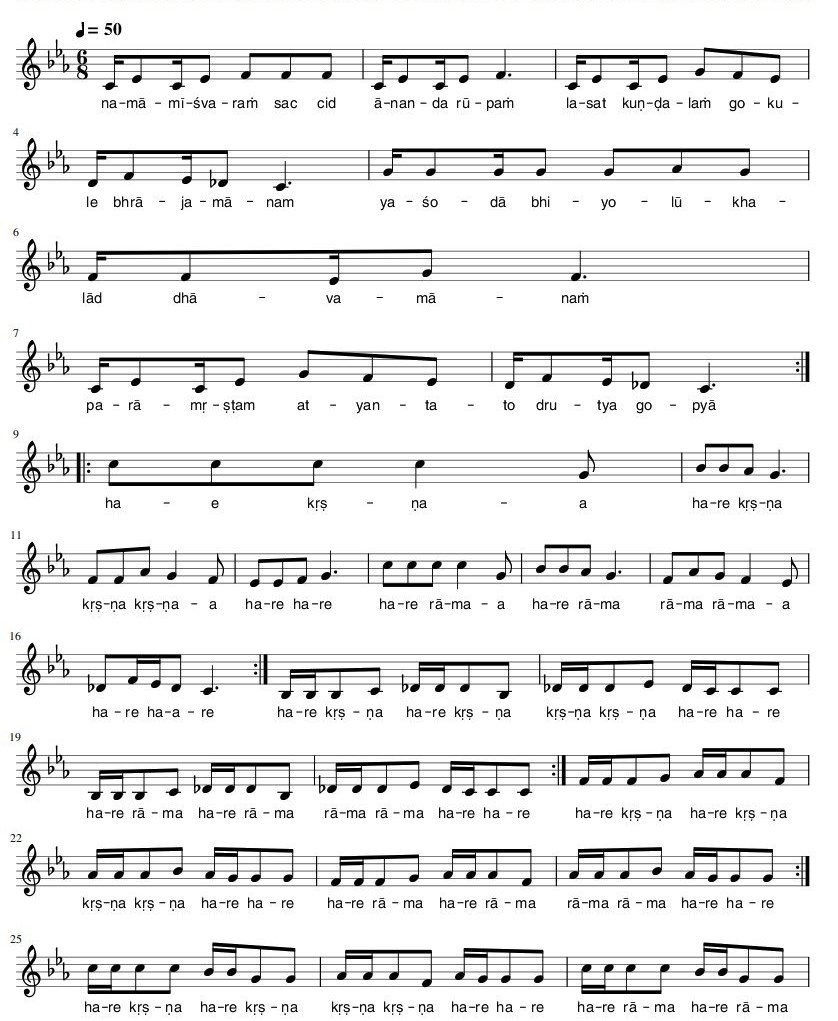
mo bara adhama durācāra dārūṇa-saṁsāra-nidhi tāte ḍubāila vidhi keśe dhari more kara pāra ṭhākura vaiṣṇava-gaṇa—the Vaiṣṇavas; kari ei nivedana—I request; mo—I am; bara—very; adhama—fallen; durācāra—wretched; dārūṇa—terrible; saṁsāra- nidhi—ocean of material existence; tābe—it; ḍubāila—drowned; vidhi—by Providence; keśe dhari—pulling my hair; more kara pāra—please deliver me.
O saintly Vaiṣṇava! Please hear my prayer. I am the most wretched and fallen soul, drowning in this formidable material ocean by Providence. Please help me to cross over this ocean by grabbing me by the hair and pulling me out.
2 vidhi bara balavān nā śune dharama-jñāna
sadāi karama-pāśe bāṅdhe nā dekhi tāraṇa leśa jata dekhi saba kleśa anātha kātare tewi kānde vidhi—the Providence; bara balavān—very powerful; nā śune—not heed; dharama—religious principles; jñāna—knowledge; sadāi—always; karama- pāśe—with the ropes of karma; baṅdhe—binds; nā dekhi—I do not see; tāraṇa leśa—the way of deliverance; jata dekhi—whatever I see; saba kleśa—is simply distress; anātha—helpless; kātare—pathetic; tewi—because of that; kānde— weeps.
The laws of Providence are so powerful that they do not consider religion or knowledge, rather they bind one with the ropes of karma. I do not find any source of deliverance from these miserable conditions, and I always lament because I am afflicted by this and I am without a master.
3 kāma krodha lobha moha mada abhimāna saha
āpana āpana sthāne ṭāne aichana āmāra mana phire jena andha jana supatha vipatha nāhi jāne kāma—lust; krodha—anger; lobha—greed; moha—illusion; mada—pride; abhimāna—false ego; saha—along with; apana āpana sthāne—to their respective ends; ṭāne—pulls; aichana—such; āmāra mana—my mind; phire—wanders; jena—like; andha jana—blind man; supatha—right path; vipatha—wrong path; nāhi jāne—does not know.
Lust, anger, greed, illusion, pride are pulling me to their respective places. Thus my mind is like a blind man without any sense of discrimination.
4 nā lainu sat mata asate majila citta
tuwā pāye nā karinu āśa narottama dāse kaya dekhi śuni lāge bhaya tarāiyā laha nija pāśa nā lainu—did not take; sat mata—the path of the devotees; asate—in bad association; majila—absorbed; citta—heart; tuyā pāye—on your lotus feet; nā karinu—did not; āśa—desire; narottama dāse—Narottama dāsa; kaya—says; dekhi śuni—by seeing and hearing; lāge bhaya—I am afraid of; tarāiyā—by delivering; laha—keep me; nija pāśa—at your lotus feet.
My mind did not accept the path of the devotees. I was absorbed in bad association. Narottama dāsa says, “I did not aspire for your lotus feet, O Lord. Please accept me and keep me at Your lotus feet, as I am afraid.”
Commentary
This is song 44 in Narottama dāsa Ṭhākura’s Prārthana. The official title is Vaiṣṇava-vijñapti (Prayer to the Vaiṣṇavas). As in the next song and many others, the importance of vaiṣṇava-sevā (service to the devotees) is stressed. Prabhupāda often quotes the following line from Narottama dāsa Ṭhākura: chāriyā vaiṣṇava- sevā nistāra pāyeche kebā, which means that unless one serves the Vaiṣṇavas and brāhmaṇas, one cannot get liberation from the material clutches. Here are some examples:
Śrīmad-Bhāgavatam 6.1.16 – Purport Śrīla Narottama dāsa Ṭhākura has said, chāriyā vaiṣṇava-sevā nistāra pāyeche kebā: "Without serving a bona fide spiritual master, an ideal Vaiṣṇava, who can be delivered from the clutches of māyā?" This idea is also expressed in many other places. Śrīmad-Bhāgavatam (5.5.2) says, mahat-sevāṁ dvāram āhur vimukteḥ: if one desires liberation from the clutches of māyā, one must associate with a pure devotee mahātmā. A mahātmā is one who engages twenty-four hours daily in the loving service of the Lord. As Kṛṣṇa says in Bhagavad-gītā (9.13):
mahātmānas tu māṁ pārtha daivīṁ prakṛtim āśritāḥ bhajanty ananya-manaso jñātvā bhūtādim avyayam
"O son of Pṛthā, those who are not deluded, the great souls, are under the protection of the divine nature. They are fully engaged in devotional service because they know Me as the Supreme Personality of Godhead, original and inexhaustible." Thus the symptom of a mahātmā is that he has no engagement other than service to Kṛṣṇa. One must render service to a Vaiṣṇava in order to get freed from sinful reactions, revive one's original Kṛṣṇa consciousness and be trained in how to love Kṛṣṇa. This is the result of mahātma-sevā. Of course, if one engages in the service of a pure devotee, the reactions of one's sinful life are vanquished automatically. Devotional service is necessary not to drive away an insignificant stock of sins but to awaken our dormant love for Kṛṣṇa. As fog is vanquished at the first glimpse of sunlight, one's sinful reactions are automatically vanquished as soon as one begins serving a pure devotee; no separate endeavor is required.
Śrīmad-Bhāgavatam 6.11.18 – Purport A Vaiṣṇava always desires the dust of the lotus feet of previous ācāryas and Vaiṣṇavas. Vṛtrāsura was certain that he would be killed in the battle with Indra, because this was the desire of Lord Viṣṇu. He was prepared for death because he knew that after his death he was destined to return home, back to Godhead. This is a great destination, and it is achieved by the grace of a Vaiṣṇava. Chāriyā vaiṣṇava-sevā nistāra pāyeche kebā: no one has ever gone back to Godhead without being favored by a Vaiṣṇava. In this verse, therefore, we find the words manasvināṁ pāda-rajaḥ prapatsye: "I shall receive the dust of the lotus feet of great devotees." The word manasvinām refers to great devotees who always think of Kṛṣṇa. They are always peaceful, thinking of Kṛṣṇa, and therefore they are called dhīra. The best example of such a devotee is Nārada Muni. If one receives the dust of the lotus feet of a manasvī, a great devotee, he certainly returns home, back to Godhead. Śrīmad-Bhāgavatam 7.9.24 – Purport By following in the footsteps of Prahlāda Mahārāja, one should gain thorough experience that all material opulence is perishable at every moment. Even this body, for which we try to acquire so many sensual pleasures, may perish at any time. The soul, however, is eternal. Na hanyate hanyamāne śarīre: [Bg. 2.20] the soul is never vanquished, even when the body is destroyed. An intelligent man, therefore, should care for the happiness of the spirit soul, not of the body. Even if one receives a body with a long duration of life, like those of Lord Brahmā and the other great demigods, it will also be destroyed, and therefore an intelligent man should be concerned with the imperishable spirit soul. To save oneself, one must take shelter of a pure devotee. Narottama dāsa Ṭhākura therefore says, chāḍiyā vaiṣṇava-sevā nistāra pāyeche kebā. If one wants to save himself from material nature's onslaughts, which arise because of the material body, one must become Kṛṣṇa conscious and try to fully understand Kṛṣṇa. Śrīmad-Bhāgavatam 10.10.25 – Purport If one seeks the favor of a devotee instead of directly asking favors from the Supreme Personality of Godhead, one is very easily successful. Śrīla Bhaktivinoda Ṭhākura has therefore recommended: vaiṣṇava ṭhākura tomāra kukkura baliyā jānaha more, kṛṣṇa se tomāra kṛṣṇa dite pāra. One should desire to become like a dog in strictly following a devotee. Kṛṣṇa is in the hand of a devotee. Adurlabham ātma-bhaktau. Thus without the favor of a devotee, one cannot directly approach Kṛṣṇa, what to speak of engaging in His service. Narottama dāsa Ṭhākura therefore sings, chāriyā vaiṣṇava-sevā nistāra pāyeche kebā: unless one becomes a servant of a pure devotee, one cannot be delivered from the material condition of life. In our
Gauḍīya Vaiṣṇava society, following in the footsteps of Rūpa Gosvāmī, our first business is to seek shelter of a bona fide spiritual master (ādau gurv-āśrayaḥ).
Ei-bāra karuṇā kara
1 ei-bāra karuṇā kara vaiṣṇava gosāi
patita-pāvana tomā vine keha nāi
ei-bāra—now; karuṇā kara—be compassionate; vaiṣṇava gosāi—O Vaiṣṇava Gosvāmī; patita-pāvana—purifier of the fallen souls; tomā vine—except you; keha nāi—none else.
O Vaiṣṇava Gosvāmī, please be merciful to me at least this one time. Except for you, there is no one who can purify the fallen souls.
2 yāhāra nikaṭe gele pāpa dūre jāya emana dayāla prabhu kebā kothā pāya jāhāra—who; nikaṭe gele—if one approaches; pāpa—the sins; dūre jāya—are destroyed; emana—such a; dayāla—merciful; prabhu—master; kebā—who can; kothā pāya—get anywhere.
Where can anyone find such a merciful personality by whose mere audience all sins go far away?
3 gaṅgara paraśa haile paścāte pāvana
darśane pavitra kara-ei tomāra guṇa
gaṅgara—of the Ganges; paraśa haile—touched; paścāte—later; pāvana— purification; darśane—audience; pavitra kara—purify; ei—this is; tomāra guṇa— your qualities.
After bathing in the waters of the sacred Ganges many times, one becomes purified, but just by the sight of you, the fallen souls become purified. This is your great quality.
4 hari-sthāne aparādhe tāre hari-nāma tomā sthāne aparādhe nāhi paritrāna hari-sthāne—to Lord Hari; aparādhe—if one commits offences; tāre—delivers; harinām—the holy names of Hari; tomā sthāne—to you; aparādhe—if one commits offences; nāhi—there is no; paritrāna—deliverance.
The holy name can deliver anyone who commits an offense to Lord Hari, but if someone commits an offense to you, there is no means of deliverance.
5 tomāra hṛdaye sadā govinda-viśrāma govinda kahena—mama vaiṣṇava parāṇa tomāra hṛdaye—in your heart; sadā—always; govinda—Lord Govinda; viśrāma— is residing; govinda—Lord Govinda; kahena—says; mama—mine; vaiṣṇava—the vaiṣṇavas; parāṇa—in My heart.
Govinda is always residing in your heart, so Govinda says, “The Vaiṣṇavas are My heart.”

6 prati-janme kari āśā caraṇera dhūli
narottame kara dayā āpanāra bali
prati-janme—in every birth; kari āśā—I desire; caraṇera dhūli—the dust from your lotus feet; narottame—Narottama dāsa; kara dayā—be merciful; āpanāra bali— considering as yours.
I desire the dust of your holy feet in every birth I may take. Please consider Narottama dāsa yours, and be kind upon him.
Commentary
This is Song 45 in Narottama dāsa Ṭhākura’s Prārthana. He continues to express the same mood as in the previous song and specifically begs for the mercy of a Vaiṣṇava, because he is confident that the devotees are very dear to Kṛṣṇa and have the power to purify even the most sinful person by their association.
Kṛpa kara' vaiṣṇava ṭhākura
1 kṛpā kara' vaiṣṇava ṭhākura sambandha jāniyā, bhajite bhajite, abhimāna hau dura kṛpa—mercy; kara'—bestow; vaiṣṇava ṭhākura—O Vaiṣṇava Ṭhākura; sambandha—relationship; jāniyā—knowing; bhajite bhajite—continuously worshiping; abhimāna—false ego; hau—may be; dura—far away.
Please bestow your mercy onto me, o revered Vaisnava Thakura! Then only, by constant worship in full knowledge of my real eternal position, my false ego will go far away.
2 āmi ta’ vaiṣṇava, e-buddhi ha-ile,
amānī nā haba āmi pratiṣṭhāśā āsi’, hṛdaya dūṣibe, ha-iba niraya-gāmī āmi —I; ta’—certainly; vaiṣṇava—a devotee; e-buddhi—this thinking; ha-ile—if there is; amānī—free from desire for false prestige; nā—not; haba—will become; āmi—I; pratiṣṭhāśā—reputation; āsi’—having come; hṛdaya—heart; dūṣibe—will be polluted; ha-iba—I shall; niraya—hell; gāmī—go towards.
If I think “I am a Vaisnava”, then I shall look forward to receiving respect from others. And if the desire for false prestige and reputation pollutes my heart, then certainly I shall glide down to a life in hell.
3 tomāra kiṅkara, āpane jāniba,
'guru'-abhimāna tyaji' tomāra ucchiṣṭha, pada-jala-reṇu sadā niṣkapaṭe bhaji tomāra—your; kiṅkara—servant; āpane—myself; jānibo—I will know; 'guru' - abhimāna—the pride of being “guru”; tyaji'—having given up; tomāra—your; ucchiṣṭha—remnants; pada—foot; jala—water; reṇu—dust; sadā—always; niṣkapaṭe—sincerely; bhaji—I honor.
I will understand myself to be your humble servant when I renounce the false conception that “I am a guru”. I sincerely worship the remnants of your food, o pure devotee, as well as the water that has washed the sacred dust of your lotus feet.
4 nije śreṣṭha jāni’, ucchiṣṭādi-dāne,
habe abhimāna bhāra tāi śiṣya tava, thākiyā sarvadā, nā la-iba pūjā kāra nije—myself; śreṣṭha—the best; jāni’—having known; ucchiṣṭa—remnants; ādi— and so on; dāne—by giving; habe—will become; abhimāna—false pride; bhāra— heavy; tāi—thus; śiṣya—disciple; tava—your; thākiyā—remaining; sarvadā— forever; nā—not; la-iba—I will take; pūjā—worship; kāra—anyone.
By giving others the remnants of my food, I shall consider myself superior and will be burdened with the weight of false pride. Therefore, always remaining your surrendered disciple, I shall not accept worship from anyone.
5 amānī mānada, haile kīrtane,
adhikāra dibe tumi tomāra caraṇe, niṣkapaṭe āmi,
kāṇdiyā luṭiba bhumi
amāni—without a desire for honor; mānada—offering respect to others; haile—if it happens; kīrtane—to chant; adhikāra—the qualification; dibe—will give; tumi— you; tomāra—your; caraṇe—at feet; niṣkapaṭe—without; āmi—I; kāṇdiyā—having cried; luṭiba—I shall roll; bhumi—on the ground.
If you will bestow upon me the right to chant the holy name, I will then give all honor to others without expecting any for myself. Thus I will sincerely weep in ecstasy while rolling on the ground at your lotus feet.
Commentary
This is Song 8 In Bhaktivinoda Ṭhākura’s Kalyāna-kalpataru, Third Branch (Overflowing Spiritual Emotions, Part 2 (Prayers of Eager Longing), Prayer to the pure devotee. We are including it in this collection because Prabhupāda quotes almost the entire song in Śrī Caitanya-caritāmṛta, Antya-līlā, 4.173: “Śrīla Bhaktisiddhānta Sarasvatī Ṭhākura gives his opinion about how a person completely engaged in the service of the Lord transforms his body from material to transcendental. He says, ‘A pure devotee engaged in the service of Lord Kṛṣṇa has no desire for his personal sense gratification, and thus he never accepts anything for that purpose. He desires only the happiness of the Supreme Personality of Godhead, Kṛṣṇa, and because of his ecstatic love for Kṛṣṇa, he acts in various ways. Karmīs think that the material body is an instrument for material enjoyment, and that is why they work extremely hard. A devotee, however, has no such desires. A devotee always engages wholeheartedly in the service of the Lord, forgetting about bodily conceptions and bodily activities. The body of a karmī is called material because the karmī, being too absorbed in material activities, is always eager to enjoy material facilities, but the body of a devotee who tries his best to work very hard for the satisfaction of Kṛṣṇa by fully engaging in the Lord’s service must be accepted as transcendental. Whereas karmīs are interested only in the personal satisfaction of their senses, devotees work for the satisfaction of the Supreme Lord. Therefore one who cannot distinguish between devotion and ordinary karma may mistakenly consider the body of a pure devotee material. One who
knows does not commit such a mistake. Nondevotees who consider devotional activities and ordinary material activities to be on the same level are offenders to the chanting of the transcendental holy name of the Lord. A pure devotee knows that a devotee’s body, being always transcendental, is just suitable for rendering service to the Lord. “A devotee on the topmost platform of devotional service always humbly thinks that he is not rendering any devotional service. He thinks that he is poor in devotional service and that his body is material. On the other hand, those known as the sahajiyās foolishly think that their material bodies are transcendental. Because of this, they are always bereft of the association of pure devotees, and thus they cannot behave like Vaiṣṇavas. Observing the defects of the sahajiyās, Śrīla Bhaktivinoda Ṭhākura has sung as follows in his book Kalyāṇa-kalpataru:
āmi ta’ vaiṣṇava, e-buddhi ha-ile,
amānī nā haba āmi pratiṣṭhāśā āsi’, hṛdaya dūṣibe, ha-iba niraya-gāmī nije śreṣṭha jāni’, ucchiṣṭādi-dāne, habe abhimāna bhāra tāi śiṣya tava, thākiyā sarvadā, nā la-iba pūjā kāra
“‘If I think I am a Vaiṣṇava, I shall look forward to receiving respect from others. And if the desire for fame and reputation pollutes my heart, certainly I shall go to hell. By giving others the remnants of my food, I shall consider myself superior and shall be burdened with the weight of false pride. Therefore, always remaining your surrendered disciple, I shall not accept worship from anyone.’ Śrīla Kṛṣṇadāsa Kavirāja Gosvāmī has written (Antya-līlā 20.28):
premera svabhāva—yāhāṅ premera sambandha
sei māne,—‘kṛṣṇe mora nāhi prema-gandha’
“‘Wherever there is a relationship of love of Godhead, the natural symptoms are that the devotee does not think himself a devotee, but always thinks that he has not even a drop of love for Kṛṣṇa.’”
Gaurāṅga karuṇā kara
1 gaurāṅga karuṇā kara, dīna hīna jane mo-sama patita prabhu, nāhi tri-bhuvane gaurāṅga—O my dear Lord Gaurāṅga; karuṇā kara—please show Your mercy; dīna hīna jane—to this fallen and destitute soul; mo-sama—like myself; patita— fallen; prabhu—O Lord!; nāhi—there is not; tri-bhuvane—in the three worlds.
O my dear Lord Gaurāṅga! Please show Your mercy to this lowly and destitute soul. O Lord! There is no one more fallen than myself in all the three worlds.
2 dante tṛṇa dhari’ gaura, ḍāki he tomāra
kṛpā kari’ eso āmāra, hṛdaya mandire
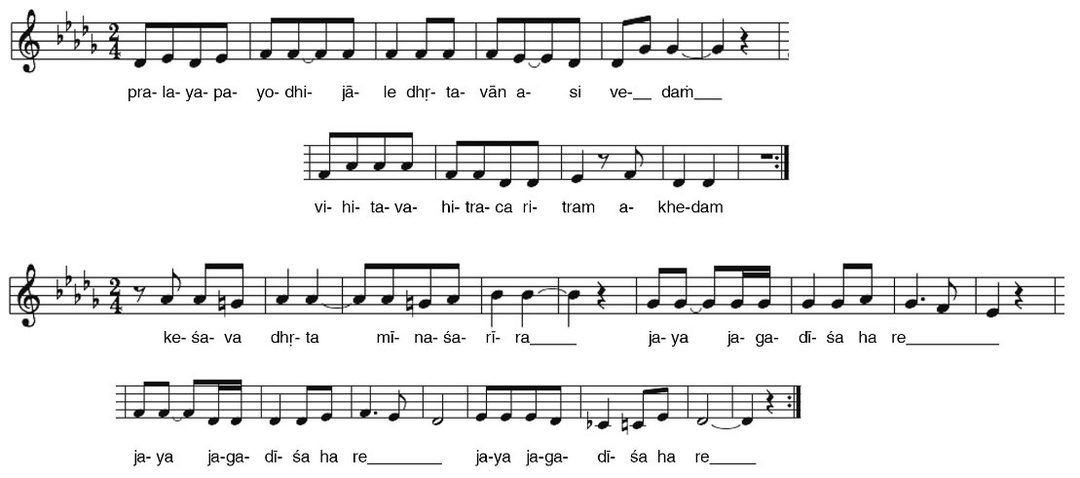
dante—between my teeth; tṛṇa dhari'—holding grass; gaura—O Lord Gaura!; ḍāki—I am calling out; he—O!; tomāra—your; kṛpā—mercy; kari'—showing; eso—please come; āmāra—my; hṛdaya mandire—into the temple of the heart.
Holding grass between my teeth, O Lord Gaura, I am calling out to You now! Please be compassionate upon me and come to reside within the temple of my heart.
3 yadi dayā nā karibe, patita dekhiyā
patita pāvana nāma, kisera lāgiyā
yadi—if; dayā—mercy; nā karibe—You do not give; patita—fallen; dekhiyā— seeing; patita pāvana—savior of the fallen; nāma—the name; kisera lāgiyā—why are You known.
If You do not give Your mercy, seeing how fallen I am, then why are You known as Patita Pāvana—the merciful savior of the fallen?
4 pareci bhava tuphāne, nāhika nistāra śrī caraṇa taraṇī dāne, dāse kara pāra pareci—I have fallen; bhava tuphāne—in the hurricane of this material world; nāhika nistāra—there is no escape; śrī caraṇa—divine lotus feet; taraṇī— compared to a boat; dāne—by the gift; dāse—to Your servant; kara pāra—make cross over.
I am plunged amidst the violent hurricane-stricken waves in the ocean of this material world, from which there is no escape. Kindly give me the gift of Your divine lotus feet, which are compared to a boat in which Your servant may cross over the ocean of birth and death.
5 śrī kṛṣṇa caitanya prabhu, dāsera anudāsa
prārthanā karaye sadā, narottama dāsa
śrī kṛṣṇa caitanya prabhu—Lord Śrī Kṛṣṇa Caitanya Prabhu; dāsera anudāsa— servant of the servant; prārthanā karaye—makes this prayer; sadā—always; narottama dāsa—Narottama Dāsa.
Narottama Dāsa, the servant of the servant of Śrī Kṛṣṇa Caitanya Prabhu, ceaselessly makes this prayer.
Commentary
After begging for the mercy of the Vaiṣṇavas, we should approach the most magnanimous incarnation of the Lord and beg for His mercy also, as Narottama dāsa Ṭhākura shows in this song begging for the mercy of Lord Gaurāṅga.
Jadi gaura nā haita
Vasu Ghosh
1 jadi gaura nā haita, tabe ki haita,
kemane dharitām de rādhāra mahimā, prema-rasa-sīmā, jagate jānāta ke jadi—if; gaura—Lord Gaura; nā haita—had not incarnated; tabe—then; ki haita— what would have happened?; kemane—how?; dharitām de—we maintained these bodies; rādhāra mahimā—the glories of Rādhā; prema-rasa-sīmā—the topmost limit of divine love; jagate—in the universe; jānāta—cause to know; ke—who?
If Lord Gaura had not appeared as the yuga-avatāra in this age of Kali, then what would have become of us? How could we have tolerated living? Who in this universe would have ever learned about the topmost limits of loving mellows that comprise the glory of Śrī Rādhā?
2 madhura vṛndā, vipina-mādhurī,
praveśa cāturī sāra varaja-yuvati, bhāvera bhakati, śakati haita kāra madhura—sweet; vṛndā vipina-mādhurī—the sweetness of the forest of Vṛndā Devī; praveśa—entrance; cāturī—cleverness; sāra—the essence; varaja-yuvati— the damsels of Vraja; bhāvera bhakati—devotion in their mood; śakati—potency; haita—to become; kāra—whose?
Who would have had the power to render ecstatic devotional service that follows in the footsteps of the damsels of Vraja? Indeed, the clever expertise of the Vraja-gopīs is a prerequisite for entering the supremely sweet forest of Vṛndā Devī.
3 gāo gāo punaḥ, gaurāṅgera guṇa,
sarala kariyā mana e bhava-sāgare, emana dayāla,
nā dekhiye eka-jana
gāo gāo—sing and sing; punaḥ—repeatedly; gaurāṅgera guṇa—the qualities of Lord Gaura; sarala—simple; kariyā—making; mana—the mind; e bhava-sāgare— in the ocean of this material world; emana dayāla—such a merciful one; nā dekhiye—is not seen; eka-jana—not even one person.
Oh, please sing again and again of the glorious qualities of Lord Gaurāṅga! Just try to keep your heart simple. Not even one person within this ocean of nescience has ever seen such a magnanimous personality as He.
4 (āmi) gaurāṅga baliyā, nā genu galiyā,
kemane dharinu de vāsura hiyā, pāṣāṇa diyā,
kemane gariyāche
āmi—I; gaurāṅga baliyā—chanting the name of Gaurāṅga; nā—not; genu— passed; galiyā—melting; kemane—how?; dharinu—have I held; de—this body; vāsura hiyā—the heart of Vasu Ghosh; pāṣāṇa—stone; diyā—giving; kemane— how?; gariyāche—is created.
Even though I chant the holy name of Lord Gaurāṅga, somehow I still have not melted in ecstasy –how then have I maintained the burden of this body? How has the creator fashioned this body with a stone in place of Vasu Ghosh's heart?
Commentary
What would have happened if Śrī Caitanya Mahāprabhu would not have come? If the benediction moon would not have risen, the world would have remained in the dense darkness of ignorance. As Prabhupāda pointed out Kṛṣṇa came 5000 years ago and taught the highest dharma, complete self-surrender unto His lotus feet. But most people could not accept.
When discussing the philosopher Kierkegaard, Prabhupāda pointed out: “Kṛṣṇa came as He is, but people misunderstood Him because He appeared as a human being. Consequently, they could not surrender to Him. Therefore Kṛṣṇa came later as a devotee, Śrī Caitanya Mahāprabhu, to teach men how to approach God. Caitanya Mahāprabhu taught the very same philosophy that Kṛṣṇa taught in the Bhagavad-gītā. But instead of coming as Kṛṣṇa, Lord Caitanya came as Kṛṣṇa’s devotee. Rūpa Gosvāmī appreciated Caitanya Mahāprabhu as the most munificent incarnation, because He gives not only Kṛṣṇa but also pure love of Kṛṣṇa (namo mahā-vadānyāya kṛṣṇa-prema-pradāya te). In exchange for Himself, Kṛṣṇa demands full surrender from the devotee. But Caitanya Mahāprabhu, without making any demands, gave pure love of Kṛṣṇa. Because we are all His sons, Kṛṣṇa—the Supreme Lord—is affectionate toward us. He sees us rotting in this material world, and He comes Himself—or He comes as His devotee—and leaves His instructions. Kṛṣṇa is always anxious to enlighten the human beings and show them how to return home, back to Godhead.” Therefore, if Śrī Caitanya Mahāprabhu would not have come, we and all the other unfortunate residents of Kali-yuga would have no chance whatsoever to get out of their rotten condition in this world. Consequently, shouldn’t we be grateful and show our gratitude by assisting the Lord and His devotees in their mission to bring some light into the darkness?
Prabhu tava pada-yuge
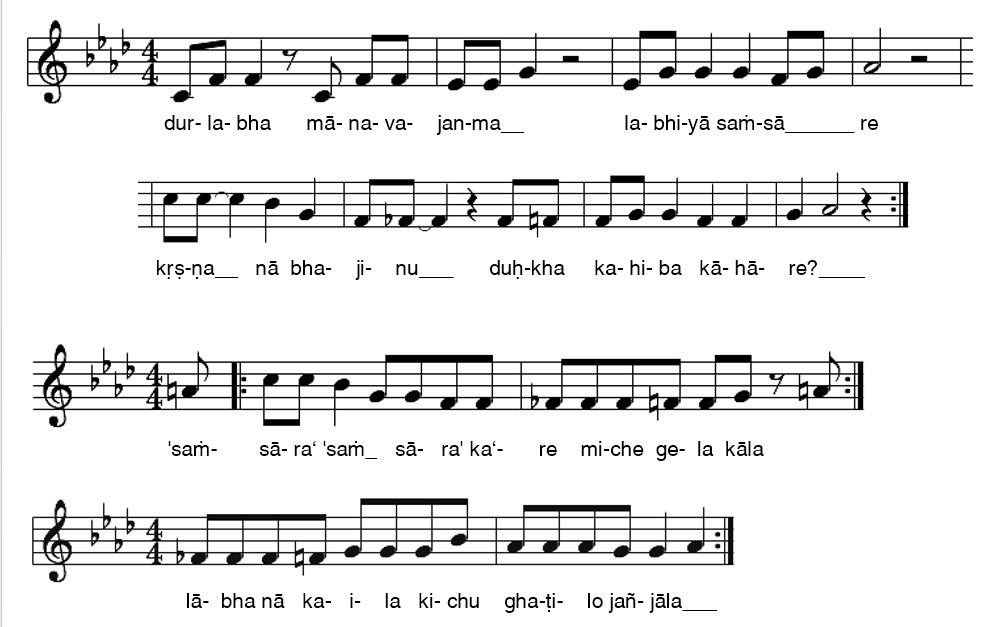
1 prabhu tava pada-yuge mora nivedana nāhi māgi deha-sukha, vidyā, dhana, jana prabhu—o Lord; tava—Your; pada-yuge—lotus feet; mora—My; nivedana— submission; nāhi māgi—I don’t ask for; deha-sukha—pleasure for the body; vidyā—learning; dhana—wealth; jana—followers.
O Lord! This is my humble submission at Your lotus feet. I do not ask from You sensual pleasure, learning, wealth, or followers.
2 nāhi māgi svarga, āra mokṣa nāhi māgi
nā kari prārthanā kona vibhūtira lāgi'
nāhi—there is no; māgi—begging; svarga—of the heavenly planets; āra—and; mokṣa—for liberation; nāhi—there is no; māgi—begging; nā—not; kari—do; prārthanā—desires; kona—some; vibhūtira—mystic powers; lāgi'—for.
I do not beg for residence on the celestial planets, nor do I wish liberation from this mundane existence. Nor do I pray for the attainment of any mystic powers.
3 nija-karma-guna-doṣe je je janma pāi janme janme yena tava nāma-guna gāi nija—own; karma—of work; guna—by the qualities; doṣe—by the fault; je—who; je—who; janma—birth; pāi—I get; janme janme—birth after birth; yena—by which; tava—your; nāma—of the holy name; guna—the qualities; gāi—I sing.
Whatever birth I may obtain due to the faults of my previous worldly activities, I pray that I may sing the glories of Your holy name birth after birth.
4 ei mātra āśā mama tomāra caraṇe ahaitukī bhakti hṛde jāge anukṣane ei—this; mātra—only; āśā—desire; mama—my; tomāra—Your; caraṇe—lotus feet; ahaitukī—unmotivated; bhakti—devotion; hṛde—in the heart; jāge—awakens; anukṣane—every moment.
This is my only desire, O Lord, and I submit it at Your lotus feet: That unmotivated devotion to You may constantly awaken in my heart.
5 viṣaye je prīti ebe āchaye āmāra sei-mata prīti hauka caraṇe tomāra viṣaye—material enjoyment; je—this; prīti—attachment; ebe—now; āchaye— there is; āmāra—my; sei—that; mata—similar; prīti—attachment; hauka—let there be; caraṇe—feet; tomāra—Your.
As much attachment as I now have for worldly affairs, I pray that a similar degree of attachment may develop for Your lotus feet.
6 vipade sampade tāhā thākuka sama-bhāve
dine dine vṛddhi hauka nāmera prabhāve
vipade—from danger; sampade—prosperity; tāhā—that; thākuka—may remain; sama—equipoised; bhāve—heart; dine dine—day after day; vṛddhi—may increase; hauka—let there be; nāmera—of the holy name; prabhāve—by the influence.
I pray that my love for You may remain undisturbed both in misfortune and in prosperity, and that day after day it may increase by the power and influence of Your holy name.
7 paśu-pakṣi ha’ ye thāki svarge vā niraye
tava bhakti rahu bhaktivinoda-hṛdaye
paśu—animals; pakṣi—bird; ha’ ye—there is; thāki—reside; svarge—in heaven; vā—or; niraye—in hell; tava—Your; bhakti—devotion; rahu—let there be; bhaktivinoda-hṛdaye—in the heart of Bhaktivinoda.
Be my life in heaven or in hell, be it as a bird or a beast, may devotion to You always remain within the heart of Bhaktivinoda.
Commentary
This song is based on Śikṣāṣṭaka prayer 4: na dhanam na janam na sundarīm. Here Bhaktivinoda Ṭhākura expresses his humble request to be granted unmotivated, unalloyed devotional service. This includes a list of things a pure devotee does not desire, such as worldly pleasure, learning, wealth or fame, residents in heaven or merging into the Brahman effulgence. Rather he prays to the Lord to be granted remembrance of Kṛṣṇa in any form of life, devotion to His lotus feet and loving devotional feelings in the heart under any circumstances. The mood of this song is deep humility mixed with the hopeful expectation to receive the mercy of the Lord.
Krsna! he Śrī Caitanya Mahāprabhu
kṛṣṇa! kṛṣṇa! kṛṣṇa! kṛṣṇa! kṛṣṇa! kṛṣṇa! kṛṣṇa! he kṛṣṇa! kṛṣṇa! kṛṣṇa! kṛṣṇa! kṛṣṇa! kṛṣṇa! kṛṣṇa! he kṛṣṇa! kṛṣṇa! kṛṣṇa! kṛṣṇa! kṛṣṇa! kṛṣṇa! rakṣa mām kṛṣṇa! kṛṣṇa! kṛṣṇa! kṛṣṇa! kṛṣṇa! kṛṣṇa! pāhi mām rāma! rāghava! rāma! rāghava! rāma! rāghava! rakṣa mām kṛṣṇa! keśava! kṛṣṇa! keśava! kṛṣṇa! keśava! pāhi mām kṛṣṇa—Lord Kṛṣṇa; he—O; rakṣa—please protect; mām—Me; pāhi—please maintain; rāma—Lord Rāma; rāghava—descendant of King Raghu; keśava—killer of the Keśī demon.
“O Lord Kṛṣṇa, please protect Me and maintain Me. O Lord Rāma, descendant of King Raghu, please protect Me. O Kṛṣṇa, O Keśava, killer of the Keśī demon, please maintain Me.”
Commentary
This verse appears in the Śrī Caitanya-caritāmṛta, Madhya-lila, Chapter 7 as Text 96. After having spent some time in Jagannātha Puri, Śrī Caitanya Mahāprabhu decided to tour South India to deliver the people there. His mood while walking on the road is described in the previous verse (95): “Almost like a mad lion, Lord Śrī Caitanya Mahāprabhu went on His tour filled with ecstatic love and performing saṅkīrtana, chanting Kṛṣṇa’s names as follows.”
kṛṣṇa! kṛṣṇa! kṛṣṇa! kṛṣṇa! kṛṣṇa! kṛṣṇa! kṛṣṇa! he
… The Śrī Caitanya-caritāmṛta was published in 1975, but Prabhupāda had quoted this verse already in 1970 in the Introduction to his Kṛṣṇa Book. The earliest account of Prabhupāda chanting this mantra is mentioned in a letter to Brahmananda, dated August 4, 1967:
I sang this mantra at the airport: K, K, K, K, K, K, K, HE (twice); K, K, K, K, K, K, raksa mam; K, K, K, K, K, K, pahi mam; Rama Raghava, Rama Raghava, Rama Raghava raksa mam; K. Kesava, K. Kesava, K. Kesava, K. Kesave pahi mam.
Adi-lila 8.26 – Purport In this age, although people are greatly sinful, simply chanting the Hare Kṛṣṇa mahā-mantra can relieve them from the reactions of their sins. Eka kṛṣṇa-nāme: only by chanting Kṛṣṇa’s name is this possible. This is confirmed in Śrīmad- Bhāgavatam (12.3.51): kīrtanād eva kṛṣṇasya mukta-saṅgaḥ. Caitanya Mahāprabhu has also taught us this. While passing on the road, He used to chant:
kṛṣṇa kṛṣṇa kṛṣṇa kṛṣṇa kṛṣṇa kṛṣṇa kṛṣṇa he
If one always chants the holy name of Kṛṣṇa, gradually one is freed from all reactions of sinful life, provided he chants offenselessly and does not commit more sinful activities on the strength of chanting the Hare Kṛṣṇa mantra. In this way one is purified, and his devotional service causes the arousal of his dormant love of God. If one simply chants the Hare Kṛṣṇa mantra and does not commit sinful activities and offenses, one’s life is purified, and thus one comes to the fifth stage of perfection, or engagement in the loving service of the Lord (premā pum-artho mahān).
Lecture on Śrīmad-Bhāgavatam 6.2.1-5 – Calcutta, 1971 So we have to be very careful. The age is very bad, the Kali-yuga. You are experiencing. We have to simply take shelter of Kṛṣṇa and always cry, kṛṣṇa, kṛṣṇa, kṛṣṇa, kṛṣṇa, kṛṣṇa, kṛṣṇa, kṛṣṇa, he!
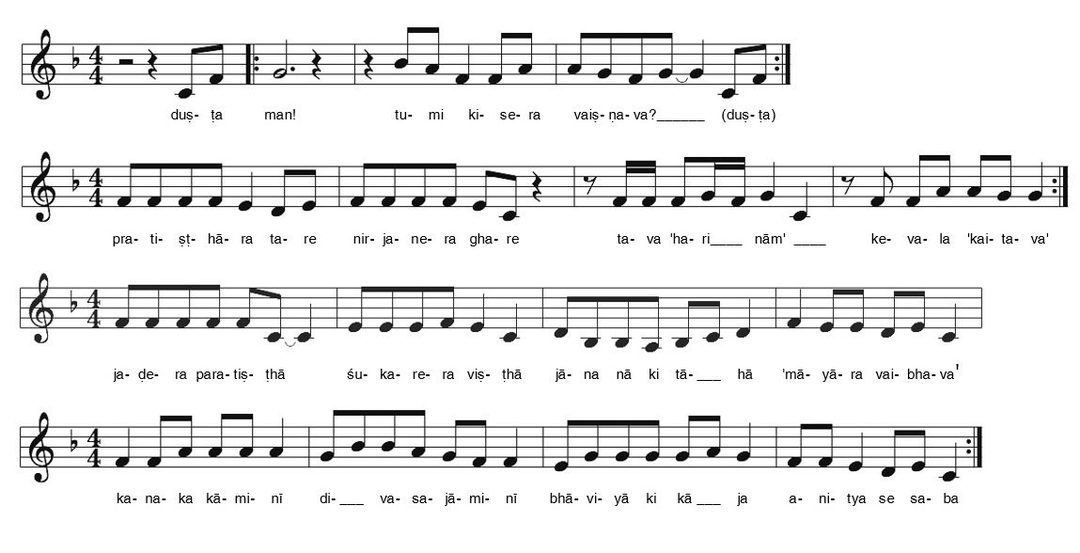
Like that, as Caitanya Mahāprabhu taught us. The time is very dangerous. And still, in this dangerous time... Just like in epidemic condition where every people is being contaminated and dying, still, the doctors appointed by the government, they have to go into the epidemic area and try to treat the person and save them. Our duty is like that. The whole atmosphere is epidemic, whole atmosphere, this Kali-yuga. And still, by the superior orders we have to preach this Kṛṣṇa consciousness movement. Therefore our only shelter is Kṛṣṇa. Kṛṣṇa, kṛṣṇa, kṛṣṇa, kṛṣṇa, kṛṣṇa, kṛṣṇa, rakṣa mām. Letter to Syamasundara - Los Angeles,1970 Regarding authorized songs, you may inform George that authorized songs means the songs which were sung or composed by self-realized Acaryas. It is an injunction in the Vaisnava regulations that unauthorized songs or statements should never be heard. The comparison is given that milk, although very nutritious food, if it is touched by the tongue of a serpent, it acts like poison. So I am giving herewith a few lines of authorized songs which you may deliver to George. They are as follows:
1. Hare Krsna Hare Krsna Krsna Krsna Hare Hare Hare Rama Hare Rama Rama Rama Hare Hare
2. Hari Haraye Namah Krsna Yadavaya Namah Yadavaya Madhavaya Kesavaya Namah
3. Krsna Krsna Krsna Krsna Krsna Krsna Krsna Hay Krsna Krsna Krsna Krsna Krsna Krsna Krsna Hay Krsna Krsna Krsna Krsna Krsna Krsna Raksa mam Krsna Krsna Krsna Krsna Krsna Krsna Pahi mam Krsna Kesava Krsna Kesava Krsna Kesava Raksa mam Rama Raghava Rama Raghava Rama Raghava Pahi mam
So these songs were sung by Lord Caitanya Himself, therefore they are the most authorized songs.
Kabe habe bala
1 kabe ha' be bala se-dina āmāra (āmāra) aparādha ghuci', śuddha nāme ruci, kṛpā-bale ha'be hṛdaye sañcāra kabe—when?; ha' be—will be; bala—tell; se—that; dina—day; āmāra—my; āmāra—mine; aparādha—offenses; ghuci'—having ceased; śuddha—pure;
nāme—for the name; ruci—taste; kṛpā—mercy; bale—by the power; ha'be—will be; hṛdaye—in heart; sañcāra— advent.
Please tell me, when oh when will that day be mine? My offenses will come to an end, and a taste for the pure holy name will be infused within my heart by the power of divine grace.
2 tṛnādhika hīna, kabe nije māni',
sahiṣnutā-guna hṛdayete āni' sakale mānada, āpani amānī, ha’ ye āsvādiba nāma-rasa-sāra tṛnā—grass; adhika—more; hīna—low; kabe—when?; nije—myself; māni'— having considered; sahiṣnutā—tolerance; guna—the quality; hṛdayete—into the heart; āni'—having ushered;sakale—to all; mānada—giving respect; āpani— myself; amānī—without respect; ha’ye—having become; āsvādiba—I will taste; nāma—the holy name; rasa—nectar; sāra—essence. Feeling myself lower than a blade of grass, welcoming the quality of forbearance into my heart, giving honor to all living beings, and being freed from false pride, when will I taste the essence of the liquid nectar of the holy name?*
3 dhana jana āra, kavitā-sundarī,
baliba nā cāhi deha-sukha-karī janme janme dāo, ohe gaurahari!
ahaitukī bhakti caraṇe tomāra
dhana—wealth; jana—followers; āra—and; kavitā—praise; sundarī—beautiful women;baliba—I will say; nā—not; cāhi—I want; deha— bodily; sukha-karī— pleasures; janme janme—in birth after birth; dāo—give; ohe gaurahari!—O Haurahari; ahaitukī—selfless; bhakti—devotion; caraṇe—at feet; tomāra—Your.
Wealth, followers, beautiful women as described in worldly poetry—I do not want any such bodily pleasures. O Lord Gaurahari! Please give me unmotivated devotion to Your lotus feet birth after birth.
4 (kabe) karite śrī-kṛṣṇa-nāma uccāraṇa,
pulakita deha gadgada vacana vaivarnya-vepathu, ha' be saṁghaṭana, nirantara netre ba' be aśru-dhāra
(kabe)—when?; karite—while doing; śrī-kṛṣṇa-nāma—the names of Śrī Kṛṣṇa; uccāraṇa—uttering; pulakita—horripilated; deha—body; gadgada—choked; vacana—words; vaivarnya—changing of color, pale; vepathu—trembling; ha' be— will happen; saṁghaṭana—all togheter; nirantara—endlessly; netre—from eyes; ba' be—will flow; aśru—tear; dhāra—stream.
When, while articulating the divine name of Śrī Kṛṣṇa, will my body be thrilled in ecstatic rapture, my words choking with emotion, loss of color and ecstatic trembling occuring, and streams of tears flowing constantly from my eyes?
5 kabe navadvīpe, suradhunī-taṭe, gaura-nityānanda bali' niṣkapaṭe nāciyā gāiyā, berāiba chuṭe, vātulera prāya chāriyā vicāra kabe—when?; navadvīpe—in Navadvīpa; suradhunī—Suradhunī River; taṭe—on the bank; gaura-nityānanda—“Gaura! Nityānanda!”; bali'—having called; niṣkapaṭe—without duplicity; nāciyā—having danced; gāiyā—having sung; berāiba—I shall wonder; chuṭe—running; vātulera—madman; prāya—just like; chāriyā—having given up; vicāra—consideration.
When, in the land of Navadvīpa, on the banks of the celestial Gaṅgā, will I run about innocently calling out, "O Gaura! O Nityānanda!"? Dancing and singing, I will wander about like a madman, giving up all consideration of proper social behavior.
6 kabe nityānanda, more kari ‘dayā,
chārāibe mora viṣayera māyā diyā more nija-caraṇera chāyā, nāmera hāṭete dibe adhikāra kabe—when?; nityānanda—Nityānanda Prabhu; more—to me; kari ‘dayā— mercifull; chārāibe—make relinquish; mora—me; viṣayera—of material enjoyment; māyā—illusion; diyā—having given; more—to me; nija—his; caraṇera—feet´s; chāyā—shade; nāmera—of the holy name; hāṭete—in the marketplace; dibe—He will give; adhikāra—qualification.
When will Lord Nityānanda be merciful to me and release me from the illusion of worldliness? When will He give me the shade of His own lotus feet and bestow upon me the qualification necessary to enter the Marketplace of the Holy Name?*
7 kiniba, luṭiba, hari-nāma-rasa,
nāma-rase māti' haiba vivaśa rasera rasika-caraṇa paraśa, kariyā majiba rase anibāra kiniba—I will buy; luṭiba—I will steal; hari-nāma—names of Hari; rasa—nectar; nāma-the holy name; rase—by the nectar; māti'—having become intoxicated; hoiba—I will become; vivaśa—overwhelmed; rasera—of the nectar; rasika—the relishers; caraṇa—feet; paraśa—touch; kariyā—having done; mojiba—I will done; rase—in nectar; anibāra—continously.
Somehow or other I shall buy or steal the mellows of the name of Lord Hari. Becoming thoroughly intoxicated by those liquid mellows, I will be stunned. By touching the feet of those great souls who are expert in relishing those mellows, I will be constantly immersed in the sweet nectar of the holy name.
8 kabe jīve dayā, haibe udaya, nija-sukha bhuli' sudīna-hṛdaya bhakativinoda, kariyā vinaya, śrī-ājñā-ṭahala karibe pracāra kabe—when?; jīve—for living beings; daya—compassion; hoibe—will; udaya— arise; nija— own; sukha—happiness; bhuli'—having forgotten; sudīna—very humble; hṛdaya—heart; bhakativinoda—Bhakativinoda; kariyā vinaya—meekly; śrī-ājñā— the sacred order; ṭahala—to beg by wandering and singing; karibe pracāra— (Bhakativinoda) will preach.
When will there be an awakening in me of compassion for all fallen souls? Then this Bhaktivinoda will forget his own happiness, and with a meek heart he will set out to propagate by humble solicitation the sacred order of Śrī Caitanya Mahāprabhu.
Commentary
This song is listed in the songbook Śaraṇāgati after the six processes of surrender under the heading Vijñapti (Spiritual Request). The repeated use of the word kabe (when?) expresses the eagerness for the attainment of different spiritual benedictions. Such eagerness is necessary to quickly advance on the path of devotional service. Narottama dāsa Ṭhākura, in ‘Gaurāṅga’ balite habe, also uses the word kabe several times. Śrīla Prabhupāda comments:
Narottama dāsa Ṭhākura says that one who has actually received the causeless mercy of Nityānanda, has no more any material desires. That is the symptom. Āra kabe nitāicaṅd karuṇā karibe saṁsāra-vāsanā mora kabe tuccha. Saṁsāra- vāsanā means desire for material enjoyment. When will it become very insignificant? Of course, so long we have got this body we have to accept so many material things. But not in the spirit of enjoyment, but to keep the body and soul together.
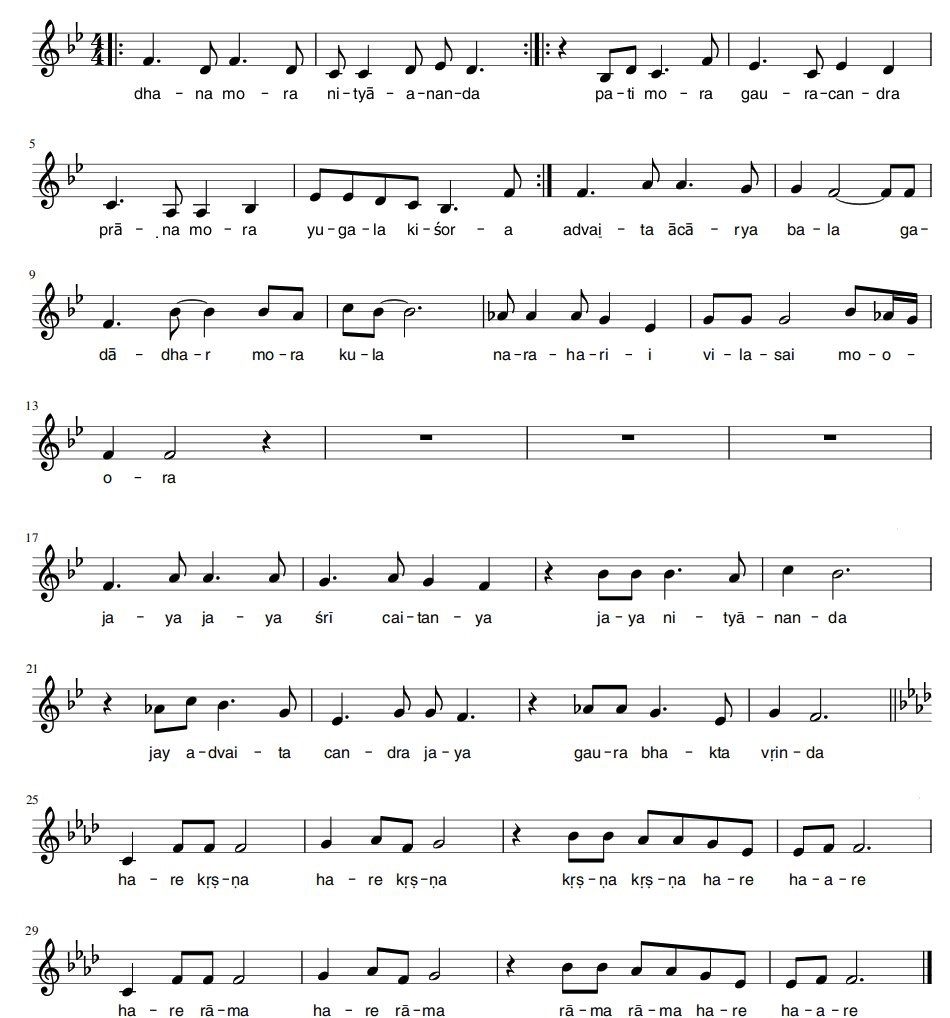
And he says further: rūpa-raguṇatha-pade haibe ākuti. When I shall be very much eager to study the books left by the Six Gosvāmīs? Ākuti means eagerness. Because Rūpa Gosvāmī is the father of this devotional service. He has written that book, Bhakti-rasāmṛta-sindhu. […] Narottama dāsa Ṭhākura says: viṣaya śuddha kabe śuddha ha'be mana. When my mind will be completely purified, being freed from material anxieties and desires, then I shall be able to understand what Vṛndāvana is, what conjugal love of Rādhā and Kṛṣṇa is, and then my spiritual life will be successful.
E duṣṭa hṛdaye kāma
1 e duṣṭa hṛdaye kāma, ādi ripu chaya kuṭināṭī pratiṣṭhāśā, śāṭhya sadā rahi’ hṛdaya-śodhana āra, kṛṣṇera vāsanā nṛsiṁha-caraṇe mora, ei ta' kāmanā e—this; dusta—wicked, sinful; hrdaye—within my heart; kama-adi—material desires headed by lust; ripu—enemies (kama (lust), krodha (anger), lobha (greed), moha (illusion), mada (madness) and matsarya (envy); chaya—six; kuṭināṭī— duplicity; pratiṣṭhāśā—the desire for name and fame and high position; śāṭhya— cunning behavior; sadā—always; rahi’—staying; śodhana—purification; āra—and; kṛṣṇera—of Lord Kṛṣṇa; vāsanā—desirious; nṛsiṁha-caraṇe—at the lotus feet of Nṛsiṁhadeva; mora—my; ei—these; ta’—certainly; kāmanā—desires.
Within my wicked, sinful heart the six enemies headed by lust perpetually reside, as well as duplicity, the desire for fame, plus sheer cunning. At the lotus feet of Lord Nṛsiṁha, I hope that He will mercifully purify my heart and give me the desire to serve Lord Krsna.
2 e kāndiyā nṛsiṁha-pade, māgiba kakhana
nirāpade navadvīpe, yugala-bhajana bhaya bhaya pāya yā’ ra, daraśane se hari prasanna haiba kabe, more dayā kari kāndiyā—crying; nṛsiṁha-pade—the lotus feet of Lord Nrsimhadeva; māgiba—I shall ask for; kakhana—any time; nirāpade—benediction; navadvīpe—in Navadvīpa; yugala-bhajana—the worship of the Divine Couple; bhaya—fear; bhaya—fear; pāya—obtains; yā’ ra—of whom; daraśane—by seeing; se—that;
hari—Hari; prasanna—being pleased; haiba—will become; kabe—when; more— me; dayā—His mercy; kari—doing.
Weeping, I will beg at the lotus feet of Lord Nṛsiṁha for the benediction of worshipping Rādhā and Kṛṣṇa in Navadvipa, perfectly safe and free from all difficulties. When will this Lord Hari, whose terrible form strikes fear into fear itself, ever become pleased and show me His mercy?
3 yadyapi bhīṣaṇa mūrti duṣṭa-jīva-prati prahlādādi kṛṣṇa-bhakta-jane bhadra ati kabe vā prasanna ha’ ye sva kṛpā-vacane nirbhaya karibe ei mūḍha akiñcane yadyapi—although; bhīṣaṇa—terrifying; mūrti—form; duṣṭa-jīva-prati—toward the sinful souls; prahlāda-adi—and devotees like Prahlāda Mahārāja; kṛṣṇa-bhakta- jana—of pure devotees of Lord Krsna; bhadra—auspiciousness; ati—great; kabe—when; vā—or; prasanna—pleased; ha’ ye—will become; sa—that; kṛpā- vacane—words of compassion; nirbhaya—fearless; karibe—will do; ei—this; mūḍha—foolish rascal; akiñcane—worthless.
Even though Lord Nṛsiṁha is terrifying toward the sinful souls, He offers great auspiciousness unto the devotees of Lord Kṛṣṇa headed by Prahlāda Mahārāja. When will He be pleased to speak words of compassion unto me, a worthless fool, and thereby make me fearless?
4 svacchande baisa he vatsa, śrī gaurāṅga-dhāme
yugala-bhajana hau, rati hau nāme mama bhakta-kṛpā-bale, vighna jābe dūra śuddha citte bhajo, rādhā-kṛṣṇa-rasa-pūra svacchande—without disturbance or anxiety; baisa—reside; he vatsa—o dear child; śrī gaurāṅga-dhāme—in Śrī Gaurāṅga-dhāma; yugala-bhajana—the worship of the Divine Couple; hau—may it be; rati—loving attachment; hau—may it be; nāme—for Their holy names; mama—My; bhakta-kṛpā—the mercy of the devotees; bale—by the strength; vighna—obstacles; jābe—will be vanquished; dūra—far away; śuddha—purified; citte—in the heart; bhaja—worship; rādhā- kṛṣṇa-rasa—the transcendental mellows enjoyed in relation with Radha and Krsna; pūra—complete.
He will say, “Dear child! Reside here without anxiety in Śrī Gaurāṅga-dhāma. May you worship the divine couple nicely, and may you develop loving attachment for Their holy names. By the mercy of My devotees, all obstacles are vanquished. With a purified heart, just perform the worship of Rādhā and Kṛṣṇa, for such worship overflows with sweet nectar.”
5 ei bali' kabe mora, mastaka-upara svīya śrī-caraṇe harṣe, dharibe īśvara amani yugala-preme, sāttvika-vikāre dharāya luṭibo āmi, śrī-nṛsimha-dvāre ei bali'—saying this; kabe—when; mora—my; mastaka—head; upara—upon; svīya—His own; śrī-caraṇe—divine lotus feet; harṣe—in great pleasure; dharibe— will put; īśvara—Lord; amani—spontaneously; yugala—the divine couple; preme— love; sāttvika-vikāre—transcendental transformations; dharāya—on the ground; luṭibo–I will roll about; āmi—I; śrī-nṛsimha-dvāre—at the door of Śrī Nṛsiṁha temple.
Saying this, when will that Lord in great delight place His own divine lotus feet on my head? Then I will experience sublime love for the divine couple Rādhā-Kṛṣṇa and undergo the ecstatic transformations called sāttvika. Falling on the ground, I will roll about at the door of Śrī Nṛsiṁha’s temple.
Oṁ namo bhagavate narasiṁhāya
Prahlāda Mahārāja
oṁ namo bhagavate narasiṁhāya
namas tejas-tejase āvir-āvirbhava vajra-nakha vajra-daṁṣṭra karmāśayān randhaya randhaya tamo grasa grasa oṁ svāhā abhayam abhayam ātmani bhūyiṣṭhā oṁ kṣraum om—O Lord; namaḥ—my respectful obeisances; bhagavate—unto the Supreme Personality of Godhead; nara-siṁhāya—known as Lord Nṛsiṁha; namaḥ— obeisances; tejaḥ-tejase—the power of all power; āviḥ-āvirbhava—please be fully manifest; vajra-nakha—O You who possess nails like thunderbolts; vajra- daṁṣṭra—O You who possess teeth like thunderbolts; karma-āśayān—demoniac desires to be happy by material activities; randhaya randhaya—kindly vanquish; tamaḥ—ignorance in the material world; grasa—kindly drive away; grasa—kindly drive away; om—O my Lord; svāhā—respectful oblations; abhayam— fearlessness; abhayam—fearlessness; ātmani—in my mind; bhūyiṣṭhāḥ—may You appear; om—O Lord; kṣraum—the bīja, or seed, of mantras offering prayers to Lord Nṛsiṁha.
I offer my respectful obeisances unto Lord Nṛsiṁhadeva, the source of all power. O my Lord who possess nails and teeth just like thunderbolts, kindly vanquish our demonlike desires for fruitive activity in this material world. Please appear in our hearts and drive away our ignorance so that by Your mercy we may become fearless in the struggle for existence in this material world.
Commentary
Bhaktivinoda Ṭhākura’s prayer E duṣṭa hṛdaye kāma can be found in his work Śrī Navadvīpa-bhāva-taraṅga (Waves of Ecstatic Moods in Navadvīpa, Verses 36-40). We should note the connection he describes between worshiping Lord Nṛsiṁhadeva and worshiping Rādhā-Kṛṣṇa. In Deity worship, because the moods are very different, it is recommended that Lord Nṛsiṁha have His own temple, or at least a separate altar. Nevertheless, in this poem Bhaktivinoda Ṭhākura is approaching Nṛsiṁhadeva and begs Him for the benediction to be able to worship Rādhā and Kṛṣṇa. Then he envisions the result of receiving the Lord’s mercy – ecstatic love for the divine couple– and in gratitude he rolls about at the entrance to Nṛsiṁhadeva’s temple. With this poem the ācārya teaches us to seek the protection of the power of all power in our battle with the six formidable enemies (lust, anger, greed, illusion, madness and envy) and their henchmen. Without receiving the protection of the Supreme, the tiny soul is easily defeated, but the Lord is very kind to His devotees and is ready to help them. No demoniac force can resist the sharp nails and teeth of Lord Nṛsiṁhadeva. Thus He is also known as Vighna-vināśa Nṛsiṁha, the half-man-half-lion form of the Lord who destroys all obstacles on the path of devotional service. The second part of our recording features Prahlāda Mahārāja’s prayer to Lord Nṛsiṁha in the Fifth Canto of Śrīmad-Bhāgavatam (5.18.8). In the purport, Śrīla Prabhupāda writes:
“Unless one is completely freed of all material desires, which are caused by the dense darkness of ignorance, one cannot fully engage in the devotional service of the Lord. Therefore we should always offer our prayers to Lord Nṛsiṁhadeva, who killed Hiraṇyakaśipu, the personification of material desire. Hiraṇya means ‘gold,’ and kaśipu means ‘a soft cushion or bed.’ Materialistic persons always desire to make the body comfortable, and for this they require huge amounts of gold. Thus Hiraṇyakaśipu was the perfect representative of materialistic life. He was therefore the cause of great disturbance to the topmost devotee, Prahlāda Mahārāja, until Lord Nṛsiṁhadeva killed him. Any devotee aspiring to be free of material desires should offer his respectful prayers to Nṛsiṁhadeva as Prahlāda Mahārāja did in this verse.”
Rādhā-kṛṣṇa prāṇa mora
1 rādhā-kṛṣṇa prāṇa mora yugala-kiśora
jīvane maraṇe gati āra nāhi mora
rādhā—Rādhā; kṛṣṇa—Kṛṣṇa; prāṇa mora—my life and soul; yugala-kiśora—the Divine Couple; jīvane maraṇe—in life or death; gati—refuge; āra nāhi—none else; mora—of me.
The youthful dvine couple Śrī Śrī Rādhā and Kṛṣṇa are my life and soul. In life or death I have no other refuge but Them.
2 kālindīra kūle keli-kadambera vana ratana-vedīra upara vasāba du’jana kālindīra kūle—on the bank of Yamunā; keli—conjugal pastimes; kadambera vana—in the forest of Kadamba; ratana-bedīra upara—on a golden throne; vasāba—make Them sit; du’jana—Rādhā and Kṛṣṇa.
In a forest of small kadamba trees on the bank of the Yamunā, I will seat the divine couple on a throne made of brilliant jewels.
3 śyāma-gaurī-aṅge diba (cuwā) candanera gandha
cāmara ḍhulāba kabe heriba mukha-candra
śyama-gaurī-aṅge—on the body of Rādhā and Kṛṣṇa; diba—will smear; cuwā— perfumed; candanera gandha—sandalwood paste; camara ḍhulāba—will swing the whisk; kabe—when; heriba—will gaze; mukha-candra—Their moonlike faces.

I will anoint Rādhā’s and Kṛṣṇa’s fair and dark forms with sandalwood paste scented with perfume, and I will fan Them with a camara whisk. Oh, when will I behold Their moonlike faces?
4 gāṅthiyā mālatīra mālā diba doṅhāra gale
adhare tuliyā diba karpūra-tāmbūle
gāṅthiyā mālatīra mālā—making a garland of mālatī flowers; diba—I will put; dohāra gale—on Their necks; adhare—on the lips; tuliyā diba—put on; karpūra— camphor; tāmbūle—betelnuts.
After stringing together garlands of mālatī flowers, I will place them around Their necks, and I will offer tāmbūla scented with camphor to Their lotus mouths.
5 lalitā viśākhā-ādi jata sakhī-vṛnda ājñāya kariba sevā caraṇāravinda lalitā—Lalitā; viśākhā-ādi—Viśākhā etc.; jata sakhī-vṛnda—all the sakhīs; ājñāya kariba sevā—by their instructions; caraṇāravinda—will serve Their lotus feet.
With the permission of the sakhīs, headed by Lalitā and Viśākhā, I will serve the lotus feet of Rādhā and Kṛṣṇa.
6 śrī-kṛṣṇa-caitanya-prabhura dāsera anudāsa
sevā abhilāṣa kare narottama-dāsa
śrī-kṛṣṇa-caitanya-prabhura—Śrī Kṛṣṇa Caitanya Mahāprabhu; dāsera anudāsa—the servant of His servant; sevā—service; abhilāṣa kare—desires; narottama-dāsa—Narottama dāsa.
Narottama dāsa, the servant of the servant of Śrī Kṛṣṇa Caitanya Mahāprabhu, longs for this service to the divine couple.
Commentary
This is song 48 in Narottama dāsa Ṭhākura’s songbook Prārthana. The original title is Sakhī-vṛnde vijñapti (Prayer to Rādhā-Kṛṣṇa’s female friends). We should note that the ācārya is taken a humble position, describing himself as dāsera anudāsa, the servant of the servant, and he states that he will serve the divine couple only with the permission of the sakhīs. Bhaktivinoda Ṭhākura expresses the same submissive attitude in one of the more confidential songs in his songbook Śaraṇāgati, where he says: “The sakhī will then say to me, ‘Listen, O beautiful one, you shall remain in this grove as my attendant. When the time comes for me to go and serve Rādhā and Mādhava, you will stay close to me while remaining hidden. After dressing packets of betel nuts and fetching the camphor, you will hand them to me, knowing me to be your very own.’ Bhaktivinoda, having heard all these instructions, bows down at the lotus feet of that confidential sakhī.”
In Śrīmad-Bhāgavatam (6.11.24), Vṛtrāsura prays to the Lord: O my Lord, O Supreme Personality of Godhead, will I again be able to be a servant of Your eternal servants who find shelter only at Your lotus feet? O Lord of my life, may I again become their servant so that my mind may always think of Your transcendental attributes, my words always glorify those attributes, and my body always engage in the loving service of Your Lordship?
Prabhupāda writes in the purport: This verse gives the sum and substance of devotional life. One must first become a servant of the servant of the servant of the Lord (dāsānudāsa). Śrī Caitanya Mahāprabhu advised, and He also showed by His own example, that a living entity should always desire to be a servant of the servant of the servant of Kṛṣṇa, the maintainer of the gopīs (gopī-bhartuḥ pada-kamalayor dāsa-dāsānudāsaḥ). This means that one must accept a spiritual master who comes in the disciplic succession and is a servant of the servant of the Lord. Under his direction, one must then engage one's three properties, namely his body, mind and words. The body should be engaged in physical activity under the order of the master, the mind should think of Kṛṣṇa incessantly, and one's words should be engaged in preaching the glories of the Lord. If one is thus engaged in the loving service of the Lord, one's life is successful.
Je ānila prema-dhana
1 je ānila prema-dhana karuṇā pracura hena prabhu kothā gelā ācārya-ṭhākura je anilo–he who brought; prema-dhana–the treasure of divine love; karuṇā pracura–who was filled with compassion and mercy; hena prabhu–such a personality; kothā gelā–where has he gone?; ācārya-ṭhākura–Advaita Ācārya or Śrīnivāsa Ācārya, or any other ācārya.
He who brought the treasure of divine love and who was filled with compassion and mercy—where has that great personality, that Ācārya Ṭhākura, gone?
2 kāhā mora svarūpa rūpa kāhā sanātana
kāhā dāsa raghunātha patita-pāvana
kāhā–where is; mora–my; svarūpa rūpa–Svarūpa Dāmodara and Rūpa Gosvāmī; kāhā–where is; sanātan–Sanātana Gosvāmī; kāhā–where is; dāsa raghunātha patita-pāvan–Raghunātha dāsa Gosvāmī, the savior of the fallen.
Where are my Svarūpa Dāmodara and Rūpa Gosvāmī? Where is Sanātana? Where is Raghunātha dāsa, the savior of the fallen?
3 kāhā mora bhaṭṭa-yuga kāhā kavirāja
eka-kāle kathā gelā gaurā naṭa-rāja
kāhā–where is; mora–my; bhaṭṭa yuga–the two Bhaṭṭas (Raghunātha Bhaṭṭa and Gopāla Bhaṭṭa Gosvāmī); kāhā–where is; kavirāj–Kṛṣṇadāsa Kavirāja; eka-kāle– all at once; kathā gelā–where have they gone?; gaurā naṭa-rāja–Lord Gaurāṅga, the great dancer.
Where are my Raghunātha Bhaṭṭa and Gopāla Bhaṭṭa, and where is Kṛṣṇadāsa Kavirāja? Where did Lord Gaurāṅga, the great dancer, suddenly go?
4 pāṣāṇe kuṭiba māthā anale paśiba gaurāṅga guṇera nidhi kathā gele pāba pāṣāṇe–against the rock; kuṭiba māthā–I will pound my head; anale paśiba–I will enter the fire; gaurāṅga–Lord Gaurāṅga; guṇera nidhi–the reservoir of all wonderful qualities; kathā–where?; gele pāba–may I go in order to find.
I will smash my head against the rock and enter into the fire. Where will I find Lord Gaurāṅga, the reservoir of all wonderful qualities?
5 se-saba saṅgīra saṅge ye kaila vilāsa se-saṅga nā pāiyā kānde narottama dāsa se-saba–all these; saṅgīra saṅge–the association of all these devotees of the Lord; ye–with whom; koilo vilās–Lord Gaurāṅga performed His pastimes; se-saṅga–their association; nā pāiyā–being unable to obtain; kānde narottama dās–Narottama dāsa simply weeps.
Being unable to obtain the association of Lord Gaurāṅga accompanied by all of these devotees in whose association He performed His pastimes, Narottama dāsa simply weeps.
Commentary
The term ācārya-ṭhākura can be interpreted in different ways. Some devotees understand it to refer to Śrīnivāsa Ācārya; others suggest that, because Narottama dāsa Ṭhākura and Śrīnivāsa Ācārya were contemporaries, ācārya ṭhākura may refer to Advaita Ācārya because it was Advaita who brought the treasure of divine love in the form of Śrī Caitanya Mahāprabhu to this world. On the other hand, Śrīnivāsa Ācārya left his body one year before Narottama dāsa Ṭhākura, and therefore it is quite possible that the latter composed this song after Śrīnivāsa’s disappearance. Whatever the case, if we take ācārya ṭhākura as a generic term that refers to any great Vaiṣṇava, everybody should be satisfied.
It is custom to sing this song on the disappearance day of great devotees. During a lecture commemorating the disappearance of Śrīla Bhaktisiddhānta Sarasvatī Ṭhākura, Śrīla Prabhupāda said: “So spiritually, appearance and disappearance, there is no difference. Just like in material point of view, if a person takes birth... Suppose you get a son born, you become very happy. The same son, when he passes away, you become very unhappy. This is material. And spiritually, there is no such difference, appearance or disappearance. So although this is the disappearance day of Oṁ Viṣṇupāda Śrī Śrīmad Bhaktisiddhānta Sarasvatī Ṭhākura, so there is nothing to be lamented. Although we feel separation, that feeling is there, but spiritually, there is no difference between appearance and disappearance. There is a song, Narottama dāsa Ṭhākura's song, ye anila prema-dhana. Do you know, anyone of you? Can you sing that song? Ye anila prema-dhana, karuṇā pracura, hena prabhu kothā gela. I don't remember exactly the whole song. That is our lamentation, that Śrīla Bhaktisiddhānta Sarasvatī Ṭhākura brought this message to distribute all over...”