 Spiritual
Prayers for glorification
Songs of praise
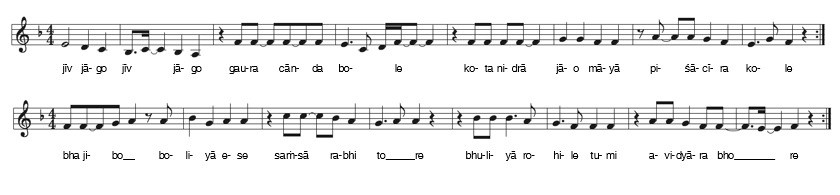
Gurvaṣṭaka 460
Śrī śrī ṣaḍ-gosvāmy-aṣṭaka 466
Advaitāṣṭaka 473
Nityānandāṣṭaka 479
Caitanyāṣṭaka 483
Śacī-sutāṣṭaka 488
Śacī-tanayāṣṭaka 491
Vṛndāvanāṣṭaka 494
Govardhanāṣṭaka 499
Rādhikāṣṭaka 503
Madhurāṣṭaka 508
Corāṣṭaka 512
Dāmodarāṣṭaka 516
Jagannāthāṣṭaka 520
Śikṣāṣṭaka 525
Gurvaṣṭaka Viśvanātha Cakravartī Ṭhākura
1 saṁsāra-dāvānala-līḍha-loka- trāṇāya kāruṇya-ghanāghanatvam prāptasya kalyāṇa-guṇārṇavasya vande guroḥ śrī-caraṇāravindam saṁsāra—(of) material existence; dāvā-anala—(by) the forest fire; līḍha—afflicted; loka—the people; trāṇāya—to deliver; kāruṇya—of mercy; ghanāghana-tvam—the quality of a cloud; prāptasya—who has obtained; kalyāṇa—auspicious; guṇa—(of) qualities; arṇavasya—who is an ocean; vande—I offer obeisances; guroḥ—of my spiritual master; śrī—auspicious; caraṇa-aravindam—unto the lotus feet.
The spiritual master is receiving benediction from the ocean of mercy. Just as a cloud pours water on a forest fire to extinguish it, so the spiritual master delivers the materially afflicted world by extinguishing the blazing fire of material existence. I offer my respectful obeisances unto the lotus feet of such a spiritual master, who is an ocean of auspicious qualities.
2 mahāprabhoḥ kīrtana-nṛtya-gīta-
vāditra-mādyan-manaso rasena romāñca -kampāśru-taraṅga-bhājo vande guroḥ śrī-caraṇāravindam mahāprabhoḥ—of Lord Caitanya Mahāprabhu; kīrtana—(by) chanting; nṛtya— dancing; gīta—singing; vāditra—playing musical instruments; mādyat— gladdened; manasaḥ—whose mind; rasena—due to the mellows of pure devotion; roma-añca—standing of the hair; kampa—quivering of the body, aśru-taraṅga— torrents of tears; bhājaḥ—who feels; vande—I offer obeisances; guroḥ—of my spiritual master; śrī—auspicious; caraṇa-aravindam—unto the lotus feet.
Chanting the holy name, dancing in ecstasy, singing, and playing musical instruments, the spiritual master is always gladdened by the saṅkīrtana movement of Lord Caitanya Mahāprabhu. Because he is relishing the mellows of pure devotion within his mind, sometimes his hair stands on end, he feels quivering in his body, and tears flow from his eyes like waves. I offer my respectful obeisances unto the lotus feet of such a spiritual master.
3 śrī-vigrahārādhana-nitya-nānā- śṛṅgāra-tan-mandira-mārjanādau yuktasya bhaktāṁś ca niyuñjato 'pi vande guroḥ śrī-caraṇāravindam śrī-vigraha—(of) the arcā-vigraha (Deities), ārādhana—the worship; nitya—daily; nānā-(with) various; śṛṅgāra—clothing and ornaments; tat—of the Lord; mandira— (of) the temple; mārjana-ādau—in the cleaning, etc.; yuktasya—who is engaged; bhaktān—his disciples; ca—and; niyuñjataḥ—who engages; api—also; vande—I offer obeisances; guroḥ—of my spiritual master; śrī—auspicious; caraṇa- aravindam—unto the lotus feet.
The spiritual master is always engaged in the temple worship of Śrī Śrī Rādhā and Kṛṣṇa. He also engages his disciples in such worship. They dress the Deities in beautiful clothes and ornaments, clean Their temple, and perform other similar worship of the Lord. I offer my respectful obeisances unto the lotus feet of such a spiritual master.
4 catur-vidha-śrī-bhagavat-prasāda- svādv-anna-tṛptān hari-bhakta-saṅghān kṛtvaiva tṛptiṁ bhajataḥ sadaiva vande guroḥ śrī-caraṇāravindam catuḥ—four; vidha—kinds; śrī—holy, bhagavat-prasāda—which have been offered to Kṛṣṇa; svādu—palatable; anna—(by) foods; tṛptān—spiritually satisfied; hari— (of) Kṛṣṇa; bhakta-saṅghān—the devotees; kṛtvā—having made; eva—thus; tṛptim—satisfaction; bhajataḥ—who feels; sada—always; eva—certainly; vande— I offer obeisances; guroḥ—of my spiritual master; śrī—auspicious; caraṇa- aravindam—unto the lotus feet.
The spiritual master is always offering Kṛṣṇa four kinds of delicious food [analyzed as that which is licked, chewed, drunk, and sucked]. When the spiritual master sees that the devotees are satisfied by eating bhagavat- prasāda, he is satisfied. I offer my respectful obeisances unto the lotus feet of such a spiritual master.
5 śrī-rādhikā-mādhavayor apāra- mādhurya-līlā guṇa-rūpa-nāmnām prati-kṣaṇāsvādana-lolupasya vande guroḥ śrī-caraṇāravindam śrī-rādhikā—(of) Śrīmatī Rādhārāṇī; mādhavayoḥ—of Lord Mādhava (Kṛṣṇa); apāra—unlimited; mādhurya—conjugal; līlā—pastimes; guṇa—qualities; rūpa— forms; nāmnām—of the holy names; prati-kṣaṇa—at every moment; āsvādana— relishing; lolupasya—who aspires after; vande—I offer obeisances; guroḥ—of my spiritual master; śrī—auspicious; caraṇa-aravindam—unto the lotus feet.
The spiritual master is always eager to hear and chant about the unlimited conjugal pastimes of Rādhikā and Mādhava, and Their qualities, names, and forms. The spiritual master aspires to relish these at every moment. I offer my respectful obeisances unto the lotus feet of such a spiritual master.
6 nikuñja-yūno rati-keli-siddhyai
yā yālibhir yuktir apekṣaṇīyā tatrāti-dākṣyād ati-vallabhasya vande guroḥ śrī-caraṇāravindam nikuñja-yūnaḥ—of Rādhā and Kṛṣṇa; rati—(of) conjugal love; keli—(of) pastimes; siddhyai—for the perfection; yā yā—whatever; ālibhiḥ—by the gopīs; yuktiḥ— arrangements; apekṣaṇīyā—desirable; tatra—in that connection; ati-dākṣyāt— because of being very expert; ati-vallabhasya—who is very dear; vande—I offer obeisances; guroḥ—of my spiritual master; śrī—auspicious; caraṇa-aravindam— unto the lotus feet.
The spiritual master is very dear, because he is expert in assisting the gopīs, who at different times make different tasteful arrangements for the perfection of Rādhā and Kṛṣṇa's conjugal loving affairs within the groves of Vṛndāvana. I offer my most humble obeisances unto the lotus feet of such a spiritual master.
7 sākṣād-dharitvena samasta-śāstrair
uktas tathā bhāvyata eva sadbhiḥ
kintu prabhor yaḥ priya eva tasya
vande guroḥ śrī-caraṇāravindam
sākṣāt—directly; hari-tvena—with the quality of Hari; samasta—all; śāstraiḥ—by scriptures; uktaḥ—acknowledged; tathā—thus; bhāvyate—is considered; eva— also; sadbhiḥ—by great saintly persons; kintu—however; prabhoḥ—to the Lord; yaḥ—who; priyaḥ—dear; eva—certainly; tasya—of him (the guru); vande—I offer obeisances; guroḥ—of my spiritual master; śrī—auspicious; caraṇa-aravindam— unto the lotus feet.
The spiritual master is to be honored as much as the Supreme Lord, because he is the most confidential servitor of the Lord. This is acknowledged in all revealed scriptures and followed by all authorities. Therefore I offer my respectful obeisances unto the lotus feet of such a spiritual master, who is a bona fide representative of Śrī Hari [Kṛṣṇa].
8 yasya prasādād bhagavat-prasādo
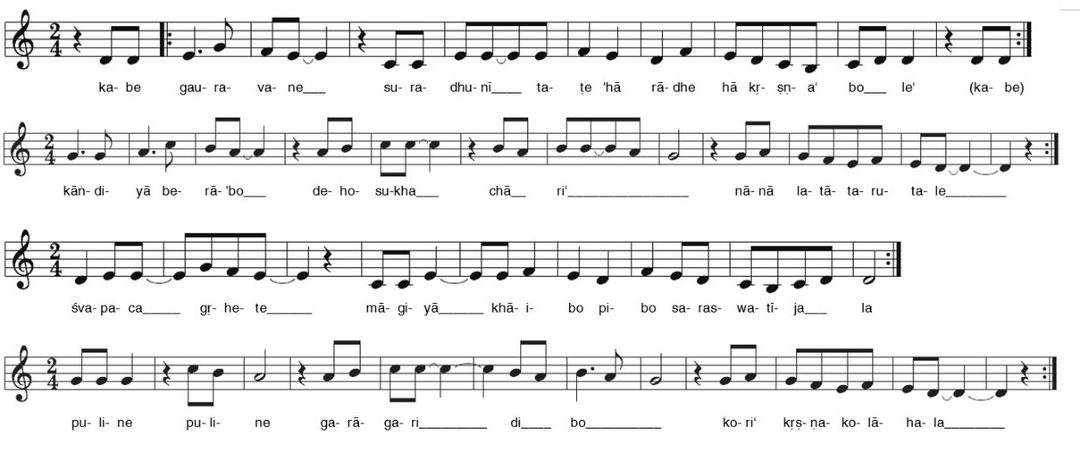
yasyāprasādān na gatiḥ kuto 'pi dhyāyan stuvaṁs tasya yaśas tri-sandhyaṁ vande guroḥ śrī-caraṇāravindam yasya—of whom (the spiritual master); prasādāt—by the grace; bhagavat—(of) Kṛṣṇa; prasādaḥ—the mercy; yasya—of whom; aprasādāt—without the grace; na—not; gatiḥ—means of advancement; kutaḥ api—anywhere; dhyāyan— meditating upon; stuvan—praising; tasya—of him (the spiritual master); yaśaḥ— the glory; tri-sandhyam—three times a day (sunrise, noon, and sunset); vande—I offer obeisances; guroḥ—of my spiritual master; śrī—auspicious; caraṇa- aravindam—unto the lotus feet.
By the mercy of the spiritual master one receives the benediction of Kṛṣṇa. Without the grace of the spiritual master, one cannot make any advancement. Therefore, I should always remember and praise the spiritual master. At least three times a day I should offer my respectful obeisances unto the lotus feet of my spiritual master.
Commentary
This song in praise of the spiritual master by Viśvanātha Cakravartī Ṭhākura is sung during Maṅgala-ārati, the first ceremony of the day for worshipping the Lord and His representative, the spiritual master. Prabhupāda quoted from it hundreds of times. Here are some examples, one for each verse (1-7), from a public program in Sweden. Lecture at Uppsala University – Stockholm, September, 9, 1973 1 So guru means spiritual master means who can deliver one from this forest fire. Just like when there is forest fire, the animals are very much disturbed, and they die mostly. The snakes, they die immediately. So this forest fire, saṁsāra-dāvānala, is going on perpetually, and the person or the authorized person who can deliver you from this forest fire of material existence, he's called guru, or the spiritual master. Fire means it requires water to be extinguished. But where the water is coming from? From your bucket or from your fire brigade? No. It must come from the sky. It must come from the sky. When there will be torrents of rain from the sky, this forest fire, blazing forest fire will be extinguished. So these rains from the sky, it does not depend on your scientific propaganda or manipulation. It depends on the mercy of the Supreme Lord. So the spiritual master is compared with the cloud. Just like from the cloud there is torrents of rain, similarly, a spiritual master is considered just like cloud. Saṁsāra-dāvānala-līḍha-loka . Just like cloud takes the water from the sea-cloud hasn't got its own water; cloud takes water from the sea— similarly, a spiritual master brings mercy from the Supreme Personality of
Godhead. Just see the comparison. He has no own mercy, but he carries the mercy of the Supreme Personality of Godhead. So spiritual master is offered obeisances: "Sir, you have brought the mercy from the Supreme Lord. Therefore we are much obliged to you. To deliver us, you have come. We offer our respectful obeisances." This is the meaning of this verse. Vande guroḥ śrī-caraṇāravindam. That means the first qualification of the spiritual master, or guru, is to deliver you some message by which immediately your blazing fire in the heart will be stopped. This is the test. 2 First symptom is that guru will give you such instruction that immediately you will feel relief from all anxieties. And the second symptom is that he's personally engaged also always in chanting and dancing the holy name of the Lord, mahāprabhoḥ kīrtana-nṛtya-gīta-vaditra-mādyan manaso rasena, and enjoy the transcendental bliss within the mind by chanting and dancing. Unless you become blissful, very happy, you cannot dance. Artificially, you cannot dance. These dances, they are not artificial. They feel some transcendental bliss; therefore they dance. It is not they are dancing dog. No. They dance from the spiritual platform. 3 It is not that one should worship Kṛṣṇa once a week or once a month. Rather, one should worship Kṛṣṇa twenty-four hours a day (nitya). The Deity should have a new dress every day or twice or four times a day—as many times as possible. This is called śṛṅgāra. Kṛṣṇa is the most opulent enjoyer, and we should supply Him things by which He can enjoy. For instance, if someone gives me new clothing, I say, "Oh, this new clothing is very nice," and this is my enjoyment. Similarly, we should try to satisfy Kṛṣṇa every day with gorgeous clothing. The dress for the Deity should be first class, the food offered to Him must be first class, and the place where He is situated in the temple must be first class or even more than first class. Furthermore, the temple should always be as clean as glass. Everyone remarks that the temples of the Kṛṣṇa consciousness movement are very clean, and they must be very clean. The more one cleanses the temple, the more one's heart becomes cleansed. This is the process of devotional service. The more we dress Kṛṣṇa, the more satisfied we become. At the present moment we are accustomed to seeing and appreciating our own clothing. I think, "What costly clothing I have," and in this way I become satisfied. But when we dress Kṛṣṇa we shall feel spiritual satisfaction. Yuktasya bhaktāṁś ca niyuñjato 'pi vande guroḥ śrī-caraṇāravindam. It is the duty of the spiritual master to engage his disciples always in worshiping the Deity in this way, and it is to such a guru, or spiritual master, that we offer our obeisances. 4 The fourth symptom is that a guru, the spiritual master, encourages prasāda distribution, remnants of foodstuff distributed to the public. Ours is not dry philosophy, simply we talk and go home. No. We distribute prasādam, very sumptuous prasādam. In every temple, anyone who comes, we can offer prasādam. In each and every temple, we have got already from fifty to two hundred devotees. And outsiders also, they come and take prasādam. This introduction is also another symptom of guru, prasādam distribution. […] If you eat bhagavat- prasādam, then gradually you become spiritualized. It has got the potency. If you eat the prasādam. Therefore it is said that realization of God can be done by the tongue. Sevonmukhe hi jihvādau. If you engage your tongue in the service of the Lord, then you realize God realization. 5 The spiritual master is always thinking of the pastimes of Kṛṣṇa with His consort, Śrīmatī Rādhārāṇī, and the gopīs. Sometimes he is thinking about Kṛṣṇa's pastimes with the cowherd boys. This means that he is always thinking of Kṛṣṇa engaged in some kind of pastime. Pratikṣaṇāsvādana-lolupasya. Pratikṣaṇa means he is thinking that way twenty-four hours a day. That is Kṛṣṇa consciousness. One must be engaged twenty-four hours a day in thinking of Kṛṣṇa. You have to make yourself a program like this. We, at least, have made such a program. All the boys and girls in the Kṛṣṇa consciousness movement are engaged twenty-four hours daily, not just officially, not that once a week they meditate or go to some temple. No, they engage twenty-four hours a day. 6 Nikuñja-yūno rati-keli-siddhyai yā yālibhir yuktir apekṣaṇīyā. So the ultimate goal of the spiritual master is that he wants to be transferred to the planet of Kṛṣṇa, where he wants to associate with the gopīs to help them to serve Kṛṣṇa. Some, some of them are, some of the devotees, spiritual master, they are thinking of becoming assistants to the gopīs, some of them are thinking to be assistants to the cowherds boy, some of them are thinking to be assistant to mother Yaśodā or Nanda, and some of them are thinking to the servants of God. Or some of them are thinking how to become a flower, tree, a fruit tree or a calf or a cow in Vṛndāvana. There are five kinds of mellows: śānta, dāsya, sākhya, vātsalya and mādhurya. Everything is there spiritual. That I shall describe next. Cintāmaṇi-prakara-sadmasu. So in the spiritual sky, the land is spiritual, the tree is spiritual, the fruit is spiritual, the flower is spiritual, the water is spiritual, the servant is spiritual, the friend is spiritual, the Lord is spiritual and His associates are spiritual. Everything. Therefore oneness, Absolute Truth, everything absolute. Although there are varieties, these varieties, the spiritual varieties, are simply reflection in this material world. Just like there is a tree on the bank of the river. That is reflected in the water. But reflected how? The top has gone down. The topmost thing has gone down. So this material world is the reflection of the spiritual world—but perverted reflection. 7 Guru means Kṛṣṇa; Kṛṣṇa means guru. Not Māyāvāda, but guru means one who follows Kṛṣṇa, he is guru. Sākṣād-dharitvena samasta-śāstrair uktas tathā bhāvyata eva sadbhiḥ. So guru is directly God, sākṣād-hari. Sākṣād means directly. […] So why? Kintu prabhor yaḥ priya eva... It does not mean Māyāvādī, that he has become God. But kintu prabhor yaḥ priya eva tasya, he is the most confidential servant. He's therefore servant-God. He's God, servant-God. God is master-God. So why he has become priya? That is, Kṛṣṇa says personally, na ca tasmān manuṣyeṣu kaścin me priya-kṛttamaḥ: nobody is dearer than him in the whole world. Why? Ya idaṁ paramaṁ guhyaṁ mad-bhakteṣv abhidā.... "Who preaches this gospel of Bhagavad-gītā among My devotees." So the guru has got two business. He has to make devotees and teach them the principles of Bhagavad-gītā. Therefore he's so dear. 8 […] we should learn this principle enunciated by Viśvanātha Cakravartī Ṭhākura: yasya prasādād bhagavat-prasādo/ yasyāprasādān na gatiḥ kuto 'pi."By the mercy of the spiritual master one is benedicted by the mercy of Kṛṣṇa. Without the grace of the spiritual master, one cannot make any advancement." A disciple should never be a hypocrite or be unfaithful to his spiritual master. In Śrīmad-Bhāgavatam (11.17.27), the spiritual master is also called ācārya. Ācāryaṁ māṁ vijānīyān: the Supreme Personality of Godhead says that one should respect the spiritual master, accepting him as the Lord Himself. Nāvamanyeta karhicit: one should not disrespect the ācārya at any time. Na martya-buddhyāsūyeta: one should never think the ācārya an ordinary person. Familiarity sometimes breeds contempt, but one should be very careful in one's dealings with the ācārya. (SB 6.7.15 Purport)
Ṣaḍ-gosvāmy-aṣṭaka
Śrīnivāsa Ācārya
1 kṛṣṇotkīrtana-gāna-nartana-parau premāmṛtāmbho-nidhī dhīrādhīra-jana-priyau priya-karau nirmatsarau pūjitau śrī-caitanya-kṛpā-bharau bhuvi bhuvo bhārāvahantārakau vande rūpa-sanātanau raghu-yugau śrī-jīva-gopālakau kṛṣṇa—of Kṛṣṇa; utkīrtana—loud chanting; gāna—singing; nartana—dancing; parau—they who are absorbed; prema-amṛta—the nectar of love of God; ambhaḥ- nidhī—like oceans; dhīra-adhīra-jana—to the gentle and the ruffians; priyau—they who are dear; priya-karau—they who are all-pleasing; nirmatsarau—they who are non-envious; pūjitau—they who are all-worshipable; śrī-caitanya—of Śrī Caitanya; kṛpā-bharau—they who are bearing the mercy; bhuvi—in the world; bhuvaḥ—of the world; bhāra—the burden; avahantārakau—they who dispel; vande—I offer my respectful obeisances; rūpa—to Śrī Rūpa Gosvāmī; sanātanau—and to Śrī Sanātana Gosvāmī; raghu-yugau—to the two Raghus : Śrī Raghunātha Bhaṭṭa Gosvāmī and Śrī Raghunātha dāsa Gosvāmī; śrī-jīva—to Śrī Jīva Gosvāmī; gopālakau—and to Śrī Gopāla Bhaṭṭa Gosvāmī.
I offer my respectful obeisances unto the Six Gosvāmīs, namely Śrī Rūpa Gosvāmī, Śrī Sanātana Gosvāmī, Śrī Raghunātha Bhaṭṭa Gosvāmī, Śrī Raghunātha dāsa Gosvāmī, Śrī Jīva Gosvāmī, and Śrī Gopāla Bhaṭṭa Gosvāmī, who are always engaged in chanting the holy name of Kṛṣṇa and dancing. They are just like the ocean of love of God, and they are popular both with the gentle and with the ruffians, because they are not envious of anyone. Whatever they do, they are all-pleasing to everyone, and they are fully blessed by Lord Caitanya. Thus they are engaged in missionary activities meant to deliver all the conditioned souls in the material universe.
2 nānā-śāstra-vicāraṇaika-nipuṇau sad-dharma-saṁsthāpakau lokānāṁ hita-kāriṇau tri-bhuvane mānyau śaraṇyākarau rādhā-kṛṣṇa-padāravinda-bhajanānandena mattālikau vande rūpa-sanātanau raghu-yugau śrī-jīva-gopālakau nānā-śāstra—various scriptures; vicāraṇa—in scrutinizingly studying; eka- nipuṇau—they who are uniquely expert; sat-dharma—eternal religious principles; saṁsthāpakau—they who are the establishers; lokānām—of all human beings; hita-kārinau—they who are the performers of beneficial activities; tri-bhuvane— throughout the three worlds; manyau—they who are worthy of honor; śaraṇyākarau—they who are worth taking shelter of; rādhā-kṛṣṇa—of Rādhā and Kṛṣṇa; pada-aravinda—at the lotus feet; bhajana-ānandena—in the bliss of worship; matta-ālikau—they who are intoxicated with the mood of the gopīs.
I offer my respectful obeisances unto the six Gosvāmīs, namely Śrī Rūpa Gosvāmī, Śrī Sanātana Gosvāmī, Śrī Raghunātha Bhaṭṭa Gosvāmī, Śrī Raghunātha dāsa Gosvāmī, Śrī Jīva Gosvāmī, and Śrī Gopāla Bhaṭṭa Gosvāmī, who are very expert in scrutinizingly studying all the revealed scriptures with the aim of establishing eternal religious principles for the benefit of all human beings. Thus they are honored all over the three worlds and they are worth taking shelter of because they are absorbed in the mood of the gopīs and are engaged in the transcendental loving service of Rādhā and Kṛṣṇa.
3 śrī-gaurāṅga-guṇānuvarṇana-vidhau śraddhā-samṛddhy-anvitau pāpottāpa-nikṛntanau tanu-bhṛtāṁ govinda-gānāmṛtaiḥ ānandāmbudhi-vardhanaika-nipuṇau kaivalya-nistārakau vande rūpa-sanātanau raghu-yugau śrī-jīva-gopālakau śrī-gaurāṅga—of Lord Caitanya; guṇa—the qualities; anuvarṇana—in narrating; vidhau—in the process; śraddhā—of faith; samṛddhi—with an abundance; anvitau—they who are endowed; pāpa-uttāpa—the distress of sinful reactions; nikṛntanau—they who remove; tanu-bhṛtām—of those souls who are embodied; govinda—about Lord Govinda; gāna-amṛtaiḥ—by the nectarean songs; ānanda- ambudhi—the ocean of transcendental bliss; vardhana—increasing; eka- nipuṇau—they who are totally expert; kaivalya-nistārakau—they who are the saviors from impersonal liberation.
I offer my respectful obeisances unto the six Gosvāmīs, namely Śrī Rūpa Gosvāmī, Śrī Sanātana Gosvāmī, Śrī Raghunātha Bhaṭṭa Gosvāmī, Śrī Raghunātha dāsa Gosvāmī, Śrī Jīva Gosvāmī, and Śrī Gopāla Bhaṭṭa
Gosvāmī, who are very much enriched in understanding of Lord Caitanya and who are thus expert in narrating His transcendental qualities. They can purify all conditioned souls from the reactions of their sinful activities by pouring upon them transcendental songs about Govinda. As such, they are very expert in increasing the limits of the ocean of transcendental bliss, and they are the saviors of the living entities from the devouring mouth of liberation.
4 tyakvā tūrṇam aśeṣa-maṇḍala-pati-śreṇīṁ sadā tuccha-vat bhūtvā dīna-gaṇeśakau karuṇayā kaupīna-kanthāśritau gopī-bhāva-rasāmṛtābdhi-laharī-kallola-magnau muhur vande rūpa-sanātanau raghu-yugau śrī-jīva-gopālakau tyaktvā—having given up; tūrṇam—quickly (after being summoned by Lord Caitanya); aśeṣa—all; maṇḍala-pati-śreṇīm—the aristocracy of upper-class society; sadā—always; tuccha-vat—as insignificant; bhūtvā—having become; dīna-gaṇa—of the poor people; īśakau—they who are the protectors; karuṇayā— out of mercy; kaupīna—loincloths; kanthā—and tattered quilts; āśritau—they who have accepted; gopī-bhāva—the mood of the gopīs; rasa-amṛta-abdhi—the ocean of nectar-mellows; laharī-kallola—in the ripples and waves; magnau—they who are absorbed; muhuḥ—always and repeatedly.
I offer my respectful obeisances unto the six Gosvāmīs, namely Śrī Rūpa Gosvāmī, Śrī Sanātana Gosvāmī, Śrī Raghunātha Bhaṭṭa Gosvāmī, Śrī Raghunātha dāsa Gosvāmī, Śrī Jīva Gosvāmī, and Śrī Gopāla Bhaṭṭa Gosvāmī, who kicked off all association of aristocracy as insignificant. In order to deliver the poor conditioned souls, they accepted loincloths, treating themselves as mendicants, but they are always merged in the ecstatic ocean of the gopīs' love for Kṛṣṇa and bathe always and repeatedly in the waves of that ocean.
5 kūjat-kokila-haṁsa-sārasa-gaṇākīrṇe mayūrākule nānā-ratna-nibaddha-mūla-viṭapa-śrī-yukta-vṛndāvane rādhā-kṛṣṇam ahar-niśaṁ prabhajatau jīvārthadau yau mudā vande rūpa-sanātanau raghu-yugau śrī-jīva-gopālakau kūjat—cooing; kokila—of cuckoos; haṁsa—of swans; sārasa—and of cranes; gaṇa—flocks; ākīrṇe—crowded; mayūra—with peacocks; ākule—in the constantly agitated motion; nānā-ratna—with various jewels; nibaddha-mūla—bound around their bases; viṭapa—the trees; śrī-yukta—endowed with splendor; vṛndāvane—in the forest of Vṛndāvana; rādhā-kṛṣṇam—of Rādhā and Kṛṣṇa; ahaḥ-niśam—day and night; prabhajatau—they who are engaged in enthusiastic worship; jīva—upon the living entities; arthadau—they who bestow the ultimate goal of life; yau—they who; mudā—with great delight.
I offer my respectful obeisances unto the six Gosvāmīs, namely Śrī Rūpa Gosvāmī, Śrī Sanātana Gosvāmī, Śrī Raghunātha Bhaṭṭa Gosvāmī, Śrī Raghunātha dāsa Gosvāmī, Śrī Jīva Gosvāmī, and Śrī Gopāla Bhaṭṭa Gosvāmī, who were always engaged in worshiping Rādhā-Kṛṣṇa in the transcendental land of Vṛndāvana where there are beautiful trees full of fruits and flowers which have under their roots all valuable jewels. The Gosvāmīs are perfectly competent to bestow upon the living entities the greatest boon of the goal of life.
6 saṅkhyā-pūrvaka-nāma-gāna-natibhiḥ kālāvasānī-kṛtau nidrāhāra-vihārakādi-vijitau cātyanta-dīnau ca yau rādhā-kṛṣṇa-guṇa-smṛter madhurimānandena sammohitau vande rūpa-sanātanau raghu-yugau śrī-jīva-gopālakau saṅkhyā-pūrvaka—in a scheduled measurement; nāma-gāna—singing the holy name; naṭibhiḥ—and by bowing down; kāla-avasānī-kṛtau—they who passed their time in doing such; nidra-āhāra—sleeping and eating; vihāraka-ādi—recreation and so forth; vijitau—they who have conquered; ca—and; atyanta-dīnau—they who are extremely meek and humble; ca—and; yau—they who; rādhā-kṛṣṇa—of Rādhā and Kṛṣṇa; guṇa-smṛteḥ—in remembrance of the qualities; madhurimā—of the sweetness; ānandena—by the bliss; sammohitau—they who are fully enchanted.
I offer my respectful obeisances unto the six Gosvāmīs, namely Śrī Rūpa Gosvāmī, Śrī Sanātana Gosvāmī, Śrī Raghunātha Bhaṭṭa Gosvāmī, Śrī Raghunātha dāsa Gosvāmī, Śrī Jīva Gosvāmī, and Śrī Gopāla Bhaṭṭa Gosvāmī, who were engaged in chanting the holy names of the Lord and bowing down in a scheduled measurement. In this way they utilized their valuable lives and in executing these devotional activities they conquered over eating and sleeping and were always meek and humble enchanted by remembering the transcendental qualities of the Lord.
7 rādhā-kuṇḍa-taṭe kalinda-tanayā-tīre ca vaṁśīvaṭe premonmāda-vaśād aśeṣa-daśayā grastau pramattau sadā gāyantau ca kadā harer guṇa-varaṁ bhāvābhibhūtau mudā vande rūpa-sanātanau raghu-yugau śrī-jīva-gopālakau rādhā-kuṇḍa—of the lake Rādhā-kuṇḍa; taṭe—on the bank; kalinda-tanayā—of the daughter of Mt. Kalinda (the Yamunā river); tīre—on the bank; ca—also; vaṁśī- vaṭe—at the banyan tree called Vaṁśī-vaṭa; prema-unmāda—the madness of love of God; vaśāt—by the force; aśeṣa-daśayā—by limitless ecstatic symptoms; grastau—they who are seized; pramattau—they who are madmen; sadā—always; gāyantau—they who sing; ca—and; kadā—sometimes; hareḥ—of Lord Hari; guṇa- varam—the excellent qualities; bhāva—in ecstasy; abhibhūtau—they who are overwhelmed; mudā—with great delight.
I offer my respectful obeisances unto the six Gosvāmīs, namely Śrī Rūpa Gosvāmī, Śrī Sanātana Gosvāmī, Śrī Raghunātha Bhaṭṭa Gosvāmī, Śrī Raghunātha dāsa Gosvāmī, Śrī Jīva Gosvāmī, and Śrī Gopāla Bhaṭṭa Gosvāmī, who were sometimes on the bank of the Rādhā-kunda lake or the shores of the Yamuna and sometimes at Vaṁśīvaṭa. There they appeared just like madmen in the full ecstasy of love for Kṛṣṇa, exhibiting different transcendental symptoms in their bodies, and they were merged in the ecstasy of Kṛṣṇa consciousness.
8 he rādhe vraja-devike ca lalite he nanda-sūno kutaḥ śrī-govardhana-kalpa-pādapa-tale kālindī-vanye kutaḥ ghoṣantāv iti sarvato vraja-pure khedair mahā-vihvalau vande rūpa-sanātanau raghu-yugau śrī-jīva-gopālakau he rādhe—O Rādhā!; vraja-devike—O Queen of Vraja!; ca—and; lalite—O Lalitā Sakhī!; he nanda-sūno—O son of Nanda Mahārāja!; kutaḥ—where are you?; śrī- govardhana—on beautiful Govardhana Hill; kalpa-pādapa-tale—at the base of the desire-trees; kālindī-vanye—in the forest on the bank of the Yamunā river; kutaḥ— where are you?; ghoṣantau—they who are shouting; iti—thus; sarvataḥ— everywhere; vraja-pure—in the realm of Vraja; khedaiḥ—by distress; mahā- vihvalau—they who are greatly agitated.
I offer my respectful obeisances unto the six Gosvāmīs, namely Śrī Rūpa Gosvāmī, Śrī Sanātana Gosvāmī, Śrī Raghunātha Bhaṭṭa Gosvāmī, Śrī Raghunātha dāsa Gosvāmī, Śrī Jīva Gosvāmī, and Śrī Gopāla Bhaṭṭa Gosvāmī, who were chanting very loudly everywhere in Vṛndāvana, shouting, "Queen of Vṛndāvana, Rādhārāṇī! O Lalita! O son of Nanda Mahārāja! Where are you all now? Are you just on the hill of Govardhana, or are you under the trees on the bank of the Yamunā? Where are you?" These were their moods in executing Kṛṣṇa consciousness.
Commentary
Another song that Prabhupāda sang and recorded many times, and he quoted from it hundreds of times also. Again, one example for each verse. 1 Lecture on Bhagavad-gītā 2.22 – Hyderabad, November 26, 1972 Kṛṣṇa-kīrtana. Kṛṣṇotkīrtana-gāna-nartana-parau. All the six Gosvāmīs, they were always engaged in chanting, utkīrtanam. Utkīrtanam, not this professional kīrtana. Utkīrtanam. Udgata-tamaḥ. Transcendental kīrtana, transcendental vibration. Kṛṣṇotkīrtana-gāna-nartana-parau. So they were engaged in singing and dancing and chanting. Kṛṣṇotkīrtana-gāna-nartana-parau premāmṛtāmbho-nidhī. Merged into the ocean of love of Godhead, premāmṛtāmbho-nidhī. Dhīrādhīra-jana-priyau priya-karau nirmatsarau pūjitau. So by Kṛṣṇa-kīrtana, one can become dear, very dear, both for the dhīra and adhīra. Dhīra means sober. And adhīra means rascals. So kṛṣṇa-kīrtana is so nice that you can become favorite both for the gentle and the rascal. It is so nice. That is actually happening. So dhīrādhīra-jana-priyau priya- karau nirmatsarau. Because those who are chanting, kṛṣṇa-kīrtana, they are nirmatsarau. They are not envious. Kṛṣṇa consciousness movement is not limited therefore in India. It is for the whole world. We are not envious, we only see Indians will learn it. No. We have no such program. Tri-bhuvane mānyau. It should be honored all over the world. This is kṛṣṇa-kīrtana. 2 Śrī Caitanya-caritāmṛta, Madhya-līlā, 1.33 – Purport The six Gosvāmīs, under the direction of Śrīla Rūpa Gosvāmī and Śrīla Sanātana Gosvāmī, studied various Vedic literatures and picked up the essence of them, the devotional service of the Lord. This means that all the Gosvāmīs wrote many scriptures on devotional service with the support of the Vedic literature. Devotional service is not a sentimental activity. The essence of Vedic knowledge is devotional service, as confirmed in the Bhagavad-gītā (15.15): vedaiś ca sarvair aham eva vedyaḥ. All the Vedic literature aims at understanding Kṛṣṇa, and how to understand Kṛṣṇa through devotional service has been explained by Śrīla Rūpa and Sanātana Gosvāmīs, with evidence from all Vedic literatures. They have put it so nicely that even a rascal or first-class fool can be delivered by devotional service under the guidance of the Gosvāmīs. 3 Śrīmad-Bhāgavatam 5.14.20 – Purport Material life means being fully absorbed in eating, sleeping, mating and defending. Out of these, sleep is taken very seriously. While asleep, one completely forgets the object of life and what to do. For spiritual realization, one should try to avoid sleep as much as possible. The Gosvāmīs of Vṛndāvana practically did not sleep at all. Of course, they slept some, for the body requires sleep, but they slept only about two hours, and sometimes not even that. They always engaged in spiritual cultivation. Nidrāhāra-vihārakādi-vijitau. Following in the footsteps of the Gosvāmīs, we should try to reduce sleeping, eating, mating and defending. 4 Śrī Caitanya-caritāmṛta, Madhya-līlā 8.39 – Purport Rūpa Gosvāmī and Sanātana Gosvāmī were ministers, but they voluntarily accepted the mendicant’s life in order to humbly preach Śrī Caitanya Mahāprabhu’s message. It is said about them: tyaktvā tūrṇam aśeṣa-maṇḍala-pati-śreṇīṁ sadā tuccha-vat bhūtvā dīna-gaṇeśakau karuṇayā kaupīna-kanthāśritau. Although the Gosvāmīs were very aristocratic, on the order of Śrī Caitanya Mahāprabhu they became mendicants just to deliver the fallen souls. One should also consider that those who engage in the missionary activities of the Kṛṣṇa consciousness movement are under the guidance of Śrī Caitanya Mahāprabhu. They are not actually beggars; their real business is to deliver fallen souls. Therefore they may go from door to door just to introduce a book about Kṛṣṇa consciousness so that people can become enlightened by reading. Formerly brahmacārīs and sannyāsīs used to beg from door to door. At the present moment, especially in the Western countries, a person may be handed over to the police if he begs from door to door. In Western countries, begging is considered criminal. Members of the Kṛṣṇa consciousness movement have no business begging. Instead, they work very hard to introduce some literatures about Kṛṣṇa consciousness so that people can read them and be benefited. But if one gives some contribution to a Kṛṣṇa conscious man, he never refuses it. 5 Śrīmad-Bhāgavatam 3.2.17 – Purport One has to surrender unto the lotus feet of the Personality of Godhead, Hari, or Kṛṣṇa, in order to achieve real success. Devotional service, or engagement in Kṛṣṇa consciousness, is the direct method, and all other methods, although recommended, are indirect. In this Age of Kali the direct method is especially more feasible than the indirect because people are short-living, their intelligence is poor, and they are poverty-stricken and embarrassed by so many miserable disturbances. Lord Caitanya, therefore, has given the greatest boon [jīvārthadau]: in this age one simply has to chant the holy name of God to attain perfection in spiritual life. 6 Śrī Caitanya-caritāmṛta, Madhya-līlā, 7.37 – Purport From this verse it is clear that Caitanya Mahāprabhu was chanting the holy names a fixed number of times daily. The Gosvāmīs used to follow in the footsteps of Śrī Caitanya Mahāprabhu, and Haridāsa Ṭhākura also followed this principle. Concerning the Gosvāmīs—Śrīla Rūpa Gosvāmī, Śrīla Sanātana Gosvāmī, Śrīla Raghunātha Bhaṭṭa Gosvāmī, Śrīla Jīva Gosvāmī, Śrīla Gopāla Bhaṭṭa Gosvāmī and Śrīla Raghunātha dāsa Gosvāmī—Śrīnivāsa Ācārya confirms, saṅkhyā- pūrvaka-nāma-gāna-natibhiḥ. In addition to other duties, Śrī Caitanya Mahāprabhu introduced the system of chanting the holy name of the Lord a fixed number of times daily, as confirmed in this verse (tomāra dui hasta baddha nāma-gaṇane). Caitanya Mahāprabhu used to count on His fingers. While one hand was engaged in chanting, the other hand kept the number of rounds. This is corroborated in the Caitanya-candrāmṛta and also in Śrīla Rūpa Gosvāmī’s Stava-mālā. Therefore devotees in the line of Śrī Caitanya Mahāprabhu must chant at least sixteen rounds daily, and this is the number prescribed by the International Society for Krishna Consciousness. Haridāsa Ṭhākura daily chanted 300,000 names. Sixteen rounds is about 28,000 names. There is no need to imitate Haridāsa Ṭhākura or the other Gosvāmīs, but chanting the holy name a fixed number of times daily is essential for every devotee.
7 Śrīla Prabhupāda speaks about the ecstasy of devotional service, as exhibited by the Six Gosvāmīs in Chapter 14 of Teachings of Lord Caitanya:
Persons who have been thoroughly cleansed by devotional service and are always joyful, being situated in elevated consciousness, who are very much attached to the studies of Śrīmad-Bhāgavatam, who are always cheerful in the association of devotees, who have accepted the lotus feet of Kṛṣṇa as the ultimate shelter of their lives, and who are pleased to perform all details of devotional service, have in their pure hearts the transcendental ecstasy of attachment. When that ecstatic state of being is enriched with love of Kṛṣṇa and the transcendental experience, one gradually attains to the mature oneness of spiritual life. Such spiritual life is not possible for those who are not situated in Kṛṣṇa consciousness and devotional service. This fact is further corroborated in the Bhakti-rasāmṛta-sindhu wherein it is said: "It is very difficult for the nondevotee to understand the taste of devotional service. Only one who has completely taken shelter of the lotus feet of Kṛṣṇa and whose life is merged in the ocean of devotional service can understand this transcendental pleasure. 8 Without Kṛṣṇa, one should see everything as vacant. This is Rādhārāṇī's level of premā, but that is not possible for an ordinary living being. It was possible for Caitanya Mahāprabhu and a few devotees like His immediate disciples, the six Gosvāmīs, who were following in His footsteps. They worshiped Kṛṣṇa in separation and sought Kṛṣṇa everywhere: he rādhe vraja-devike ca lalite he nanda-sūno kutaḥ/ śrī-govardhana-kalpa-pādapa-tale kālindī-vane kutaḥ/ ghoṣantāv iti sarvato vraja-pure khedair mahā-vihvalau. They were chanting very loudly everywhere in Vṛndāvana, shouting, 'Queen of Vṛndāvana, Rādhārāṇī! O Lalitā! O son of Nanda Mahārāja! Where are you all now? Are you just on the hill of Govardhana, or are you under the trees on the bank of the Yamunā? Where are you?' These were their moods in executing Kṛṣṇa consciousness." The Gosvāmīs never said, "We have seen Kṛṣṇa." This is the recommended process—worship in separation. We should awaken our lost Kṛṣṇa consciousness in this way and become mad after Kṛṣṇa in our separation from Him. This is called kṛṣṇa-premā, and this love was distributed by Caitanya Mahāprabhu.
Advaitāṣṭaka Sārvabhauma Bhaṭṭācārya
1 huhuṅkāra-garjanādi ahorātra-sad-guṇaṁ hā kṛṣṇa rādhikā-nātha prārthanādi-bhāvanam dhūpa-dīpa-kasturī ca candanādi-lepanaṁ sītā-nāthādvaita-caraṇāravinda-bhāvanam huhuṅkāra—roaring like a lion; garjanādi—thundering like a cloud; ahorātra—day and night; sad-guṇaṁ—spiritual qualities; hā—oh; kṛṣṇa—Kṛṣṇa; rādhikā— Rādhikā; nātha—lord; prārthanādi—prays etc.; bhāvanam—with fervor; dhūpa— incense; dīpa—a lamp; kasturī—and musk; ca—also; candanādi—sandalwood; lepanaṁ—by smearing the body with oil and sandalwood pulp; sītā—Sītā; nātha— lord; advaita—Advaita Ācārya; caraṇāravinda—lotus feet; bhāvanam—I meditate.
Roaring like a lion and thundering like a monsoon cloud, He fervently prays day and night, "O Kṛṣṇa, O Lord of Rādhikā!" He smears the Śālāgrama-śīlā with a paste of sandalwood and musk and offers arati with incense and lamp. I meditate upon the lotus feet of Śrī Advaita Ācārya, the Lord of Sītādevī.
2 gaṅgā vāri mano hāri tulāsyādi mañjarī kṛṣṇa-jñāna sadā dhyāna prema-vāri jharjharī kṛpābdhiḥ karuṇā-nātha bhaviṣyati prārthanaṁ sītā-nāthādvaita-caraṇāravinda-bhāvanam gaṅgā—Gaṅgā; vāri—water; mano—mind; hāri—attractive; tulāsyādi—the plants tulāsī; mañjarī—mañjarī; kṛṣṇa—Kṛṣṇa; jñāna—knowledge of glories; sadā— always; dhyāna—meditation; prema—love; vāri—water (tears of); jharjharī— flowing and flowing kṛpābdhiḥ—ocean of mercy; karuṇā—mercy; nātha—master; bhaviṣyati—will appear; prārthanaṁ—praying; sītā—Sītā; nātha—lord; advaita— Advaita Ācārya; caraṇāravinda—lotus feet; bhāvanam—I meditate.
He worships the Śālagrāma-śilā with water of the Gaṅga mixed with Tulasi mañjarīs and leaves. Tears of love incessently flow from His eyes as He meditates upon Kṛṣṇa and sings His glories. He prays to the Supreme Lord, who is an ocean of mercy, to descend to this world. I meditate upon the lotus feet of Śrī Advaita Ācārya, the Lord of Sītādevī.
3 muhur muhuḥ kṛṣṇa kṛṣṇa uccaiḥ svare gāyataṁ
ahe nātha jaga trātaḥ mama dṛṣṭi-gocaram dvibhuja karuṇā-nātha dīyatāṁ sudarśanaṁ sītā-nāthādvaita-caraṇāravinda-bhāvanam muhur muhuḥ—repeatedly; kṛṣṇa—Kṛṣṇa; kṛṣṇa—Kṛṣṇa; uccaiḥ svare—very loudly; gāyataṁ—singing; ahe—oh; nātha—master; jaga—the universe; trātaḥ— deliverer; mama—my; dṛṣṭi—sight; gocaram—knowable; dvi-bhuja—two-handed karuṇā—mercyfull; nātha—master; dīyatāṁ—please give; sudarśanaṁ—the disc of the Lord; sītā—Sītā; nātha—master; advaita—Advaita Ācārya; caraṇāravinda— lotus feet; bhāvanam—I meditate.
Again and again He loudly sings the name of Krishna, praying to Him, "O my Lord, deliverer of the universe, please manifest Your exceedingly merciful two-armed form in my vision. Please award me the proper vision." I meditate upon the lotus feet of Śrī Advaita Ācārya, the Lord of Sītādevī.
4 śrī advaita prārthanārtha jagannātha-ālayaṁ śacī mātur garbha-jāta caitanya karuṇā-mayam śrī advaita-saṅga-raṅga- kīrtana-vilāsanaṁ sītā-nāthādvaita-caraṇāravinda-bhāvanam śrī-advaita—Śrī Advaita Acarya; prārthanārtha—due to the prayers; jagannātha— Jagannātha Misra; ālayaṁ—to the residence; śacī—Śacī; mātur—mother; garbha—womb; jāta—was born; caitanya—Śrī Caitanya; karuṇā-mayam— merciful; śrī advaita—Śrī Advaita; saṅga—association; raṅga—to enjoy; kīrtana— chant in congregation; vilāsanaṁ—pastime; sītā—Sītā; nātha—master; advaita— Advaita Ācārya; caraṇāravinda—lotus feet; bhāvanam—I meditate.
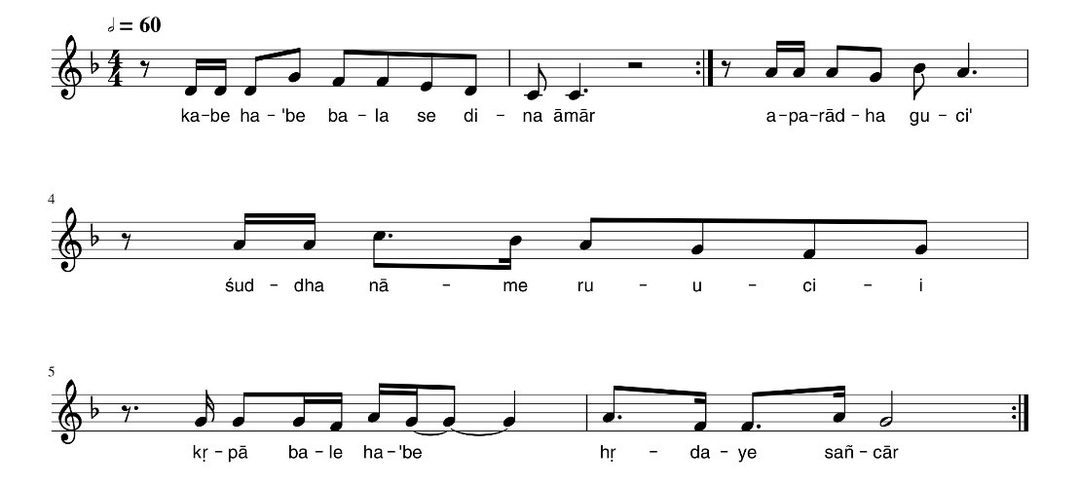
Due to the prayers of Śrī Advaita Ācārya, Śrī Caitanya appeared in the house of Jagannātha Miśra in the womb of Mother Śacī. In order to injoy the association of Śrī Advaita, Śrī Caitanya sang the holy Name of the Lord congregationally and danced with the devotees. I meditate upon the lotus feet of Śrī Advaita Ācārya, the Lord of Sītādevī.
5 advaita-caraṇāravinda-jñana-dhyāna-bhāvanam
sadādvaita-pāda-padma- reṇu-rāśi-dhāraṇam dehi bhaktiṁ jagannātha rakṣa mām abhajanaṁ sītā-nāthādvaita-caraṇāravinda-bhāvanam advaita—Śrī Advaita; caraṇāravinda—lotus feet; jñana—knowledge; dhyāna— meditation; bhāvanam—the objective; sadā—always; advaita—Advaita; pāda padma—lotus feet; reṇu—dust; rāśi—you bestow; dhāraṇam—meditation; dehi— give me; bhaktiṁ—devotional service; jagannātha—Lord; rakṣa—please protect; mām—me; abhajanaṁ—unworthy; sītā—Sītā; nātha—master; advaita—Advaita Ācārya; caraṇāravinda—lotus feet; bhāvanam—I meditate.
The lotus feet of Sri Advaita are the goal of my knowledge and the object of my meditation. I always keep the dust of His lotus feet on my head. O my Lord, please bestow devotional service upon this unworthy soul and protect him. I meditate upon the lotus feet of Śrī Advaita Ācārya, the Lord of Sītādevī.
6 sarva dātaḥ sītā-nātha prāṇeśvara sad-guṇaṁ
ye japanti sītā-nātha- pāda-padma kevalam dīyatāṁ karuṇā-nātha bhakti-yogaḥ tat kṣaṇaṁ sītā-nāthādvaita-caraṇāravinda-bhāvanam sarva—all; dātaḥ—the bestower; sītā—Sītā; nātha—lord; prāṇeśvara—the Lord of life; sad-guṇaṁ—spiritual qualities; ye—those; japanti—chant; sītā—Sītā; nātha-master; pāda-padma—lotus feet; kevalam—only; dīyatāṁ—deliver; karuṇā— mercy;nātha—master; bhakti-yogaḥ—devotional service; tat—He; kṣaṇaṁ—moment; sītā—Sītā; nātha—master; advaita—Advaita Ācārya; caraṇāravinda—lotus feet—bhāvanam—I meditate. Sri Advaita, the Lord of Sitadevi, is the bestower of all benedictions and perfections, and is the Lord of my life. That most merciful Lord immediately bestows bhakti upon those who meditate exclusively upon his lotus feet. I meditate upon the lotus feet of Śrī Advaita Ācārya, the Lord of Sītādevī.
7 śrī caitanya jayādvaita nityānanda karuṇa-mayaṁ
eka aṅga tridhāmūrti kaiśorādi sadā varam jīva-trāṇa bhakti-jñāna huṅkārādi garjanaṁ sītā-nāthādvaita-caraṇāravinda-bhāvanam śrī-caitanya—Lord Caitanya; jaya—all glories; advaita—Advaitācārya; nityānanda—Nityānanda Prabhu; karuṇa-mayaṁ—merciful; eka—one; aṅga— form; tridha—in three; mūrti—form; kaiśora—the age of kaiśora (the age between the eleventh and fifteenth years); adi—beginning with; sadā—always; varam— benediction; jīva—living entity; trāṇa—to deliver; bhakti—devotional service; jñāna—knowledge; huṅkārādi—loud roaring; garjanaṁ—thunders; sītā—Sītā; nātha—master; advaita—Advaita Ācārya;caraṇāravinda—lotus feet; bhāvanam— I meditate. All glories to Śrī Advaita along with Śrī Caitanya Mahāprabhu and the most merciful Nityānanda Prabhu. They are all one, but in three different forms, depicting the different phases of life, like adolescence, etc. Sri Advaita roars and thunders in order to deliver the living entities by giving them transcendental knowledge and pure devotional service. I meditate upon the lotus feet of Śrī Advaita Ācārya, the Lord of Sītādevī.
8 dīna-hīna-nindakādi prema-bhakti-dāyakaṁ
sarva dātaḥ sītā-nātha śāntipura nāyakam rāga-raṅga saṅga-doṣa karma-yoga mokṣanaṁ sītā-nāthādvaita-caraṇāravinda-bhāvanam dīna—wretched; hīna—poor; nindakādi—critics and similar people; prema—pure love; bhakti—devotional service; dāyakaṁ—giving; sarva—everything; dātaḥ—the bestower; sītā—Sītā; nātha—master; śāntipura—Śāntipura; nāyakam—the leader; rāga—attachment; raṅga—happines; saṅga—asociation;doṣa—fault; karma- yoga—people engaged in working; mokṣanaṁ—of liberation; sītā—Sītā; nātha— master; advaita—Advaitacarya; caraṇāravinda—lotus feet; bhāvanam—I meditate.
He bestows loving devotional service upon the lowly, mean, blasphemous and other such fallen people. The bestower of everything, Śrī Advaita, the Lord of Sītādevī, is the leader of Śāntipura. He frees one from the bondage of material attachments, bad association, fruitive activities and mystic yoga. I meditate upon the lotus feet of Śrī Advaita Ācārya, the Lord of Sītādevī.
Cc. Ādi 6.1 vande taṁ śrīmad-advaitācāryam adbhuta-ceṣṭitam yasya prasādād ajño ’pi tat-svarūpaṁ nirūpayet vande—I offer my respectful obeisances; tam—unto Him; śrīmat—with all opulences; advaita-ācāryam—Śrī Advaita Ācārya; adbhuta-ceṣṭitam—whose activities are wonderful; yasya—of whom; prasādāt—by the mercy; ajñaḥ api— even a foolish person; tat-svarūpam—His characteristics; nirūpayet—may describe. I offer my respectful obeisances to Śrī Advaita Ācārya, whose activities are all wonderful. By His mercy, even a foolish person can describe His characteristics.
Cc. Ādi 6.2 jaya jaya śrī-caitanya jaya nityānanda jayādvaita-candra jaya gaura-bhakta-vṛnda jaya jaya—all glories; śrī-caitanya—to Lord Śrī Caitanya Mahāprabhu; jaya—all glories; nityānanda—to Lord Nityānanda; jaya advaita-candra—all glories to Advaita Ācārya; jaya gaura-bhakta-vṛnda—all glories to the devotees of Śrī Caitanya Mahāprabhu.
All glories to Lord Śrī Caitanya Mahāprabhu! All glories to Lord Nityānanda! All glories to Advaita Ācārya! And all glories to all the devotees of Lord Śrī Caitanya Mahāprabhu!
Cc. Ādi 6.5
advaitaṁ hariṇādvaitād ācāryaṁ bhakti-śaṁsanāt
bhaktāvatāram īśaṁ tam advaitācāryam āśraye
advaitam—known as Advaita; hariṇā—with Lord Hari; advaitāt—from being nondifferent; ācāryam—known as Ācārya; bhakti-śaṁsanāt—from the propagation of devotional service to Śrī Kṛṣṇa; bhakta-avatāram—the incarnation as a devotee; īśam—to the Supreme Lord; tam—to Him; advaita-ācāryam—to Advaita Ācārya; āśraye—I surrender.
Because He is nondifferent from Hari, the Supreme Lord, He is called Advaita, and because He propagates the cult of devotion, He is called Ācārya. He is the Lord and the incarnation of the Lord’s devotee. Therefore I take shelter of Him.
Cc. Ādi 6.12 jagat-maṅgala advaita, maṅgala-guṇa-dhāma maṅgala-caritra sadā, ’maṅgala’ yāṅra nāma jagat-maṅgala—all-auspicious for the world; advaita—Advaita Ācārya; maṅgala- guṇa-dhāma—the reservoir of all auspicious attributes; maṅgala-caritra—all characteristics are auspicious; sadā—always; maṅgala—auspicious; yāṅra nāma—whose name.
Being a reservoir of all auspicious attributes, Śrī Advaita Ācārya is all- auspicious for the world. His characteristics, activities and name are always auspicious.
jaya sītānātha sītānātha sītānātha jaya sītānātha
All glories to Advaita Ācārya, the lord of Sītā-devī.
Commentary
The glories of Advaita Ācārya are described in the 6. chapter of Śrī Caitanya- caritāmṛta. In the purport to Text 12, Prabhupāda writes:
Śrī Advaita Prabhu, who is an incarnation of Mahā-Viṣṇu, is an ācārya, or teacher. All His activities and all the other activities of Viṣṇu are auspicious. Anyone who can view the all-auspiciousness in the pastimes of Lord Viṣṇu also becomes auspicious simultaneously. Therefore, since Lord Viṣṇu is the fountainhead of auspiciousness, anyone who is attracted by the devotional service of Lord Viṣṇu can render the greatest service to human society. Rejected persons of the material world who refuse to understand pure devotional service as the eternal function of the living entities, and as actual liberation of the living being from conditioned life, become bereft of all devotional service because of their poor fund of knowledge. In the teachings of Advaita Prabhu there is no question of fruitive activities or impersonal liberation. Bewildered by the spell of the material energy, however, persons who could not understand that Advaita Prabhu is nondifferent from Viṣṇu wanted to follow Him with their impersonal conceptions. The attempt of Advaita Prabhu to punish them is also auspicious. Lord Viṣṇu and His activities can bestow all good fortune, directly and indirectly. In other words, being favored by Lord Viṣṇu and being punished by Lord Viṣṇu are one and the same because all the activities of Viṣṇu are absolute. According to some, Maṅgala was another name of Advaita Prabhu. As the causal incarnation, or Lord Viṣṇu’s incarnation for a particular occasion, He is the supply agent or ingredient in material nature. However, He is never to be considered material. All His activities are spiritual. Anyone who hears about and glorifies Him becomes glorified himself, for such activities free one from all kinds of misfortune. One should not invest any material contamination or impersonalism in the Viṣṇu form. Everyone should try to understand the real identity of Lord Viṣṇu, for by such knowledge one can attain the highest stage of perfection.
Nityānandāṣṭaka Vṛndāvana dāsa Ṭhākura
1 sarac-candra-bhrāntiṁ sphurad-amala-kāntiṁ gaja-gatiṁ hari-premonmattaṁ dhṛta-parama-sattvaṁ smita-mukham sadāghūrṇan-netraṁ kara-kalita-vetraṁ kali-bhidaṁ bhaje nityānandaṁ bhajana-taru-kandaṁ niravadhi sarac—auttum; candra—moon; bhrāntiṁ—mocks; sphurad—brilliant; amala— spotless; kāntiṁ—whose complexion; gaja—elephant; gatiṁ—gait; hari- premonmattaṁ—maddened in love for Hari; dhṛta—manifested; parama— supreme; sattvaṁ—mode of goodness; smita—smile; mukham—face; sadāghūrṇan—always rolling; netraṁ—eyes; kara—hand; kalita—held; vetraṁ— the staff; kali—Kali-yuga; bhidaṁ—cuts into pieces; bhaje—I worship; nityānandaṁ—Lord Nityānanda; bhajana—of devotional service; taru—the tree; kandaṁ—worshipable Lord; niravadhi—always.
Again and again I worship Śrī Nityānanda Prabhu, the root of the kṛṣṇa-bhakti tree, whose bright face mocks the full autumn moon, whose pure complexion glistens, whose gait is like that of a maddened elephant, who is always intoxicated in kṛṣṇa-prema, who embodies pure spiritual energy, whose face holds a gentle smile, whose eyes are always rolling due to His absorption in kṛṣṇa-prema, whose lotus hand holds a glowing staff, and who, by the performance of nāma-saṅkīrtana, cuts the influence of Kali-yuga into pieces.
2 rasānām āgāraṁ svajana-gaṇa-sarvasvam atulaṁ
tadīyaika-prāṇa-pramita-vasudhā-jāhnava-patim sadā-premonmādaṁ param aviditaṁ manda-manasām bhaje nityānandaṁ bhajana-taru-kandaṁ niravadhi rasānām—of rasas; āgāraṁ—the abode; svajana—relatives; gaṇa—the multitude; sarvasvam—everything; atulaṁ—unequaled; tadīyaika—in relationship with; prāṇa—of the life air; pramita—extent; vasudhā—Vasudhā-devī; jāhnava— Jāhnava-devi; patim—their master; sadā—always; premonmādaṁ—maddened in love of God; param—better; aviditaṁ—unknown; manda—bad; manasām—whose minds; bhaje—I worship; nityānandaṁ—Lord Nityānanda; bhajana—devotional service; taru—the tree; kandaṁ—worshipable Lord; niravadhi—again and again.
Again and again I worship Śrī Nityānanda Prabhu, the root of the kṛṣṇa-bhakti tree, who is the reservoir of all the rasas, who is everything to His devotees, who has no equal, who is the Lord of both Vasudhā and Jahnavā, who consider Him more dear than their own lives, who is always maddened in kṛṣṇa-prema, and who is unknown only to those of meager intelligence.
3 śacī-sūnu-preṣṭhaṁ nikhila-jagad-iṣṭaṁ sukha-mayaṁ kalau majjaj-jivoddharaṇa-karaṇoddāma-karuṇam harer ākhyānād vā bhava-jaladhi-garvonnati-haraṁ bhaje nityānandaṁ bhajana-taru-kandaṁ niravadhi śacī-sūnu—of the son of Śacī; preṣṭhaṁ—is very dear; nikhila—to the entire; jagad—universe; iṣṭaṁ—worship; sukha—of happiness; mayaṁ—by mystic illusion; kalau—this age;majjaj—inmersed; jivoddharaṇa—the deliverer of the souls; karaṇoddāma—drowning in the ocean; karuṇam—mercy; harer—of Lord Hari; ākhyānād—known as; vā—or; bhava—ecstasy; jaladhi—in the ocean; garvonnati—the false pride; haraṁ—who removes; bhaje—I worship; nityānandaṁ—Lord Nityānanda; bhajana—devotional service; taru—the tree; kandaṁ—worshipable Lord; niravadhi—again and again.
Again and again I worship Śrī Nityānanda Prabhu, the root of the kṛṣṇa-bhakti tree, who is very dear to the son of Śacī, who is worshiped by the entire universe, who is the embodiment of happiness, who possesses infinite mercy for delivering the souls who are drowning in the age of Kali, and who, by the performance of harināma-saṅkīrtana, thwarts the progressing false pride of the ocean of repeated birth and death.
4 aye bhrātar nīṇāṁ kali-kaluṣiṇāṁ kiṁ nu bhavitā tathā prāyaścittaṁ racaya yad-anāyāsata ime vrajanti tvām itthaṁ saha bhagavatā mantrayati yo bhaje nityānandaṁ bhajana-taru-kandaṁ niravadhi aye—oh; bhrātar—my dear brother; nīṇāṁ— kali—óf Kali-yuga; kaluṣiṇāṁ—sinful souls kiṁ—what; nu—will; bhavitā—become; tathā—just so; prāyaścittaṁ— atonement; racaya—method; yad—whose; anāyāsata—redeemed; ime—all these; vrajanti—approach; tvām—You; itthaṁ—thus; saha—with; bhagavatā— transcendental; mantrayati—You will deliver; yo—I; bhaje—I worship; nityānandaṁ—Lord Nityānanda; bhajana—devotional service; taru—the tree; kandaṁ—worshipable Lord; niravadhi—again and again.
Again and again I worship Śrī Nityānanda Prabhu, the root of the kṛṣṇa-bhakti tree, who says to Śrī Caitanya Mahāprabhu, "My dear brother, what will be the fate of the sinful souls of Kali-yuga? How will they be saved? Please devise a method by which they will easily attain You.
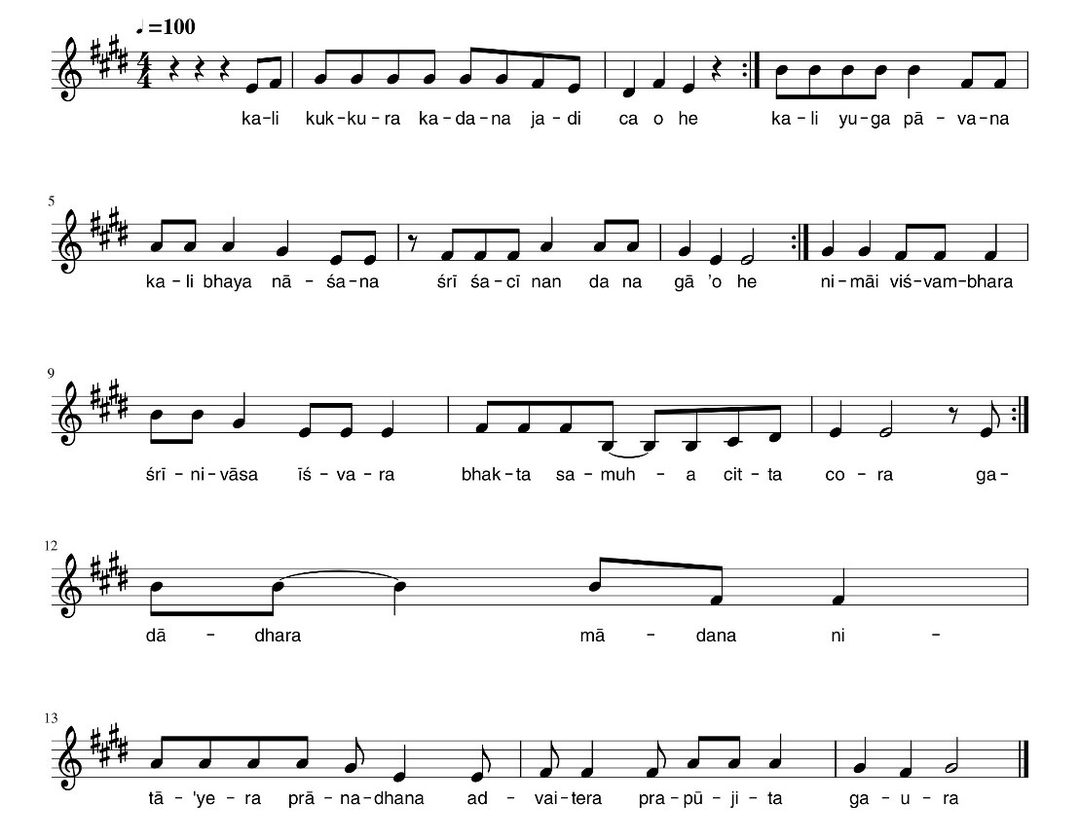
5 yatheṣṭhaṁ re bhrātaḥ kuru hari-hari-dhvānam aniśaṁ tato vaḥ saṁsārāmbudhi-taraṇa-dāyo mayi laget idaṁ bāhu-sphoṭair aṭati raṭayan yaḥ pratigṛham bhaje nityānandaṁ bhajana-taru-kandaṁ niravadhi yatheṣṭhaṁ—to your heart’s content; re—oh; bhrātaḥ—brother; kuru—do; hari- hari-dhvānam—the vibration of the holy name of Hari; aniśaṁ—always;tato— thereafter; vaḥ—of you; saṁsāra-ambudhi—the ocean of birth and death; taraṇa— liberation; dāyaḥ—merciful; mayi—upon me; laget—should take; idaṁ—this; bāhu—arms; sphoṭair—raising; aṭati—he wanders; raṭayan—calling out; yaḥ—one who; prati—every; gṛham—a house; bhaje—I worship; nityānandaṁ—Lord Nityānanda; bhajana—devotional service; taru—the tree; kandaṁ—worshipable Lord; niravadhi—again and again.
Again and again I worship Śrī Nityānanda Prabhu, the root of the kṛṣṇa-bhakti tree, who wanders around Bengal and approaches of each and every home, where He raises His arms and exclaims, "O brothers! Always chant the holy name of Hari together to your heart’s content. If you do this, I will take the responsibility to deliver you all from the ocean of material existence.
6 balāt saṁsārāmbhonidhi-harana-kumbhodbhavam aho satāṁ śreyaḥ-sindhūnati-kumuda-bandhuṁ samuditaṁ khala-śreṇī-sphūrjit-timira-hara-sūrya-prabham ahaṁ bhaje nityānandaṁ bhajana-taru-kandaṁ niravadhi balāt—by force; saṁsāra—birth and death cycle; ambho—water; nidhi—ocean harana—swallows; kumbha—pot; udbhavam—born in (Agastya Muni); aho—oh; satāṁ—of the devotees; śreyaḥ—benediction; sindhūnati—the ocean; kumuda—of the lotuses; bandhuṁ—friend; samuditaṁ—rising; khala—the demons; śreṇī—by the host of; sphūrjit—full moon; timira—of darkness; hara—removing; sūrya—sun; prabham—effulgent; ahaṁ—I; bhaje—I worship; nityānandaṁ—Lord Nityānanda; bhajana—devotional service; taru—the tree; kandaṁ—worshipable Lord; niravadhi—again and again.
Again and again I worship Śrī Nityānanda Prabhu, the root of the kṛṣṇa-bhakti tree, who is like Agastya Muni in swallowing the ocean of repeated birth and death, who is a rising full moon which increases the ocean of the saintly persons' welfare, and who is a sun which dissipates the darkness of ignorance cast by the various classes of miscreants.
7 naṭantaṁ gāyantaṁ harim anuvadantaṁ pathi pathi vrajantaṁ paśyantaṁ svam api na dayantaṁ jana-gaṇam prakurvantaṁ santaṁ sa-karuṇa-dṛg-antaṁ prakalanād bhaje nityānandaṁ bhajana-taru-kandaṁ niravadhi naṭantaṁ—dancing; gāyantaṁ—singing; harim—the Supreme Personality of Godhead; anuvadantaṁ—repeating; pathi pathi—on the way, one after another; vrajantaṁ—while walking; paśyantaṁ—the one who sees; svam—his own; api— even; na—neither; dayantaṁ—compassionate; jana—of the associates; gaṇam—all of them; prakurvantaṁ—makes them; santaṁ—saintly persons; sa—he; karuṇa— mercy; dṛg—seeing; antaṁ—at the end; prakalanād—pursuing; bhaje—I worship; nityānandaṁ—Lord Nityānanda; bhajana—devotional service; taru—the tree; kandaṁ—worshipable Lord; niravadhi—again and again.
Again and again I worship Śrī Nityānanda Prabhu, the root of the tree of kṛṣṇa-bhakti, who wanders on every path in Bengal dancing, singing, and repeating the holy name of Hari. When He sees people who have no compassion even for their own selves, He turns them into saintly persons by His merciful glance.
8 su-bibhrāṇaṁ bhrātuḥ kara-sarasijaṁ kamalataraṁ mitho vaktrālokocchalita-paramānanda-hṛdayam bhramantaṁ mādhuryair ahaha madayantaṁ pura-janān bhaje nityānandaṁ bhajana-taru-kandaṁ niravadhi su—beautiful; bibhrāṇaṁ—assuming, displaying, bearing; bhrātuḥ—of the brother; kara—in Your hand; sarasijaṁ—very soft; kamalataraṁ—lotus; mitho—between one another; vaktrālokocchalita—became filled; paramānanda—the highest bliss; hṛdayam—heart; bhramantaṁ—wandering; mādhuryair—by the exquisite charm and beauty; ahaha—aha!; madayantaṁ—delighting; pura—formerly; janān—people in general; bhaje—I worship; nityānandaṁ—Lord Nityānanda; bhajana—devotional service; taru—the tree; kandaṁ—worshipable Lord; niravadhi—again and again.
Again and again I worship Śrī Nityānanda Prabhu, the root of the kṛṣṇa- bhakti tree, who holds the supremely soft lotus-hand of His brother, whose heart became filled with the highest bliss when They look at each other, and who wanders here and there delighting the townspeople with His sweetness.
9 rasānāṁ ādhāraṁ rasika-vara-sad-vaiṣṇava-dhanaṁ
rasāgāraṁ sāraṁ patita-tati-tāraṁ smaraṇataḥ paraṁ nityānandāṣṭakam idam apūrvaṁ pathati yaḥ tad-aṅghri-dvandvābjaṁ sphuratu nitarāṁ tasya hṛdaye rasānāṁ—taste; ādhāraṁ—place; rasika—expert in transcendental mellows; vara— a benediction; sad—exalted; vaiṣṇava—Vaiṣṇavas; dhanaṁ—riches; rasāgāraṁ— the reservoir of rasa; sāraṁ—the essence; patita—fallen; tati—their; tāraṁ—very; smaraṇataḥ— paraṁ—supreme; nityānandāṣṭakam—Nityānandāṣṭakam; idam— this; apūrvaṁ—unprecedented; pathati—recites; yaḥ—who; tad—that; aṅghri—by the feet; dvandva—two; abjaṁ—lotus; sphuratu—manifest; nitarāṁ—highly qualified; tasya—his; hṛdaye—in the heart.
May Śrī Nityānanda Prabhu place His lotus feet in the heart of one who lovingly recites this unprecedented Nityānandāṣṭaka, which is the reservoir of rasa, the greatest treasure of the most exalted of rasika Vaiṣṇavas, and the storehouse of the essence of bhakti-rasa.
Commentary
The glories of Nityānanda Prabhu are described in Chapter 5 of the Śrī Caitanya- caritāmṛta. In the purport to Text 10, Prabhupāda writes:
According to expert opinion, Balarāma, as the chief of the original quadruple forms, is also the original Saṅkarṣaṇa. Balarāma, the first expansion of Kṛṣṇa, expands Himself in five forms: (1) Mahā-saṅkarṣaṇa, (2) Kāraṇābdhiśāyī, (3) Garbhodakaśāyī, (4) Kṣīrodakaśāyī, and (5) Śeṣa. These five plenary portions are responsible for both the spiritual and material cosmic manifestations. In these five forms Lord Balarāma assists Lord Kṛṣṇa in His activities. The first four of these forms are responsible for the cosmic manifestations, whereas Śeṣa is responsible for personal service to the Lord. Śeṣa is called Ananta, or unlimited, because He assists the Personality of Godhead in His unlimited expansions by performing an unlimited variety of services. Śrī Balarāma is the servitor Godhead who serves Lord Kṛṣṇa in all affairs of existence and knowledge. Lord Nityānanda Prabhu, who is the same servitor Godhead, Balarāma, performs the same service to Lord Gaurāṅga by constant association.
Caitanyāṣṭaka
Rupa Gosvāmī
1 sadopāsyaḥ śrīmān dhṛta-manuja-kāyaiḥ praṇayitāṁ vahadbhir girbāṇair giriśa-parameṣṭhi-prabhṛtibhiḥ sva-bhaktebhyaḥ śuddhaṁ nija-bhajana-mudrām upadiśan sa caitanyaḥ kiṁ me punar api dṛśor yāsyati padam sadā—always; upāsyaḥ—worshipable; śrīmān—beautiful; dhṛta—who accepted; manuja- kāyaiḥ—the bodies of men; pranayitām—love; vahadbhiḥ—who were bearing; giḥ-vāṇaiḥ— by the demigods; giriśa—Lord Śiva; parameṣṭhi—Lord Brahmā; prabhṛtibhiḥ—headed by; sva-bhaktebhyaḥ—unto His own devotees; śuddhām—pure; nija-bhajana—of His own worship; mudrām—the mark; upadiśan—instructing; saḥ—He; caitanyaḥ—Lord Caitanya; kim—what; me—my; punaḥ—again; api—certainly; dṛśoḥ—of the two eyes; yāsyati—He will go; padam—on the path.
Śrī Caitanya Mahāprabhu is always the most worshipable Deity of the demigods, including Lord Śiva and Lord Brahmā, who came in the garb of ordinary men, bearing love for Him. He instructs His own pure devotional service to His own devotees. Will He again be the object of my vision?
2 sureśānāṁ durgaṁ gatir atiśayenopaniṣadāṁ munīnāṁ sarvasvaṁ praṇata-paṭalīnāṁ madhurimā viniryāsaḥ premṇo nikhila-paśu-pālaṁbhuja-dṛśām sa caitanyaḥ kiṁ me punar api dṛśor yāsyati padam sura-īśānām—of the kings of the demigods; durgam—fortress; gatiḥ—the goal; atiśayena— eminently; upaniṣadām—of the Upaniṣads; munīnām—of the sages; sarva-svam—the be- all and end-all; praṇata-paṭalīnām—of the groups of the devotees; madhurimā—the sweetness; viniryāsaḥ—the essence; premṇaḥ—of love; nikhila—all; paśu-pālā—of the cowherd women; ambuja-dṛśām—lotus-eyed; saḥ—He; caitanyaḥ—Lord Caitanya; kim— what; me—my; punaḥ—again; api—certainly; dṛśoḥ—of the two eyes; yāsyati—will come; padam—on the path.
Lord Caitanya is the shelter of the demigods, the goal of the Upaniṣads, the be-all and end-all of the great sages, the beautiful shelter of His devotees, and the essence of the love of the lotus-eyed gopīs. Will He again be the object of my vision?
3 svarūpaṁ bibhrāṇo jagad-atulam advaita-dayitaḥ
prapanna-śrīvāso janita-paramānanda-garimā
harir dīnoddhārī gajapati-kṛpotseka-taralaḥ sa caitanyaḥ kiṁ me punar api dṛśor yāsyati padam svarūpaṁ—own form; bibhrāṇa—He who maintains; jagad-atulam—the unlimited universe; advaita—Advaita Ācārya; dayitaḥ—dear; prapanna—surrendered; śrīvāso—Śrīvāsa Paṇḍita; janita—manifested; paramānanda—Paramānanda Purī; garimā—excellence; harir—the Supreme Lord; dīna-uddhārī—the deliverer of the fallen; gajapati—the king of Orissa; kṛpa utseka—showered mercy; taralaḥ—reckless; sa—He; caitanyaḥ—Lord Caitanya; kiṁ—what; me—my; punar—again; api—certainly; dṛśor—of the two eyes; yāsyati—will come; padam—on the path.
Śrī Caitanya Mahāprabhu has manifested His own form, which cannot be compared to anything in the material universe. He is very dear to Advaita Ācārya, and Śrīvāsa Pandita is surrendered to Him. He is very respectful to Paramānanda Purī. He takes away the ignorance of the material world and delivers the conditioned souls suffering from the threefold misery. He showered His mercy on Mahārāja Pratāparudra, the king of Orissa. Will He again become vis rasoddāmā kāmārbuda-madhura-dhāmojjvala-tanur yatīnām uttaṁsas taraṇikara-vidyoti-vasanaḥ hiraṇyāṇāṁ lakṣmī-bharam abhibhavann āṅgika-rucā sa caitanyaḥ kiṁ me punar api dṛśor yāsyati padam rasa-uddāmā—maddened by tasting rasa; kāma—desire; arbuda—millions; madhura— sweetness; dhāma—abode; ujjvala—effulgent; tanur—the body; yatīnām—by renunciants; uttaṁsas—the crest jewel; taraṇi-kara—like sunlight; vidyoti—effulgent; vasanaḥ—wearing; hiraṇyāṇāṁ—of gold; lakṣmī-bharam—great transcendental opulence; abhibhavann— subduing; āṅgika-rucā—the luster of the body; sa—He; caitanyaḥ—Lord Caitanya; kiṁ— what; me—my; punar—again; api—certainly; dṛśor—of the two eyes; yāsyati—will come; padam—on the path.
Śrī Caitanya Mahāprabhu becomes maddened by tasting the mellows of devotional service. His effulgent form is the abode of sweetness for millions of Cupids, and He is the crest jewel of sannyāsīs. His garments display the effulgence of the sun, and the splendor of His body eclipses the beauty of gold. Will He again become visible before the path of my eyes?
5 payo-rāśes tīre sphurad-upavanālī-kalanayā muhur vṛndāraṇya-smaraṇa-janita-prema-vivaśaḥ kvacit kṛṣṇāvṛtti-pracala-rasano bhakti-rasikaḥ sa caitanyaḥ kiṁ me punar api dṛśor yāsyati pada payaḥ-rāśeḥ—by the sea; tīre—on the beach; sphurat—beautiful; upavana-ālī—garden; kalanayā—by seeing; muhuḥ—continuously; vṛndāraṇya—the forest of Vṛndāvana; smaraṇa- janita—by remembering; prema-vivaśaḥ—being overwhelmed by ecstatic love of Kṛṣṇa; kvacit—sometimes; kṛṣṇa—of the holy name of Kṛṣṇa; āvṛtti—repetition; pracala—busily engaged in; rasanaḥ—whose tongue; bhakti-rasikaḥ—expert in devotional service; saḥ—that; caitanyaḥ—Śrī Caitanya Mahāprabhu; kim—whether; me—my; punaḥ api—again; dṛśoḥ—of the eyes; yāsyati—will go; padam—on the path.
Śrī Caitanya Mahāprabhu is the topmost of all devotees. Sometimes, while walking on the beach, He would see a beautiful garden nearby and mistake it for the forest of Vṛndāvana. Thus He would be completely overwhelmed by ecstatic love of Kṛṣṇa and begin to chant the holy name and dance. His tongue worked incessantly as He chanted, “Kṛṣṇa! Kṛṣṇa!” Will He again become visible before the path of my eyes?
6 hare kṛṣṇety-uccaiḥ sphurita-rasano nāma-gaṇanā- kṛta-granthi-śreṇī-subhaga-kaṭi-sūtrojjvala-karaḥ viśālākṣo dīrghārgala-yugala-khelāñcita-bhujaḥ sa caitanyaḥ kiṁ me punar api dṛśor yāsyati padam payaḥ-rāśeḥ—by the sea; tīre—on the beach; sphurat—beautiful; upavana-ālī—garden; kalanayā—by seeing; muhuḥ—continuously; vṛndāraṇya—the forest of Vṛndāvana; smaraṇa-janita—by remembering; prema-vivaśaḥ—being overwhelmed by ecstatic love of Kṛṣṇa; kvacit—sometimes; kṛṣṇa—of the holy name of Kṛṣṇa; āvṛtti—repetition; pracala— busily engaged in; rasanaḥ—whose tongue; bhakti-rasikaḥ—expert in devotional service; saḥ—that; caitanyaḥ—Śrī Caitanya Mahāprabhu; kim—whether; me—my; punaḥ api— again; dṛśoḥ—of the eyes; yāsyati—will go; padam—on the path.
Śrī Caitanya Mahāprabhu is the topmost of all devotees. Sometimes, while walking on the beach, He would see a beautiful garden nearby and mistake it for the forest of Vṛndāvana. Thus He would be completely overwhelmed by ecstatic love of Kṛṣṇa and begin to dance and chant the holy name. His tongue worked incessantly as He chanted, 'Kṛṣṇa! Kṛṣṇa!' Will He again become visible before the path of My eyes?
7 rathārūḍhasyārād adhipadavī-nīlācala-pater adabhra-premormi-sphurita-naṭanollāsa-vivaśaḥ sa-harṣaṁ gāyadbhiḥ parivṛta-tanur vaiṣṇava-janaiḥ sa caitanyaḥ kiṁ me punar api dṛśor yāsyati padam ratha-ārūḍhasya—of the Supreme Lord, who was placed aboard the car; ārāt—in front; adhipadavi—on the main road; nīlācala-pateḥ—of Lord Jagannātha, the Lord of Nīlācala; adabhra—great; prema-ūrmi—by waves of love of Godhead; sphurita—which was manifested; naṭana-ullāsa-vivaśaḥ—being overwhelmed by the transcendental bliss of dancing; sa-harṣam—with great pleasure; gāyadbhiḥ—who were singing; parivṛta— surrounded; tanuḥ—body; vaiṣṇava-janaiḥ—by the devotees; saḥ caitanyaḥ—that Lord Śrī Caitanya Mahāprabhu; kim—whether; me—my; punaḥ api—again; dṛśoḥ—of vision; yāsyati—will enter; padam—on the path.
Śrī Caitanya Mahāprabhu danced down the main road in great ecstasy before Lord Jagannātha, the master of Nīlācala, who was sitting on His car. Overwhelmed by the transcendental bliss of dancing and surrounded by Vaiṣṇavas who sang the holy names, He manifested waves of ecstatic love of Godhead. When will Śrī Caitanya Mahāprabhu again be visible to my vision?
8 bhuvaṁ siñcan aśru-śrutibhir abhitaḥ sāndra-pulakaiḥ parītāṅgo nīpa-stabaka-nava-kiñjalka-jayibhiḥ ghana-sveda-stoma-stimita-tanur utkīrtana-sukhī sa caitanyaḥ kiṁ me punar api dṛśor yāsyati padam bhuvaṁ—the earth; siñcan—pouring water; aśru—tears; śrutibhir—by the ears; abhitaḥ— on all sides; sāndra—concentrated, dense; pulakaiḥ—by thrilled hairs standing erect; parīta—filled; aṅgaḥ—body; nīpa—of the kadamba tree; stabaka—blossoms; nava—fresh; kiñjalka—filaments; jayibhih—glorious; ghana—new cloud; sveda—perspiration; stoma—of a multitude; stimita—stunned; tanur—divine bodies; utkīrtana—loud chanting; sukhī—happy;
sa—that; caitanyaḥ—Śrī Caitanya Mahāprabhu; kiṁ—whether; me—my; punar api—again; dṛśor—of vision; yāsyati—will enter; padam—on the path.
Śrī Caitanya Mahāprabhu became joyful during the loud chanting of the holy names, and He sprinkled the earth with showers of tears. All the hairs of His body, standing on end, appeared like beautiful filaments of newly-grown kadamba blossoms, and His body glistened with profuse perspiration. Will he again become visible before the path of my eyes?
9 adhīte gaurāṅga-smaraṇa-padavī maṅgalataraṁ kṛtī yo viśrambha-sphurad-amala-dhīr aṣṭakam idam parānande sadyas tad-amala-padāmbhoja-yugale parisphārā tasya sphuratu nitarāḿ prema-laharī adhīte—one obtains; gaurāṅga—Gaurāṅga; smaraṇa—remembering; padavī—the position; maṅgalataraṁ—most auspicious; kṛtī—most fortunate; yo—whoever; viśrambha— devotional service devoid of a respectful attitude toward the Lord; sphurad—brillant; amala— spotless; dhīr—intelligence; aṣṭakam—eight; idam—this; parānande—spiritual bliss; sadyas—immediately; tad-amala—a los pies de loto inmaculados de la Suprema Personalidad de Dios; padāmbhoja—the lotus feet; yugale—on the two eyes; parisphārā— ; tasya—his; sphuratu—let Him be manifest; nitarām—always; prema—pure love; laharī— waves.
May the great ocean full of waves of pure love for the two white lotus flowers of the feet of Śrī Caitanya Mahāprabhu become immediately visible at every moment to whatever pious person reads these eight most auspicious verses, his pure intelligence shining with faith as he meditates on Lord Gaurāṅga.
Commentary
Śrīla Rūpa Gosvāmī composed three hymns with the title Caitanyāṣṭaka: Prathama, Dvitiya and Tritiya which are included in his Stava-mālā (garland of hymns), a collection of prayers and songs of praise. The above Caitanyāṣṭaka: is Prathama. Several verses of the Prathama and Dvitiya Caitanyāṣṭakas are included in Kṛṣṇadāsa Kavirāja Gosvāmī’s Śrī Caitanya- caritāmṛta. The next two Aṣṭakas were composed by Sārvabhauma Bhaṭṭācārya whose first encounter with Śrī Caitanya Mahāprabhu and His subsequent conversion to Vaiṣṇavism are described in Chapter 6 of the Madhya-līlā. Here some excerpts from the summary of the chapter:

When Sārvabhauma met Śrī Caitanya Mahāprabhu, he asked Him to hear Vedānta philosophy from him. Śrī Caitanya Mahāprabhu accepted this proposal, and for seven days He continually heard Sārvabhauma Bhaṭṭācārya explain the Vedānta-sūtra. […] The Bhaṭṭācārya was an impersonalist, but Śrī Caitanya Mahāprabhu proved that the Absolute Truth is the Supreme Personality of Godhead. He proved that the conceptions of the Māyāvādī philosophers concerning the impersonal Absolute Truth are incorrect. […]
When the Bhaṭṭācārya came to his senses, Śrī Caitanya Mahāprabhu disclosed His real identity. The Bhaṭṭācārya then recited one hundred verses in praise of Lord Caitanya Mahāprabhu and offered his obeisances. […] On another day, the Bhaṭṭācārya wanted to change the reading of the tat te ’nukampām [SB 10.14.8] verse because he did not like the word mukti-pada. He wanted to substitute the word bhakti-pada. Śrī Caitanya Mahāprabhu advised Sārvabhauma not to change the reading of Śrīmad-Bhāgavatam, because mukti- pada indicated the lotus feet of the Supreme Personality of Godhead, Lord Kṛṣṇa. Having become a pure devotee, the Bhaṭṭācārya said, “Because the meaning is hazy, I still prefer bhakti-pada.” At this, Śrī Caitanya Mahāprabhu and the other inhabitants of Jagannātha Purī became very pleased. Sārvabhauma Bhaṭṭācārya thus became a pure Vaiṣṇava, and the other learned scholars there followed him.
Śacī-sutāṣṭakam Sārvabhauma Bhaṭṭācārya
1 nava gaura-varaṁ nava-puṣpa-śaraṁ nava-bhāva-dharaṁ nava-lāsya-param nava-hāsya-karaṁ nava-hema-varaṁ praṇamāmi śacī-suta-gaura-varam nava-gaura-varam—fresh excellent gold; nava-puṣpa-śaram—arrows of newly blossomed flowers; nava-bhāva-dharam—sustaining ever-new ecstatic moods; nava-lāsya-param— absorbed in novel dances; nava-hāsya-karam—causing new laughter; nava-hema-varam— beautiful new gold; praṇamāmi—I bow down; śacī-suta—the son of Mother Śacī; gaura- varam—excellent gold.
His complexion is the hue of fresh cream tinged with kuṅkuma. He is the ever-fresh Cupid who shoots arrows of newly blossoming flowers. He bears newer and newer moods of emotional ecstasies. He is fond of performing novel dances. He makes ever-new jokes that cause much laughter. His brilliant luster is like freshly cast gold. I bow down to Gaura, the beautiful son of Mother Śacī.
2 nava-prema-yutaṁ nava-nīta-śucaṁ nava-veśa-kṛtaṁ nava-prema-rasam navadhā vilasat śubha-prema-mayaṁ praṇamāmi śacī-suta-gaura-varam nava-prema-yutam—endowed with ever-fresh divine love; nava-nīta-śucam—luminous like fresh butter; nava-veśa-kṛtam—wears fresh attire in novel fashions; nava-prema-rasam— tastes ever-new mellows of love for Kṛṣṇa; navadhā vilasat—whose shines in ninefold newer and newer ways [while executing the nine-fold processes of devotionsal service]; śubha- prema-mayam—auspicious loving nature.
He is endowed with ever-fresh love of Godhead. His radiant luster is like the color of fresh butter. His fresh attire is arranged in ever-new fashions. He relishes ever-new mellows of love for Kṛṣṇa. He shines in nine-fold new ways while executing the nine- fold processes of devotion. He is permeated with a most auspicious loving nature. I bow down to Gaura, the beautiful son of Mother Śacī.
3 hari-bhakti-paraṁ hari-nāma-dharaṁ
kara-japya-karaṁ hari-nāma-param nayane satataṁ praṇayāśru-dharaṁ praṇamāmi śacī-suta-gaura-varam hari-bhakti-param—absorbed in devotion to Śrī Hari; hari-nāma-dharam—who holds the names of Hari; kara-japya-karam—who uses His hands for chanting japa—meditation; hari- nāma-param—who is addicted to the names of Hari; nayane—in His eyes; satatam— always; praṇaya-aśru—tears of love; dharam—bears.
He is absorbed in devotion to Śrī Hari. He maintains the chanting of the names of Hari. While chanting He counts the holy names on the fingers of His hands. He is addicted to the name of Hari. He always has tears of love welling in His eyes. I bow down to Gaura, the beautiful son of Mother Śacī.
4 satataṁ janatā-bhava-tāpa-haraṁ
paramārtha-parāyaṇa-loka-gatim nava-leha-karaṁ jagat-tāpa-haraṁ praṇamāmi śacī-suta-gaura-varam satatam—always; janatā—mankind; bhava—material existence; tāpa-haram—who takes away suffering; parama-artha—the supreme purpose; parāyaṇa—dedicated; loka—people; gatim—goal; nava-leha-karam—who renders men like bees anew; jagat-tāpa-haram—who takes away the suffering of the material world.
He is always removing the suffering of material existence for mankind. He is the goal of life for persons who are dedicated to their supreme interest. He inspires men to become like honeybees (eager for the honey of kṛṣṇa-prema). He removes the burning fever of the material world. I bow down to Gaura, the beautiful son of Mother Śacī.
5 nija-bhakti-karaṁ priya-cārutaraṁ
naṭa-nartana-nāgara-rāja-kulam kula-kāmini-mānasa-lāsya-karaṁ praṇamāmi śacī-suta-gaura-varam nija-bhakti-karam—who causes devotional service to Himself; priya-cārutaram—who is most attractive to His beloved servitors; naṭa-nartana—who dances with a greatly dramatic mood; nāgara-rāja-kulam—He promotes the family of Kṛṣṇa, the king of paramours; kula kāmini— attractive young women; mānasa—mind; lāsya—dancing; karam—causes.
He motivates pure devotion unto Himself. He is most attractive to His beloved servitors. By His dramatic dancing He exhibits the characteristics of the King of paramours. He causes the minds of beautiful young village women to dance. I bow down to Gaura, the beautiful son of Mother Śacī.
6 karatāla-valaṁ kala-kaṇṭha-ravaṁ mṛdu-vādya-suvīṇikayā madhuram nija-bhakti-guṇāvṛta-nātya-karaṁ praṇamāmi śacī-suta-gaura-varam kara-tāla-valam—together with hand cymbals; kala—soft; kaṇṭha—throat; ravam—sound; mṛdu—soft; vādya—played; suvīṇakayā—with the pleasing stringed vīṇā; madhuram— sweet; nija-bhakti—His own devotion; guṇa—qualities; āvṛta—covered; nātya-karam— causing dancing.
He plays karatālas as His throat emits sweet melodious sounds and the vibrant notes of the vīṇā are softly played. He thus inspires the devotees to perform dramatic dancing that is infused with aspects of His own devotional service. I bow down to Gaura, the beautiful son of Mother Śacī.
7 yuga-dharma-yutaṁ punar nanda-sutaṁ
dharaṇī-sucitraṁ bhava-bhāvocitam
tanu-dhyāna-citaṁ nija-vāsa-yutaṁ
praṇamāmi śacī-suta-gaura-varam
yuga-dharma—the religious practice for the Age of Kali; yutam—embued; punaḥ—again; nanda-sutam—the son of Nanda; dharaṇī—the earth; su-citram—very wonderful; bhava— birth and death; bhāva—the mood; ucitam—suitable; tanu—body; dhyāna—meditation; citam—consciousness; nija-vāsa—His own abode; yutam—accompanied.
He is accompanied by the saṅkīrtan movement, which is the religious practice for the age of Kali. He is the son of Nanda Mahārāja come again. He is the extraordinarily brilliant ornament of the earth. His preaching mood is suitably adapted to the cycle of birth and death. His consciousness is fixed in meditation on His own form of Kṛṣṇa. He is always accompanied by His transcendental abode. I bow to Gaura, the beautiful son of Mother Śacī.
8 aruṇaṁ nayanaṁ caraṇaṁ vasanaṁ vadane skhalitaṁ svaka-nāma-dharam kurute su-rasaṁ jagataḥ jīvanaṁ praṇamāmi śacī-suta-gaura-varam aruṇam—red as the rising sun; nayanam—eyes; caraṇam—feet; vasanam—clothing; vadane—in His mouth; skhalitam—faltering; svaka-nāma—His own names; dharam— taking; kurute—He influences; su-rasam—a sweet flavor; jagataḥ—of the cosmic manifestation; jīvanam—life.
His eyes, the soles of His feet, and His clothing are reddish like the color that heralds the rising sun. As He utters His own names, His voice falters. He awakens a sweet flavor to life throughout the universe. I bow down to Gaura, the beautiful son of Mother Śacī.
Śacī-tanayāṣṭaka Sārvabhauma Bhaṭṭācārya
1 ujjvala-varaṇa-gaura-vara-dehaṁ
vilasita-niravadhi-bhāva-videham tri-bhuvana-pāvana-kṛpāyāḥ leśaṁ taṁ praṇamāmi ca śrī-śacī-tanayam ujjvala—brilliant; varaṇa—complexion; gaura-vara-deham—beautiful golden body; vilasita—sported; niravadhi—incessantly; bhāva—ecstasy; videham— transcendental body; tri-bhuvana—the three worlds; pāvana—purifying; kṛpāyāḥ— by His mercy; leśam—atomic particle; tam—to Him; praṇamāmi—I bow down; ca—also; śrī-śacī-tanayam—to the son of Mother Śacī.
His superexcellent spiritual body is a brilliant golden color. He is incessantly churned by sublime transcendental ecstasies. A fraction of His mercy is able to deliver all the three worlds. Unto that son of Śrī Śacīdevī I offer my respectful obeisances.
2 gadgadāntara-bhāva-vikāraṁ
durjana-tarjana-nāda-viśālam bhava-bhaya-bhañjana-kāraṇa-karuṇaṁ taṁ praṇamāmi ca śrī-śacī-tanayam gadgada—choked-up; antara—internally; bhāva-vikāram—ecstatic transfor- mations; durjana—wicked men; tarjana—threatening; nāda—sounds; viśālam— immense; bhava-bhaya—fear of the repeating cycle of birth and death; bhañjana— smashing; kāraṇa—cause; karuṇam—mercy; tam—to Him; praṇamāmi—I bow down; ca—also; śrī-śacī-tanayam—to the son of Mother Śacī.
Within Himself there are transformations of ecstasy such as faltering of the voice. The mighty sound of His voice chastises wicked men. His mercy dispels all fears caused by worldly existence. Unto that son of Śrī Śacīdevī I offer my respectful obeisances.
3 aruṇāmbara-dhara cāru-kapolaṁ indu-vinindita-nakha-caya-ruciram jalpita-nija-guṇa-nāma-vinodaṁ taṁ praṇamāmi ca śrī-śacī-tanayam aruṇa—saffron; ambara—garments; dhara—wearing; cāru—beautiful; kapolam— forehead; indu—moon; vinindita—mocking; nakha—fingernails; caya—rows; ruciram—radiance; jalpita—uttered; nija-guṇa—His own qualities; nāma—His name; vinodam—the enjoyer; tam—to Him; praṇamāmi—I bow down; ca—also; śrī-śacī-tanayam—to the son of Mother Śacī.
The garments He wears are reddish like the morning sun, and His forehead is very beautiful. His shining fingernails mock the beauty of the moon, and He delights in chanting about His own transcendental qualities and His own name. Unto that son of Śrī Śacīdevī I offer my respectful obeisances.
4 vigalita-nayana-kamala-jala-dhāraṁ
bhūṣaṇa-nava-rasa-bhāva-vikāram
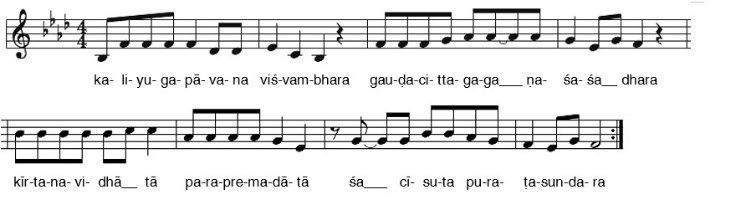
gati-atimanthara-nṛtya-vilāsaṁ taṁ praṇamāmi ca śrī-śacī-tanayam vigalita—flowing; nayana-kamala—lotus eyes; jala-dhāram—streams of water; bhūṣaṇa—ornament; nava-rasa—of fresh mellows; bhāva-vikāram—ecstatic transformations; gati—the movements; ati-manthara—very slow; nṛtya-vilāsam— pastimes of dancing; tam—to Him; praṇamāmi—I bow down; ca—also; śrī-śacī- tanayam—to the son of Mother Śacī.
Tears flow from His lotus eyes like streams of water, and His ornaments are the transformations of ecstasy caused by tasting ever-new loving sentiments. His movements are very slow and full of grace when He performs His dancing pastimes. Unto that son of Śrī Śacīdevī I offer my respectful obeisances.
5 cañcala-cāru-caraṇa-gati-ruciraṁ mañjīra-rañjita-pada-yuga-madhuram candra-vinindita-śītala-vadanaṁ taṁ praṇamāmi ca śrī-śacī-tanayam cañcala—restless; cāru-caraṇa—lovely feet; gati—the movements; ruciram— pleasing; mañjīra-rañjita—adorned by anklets; pada-yuga—the two feet; madhuram—sweet; candra-vinindita—surpassing the moon; śītala-vadanam— cooling face; tam—to Him; praṇamāmi—I bow down; ca—also; śrī-śacī-tanayam— to the son of Mother Śacī.
The sprightly movements of His lovely dancing feet are very pleasing. Those two feet are sweetened by tinkling ankle bells. His soothing face surpasses the cooling rays of the moon. Unto that son of Śrī Śacīdevī I offer my respectful obeisances.
6 dhṛta-kaṭi-ḍora-kamaṇḍalu-daṇḍaṁ
divya-kalevara-muṇḍita-muṇḍam durjana-kalmaṣa-khaṇḍana-daṇḍaṁ taṁ praṇamāmi ca śrī-śacī-tanayam dhṛta—wearing; kaṭi-ḍora—loincloth; kamaṇḍalu—waterpot; daṇḍam—staff; divya-kalevara—divine body; muṇḍita—shaven; muṇḍam—head; durjana— wicked souls; kalmaṣa—sins; khaṇḍana—destroying; daṇḍam—chastisement; tam—to Him; praṇamāmi—I bow down; ca—also; śrī-śacī-tanayam—to the son of Mother Śacī.
He wears a loincloth and carries the staff and waterpot of a mendicant. His divine body is graced by a shaven head. His chastisement breaks apart and destroys the sins of wicked souls. Unto that son of Śrī Śacīdevī I offer my respectful obeisances.
7 bhūṣaṇa-bhū-raja-alakā-valitaṁ kampita-bimbādhara-varadd-ruciram malayaja-viracita-ujjvala-tilakaṁ taṁ praṇamāmi ca śrī-śacī-tanayam bhūṣaṇa—ornament; bhū-raja—dust of the earth; alakā—hair; valitam—endowed; kampita—trembling; bimba-adhara—lips like red berries; vara-ruciram—excellent and pleasing; malaya-ja—sandalwood; viracita—drawn; ujjvala-tilakam—brilliant forehead markings; tam—to Him; praṇamāmi—I bow down; ca—also; śrī-śacī- tanayam—to the son of Mother Śacī.
As a householder, His face is surrounded by locks of dark hair, decorated with the dust of the earth. His excellent lips, which are red like the bimba fruit, are beautified by their trembling in ecstasy. Upon His forehead He wears brilliant tilak made of sandalwood paste. Unto that son of Śrī Śacīdevī I offer my respectful obeisances.
8 nindita-aruṇa-kamala-dala-nayanaṁ
ājānu-lambita-śrī-bhuja-yugalam
kalevara-kaiśora-nartaka-veśaṁ taṁ praṇamāmi ca śrī-śacī-tanayam nindita—surpassing; āruṇa—reddish; kamala-dala—lotus petal; nayanam—eyes; ā-jānu—down to the knees; lambita—extending; śrī—splendrous; bhuja- yugalam—two arms; kalevara—divine body; kaiśora—adolescent; nartaka- veśam—dress of a dramatic dancing actor; tam—to Him; praṇamāmi—I bow down; ca—also; śrī-śacī-tanayam—to the son of Mother Śacī.
The glowing beauty of His lotus-petal eyes exceeds that of the rising sun. His two beautiful arms extend down to His knees. His divine body is dressed in the fashion of an adolescent dramatic dancer. Unto that son of Śrī Śacīdevī I offer my respectful obeisances.
Vṛndāvanāṣṭaka
Rūpa Gosvāmī
1 mukunda-muralī-rava-śravaṇa-phulla-hṛd-ballavī- kadambaka-karambita-prati-kadamba-kuñjāntarā kalinda-giri-nandinī-kamala-kandalāndolinā su-gandhir anilena me śaraṇam astu vṛndāṭavī mukunda—Mukunda; muralī—of the flute; rava—of the sound; śravaṇa—hearing; phulla—blossom; hṛd—heart; ballavī—of gopīs; kadambaka—kadambaka trees ; karambita—playing; prati—towards each other; kadamba—kadamba flowers; kuñjāntarā—groves; kalinda giri nandinī—the daughter of the Kalinda Mountain (Yamunā); kamala—lotus flower; kandalāndolinā—small white flower; su— beautiful; gandhir—fragrance; anilena—He brought by the air; me—my; śaraṇam—take shelter; astu—let it be; vṛndāṭavī—of Vṛndāvana.
May Vṛndāvana, which is fragrant with a gentle breeze that makes the lotuses in the Yamunā rock to and fro, where there are groves of kadamba trees and there are many gopīs, their hearts blossoming with happiness by hearing the melodious sound of Mukunda's flute murali, be my shelter.
2 vikuṇṭha-pura-saṁśrayād vipinato 'pi niḥśreyasāt sahasra-guṇitāṁ śriyaṁ praduhatī rasa-śreyasīm caturmukha-mukhair api spṛhita-tārṇa-dehodbhavā jagad-gurubhir agrimaiḥ śaraṇam astu vṛndāṭavī vikuṇṭha—Vaikuṇṭha; pura—cities; saṁśrayād—by strength; vipinato—forest; api—even though; niḥśreyasāt—the highest good; sahasra—thousands;
guṇitāṁ—endowed with good qualities; śriyaṁ—opulences; praduhatī—manifests; rasa-śreyasīm—wonderful rasa; caturmukha-mukhair—with four heads and mouths; api—even; spṛhita—desired; tārṇa—a blade of grass; deha—bodys udbhavā—to obtain; jagad—universe; gurubhir—by the spiritual masters; agrimaiḥ—very advanced; śaraṇam—shelter; astu—let there be; vṛndāṭavī—of Vṛndāvana.
May Vṛndāvana, where Lord Brahmā and other jagad-gurus desire to be born even as a blade of grass, and which, even though it is a forest, are many thousands of times more opulent, beautiful, charming, and sweet than the spiritual cities of Vaikuṇṭha, be my shelter.
3 anārata-vikasvara-vratati-puñja-puṣpāvalī- visāri-vara-saurabhodgama-ramā-camatkāriṇī amanda-makaranda-bhṛd-viṭapi-vṛnda-vandī-kṛta- dvirepha-kula-vanditā śaraṇam astu vṛndāṭavī anārata—without interruption; vikasvara—expanded; vratati—creepers; puñja— heaps; puṣpa—of flowers; avalī—of groups; visāri—a kind of plant; vara— excellent; saurabha—fragrance; udgama—coming forth; ramā—the goddess of fortune; camatkāriṇī—fills with wonder; amanda—bright; makaranda—honey; bhṛd—bumblebees; viṭapi—of the tree; vṛnda— vandī—offering prayers to; kṛta— havind done; dvirepha—bees; kula—with the groups; vanditā—recite prayers; śaraṇam—take shelter; astu—let there be; vṛndāṭavī—of Vṛndāvana. May Vṛndāvana, where the fragrance of the eternally blossoming flower vines fills the goddess of fortune with wonder, and where the bumblebees in the trees filled with very sweet honey are poets who bow down and recite eloquent prayers, be my shelter.
4 kṣaṇadyuti-ghana-śriyor vraja-navīna-yūnoḥ padaiḥ su-valgubhir alaṅkṛtā lalita-lakṣma-lakṣmī-bharaiḥ tayor nakhara-maṇḍalī-śikhara-keli-caryocitair vṛtā kiśalayāṅkuraiḥ śaraṇam astu vṛndāṭavī kṣaṇadyuti—lightning; ghana—cloud; śriyor—as beautiful; vraja—Vraja; navīna— new; yūnoḥ—of the young couple; padaiḥ—footprints; su—beautifull; valgubhir— charming; alaṅkṛtā—decorated; lalita—delicate; lakṣma—the mark; lakṣmī— fortunate; bharaiḥ—by the great weight; tayor—of them; nakhara—the nails; maṇḍalī—the circle; śikhara—the domes; keli—playful; caryocitair—befitting activity; vṛtā—surrounded by; kiśalayāṅkuraiḥ—twigs and sprouts; śaraṇam— take shelter; astu—let there be; vṛndāṭavī—of Vṛndāvana. May Vṛndāvana, which is decorated with blades of grass that bear the charming, gracefully marked footprints and playful toenail prints of the youthful divine couple of Vraja, who are as glorious as a monsoon cloud and lightning, be my shelter.
5 vrajendra-sakha-nandinī-śubhatarādhikāra-kriyā- prabhāvaja-sukhotsava-sphurita-jaṅgama-sthāvarā pralamba-damanānuja-dhvanita-vaṁśikā-kākalī- rasajña-mṛga-maṇḍalā śaraṇam astu vṛndāṭavī vrajendra sakha—Lord Kṛṣṇa; nandinī—daughter; śubhatarādhikāra—of the glorious Rādhikā; kriyā—pastimes; prabhāvaja—; sukha-utsava—festival of great happiness; sphurita—was taking place; jaṅgama—moving; sthāvarā—not moving; pralamba—hanging down; damana—controlling; anuja—younger brother; dhvanita—caused to sound; vaṁśikā—of the vaṁśi flute; kākalī—the sweet tone; rasajña— mṛga—deer; maṇḍalā—place; śaraṇam—take shelter; astu—let there be; vṛndāṭavī—of Vṛndāvana. May Vṛndāvana, where the moving and inert creatures celebrate a festival of great happiness by seeing the glory of Śrīmatī Rādhārānī's beautiful pastimes, and where the deer taste the nectar of Lord Kṛṣṇa's sweet flute- music, be my shelter.
6 amanda-mudirāmbudābhyadhika-mādhurī-medura-
vrajendra-suta-vīkṣaṇonnaṭita-nīla-kaṇṭhotkarā
dineśa-suhṛd-ātmajā-kṛta-nijābhimānollasal- latā-khaga-mṛgāṅganā śaraṇam astu vṛndāṭavī amanda—great; mudira—as a lightning cloud; ambuda—cloud; abhyadhika— more; mādhurī—sweetness; medura—glistening; vrajendra-suta—the son of the king of Vraja (Nanda Mahārāja); vīkṣaṇa—by the glance; unnaṭita—acting; nīla— blackish-blue; kaṇṭha—neck; utkarā—host; dineśa—the son of the Sun; suhṛd— well-wishing friend; ātmajā—kinsmen; kṛta—done; nija—own; abhimān—pride; anollasal—jubilant; latā—creepers; khaga—the birds; mṛga—animals; aṅganā— walking; śaraṇam—take shelter; astu—let there be; vṛndāṭavī—of Vṛndāvana. May Vṛndāvana, where the peacocks leap and dance to see the son of the king of Vraja, who is more charming than a host of monsoon clouds, and where the does, birds, and flowering creepers become jubilant to hear Śrīmatī Rādhārānī proudly claim the forest as Her property, be my shelter.
7 agaṇya-guṇa-nāgarī-gaṇa-gariṣṭha-gāndharvikā-
manoja-raṇa-cāturī-piśuna-kuñja-puñjojjvalā jagat-traya-kalā-guror lalita-lāsya-valgat-pada- prayoga-vidhi-sākṣiṇī śaraṇam astu vṛndāṭavī agaṇya—innumerable; guṇa—qualities; nāgarī—heroine; gaṇa—the multitude; gariṣṭha—most heavy; gāndharvikā—Rādhārāṇī; manoja—o Cupid; raṇa— quarrel; cāturī—with expertise; piśuna—exciting; kuñja—and in the forests; puñjojjvalā—splendid; jagat—of the universe; traya—three; kalā— guror—the master; lalita— lāsya—dancing; valgat—graceful; pada—feet; prayoga— procedure; vidhi—rules; sākṣiṇī—a witness; śaraṇam—take shelter; astu—let there be; vṛndāṭavī—of Vṛndāvana.
May Vṛndāvana, which is splendid with the expert skill in lover's quarrels of Śrīmatī Rādhārānī, the best of all virtuous heroines, and which is the witness to the gracefully dancing feet of Lord Kṛṣṇa, the teacher of fine arts to the three worlds, be my shelter.
8 variṣṭha-hari-dāsatā-pada-samṛddha-govardhanā madhūdvaha-vadhū-camatkṛti-nivāsa-rāsa-sthalā agūḍha-gahana-śriyo madhurima-vrajenojjvalā vrajasya sahajena me śaraṇam astu vṛndāṭavī variṣṭha—the best; hari—of Lord Hari; dāsatā—servanthood; pada—feet; samṛddha—flourishing; govardhanā—Govardhanā Hill; madhu—honey; udvaha— carrying; vadhū—gopīs; camatkṛti—of wonder; nivāsa—residence; rāsa—rāsa dance; sthalā—land; agūḍha—manifest; gahana—forest groves; śriyaḥ— beautiful; madhurima—the sweetness; vrajena—of Vraja; ujjvalā—splendid; vrajasya—of Vraja; sahajena—natural; me—my; śaraṇam—shelter; astu—let there be; vṛndāṭavī—of Vṛndāvana.
May Vṛndāvana, where is Govardhana Hill, which is fortunate to be the best servant of Lord Hari, and where is the rasa dance arena, which fills the beautiful gopīs with wonder, and where is the splendid sweetness of many charming forest groves, be my shelter.
9 idaṁ nikhila-niṣkuṭāvali-variṣṭha-vṛndāṭavī- guṇa-smaraṇa-kāri yaḥ paṭhati suṣṭhu padyāṣṭakam vasan vyasana-mukta-dhīr aniśam atra sad-vāsanaḥ sa pīta-vasane vaśī ratim avāpya vikrīḍati idaṁ—this; nikhila—all; niṣkuṭa—of the gardens; avali—of a multitude; variṣṭha— the best; vṛndāṭavī—of the Vṛndāvana forest; guṇa—quality; smaraṇa— remembering; kāri—I do; yaḥ—who; paṭhati—one who reads; suṣṭhu—carefully; padyāṣṭakam—these eight verses; vasan—residing; vyasana—trouble; mukta— liberated;dhīr—intelligence; aniśam—always; atra—here; sad-vāsanah—always desiring; sa—that person; pīta-vasane—one who dresses with yellow cloth (Kṛṣṇa); vaśī—control; ratim—attraction; avāpya—attaining; vikrīḍati—enjoys His pastimes.
A person who resides here in Vṛndāvana, whose heart is free from sin, who controls his senses, who always stays with the devotees, and who carefully reads these eight verses, which bring to mind the transcendental virtues of Vṛndāvana, the best of all forest gardens, will attain love for and enjoy transcendental pastimes with Lord Kṛṣṇa.
Commentary
The beauty of Vṛndāvana is beyond the imagination of even the greatest poets. Only nitya-siddhas like Rūpa Gosvāmī can describe Kṛṣṇa’s transcendental abode and thus attract our minds and awaken a desire to join Him in His eternal pastimes. The glories of Vṛndāvana are described in Chapter 20 of the Kṛṣṇa Book.
Vṛndāvana forest improved from the rains and was replete with ripened dates, mangoes, blackberries and other fruits. Lord Kṛṣṇa, the Supreme Personality of Godhead, along with His boyfriends and Lord Balarāma, entered the forest to enjoy the new seasonal atmosphere. The cows, being fed by new grasses, became very healthy, and their milk bags were all very full. When Lord Kṛṣṇa called them by name, they immediately came to Him out of affection, and in their joyful condition the milk flowed from their bags. Lord Kṛṣṇa was very much pleased when passing through the Vṛndāvana forest by the site of Govardhana Hill. On the bank of the Yamunā He saw all the trees decorated with beehives pouring honey. There were many waterfalls on Govardhana Hill, and their flowing made a nice sound. Kṛṣṇa heard them as He looked into the caves of the hill. When the rainy season was not ended completely but was gradually turning to autumn, sometimes, especially when there was rainfall within the forest, Kṛṣṇa and His companions would sit under a tree or within the caves of Govardhana Hill and enjoy eating the ripened fruits and talking with great pleasure. When Kṛṣṇa and Balarāma were in the forest, mother Yaśodā used to send Them some fruits, sweetmeats and rice mixed with yogurt. Kṛṣṇa would take them, sit down on a slab of stone on the bank of the Yamunā, and call His friends to join Him. While Kṛṣṇa and Balarāma and Their friends were eating, they watched the cows, calves and bulls. The cows appeared to be a little tired from standing with their heavy milk bags. By sitting and chewing grass, they became happy, and Kṛṣṇa was pleased to see them. He was proud to see the beauty of the forest due to the rainy season, which was nothing but the manifestation of His own energy.
Govardhanāṣṭaka Viśvanātha Cakravartī Ṭhākura

1 kṛṣṇa-prasādena samasta-śaila-
sāmrājyam āpnoti ca vairiṇo 'pi śakrasya yaḥ prāpa balim sa sākṣād govardhano me diśatam abhīṣṭam kṛṣṇa-prasādena—by Kṛṣṇa's mercy; samasta—of all; śaila—the mountains; sāmrājyam—rulership; āpnoti—achieved; ca—and; vairiṇo—enemy; api— although; śakrasya—by Indra; yaḥ—he who; prāpa—obtained; balim—means of worship; saḥ—that; sākṣāt—directly; govardhanaḥ—Govardhana; me—My; diśatam—may fulfill; abhīṣṭam—cherished desire.
By Kṛṣṇa's mercy Govardhana Hill became the king of all mountains and received the respectful tribute of its arch-enemy Indra. May Govardhana Hill fulfill my desire.
2 sva-preṣṭha-hastāmbuja-saukumārya-
sukhānubhūter ati-bhūmi-vṛtteḥ mahendra-vajrahatim apy ajñānam govardhano me diśatam abhīṣṭam sva-preṣṭha—own beloved; hastaḥ-ambuja—lotus hand; saukumārya—with youthful delicacy; sukha—happiness; anubhūta—being aware; ati—too; bhūmi— the earth; vṛtteḥ—by following in the footsteps; mahendra—of Indra; vajra— thunderbolt; hati—struck; api—although; ajñānam—unaware; govardhanaḥ— Govardhana; me—My; diśatam—may fulfill; abhīṣṭam—cherished desire.
As Govardhana Hill was held above the earth it became so filled with happiness by experiencing the softness of its beloved lotus hand it did not even know it was being struck by Indra's thunderbolt. May Govardhana Hill fulfill my desire.
3 yatraiva kṛṣṇo vṛṣabhānu-putryā
dānam gṛhītum kalāham vitene śruteḥ spṛhā yatra mahaty ataḥ śrī- govardhano me diśatam abhīṣṭam yatra—where; eva—certainly; kṛṣṇaḥ—Kṛṣṇa; vṛṣabhānu-putryāḥ—of the daughter of King Vṛṣabhānu; dānam—charity; gṛhītum—to collect; kalaham—a fight; vitene—has spread; śruteḥ—of the Vedas; spṛhā—desire; yatra—where;
mahatī—great; ataḥ—therefore; śrī—holy; govardhanaḥ—Govardhana; me—My; diśatam—may fulfill; abhīṣṭam—cherished desire. Trying to collect a toll, Krsna quarrelled there with King Vrsabhanu's daughter. The personified Vedas yearn to listed to that quarrel. May Govardhana his fulfill my desire.
4 snātvā saraḥ svasu samīra-hasti
yatraiva nīpādi-parāga-dhūliḥ
ālolāyan khelati cāru sa śrī- govardhano me diśatam abhīṣṭam snātvā—taking a bath; saraḥ—lake; svasu—pleasant; samīra—of the breeze; hasti—the elephant; yatra—where; eva—certainly; nīpādi—nīpa flowers and others like kadamba; parāga—of the pollen; dhūliḥ—dust; ālola—swinging; ayat— considering; khelati—is sporting; cāru—beautiful; saḥ—el; śrī—holy (address); govardhanaḥ—Govardhana; me—My; diśatam—may fulfill; abhīṣṭam—cherished desire.
Bathing in a nearby lake, the elephant of a pleasant breeze, covered with pollen of kadamba and other flowers, gracefully plays there. May Govardhana Hill fulfill my desire.
5 kastūrikābhiḥ śāyitām kim atreti uhaṁ prabhoḥ svasya muhur vitanvan naisargika-svīya-śilā-sugandhair govardhano me diśatam abhīṣṭam kastūrikā—musk; śāyitām—relax; kim—what; atreti—come; svasya—of His own; muhuḥ—repeatedly; vitanvan—distributing; svīya—its own; śilā—stone; sugandha—fragrance; govardhanaḥ—Govardhana; me—My; diśatam—may fulfill; abhīṣṭam—cherished desire.
Does the sweet fragrance of Govardhana come from the musk deer who relax there? From the Lord who plays there? Or is it Govardhana's own natural scent? May Govardhana Hill fulfill my desire.
6 vaṁśī-pratidhvāny-anusara-vartma
didṛkṣavo yatra hariṁ harinyah yantyo labhante na hi vismitāḥ sa govardhano me diśatam abhīṣṭam vaṁśī—of the flute; pratidhvāna—the sound; anusara—go follow; vartma—path; didṛkṣavaḥ—who are inquisitive; yatra—where; harim—Hari; hariṇyaḥ—the female deer; yantyaḥ—while going, making sweet vibrations; labhante—do achieve; na—not; hi—certainly; vismitāḥ—being struck with wonder; saḥ—Him; govardhanaḥ—Govardhana; me—My; diśatam—may fulfill; abhīṣṭam—cherished desire.
Searching there for Lord Hari on the path of His flute music, the astonished deer do not find Him. May Govardhana Hill fulfill my desire.
7 yatraiva gaṅgām anu nāvi rādhām āroha madhye tu nimagna-naukāḥ kṛṣṇo hi rādhānugalo babhau sa govardhano me diśatam abhīṣṭam yatra—where; eva—certainly; gaṅgām—on the River Ganges; anu—follow; nāvi— on the boat; āroha—seated; madhye—in the middle; tu—but; nimagna— submerged; naukā—boat; āgala—splendidly; babhau—shone; sa—He; govardhanaḥ—Govardhana; me—My; diśatam—may fulfill; abhīṣṭam—cherished desire.
As the divine couple travelled on the Ganges there the boat began to sink in the middle. Krsna was splendidly handsome as Radha clung to His neck. May Govardhana Hill fulfill my desire.
8 vinā bhavet kiṁ hari-dāsa-varya- padāśrayaṁ bhaktir ataḥ śrayāmi yam eva saprema nijeśayoḥ sri- govardhano me diśatam abhīṣṭam vinā—without; bhavet—achieved; kim—what; hari-dāsa-varya—the best of Lord Hari’s servants; pada—by the feet; āśrayam—who is sheltered; bhaktiḥ—pure devotional service; ataḥ—therefore; yam—whom (the Divine King and Queen); eva—certainly; sa-prema—of ecstatic love; nija—as their own; īśa—master; śrī— holy (address); govardhanaḥ—Govardhana; me—My; diśatam—may fulfill; abhīṣṭam—cherished desire.
Without taking shelter of the feet of the hill that is the best of Lord Hari's servants and full of love for the Divine King and Queen, how is it possible to attain pure devotional service? May Govardhana Hill fulfill my desire.
9 etat paṭhed yo hari-dāsa-varya- mahānubhāvāṣṭakam ārdra-cetaḥ śrī-rādhikā-mādhavayoḥ pādābja- dāsyam sa vinded acireṇa sākṣāt etat—this; paṭhed—the reader; hari-dāsa-varya—the best of Lord Hari’s servants; mahā-anubhāva—the supremely opulent; aṣṭaka—eight verses; ārdra-cetaḥ—with melted hearts; śrī-rādhikā-mādhavayaḥ—of Śrī Rādhā-Mādhava; pādābja—the lotus feet; dāsyam—servitorship; sa—he; vindet—can get; acireṇa—very soon; sākṣāt—direct.
May the reader of these eight verses glorifying Lord Hari's greatest servant, his heart melting with pure love, quickly attain direct service to the lotus feet of Śrī Śrī Rādhā-Mādhava.
Commentary
A description of Govardhana Hill and Kṛṣṇa’s pastime of lifting it can be found in the Tenth Canto of Śrīmad-Bhāgavatam, Chapters 24-26. While commenting on the song Jaya Rādhā-Mādhava which also mentions Kṛṣṇa as the lifter of Govardhana, giri-vara-dhārī, Prabhupāda said: “So as the residents of Vṛndāvana, they love Kṛṣṇa without any condition, similarly, Kṛṣṇa also loves them without any condition. Vraja-jana-vallabha giri-vara-dhārī. When the inhabitants of Vṛndāvana were in danger because they stopped Indra-yajña and Indra became very angry, and he sent very great, powerful cloud and rained over Vṛndāvana incessantly for seven days, so when the inhabitants became very much disturbed, Kṛṣṇa, although He was only seven-years-old boy, He saved them by lifting the Govardhana Hill. So He taught Indradeva, demigod, that "To stop your disturbance is the business of My little finger, that's all." [chuckles] So he came down to his knees. These things you'll find in Kṛṣṇa book. So as gopī-jana-vallabha, His only business is how to protect gopī-jana. So our Kṛṣṇa consciousness movement is how to become one of the gopī-jana. Then Kṛṣṇa will save us from any danger—even by lifting a hill or mountain. Kṛṣṇa is so kind and so powerful. When Kṛṣṇa lifted the hill, He did not practice some yoga system. That is God. Although He was a child, He was playing like a child, He was dealing like a child, but when there was need, He was manifesting as God. That is Kṛṣṇa.”
Rādhikāṣṭaka Kṛṣṇadāsa Kavirāja Gosvāmī
1 kuṅkumākta-kāñcanābja-garva-hāri-gaurabhā
pītanāñcitābja-gandha-kīrti-nindi-saurabhā
ballaveśa-sūnu-sarva-vāñcitārtha-sādhikā mahyam ātma-pāda-padma-dāsya-dāstu rādhikā kuṅkuma—with red scented powder; akta—covered; kāñcana—golden; abja— lotus flower; garva—pride; hāri—removing; gaura—golden; bhā—She who is splendrous; pītana—with saffron; añcita—marked; abja—of the lotus flower; gandha—sweet aroma; kīrti—fame; nindi—belittling; saurabhā—She who has the pleasant fragrance; ballava—of the cowherd men; īśa—of the king (Nanda); sūnu— of the Son (Kṛṣṇa); sarva—all; vāñcita—that which is desired; artha—for the purpose; sādhikā—She who fulfills; mahyam—to me; ātma—Her own; pāda- padma—of the lotus feet; dāsya-dā—the giver of service; astu—may become; rādhikā—Śrīmatī Rādhārāṇī.
Her splendrous golden complexion steals the pride of a golden lotus flower anointed with a tinge of red kuṅkum powder. Her sweet fragrance mocks the fame of the aroma of a lotus flower sprinkled with saffron powder. She is fully qualified to fulfill all the desires of the son of the king of cowherd men. May Śrī Rādhikā bestow upon me the service of Her lotus feet.
2 kauravinda-kānti-nindi-citra-paṭṭa-śāṭikā kṛṣṇa-matta-bhṛṅga-keli-phulla-puṣpa-vāṭikā kṛṣṇa-nitya-saṅgamārtha-padma-bandhu-rādhikā mahyam ātma-pāda-padma-dāsya-dāstu rādhikā kauravinda—of coral; kānti—the splendor; nindi—chastising; citra—amazing and colorful; paṭṭa-śāṭikā—She who wears silken garments; kṛṣṇa—Kṛṣṇa; matta— maddened; bhṛṅga—bumblebee; keli—pastimes; phulla—blossomed; puṣpa— flower; vāṭikā—She who is a garden; kṛṣṇa—with Kṛṣṇa; nitya—daily; saṅgama— union; artha—for the purpose; padma-bandhu—the friend of the lotus flowers (the sun-god); rādhikā—She who is the worshipper; mahyam—to me; ātma—Her own; pāda-padma—of the lotus feet; dāsya-dā—the giver of service; astu—may become; rādhikā—Śrīmatī Rādhārāṇī. Her amazing and colorful silken garments make the splendor of coral feel ashamed. She is a garden of blossoming flowers where the maddened bumble-bee named Kṛṣṇa performs His pastimes. She worships the sun-god daily in order to attain the continual association of Her beloved Kṛṣṇa. May Śrī Rādhikā bestow upon me the service of Her lotus feet.
3 saukumārya-sṛṣṭa-pallavāli-kīrti-nigrahā candra-candanotpalendu-sevya-śīta-vigrahā svābhimarśa-ballavīśa-kāma-tāpa-bādhikā mahyam ātma-pāda-padma-dāsya-dāstu rādhikā saukumārya—with youthful delicacy; sṛṣṭa—provided; pallava—of newly blossoming leaves; āli—of the multitude; kīrti—the fame; nigrahā—She who negates; candra—the moon; candana—sandalwood paste; utpala—lotus flowers; indu—and camphor; sevya—worshipable by; śīta—cool; vigrahā—She whose form;
sva—Her own; abhimarśa—by the touch; ballavī—of the cowherd girls; īśa—of the Lord (Kṛṣṇa); kāma—of the desires; tāpa—the heat and distress; bādhikā—She who removes; mahyam—to me; ātma—Her own; pāda-padma—of the lotus feet; dāsya-dā—the giver of service; astu—may become; rādhikā—Śrīmatī Rādhārāṇī.
Her charming youthful delicacy negates the fame of freshly-sprouted leaves. Her refreshing form is worthy of being served by the cooling moon, sandalwood paste, lotus flowers, and camphor. When She touches the master of the gopīs, She dispels the burning heat of His ardent desires. May Śrī Rādhikā bestow upon me the service of Her own lotus feet.
4 viśva-vandya-yauvatābhivanditāpi yā ramā rūpa-navya-yauvanādi-saṁpadā na yat-samā śīla-hārda-līlayā ca sā yato 'sti nādhikā mahyam ātma-pāda-padma-dāsya-dāstu rādhikā viśva—by the universe; vandya—adored; yauvatā—by the multitude of young gopīs; abhivanditā—She who is reverentially worshipped; api—even; yā—She who; ramā—of the goddess of fortune; rūpa—beauty; navya-yauvana—praiseworthy youthfulness; ādi—and so forth; sampadā—with the opulences; na—not; yat—to whom; samā—She who is equal; śīla—of nature; hārda—of pure love; līlayā—by the pastimes; ca—and; sā—She; yataḥ—from whom; asti—there is; na—not; adhikā—anyone greater; mahyam—to me; ātma—Her own; pāda-padma—of the lotus feet; dāsya-dā—the giver of service; astu—may become; rādhikā—Śrīmatī Rādhārāṇī.
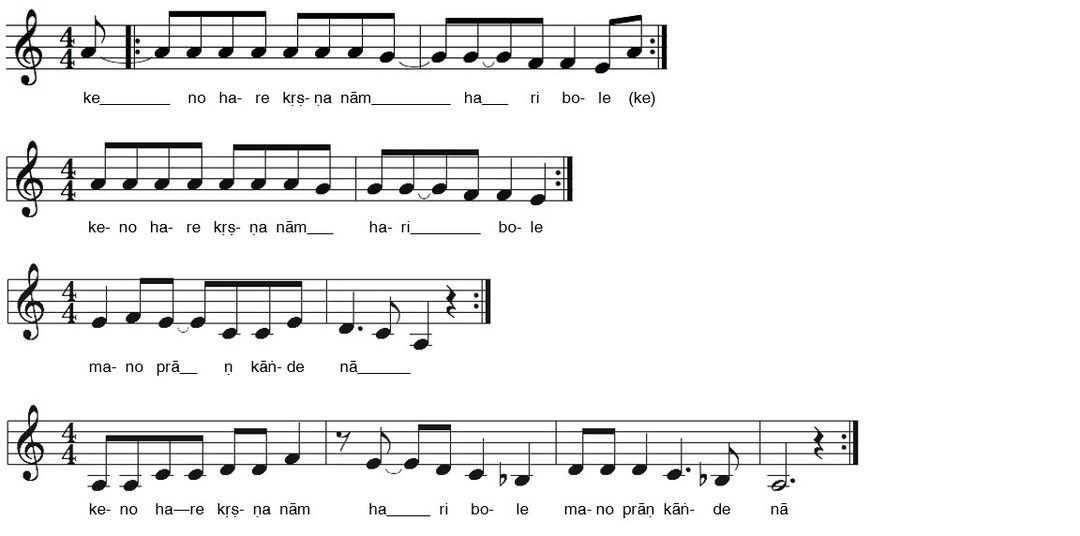
Although the goddess of fortune Lakṣmī Devī is adored by other youthful goddesses, who are themselves glorified throughout all the universe, still she is nowhere near Śrī Rādhikā in the matter of beauty, praiseworthy youthfulness, or other divine feminine opulences. There is no one in the material or spiritual worlds superior to Rādhikā in the expression of naturally loving pastimes. May Śrī Rādhikā bestow upon me the service of Her own lotus feet.
5 rāsa-lāsya-gīta-narma-sat-kalāli-paṇḍitā prema-ramya-rūpa-veśa-sad-guṇāli-maṇḍitā viśva-navya-gopa-yoṣid-ālito 'pi yādhikā mahyam ātma-pāda-padma-dāsya-dāstu rādhikā rāsa-lāsya—in the rāsa dance; gīta—singing; narma—joking; sat—transcendental; kalā—in the arts; āli—the multitude; paṇḍitā—She who is very learned; prema— love; ramya—beautiful; rūpa—form; veśa—dress and ornaments; sat— transcendental; guṇa—of qualities; āli—by the multitudes; maṇḍitā—She who is decorated; viśva—by the universe; navya—to be praised; gopa-yoṣit—of cowherd women; ālitaḥ—than the multitude; api—even; yā—who; adhikā—She who is the best; mahyam—to me; ātma—Her own; pāda-padma—of the lotus feet; dāsya-dā— the giver of service; astu—may become; rādhikā—Śrīmatī Rādhārāṇī.
She is very learned in many transcendental arts, such as performing in the rāsa dance, singing, and joking. She is decorated with many divine qualities, such as loving nature, exquisite beauty, and wonderful garments and ornaments. Even among the cowherd damsels of Vraja, who are praised by the entire universe, She is the best in every way. May Śrī Rādhikā bestow upon me the service of Her lotus feet.
6 nitya-navya-rūpa-keli-kṛṣṇa-bhāva-sampadā kṛṣṇa-rāga-bandha-gopa-yauvateṣu kampadā kṛṣṇa-rūpa-veśa-keli-lagna-sat-samādhikā mahyam ātma-pāda-padma-dāsya-dāstu rādhikā nitya—eternal; navya—youthful; rūpa—beauty; keli—pastimes; kṛṣṇa—of Kṛṣṇa; bhāva—love; sampadā—She who is endowed with the opulences; kṛṣṇa—of Kṛṣṇa; rāga—by love; bandha—with bonds; gopa-yauvateṣu—to the young gopīs; kampadā—She who causes trembling; kṛṣṇa—of Kṛṣṇa; rūpa—beautiful form; veśa—garments and ornaments; keli—pastimes; lagna—attached; sat— transcendental; samādhikā—She who is engaged in meditation; mahyam—to me; ātma—Her own; pāda-padma—of the lotus feet; dāsya-dā—the giver of service; astu—may become; rādhikā—Śrīmatī Rādhārāṇī.
She possesses the opulences of eternal youthful beauty, eternal pastimes, and eternal love for Kṛṣṇa. Her ecstatic feelings of love for Kṛṣṇa cause the gopīs, who are also in love with Kṛṣṇa, to tremble. She is always attached to meditating on Śrī Kṛṣṇa's beautiful form, ornaments, garments, and pastimes. May Śrī Rādhikā bestow upon me the service of Her own lotus feet.
7 sveda-kampa-kaṇṭakāśru-gadgadādi-sañcitā
marṣa-harṣa-vāmatādi-bhāva-bhuṣaṇāñcitā
kṛṣṇa-netra-toṣi-ratna-maṇḍanāli-dādhikā mahyam ātma-pāda-padma-dāsya-dāstu rādhikā sveda—perspiring; kampa—trembling; kaṇṭaka—standing up of hairs on the body; aśru—tears; gadgada—choking up of the voice; ādi—and other symptoms of ecstasy; sañcitā—She who has accumulated; amarṣa—impatience; harṣa—joy; vāmatā—crookedness; ādi—and others; bhāva—of ecstatic moods; bhuṣaṇā— with the ornaments; añcitā—She who is marked; kṛṣṇa—of Kṛṣṇa; netra—the eyes; toṣi—delighting; ratna—jewels; maṇḍana—ornaments; āli—with the multitudes;
dādhikā—She who wears; mahyam—to me; ātma—Her own; pāda-padma—of the lotus feet; dāsya-dā—the giver of service; astu—may become; rādhikā—Śrīmatī Rādhārāṇī.
She is graced with the eight ecstatic symptoms of sāttvika-bhāva, such as trembling, perspiring, standing up of bodily hairs, tears and faltering of the voice. She is adorned with different ecstatic emotional ornaments, such as impatience, joy and contrariness. She is decorated with beautiful jewels that give total delight to the eyes of Kṛṣṇa. May Śrī Rādhikā bestow upon me the service of Her own lotus feet.
8 yā kṣaṇārdha-kṛṣṇa-viprayoga-santatoditā-
neka-dainya-cāpalādi-bhāva-vṛnda-moditā yatna-labdha-kṛṣṇa-saṅga-nirgatākhilādhikā mahyam ātma-pāda-padma-dāsya-dāstu rādhikā yā—She who; kṣaṇa-ardha—half a moment; kṛṣṇa—Śrī Kṛṣṇa; viprayoga—by separation; santata—extended; udita—arisen; aneka—many; dainya—of suffering; cāpala—restlessness; ādi—and more; bhāva—ecstasies; vṛnda—multitudes; moditā—She who is excited; yatna—with great endeavor; labdha—attained; kṛṣṇa—of Kṛṣṇa; saṅga—association; nirgata—gone; akhila—all; ādhikā—mental anguish; mahyam—to me; ātma—Her own; pāda-padma—of the lotus feet; dāsya- dā—the giver of service; astu—may become; rādhikā—Śrīmatī Rādhārāṇī.
If She is separated from Kṛṣṇa for even half a moment, She becomes stricken with wretched suffering, restlessness, and a multitude of other ecstatic symptoms of separation. When She regains the association of Kṛṣṇa after some effort, then all Her anguish immediately vanishes. May Śrī Rādhikā bestow upon me the service of Her own lotus feet.
9 aṣṭakena yas tv anena nauti kṛṣṇa-vallabhāṁ
darśane 'pi śailajādi-yoṣidāli-durlabhām kṛṣṇa-saṅga-nanditātma-dāsya-sīdhu-bhājanaṁ taṁ karoti nanditāli-sañcayāśu sā janam aṣṭakena—by these eight verses; yaḥ—whoever; tu—indeed; anena—with these; nauti—glorifies; kṛṣṇa-vallabhām—She who is dear to Kṛṣṇa; darśane—in sight; api—even; śaila-jā—She who was born from the mountain (Pārvatī); ādi—and others; yoṣit—of women; āli—for multitudes; durlabhām—very difficult to attain; kṛṣṇa—of Kṛṣṇa; saṅga—by the association; nandita—delighted; ātma—Her own; dāsya—service; sīdhu—of the nectar; bhājanam—the recipient; tam—to him; karoti—She makes; nandita—jubilant; āli—gopī friends; sañcayā—in the assembly; āśu—quickly; sā—She; janam—that person; mahyam—to me; ātma—Her own;
pāda-padma—of the lotus feet; dāsya-dā—the giver of service; astu—may become; rādhikā—Śrīmatī Rādhārāṇī.
It is very difficult for Pārvatī and other exalted goddesses to attain even a glimpse of Śrīmatī Rādhārāṇī, who is dear to Lord Kṛṣṇa. But if someone glorifies Her by reciting these eight verses, then She who is delighted by Kṛṣṇa's continuous association will grant the sweet nectar of Her personal service to that person, who thereby enters the assembly of Her similarly delighted girlfriends.
Commentary
As mentioned in regard to Rūpa Gosvāmī’s song Rādhikā-stava, Prabhupāda and the previous ācāryas were careful to speak about Śrīmatī Rādhārāṇī, Her tattva being a confidential topic. Nevertheless, on special occasions, like Rādhāṣṭamī, devotees are encouraged to approach Her and ask for blessings. In 1973, Prabhupāda celebrated Rādhārāṇī’s appearance day in London. At the end of the lecture, he told his audience:
Rādhārāṇī is the original pleasure potency, always absorbed in thought of Kṛṣṇa. So anyone who comes before Rādhārāṇī to serve Kṛṣṇa, oh, She becomes so pleased, "Oh, here is a devotee of Kṛṣṇa." She immediately recommends, "Kṛṣṇa, oh, here is a devotee. He is better than Me." This is Rādhārāṇī. I may be most fallen rascal. But if I try to reach Kṛṣṇa through Rādhārāṇī, then my business is successful. Therefore we should worship Rādhārāṇī first. That is our business. Instead of offering directly one flower to Kṛṣṇa, you just put it in the hands of Rādhārāṇī: "My mother Rādhārāṇī, jagan-mātā, if You kindly take this flower and offer it to Kṛṣṇa." […] So this is our philosophy, to please Kṛṣṇa through Rādhārāṇī, and just today is the auspicious day of Rādhārāṇī's appearance. So we should offer puṣpāñjali and pray to Rādhārāṇī that "Rādhārāṇī, kindly be merciful and tell about me to Your Kṛṣṇa. To Your Kṛṣṇa. Kṛṣṇa is Yours." Kṛṣṇa, Rādhā- Kṛṣṇa. Kṛṣṇa is not independent. Kṛṣṇa is Rādhārāṇī's property. So you have to approach Kṛṣṇa through Rādhārāṇī. That is, today is the auspicious day. Worship Rādhārāṇī very nicely and be happy. Thank you very much. Hare Kṛṣṇa.
Madhurāṣṭaka
Vallabhācārya
1 adharaṁ madhuraṁ vadanaṁ madhuraṁ
nayanaṁ madhuraṁ hasitaṁ madhuraṁ hṛdayaṁ madhuraṁ gamanaṁ madhuraṁ madhurādhi-pater akhilaṁ madhuraṁ adharam—lips; madhuram—sweet; vadanam—face; madhuram—sweet; nayanam—eyes; madhuram—sweet; hasitam—smile; madhuram—sweet; hṛdayam—heart; madhuram—sweet; gamanam—gait; madhuram—sweet; madhura-adhi-pateḥ—of the Emperor of sweetness; akhilam—all; madhuram— sweet.
His lips are sweet, His face is sweet His eyes are sweet, His smile is sweet His heart is sweet, His gait is sweet-Everything is sweet about the Emperor of Sweetness!
2 vacanaṁ madhuraṁ caritaṁ madhuraṁ
vasanaṁ madhuraṁ valitaṁ madhuraṁ calitaṁ madhuraṁ bhramitaṁ madhuraṁ madhurādhi-pater akhilaṁ madhuraṁ vacanam—speech; madhuram—sweet; caritam—character; madhuram—sweet; vasanam—clothing; madhuram—sweet; valitam—belly-folds; madhuram—sweet; calitam—wandering; madhuram—sweet; bhramitam—wandering; madhuram— sweet; madhura-adhi-pateḥ—of the Emperor of sweetness; akhilam—all; madhuram—sweet.
His words are sweet, His character is sweet His dress is sweet, His belly- folds are sweet His movements are sweet, His wandering is sweet- Everything is sweet about the Emperor of Sweetness!
3 veṇur madhuro reṇur madhuraḥ pāṇir madhuraḥ pādau madhurau nṛtyaṁ madhuraṁ sakhyaṁ madhuraṁ madhurādhi-pater akhilaṁ madhuraṁ veṇuḥ—flute; madhuraḥ—sweet; reṇuḥ—dust; madhuraḥ—sweet; pāṇiḥ—hands; madhuraḥ—sweet; pādau—feet; madhurau—sweet (pair); ntyam—dancing; madhuram—sweet; sakhyam—friendship; madhuram—sweet; madhura-adhi- pateḥ—of the Emperor of sweetness; akhilam—all; madhuram—sweet.
His flute is sweet, His foot-dust is sweet His hands are sweet, His feet are sweet His dancing is sweet, His friendship is sweet-Everything is sweet about the Emperor of Sweetness!
4 gītaṁ madhuraṁ pītaṁ madhuraṁ bhuktaṁ madhuraṁ suptam madhuraṁ rūpaṁ madhuraṁ tilakaṁ madhuraṁ madhurādhi-pater akhilaṁ madhuraṁ gītam—singing; madhuram—sweet; pītam—yellow cloth; madhuram—sweet; bhuktam—eating; madhuram—sweet; suptam—sleeping; madhuram—sweet; rūpam—beauty; madhuram—sweet; tilakam—forehead marking; madhuram— sweet; madhura-adhi-pateḥ—of the Emperor of sweetness; akhilam—all; madhuram—sweet.
His singing is sweet, His yellow cloth is sweet His eating is sweet, His sleeping is sweet His beauty is sweet, His tilaka is sweet-Everything is sweet about the Emperor of Sweetness!
5 karaṇaṁ madhuraṁ taraṇaṁ madhuraṁ haraṇaṁ madhuraṁ ramaṇaṁ madhuraṁ vamitaṁ madhuraṁ śamitaṁ madhuraṁ madhurādhi-pater akhilaṁ madhuraṁ karaṇam—deeds; madhuram—sweet; taraṇam—deliverance; madhuram—sweet; haraṇam—stealing; madhuram—sweet; ramaṇam—love-making; madhuram— sweet; vamitam—offering oblations; madhuram—sweet; śamitam—tranquility; madhuram—sweet; madhura-adhi-pateḥ—of the Emperor of sweetness; akhilam—all; madhuram—sweet.
His deeds are sweet, His liberating is sweet His stealing is sweet, His love- sports are sweet, His oblations are sweet, His tranquility is sweet-Everything is sweet about the Emperor of Sweetness!
6 guñjā madhurā mālā madhurā yamunā madhurā vīcī madhurā salilaṁ madhuraṁ kamalaṁ madhuraṁ madhurādhi-pater akhilaṁ madhuraṁ guñjā—berry necklace; madhurā—sweet; mālā—garland; madhurā—sweet; yamunā—the river; madhurā—sweet; vīcī—ripples; madhurā—sweet; salilam— water; madhuram—sweet; kamalam—lotuses; madhuram—sweet; madhura-adhi- pateḥ—of the Emperor of sweetness; akhilam—all; madhuram—sweet.
His gopīs are sweet, His Pastimes are sweet, His union is sweet, His food is sweet, His delight is sweet, His courtesy is sweet -Everything is sweet about the Emperor of Sweetness
7 gopī madhurā līlā madhurā yuktaṁ madhuraṁ bhuktaṁ madhuraṁ hṛṣṭaṁ madhuraṁ śiṣṭaṁ madhuraṁ madhurādhi-pater akhilaṁ madhuraṁ gopī—cowherd girls; madhurā—sweet; līlā—pastimes; madhurā—sweet; yuktam—union; madhuram—sweet; bhuktam—food; madhuram—sweet; hṛṣṭam—delight; madhuram—sweet; śiṣṭam—courtesy; madhuram—sweet; madhura-adhi-pateḥ—of the Emperor of sweetness; akhilam—all; madhuram— sweet.

His guñjā-berry necklace is sweet, His flower garland is sweet, His Yamunā river is sweet, His ripples are sweet His water is sweet, His lotuses are sweet- Everything is sweet about the Emperor of Sweetness!
8 gopā madhurā gāvo madhurā yaṣṭir madhurā sṛṣṭir madhurā dalitaṁ madhuraṁ phalitaṁ madhuraṁ madhurādhi-pater akhilaṁ madhuraṁ gopāḥ—cowherd boyfriends; madhurā—sweet; gāvaḥ—cows; madhurā—sweet; yaṣṭiḥ—staff; madhurā—sweet; sṛṣṭiḥ—creation; madhurā—sweet; dalitam— trampling; madhuram—sweet; phalitam—fruitfulness; madhuram—sweet; madhura-adhi-pateḥ—of the Emperor of sweetness; akhilam—all; madhuram— sweet.
His gopas are sweet, His cows are sweet His staff is sweet, His creation is sweet His trampling is sweet, His fruitfulness is sweet-Everything is sweet about the Emperor of Sweetness!
Commentary
Kṛṣṇa’s sweetness is a confidential topic, because it can be tasted only when the consciousness is completely free from all material contamination and the devotee is fully absorbed in the sentiment of servitude. Otherwise, the tendency will be to enjoy the sweetness of the Lord for one’s own selfish purposes. Prabhupāda gives us a glimpse of the inconceivably wonderful characteristic of Kṛṣṇa’s sweetness in the following purport (Cc. Madhaya 21.104: “When we consider impartially all the unlimited pastimes of the Lord, we find that His pastimes as a human being on this
planet—wherein He sports as a cowherd boy with a flute in His hands and appears youthful and fresh like a ballet dancer—are pastimes and features that are never subjected to material laws and inebrieties. The wonderful beauty of Kṛṣṇa is presented in the supreme planet, Gokula (Goloka Vṛndāvana). Inferior to that is His representation in the spiritual sky, and inferior to that is His representation in the external energy (Devī-dhāma). A mere drop of Kṛṣṇa’s sweetness can drown these three worlds—Goloka Vṛndāvana, Hari-dhāma (Vaikuṇṭhaloka) and Devī-dhāma (the material world). Everywhere, Kṛṣṇa’s beauty merges everyone in the ecstasy of transcendental bliss. Actually the activities of yogamāyā are absent in the spiritual sky and the Vaikuṇṭha planets. She simply works in the supreme planet, Goloka Vṛndāvana, and she works to manifest the activities of Kṛṣṇa when He descends to the material universe to please His innumerable devotees within the material world.” Upadeśāmṛta 7 – Purport The holy name of Lord Kṛṣṇa, His quality, pastimes and so forth are all of the nature of absolute truth, beauty and bliss. Naturally they are very sweet, like sugar candy, which appeals to everyone. Nescience, however, is compared to the disease called jaundice, which is caused by bilious secretions. Attacked by jaundice, the tongue of a diseased person cannot palatably relish sugar candy. Rather, a person with jaundice considers something sweet to taste very bitter. Avidyā (ignorance) similarly perverts the ability to relish the transcendentally palatable name, quality, form and pastimes of Kṛṣṇa. Despite this disease, if one with great care and attention takes to Kṛṣṇa consciousness, chanting the holy name and hearing Kṛṣṇa's transcendental pastimes, his ignorance will be destroyed and his tongue enabled to taste the sweetness of the transcendental nature of Kṛṣṇa and His paraphernalia. Such a recovery of spiritual health is possible only by the regular cultivation of Kṛṣṇa consciousness.
Corāṣṭaka Bilvamangala Ṭhākura
1 vraje prasiddhaṁ navanīta-cauraṁ
gopāṅganānāṁ ca dukūla-cauram
aneka-janmārjita-pāpa-cauraṁ caurāgragaṇyaṁ puruṣaṁ namāmī vraje—in Vraja; prasiddhaṁ—well known; navanīta-cauraṁ—butter thief; gopāṅganānāṁ—of the gopīs; ca—and; dukūla-cauram—He who steals garments of fine cloth; aneka—many; janma—births; arjita—accrued; pāpa—sins; cauraṁ— takes away; caura—thief; agragaṇyaṁ—foremost; puruṣaṁ—supreme person; namāmī—I offer my respectful obeisances.
I offer my respectful obeisances to that foremost of thieves — who is famous in Vraja as the butter-thief and He who steals the gopis’ clothes, and who, for those who take shelter of Him, takes away the sins which have accrued over many lifetimes.
2 śrī-rādhikāyā hṛdayasya cauraṁ navāmbuda-śyāmala-kānti-cauram padāśritānāṁ ca samasta-cauraṁ caurāgragaṇyaṁ puruṣaṁ namāmī śrī-rādhikāyā—Śrī Rādhikā’s; hṛdayasya—of the heart; cauraṁ—thief; nava— newly formed; ambuda—raincloud; śyāmala-kānti—dark luster; cauram—steals; pada-āśritānāṁ—of those who have taken shelter at His feet; ca—and; samasta— all kinds of sins and miseries; cauraṁ—takes away; caura—thief; āgragaṇya— foremost; puruṣaṁ—to the supreme person; namāmī—I offer my respectful obeisances.
I offer my respectful obeisances to the foremost of thieves who steals Śrī Rādhikā’s heart, who steals the dark luster of a fresh raincloud, and who steals all the sins and sufferings of those who take shelter at His lotus feet.
3 akiñcanī-kṛtya padāśritaṁ yaḥ karoti bhikṣuṁ pathi geha-hīnam kenāpy aho bhīṣaṇa-caura īdṛg dṛṣṭaḥ śruto vā nā jagat-traye ‘pi akiñcanī-kṛtya—turns into paupers; pada-āśritam—having taken shelter at His feet; yaḥ—one who; karoti—makes; bhikṣuṁ—beggar; pathi—on the path; geha- hīnam—without home; kena—why; api—even; aho—oh!; bhīṣaṇa-caura— fearsome thief; īdṛg—this; dṛṣṭaḥ—seen; śrutaḥ—hear; vā—or; nā—not; jagat- traye—in the three worlds; api—even.
He turns His surrendered devotees into paupers and wandering, homeless beggars — alas! Such a fearsome thief has never been seen or heard of in all the three worlds.
4 yadīya nāmāpi haraty aśeṣaṁ
giri-prasārān-api pāpa-rāśīn āścarya-rūpo nanu caura īdṛg dṛṣṭaḥ śruto vā na mayā kadāpi yadi—if; iya—this; nāma—name; api—even; harati—takes away; aśeṣaṁ— unlimited; giri-prasārān—mountains; api—even; pāpa-rāśīn—signs of sin; āścarya- rūpaḥ—wonderful form; nanu—but; caura—thief; īdṛg—such; dṛṣṭaḥ—I have seen; śrutaḥ—heard; vā—or; na—not; mayā—I; kadā—when; api—even. Mere utterance of His name purges one of a mountain of sins — such an astonishingly wonderful thief I have never seen or heard of anywhere!
5 dhanaṁ ca mānaṁ ca tathendriyāṇi prāṇāṁś ca hṛtvā mama sarvam eva palāyase kutra dhṛto ‘dya caura tvaṁ bhakti-dāmnāsi mayā niruddhaḥ dhanaṁ—wealth; ca—and; mānaṁ—mind; ca—and; tatha—as well as; indriyāṇi—senses; prāṇān—life; ca—and; hṛtvā—after stealing; mama—my; sarvam—everything; eva—certainly; palāyase—get protection; kutra—where; dhṛtaḥ—taken; adya—today; caura—thief; tvaṁ—You; bhakti-dāmnā—rope of devotion; asi—are You; mayā—by me; niruddhaḥ—caught.
O Thief! Having stolen my wealth, my honor, my senses, my life and my everything, where can You run to? I have caught You with the rope of my devotion.
6 chinatsi ghoraṁ yama-pāśa-bandhaṁ bhinatsi bhīmaṁ bhava-pāśa-bandham chinatsi sarvasya samasta-bandhaṁ naivātmano bhakta-kṛtaṁ tu bandham chinatsi—cut; ghoraṁ—terrible; yama-pāśa-bandhaṁ—noose of Yamarāja; bhinatsi—sever; bhīmaṁ—dreadful; bhava-pāśa-bandham—shackles of material existence; chinatsi—cut; sarvasya—of everyone; samasta-bandhaṁ—all bondage; na—not; eva—certainly; ātmanaḥ—own; bhakta-kṛtaṁ—devotees; tu— but; bandham—knot.
You cut the terrible noose of Yamarāja, You sever the dreadful noose of material existence, and You slash everyone’s material bondage, but You are unable to cut the knot fastened by Your own loving devotees.
7 man-mānase tāmasa-rāśi-ghore kārā-gṛhe duḥkha-maye nibaddhaḥ labhasva he caura! hare! cirāya sva-caurya-doṣocitam eva daṇḍam man-mānase—in my mind (heart); tāmasa-rāśi-ghore—the terrible darkness of ignorance; kārā-gṛhe—prison house; duḥkha-maye—miserable; nibaddhaḥ— bound; labhasva—gain; he caura!—o thief; hare!—He who takes away; cirāya— after a long time; sva-caurya—Your stealing; doṣa—crimes; ucitam—befitting; eva—cetainly; daṇḍam—punishment.
O stealer of my everything! O Thief! Today I have imprisoned You in the miserable prison house of my heart which is very fearful due to the terrible darkness of my ignorance, and there for a very long time You will remain, receiving befitting punishment for Your crimes of thievery!
8 kārā-gṛhe vasa sadā hṛdaye madīye mad-bhakti-pāśa-dṛḍha-bandhana-niścalaḥ san tvāṁ kṛṣṇa he! pralaya-koṭi-śatāntare ‘pi sarvasva caura hṛdayān-nāhi mocayāmi kārā-gṛhe—prison house; vasa—reside; sadā—forever; hṛdaye—in the heart; madīye—my; mad-bhakti-pāśa—the noose of my devotion; dṛḍha—strong; bandhana—binding; niścalaḥ—unflinching; sat—exists eternally; tvāṁ—Your; kṛṣṇa he!—o Kṛṣṇa; pralaya—annihilation; koṭi—millions; śata—hundreds; antare—in different; api—although; sarvasva—all; caura—thief; hṛdayān—of my heart; nāhi—not; mocayāmi—I will release. O Krsna, thief of everything I possess! The noose of my devotion remaining forever tight, You will continue to reside eternally in the prison house of my heart because I will not release You for millions of aeons.
Commentary
In this prayer, the absolute nature of Kṛṣṇa’s transcendental qualities is described. Even when He acts a thief, a behavior condemned and punished in this world, such stealing is always for the benefit of those He steals from, and such activities are a fountain of joy for all those involved. A devotee the Lord steals from is never a loser but gains beyond his imagination. Śrīla Prabhupāda speaks about Kṛṣṇa’s stealing propensity in his books and lectures. Here are some examples. Śrīmad-Bhāgavatam 1.7.10 – Purport The word hari conveys various meanings, but the chief import of the word is that He (the Lord) vanquishes everything inauspicious and takes away the mind of the devotee by awarding pure transcendental love. By remembering the Lord in acute distress one can be free from all varieties of miseries and anxieties. Gradually the Lord vanquishes all obstacles on the path of devotional service of a pure devotee, and the result of nine devotional activities, such as hearing and chanting, becomes manifested. Teachings of Queen Kuntī – Text 27 Because we are part and parcel of Kṛṣṇa, who has full freedom, we too have full freedom, although the quantity of that freedom is quite minute. Although the quantity of salt in a drop of seawater is not comparable to the quantity of salt in the ocean, the chemical composition of both the drop and the ocean is the same. Similarly, whatever we have in a minute quantity is present in its fullness in Kṛṣṇa (janmādy asya yataḥ). For example, we have a propensity to steal, to take things that belong to others. Why? Because Kṛṣṇa has the same propensity. Unless the propensity to steal is present in the Absolute Truth, how can it be present in us? Kṛṣṇa is known as "the butter thief." But Kṛṣṇa's stealing and our stealing are different. Because we are materially contaminated, our stealing is abominable, whereas on the spiritual, absolute platform the same stealing is so nice that it is enjoyable. Mother Yaśodā therefore enjoys Kṛṣṇa's activities of stealing. This is the difference between material and spiritual.
Śrīmad-Bhāgavatam 8.19.32 – Purport Śrīla Viśvanātha Cakravartī Ṭhākura explains in this regard that the very word hariḥ means "one who takes away." If one connects himself with Hari, the Supreme Personality of Godhead, the Lord takes away all his miseries, and in the beginning the Lord also superficially appears to take away all his material possessions, reputation, education and beauty. As stated in Śrīmad-Bhāgavatam (10.88.8), yasyāham anugṛhṇāmi hariṣye tad-dhanaṁ śanaiḥ. The Lord said to Mahārāja Yudhiṣṭhira, "The first installment of My mercy toward a devotee is that I take away all his possessions, especially his material opulence, his money." This is the special favor of the Lord toward a sincere devotee. If a sincere devotee wants Kṛṣṇa above everything but at the same time is attached to material possessions, which hinder his advancement in Kṛṣṇa consciousness, by tactics the Lord takes away all his possessions. Here Śukrācārya says that this dwarf brahmacārī would take away everything. Thus he indicates that the Lord will take away all one's material possessions and also one's mind. If one delivers his mind to the lotus feet of Kṛṣṇa (sa vai manaḥ kṛṣṇa-padāravindayoḥ), one can naturally sacrifice everything to satisfy Him. Although Bali Mahārāja was a devotee, he was attached to material possessions, and therefore the Lord, being very kind to him, showed him special favor by appearing as Lord Vāmana to take away all his material possessions, and his mind as well.
Dāmodarāṣṭaka Kṛṣṇa Dvaipāyana Vyāsa
1 namāmīśvaraṁ sac-cid-ānanda-rūpaṁ
lasat-kuṇḍalaṁ gokule bhrājamanam
yaśodā-bhiyolūkhalād dhāvamānaṁ parāmṛṣṭam atyantato drutya gopyā namāmi—I bow down; īśvaram—to the supreme controller; sat-cit-ānanda- rūpam—whose form is composed of eternity, knowledge and bliss; lasat- kuṇḍalam—whose earrings play and swing; gokule bhrājamānam—who is splendrously manifest in Gokula; yaśodā-bhiyā—in fear of mother Yaśodā; ulūkalāt-dhāvamānam—who gets down from the wooden rice-grinding mortar and runs away; para-āmṛṣṭam—catching Him by the back; atyam—very much; tatam drutya—chasing after Him quickly; gopyā—by the gopī (Śrī Yaśodā).
To the Supreme Lord, whose form is the embodiment of eternal existence, knowledge, and bliss, whose shark-shaped earrings are swinging to and fro, who is beautifully shining in the divine realm of Gokula, who [due to the offense of breaking the pot of yogurt that His mother was churning into butter and then stealing the butter that was kept hanging from a swing] is quickly running from the wooden grinding mortar in fear of mother Yaśodā, but who has been caught from behind by her who ran after Him with greater speed-to that Supreme Lord, Śrī Dāmodara, I offer my humble obeisances.
2 rudantaṁ muhur netra-yugmaṁ mṛjantam
karāmbhoja-yugmena sātaṅka-netram muhuḥ śvāsa-kampa-trirekhāṅka-kaṇṭha- sthita-graivaṁ dāmodaraṁ bhakti-baddham rudantam—crying; muhuḥ—again and again; netra-yugmam—His two eyes; mṛjantam—rubbing; kara-ambhoja-yugmena—with His two lotus-like hands; sa- ātaṅka-netram—with very fearful eyes; muhuḥ—again and again; śvāsa—quick breathing and sighing; kampa—trembling; tri-rekha-aṅka-kaṇṭha—neck marked with three lines (just like a conchshell); sthita—situated; graiva—pearl necklaces and other neck-ornaments; dāma-udaram—unto He with a rope around His belly; bhakti-baddham—who is bound by devotion.
[Seeing the whipping stick in His mother's hand,] He is crying and rubbing His eyes again and again with His two lotus hands. His eyes are filled with fear, and the necklace of pearls around His neck, which is marked with three lines like a conchshell, is shaking because of His quick breathing due to crying. To this Supreme Lord, Śrī Dāmodara, whose belly is bound not with ropes but with His mother's pure love, I offer my humble obeisances.
3 itīdṛk sva-līlābhir ānanda-kuṇḍe sva-ghoṣaṁ nimajjantam ākhyāpayantam tadīyeṣita-jñeṣu bhaktair jitatvaṁ punaḥ prematas taṁ śatāvṛtti vande iti īdṛk—displaying in this way (childhood pastimes such as the Dāmodara-līlā and so forth); sva-līlābhiḥ—by His own pastimes; ānanda-kuṇḍe—in a pool of bliss; sva- ghoṣam—His own family and the other residents of Gokula; nimajjantam— immersing; ākhyāpayantam—makes known; tadīya-īśita-jñeṣu—to those desirous of knowing His majesty (aiśvarya); bhaktaiḥ jitatvam—His quality of being conquered by His loving devotees (who are devoid of aiśvarya-jñāna); punaḥ— again; premataḥ—with love and devotion; tam—unto that Lord Dāmodara; śata- āvṛtti—hundreds and hundreds of times; vande—I praise.
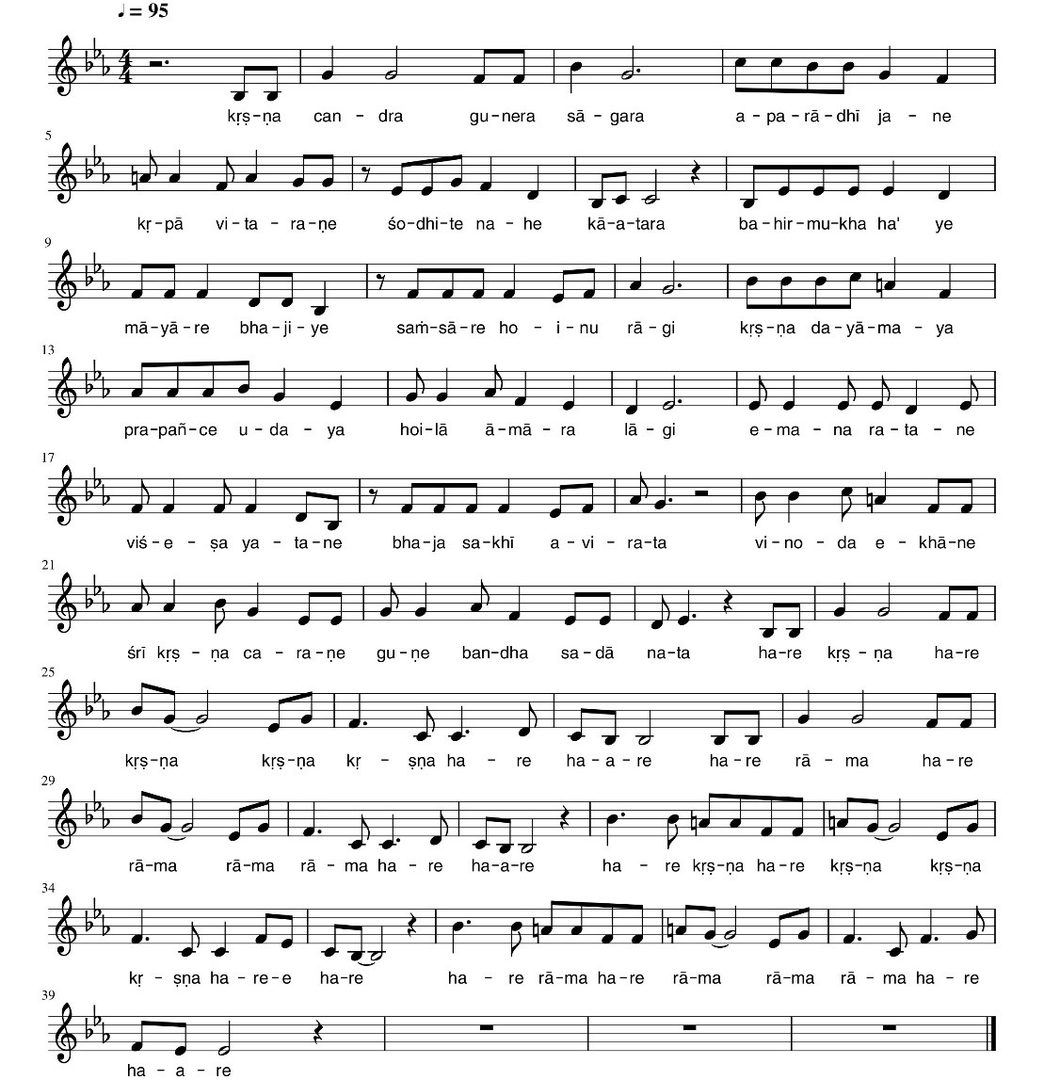
By such childhood pastimes as this He is drowning the inhabitants of Gokula in pools of ecstasy, and is revealing to those devotees who are absorbed in knowledge of His supreme majesty and opulence that He is only conquered by devotees whose pure love is imbued with intimacy and is free from all conceptions of awe and reverence. With great love I again offer my obeisances to Lord Dāmodara hundreds and hundreds of times.
4 varaṁ deva mokṣaṁ na mokṣāvadhiṁ vā
na canyaṁ vṛṇe 'haṁ vareṣād apīha
idaṁ te vapur nātha gopāla-bālaṁ sadā me manasy āvirāstāṁ kim anyaiḥ varam—boons; deva—O Lord!; mokṣam—liberation; na—not; mokṣā-avadhim— the highest pinnacle of liberation (the realm of Śrī Vaikuṇṭha-loka); vā—or; na— not; ca-anyam—or anything else; vṛṇe aham—I pray for; vara-īśāt—from You Who can bestow any boon; api—also; iha—here in Vṛndāvana; idam—this; te—Your; vapuḥ—divine bodily form; nātha—O Lord!; gopāla-bālam—a young cowherd boy; sadā—always; me manasi—in my heart; āvirāstām—may it be manifest; kim anyaiḥ—what is the use of other things (mokṣā, and so forth.)
O Lord, although You are able to give all kinds of benedictions, I do not pray to You for the boon of impersonal liberation, nor the highest liberation of eternal life in Vaikuṇṭha, nor any other boon [which may be obtained by executing the nine processes of bhakti ]. O Lord, I simply wish that this form of Yours as Bāla Gopāla in Vṛndāvana may ever be manifest in my heart, for what is the use to me of any other boon besides this?
5 idaṁ te mukhāmbhojam atyanta-nīlair vṛtaṁ kuntalaiḥ snigdha-raktaiś ca gopyā muhuś cumbitaṁ bimba-raktādharaṁ me manasy āvirāstām alaṁ lakṣa-lābhaiḥ idam—this; te—Your; mukha-ambhojam—lotus-like face; avyakta-nīlaiḥ—by very dark blue; vṛtam—surrounded; kuntalaiḥ—by curling locks of hair; snigdha—soft and glossy; raktaiḥ—by reddish-tinted; ca—also; gopyā—by the gopī (Śrī Yaśodā); muhuḥ—again and again; cumbitam—kissed; bimba-rakta-adharam—with lips red as the bimba fruit; me—my; manasi—in the heart; āvirāstām—may it be manifest; alam—useless (there is no need for me); lakṣa-lābhaiḥ—by millions of attainments of other boons.
O Lord, Your lotus face, which is encircled by locks of soft black hair tinged with red, is kissed again and again by mother Yaśodā, and Your lips are reddish like the bimba fruit. May this beautiful vision of Your lotus face be ever manifest in my heart. Thousands and thousands of other benedictions are of no use to me.
6 namo deva dāmodarānanta viṣṇo prasīda prabho duḥkha-jālābdhi-magnam kṛpā-dṛṣṭi-vṛṣṭyāti-dīnaṁ batānu gṛhāṇeṣa mām ajñam edhy akṣi-dṛśyaḥ namaḥ—I bow down; deva—O divine Lord!; dāmodara—O Lord whose belly is bound with a rope!; ananta—O limitless Lord!; viṣṇo—O all-pervading Lord!; prasīda—be pleased; prabho—O my Master!; duḥkha-jāla—a network of material miseries; abdhi-magnam—immersed in the ocean; kṛpā-dṛṣṭi-vṛṣṭyā—by the rain of merciful glances; āti-dīnam—very fallen; bata—alas!; anugṛhāṇa—please accept; īśa—O supremely independent Lord!; mām—me; ajñam—ignorant; edhi— please come; akṣi-dṛśyaḥ—perceptible to my eyes.
O Supreme Godhead, I offer my obeisances unto You. O Dāmodara! O Ananta! O Viṣṇu! O master! O my Lord, be pleased upon me. By showering Your glance of mercy upon me, deliver this poor ignorant fool who is immersed in an ocean of worldly sorrows, and become visible to my eyes.
7 kuverātmajau baddha-mūrtyaiva yadvat
tvayā mocitau bhakti-bhājau kṛtau ca tathā prema-bhaktiṁ svakāṁ me prayaccha na mokṣe graho me 'sti dāmodareha kuvera-ātmajau—the two sons of Kuvera (named Nalakūvara and Maṇigrīva); baddha-mūrtyā-eva—by He whose divine form was bound with ropes to the grinding mortar; yat-vat—since they were like that (cursed by Nārada to take birth as twin arjuna trees); tvayā—by You; mocitau—they who were liberated; bhakti- bhājau—the recipients of devotional service; kṛtau—You made them; ca—also; tathā—then; prema-bhaktim—loving devotion; svakām—Your own; me—unto me; prayaccha—please give; na mokṣe—not for liberation; grahaḥ—enthusiasm; me— my; asti—is; dāmodara—O Lord Dāmodara!; iha—this.
O Lord Dāmodara, just as the two sons of Kuvera-Manigrīva and Nalakūvara- were delivered from the curse of Nārada and made into great devotees by You in Your form as a baby tied with rope to a wooden grinding mortar, in the same way, please give to me Your own prema-bhakti. I only long for this and have no desire for any kind of liberation.
namas te 'stu dāmne sphurad-dīpti-dhāmne
tvadīyodarāyātha viśvasya dhāmne
namo rādhikāyai tvadīya-priyāyai namo 'nanta-līlāya devāya tubhyam namaḥ—obeisances; te—to You; astu—may there be; dāmne—unto the rope around Your waist; sphurat—splendrous; dīpti-dhāmne—unto the effulgent abode; tvadīya-udarāya—unto Your belly; atha—thus; viśvasya—of the entire universe; dhāmne—unto the shelter; namaḥ—obeisances; rādhikāyai—unto Rādhikā; tvadīya priyāyai—unto Your Beloved; namaḥ—obeisances; ananta-līlāya—unto Your limitless sportive pastimes; devāya—unto Your transcendental nature; tubhyam—unto You.
O Lord Dāmodara, I first of all offer my obeisances to the brilliantly effulgent rope which binds Your belly. I then offer my obeisances to Your belly, which is the abode of the entire universe. I humbly bow down to Your most beloved Śrīmatī Rādhārāṇī, and I offer all obeisances to You, the Supreme Lord, who displays unlimited pastimes.
Commentary
Prabhupāda comments about Kṛṣṇa’s damodara-līlā in the Tenth Canto of Śrīmad- Bhāgavatam (9.15): When mother Yaśodā was trying to bind the offending child, she saw that the binding rope was short by a distance the width of two fingers. Thus she brought another rope to join to it.
PURPORT Here is the first chapter in Kṛṣṇa's exhibition of unlimited potency to mother Yaśodā when she tried to bind Him: the rope was too short. The Lord had already shown His unlimited potency by killing Pūtanā, Śakaṭāsura and Tṛṇāvarta. Now Kṛṣṇa exhibited another vibhūti, or display of potency, to mother Yaśodā. "Unless I agree," Kṛṣṇa desired to show, "you cannot bind Me." Thus although mother Yaśodā, in her attempt to bind Kṛṣṇa, added one rope after another, ultimately she was a failure. When Kṛṣṇa agreed, however, she was successful. In other words, one must be in transcendental love with Kṛṣṇa, but that does not mean that one can control Kṛṣṇa. When Kṛṣṇa is satisfied with one's devotional service, He does everything Himself. Sevonmukhe hi jihvādau svayam eva sphuraty adaḥ. He reveals more and more to the devotee as the devotee advances in service. Jihvādau: this service begins with the tongue, with chanting and with taking the prasādam of Kṛṣṇa.
Jagannāthāṣṭaka
Śaṅkarācārya
1 kadācit kālindī-taṭa- vipina-saṅgītaka-ravo mudābhīrī-nārī-vadana- kamalāsvāda-madhupaḥ ramā-śambhu-brahmāmara- pati-gaṇeśārcita-pado jagannāthaḥ svāmī nayana-patha-gāmī bhavatu me kadācit—sometimes; kālindī-taṭa—on the banks of the Yamunā River; vipina—in the groves; saṅgītaka—of music and singing; ravaḥ—who makes the sounds; mudā—with delight; ābhīrī-nārī—of the cowherd damsels; vadana-kamala—the lotus like faces; āsvāda—tasting; madhupaḥa—bumblebee; ramā—by Lakṣmī; śambhu—Śiva; brahmā—Brahmā; amara—of the immortals (the demigods); pati—the lord (Indra); gaṇeśa—and Gaṇeśa; arcita—worshiped; padaḥ—whose lotus feet; jagannāthaḥ svāmī—Lord Jagannātha; nayana-patha—the path of the eyes; gāmī—traveling; bhavatu—may He be; me—my.
Sometimes in great happiness Lord Jagannātha makes a loud concert with His flute in the groves on the banks of the Yamunā. He is like a bumblebee tasting the beautiful lotuslike faces of the cowherd damsels of Vraja, and great personalities such as Lakṣmī, Śiva, Brahmā, Indra, and Gaṇeśa worship His lotus feet. May that Jagannātha Svāmī be the object of my vision.
2 bhuje savye veṇuṁ śirasi śikhi-puccham kaṭi-taṭe dukūlaṁ netrānte saha_cara-kaṭākṣaṁ vidadhate sadā śrīmad-vṛndāvana- vasati-līlā-paricayo jagannāthaḥ svāmī nayana-patha-gāmī bhavatu me bhuje—in His hand; savye—left; veṇum—His flute; śirasi—upon His head; śikhi- piccham—a peacock feather; kaṭi-taṭe—around His hips; dukūlam—fine silken cloth; netra-ante—from the corners of His eyes; saha-cara—upon His loving companions; kaṭā-akṣam—sidelong glances; vidadhate—He casts; sadā— perpetually; śrīmat-vṛndāvana-vasati—living in Śrī Vṛndāvana; līlā-paricayaḥ—fond of the pastimes.
In His left hand Lord Jagannātha holds a flute, on His head He wears peacock feathers, and on His hips He wears fine yellow silken cloth. From the corners of His eyes He bestows sidelong glances upon His loving devotees, and He always reveals Himself through His pastimes in His divine abode of Vṛndāvana. May that Jagannātha Svāmī be the object of my vision.
3 mahāmbhodhes tīre kanaka- rucire nīla-śikhare vasan prāsādāntaḥ sahaja- balabhadreṇa balinā subhadrā-madhya-sthaḥ sakala- sura-sevāvasara-do jagannāthaḥ svāmī nayana-patha-gāmī bhavatu me mahā-ambhodeḥ—of the great ocean; tīre—on the shore; kanaka—golden; rucire—with an effulgence; nīla—of blue sapphire; śikhare—on the hill; vasan— residing; prāsāda antaḥ—in a large palace; sahaja—with His brother; balabhadreṇa—Balabhadra; balinā—the powerful one; subhadrā—His sister Subhadrā; madhya-sthaḥ—situated between; sakala—to all; sura—godly souls; sevā-avasara—opportunities to render devotional services; daḥ—bestowing.
On the shore of the great ocean, within a large palace atop the brilliant, golden Nīlācala Hill, Lord Jagannātha resides with His powerful brother Balabhadra and His sister Subhadrā, who sits between Them. May that Jagannātha Svāmī, who bestows the opportunity for devotional service upon all godly souls, be the object of my vision.
4 rathārūḍho gacchan pathi milita-bhūdeva-paṭalaiḥ stuti-prādurbhāvam prati- padam upākarṇya sadayaḥ dayā-sindhur bandhuḥ sakala jagatāṁ sindhu-sutayā jagannāthah svāmī nayana-patha-gāmī bhavatu me kṛpā-pārāvāraḥ—an ocean of mercy; sa-jala—full of water; jalada—of rainclouds; śreṇi—like a row; ruciraḥ—whose beautiful complexion; ramā—of goddess Lakṣmī; vāṇī—by the words; rāmaḥ—pleased; sphurat—fully-blown; amala— spotless; paṅkeruha-mukhaḥ—whose lotus face; sura-indraiḥ—by the best of sages; ārādhyaḥ—who is worshiped; śruti-gaṇa-śikhā—by the topmost Upaniṣads; gīta-caritaḥ—whose activities are glorified in song.
Lord Jagannātha is an ocean of mercy and is as beautiful as a row of blackish rain clouds. He is the storehouse of bliss for Lakṣmī and Sarasvatī, and His face resembles a spotless full-blown lotus. The best of demigods and sages worship Him, and the Upaniṣads sing His glories. May that Jagannātha Svāmī be the object of my vision.
5 kṛpā-pārāvāraḥ sajala- jalada-śreṇi-ruciro ramā-vāṇī-rāmaḥ sphurad- amala-paṅkeruha-mukhaḥ surendrair ārādhyaḥ śruti- gaṇa-śikhā-gīta-carito jagannāthaḥ svāmī nayana-patha-gāmī bhavatu me ratha-ārūḍhaḥ—having mounted His cart; gacchan—parading along; pathi—by the road; milita—assembled; bhū-deva—of gods on earth (the brāhmaṇas); paṭalaiḥ— by multitudes; stuti-prādurbhāvam—presentation of prayers; prati-padam—at every step; upākarṇya—hearing; sa-dayaḥ—favorably disposed; dayā-sindhuḥ— an ocean of mercy; bandhuḥ—the friend; sakala-jagatām—of all the worlds; sindhu—of the ocean (of nectar); sutayā—along with the daughter (Lakṣmī).
When Lord Jagannātha moves along the road on His Rathayātrā car, at every step large assemblies of brāhmaṇas loudly chant prayers and sing songs for His pleasure. Hearing their hymns, Lord Jagannātha becomes very favorably disposed toward them. He is the ocean of mercy and the true friend of all the worlds. May that Jagannātha Svāmī, along with His consort Lakṣmī, who was born from the ocean of nectar, be the object of my vision.
6 para-brahmāpīḍaḥ kuvalaya- dalotphulla-nayano
nivāsī nīlādrau nihita- caraṇo 'nanta-śirasi rasānando rādhā-sarasa- vapur-āliṅgana-sukho jagannāthaḥ svāmī nayana-patha-gāmī bhavatu me para-brahma—of the supreme demigod, Brahmā; āpīḍaḥ—the crown; kuvalaya- dala—like petals of a blue lotus; utphulla—full-blown; nayanaḥ—whose eyes; nivāsī—who resides; nīla-adrau—in the Nīlācala temple that resembles a sapphire hill; nihita-caraṇaḥ—whose lotus feet are placed; ananta-śirasi—upon the heads of Lord Anantadeva; rasa-ānandaḥ—overwhelmed by the flow of loving mellows; rādhā—of Śrī Rādhā; sarasa—like a cool pond; vapuḥ—the body; āliṅgana- sukhaḥ—who becomes happy by embracing.
Lord Jagannātha, whose eyes resemble full-blown lotus petals, is the ornament on Lord Brahmā's head. He resides on Nīlācala Hill with His lotus feet placed on the heads of Anantadeva. Overwhelmed by the mellows of love, He joyfully embraces Śrīmatī Rādhārāṇī's body, which is like a cool pond. May that Jagannātha Svāmī be the object of my vision.
7 na vai yāce rājyaṁ na ca kanaka-māṇikya-vibhavaṁ na yāce 'haṁ ramyāṁ sakala jana-kāmyāṁ vara-vadhūm sadā kāle kāle pramatha- patinā gīta-carito jagannāthaḥ svāmī nayana-patha-gāmī bhavatu me na vai—certainly not; yāce—I pray; rājyam—for a kingdom; na ca—or not; kanaka—of gold; māṇikya—and rubies; vibhavam—wealth; na yāce—do not ask; aham—I; ramyām—beautiful; sakala—by all; jana—men; kāmyām—desired; vara- vadhūm—an excellent wife; sadā—always; kāle kāle—always; pramatha-patinā— by Śiva (the lord of the goblins); gīta-caritaḥ—whose glories are sung.
I do not pray for a kingdom, nor for gold, rubies, or wealth. I do not ask for a beautiful wife, as desired by all men. I simply pray that Jagannātha Svāmī, whose glories Lord Śiva always sings, may be the constant object of my vision.
8 hara tvaṁ saṁsāraṁ druta- taram asāraṁ sura-pate hara tvaṁ pāpānāṁ vitatiṁ aparāṁ yādava-pate aho dīne 'nāthe nihita- caraṇo niścitam idarṅ jagannāthaḥ svāmī nayana-patha-gāmī bhavatu me hara—please remove; tvam—You; saṁsāram—material existence; drutataram— quickly; asāram—useless; sura-pate—O Lord of the demigods; hara—please remove; tvam—You; pāpānām—of sinful reactions; vitatim—the accumulation; aparām—boundless; yādava-pate—O Lord of the Yadus; aho—ah; dīne—on those who feel themselves humble; anāthe—the helpless; nihita-caraṇaḥ—whose feet are bestowed; niścitam—it is certain; idam—this.
O Lord of the demigods, please quickly remove this useless material existence I am undergoing. O Lord of the Yadus, please destroy this vast, shoreless ocean of sins. Ah, this is certain: Lord Jagannātha bestows His lotus feet upon those who feel themselves fallen and have no shelter in this world but Him. May that Jagannātha Svāmī be the object of my vision.
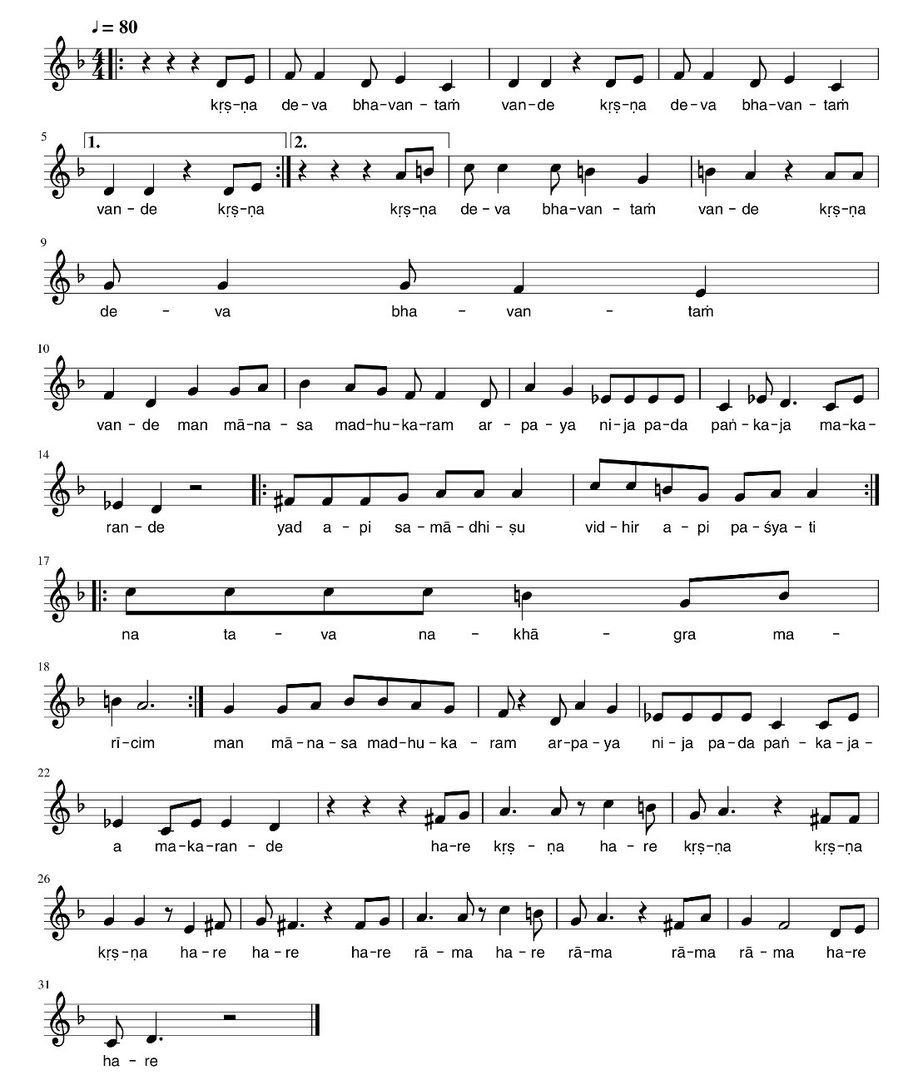
9 jagannāthāṣṭakaṁ punyaṁ yaḥ paṭhet prayataḥ śuciḥ sarva-pāpa-viśuddhātmā viṣṇu-lokaṁ sa gacchati jagannātha-aṣṭakam—eight verses glorifying Lord Jagannātha; puṇyam— auspicious; yaḥ paṭhet—whoever recites; prayataḥ—devoted; śuciḥ—clean; sarva-pāpa—from all sins; viśuddha-ātmā—purified; viṣṇu-lokam—to Lord Viṣṇu’s abode; saḥ—he; gacchati—goes.
That devoted and virtuous soul who recites these eight verses glorifying Lord Jagannātha becomes cleansed of all sins and duly proceeds to Lord Viṣṇu’s abode.
Commentary
On March 26, 1967, Prabhupāda installed the Deities of Lord Jagannātha, Baladeva and Subhadra in the San Francisco temple which was renamed New Jagannātha Purī. After the installation ceremony, he spoke to all the assembled devotees and guests about some basic aspects of worshiping Their Lordships. Prabhupāda:The Bhāgavatam has recommended hearing, chanting, thinking. Just hearing, chanting, thinking and worshiping, the process which we just now introduced on the advent of Jagannātha Svāmī. This temple is now completely fixed. So this is the worshiping process. This is called ārātrika. So at the end of kīrtana this ārātrika will go, and the worshiping process is to take the heat of the light, and whatever your condition is, pay something for the worship. So this simple process, if you follow, you just see how you realize the Absolute Truth. Another, I request you, all the devotees, when you come to the temple, you bring one fruit and one flower. If you can bring more fruit, more flower, it is very good. If not, it is not very expensive, one fruit and one flower. And offer to the Deity.
So I'll request you when you come to the temple you bring this. Whatever fruit it may be. It does not mean that you have to bring very costly fruit. Any fruit, whatever you can afford. One fruit and one flower. Yes. Now you can distribute prasādam? [pause; guests taking prasādam] Prabhupāda: Very nice preparation. Mmmm. All glories to the cookers. Girl devotee: Hare Kṛṣṇa. Prabhupāda: Jagannāthaḥ svāmī nayana-patha-gāmī bhavatu me. Howard, repeat this. Hayagrīva: Jagannāthaḥ svāmī nayana-patha-gāmī bhavatu me. Prabhupāda: Yes, this should be chanted: jagannāthaḥ svāmī nayana-patha-gāmī bhavatu me (May that Jagannātha Svāmī be the object of my vision). If someone wonders how it is possible that the greatest teacher of impersonalism can glorify the Lord of Universe, Prabhupāda gives the following answer: “The devotees know Śaṅkarācārya, who he is. Śaṅkarācārya is the incarnation of Lord Śaṅkara, Lord Śiva. Vaiṣṇavānāṁ yathā śambhuḥ. He is the topmost Vaiṣṇava. So the devotees know that Śaṅkarācārya was at heart a Vaiṣṇava, but he had to preach like Avaiṣṇava because he had to drive away Buddhism from India. That was the mission.” Śikṣāṣṭaka Śrī Caitanya Mahāprabhu
1 ceto-darpaṇa-mārjanaṁ bhava-mahā-dāvāgni-nirvāpaṇaṁ śreyaḥ-kairava-candrikā-vitaraṇaṁ vidyā-vadhū-jīvanam ānandāmbudhi-vardhanaṁ prati-padaṁ pūrṇāmṛtāsvādanaṁ sarvātma-snapanaṁ paraṁ vijayate śrī-kṛṣṇa-saṅkīrtanam cetaḥ—of the heart; darpaṇa—the mirror; mārjanam—cleansing; bhava—of material existence; mahā-dāva-agni—the blazing forest fire; nirvāpaṇam— extinguishing; śreyaḥ—of good fortune; kairava—the white lotus; candrikā—the moonshine; vitaraṇam—spreading; vidyā—of all education; vadhū—wife; jīvanam—the life; ānanda—of bliss; ambudhi—the ocean; vardhanam— increasing; prati-padam—at every step; pūrṇa-amṛta—of the full nectar; āsvādanam—giving a taste; sarva—for everyone; ātma-snapanam—bathing of the self; param—transcendental; vijayate—let there be victory; śrī-kṛṣṇa- saṅkīrtanam—for the congregational chanting of the holy name of Kṛṣṇa.
“‘Let there be all victory for the chanting of the holy name of Lord Kṛṣṇa, which can cleanse the mirror of the heart and stop the miseries of the blazing fire of material existence. That chanting is the waxing moon that spreads the white lotus of good fortune for all living entities. It is the life and soul of all education. The chanting of the holy name of Kṛṣṇa expands the blissful ocean of transcendental life. It gives a cooling effect to everyone and enables one to taste full nectar at every step.’
2 nāmnām akāri bahudhā nija-sarva-śaktis
tatrārpitā niyamitaḥ smaraṇe na kālaḥ
etādṛśī tava kṛpā bhagavan mamāpi durdaivam īdṛśam ihājani nānurāgaḥ nāmnām—of the holy names of the Lord; akāri—manifested; bahudhā—various kinds; nija-sarva-śaktiḥ—all kinds of personal potencies; tatra—in that; arpitā— bestowed; niyamitaḥ—restricted; smaraṇe—in remembering; na—not; kālaḥ— consideration of time; etādṛśī—so much; tava—Your; kṛpā—mercy; bhagavan—O Lord; mama—My; api—although; durdaivam—misfortune; īdṛśam—such; iha—in this (the holy name); ajani—was born; na—not; anurāgaḥ—attachment.
“‘My Lord, O Supreme Personality of Godhead, in Your holy name there is all good fortune for the living entity, and therefore You have many names, such as “Kṛṣṇa” and “Govinda,” by which You expand Yourself. You have invested all Your potencies in those names, and there are no hard and fast rules for remembering them. My dear Lord, although You bestow such mercy upon the fallen, conditioned souls by liberally teaching Your holy names, I am so unfortunate that I commit offenses while chanting the holy name, and therefore I do not achieve attachment for chanting.’
3 tṛṇād api su-nīcena taror iva sahiṣṇunā amāninā māna-dena kīrtanīyaḥ sadā hariḥ tṛṇāt api—than downtrodden grass; su-nīcena—being lower; taroḥ—than a tree; iva—like; sahiṣṇunā—with tolerance; amāninā—without being puffed up by false pride; māna-dena—giving respect to all; kīrtanīyaḥ—to be chanted; sadā—always; hariḥ—the holy name of the Lord.
“‘One who thinks himself lower than the grass, who is more tolerant than a tree, and who does not expect personal honor but is always prepared to give all respect to others can very easily always chant the holy name of the Lord.’
4 na dhanaṁ na janaṁ na sundarīṁ
kavitāṁ vā jagad-īśa kāmaye
mama janmani janmanīśvare bhavatād bhaktir ahaitukī tvayi na—not; dhanam—riches; na—not; janam—followers; na—not; sundarīm—a very beautiful woman; kavitām—fruitive activities described in flowery language; vā— or; jagat-īśa—O Lord of the universe; kāmaye—I desire; mama—My; janmani—in birth; janmani—after birth; īśvare—unto the Supreme Personality of Godhead; bhavatāt—let there be; bhaktiḥ—devotional service; ahaitukī—with no motives; tvayi—unto You.
“‘O Lord of the universe, I do not desire material wealth, materialistic followers, a beautiful wife or fruitive activities described in flowery language. All I want, life after life, is unmotivated devotional service to You.’
5 ayi nanda-tanuja kiṅkaraṁ patitaṁ māṁ viṣame bhavāmbudhau kṛpayā tava pāda-paṅkaja- sthita-dhūlī-sadṛśaṁ vicintaya ayi—O My Lord; nanda-tanuja—the son of Nanda Mahārāja, Kṛṣṇa; kiṅkaram— the servant; patitam—fallen; mām—Me; viṣame—horrible; bhava-ambudhau—in the ocean of nescience; kṛpayā—by causeless mercy; tava—Your; pāda- paṅkaja—lotus feet; sthita—situated at; dhūlī-sadṛśam—like a particle of dust; vicintaya—kindly consider.
“‘O My Lord, O Kṛṣṇa, son of Mahārāja Nanda, I am Your eternal servant, but because of My own fruitive acts I have fallen into this horrible ocean of nescience. Now please be causelessly merciful to Me. Consider Me a particle of dust at Your lotus feet.’
6 nayanaṁ galad-aśru-dhārayā vadanaṁ gadgada-ruddhayā girā pulakair nicitaṁ vapuḥ kadā tava nāma-grahaṇe bhaviṣyati nayanam—the eyes; galat-aśru-dhārayā—by streams of tears running down; vadanam—mouth; gadgada—faltering; ruddhayā—choked up; girā—with words; pulakaiḥ—with erection of the hairs due to transcendental happiness; nicitam— covered; vapuḥ—the body; kadā—when; tava—Your; nāma-grahaṇe—in chanting the name; bhaviṣyati—will be.
“‘My dear Lord, when will My eyes be beautified by filling with tears that constantly glide down as I chant Your holy name? When will My voice falter and all the hairs on My body stand erect in transcendental happiness as I chant Your holy name?’
7 yugāyitaṁ nimeṣeṇa cakṣuṣā prāvṛṣāyitam
śūnyāyitaṁ jagat sarvaṁ
govinda-viraheṇa me
yugāyitam—appearing like a great millennium; nimeṣeṇa—by a moment; cakṣuṣā—from the eyes; prāvṛṣāyitam—tears falling like torrents of rain; śūnyāyitam—appearing void; jagat—the world; sarvam—all; govinda—from Lord Govinda, Kṛṣṇa; viraheṇa me—by My separation.
“‘My Lord Govinda, because of separation from You, I consider even a moment a great millennium. Tears flow from My eyes like torrents of rain, and I see the entire world as void.’
8 āśliṣya vā pāda-ratāṁ pinaṣṭu mām adarśanān marma-hatāṁ karotu vā yathā tathā vā vidadhātu lampaṭo mat-prāṇa-nāthas tu sa eva nāparaḥ āśliṣya—embracing with great pleasure; vā—or; pāda-ratām—who have fallen at the lotus feet; pinaṣṭu—let Him trample; mām—Me; adarśanāt—by not being visible; marma-hatām—brokenhearted; karotu—let Him make; vā—or; yathā—as (He likes); tathā—so; vā—or; vidadhātu—let Him do; lampaṭaḥ—a debauchee, who mixes with other women; mat-prāṇa-nāthaḥ—the Lord of My life; tu—but; saḥ—He; eva—only; na aparaḥ—not anyone else.
“Let Kṛṣṇa tightly embrace this maidservant who has fallen at His lotus feet, or let Him trample Me or break My heart by never being visible to Me. He is a debauchee, after all, and can do whatever He likes, but still He alone, and no one else, is the worshipable Lord of My heart.
Cc. 19.53
namo mahā-vadānyāya kṛṣṇa-prema-pradāya te
kṛṣṇāya kṛṣṇa-caitanya- nāmne gaura-tviṣe namaḥ
namaḥ—obeisances; mahā-vadānyāya—who is most munificent and charitably disposed; kṛṣṇa-prema—love of Kṛṣṇa; pradāya—who can give; te—unto You; kṛṣṇāya—the original Personality of Godhead; kṛṣṇa-caitanya-nāmne—under the name Kṛṣṇa Caitanya; gaura-tviṣe—whose complexion is the golden complexion of Śrīmatī Rādhārāṇī; namaḥ—obeisances.
[Rūpa Gosvāmī and Sanātana Gosvāmī praised the Lord:] “O most munificent incarnation! You are Kṛṣṇa Himself appearing as Śrī Kṛṣṇa Caitanya Mahāprabhu. You have assumed the golden color of Śrīmatī
Rādhārāṇī, and You are widely distributing pure love of Kṛṣṇa. We offer our respectful obeisances unto You.
Commentary
Śrī Caitanya Mahāprabhu condensed His teachings in eight verses. The essence of Kṛṣṇa consciousness, the process how to develop pure love of God, is contained in the Śikṣāṣṭaka Prayers. In the audio version, we have have added the famous verse of praise that Rūpa Gosvāmī and his brother Sanātana recited when meeting Śrī Caitanya Mahāprabhu for the first time. In the beginning of Teachings of Lord Caitanya, Śrīla Prabhupāda writes:
Lord Caitanya Mahāprabhu instructed His disciples to write books on the science of Kṛṣṇa, a task which those who follow Him have continued to carry out down to the present day. Due to the unbreakable system of disciplic succession, the elaborations and expositions on the philosophy taught by Lord Caitanya are in fact the most voluminous, exacting and consistent of any religious culture in the world. Although Lord Caitanya was widely renowned as a scholar in His youth, He left only eight verses, called Śikṣāṣṭaka. These eight verses clearly reveal His mission and precepts. These supremely valuable prayers are translated herein. In his lectures and elsewhere, Śrīla Prabhupāda quoted from these eight verses hundreds of times. Here are examples for each of the eight verses. 1 Śrīmad-Bhāgavatam 4.23.17 – Purport When the mind is completely washed of all material contamination, the pure consciousness acts. The sound vibration from the spiritual sky can automatically cleanse all material contaminations, as confirmed by Caitanya Mahāprabhu: ceto- darpaṇa-mārjanam [Cc. Antya 20.12]. We need only take the advice of Lord Caitanya Mahāprabhu and chant the Hare Kṛṣṇa mantra to cleanse the mind of all material contamination, and this may be considered the summary of this difficult verse. As soon as the whole material contamination is washed away by this process of chanting, all desires and reactions to material activities become immediately vanquished, and real life, peaceful existence, begins. 2 Lecture on Bhagavad-gītā 2.18 – Hyderabad, November 23, 1972 Take this chanting of Hare Kṛṣṇa heart and soul, and anywhere... Niyamitaḥ smaraṇe na kālaḥ. There is no rules and regulations, that "You have to chant at this time or that time, in this position or that position." No. Because it is especially meant for these fallen conditioned souls, there is no hard-and-fast rule. Nāmnām akāri bahudhā nija-sarva-śaktis tatrārpitā niyamitaḥ smaraṇe na kālaḥ. The name, the holy name of Kṛṣṇa, is as powerful as Kṛṣṇa. There is no difference with Kṛṣṇa and His name. Kṛṣṇa is Absolute. Therefore there is no distinction between Kṛṣṇa's name, Kṛṣṇa's form, Kṛṣṇa's quality, Kṛṣṇa's entourage, Kṛṣṇa's pastimes, from Kṛṣṇa. Everything is Kṛṣṇa. If you hear about Kṛṣṇa, then you should know that you are touching Kṛṣṇa by aural reception. If you see Kṛṣṇa the Deity, that means you are seeing personally Kṛṣṇa. Because Kṛṣṇa is absolute. He can accept your service, any way. Because He is everything. Īśāvāsyam idaṁ sarvam [Īśo 1]. His energy. Parasya brahmaṇaḥ śaktis tathedam akhilaṁ jagat. Everything's Kṛṣṇa's energy. So if we are in touch with Kṛṣṇa's energy, with a little knowledge, we are directly in touch with Kṛṣṇa. This is the process. As you become constantly in touch with Kṛṣṇa, that is Kṛṣṇa consciousness. Then you become purified. Purified. Just like if you put one iron rod in the fire, it becomes warm, warmer, warmer, and at last it becomes red hot. When it is red hot, it is fire. It is no more iron rod. Similarly, if you keep always in Kṛṣṇa consciousness, you become Kṛṣṇized. This is the process. Then everything becomes purified; then your spiritual life is manifested. Then your life is successful. 3 Śrīmad-Bhāgavatam 7.5.23-24 – Purport A devotee can very peacefully chant the holy name of the Lord by behaving more humbly than the grass, being tolerant like a tree and offering respects to everyone, without expecting honor from anyone else. Such qualifications make it easier to chant the holy name of the Lord. The process of transcendental chanting can be easily performed by anyone. Even if one is physically unfit, classified lower than others, devoid of material qualifications or not at all elevated in terms of pious activities, the chanting of the holy name is beneficial. An aristocratic birth, an advanced education, beautiful bodily features, wealth and similar results of pious activities are all unnecessary for advancement in spiritual life, for one can very easily advance simply by chanting the holy name. 4 Śrīmad-Bhāgavatam 5.3.13 – Purport Śrī Caitanya Mahāprabhu has taught us how to approach the Supreme Lord and ask Him for the ultimate benediction. He said: na dhanaṁ na janaṁ na sundarīṁ kavitāṁ vā jagad-īśa kāmaye. He did not want to ask the Supreme Lord for anything material. Material opulence means riches, a nice family, a good wife and many followers, but an intelligent devotee doesn't ask the Supreme Lord for anything material. His only prayer is: mama janmani janmanīśvare bhavatād bhaktir ahaitukī tvayi. He wants to be engaged perpetually in the loving service of the Lord. He does not want promotion to the heavenly planets or mukti, liberation from material bondage. If this were the case, Śrī Caitanya Mahāprabhu would not have said, mama janmani janmani. It doesn't matter to a devotee whether or not he takes birth life after life, as long as he remains a devotee. Actually eternal liberty means returning home, back to Godhead.
5 Lecture in the City Hall – Durban, October 7, 1975 Just like if you are in danger, you ask your friends to help you. This is prayer. So our prayer is, to Kṛṣṇa, ayi nanda-tanuja. Nanda-tanuja means... Kṛṣṇa appeared as the foster son of Nanda Mahārāja; therefore He is addressed as nanda-tanuja, means "the son of Mahārāja Nanda." So patitaṁ kiṅkaraṁ māṁ viṣame bhavāmbudhau. "I am your eternal servant. Somehow or other, I am now fallen in this ocean of nescience, ignorance." Just like if you are a person of the land, if you are thrown in the ocean, it is struggle for existence. Manaḥ ṣaṣṭhānīndriyāṇi prakṛti- sthāni karṣati [Bg. 15.7]. This is struggle for exis... Everyone is struggling. But what you will struggle in the ocean? You may be a very big swimmer, but how long you shall swim? You will be tired. The only means is to take you out of the ocean. Even one inch above the ocean is your safety. It doesn't matter how many inches you are taken from the ocean. Similarly, the prayer is, "My dear Lord Kṛṣṇa, I am your eternal servant. Somehow or other, I am now fallen in this ocean. Please pick me up and fix me again as the dust of Your lotus feet." This is the prayer. So we should know in what dangerous position we are. Then there is necessity of prayer. And prayer to whom? To the Supreme Person to save us. Therefore there are so many prayers in the śāstra. Prayers means addressing the Lord to save us from this. The real saving is to pick us up from this ocean of nescience, ignorance. Then everything is all right. 6 Philosophical discussion on Skinner, Mills and Stuart Dissatisfaction is a good thing if it is for better advancement. [… ] Just like Caitanya Mahāprabhu is dissatisfied. Kadā tava-nāma-grahaṇe bhaviṣyate. There is dissatisfaction, "When My heart will be throbbing? When torrents of rain will come out from My eyes? When My speech will be faltering? When that day will come?" That means this ordinary way He's not satisfied. That is the ecstatic summit: one becomes like a madman, chanting Hare Kṛṣṇa. So He is expecting, "When that stage will come?" This stage comes when one is in the summit of chanting, this stage, aṣṭa-śakti-vidhā, eight kinds of transformation. So Caitanya Mahāprabhu is putting forward that "When that stage will come?" 7 Śrīmad-Bhāgavatam 7.4.41 – Purport When a devotee feels separation from the Lord, he becomes eager to see where the Lord is, and sometimes when he feels pangs of separation, tears flow incessantly from his half-closed eyes. As stated by Śrī Caitanya Mahāprabhu in His Śikṣāṣṭaka, yugāyitaṁ nimeṣeṇa cakṣuṣā prāvṛṣāyitam. The words cakṣuṣā prāvṛṣāyitam refer to tears falling incessantly from the devotee's eyes. These symptoms, which appear in pure devotional ecstasy, were visible in the body of Prahlāda Mahārāja.
8 Lecture on Bhagavad-gītā 2.3 – London, August, 4 1973 Caitanya Mahāprabhu gives us instruction, aśliṣya vā pāda-ratāṁ pinastu māṁ marma-hatāṁ karotu vā adarśanam. Adarśanam. Everyone wants to see Kṛṣṇa, a devotee, but a pure devotee says that "No, if you don't like to see me, that's all right. You can break my heart. I may always pray to see You. But You do not come and break my heart, that is also accepted. Still, I shall worship You." This is pure devotion. Not that "I have asked Kṛṣṇa to come before me dancing. He did not come. So I give up this nonsense. The Kṛṣṇa consciousness movement is no value." Not like that.