 Spiritual
Śrīman-mahāprabhura-śata-nāma
(100 names of Śrī Caitanya Mahāprabhu)
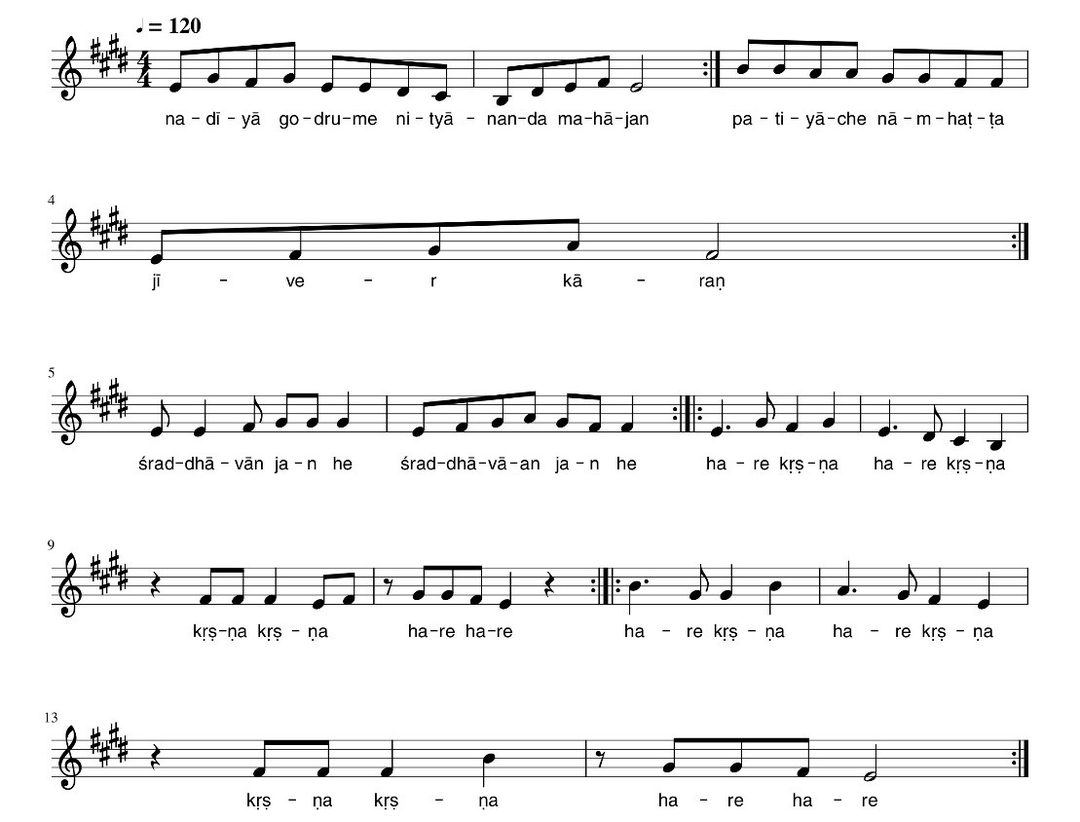
(Refrain:) nadīyā-nagare nitāi nece' nece' gāya re nadīyā-nagare—in the town of Nadīyā; nitāi—Lord Nityānanda; nece'—while dancing; nece'—while dancing; gāya—chant; re—Oh.
Oh! In the towns and villages of Nadīyā, Lord Nityānanda ecstatically dances and sings these names of Śrī Caitanya Mahāprabhu:
(1) jagannātha-suta mahāprabhu viśvambhara
māyāpura-śaśī navadvīpa-sudhākara
Lord Caitanya is the beloved son of Jagannātha Miśra. He is Mahāprabhu, the great master, and maintainer of the whole world. He is the shining moon of Māyāpur, and the source of all nectar for the land of Navadvīpa.
(2) śacī-suta gaurahari nimāi-sundara rādhā-bhāva-kānti-ācchādita naṭavara
He is the beloved son of Śacī Mātā, and is Lord Hari with a fair golden complexion. As He was born under a nīm tree He was called Nimāi-sundara (beautiful Nimāi). He is covered by the sentiment and luster of Śrīmatī Rādhārāṇī, and He is the best of all dancers.
(3) nāmānanda capala bālaka mātṛ-bhakta brahmānḍa-vadana tarkī kautukānurakta
He becomes restless upon hearing the holy names of Lord Hari. In His boyhood pastimes He is swift and agile, and is devoted to His mother. He displays the entire universe within His mouth, is a great logician, and is fond of joking and playing pranks.
(4) vidyārthi-uḍupa caura-dvayera mohana tairthika-sarvasva grāmya-bālikā-krīḍana
He is the moon among scholarly students, and He bewildered two thieves who tried to steal His jewels when He was a small child. He is the cynosure of all philosophers, and He teased and joked with the village girls of Nadīyā.
(5) lakṣmī-prati bara-dātā uddhata bālaka
śrī-śacīra pati-putra-śoka-nibāraka
He is the giver of blessings to Lakṣmī-priyā. He is very mischievous as a child, and is the dispeller of the grief Śacī-mātā felt after losing her husband Jagannātha and first son Viśvarūpa.
(6) lakṣmī-pati pūrva-deśa-sarva-kleśa-hara
digvijayi-darpa-hārī viṣnu-priyeśvara
He is the Lord and husband of Lakṣmī-priyā. By His saṅkīrtan movement He removed all the distress of East Bengal. He eradicated the pride of the conquering panḍita named Keśava Kaśmiri, and is the beloved Lord of Viṣnu- priyā.
(7) ārya-dharma-pāla pitṛ-gayā pinḍa-dātā purī-śiṣya madhvācārya-sampradāya-pātā
He is the preserver of sanātana-dharma, and the giver of the pinḍa oblation at the holy town of Gayā after the disappearance of His father Jagannāth Miśra. He became the disciple of Īśvara Purī, and is the protector of the Madhvācārya Sampradāya.
(8) kṛṣṇa-nāmonmatta kṛṣṇa-tattva-adhyāpaka
nāma-saṅkīrtana-yuga-dharma-pravartaka
He becomes madly intoxicated by tasting the holy name of Kṛṣṇa, and is the professor of the science of Kṛṣṇa consciousness. Thus He inaugurated the religion of the age, nāma-saṅkīrtana.
(9) advaita-bāndhava śrīnivāsa-gṛha-dhana
nityānanda-prāna gadādharera jīvana
He is the friend of Advaita Ācārya, the treasure of Śrīvāsa Ṭhākura's home, the life and soul of Nityānanda Prabhu, and the very source of life for Gadādhara Panḍita.
(10) antardvīpa-śaśadhara sīmanta-vijaya godruma-bihārī madhyadvīpa-līlāśraya
He is the moon of Antardvīpa, and the triumph of Sīmantadvīpa. He enjoys wandering and frolicking on the island of Godruma, and is the shelter of pastimes in Madhyadvīpa.
(11) koladvīpa-pati ṛtudvīpa-maheśvara jahnu-modadruma-rudradvīpera īśvara
He is the Lord of Koladvīpa, the great controller of Ritudvīpa, and the creator of Jahnudvīpa, Modadrumadvīpa, and Rudradvīpa.
(12) nava-khanḍa-raṅganātha jāhnavī-jīvana
jagāi-mādhāi-ādi durvṛtta-tāraṇa
He is thus the Supreme Lord of the nine islands of Navadvīpa, which serves as the stage for His wonderful pastimes. He is the life of the River Gaṅgā, and the deliverer of all sorts of rogues and rascals beginning with Jagāi and Mādhāi.
(13) nagara-kīrtana-siṁha kājī-uddhāraṇa śuddha-nāma-pracāraka bhaktārti-haraṇa

He is the lion of the village kīrtanas, and the deliverer of Chānd Kazi. He is the preacher of the pure holy name, and the remover of the distresses of His devotees.
(14) nārāyanī-kṛpā-sindhu jīvera niyantā adhama-paḍuyā-danḍī bhakta-doṣa-hantā
He is the ocean of mercy for Nārāyanī (the mother of Śrīla Vṛndāvana dāsa Ṭhākura), and is the regulator of all souls. He is the chastiser of the fallen students who criticized His chanting of "gopī! gopī!", and is the destroyer of the sins of His devotees.
(15) śrī-kṛṣṇa-caitanya-candra bhāratī-tāraṇa
parivraja-śiromaṇi utkala-pāvana
He was initiated into sannyāsa with the name of Śrī Kṛṣṇa Caitanya, and He is beautiful like the moon. He delivered His sannyāsa-guru Keśava Bhāratī, is Himself the crest-jewel of all wandering renunciates, and is the savior of the region of Orissa.
(16) ambu-liṅga-bhuvaneśa-kapoteśa-pati
kṣīra-cora-gopāla-darśana-sukhī yati
He is the master of Lord Śiva, who is known in three different Śaiva tīrthas as Ambu-liṅga, Bhuvaneśvara, and Kapoteśvara (visited by Lord Caitanya on His way to Jagannātha Purī). As a sannyāsī He rejoiced at the sight of the Orissan deities Kṣīra-cora Gopīnātha and Sākṣī Gopāla.
(17) nirdanḍi-sannyāsī sārvabhauma-kṛpāmaya
svānanda-āsvādānandī sarva-sukhāśraya
He became a sannyāsī without a danḍa (due to Lord Nityānanda's breaking it in three parts and throwing it in the Bhargī River), and is full of mercy for Sārvabhauma Bhaṭṭācārya. He is ecstatic by tasting the bliss of Himself in the form of Kṛṣṇa, and He is the resting place of all universal happiness.
(18) puraṭa-sundara vāsudeva-trāna-kartā rāmānanda-sakhā bhaṭṭa-kula-kleśa-hartā
He is beautiful like molten gold, and He delivered the leper Vāsudeva. He is the intimate friend of Rāmānanda Rāy, and the remover of all miseries from the family of Vyeṅkaṭa Bhaṭṭa.
(19) bauddha-jain-māyāvādi-kutarka-khaṇḍana dakṣina-pāvana bhakti-grantha-uddhāraṇa
He is the refuter of the atheistic arguments of the Buddhists, Jains, and Māyāvādīs. He is the savior of South India, and He has brought to light the two devotional literatures, Kṛṣṇa-karnāmṛta and Brahma-saṁhitā.
(20) ālāla-darśanānandī rathāgra-nartaka gajapati-trāna devānanda-uddhāraka
He became ecstatic at the sight of the deity Ālālanātha, and He danced in front of the Jagannātha cart during the Ratha-yātrā festival. He delivered Gajapati Pratāpa-Rudra, and was the savior of Devānanda Panḍita.
(21) kuliyā-prakāśe duṣṭa paḍuyāra trāna rūpa-sanāntana-bandhu sarva-jīva-prāna
By His appearance at Kuliyā He delivered the ill-behaved student community there. He is the friend of Rūpa and Sanātana Goswāmī, and the life of all souls.
(22) vṛndāvanānanda-mūrti balabhadra-saṅgī
yavana-uddhārī bhaṭṭa-vallabhera raṅgī
He is the personification of bliss in the transcendental realm of Vṛndāvana, and He is the companion and friend of Balabhadra Bhaṭṭācārya. On His return from Vṛndāvana He delivered many Muslims, and He is very fond of intimate exchanges with Vallabha Bhaṭṭa.
(23) kāśīvāsi-sannyāsī-uddhārī prema-dātā
markaṭa-vairāgī-danḍī ā-canḍāla-trātā
He delivered the Māyāvādī sannyāsīs of Kāśī, and He is the bestower of love of God. He is the chastiser of the false renunciates who behave like monkeys, and He is the savior of everyone down to the lowest class of men, the dog-eaters.
(24) bhaktera gaurava-kārī bhakta-prāna-dhana
haridāsa-raghunātha-svarūpa-jīvana
He is the glorifier of His devotees, and is the treasured wealth of their lives. He is the very life of such devotees as Haridāsa Ṭhākura, Raghunātha Dāsa Goswāmī, and Svarūpa Dāmodara.
(25) nadīyā-nagare nitāi nece' nece' gāya re bhakativinoda tā'ra pare raṅga-pāya re
Oh! In the towns and villages of Nadīyā, Lord Nityānanda dances and dances ecstatically while singing these divine names, and Bhaktivinoda falls down at His reddish lotus feet. Oh!
Commentary
This song is from Bhaktivinoda Ṭhākura’s Gītāvalī. It is the first of four songs from the section Śrīman Mahāprabhura-śata-nāma, One Hundred Names of Śrī Caitanya Mahāprabhu. The next song, Kali-yuga-pāvana, is Song 3 from that same section.
Kali-yuga-pāvana
Bhaktivinoda Ṭhakura
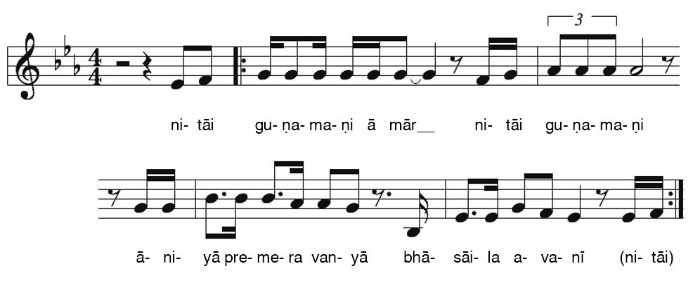
kali-yuga-pāvana viśvambhara gauḍa-citta-gagaṇa-śaśadhara kīrtana-vidhātā, para-prema-dātā, śacī-suta puraṭa-sundara kali-yuga-pāvana—the savior of Kali-yuga; viśvambhara—Lord Caitanya, the maintainer of the universe; gauḍa-citta—of the hearts of the people of Bengal; gagaṇa—in the sky; śaśadhara—the full moon; kīrtana-vidhātā—the inaugurator of congregational chanting; para-prema-dātā—the bestower of ecstatic love; śacī- suta—the son of Saci-devi; puraṭa-sundara—with a pure golden complexion.
Śrī Caitanya Mahāprabhu who is also known as Viśvambhara (the maintainer of the universe) is the savior of the age of Kali, the full moon in the sky of the hearts of the people of Bengal, the inaugurator of congregational chanting, the bestower of transcendental ecstatic love, and Mother Śaci’s beloved son who has a pure golden complexion.
Kali-kukkura-kadana
1 kali-kukkura-kadana yadi cā’o (he) kali-yuga-pāvana, kali-bhaya-nāśana, śrī-śacī-nandana gā’o (he)
kali-kukkura—the dog-like Kali; kadana—to fight; yadi—if; cā’o—you want; (he)— hey; kali-yuga-pāvana—the deliverer of the age of Kali; kali-bhaya-nāśana—the destroyer of all fear caused by Kali; śrī-śacī-nandana—the son of Śacīdevī; gā’o— chant; (he)—hey.
If you want to counteract the influence of the dog-like personality of Kali, then just chant the glories of the son of Mother Śacī who is our savior savior in Kali-yuga and the destroyer of all fear caused by Kali.
2 gadādhara-madana, nitā'yer prāṇa-dhana,
advaitera prapūjita gaura nimāi viśvambhara, śrīnivasa-īśvara, bhakta-samūha-cita-cora gadādhara-madana—He who maddens Gadādhara; nitā'yer prāna-dhana—He who is the life and soul of Nitāi; advaiter prapūjita—He who is the worshipable object of Advaita Ācārya; gaura—Gaura; nimāi—who is called Nimāi; viśvambhara—who is known as Viśvambhara; śrīnivasa-īśvara—the lord of Śrīvasa Ṭhākura; bhakta-samūha—all the devotees; cita-cora—the thief of their hearts.
He is the enchanter of Gadādhara, the life and soul of Nitāi and the most worshipable object of Advaita. He is known as Gaura, Nimāi, Viśvambhara, the lord of Śrīvāsa Paṇḍita, and the thief of the hearts of all the assembled devotees.
3 nadīyā-śaśadhara, māyāpura-īśvara,
nāma-pravartana sura gṛhī-jana-śikṣaka, nyāsi-kula-nāyaka, mādhava rādhā-bhāva-pūra nadiya-śaśadhara—the moon of Nadiya; māyāpura-īśvara—the ruler of Māyāpura; nāma-pravartana—He who introduced the holy name; sura—divine; grhi-jana— those who live in household life; śikṣaka—the instructor; nyāsi-kula—of the members of the renounced order of life; nāyaka—the foremost; mādhava—the husband of the goddess of fortune; rādhā-bhāva—the ecstatic sentiments of Rādhārāṇi; pūra—a storehouse.
He is the moon of Nadīyā, the lord of Śrī Māyāpura-dhāma, and the divine propagator of His own holy name. He is the instructor of family men, and He is also the hero of the members of the renounced order. He is the husband of the goddess of fortune, and He is overflowing with the ecstatic moods and sentiments of Śrīmatī Rādhārāṇī.
4 sārvabhauma-śodhana, gajapati-tāraṇa,
ramānanda-poṣaṇa vīra rūpānanda-vardhana, sanātana-pālana, haridāsa-madana dhīra sārvabhauma-śodhana—the purifier of Sārvabhauma Bhaṭṭācārya; gajapati- tāraṇa—the deliverer of King Pratāparudra; ramānanda-poṣaṇa—the nourisher of Ramānanda Rāya; vīra—hero; rūpānanda-vardhana—He who increases the bliss of Rupa Gosvāmi; sanātana-pālana—the protector of Sanātana Gosvāmi; haridāsa-madana—the enchanter of Haridāsa; dhīra—grave, equipoised.
He is the purifier of Sārvabhauma Bhattācārya and the deliverer of King Pratāparudra. He is the source of nourishment for Śrila Rāmānanda Rāya and He is a great hero. He increases the ecstasy of Rūpa Gosvāmī, He protects Sanātana Gosvāmī, He gladdens Haridāsa Ṭhākura, and He is very grave.
5 vraja-rasa bhāvana, duṣṭa-mata-śātana,
kapati bighātana kāma śuddha-bhakta-pālana, śuṣka-jñāna tādaṇa, chala-bhakti-dūṣaṇa rāma vraja-rasa—of the mellows found in Vraja; bhāvana—He who is immersed in; duṣṭa-mata—of the evil mentality; śātana—the chastiser; kapati—of those who are pretenders; bighātana kāma—disolves the lusty tendencies; śuddha-bhakta—of the pure devotees; pālana—the protector; śuṣka-jñāna—of dry knowledge; tādaṇa—the destroyer; chala-bhakti—of imaginary devotional service; dūṣaṇa— the destroyer; rāma—the supremely blissful Lord.
He is always inmersed in the transcendental mellows of Vraja-dhāma, He destroys all evil mentalities, and He dissolves the mundane lust of the deceitful insincere souls by His causeless mercy. He maintains and protects His pure devotees, and He chastises dry speculative knowledge. He destroys pretentious and hypocritical devotion, and He is the reservoir of pleasure.
Commentary
Kali-kukkura-kadana and Vibhāvarī-śeṣa are subtitled Nāma-kīrtana. They are the first two songs of Part 4 of the Third Branch of the songbook Kalyana kalpa-taru which is entitled Ucchvāsa-kīrtana (The loud chanting of overflowing spiritual emotions). These songs are entirely composed of different names of Lord Caitanya and Lord Kṛṣṇa respectively.
Vibhāvarī-śeṣa
1 vibhāvarī-śeṣa, āloka-praveśa,
nidrā chāri' uṭha jīva bala hari hari, mukunda murāri, rāma kṛṣṇa hayagrīva vibhāvarī—the night; śeṣa—has come to an end; āloka-praveśa—the light of dawn is entering; nidrā chāri'—giving up your sleep; utha—arise; jīva—O soul!; bala hari hari—chant the holy names of Lord Hari; mukunda—the giver of liberation; murāri—the enemy of the Mura demon; rāma—the supreme enjoyer; kṛṣṇa—the all-attractive one; hayagrīva—the horse-headed incarnation.
The night has come to an end and the light of dawn is entering. O jīva soul, arise and give up your sleep. Chant the holy names of Lord Hari, who is the giver of liberation; the enemy of the Mura demon; the supreme enjoyer; the all-attractive one; and the horse-headed incarnation, Hayagrīva.
2 nṛsiṁha vāmana, śrī-madhusūdana,
vrajendra-nandana śyāma pūtanā-ghātana, kaiṭabha-śātana, jaya dāśarathi-rāma nṛsiṁha—the half-man, half-lion; vāmana—the dwarf brāhmaṇa; śrī- madhusūdana—the killer of the Madhu demon; vrajendra-nandana—the beloved son of the King of Vraja; śyāma—who is blackish in complexion; pūtanā-ghātana— the slayer of the Pūtanā witch; kaiṭabha-śātana—the destoyer of the demon Kaiṭabha; jaya—all glories!; dāśarathi-rāma—Lord Rāma, the son of King Daśaratha.
Lord Hari incarnated as the half-man, half-lion, Nṛsiṁha. He appeared as the dwarf brāhmaṇa Vāmana and is the killer of the Madhu demon. He is the beloved son of the King of Vraja, Nanda Mahārāja, and is blackish in complexion. He is the slayer of the Pūtanā witch and the destroyer of the demon Kaiṭabha. All glories to Lord Hari, who appeared as Lord Rāma, the son of King Daśaratha!
3 yaśodā dulāla, govinda-gopāla,
vṛndāvana purandara gopī-priya-jana, rādhikā-ramaṇa, bhuvana-sundara-bara yaśodā dulāla—the darling of Mother Yaśodā; govinda—the giver of pleasure to the cows; gopāla—the protector of the cows; vṛndāvana purandara—the monarch of the Vṛndāvana forest; gopī-priya jana—the beloved of the gopīs; rādhikā- ramaṇa—the lover of Rādhikā; bhuvana-sundara-bara—the most beautiful personality in all the worlds.
He is the darling of mother Yaśodā, the giver of pleasure to the cows, land, and spiritual senses, and the protector of the cows. He is the Lord of the Vṛndāvana forest, the gopīs' beloved, the lover of Rādhikā, and the most beautiful personality in all the worlds.
4 rāvaṇāntakara, mākhana-taskara,
gopī-jana-vastra-hārī vrajera rākhāla, gopa-vṛnda-pāla, citta-hārī vaṁśī-dhārī rāvaṇāntakara—who brought about the end of the demon Rāvaṇa; makhana- taskara—who stole the older gopīs' butter; gopījana-vastra-hārī—who stole the younger gopīs' clothes; vrajera rākhala—a cowherd boy of Vraja; gopa-vṛnda- pāla—the protector of the cowherd boys; citta-hārī—who steals the hearts of all; vaṁśī-dhārī—who always holds a flute.
As Rāmacandra He put an end to the demoniac King Rāvaṇa. As Kṛṣṇa, in His childhood He stole butter from the elder gopīs, and in His youth He stole the clothes of the younger gopīs while they bathed in the Yamunā. He is a cowherd boy of Vraja and the protector of the cowherd boys. He steals the hearts of all and always holds a flute.
5 yogīndra-vandana, śrī-nanda-nandana,
vraja-jana-bhaya-hārī navīna nīrada, rūpa manohara, mohana-vaṁśī-vihārī yogīndra-vandana—worshiped by the best of yogīs; śrī-nanda-nandana—the delightful son of Nanda; vraja-jana-bhaya-hārī—who removes all the fears of the inhabitants of Vraja; navīna nīrada—who is the color of a fresh rain cloud; rūpa manohara—whose form is enchanting; mohana-vaṁśī-vihārī—who looks very charming wandering about playing His flute.

Lord Kṛṣṇa is worshiped by the best of yogīs, He is the son of Nanda, He removes all the fears of the inhabitants of Vraja, He is the color of a fresh rain cloud, and His form is enchanting. When He wanders about, playing His flute, He looks very charming.
6 yaśodā-nandana, kaṁsa-nisūdana,
nikuñja-rāsa-vilāsī kadamba-kānana, rāsa-parāyaṇa, vṛnda-vipina-nivāsī yaśodā-nandana—the delightful son of Yaśodā; kaṁsa-nisūdana—the killer of King Kaṁsa; nikuñja-rāsa-vilāsī—who sports the rāsa dance amongst the garden groves; kadamba-kānana rāsa-parāyaṇa—who is fond of engaging in the rāsa dance underneath the kadamba trees; vṛndā-vipina-nivāsī—who resides in the forest of Vṛndā Devī.
He is the son of Yaśodā and the killer of King Kaṁsa, and He sports in the rāsa dance among the groves of Vraja. Kṛṣṇa engages in the rāsa dance beneath the kadamba trees, and He resides in the forest of Vṛndāvana.
7 ānanda-vardhana, prema-niketana,
phula-śara-yojaka kāma gopāṅganā-gaṇa, citta-vinodana, samasta-guṇa-gaṇa-dhāma ānanda-vardhana—who increases the ecstasy of His devotees; prema- niketana—the reservoir of all love; phula-śara—flowered arrows; yojaka—who uses; kāma—the transcendental Cupid; gopāṅgana-gaṇa citta-vinodana—the pleasure of the cowherd girls' hearts; samasta-guṇa-gaṇa-dhāma—the abode of all wonderful qualities.
He increases the ecstasy of His devotees. He is the reservoir of all love and is the transcendental Cupid who uses His flower arrows to increase the loving desires of the gopīs. He is the pleasure of the gopīs' hearts and the abode of all wonderful qualities.
8 yāmuna-jīvana, keli-parāyaṇa,
mānasa-candra-cakora nāma-sudhā-rasa, gāo kṛṣṇa-yaśa rākha vacana mana mora yāmuna-jīvana—the life of the river Yamunā; keli-parāyaṇa—who is always absorbed in amorous pastimes; mānasa-candra-cakora—who is the moon of the gopīs' minds, which are like cakora birds (that subsist only upon moonlight); nāma- sudhā-rasa—the nectarean mellows of these holy names; gāo—please sing; kṛṣṇa yaśa—the glories of Śrī Kṛṣṇa; rākha vacana—please obey this advice; mana mora—O my dear mind!
Lord Kṛṣṇa is the life of the river Yamunā. He is always absorbed in amorous pastimes, and He is the moon for the cakora birds of the gopīs' minds. O mind, obey these words of mine and sing the glories of Śrī Kṛṣṇa in the form of these holy names, which are full of nectarean mellows.
Commentary
This song has become well-known all over ISKCON, because it is sung every morning during Maṅgala-ārati at the Krishna-Balaram Mandir. Similar to the next one (Yaśomatī-nandana), Vibhavarī-śeṣa, it is composed of different names of the Lord which are given to Him according to His pastimes and relationships with His devotees. Śrīla Prabhupāda speaks about this in a lecture given at the Los Angeles Temple in 1969:
This Kṛṣṇa consciousness movement is trying to teach people to not to declare independence, which is not possible, nor to try to make this world happy without Kṛṣṇa. That is not possible. That is our propaganda. Whatever you do, you take shelter of Kṛṣṇa, or God. "Kṛṣṇa" is the most explicit term for God. God may have many names. Kṛṣṇa is the perfect name. “God has no name”, some philosophers say. “No name” means that His name is understood by His different actions. Just like Kṛṣṇa is sometimes called Yaśodā-nandana. Because He has accepted mother Yaśodā, to become her son, therefore Kṛṣṇa's name is Yaśodā-nandana. Kṛṣṇa's name is Pārtha-sārathi. Why? Because Kṛṣṇa has accepted to become the chariot driver of Arjuna. Pārtha means Arjuna, and sārathi means chariot driver. So Kṛṣṇa's name became Pārtha-sārathi. Kṛṣṇa used to steal butter from His mother's butter stock; therefore Kṛṣṇa's name is Mākhana-cora. So in this way Kṛṣṇa's name are varieties. Kṛṣṇa has unlimited number of activities, and according to such activities He has got unlimited names. But the primary name which is applicable in all circumstances is "Kṛṣṇa." Kṛṣṇa means "all-attractive." Kṛṣṇa attracts everyone. Otherwise how you're attracted, if Kṛṣṇa is not all-attractive? From the beginning of your life you never heard of Kṛṣṇa, neither you knew about Kṛṣṇa. Why you are attracted? So Kṛṣṇa is all-attractive. That is the perfect name of God: "Kṛṣṇa."
Yaśomatī-nandana
(Śrī nāma-kīrtana) Bhaktivinoda Ṭhākura
1 yaśomatī-nandana, vraja-vara-nāgara,
gokula-rañjana kāna gopī-parāṇa-dhana, madana-manohara, kāliya-damana-vidhāna yaśomatī-nandana—Lord Kṛṣṇa is the beloved son of Mother Yaśodā; vraja-vara- nāgara—most beloved of the inhabitants of Vraja; gokula-rañjana—the attractor of the people of Gokula; kāna—(an intimate nickname); gopī-parāṇa-dhana—the wealth of the lives of the gopīs; madana-manohara—who can attract even the mind of Cupid; kāliya-damana-vidhāna—the chastiser of the Kāliya serpent.
Lord Kṛṣṇa is the beloved son of Mother Yaśodā; the transcendental lover in the land of Vraja; the delight of Gokula; Kāna [a nickname of Kṛṣṇa]; the wealth of the lives of the gopīs. He steals the mind of even Cupid and punishes the Kāliya serpent.
2 amala harināma amiya-vilāsā vipina-purandara, navīna nāgara-vara, vaṁśī-vadana suvāsā amala harinām—these pure holy names; amiya vilāsā—are full of sweet, nectarean pastimes; vipina-purandara—He is the monarch of the garden groves; navīna nāgara-vara—He is the best of youthful lovers; vaṁśī-vadana—He is seen with His flute placed to His lips; suvāsā—He is an excellent dresser.
These pure holy names of Lord Hari are full of sweet, nectarean pastimes. Kṛṣṇa is the Lord of the twelve forests of Vraja, He is ever-youthful and is the best of lovers. He is always playing on a flute, and He is an excellent dresser.
3 vraja-jana-pālana, asura-kula-nāśana
nanda-godhana-rākhoyālā govinda mādhava, navanīta-taskara, sundara nanda-gopālā braja-jana-pālana—the protector of the inhabitants of Vraja; asura-kula-nāśana— the destroyer of demonic dynasties; nanda-godhana-rākhoyālā—the keeper of Nanda Mahārāja's valuable cows; govinda—the giver of pleasure to the cows; mādhava—the husband of the goddess of fortune; navanīta-taskara—the butter thief; sundara nanda-gopālā—the beautiful cowherd son of Nanda Mahārāja.
Kṛṣṇa is the protector of the inhabitants of Vraja; the destroyer of various demoniac dynasties; the keeper and tender of Nanda Mahārāja's cows; the giver of pleasure to the cows, land, and spiritual senses; the husband of the goddess of fortune; the butter thief; and the beautiful cowherd boy of Nanda Mahārāja.
4 yāmuna-taṭa-cara, gopī-vasana-hara,
rāsa-rasika, kṛpāmaya śrī-rādhā-vallabha, vṛndāvana-naṭavara, bhakativinoda-āśraya yāmuna-taṭa-cara—He wanders along the banks of the river Yamunā; gopī- vasana-hara—He steals the garments of the gopīs; rāsa-rasika—He delights in the mellows of the rāsa dance; kṛpāmaya—He is very merciful; śrī-rādhā-vallabha— the most beloved of Śrīmatī Rādhāraṇī; vṛndāvana-naṭavara—the great dancer of Vṛndāvana; bhakativinoda-āśraya—the shelter of Bhaktivinoda.
Kṛṣṇa wanders along the banks of the river Yamunā. He stole the garments of the young damsels of Vraja who were bathing there. He delights in the mellows of the rāsa dance; He is very merciful; the lover and beloved of Śrīmatī Rādhārāṇī; the great dancer of Vṛndāvana; and the shelter and only refuge of Bhaktivinoda.
Commentary
Yaśomatī-nandana is another of Prabhupāda’s favorite bhajanas. Many devotees know this song by heart, and it is often chanted when the Deities are greeted in the morning. Śrīla Prabhupāda’s special liking of this song is evident from the following entry in Tamal Krishna Mahārāja’s Diary Prabhupāda’s Final Days:
October 9 Guru-kṛpā Swami was leading kīrtana softly when suddenly Prabhupāda said, "Yaśomatī-nandana, Yaśomatī-nandana." Guru-kṛpā immediately broke into Yaśomatī-nandana braja-baro-nāgara. Prabhupāda smiled slightly. … As Guru- kṛpā sang, Prabhupāda softly spoke, "Let me drink harināma amiya-vilāsā," and smiled broadly. Hari-śauri: “That is sweetest nectar.” Prabhupāda: “Hmm.” Then he said, "Yaśomatī-nandana," and fell silent again. According to the diary, later in the day, a devotee began to chant the Brahma- samhitā prayers. When he got to the verse, advaitam acyutam..., Prabhupāda opened his eyes and said. “This one, Yaśomatī-nandana, and Hare Kṛṣṇa. Chant these three.” Apparently, Śrīla Prabhupāda’s spiritual master, Śrīla Bhaktisiddhānta Sarasvatī, was also very fond of this song. At the end of the biography A Ray of Viṣṇu, by Rūpa Vilāsa, we find a description of Śrīla Bhaktisiddhānta’s samādhi ceremony:
“Flower garlands were offered around his neck, and tulasī plants were sown on all sides. His favorite songs were sung: Śrī Rūpa Mañjarī, Svānanda-sukhada-kuñja- manohara, and Yaśomatī-nandana. Then, chanting Je ānila prema-dhana, the devotees circumambulated the samādhi site four times. The samādhi was covered with earth and surrounded by tulasī on all four sides, marked with the sign of tilaka and covered with flower garlands.”
Nadīyā-godrume
(Ājñā-Ṭahal) Bhaktivinoda Ṭhākura
1 nadīyā-godrume nityānanda mahājana
patiyāche nām-haṭṭa jīvera kāraṇa

nadīyā—Nadīyā; godrume—in Godruma; nityānanda—Nityānanda; mahājana— the greart personality; patiyāche—opened; nām—holu name; haṭṭa—marketplace; jīvera—living entity´s; kāraṇa—for the cause.
In the land of Nadīyā, on the island of Godruma, the magnanimous Lord Nityānanda has opened the marketplace of the holy name in order to deliver all fallen souls.
2 (śraddhāvāna jana he, śraddhāvāna jana he)
prabhura ājñāya, bhāi, māgi ei bhikṣā bala 'kṛṣṇa,' bhaja kṛṣṇa, kara kṛṣṇa-śikṣā
(śraddhāvāna—possessing; jana—person; he—O!; śraddhāvāna—possessing; jana—person; he—O!); prabhura—of the Lord; ājñāya—on the order; bhāi—o brothers; māgi—I beg; ei—these; bhikṣā—alms; bala—chant; 'kṛṣṇa'—Kṛṣṇa; bhaja—worship; kṛṣṇa—Kṛṣṇa; kara—follow; kṛṣṇa—Kṛṣṇa; śikṣā—instructions.
O men of faith! O men of faith! By the order of Lord Gaurāṅga, O brothers, I beg this one request: Chant "Kṛṣṇa!", worship Kṛṣṇa, and follow Kṛṣṇa's instructions.
3 aparādha-śūnya ha' ye laho kṛṣṇa-nāma kṛṣṇa mātā, kṛṣṇa pitā, kṛṣṇa dhana-prāṇa aparādha—offenses; śūnya—free; ha' ye—having been; laho—chant; kṛṣṇa— kṛṣṇa; nāma—names; kṛṣṇa—Kṛṣṇa; mātā—mother; kṛṣṇa—Kṛṣṇa; pitā—father; kṛṣṇa—Kṛṣṇa; dhana—treasure; prāṇa—life.
Being careful to remain free of offenses, just take the holy name of Kṛṣṇa. Kṛṣṇa is your mother, Kṛṣṇa is your father, and Kṛṣṇa is the treasure of your life.
4 kṛṣṇera saṁsāra kara chāri' anācāra jīve dayā, kṛṣṇa-nāma-sarva-dharma-sāra kṛṣṇera—of Kṛṣṇa (with Kṛṣṇa at the center); saṁsāra kara—lead a domestic life, manage domestic affairs; chāri'—having given up; anācāra—sinful behavior; jīve— to the living entities; dayā—compassion; kṛṣṇa—Kṛṣṇa; nāma—names; sarva— all; dharma—religion; sāra—essence.
Giving up all improper behavior, carry on your worldly duties only in relation to Kṛṣṇa. The showing of compassion to all fallen souls by loudly chanting the holy name of Kṛṣṇa is the essence of all forms of religion.
Commentary
In Bhaktivinoda Ṭhākura’s songbook Gītāvalī, this is Song 1 in the section Śrī Nagar-kīrtana, Congregational chanting in public places. Bhaktivinoda Ṭhākura has explained the meaning of each verse of this song. Here are some excerpts: Śrī Mahāprabhu displayed His mercy toward the jīvas tortured by Kali-yuga by ordering Śrī Nityānanda Prabhu to preach the holy name from home to home; therefore Śrī Nityānanda Prabhu is verily the Mūla-mahājana (the chief proprietor) of the Nāma-haṭṭa located at Godruma. Even though all the employees of the Nāma-haṭṭa are qualified for performing ājñā-ṭahal, the 'Patrol According to the Lord's Order', still the great mahāśayas, who are like patrolling watchmen, are especially empowered to render these duties in an entirely selfless manner. The mahāśaya on patrol plays his karatālas and calls out, "O people of faith! I do not wish to beg from you any worldly thing or mundane favor. The only alms I beg is that all of you honor the order of the Lord by chanting the name of Kṛṣṇa, worshiping Kṛṣṇa, and teaching others about Kṛṣṇa. Just invoke the true name of Kṛṣṇa. Specifically, by giving up nāmābhāsa, please chant the purely spiritual holy name of the Lord." The word 'aparādha' indicates the ten offenses against chanting the holy names of the Lord. […] O people of faith! Remaining free of these ten offenses, just worship Lord Kṛṣṇa. Only Kṛṣṇa is the jīva's mother, father, offspring, wealth, husband, and life-treasure. The jīva is a spiritual ray (cit-kaṇa), Kṛṣṇa is the spiritual sun (cit- sūrya), and the material world is the jīva's prison. Truly the pastimes of Kṛṣṇa, which lie beyond the material realm, are your factual riches to be sought. O faithful jīva! You have turned away from Kṛṣṇa and then suffered the experience of so-called happiness and distress in the realm of māyika-saṁsāra. This situation is not befitting you. As long as you remain bound to the wheel of karma as a result of your faulty aversion to Kṛṣṇa, please accept one transcendental remedy. If you are inclined toward the path of pravritti (positive use of material situations), then just become a gṛhastha, brahmacārī, or vānaprastha; or if you are inclined to the path of nivritti (renunciation of material situations), then just be a sannyāsī. But in whatever position you find yourself, please give up all sinful activities, while offering your body, home, wife, children, and wealth unto Śrī Kṛṣṇa. Living in Kṛṣṇa's world, perform all your actions by dovetailing your senses and mind with topics of Kṛṣṇa, and with a heart purified of envious aversion pass the journey of life. The supreme nectar of favorable service rendered unto Lord Kṛṣṇa will gradually become thickened until it breaks through your two bodies –the gross and the subtle – and will finally cause your eternal spiritual form to again awaken.
(Hari) haraye namaḥ
(Nāma-saṅkīrtana) Narottama dasa Thakura
1 (hari) haraye namaḥ kṛṣṇa yādavāya namaḥ
yādavāya mādhavāya keśavāya namaḥ
hari haraye—unto Hari; namaḥ—obeisances; kṛṣṇa yādavāya—unto Kṛṣṇa known as Yādava (the best of the Yadu dynasty); namaḥ—obeisances; yādavāya—unto Yādava; mādhavāya—unto Mādhava, the husband of the goddess of fortune; keśavāya—unto Keśava, He of fine hair; namaḥ—obeisances.
O Lord Hari, O Lord Kṛṣṇa, I offer my obeisances to You, who are known as Hari, Yādava, Mādhava, and Keśava.
2 gopāla govinda rāma śrī-madhusūdana
giridhārī gopīnātha madana-mohana
gopāla—He appears as a cowherd boy; govinda—the pleaser of the cows; rāma— the reservoir of pleasure; śrī-madhusūdana—the magnificent killer of the demon named Madhu; giridhārī—the lifter of Govardhana Hill; gopīnātha—the Lord of the cowherd damsels; madana-mohana—the enchanter of Cupid.
O Gopāla, Govinda, Rāma, Śrī Madhusūdana, Giridhārī Gopīnātha, and Madana-mohana!
3 śrī-caitanya-nityānanda śrī-advaita-sītā
hari guru vaiṣṇaba bhāgavata gītā
śrī-caitanya-nityānanda—chanting the names of Lord Caitanya and Lord Nityānanda; śrī-advaita-sītā—Śrī Advaita ācārya and his wife Sītā Ṭhākurāṇī; hari—Lord Hari; guru—the spiritual master; vaiṣṇava—all the assembled devotees; bhāgavata—the Śrīmad-Bhāgavatam; gītā—the Bhagavad-Gītā.
All glories to Śrī Caitanya and Nityānanda! All glories to Śrī Advaita Ācārya and His consort, Śrī Sītā Ṭhākurāṇī. All glories to Lord Hari, to the spiritual master, the Vaiṣṇavas, Śrīmad-Bhāgavatam, and Śrīmad Bhagavad-Gītā.
4 śrī-rūpa sanātana bhaṭṭa-raghunātha śrī-jīva gopāla-bhaṭṭa dāsa-raghunātha śrī-rūpa sanātana bhaṭṭa-raghunāth śrī-jīva gopāla-bhaṭṭa dāsa-raghunāth— chanting the names of the Six Gosvāmīs : Śrī Rūpa, Sanātana, Raghunāth Bhaṭṭa, Śrī Jīva, Gopāla Bhaṭṭa, and Raghunāth dāsa.
All glories to Śrī Rūpa Gosvāmī, Sanātana Gosvāmī, Raghunātha Bhaṭṭa Gosvāmī, Śrī Jīva Gosvāmī, Gopāla Bhaṭṭa Gosvāmī, and Raghunātha dāsa Gosvāmī.
5 ei chaya gosāir kari caraṇa vandana yāhā hoite vighna-nāśa abhīṣṭa-pūraṇa ei chay gosāir—of these six Gosvāmīs; kori—I offer; caraṇa vandan—obeisances unto their feet; yāhā hoite—by which; vighna-nāś—obstacles to devotion are destroyed; abhīṣṭa-pūraṇ—all spiritual desires are fulfilled.
I offer my obeisances to the feet of these six Gosvāmīs. Bowing to them destroys all obstacles to devotional service and fulfills all spiritual desires.
6 ei chaya gosāi yāṅra-mui tāṅra dāsa tā-sabāra pada-reṇu mora pañca-ṅgrāsa ei chaya gosāi—of these six Gosvāmīs; yāṅra—whoever is; mui—I; tāṅra—their; dāsa—servant; tā-sabāra—of all of them; pada-reṇu—the dust of the feet; mora— my; pañca-grās—five kinds of foodstuffs.
I am the servant of that person who is a servant of these six Gosvāmīs. The dust of their lotus feet is my five kinds of foods.
7 tāṅdera caraṇa-sevi-bhakta-sane vāsa
janame janame haya ei abhilāṣa
tāṅdera caraṇa—the lotus feet of these six Gosvāmīs; sevi bhakta—those devotees who serve; sane vāsa—living along with; janame janame—birth after birth; haya—there is; ei abhilāśa—this is my desire.
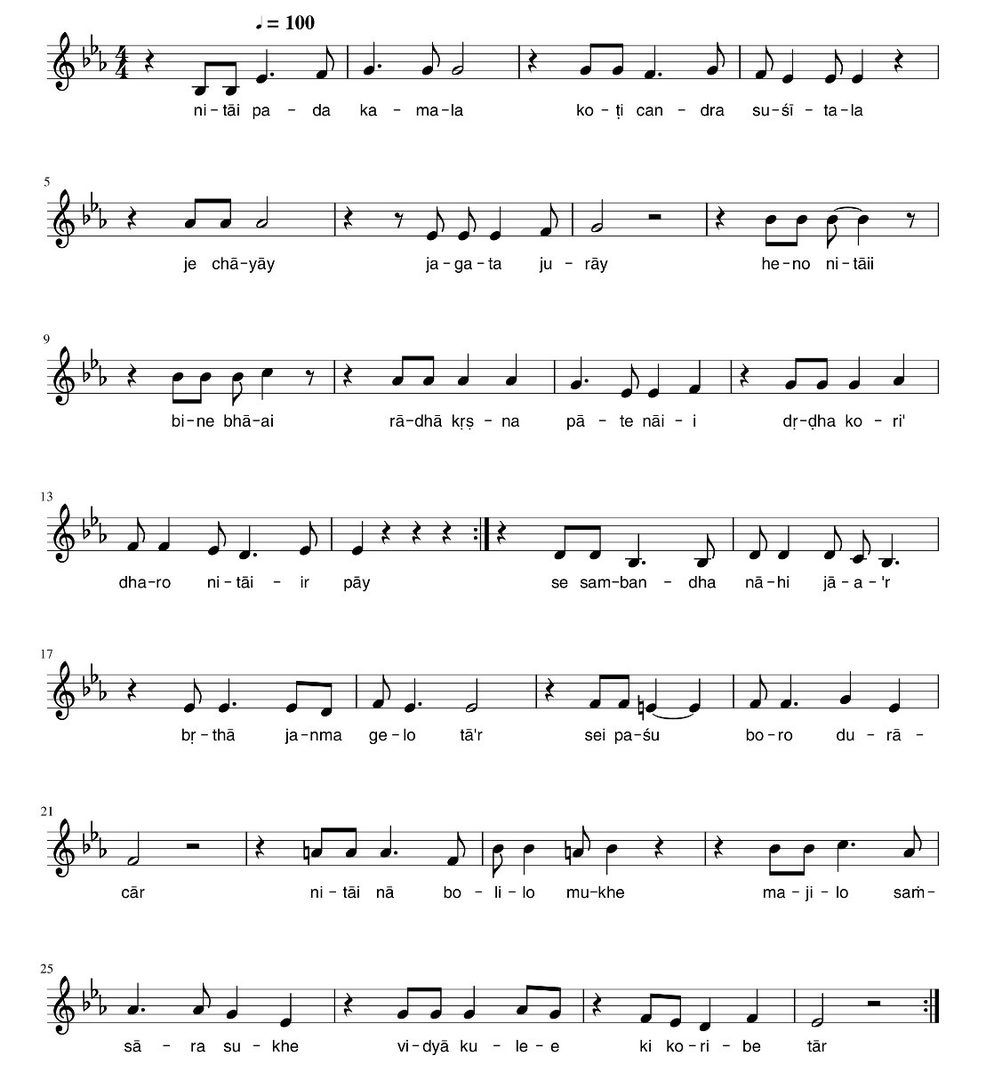
This is my desire: that birth after birth I may live with those devotees who serve the lotus feet of these six Gosvāmīs.
8 ei chaya gosāi jabe vraje koilā vāsa rādhā-kṛṣṇa-nitya-līlā karilā prakāśa ei chaya gosāi—these six Gosvāmīs; jabe—when; vraje—in Vraja; koilā vāsa— lived; rādhā-kṛṣṇa-nitya-līlā—the eternal pastimes of Rādhā and Kṛṣṇa; karila prakāśa—they revealed.
When these six Gosvāmīs lived in Vraja they revealed the lost holy places and explained the eternal pastimes of Rādhā and Kṛṣṇa.
9 ānande bala hari bhaja vṛndavana śrī-guru-vaiṣṇava-pade majāiyā mana ānande—in bliss; bala—just chant; hari—the names of Lord Hari; bhaja—just worship; vṛndāvana—the transcendental realm of Vṛndāvana; śrī-guru vaiṣṇava— the spiritual master and the Vaiṣṇavas; pade—on the lotus feet; majāiyā mana— absorbing your mind in meditation.
Just shout the names of Lord Hari in great ecstasy and worship the transcendental realm of Vṛndāvana while absorbing your mind in meditation upon the divine feet of the spiritual master and the Vaiṣṇavas.
10 śrī-guru-vaiṣṇaba-pada-padma kari āśa
narottama dāsa kahe nāma-saṅkīrtana
śrī-guru-vaiṣṇava—of Śrī Guru and the Vaiṣṇavas; pāda-padma—the lotus feet; kari āśa—I am desiring; nāma-saṅkīrtana—the glorification of the holy name; kahe—sings; narottama dāsa—the author, Narottama dāsa Ṭhākura.
Desiring to serve the lotus feet of Śrī Guru and the Vaiṣṇavas, Narottama Dāsa sings this saṅkīrtana of the holy names of Lord Hari.
Commentary
Narottama dāsa Ṭhākura composed this song on the basis of a verse that Śrī Caitanya Mahāprabhu sang personally and taught His followers to chant in public in alternation with the Hare Kṛṣṇa mahā-mantra: harāye namaḥ kṛṣṇa yadavāya namaḥ/ gopāla govinda rāma śrī madhusudāna. This verse is mentioned in the Śrī Caitanya-caritāmṛta (Ādi 17.122 and Madhya 25.64). In most songbooks we find hari added at the beginning in parenthesis (hari). However, when Prabhupāda sings this bhajana, he does not add hari. Following his example, we begin our audio versions of this song with haraye. Śrīla Prabhupāda quoted from this song many times, stressing especially the importance of sādhu-saṅga, the association of devotees. Śrī Caitanya-caritāmṛta Madhya-līlā 4.79 – Purport If the preachers in our Kṛṣṇa consciousness movement are sincere devotees of Kṛṣṇa, Kṛṣṇa will always be with them because He is very kind and favorable to all His devotees. Just as Arjuna and Kṛṣṇa were victorious in the Battle of Kurukṣetra, this Kṛṣṇa consciousness movement will surely emerge victorious if we but remain sincere devotees of the Lord and serve the Lord according to the advice of the predecessors (the six Gosvāmīs and other devotees of the Lord). As Narottama dāsa Ṭhākura has stated: tāṅdera caraṇa sevi bhakta-sane vāsa, janame janame haya ei abhilāṣa. The Kṛṣṇa consciousness devotees must always desire to remain in the society of devotees. Bhakta-sane vāsa: they cannot go outside the Kṛṣṇa consciousness society or movement. Within the society we must try to serve the predecessors by preaching Caitanya Mahāprabhu’s cult and spreading His name and fame all over the world. If we attempt this seriously within the society, it will be successfully done. There is no question of estimating how this will happen in the mundane sense. But without a doubt, it happens by the grace of Kṛṣṇa. Lecture on Nectar of Devotion – Vṛndāvana, November 13, 1972 The Gosvāmīs, or in the Pañcarātra system, in the śāstras, the regulative principles are so made that, if we practice it, gradually our dormant Kṛṣṇa consciousness will be awakened. Therefore these prescribed rules and regulations, as it is given in the śāstras and confirmed by the ācāryas... Narottama dāsa Ṭhākura says, tāṅdera caraṇa-sevi. We have to follow the footprints of the ācāryas. Ācārya means paramparā. One ācārya is following the previous ācārya. An ācārya does not manufacture anything, something novel. He follows the previous ācārya. And therefore he's ācārya. And one who follows... Ācāryavān puruṣo veda. Ācārya upāsanam, in the Bhagavad-gītā it is said. So we have to accept the principles laid down by the ācāryas. Tāṅdera caraṇa-sevi-bhakta-sane vāsa. Rūpa-raghunātha- pade haibe ākuti kabe hāma bujhaba śrī-yugala-pīriti. Narottama dāsa Ṭhākura's versions are accepted as Vedic versions, śruti-pramāṇa. Viśvanātha Cakravartī Ṭhākura says that the statements of Narottama dāsa Ṭhākura are as good as Vedic evidences. Therefore we quote from Narottama dāsa Ṭhākura often. Not only Narottama dāsa Ṭhākura, also Kṛṣṇadāsa Kavirāja Gosvāmī and the six Gosvāmīs, they are authorities. So we have no difficulty. Tāṅdera caraṇa-sevi-bhakta-sane vāsa. That's all. Let us follow the footprints of the ācāryas, gosvāmīs, and live together as sincere, serious devotees. Then our life is successful. It is not very difficult. Bhakta-sane vāsa. Tāṅdera caraṇe. We should live together as devotee and follow the footprints of the ācāryas. Don't manufacture concoction. Then it will be spoiled. Simply try to follow. They'll protect. They'll give protection. Because Kṛṣṇa says, ahaṁ tvāṁ sarva-pāpebhyo mokṣayiṣyāmi. So if we take shelter of the ācāryas, that means we take shelter of Kṛṣṇa. Yasya prasādād bhagavat- prasādaḥ. If the ācārya, guru, is satisfied, then we must know certainly that Kṛṣṇa is satisfied. So this is the principle, and the ācāryas give us direction. It is not very difficult. Simply we have to become very serious and sincere. Then everything is all right. Śrī Caitanya-caritāmṛta Ādi-līlā 17.123 – Purport The International Society for Krishna Consciousness now has its world center in Navadvīpa, Māyāpur. The managers of this center should see that twenty-four hours a day there is chanting of the holy names of the Hare Kṛṣṇa mahā-mantra, with the addition of haraye namaḥ, kṛṣṇa yādavāya namaḥ, for this song was a favorite of Śrī Caitanya Mahāprabhu’s. But all such saṅkīrtana must be preceded by the chanting of the holy names of the five tattvas—śrī-kṛṣṇa-caitanya prabhu- nityānanda śrī-advaita gadādhara śrīvāsādi-gaura-bhakta-vṛnda. We are already accustomed to chant these two mantras—śrī-kṛṣṇa-caitanya prabhu-nityānanda śrī-advaita gadādhara śrīvāsādi-gaura-bhakta-vṛnda and Hare Kṛṣṇa, Hare Kṛṣṇa, Kṛṣṇa Kṛṣṇa, Hare Hare/ Hare Rāma, Hare Rāma, Rāma Rāma, Hare Hare. Now, after these, the other two lines—namely haraye namaḥ, kṛṣṇa yādavāya namaḥ/ gopāla govinda rāma śrī-madhusūdana—should be added, especially in Māyāpur. Chanting of these six lines should go on so perfectly well that no one there hears any vibration other than the chanting of the holy names of the Lord. That will make the center spiritually all-perfect.
Govinda jaya jaya
Traditional
govinda jaya jaya, gopāla jaya jaya rādhā-ramaṇa hari, govinda jaya jaya
All glories to Govinda! All glories to Gopāla!
All glories to Hari, the lover of Rādhā.
Commentary
In January of 1967, the day after the Mantra-Rock Dance at the Avalon Ballroom in San Francisco, Prabhupāda walked with Kīrtanānanda and Hayagrīva along the boardwalk, near the Pacific Ocean. As they walked, he began softly singing a mantra that Kīrtanānanda and Hayagrīva had never heard before: Govinda jaya jaya, gopāla jaya jaya, rādhā-ramaṇa hari, govinda jaya jaya. From that day on, this short traditional song became very popular among the devotees, and Prabhupāda recorded it several times, with a group of disciples responding to his chanting. Apparently, during the next years, the singing of Govinda jaya jaya became a regular practice, and Śrīla Prabhupāda requested the devotees to chant it on different occasions, for example after the installation of Jagannātha, Subhadra and Baladeva in San Francisco, in March of 1967, and after initiation and wedding ceremonies. The devotees who went to London, included it on their record produced by George Harrison, and during that time, Prabhupāda also wrote the following letter: Letter to Daniel – Montreal, 22 August, 1968 Please go on chanting "Govinda Jaya Jaya, Govinda Jaya Jaya, Radha Ramana Hari, Govinda Jaya Jaya'', along with "Hare Krishna, Hare Krishna, Krishna Krishna, Hare Hare/ Hare Rama, Hare Rama, Rama, Rama, Hare Hare,'' and in any condition you shall be happy without any doubt.
Nārada Muni Bhaktivinoda Ṭhākura
1 nārada muni, bājāya vīṇā 'rādhikā-ramaṇa'-nāme nāma amani, udita hayā, bhakata-gītā-sāme nārada muni—Nārada Muni; bājāya—plays; vīṇā—his vīṇā; ‘rādhikā-ramaṇa’ nāme—the holy name Rādhikā-ramaṇa; nāma—that name; amani— spontaneously; udita—rise; hayā—does; bhakata—the devotees of the Lord; gītā—singing; sāme—in the association.
When the great soul Nārada Muni plays his stringed vīṇā, the holy name Rādhikā-ramaṇa descends and immediately appears amidst the kīrtana of the Lord's devotees.
2 amiya-dhārā, variṣe ghana,
śravaṇa-yugale giyā bhakata jana, saghane nāce,
bhariyā āpana hiyā
amiya—of nectar; dhārā—a flood; variṣe—does shower down; ghana—like a monsoon cloud; śravaṇa—of ears; yugale—into their pairs; giyā—gives; bhakata jana—the devotees; saghane—enthusiastically; nāce—dance; bhoriyā—full; āpana—one’s own; hiyā—heart.
Like a monsoon cloud, the holy name showers pure nectar into their ears. Due to great ecstasy, all the devotees enthusiastically dance to their heart's content.
3 mādhurī-pūra, āsava paśi',
mātāya jagata-jane keha vā kāṅde, keha vā nāce,
keho māte mane mane
mādhurī-pūra—full of sweetness; āsava—intoxicating beverage; paśi’—drinking; mātāya—maddening; jagata—of the universe; jane—inhabitants; keha vā—some; kāṅde—weeping; keha vā—some; nāce—dancing; keha—some; māte— intoxicated; mane mane—within their minds.
All the inhabitants of the universe become maddened upon drinking these intoxicating showers of divine sweetness. Some people cry, some dance, and others become fully intoxicated within their minds.
4 pañca-vadana, nārade dhari',
premera saghana rola kamalāsana, nāciyā bale,
'bala bala hari bala'
pañca-vadana—the five-faced one (Śiva); nārade—Narada; dhari’—embraces; premera—out of love; saghana—ecstatically rol—shouts; kamala-āsana— Brahmā, whose seat is a lotus; nāciyā—dances; bole—declares; bolo bolo—chant, chant; hari—the name Hari; bolo—chant.
Five-faced Lord Śiva embraces Nārada Muni and repeatedly shouts in ecstasy, while Lord Brahmā dances very ecstatically and exclaims, "All of you chant 'Haribol! Haribol!'"
5 sahasrānana, parama-sukhe,

'hari hari' bali' gāya nāma-prabhāve, mātila viśva, nāma-rasa sabe pāya sahasrānana—the thousand-faced one, Ananta Śeṣa; parama—in supreme; sukhe—happiness; hari hari—Hari, Hari; bali’—calls out; gāya—sings; nāma—of the name; prabhāve—by the influence; mātila—goes mad; viśva—the universe; nāma—of the holy name; rasa—by the mellows; sabe—everyone; pāya—relishes.
In supreme happiness, thousand-faced Ananta Śeṣa sings and calls out, "Hari! Hari!" By the influence of the transcendental vibration of the holy name, the whole universe becomes mad with ecstasy as everyone relishes the mellows of the holy name.
6 śrī-kṛṣṇa-nāma, rasane sphuri',
pūrā'la āmāra āśa śrī-rūpa-pade, yācaye ihā,
bhakativinoda-dāsa
śrī-kṛṣṇa-nāma—the holy name of Kṛṣṇa; rasane—on the tongue; sphuri’—by manifesting; pūrāla—has fulfilled; āmāra—my; āśa—desires; śrī-rūpa—of Śrīla Rūpa Gosvāmī; pade—the lotus feet; yācaye—I beg; ihā—now; bhakativinoda— Bhaktivinoda; dāsa—the servant.
The holy name of Śrī Krishna has fulfilled all my desires by thus manifesting on everyone's tongue. Bhakativinoda, the humble servant of the Lord, therefore prays at the feet of Śrī Rūpa Gosvāmī that the chanting of harināma may always continue in this way.
Commentary
Nārada Muni’s mission of traveling all over the universe to enlighten everyone by singing the glories of the Lord is described in the 6. Canto of Śrīmad-Bhāgavatam, Text 22: The seven musical notes ṣa, ṛ, gā, ma, pa, dha and ni are used in musical instruments, but originally they come from the Sāma Veda. The great sage Nārada vibrates sounds describing the pastimes of the Supreme Lord. By such transcendental vibrations, such as Hare Kṛṣṇa, Hare Kṛṣṇa, Kṛṣṇa Kṛṣṇa, Hare Hare/ Hare Rāma, Hare Rāma, Rāma Rāma, Hare Hare, he fixes his mind at the lotus feet of the Lord. Thus he directly perceives Hṛṣīkeśa, the master of the senses. After delivering the Haryaśvas, Nārada Muni continued traveling throughout the planetary systems, his mind always fixed at the lotus feet of the Lord.
PURPORT The goodness of the great sage Nārada Muni is described herewith. He always chants about the pastimes of the Lord and delivers the fallen souls back to Godhead. In this regard, Śrīla Bhaktivinoda Ṭhākura has sung: nārada-muni, bājāya vīṇā, 'rādhikā-ramaṇa'-nāme… [the entire song is quoted]. The purport of this song is that Nārada Muni, the great soul, plays a stringed instrument called a vīṇā, vibrating the sound Rādhikā-ramaṇa, which is another name for Kṛṣṇa. As soon as he strokes the strings, all the devotees begin responding, making a very beautiful vibration. Accompanied by the stringed instrument, the singing seems like a shower of nectar, and all the devotees dance in ecstasy to the fullest extent of their satisfaction. While dancing, they appear madly intoxicated with ecstasy, as if drinking the beverage called mādhurī-pūra. Some of them cry, some of them dance, and some of them, although unable to dance publicly, dance within their hearts. Lord Śiva embraces Nārada Muni and begins talking in an ecstatic voice, and seeing Lord Śiva dancing with Nārada, Lord Brahmā also joins, saying, "All of you kindly chant 'Hari bol! Hari bol!' " The King of heaven, Indra, also gradually joins with great satisfaction and begins dancing and chanting "Hari bol! Hari bol!" In this way, by the influence of the transcendental vibration of the holy name of God, the whole universe becomes ecstatic. Bhaktivinoda Ṭhākura says, "When the universe becomes ecstatic, my desire is satisfied. I therefore pray unto the lotus feet of Rūpa Gosvāmī that this chanting of harer nāma may go on nicely like this." Lord Brahmā is the guru of Nārada Muni, who is the guru of Vyāsadeva, and Vyāsadeva is the guru of Madhvācārya. Thus the Gauḍīya-Mādhva-sampradāya is in the disciplic succession from Nārada Muni. The members of this disciplic succession—in other words, the members of the Kṛṣṇa consciousness movement—should follow in the footsteps of Nārada Muni by chanting the transcendental vibration Hare Kṛṣṇa, Hare Kṛṣṇa, Kṛṣṇa Kṛṣṇa, Hare Hare/ Hare Rāma, Hare Rāma, Rāma Rāma, Hare Hare. They should go everywhere to deliver the fallen souls by vibrating the Hare Kṛṣṇa mantra and the instructions of Bhagavad-gītā, Śrīmad-Bhāgavatam and Caitanya-caritāmṛta. That will please the Supreme Personality of Godhead. One can spiritually advance if one actually follows the instructions of Nārada Muni. If one pleases Nārada Muni, then the Supreme Personality of Godhead, Hṛṣīkeśa, is also pleased (yasya prasādād bhagavat-prasādaḥ). Both Nārada Muni and the present spiritual master speak the same teachings of Kṛṣṇa, who says in Bhagavad-gītā (18.65-66):
man-manā bhava mad-bhakto mad-yājī māṁ namaskuru
mām evaiṣyasi satyaṁ te pratijāne priyo 'si me sarva-dharmān parityajya mām ekaṁ śaraṇaṁ vraja ahaṁ tvāṁ sarva-pāpebhyo mokṣayiṣyāmi mā śucaḥ
"Always think of Me and become My devotee. Worship Me and offer your homage unto Me. Thus you will come to Me without fail. I promise you this because you are My very dear friend. Abandon all varieties of religion and just surrender unto Me. I shall deliver you from all sinful reaction. Do not fear."
Gāya gorā madhura svare
(Śrī Nāma) Bhaktivinoda Ṭhākura
(1) gāya gorā madhura svare hare kṛṣṇa hare kṛṣṇa kṛṣṇa kṛṣṇa hare hare hare rāma hare rāma rāma rāma hare hare gāya—sings; gorā—Lord Gaurasundara; madhura svare—in a very sweet voice.
Lord Gaurasundara sings in a very sweet voice, Hare Kṛṣṇa, Hare Kṛṣṇa, Kṛṣṇa Kṛṣṇa, Hare Hare/ Hare Rāma, Hare Rāma, Rāma Rāma, Hare Hare.
(2) gṛhe thāka, vane thāka, sadā 'hari' bale' ḍāka, sukhe duḥkhe bhula nā' ko, vadane hari-nāma kara re gṛhe thāka—just live at home; vane thāka—or live in the forest; sadā—always; ‘hari'—the holy name of Hari; bale' ḍāka—shout while chanting; sukhe duḥkhe—in happiness or distress; bhulo nā'ko—don't forget; vadane—with your lips; hari- nām—the holy names; koro re—oh please chant!
Whether you are a householder or a sannyāsī, constantly chant "Hari! Hari!" Do not forget this chanting, whether you are in a happy condition or a distressful one. Just fill your lips with the hari-nāma.
(3) māyā-jāle baddha ha 'ye, ācho miche kāja la’ ye, ekhana cetana pe' ye, 'rādhā-mādhava' nāma bala re māyā-jāle—in the entangling network of māyā; baddha ha'ye—you are bound up; ācho—yours is; miche kāja—fruitless toil; la'ye—accepting; ekhana—now; cetana pe'ye—obtaining full consciousness; ‘rādhā-mādhava' nāma—the names of Śrī Śrī Rādhā and Mādhava; bala re—so chant!
You are bound up in the network of māyā and are forced to toil fruitlessly. Now you have obtained full consciousness in the human form of life, so chant the names of Rādhā-Mādhava.
(4) jīvana hoila śeṣa, nā bhajile hṛṣīkeśa bhaktivinodopadeśa, ekabāra nāma-rase māta re jīvana—your life; hoila śeṣa—may end at any moment; na bhajile—you have not served; hṛṣīkeśa—the Lord of the senses; bhaktivinodopadeśa—this advice of Bhaktivinoda Ṭhākura; ekabāra—just once; nāma-rase—in the nectar of the holy name; māta—become intoxicated; re—oh!
Your life may end at any moment, and you have not served the Lord of the senses, Hṛṣīkeśa. Take this advice of Bhaktivinoda Ṭhākura: "Just once, relish the nectar of the holy name!"
Commentary
In Bhaktivinoda Ṭhākura’s songbook Gītāvalī, this is Song 2 in the section Śrī Nagar-kīrtana, Congregational chanting in public places. Śrīla Prabhupāda speaks about this song on a morning walk in Hawaii in 1975: Whether you live in temple or outside temple, the rules and regulation and the process must be followed. Then you are successful. It doesn't matter that you have to live in the temple. Gṛhe thāka vane thāka, 'hā gaurāṅga' ba'le ḍāka. Not that everyone has to live in the temple. If he does not agree with other Godbrothers, friends, he can live separately. But he must follow the rules and regulation. That is wanted. But if you live with devotees, it will be automatically done. Therefore it is recommended that you live with devotees. But if you cannot agree with the
devotees, you have got your own opinion, then you cannot make a new opinion so far the process is concerned. That must be followed. This is not good idea, that "Whatever I do, it is my independence, and I will chant." So that is good in sense that some day he will come to senses. Otherwise, for the time being, the chant is not very powerful. The fire in wet wood is not powerful. It will create some smoke. Although the fire is there. But if you put dry wood, immediately it will be blazing, and your business will be quickly done. This is intelligence. There are many examples. A patient suffering from disease, a doctor said, "You should do; you should not do." So if we follow "You should not do," then he becomes quickly recovered. But if he becomes under the treatment of the doctor at the same time he does all nonsense, then how it can be successful?
Jaya rādhā-mādhava
jaya rādhā-mādhava kuñja-bihārī gopī-jana-vallabha giri-vara-dhārī yaśodā-nandana, vraja-jana-rañjana, yāmuna-tīra-vana-cārī jaya—all glories to; rādhā-mādhava—Rādhā and Mādhava; kuñja-bihārī—He who enjoys loving pastimes in the groves of Vṛndāvana; gopī-jana-vallabha—the lover of the cowherd maidens of Vraja; giri-vara-dhārī—the holder of the great hill named Govardhana; yaśodā-nandana—the beloved son of mother Yaśodā; vraja-jana- rañjana—the delighter of the inhabitants of Vraja; yāmuna-tīra-vana-cārī—who wanders in the forests along the banks of the river Yamunā. Kṛṣṇa is the lover of Rādhā. He displays many amorous pastimes in the groves of Vṛndāvana, He is the lover of the cowherd maidens of Vraja, the holder of the great hill named Govardhana, the beloved son of mother Yaśodā, the delighter of the inhabitants of Vraja, and He wanders in the forests along the banks of the River Yamunā.
Commentary
This song is also from Bhaktivinoda Ṭhākura’s collection Gītāvalī. Śrīla Prabhupāda was very fond of this song and sang it just before his lectures. In Allahabad and Gorakhpur he fell into a trance after singing the first two lines. After some time he came back into external consciousness and said, "Now just chant Hare Kṛṣṇa." Śrīla Prabhupāda said that this song is "a picture of Vṛndāvana. Everything is there- Śrīmatī Rādhārāṇī, Vṛndāvana, Govardhana, Yaśodā, and all the cowherd boys.”
Nitāi ki nām eneche re
(1) nitāi ki nāma eneche re (nitāi) nāma eneche, nāmera hāṭe, śraddhā-mūlye nāma diteche re nitāi—Nitāi; ki—what!; nāma—names; eneche—brought; re—oh!; (nitāi)—Nitāi; nāma—names; eneche—brought; nāmera—of the holy names; hāṭe—in the marketplace; śraddhā—faith; mūlye—for the price; nāma—names; diteche—He is selling; re—oh!.
Oh, what a wonderful name Lord Nityānanda has brought! Nitāi has brought the divine name to the Marketplace of the Holy Name, and He is giving away that name for the mere price of your faith! Oh!
(2) hare kṛṣṇa hare kṛṣṇa kṛṣṇa kṛṣṇa hare hare re hare rāma hare rāma rāma rāma hare hare re
Hare Kṛṣṇa, Hare Kṛṣṇa, Kṛṣṇa Krṣna, Hare Hare Oh! Hare Rāma, Hare Rāma, Rāma Rāma, Hare Hare Oh!
(3) (nitāi) jīvera daśā, malina dekhe',
nāma eneche vraja theke re

(nitāi)—Nitāi; jīvera—of the living beings; daśā—condition; malina—sorrowful, gloomy; dekhe'—having see; nāma—holy name; eneche—He brougth; vraja— Vraja; theke—from; re—oh!. Oh, seeing the miserable condition of the fallen souls of this world, Nitāi has personally brought the holy name from the transcendental realm of Vraja!
(4) e nāma śiva jape pañca-mukhe re
e—these; nāma—names; śiva—Lord Śiva; jape—chants; pañca—five; mukhe— with mouths; re—oh!; (madhura—sweet; e—these; harināma—names of Hari).
Oh, Lord Śiva chants this holy name with his five mouths! This holy name is so sweet!
(5) e nāma brahmā jape catur-mukhe re
e—these; nāma—names; brahmā—Lord Brahmā; jape—chants; catur—four; mukhe— with mouths; re—oh!; (madhura—sweet; e—these; harināma—names of Hari).
Oh, Lord Brahmā chants this holy name with his four mouths! This holy name is so sweet!
(6) e nāma nārada jape vīnā-yantre re
e—these; nāma—names; nārada—Nārada Muni; jape vīnā—chants bīnā – a kind of musical heptacord; yantre—with instrument; re—oh!; (madhura—sweet; e— oh!; harināma—names of Hari).
Oh, Nārada Muni chants this holy name while playing on his vīnā! This holy name is so sweet!
(7) e nāmābase ajāmila vaikuṇṭhe gela re
e nāma balte balte vraje cala re
(bhaktivinoda bale)
e—these; nāma—names; ābase—by a mere semblance; ajāmila—Ajāmila; vaikuṇṭhe—to Vaikuṇṭhe; gela—went; re—oh!; e—these; nāma—names; balte balte—chanting and chanting; vraje—to Vraja; cala—come on, let´s go; re—oh!; (bhaktivinoda—Bhaktivinoda; bale—says).
Oh, just by the dim reflection of this holy name, the sinful Ajāmila went to Vaikuṇṭha! Bhaktivinoda therefore says, "Oh, continuously chanting this holy name, go at once to the divine realm of Vraja! This holy name is so sweet!"
Commentary
In Bhaktivinoda Ṭhākura’s songbook Gītāvalī, this is Song 7 in the section Śrī Nagar-kīrtana, Congregational chanting in public places. Śrīla Prabhupāda recorded it in Los Angeles in July of 1971. He then gave the following purport:
This mahā-mantra, Hare Kṛṣṇa Hare Kṛṣṇa Kṛṣṇa Kṛṣṇa Hare Hare, is being chanted by Brahmā with his four mouths, brahmā-jape catur-mukhe. Brahmā means Lord Brahmā, and jape means he is chanting, catur-mukhe, with his four heads. Within this universe, only Brahmā has got four heads. And Lord Śiva sometimes exhibits five heads. So it is explained here that Lord Brahmā is also chanting this Hare Kṛṣṇa Hare Kṛṣṇa Kṛṣṇa Kṛṣṇa Hare Hare, Hare Rāma Hare Rāma Rāma Rāma Hare Hare, with his four mouths. Still he is chanting. He does not think that he is satiated. This transcendental name is so sweet that either you chant with your one mouth and one tongue or with one thousand mouth or one thousand tongue, still, you will never feel tired. That is the purport of this song. Śrīla Rūpa Gosvāmī, he lamented that “This Hare Kṛṣṇa Hare Kṛṣṇa Kṛṣṇa Kṛṣṇa Hare Hare, Hare Rāma Hare Rāma Rāma Rāma Hare Hare, these names are so sweet that how I can relish the transcendental sweetness with one tongue and one mouth? If God would have given me millions of tongues and millions of mouths, then I would have relished a little of it.” So he lamented. Here also it is said that Nārada Muni, he has got always with him a tambura, and he is traveling all over the universe constantly. He cannot stay in any place more than a few seconds, and he has no companion. But his only companion is that tambura and chanting Hare Kṛṣṇa. Therefore it is said here, nārada-jape, vīṇā-yantre, kṛṣṇa kṛṣṇa hare hare. So all the devotees of the Lord, they are chanting in their own way, still they never feel tired or satiated. That is the significance of transcendental chanting.
Bhaktivinoda Ṭhākura describes in his journal Sajjana Toṣaṇī (4/2) how his spiritual master, Jagannātha Dās Bābāji Mahārāja, went out on nagara-saṅkīrtana with all the devotees in the village of Āmlājoḍa: “The symptoms of ecstatic love that Bābāji Mahārāja began to exhibit at the time of kīrtana is beyond description. Even though he was more than one hundred years old, yet he wonderfully sang, cried and rolled on the ground like a lion. It was an unprecedented scenery the way he sang as follows:
nitāi ki nāma eneche re (nitāi) nāma eneche, nāmera hāṭe, śraddhā-mūlye nāma diteche re
‘What wonderful holy names has Lord Nityānanda brought. He is distributing the holy names in exchange of only one’s faith.’ And then he added: ‘Although my most merciful Nityānanda was hit on the head by Jagāi, still He distributed love of God to everyone’. On seeing the symptoms of Bābāji Mahārāja’s ecstatic love everyone became filled with bliss of kīrtana, displayed the symptoms of ecstatic love such as shedding of tears, standing of the hairs on end, and danced for a long time with ecstasy. After a while when kīrtana came to an end, he briefly delivered a lecture on nāma-haṭṭa [Nityānanda’s marketplace of the holy name].
Lakṣmī-Nṛsiṁha nāmāṣṭottara-śata-stotra
(108 names of Lakṣmī-Nṛsiṁha)
oṁ nṛsiṁhāya namaḥ oṁ mahāsiṁhāya namaḥ
oṁ divyasiṁhāya namaḥ
oṁ mahābalāya namaḥ oṁ ugrasiṁhāya namaḥ oṁ mahadevāya namaḥ
(Refrain) śrī nṛsiṁha jaya nṛsiṁha jaya jaya nṛsiṁha prahlādeśa jaya padma mukha padma bhṛṅga
(1) nārasiṁho1 mahāsiṁho2 divyasiṁho3 mahābalaḥ4 ugrasiṁho5 mahādevaḥ6 stambha-jaś7 cogra-locanaḥ8
(2) raudraḥ9 sarvādbhutaḥ10 śrīmān11 yogānandas12 trivikramaḥ13 hariḥ14 kolāhalaś15 cakrī16 vijayo17 jaya-vardhanaḥ18
(3) pañcānanaḥ19 para-brahma20 caghoro21 ghora-vikramaḥ22 jvālān-mukho23 jvālamālī24 mahājvālo25 mahāprabhuḥ26
(4) nitilākṣaḥ27 sahasrākṣo28 durnirīkṣyaḥ29 pratāpanaḥ30 mahādaṁṣṭrā31 yudhaḥ-prājñaś32 caṇḍa-kopī33 sadāśivaḥ34
(5) hiraṇyakaśipu-dhvaṁsī35 daitya-dānava-bhañjanaḥ36 guṇa-bhadro37 mahābhadro38 bala-bhadro39 subhadrakaḥ40
(6)
karālo41 vikarālaś42 ca vikartā43 sarva-kartṛkaḥ44 śiṁśumāras45 trilokātmā46 īśaḥ47 sarveśvaro48 vibhuḥ49
(7) bhairavāḍambaro50 divyaś51 cācyutaḥ52 kavi53 mādhavaḥ54 adhokṣajo55 'kṣaraḥ56 śarvo57 vanamālī58 varapradaḥ59
(8) viśvambharo60 'dbhuto61 bhavyo62 viṣṇuśca63 puruṣottamaḥ64 amoghāstro65 nakhāstraś66 ca sūryajyotiḥ67 sureśvaraḥ68
(9) sahasrabāhuḥ69 sarvajñaḥ70 sarva-siddhi-pradāyakaḥ71 vajra-daṁṣṭro72 vajra-nakho73 mahānāndaḥ74 parantapaḥ75
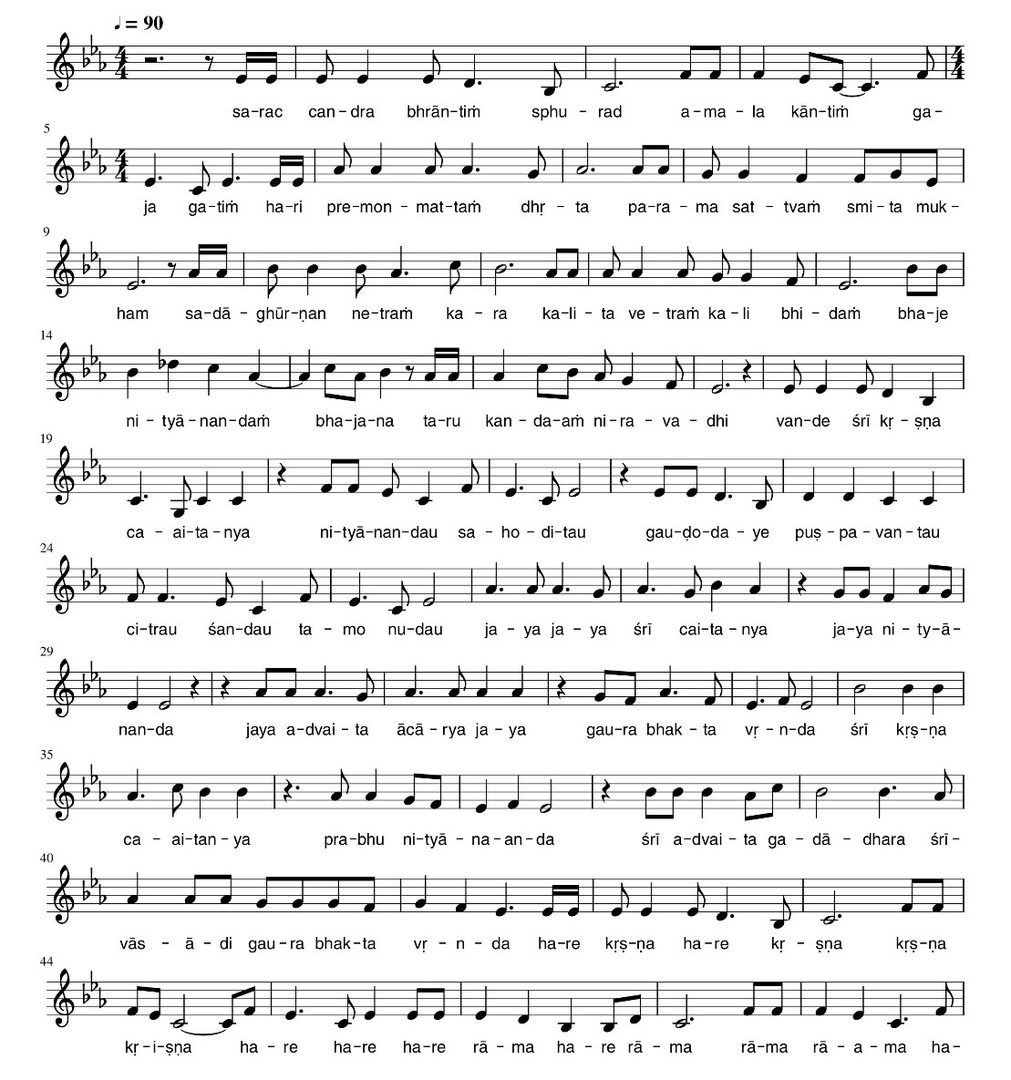
(10) sarva-mantraika-rūpaś76 ca sarva-yantra-vidāraṇaḥ77 sarva-tantrātmako78 'vyaktaḥ79 suvyakto80 bhakta-vatsalaḥ81
(11) vaiśākha-śuklasam-bhūtaḥ82 śaraṇāgata-vatsalaḥ83 udāra-kīrtiḥ84 puṇyātmā85 mahātmā86 caṇḍa-vikramaḥ87
(12) vedatraya88 prapūjyaś89 ca bhagavān90 parameśvaraḥ91 śrīvatsāṅkaḥ śrīnivāso92 jagad-vyāpī93 jagan-mayaḥ94
(13) jagat-pālo95 jagannātho96 mahākāyo97 dvi-rūpabhṛt98 paramātmā99paraṣjyotir100 nirguṇaś101 ca nṛkesarī102
(14) para-tattvaṁ103 paran-dhāma104 sac-cid-ānanda vigrahaḥ105 lakṣmī-nṛsiṁhaḥ106 sarvātmā107 dhīraḥ prahlāda-pālakaḥ108
(15) idaṁ lakṣmī-nṛsiṁhasya nāmāṣṭottaramī śatam tri-sandhyaṁ yaḥ pathed bhaktyā sarvābhīṣṭamavāpnuyāt
Commentary
On His tour of South India, Śrī Caitanya Mahāprabhu arrived one day at the place of pilgrimage known as Jiyaḍa-nṛsiṁha. Upon seeing the Deity of Lord Nṛsiṁha in the temple, Śrī Caitanya Mahāprabhu offered His respectful obeisances by falling flat. Then, in ecstatic love, He performed various dances, chanted, and offered prayers:
“śrī-nṛsiṁha, jaya nṛsiṁha, jaya jaya nṛsiṁha prahlādeśa jaya padmā-mukha-padma-bhṛṅga”
“‘All glories to Nṛsiṁhadeva! All glories to Nṛsiṁhadeva, who is the Lord of Prahlāda Mahārāja and, like a honeybee, is always engaged in beholding the lotuslike face of the goddess of fortune.’” The following is the translation of the 108 names of Nṛsiṁhadeva by Bhaktivinoda Ṭhākura: I offer my humble obeisances to:
1. the Supreme Lord in the form of a half-man half-lion, 2. the divine lion, 4. the greatly powerful, 5. the terrifying lion, 6. the Lord of lords, 7. the one who appeared from a pillar, 8. the one who possesses terrifying eyes, 9. the one who showed great anger, 10. the one who is all-wonderful 11. the one who is most beautiful, 12. the source of yogic bliss, 13. the one who took three gigantic steps, 14. the one who takes away all troubles, 15. the one who roars loudly, 16. the one who carries a disk, 17. the one who is always victorious, 18. the one whose glories are always increasing, 19. Him who possesses five heads, 20. the Supreme Absolute Truth, 21. the one who for His devotees is not horrible, 22. the one whose actions are terrifying, 23. the one whose face is effulgent, 24. the one who is decorated with an effulgent garland of flames, 25. the one who is most effulgent, 26. the Supreme Master, 27. the one who possesses all good (moral) qualities, 28. the one who has one thousand eyes, 29. the one who is difficult to look at, 30. the one who oppresses His enemies with great heat, 31. the one who possesses huge teeth, 32. the supremely astute in battle who is always ready to fight, 33. the one who is compared to an angry moon, 34. the all-auspicious Lord, 35. the one who destroys Hiraṇyakaśipu, 36. the one who destroys the masses of the race of demons and giants, 37. the one who is full of auspicious qualities, 38. the one who is very auspicious, 39. the one whose power is auspicious, 40. the one who is extremely auspicious, 41. the one who possesses a wide-open mouth, 42. the one who has a gaping mouth, 43. the Lord who performs wonderful activities, 44. the Lord who performs all activities, 45. the one who also appears as Matsya, 46. the soul of the three worlds, 47. the supreme controller, 48. the controller of all other controllers, 49. the one who is the best of all beings, 50. the one who causes terror by roaring in the sky, 51. that divine person, 52. the one who is infallible, 53. the supreme poet, 54. the husband of the Goddess of Fortune, 55. the one who is beyond understanding, 56. the infallible one, 57. the one who is the origin of everything, 58. the one who wears a garland of forest flowers, 59. the merciful Lord who grants boons to the deserving devotees, 60. the one who maintains the universe, 61. the one who is wonderful, 62. the one who determines the future (who is the future for His devotees), 63. the one who is the all pervading Lord Vishnu, 64. the one who is the supreme enjoyer, 65. the one who can never be wounded by weapons, 66. the one who has sharp nails for weapons, 67. the one who is the source of sun’s rays, 68. the Lord of the demigods, 69. Nara-hari the thousand-armed Lord, 70. the one who is the all-knowing, 71. the one who awards all perfections to the sadhakas (devotees), 72. the one who has teeth like lightning bolts, 73. the one who possesses nails like piercing lightning bolts, 74. the source of supreme bliss – ātmananda– Nṛsiṁha, 75. the source of all austerities, spiritual energy (and taptah - heat), 76. that divine personality who, although one, appears as the many mantrika formulas, 77. the one who destroys all machines (demoniac plans/arrangements/vehicles for demoniac works), 78. the essence and proprietor of all tantras (ritual rites - pujas), 79. the one who appears unmanifest, 80. the one who for His devotees becomes wonderfully manifest from a pillar (or whenever needed), 81. the one who always has the well-being of His devotees at heart, 82. the one who appeared during the waxing moon of the month of Visakha (April-May), 83. the one who is kind to those surrendered to Him (like the mother lioness who is kind to her cubs), 84. the one who is universally famous, 85. the one who is the essence of piety, 86. that great personality, 87. the one who is the performer of moonlike or great deeds, or who performs deeds that eclipse all others, 88. the Lord of the three original Vedas (Rg, Yajur, Sama), 89. the one who is supremely worshipable, 90. Bhagavān, the Supreme Personality of Godhead, 91. the one who is the supreme controller, 92. the one who is just like Krishna, being marked with symbol of Lakṣmī, 93. the one who pervades the entire universe, 94. the supreme mystic who makes the material world seem real, 95. the protector of the universe, 96. the Lord of Universe, 97. the one who moves in the air or with the movement of the air (is everywhere), 98. the one who has a double form (man-lion), 99. the one who is the Supersoul of all beings, 100. the one whose effulgence is the source of Brahman, 101. the one who has no material qualities (who possesses transcendental qualities), 102. the one who has a lion's mane while appearing part human), 103. the Supreme Absolute Truth (the one who is of the supreme nature), 104. the one who comes from the supreme abode, 105. the one whose form is made of eternal knowledge and bliss, 106. Nṛsiṁha (the Supreme Lord in the form of a half-man half-lion) together with Lakṣmī (the supreme Goddess of Fortune), 107. the Soul of all soul, 108. the one who is always sober (being never bewildered), who is the protector of Prahlāda Maharājā and those of that nature (who are surrendered to Him).
Bhaja bhaktata-vatsala
(Bhoga-ārati) Bhaktivinoda Ṭhākura
bhaja-bhakata-vatsala śrī-gaurahari
śrī-gaurahari sahi goṣṭha-vihārī
nanda-yaśomatī-citta-hari
bhaja—just worship; bhakata-vatsala—who is always very affectionate to His devotees; śrī-gaurahari—Lord Caitanya; śrī-gaurahari—this Śrī Gaurahari; sahi— is the same as; goṣṭha-vihārī—He who delights Himself in the pasturing grounds; nanda-yaśomatī-citta-hārī—who has stolen the hearts of Nanda Mahārāja and Mother Yaśodā.
Just worship Śrī Gaurahari, who is always affectionate toward His devotees. He is the same Supreme Godhead, Kṛṣṇa, who sported in the cowherd pastures of Vraja and stole the hearts of Nanda and Yaśodā.
2 belā ha'la dāmodara āisa ekhana bhoga-mandire basi' karaha bhojana
[Mother Yaśodā calls to Kṛṣṇa:] belā ha'la—it is very late; dāmodara—O Dāmodara!; āisa ekhona—please come now; bhoga-mandire—in the dining hall; basi'—sitting; karaha bhojana—please take Your lunch.
Mother Yaśodā calls to Kṛṣṇa, "My dear Dāmodara, it is very late. Please come right now, sit down in the dining hall, and take Your lunch."
3 nandera nideśe baise giri-vara-dhārī baladeva-saha sakhā baise sāri sāri nandera nideśe—on the direction of Nanda Mahārāja; baise—sits; giri-vara- dhārī—the holder of Govardhana Hill; baladeva-saha—along with Śrī Baladeva; sakhā—the cowherd boys; baise sāri sāri—sit down in rows.
On the direction of Nanda Mahārāja, Kṛṣṇa, the holder of Govardhana Hill, sits down, and then all the cowherd boys, along with Kṛṣṇa's elder brother, Śrī Baladeva, sit down in rows to take their lunch.
śuktā-śākādi bhāji nālitā kuṣmāṇḍa dāli dālnā dugdha-tumbī dadhi mocā-khaṇḍa śuktā—bitter curry; śāka—spinach; ādi—and so forth; bhāji—fried savories; nālitā—salad with green leaves of the jute plant; kuṣmāṇḍa—pumpkin; ḍāli ḍālnā— baskets of fruit; dugdha-tumbī—squash cooked with milk; dadhi—thick yogurt; mocā-khaṇḍa—vegetable preparations made from the flower of the banana tree.
They are then served a feast of śuktā and various kinds of green leafy vegetables, then nice fried things, and a salad made of the green leaves of the jute plant. They are also served pumpkin, baskets of fruit, small square cakes made of lentils and cooked-down milk, then thick yogurt, squash cooked in milk, and vegetable preparations made from the flower of the banana tree.
5 mudga-barā māṣa-barā roṭikā ghṛtānna
śaṣkulī piṣṭaka kṣira puli pāyasānna
mudga-boḍā—fried squares of dahl paddies; roṭikā—capātīs; ghṛtānna—rice with ghee; śaṣkulī—sweetmeats made with milk, sugar and sesamum; piṣṭaka— sweetened rice flour cakes; kṣīra—thick, cooked-down milk; puli—sweet rolls; pāyasānna—sweet rice in condensed milk.
Then they receive fried squares of mung dahl patties, and urad dahl patties, capātīs, and rice with ghee. Next, sweets made with milk, sugar, and sesamum; rice flour cakes; thick cooked-down milk; cakes floating in milk; and sweet rice.
6 karpūra amṛta-keli rambhā kṣīra-sāra
amṛta rasālā, amla dvādaśa prakāra
karpūra—scented with camphor; amṛta-keli—exotic sweet rice; rambhā— bananas; khīra-sāra—delicious cheese; amṛta rasāla—nectarean mangos; amla— sour preparations; dvādaśa prakāra—of twelve different kinds.
There is also sweet rice that tastes just like nectar due to its being mixed with camphor. There are bananas, and cheese which is nectarean and delicious. They are also served twelve kinds of sour preparations made with tamarinds, limes, lemons, oranges, and pomegranates.
7 luci cini sarpurī lāḍḍu rasābalī bhojana karena kṛṣṇa ha'ye kutūhalī luci cini—purīs with sugar; sarpurī—purīs filled with cream; lāḍḍu—chick-pea flour sweetballs; rasābalī—dahl paddies boiled in sugared rice; bhojana karena kṛṣṇa— Kṛṣṇa eats; ha'ye kutūhalī—in great fun.
There are purīs made with white flour and sugar; purīs filled with cream; laḍḍus; and dahl patties boiled in sugared rice. Kṛṣṇa eagerly eats all of the food.
8 rādhikāra pakka anna vividha byañjana
parama ānande kṛṣṇa karena bhojana

rādhikāra—by Rādhikā; pakka anna—cooked grains; vividha—various; vyañjana—cooked vegetables; parama ānande—in supreme bliss; kṛṣṇa korena bhojana—Kṛṣṇa eats.
In great ecstasy and joy Kṛṣṇa eats the rice, curried vegetables, sweets, and pastries cooked by Śrīmatī Rādhārāṇī.
9 chale-bale lāḍḍu khāya śrī-madhumaṅgala
bagala bājāya āra deya hari-bala
chale-bale—by hook or by crook; lāḍḍu khāya—eats lāḍḍu sweetballs; śrī- madhumaṅgala—Kṛṣṇa's funny brāhmaṇa friend Madhumaṅgala; bagala bājāy— makes a funny sound by slapping his hands under his armpits; āra deya—give me more!; hari-bala—“Haribol! Haribol!”
Kṛṣṇa's funny brāhmaṇa friend Madhumaṅgala, who is very fond of laḍḍus, gets them by hook or by crook. Eating the laḍḍus, he shouts, "Haribol! Haribol!" and makes a funny sound by slapping his sides under his armpits with his hands.
10 rādhikādi gaṇe heri' nayanera koṇe tṛpta ha'ye khāya kṛṣṇa yaśodā-bhavane rādhikādi gaṇe—Rādhārāṇī and Her gopī friends; heri'—beholding; nayanera koṇe—out of the corners of His eyes; tṛpta ha'ye—being very satisfied; khāya kṛṣṇa—Kṛṣṇa eats; yaśodā-bhavane—at the house of Mother Yaśodā.
Beholding Rādhārāṇī and Her gopī friends out of the corners of His eyes, Kṛṣṇa eats at the house of Mother Yaśodā with great satisfaction.
11 bhojanānte piye kṛṣṇa subāsita vāri sabe mukha prakhālaya ha'ye sāri sāri bhojanānte—after lunch; piye kṛṣṇa—Kṛṣṇa drinks; suvāsita vāri—sweet-scented water; sabe—all His friends; mukha prakhālaya—wash their mouths; ha'ye sāri sāri—standing in lines.
After lunch, Kṛṣṇa drinks rose-scented water. Then all of the boys, standing in lines, wash their mouths.
12 hasta-mukha prakhāliyā yata sakhā-gaṇe
ānande viśrāma kare baladeva-sane
hasta-mukha—their hands and mouths; prakhāliyā—after washing; yata sakhā- gaṇe—all the cowherd boys; ānande—in great bliss; viśrāma kare—they take rest; baladeva-sane—along with Lord Balarāma.
After all the cowherd boys wash their hands and mouths, in great bliss they take rest with Lord Balarāma.
13 jambula rasāla āne tāmbūla-masālā tāhā kheye kṛṣṇa-candra sukhe nidrā gelā jambula rasāla—Kṛṣṇa's servants named Jambula and Rasāla; āne—bring; tāmbūla-masālā—spiced betel nuts; tāhā kheye—chewing that; kṛṣṇa-candra—the moonlike Kṛṣṇa; sukhe—happily; nidrā gelā—goes to sleep.
The two cowherd boys Jambula and Rasāla then bring Kṛṣṇa pān made with betel nuts, fancy spices, and catechu. After eating that pān, Śrī Kṛṣṇacandra then happily goes to sleep.
14 viśālākha śikhi-puccha-cāmara ḍhulāya apūrva śayyāya kṛṣṇa sukhe nidrā yāya viśālākṣa—His servant named Viśālākṣa; śikhi-puccha-cāmara—a fan of peacock feathers; ḍhulāya—waves; apūrva śayyāya—on an excellent bedstead; kṛṣṇa— Kṛṣṇa; sukhe—happily; nidrā yāya—goes to sleep.
While Kṛṣṇa happily takes His rest on an excellent bedstead, His servant Viśālākṣa cools Him with a fan of peacock feathers.
15 yaśomatī-ājñā pe'ye dhaniṣṭhā-ānīta śrī-kṛṣṇa-prasāda rādhā bhuñje ha'ye prīta yaśomatī-ājñā—the order of Mother Yaśodā; pe'ye—receiving; dhaniṣṭhā-ānīta— brought by the gopī named Dhaniṣṭhā; śrī-kṛṣṇa-prasāda—the food remnants of Śrī Kṛṣṇa; rādhā—Śrīmatī Rādhārāṇī; bhuñje—eats; ha'ye prīta—being extremely delighted.
At Mother Yaśodā's request the gopī Dhaniṣṭhā brings remnants of food left on Kṛṣṇa's plate to Śrīmatī Rādhārāṇī, who eats them with great delight.
16 lalitādi sakhī-gaṇa avaśeṣa pāya mane mane sukhe rādhā-kṛṣṇa-guṇa gāya lalitādi—headed by Lalitā; sakhī-gaṇa—the assembly of girlfriends; avaśeṣa pāya—receiving Her remnants; mane mane—in their heart-of-hearts; sukhe— blissfully; rādhā-kṛṣṇa-guṇa—the qualities of Rādhā and Kṛṣṇa; gāya—they sing.
Lalitā-devī and the other gopīs then receive the remnants, and within their hearts they sing the glories of Rādhārāṇī and Kṛṣṇa with great joy.
17 hari-līlā eka-mātra yāhāra pramoda bhogārati gāya ṭhākura bhakativinoda hari-līlā—the wonderful pastimes of Lord Hari; eka-mātra—one and only; yāhāra— whose; pramoda—joy; bhogārati—this Bhoga-ārati song; gāya—sings; ṭhākura bhakativinoda—Ṭhākur Bhaktivinoda.
Ṭhākura Bhaktivinoda, whose one and only joy is the pastimes of Lord Hari, sings this Bhoga-ārati song.
Commentary
A devotee does not eat anything without offering it first to the Lord. Śrīla Prabhupāda always stressed the importance of kṛṣṇa-prasādam, to engage the tongue in devotional service by tasting sanctified food. This song is especially sung at noon while food (bhoga) is being offered to the Lord and then ārati performed. Actually, the Supreme Personality of Godhead is self-satisfied and does not need our offering of eatables, but out of His unlimited kindness He accepts whatever a devotee offers Him with love. In this regard, Śrīla Prabhupāda writes in the Fourth Canto of Śrīmad-Bhāgavatam (30.28):
The form of the Lord known as arcā-vigraha is an expansion of His unlimited potencies. When the Lord is gradually satisfied with the service of a devotee, in due course of time He accepts the devotee as one of His many unalloyed servants. By nature, the Lord is very compassionate; therefore the service of neophyte devotees is accepted by the Lord. As confirmed in Bhagavad-gītā (9.26):
patraṁ puṣpaṁ phalaṁ toyaṁ
yo me bhaktyā prayacchati tad ahaṁ bhakty-upahṛtam aśnāmi prayatātmanaḥ
"If one offers Me with love and devotion a leaf, a flower, fruit or water, I will accept it." The devotee offers eatables in the form of vegetables, fruits, leaves and water to the arcā-vigraha. The Lord, being bhakta-vatsala, compassionate upon His devotees, accepts these offerings. Atheists may think that the devotees are engaged in idol worship, but the fact is different. Janārdana, the Supreme Lord, accepts bhāva, the attitude of service. The neophyte devotee engaged in the worship of the Lord may not understand the value of such worship, but the Supreme Lord, being bhakta-vatsala, accepts His devotee and in due course of time takes him home.
A similar statement is found in the Seventh Canto (SB 7.2.7-8):
The Lord accepts the offerings of devotees because of their transcendental love. Because they are in love with the Supreme Lord, they do not eat anything without offering it first to the Lord. The Lord does not hanker for a small leaf or flower; He has enough to eat. Indeed, He is feeding all living entities. Nonetheless, because He is very merciful and is bhakta-vatsala, very favorable to the devotees, He certainly eats whatever they offer Him with love and devotion. This quality should not be misjudged to be childish. The highest quality of the Supreme Lord is that He is bhakta-vatsala; in other words, He is always extremely pleased with His devotees.
Gaura-ārati Bhaktivinoda Ṭhākura
1 (kiba) jaya jaya gorācāṅdera āratika śobhā
jāhnavī-taṭa-vane jaga-mana-lobhā
jaga-jana-mana-lobhā

jaya jaya—all glories, all glories!; gorācāṅdera—of the moonlike Lord Caitanya; āratika śobhā—the beautiful ārati ceremony; jāhnavī-taṭa-vane—in a grove on the banks of the Ganges river; jaga-mana-lobhā—attracting the minds of all living entities in the universe.
All glories, all glories to the beautiful ārati ceremony of Lord Caitanya! This Gaura-ārati is being performed in a grove on the bank of the Ganges and is captivating everyone in the universe.
2 dakṣiṇe nitāicāṅda, vāme gadādhara nikaṭe advaita, śrīnivāsa chatra-dhara dakhiṇe nitāicāṅda—on His right side is the moonlike Lord Nityānanda; vāme gadādhara—on His left is Śrī Gadādhara; nikaṭe advaita—nearby stands Śrī Advaita; śrīnivāsa chatra-dhara—and Śrīvāsa Ṭhākura is holding an umbrella.
On Lord Caitanya's right is Lord Nityānanda, and on His left is Śrī Gadādhara. Nearby stands Śrī Advaita, and Śrīvāsa Ṭhākura holds an umbrella over Lord Caitanya's head.
3 basiyāche gorācāṅda ratna-siṁhāsane
ārati karena brahmā-ādi deva-gaṇe
bosiyāche—is sitting; gorācāṅda—Lord Gauracandra; ratna-siṁhāsane—upon a jeweled throne; ārati korena—performing the ārati ceremony; brahmā-ādi deva- gaṇe—the demigods, headed by Lord Brahmā.
Lord Caitanya has sat down on a jeweled throne, and Lord Brahmā and the other demigods are performing His ārati.
4 narahari-ādi kari' cāmara dhulāya sañjaya-mukunda-vāsu-ghoṣa-ādi gāya narahari-ādi—Narahari Sārakāra and other associates; kari' cāmara ḍhulāya— fanning Him with cāmara whisks; sañjaya-mukunda-vāsu-ghoṣa-ādi—the devotees headed by Sañjaya, Mukunda and Vāsu Ghoṣa; gāya—are singing.
As Narahari Sarakāra and other associates of Lord Caitanya fan Him with cāmaras, Sañjaya Paṇḍita, Mukunda Datta, Vāsu Ghoṣa and other devotees sing sweet kīrtana.
5 śaṅkha bāje ghaṇṭā bāje bāje karatāla madhura mṛdaṅga bāje parama rasāla śaṅkha bāje—conchshells resound; ghaṇṭā bāje—bells resound; bāje karatāla— hand-cymbals resound; madhura mṛdaṅga bāje—sweet clay drums resound; parama rasāla—supremely sweet and relishable to hear.
Conchshells, bells, and karatālas resound, and the mṛdaṅgas play very sweetly. This kīrtana music is supremely sweet and relishable to hear.
6 bahu-koṭi candra jini' vadana ujjvala gala-deśe vana-mālā kare jhalamala bahu-koṭi—many millions; candra—of moons; jini'—conquering; vadana ujjvala— the brilliance of Lord Caitanya's face; gala-deśe—around His neck; vana-mālā— the garland of forest flowers; kare jhalamala—shines.
The brilliance of Lord Caitanya's face conquers millions upon millions of moons, and the garland of forest flowers around His neck shines.
7 śiva-śuka-nārada preme gada-gada bhakativinoda dekhe gorāra sampada śiva-śuka-nārada—Lord Śiva, Śukadeva Gosvāmī, and Nārada Muni; preme—with the ecstasy of transcendental love; gada-gada—their voices are choked; bhakativinoda—thus Ṭhākura Bhaktivinoda; dekhe—beholds; gorāra sampada— the glory of Lord Caitanya.
Lord Śiva, Śukadeva Gosvāmī, and Nārada Muni are all present, and their voices are choked with the great ecstasy of transcendental love. Thus Ṭhākura Bhaktivinoda envisions the glory of Lord Śrī Caitanya.
Commentary
This ārati song is sung in the evening. Śrīla Prabhupāda introduced this song on December 31, 1968 in Los Angeles. He had Pradyumna note down every word and explained its meaning. Sometimes, he would elaborate: Lobhā, “attractive.” This means "The ārātrika ceremony which is going on on the bank of the Ganges to receive Lord Caitanya is so beautiful that it is attractive to the people of the world, all people of the world." Jaga-jana-mana-lobhā. Mana... "Attractive to the mind of all people of the world." Pradyumna: Ārati karena. Prabhupāda: Ārati means reception, karena, doing, brahma, Lord Brahma, ādi, headed by, deva-gaṇe, all the demigods. That means "To offer ārati reception to Lord Caitanya, all the demigods have come down, headed by Lord Brahma." Ārati karena brahmā-ādi deva-gaṇe. Rasāla, very relishable. All these sounds together, when vibrated, they are very relishable to hear. So make typed copies nicely, with diacritic mark, hard "a," and explain. And the sound is there, repeat. If you practice two, three days, it will be all right. Everyone will be able to sing, and it will be very nice. Pradyumna: It's very beautiful.
Prabhupāda: Yes. Everything will come out nice, beautiful. (break—Prabhupāda sings mahā-mantra in morning tune, also mixing the words) Like that. This is to be practiced. So these words can be mixed in a different way to make the sound palatable. That's all. Just repeat. The Hare Kṛṣṇa is there, but in a different way. That's all.
Tulasī Prayers
(To be recited three times while bowing down)
vṛndāyai tulasī-devyai priyāyai keśavasya ca viṣṇu-bhakti-prade devi satyavatyai namo namaḥ vṛndāyai—unto Vṛndā; tulasī devyai—unto Tulasī Devī; priyāyai—who is dear; keśavasya—to Lord Keśava; ca—and; viṣṇu bhakti—devotional service to Lord Viṣṇu; prade—who bestows; devi—O goddess; satyavatyai—unto Satyavatī; namo namaḥ—repeated obeisances.
“I offer my repeated obeisances unto Vṛndā, Śrīmatī Tulasī Devī, who is very dear to Lord Keśava [Kṛṣṇa]. O goddess, you bestow devotional service to Lord Viṣṇu [Kṛṣṇa] and possess the highest truth.”
(To be sung during the offering of arati)
(1) namo namaḥ tulasī! kṛṣṇa-preyasī! namo namaḥ
rādhā-kṛṣṇa-sevā pābo ei abhilāṣī
(refrain) namo namaḥ—bowing again and again; tulasī—O Tulasī!; kṛṣṇa-preyasī— O beloved of Kṛṣṇa!; namo namaḥ—repeated obeisances; rādhā-kṛṣṇa-sevā—the service of Śrī Śrī Rādhā and Kṛṣṇa; pābo—I will obtain; ei—this; abhilāṣī—I am desirous.
O Tulasī, beloved of Kṛṣṇa, I bow before you again and again. My desire is to obtain the service of Śrī Śrī Rādhā-Kṛṣṇa.
(2) ye tomāra śaraṇa laya, tāra vāñchā pūrṇa haya
kṛpā kari’ kara tāre vṛndāvana-vāsī
ye—whoever; tomāra—your; śaraṇa loy—takes shelter; tāra—his; vāñchā— desires; pūrṇa hoy—are fulfilled; kṛpā kori'—being merciful; koro—you make; tāre—him; vṛndāvana-vāsī—a resident of Vṛndāvana.
Whoever takes shelter of you has his wishes fulfilled. Bestowing your mercy on him, you make him a resident of Vṛndāvana.
(3) mora ei abhilāṣa, vilāsa kuñje dio vāsa
nayane heriba sadā yugala-rūpa-rāśi
mora—my; ei—this; abhilāṣ—desire; vilās kuñje—in the pleasure-groves; dio— please give; vās—a residence; nayane—with my eyes; heribo—I will behold; sadā—always; yugala-rūpa-rāśī—the waves of the Divine Couple's beauty.
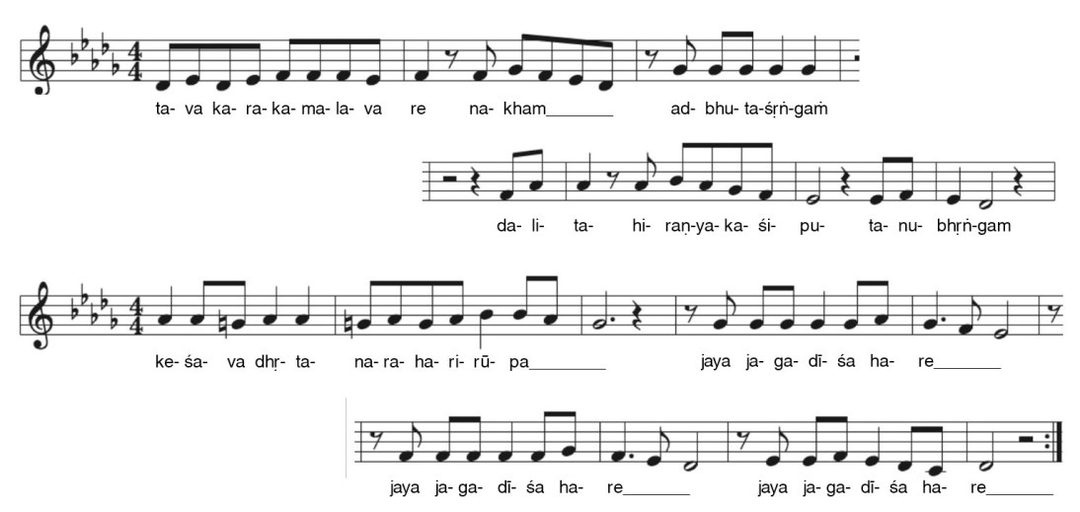
My desire is that you will also grant me a residence in the pleasure groves of Śrī Vṛndāvana-dhāma. Thus, within my vision I will always behold the beautiful pastimes of Rādhā and Kṛṣṇa.
(4) ei nivedana dhara, sakhīra anugata kara
sevā-adhikāra diye kara nija dāsī
ei nivedana—this request; dharo—please keep; sakhīra—of one of the cowherd damsels; anugata koro—make me a follower; sevā-adhikāra—the privilege of devotional service; diye—bestowing; koro—please make; nija dāsī—your own maidservant.
I beg you to make me a follower of the cowherd damsels of Vraja. Please give me the privilege of devotional service and make me your own maidservant.
(5) dīna kṛṣṇa-dāse kaya, ei yena mora haya śrī-rādhā-govinda-preme sadā yena bhāsi dīna kṛṣṇa-dāse—the fallen and lowly servant of Kṛṣṇa (named Kṛṣṇadāsa); koy— prays; ei—this; yena—just like; mora hoy—is mine; śrī-rādhā-govinda-preme—in the ecstatic love for Śrī Rādhā and Govinda; sadā—always; yena—just like; bhāsi—swimming. This very fallen and lowly servant of Kṛṣṇa prays, ‘May I always swim in the love of Śrī Śrī Rādhā and Govinda.
(To be chanted while circumambulating and watering the tulasi plant)
yāni kāni ca pāpāni brahma-hatyādikāni ca
tāni tāni praṇaśyanti pradakṣiṇaḥ pade pade
yāni kāni—whatever; ca—and; pāpāni—sins; brahma-hatya—killing of a brāhmaṇa; ādikāni—and so on; ca—also; tāni tāni—all of them; praṇaśyanti—are destroyed; pradakṣiṇaḥ—(by) the circumambulation (of Tulasī Devī); pade pade— at every step.
By the circumambulation of Śrīmatī Tulasī Devī all the sins one may have committed are destroyed at every step, even the sin of killing a brāhmaṇa.
Commentary
When Śrīla Prabhupāda came to the West, he did not expect to be able to introduce the worship of Tulasī Devī because of the cold climate. Thus he was very pleased when one of his first disciples, Govinda Dasi, succeeded in growing tulasī plants from seeds in Hawaii. In a letter to her, dated April 7, 1970, Śrīla Prabhupāda expressed his gratitude for her exceptional service and gave her the mantras for worshiping tulasī: I am giving you here with three mantras for Tulasi Devi as follows:
vrindaai tulasi devyai priyaai kesavasya ca visnubhaktiprade devi satyavatyai namo namah
This is offering obeisances, bowing down (pancanga pranam). And when collecting leaves from the plant, the following mantra should be chanted:
tulasya mrta janmasi sada tvam kesavapriya kesavarthi cinomi tvam barada bhava sobhine
Then the mantra for circumambulating the Tulasi tree:
yani kani ca papani brahmahatya dikani ca tani tani pranasyanti pradaksinah pade pade
So there are three mantras, one for bowing down, one for circumambulating (3 times round the plant both morning and evening), and one for collecting the leaves. Later someone felt that viṣṇu-bhakti in the pranama prayer should be changed to krṣṇa-bhakti, probably reasoning that following prayer chanted during arati is all about Radha-Kṛṣṇa in Vṛndāvana, not about Viṣṇu in Vaikuṇṭha. In the Vedabase we find the following statement: “Śrīla Prabhupāda gave his disciples the following prayers for worshiping Tulasī Devī: […] krṣṇa-bhakti-prade devi.” As is clear from the letter to Govinda Dasi, this is not a fact. We should stick to mantra given personally by our founder-ācārya. To correct the spiritual master, even with the best of intentions, is an offense. Furthermore, applying the same reasoning, we might as well change other verses where Viṣṇu is mentioned, for example Prahlāda Mahārāja’s teaching: śravaṇaṁ kīrtanaṁ viṣṇoḥ smaraṇaṁ? Or the injunction martavyaḥ satataṁ viṣṇuḥ. Or, for that matter, nama oṁ viṣṇu-pādāya.
Nṛsiṁha Prayers
1 namas te narasiṁhāya
prahlādāhlāda-dāyine hiraṇyakaśipor vakṣaḥ-
śilā-ṭaṅka-nakhālaye
namaḥ—obeisances; te—unto You; nara-siṁhāya—unto Lord Narasiṁha; prahlāda—(to) Prahlāda Mahārāja; āhlāda—(of) joy; dāyine—the giver; hiraṇyakaśipoḥ—of Hiraṇyakaśipu; vakṣaḥ—chest; śilā—(on) the stonelike; ṭaṅka—chisels; nakha-ālaye—whose nails.
I offer my obeisances to Lord Narasiṁha who gives joy to Prahlāda Mahārāja and whose nails are like chisels on the stonelike chest of the demon Hiraṇyakaśipu.
2 ito nṛsiṁhaḥ parato nṛsiṁho yato yato yāmi tato nṛsiṁhaḥ bahir nṛsiṁho hṛdaye nṛsiṁho nṛsiṁham ādiṁ śaraṇaṁ prapadye itaḥ—here; nṛsiṁhaḥ—Lord Nṛsiṁha; parataḥ—there; nṛsiṁhaḥ—Lord Nṛsiṁha; yataḥ yataḥ—wherever; yāmi—I go; tataḥ—there; nṛsiṁhaḥ—Lord Nṛsiṁha; bahiḥ—externally; nṛsiṁhaḥ—Lord Nṛsiṁha; hṛdaye—in the heart; nṛsiṁhaḥ— Lord Nṛsiṁha; nṛsiṁham—to Lord Nṛsiṁha; ādim—the origin; śaraṇam—the supreme refuge; prapadye—I surrender.
Lord Nṛsiṁha is here and also there. Wherever I go Lord Nṛsiṁha is there. He is in the heart and is outside as well. I surrender to Lord Nṛsiṁha, the origin of all things and the supreme refuge.
3 tava kara-kamala-vare nakham adbhuta-śṛṅgaṁ
dalita-hiraṇyakaśipu-tanu-bhṛṅgam keśava dhṛta-narahari-rūpa jaya jagadīśa hare tava—Your; kara-kamala-vare—upon the beautiful lotus hands; nakham—the nails; adbhuta-śṛṅgam—wonderfully sharp tips; dalita—ripped apart; hiraṇyakaśipu-tanu—the body of the demon Hiraṇyakaśipu; bhṛṅgam—the wasp; keśava—O Lord Keśava!; dhṛta-narahari-rūpa—who assumed the form of Narahari; jaya—all glories; jagat-īśa hare—O Hari, Lord of the universe!
O Keśava! O Lord of the universe! O Lord Hari who have assumed the form of a half-man, half-lion! All glories to You! With the wonderfully sharp nails on Your beautiful lotus hands You have ripped apart the wasplike body of Hiraṇyakaśipu.
Commentary
Prayers 1 and 2 are from the Nṛsiṁha Purāṇa and the third verse is from Jayadeva Gosvāmī’s Daśāvatāra-stotra. As described in the Śrī Caitanya-caritāmṛta, Antya- līlā 16.52-53, Śrī Caitanya Mahāprabhu used to chant these verses again and again while offering obeisances to Lord Nṛsiṁha before entering the temple of Lord Jagannātha. Yaśodānandana remembers: “When Prabhupada first introduced the namas te narasiṁhāya prayers, he said that they were for the protection of his movement. While he was singing them, some Indian lady in the crowd started to sing oṁ jaya jagadiśa hare. Prabhupada interrupted the prayer and said, "Who has said this?" He said, "No, no. Not oṁ jaya jagadiśa hare. It is jaya jagadiśa hare. Don't concoct." Prabhupada was very specific about that, because various Hindus sing ārati prayers with the words oṁ jaya jagadiśa hare. Then Prabhupada chanted the namas te narasiṁhāya prayer in a very grave tone, repeating each and every word. It was an ecstatic experience to see and hear Śrīla Prabhupāda introducing this new, potent, transcendental prayer and showing the devotees how to sing it to protect his movement.” Prabhupāda requested his disciples to chant this prayer after every ārati. Thus it is one of the main prayers of the Kṛṣṇa Consciouness Movement, and it goes without saying that therefore it should be chanted correctly. Unfortunately, many singers who lead Nṛsiṁhadeva’s ārati-kīrtana after Maṅgala-ārati in Mayapur don’t pronounce Nṛsiṁha’s names correctly. Being a Sanskrit prayer, word endings may change according to grammatical rules. In this case, the ending of Nṛsiṁhadeva’s name changes from a to o in the second verse:
ito nṛsiṁhaḥ parato nṛsiṁho yato yato yāmi tato nṛsiṁhaḥ bahir nṛsiṁho hṛdaye nṛsiṁho nṛsiṁham ādiṁ śaraṇaṁ prapadye
However, since years the singers have been chanting all endings either with a or with o. Over time, a has gained prominence and has been accepted as the standard. As a result, hundreds and thousands of devotees all over the world have been infected with this wrong chanting which can be heard in many temples, even though in some places the Nṛsiṁha Prayers are displayed on a large signboard in front of the audience. Furthermore, Nṛsiṁhadeva’s name in the last line of the prayer is nṛsiṁham not narasiṁham, as has become the custom. We know from devotees’ accounts that Śrīla Prabhupāda corrected wrong chanting whenever he heard it, sometimes even sending his servant or secretary to the temple room in order to stop the kīrtana. He is not pleased when the Nṛsiṁha Prayers are chanted incorrectly. We should make an effort to chant them as given in the Nṛsiṁha Purāṇa. What is the difficulty?
Prahlāda-Nṛsiṁha in Mayapur, India