 Spiritual
for Sanskrit and Bengali
Sanskrit, being the mother of all languages, also gave birth to Bengali, and it is
estimated that about 70% of the Bengali vocabulary is very similar, if not identical,
to its Sanskrit counterpart. Both languages have their own script and there are
different systems of transliteration, or Romanization, to facilitate the pronunciation
for those who do not speak these languages. The pronunciation of Romanized
Sanskrit is relatively straightforward whereas many transliterated letters in Bengali
do not reflect the phonetic sound. This is true for most languages, English being a
good example. The last four letters of “through”, “though”, “tough”, and “plough” are
all spelled identically but pronounced differently. On the other hand, many words
are pronounced identically but written differently, like “hear” and “here”, or “fair” and
“fare”. For somebody who has no knowledge of either English or Bengali, the
pronunciation of Bengali is probably easier to learn than the pronunciation of
English.
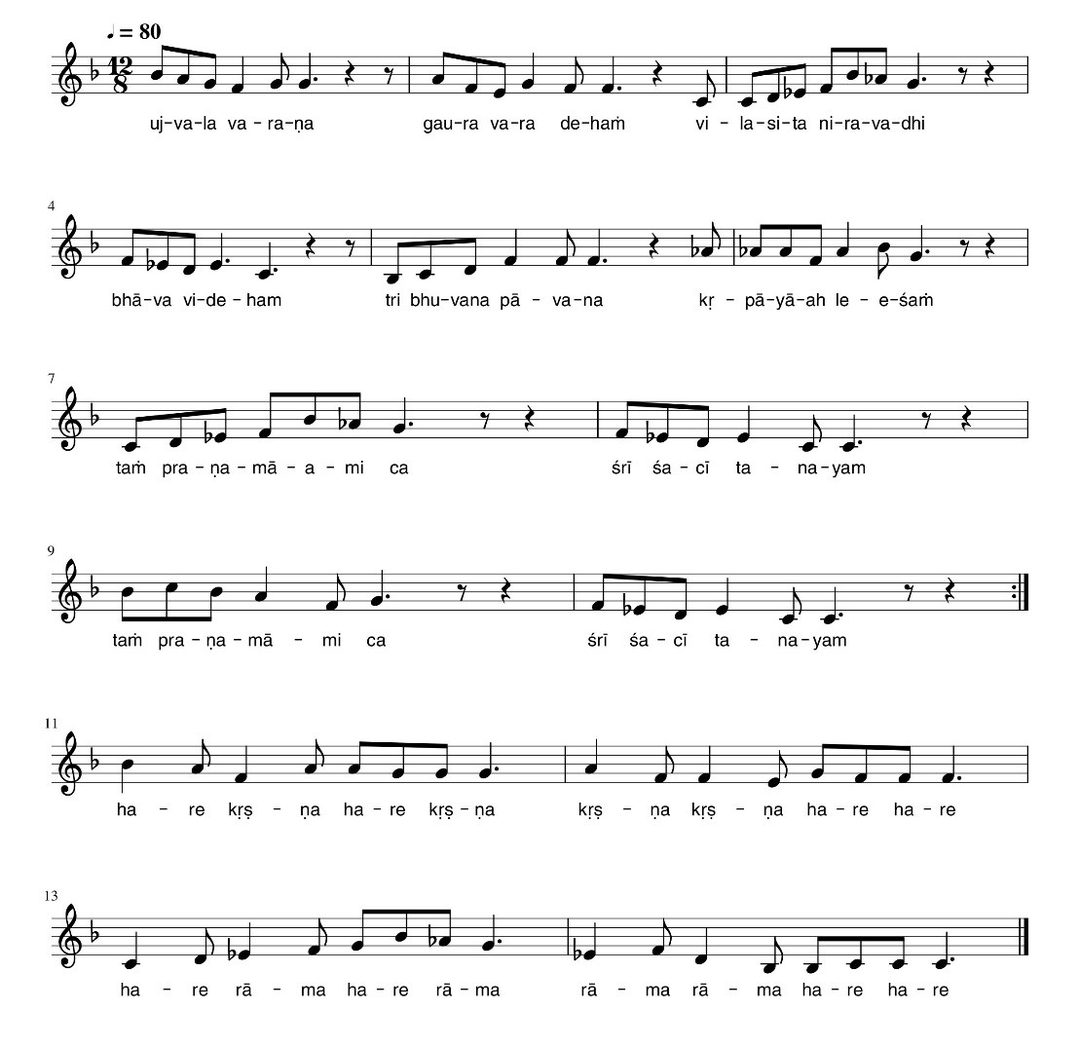
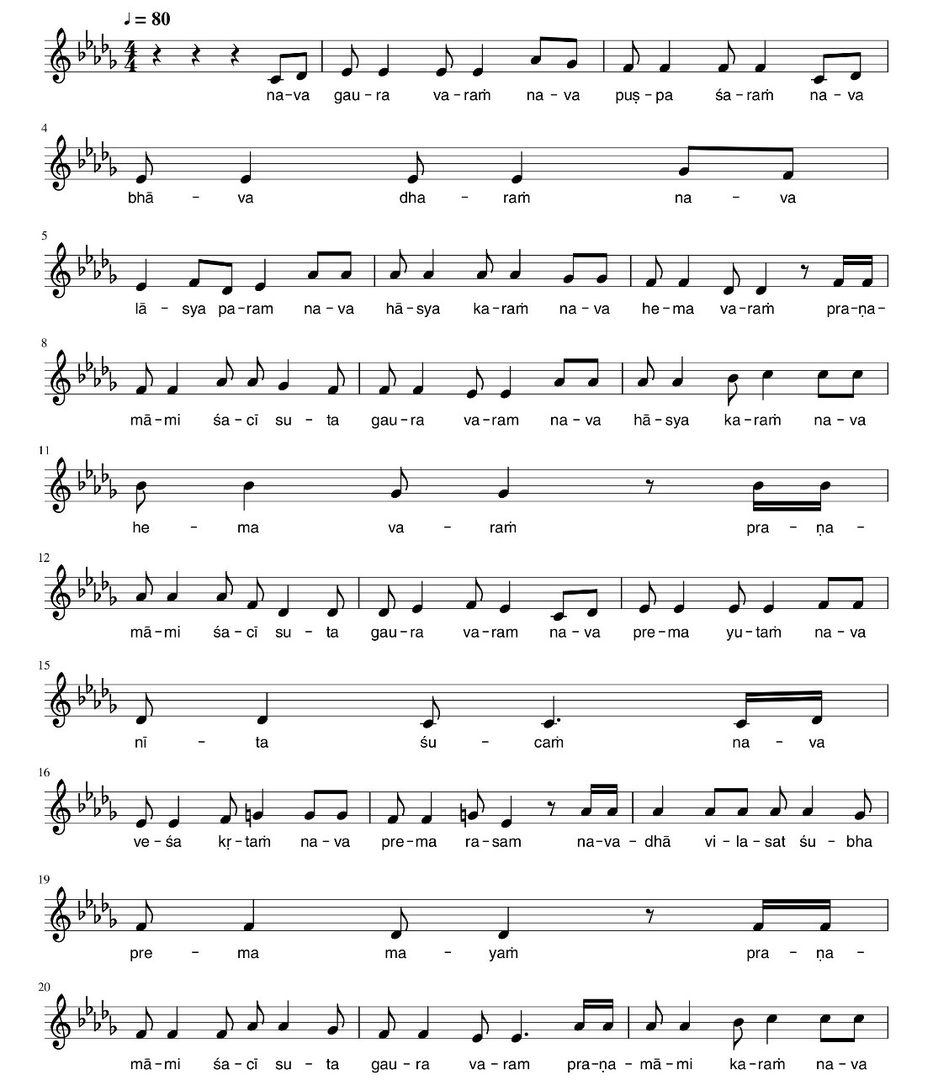
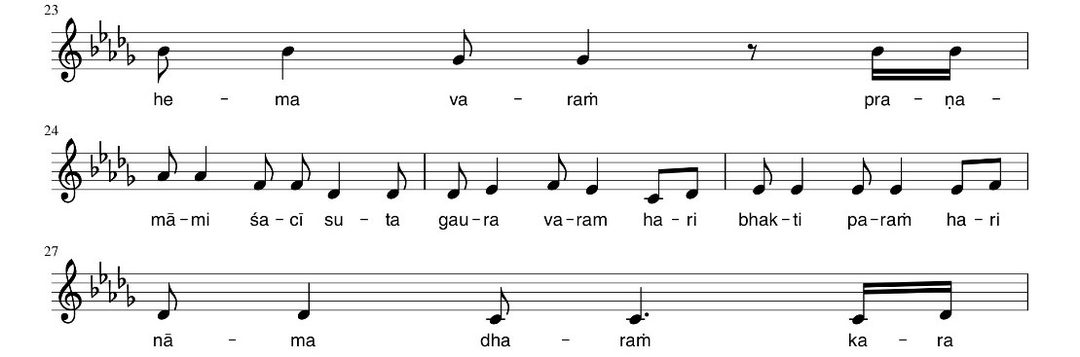
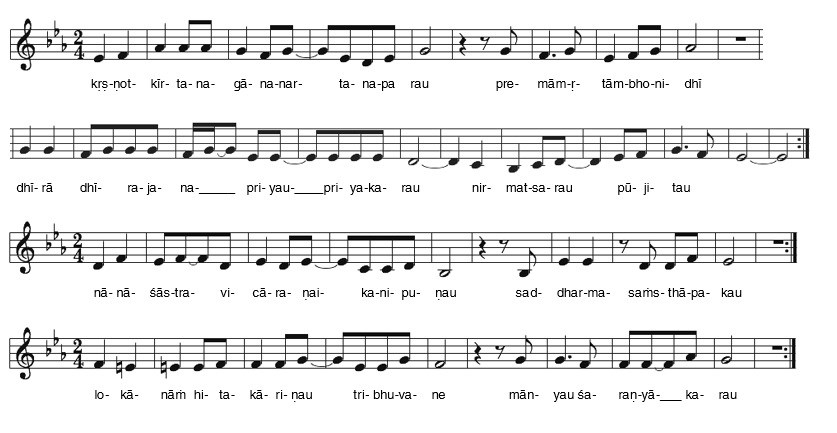
One of the objectives of this songbook is to make it as uncomplicated as possible
to sing the Vaiṣṇava songs and thus inspire devotees to incorporate singing them
as a regular part of their spiritual practice. A consistent system of Romanization
that facilitates the proper pronunciation is therefore essential, as are easy-to-follow
melodies and a clear song structure. For this reason, we have slightly modified the
transliteration method found in BBT and other publications. The IAST (International
Alphabet of Sanskrit Transliteration) system, used by the BBT, was devised in the
19th century for the Romanization of Sanskrit because it makes it possible to read
the Sanskrit text unambiguously, exactly as if it were in the original Indic script.
However, to pronounce Bengali with this system is not as easy, because many
letters don’t correspond to their phonetics. One letter in particular stands out,
because it appears quite often but is invariably incorrectly pronounced, unless you
know Bengali: ড়.
Transliterated ড় is shown as ḍ, but is pronounced r. To add to the confusion, there
is a similar letter –ড– that is also transliterated as ḍ and is indeed pronounced as
d. But in the transliterated texts of the Śrī Caitanya-caritāmṛta, as well as in many
songbooks, there is no way of telling ড় from ড apart, because both are
transliterated in the same way: ḍ. Furthermore, in the pronunciation guide at the
end of the books, the difference between the two is not mentioned.
As a result, most of us who don’t speak Bengali, have developed pronunciation
habits that are simply wrong. For example, every day, at the time of prasādam, we
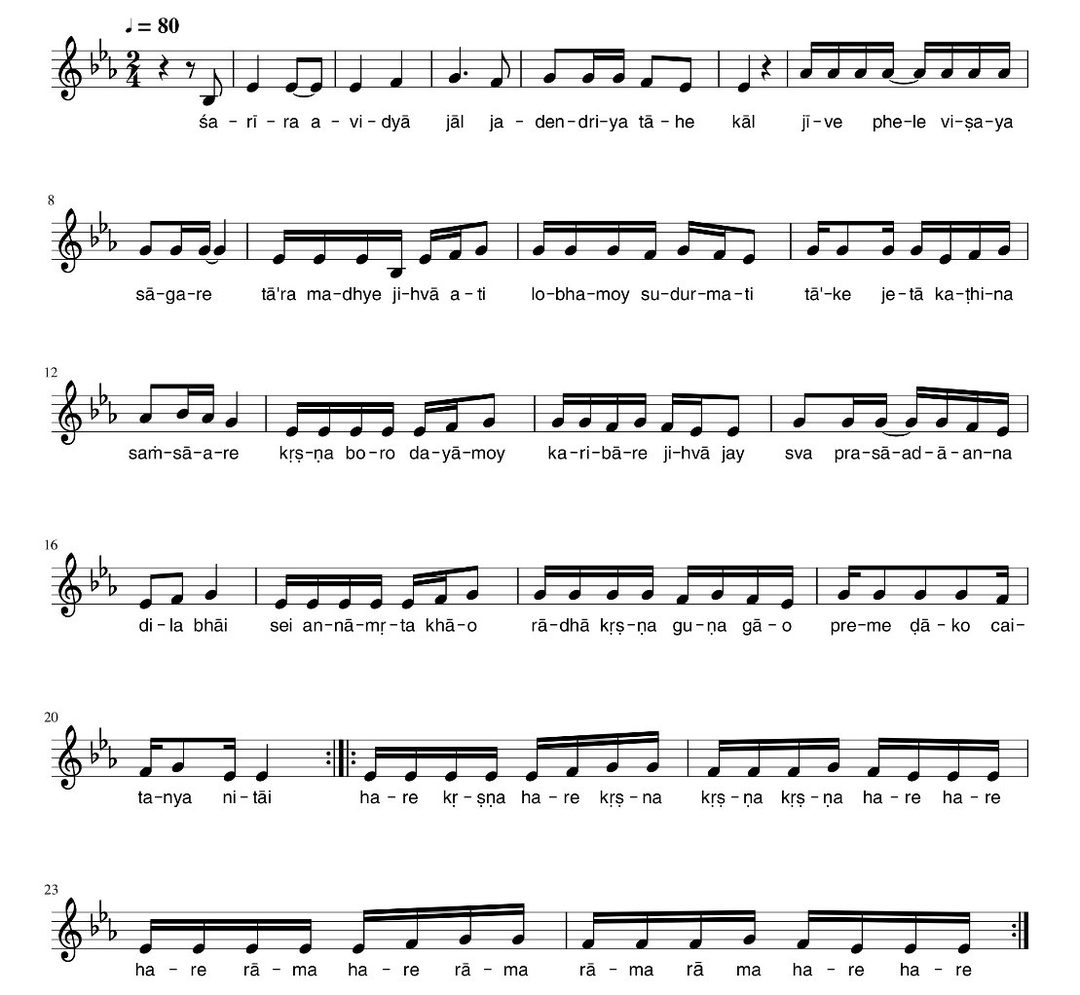
chant: śarīra avidyā-jāla, jaḍendriya tāhe kāla and kṛṣṇa baḍa dayāmaya, karibāre
jihvā jaya. The ḍ in both jaḍendriya and baḍa is not a d, it is pronounced r. The
word baḍa which is quite common, means “very”, or “great”, or “very much”, or
“elder” and “younger”, as in Baḍa Haridāsa and Choṭa Haridāsa. In the Vedabase
we can find three different transliterations: baḍa, bara and boro, the latter being an
attempt to reflect the actual Bengali pronunciation. Another common word, found
in a number of bhajanas, is chāḍiyā (giving up). Because the ḍ is not a d but an r,
it should be pronounced chāriyā.
To avoid this confusion, in Sacred Song Symphony we have transliterated ড় as r
and ড as ḍ, a simple solution. As far as the rest of transliterated Bengali goes, the
most notable difference from Sanskrit is the pronunciation of the short a. In Sanskrit
it is pronounced like the a in car, whereas in Bengali, the a is pronounced more like
an open o, as in what. And very often, at the end of a word, the a is mute.
Detailed examples of pronunciation are given in the chart on the opposite page.
When the first Vaiṣṇava Songbook was published, these rules were taken into
consideration and an attempt was made to present the transliterated Bengali in a
way that corresponds to the native pronunciation. Thus we find kara changed into
koro, or sometimes karuṇa into koruṇa. However, this rule has not been applied
consistently, and therefore many words where the a is also pronounced as an o
have been left with the original a, causing confusion.
In Sacred Song Symphony we have left the a unchanged, and it is simply a matter
of becoming accustomed to pronounce any short a like an open o, unless it is found
at the end of a word where it is generally not pronounced at all. Another good
example for both rules is jīva jaga, pronounced jīv jago. As a reminder of the rule to
mute the a, we have changed the color of the last a in many words to a dark grey.
This is a suggestion only, because there is no hard and fast rule. A singer may
mute or pronounce the last a of a word, depending on the melody and meter. In
some cases, an a may even be added. Thus bhakta becomes bhakata and karma
becomes karama, as we can see in Bhaja bhakata-vatsala or Anādi karama phale.
Noteworthy is also the s. There are three types of s, both in Sanskrit and Bengali:
s, ś and ṣ. Among these, the Bengali ṣ is special because it is not pronounced.
This happens in many words we are familiar with, like śikṣa or cakṣu. They are
pronounced śika and caku respectively. During guru-pūjā, we sing therefore
cakudana dila jei. In some songbooks, the publishers have opted to replace the ṣ
with an h, and thus we may come across words like pakhi (pakṣi) or sikha (śikṣa).
In this songbook, we have greyed the ṣ in order to indicate that it is mute.
Another peculiarity is that Bengalis pronounce the simple s as sh. Śrīla Prabhupāda
did this also, even sometimes with Sanskrit words, and thus his first disciples
became accustomed to say prashadam, or even prashad, instead of prasādam,
and Nṛshiṁa instead of Nṛsiṁha.
The following is a simplified guide for Bengali (BN) and Sanskrit (SK) pronunciation.
BN a – like an open o, e.g. the a in what. As a word ending often
mute.
SK a – short like in but
BN ā – long like in far SK the same
BN ai – oi, like in oil SK ai – like in Thailand
BN au – ou, like in shoulder SK au – like in south
BN e – like an open e, similar to the a in bag
SK e – like in ten
BN+SK
i – short like in fit ī – long like in feet
u – short like in put ū – long like in root
o – like in pot
c – like in chapter
cch – like in rich child
j – dj, like in Arjuna
y – like in yoga
ṅ – a nasal sound, similar to the ng in song.
ṁ – also a nasal sound, as above
ṛ – ri, like in ring
bh, dh, gh, th etc. – when consonants are followed by an h, the h
should be audible.
In Bengali, ph is pronounced like f. Therefore, sometimes we may
see biphale written as bifale.
ḥ – the vowel preceding ḥ is repeated, for example namaḥ is
pronounced namaha
BN
s, ś – generally pronounced like the sh in Krishna. There is a slight
difference between the two, but not perceivable for most Western
ears.
ṣ – mute, not pronounced at all
v – generally pronounced like b
w – like a w before a vowel, like in wall (ual).
SK s – like in sun; ś – like in shine; ṣ – like in shawl
When two words have a vowel at the end and at the beginning
respectively, like in sevā-adhikāra diye, they are bridged with an y.
Thus the pronunciation would sound like sevāyadhikara diye.
For a more detailed explanation
see the Pronunciation Guides in BBT publications.