 Spiritual
Instructions & Advice
Udila aruṇa 364
Jīva jaga 368
'Rādhā-kṛṣṇa' bal 371
Bhajahū re mana 374
Dhana, jana, deha 378
Kṛṣṇa-bhakti vinā 381
Āra kena māyā-jāle 383
Duṣṭa mana! 385
Godruma-candra-bhajana 395
Bhaja bhaja hari 403
Avatara-sāra 405
Śarīra avidya-jāla 407
Ami yamunā-puline 409
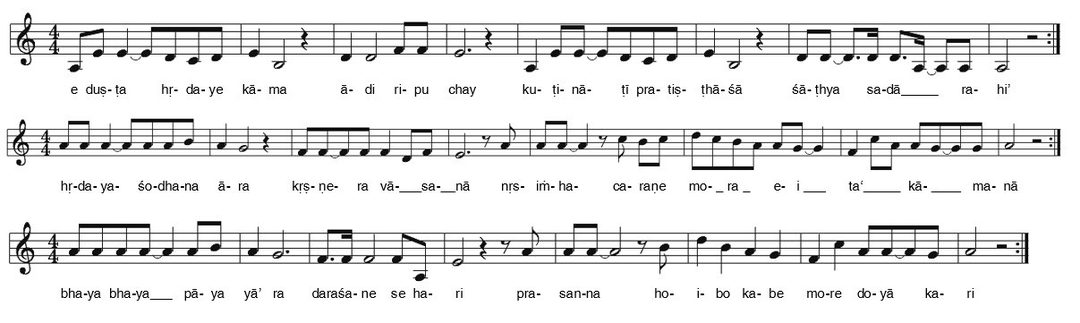
Udila aruṇa (Aruṇodaya-kīrtana I) Bhaktivinoda Ṭhākura
1 udila aruṇa pūraba-bhāge, dvija-maṇi gorā amani jāge, bhakata-samūha loiyā sāthe, gelā nagara-vrāje udila—the rising; aruṇa—redness; pūraba—eastern; bhāge—the eastern horizon; dvija-maṇi—the jewel of the twice-born brāhmaṇas; gorā—Lord Gaura; amani jāge—immediately awakens; bhakata-samūha—all the devotees; loiyā sāthe— taking them along; gelā—went; nagara-vrāje—wandering throughout the towns and villages.
When the rising sun appeared in the East, the jewel of the twice-born, Lord Gaurasundara, awakened. Taking His devotees with Him, He went all over the countryside towns and villages…
2 ‘tāthaī tāthaī’ bājala khol, ghana ghana tāhe jhājera rola, preme ḍhala ḍhala soṇāra aṅga, caraṇe nūpura bāje
‘tāthaī tāthaī’—making the sound tāthaī tāthaī; bājala khola—the mṛdaṅga drums resounded; ghana ghana—played in time; tāhe—in that kīrtana; jhājera—of the large metal cymbals; rola—the tumult; preme—in ecstatic love; ḍhala ḍhala— slightly trembled; soṇāra aṅga—the golden form of Lord Gaurāṅga; caraṇe—upon His feet; nūpura bāje—the anklebells jingled.
…and played the mṛdaṅga, and the cymbals chimed in time. Lord Gaurāṅga's shimmering golden features danced, and His footbells jingled.
3 mukunda mādhava yādava hari,
balena bala re vadana bhari',
miche nida-vaśe gela re rāti,
divasa śarīra-sāje
mukunda mādhava yādava hari—with the holy names, “Mukunda!” “Mādhava!” “Yādava!” and “Hari!”; balena—chanting; bala re—oh sing!; vadana bhari'—filling your mouths; miche—uselessly; nida-vaśe—under the control of sleep; gela—have spent; re—O!; rāti—the nights; divasa—the days; śarīra-sāje—in decorating your bodies.
All the devotees chanted the names Mukunda, Mādhava, Yadava and Hari, their mouths being filled with the vibrations. They would announce to the still sleeping people, "You spend your nights uselessly sleeping and your days decorating your bodies!
4 emana durlabha mānava-deha,
pāiyā ki kara bhāva nā keha,
ebe nā bhajile yaśodā-suta,
carame paribe lāje
emana—this; durlabha—rare; mānava-deha—human body; pāiyā—having achieved; ki kara—what are you doing?; bhava nā keha—you have not thought about it at all; ebe—now; nā bhajile—you do not worship; yaśodā-suta—the darling of mother Yaśodā; carame—ultimately; paribe—you will fall (die); lāje—in shame.
You have achieved such a rare human body, but you do not care for this gift. You remain not serving the darling of Yaśodā and slowly fall through your last moments to death.
5 udita tapana hoile asta, dina gela bali' hoibe byasta, tabe kena ebe alasa haya, nā bhaja hṛdaya-rāje udita—arisen; tapana—the sun; hoile asta—having set; dina gela—the day passes; bali'—saying; hoibe byasta—will be lost; tabe kena—then why; ebe—now; alasa haya—you remain idle; nā bhaja—you do not worship; hṛdaya-rāje—the Lord of the heart.
With every rising and setting of the sun, a day passes and is lost. Then, why do you remain idle and not serve the Lord of the heart?
6 jīvana anitya jānaha sāra, tāhe nānā-vidha vipada-bhāra, nāmāśraya kari' yatane tumi, thākaha āpana kāje jīvana—life; anitya—is temporary; jānaha sāra—please understand this essential fact; tāhe—in that; nānā-vidha—various kinds; vipada-bhāra—filled with miseries;
nāmāśraya kari'—taking shelter of the holy name; yatane—carefully; tumi—you; thākaha—remain always engaged; āpana kāje—in His service as your own eternal occupation.
This temporary life is full of various miseries. Take shelter of the holy name as your only business.
7 jīvera kalyāna-sādhana-kāma,
jagate āsi' e madhura nāma,
avidyā-timira-tapana-rūpe,
hṛd-gagane virāje
jīvera—of all living entities; kalyāṇa-sādhana-kāma—desiring to bless; jagate asi'— in the material universe; e—this; madhura nāma—sweet name of Kṛṣṇa; avidyā- timira—the darkness of ignorance; tapana-rūpe—like the sun; hṛd-gagane—in the sky of the heart; virāje—shines.
To penetrate the darkness of ignorance and bless everyone's heart, the holy name has risen like the shining sun.

8 kṛṣṇa-nāma-sudhā kariyā pāna,
jurāo bhakativinoda-prāṇa, nāma vinā kichu nāhika āra, caudda-bhuvana-mājhe kṛṣṇa-nāma-sudhā—the pure nectar of the holy name of Kṛṣṇa; kariyā pāna— drinking; jurāo—thus satisfy; bhakativinoda-prāṇa—the soul of Bhaktivinoda; nāma vinā—except for the holy name; kichu nāhika āra—there is nothing else; caudda- bhuvana-mājhe—within the fourteen worlds.
Drink the pure nectar of the holy name. There is nothing but the name to be had in the fourteen worlds. It has filled the soul of Bhaktivinoda.
Commentary
The original title of this two-part song is Aruṇodaya-kīrtana (Congregational Chanting at Sunrise). Bhaktivinoda Ṭhākura describes how Śrī Caitanya Mahāprabhu used to take His devotees early in the morning out for public chanting exhorting the people to wake up, literally and figuratively. Human life is short, and as Prahlāda Mahārāja points out to his classmates, “Every human being has a maximum duration of life of one hundred years, but for one who cannot control his senses, half of those years are completely lost because at night he sleeps twelve hours, being covered by ignorance.” In this song, the devotees of the Lord tell the people, miche nida-vaśe gela re rāti. "You spend your nights uselessly sleeping and your days decorating your bodies!” Why do you remain idle and not serve the Lord
of the heart? Below are some examples of Śrīla Prabhupāda quoting from this instructive song. Śrīmad-Bhāgavatam 10.6.3 — Purport
Śrīla Bhaktivinoda Ṭhākura has sung: nāmāśraya kari' yatane tumi, thākaha āpana kāje. (Take shelter of the holy name as your only business.) Everyone is thus advised to seek shelter in the chanting of the Hare Kṛṣṇa mahā-mantra and remain engaged in his own occupational duty. There is no loss in this, and the gain is tremendous. Even from a material point of view, everyone should take to chanting the Hare Kṛṣṇa mantra to be saved from all kinds of danger. This world is full of danger (padaṁ padaṁ yad vipadām). Therefore we should be encouraged to chant the Hare Kṛṣṇa mahā-mantra so that in our family, society, neighborhood and nation, everything will be smooth and free from danger. Initiation Lecture – New Vrindaban, May 25, 1969 Māyā is very strong. You cannot conquer māyā by so-called meditation or this or that. No. Simply by surrendering to Kṛṣṇa. Mām eva ye prapadyante. Kṛṣṇa. Only He. Mām eva ye prapadyante māyām etāṁ taranti te. He can overcome the stringent laws of māyā. So don't think that after finishing this ceremony you become all right. No. Māyā is always strong. Kṛṣṇa-nāma kara bhai āra saba miche. The instruction is that you always chant Hare Kṛṣṇa. Āra saba miche. [Everything else is useless]. Nāma vinā kichu nāhika āra, cauddha-bhuvana-majhe. "Within this fourteen world, if there is anything summum bonum, substance, this is this Hare Kṛṣṇa. Mind that. Nāma vinā kichu nāhika āra, cauddha-bhuvana-majhe. (There is nothing but the name to be had in the fourteen worlds.) So this is secondary, this [initiation] ceremony. Real strength is chanting Hare Kṛṣṇa. Evening Lecture – Bhuvanesvara, January 23, 1977 Kṛṣṇa says how one can become perfect: man-manā bhava mad-bhakto mad-yājī māṁ namaskuru. Four things. Simply think of Kṛṣṇa, this chanting of Hare Kṛṣṇa mantra—Hare Kṛṣṇa, Hare Kṛṣṇa, Kṛṣṇa Kṛṣṇa, Hare Hare/ Hare Rāma, Hare Rāma, Rāma Rāma, Hare Hare... So you remain gṛhastha. Bhaktivinoda Ṭhākura has said, nāmāśraya kari thākaha āpana kāje. In whatever occupation you are, remain there. There is no need of changing. But nāmāśraya kari, take shelter of the holy name. If you remain a gṛhastha, what is your loss if you chant Hare Kṛṣṇa mahā-mantra? And if there is gain, why don't you take it? Simple thing. And Kṛṣṇa also says, man-manā bhava mad-bhakto mad-yājī māṁ namaskuru, mām evaiṣyasi asaṁśayaḥ. These four things will get you back to home, back to Godhead. Morning Walk – Vṛndāvana, December 10, 1975 Bhaktivinoda Ṭhākura says, nāmāśraya kari thākaha āpana kārye. You do your work but take shelter of hari-nama. That is wanted. So simple. Nāmāśraya kari, thākaha āpana karye. "Go on with your duty, prescribed duty, and chant Hare Kṛṣṇa."
Jīva jāga (Aruṇodaya-kīrtana II) Bhaktivinoda Ṭhākura
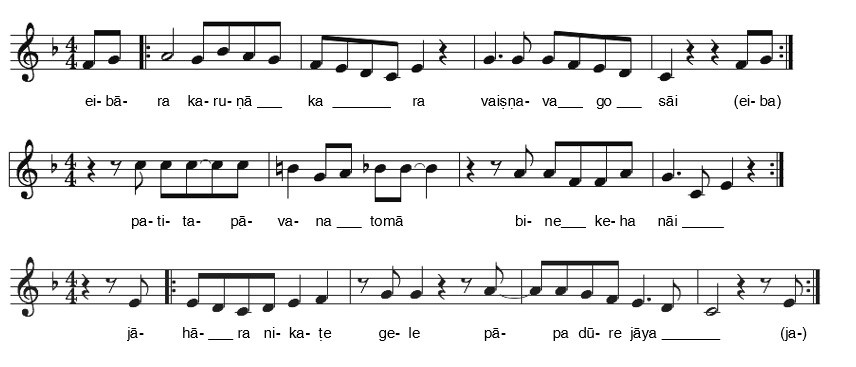
1 jīva jāga, jīva jāga, gauracānda bale
kata nidrā yāo māyā-piśācīra kole
jīva jāga—wake up, sleeping souls!; jīva jāga—wake up, sleeping souls!; gauracānda bole—Lord Gaurāṅga calls; kata nidrā yāo—how long are you sleeping?; māyā-pīśācīra—of the witch Māyā; kole—in the lap.
Lord Gaurāṅga is calling, "Wake up, sleeping souls! Wake up, sleeping souls! How long will you sleep in the lap of the witch called Māyā?
2 bhajiba baliyā ese saṁsāra-bhitare
bhuliyā rahile tumi avidyāra bhare
bhajiba—I will certainly worship the Lord; baliyā—saying; ese—having come; saṁsāra-bhitare—into the material world; bhuliyā—having forgotten; rahile tumi— you have remained; avidyāra bhare—in the darkness of ignorance.
You have forgotten the way of devotional service and are lost in the world of birth and death.
3 tomāre laite āmi hoinu avatāra āmi vinā bandhu āra ke āche tomāra tomāre laite—to reclaim you; āmi—I; hoinu avatāra—have descended as an incarnation; āmi vinā—except for Myself; bandhu āra—another friend; ke āche— who is?; tomāra—yours.
I have descended just to save you; except for Myself, who is your friend in this world?
4 enechi auṣadhi māyā nāśibāra lāgi' hari-nāma mahā-mantra lao tumi māgi'

enechi—I have brought; auṣadhi—the medicine; māyā—illusion of Māyā; nāśibāra lāgi'—for destroying; hari-nāma mahā-mantra—the great chant of the names of Hari; lao—please take it; tumi—you; māgi'—begging.
I have brought the medicine that will cure the disease of illusion from which you are suffering. Take this mahā-mantra of the holy names of Hari; just ask for it."
5 bhakativinoda prabhu-caraṇe pariyā
sei hari-nāma-mantra loila māgiyā
bhakativinoda—Bhaktivinoda; prabhu-caraṇe—at the lotus feet of Lord Gaurāṅga; pariyā—falling down; sei hari-nāma-mantra—that Hari-nāma-mantra; loila—he received; māgiyā—after begging.
After falling at the feet of the Lord and begging for it, Bhaktivinoda received this mahā-mantra.
Commentary
Purport to Jiva jāga — Columbus, May 20, 1969 Jīva jāga, jīva jāga, gauracānda bale. Jīva means the living entities. Lord Caitanya Mahāprabhu is asking all living entities to "Wake up. Please wake up. Please get up." Jāga. Jāga means "Wake up."Jīva jāga, jīva jāga, gauracānda bale, kota nidrā jāo māyā-piśācīra kole." How long you shall go on sleeping on the lap of the witch Māyā?" Bhajiba baliyā ese saṁsāra-bhitare: "In the womb of your mother you promised that this life you shall engage in the matter of developing your Kṛṣṇa consciousness." Bhuliyā rahile tumi avidyāra bhare: "But you have forgotten everything under the spell of illusory energy." Actually, when the child remains within the womb of his mother, packed up in airtight bag, at the age of seven months within the womb, when he develops his consciousness, he feels very uncomfortable, and the fortunate baby prays to God, "Please relieve me from this awkward position, and this life I shall fully engage myself in developing my God consciousness or Kṛṣṇa consciousness." But as soon as the child comes out of the womb of his mother, under the spell of these three modes of material nature he forgets, and he cries, and the parents take care, and the whole thing is forgotten. […] So Lord Caitanya is trying to wake up all children of māyā, nature's son, to wake up. The similar instruction is in the Vedic Upaniṣad. Uttiṣṭhata jāgrata. The advice is that "Everyone should now wake up. They should not sleep under the spell of illusion, material nature. This human form of body must be utilized." The same thing Lord Caitanya is speaking in ordinary songs, jīva jāga, jīva jāga, gauracānda bale: "All living entities wake up. Don't miss this opportunity." Kata nidrā yāo māyā- piśācīra: "How long you shall remain asleep in this way, under the spell of māyā? This is the opportunity. Don't sleep." Then He says, "You have forgotten. But I have brought one medicine so that..." Just like when a man remains unconscious under some intoxication or snake bite, there are some herbs. If it is put before the nostril and if the patient smells, immediately he gets consciousness. Similarly, Caitanya Mahāprabhu said that "I have brought also one medicine." Enechi auśādhi māyā nāśibāra lāgi': "This medicine can dissipate your this forgetfulness under the spell of māyā." Enechi auṣadhi māyā nāśibāra. What is that? Hari-nāma mahā-mantra lao tumi: "This is this chanting Hare Kṛṣṇa mantra. You please take it." The idea is that if one simply chants Hare Kṛṣṇa Hare Kṛṣṇa Kṛṣṇa Kṛṣṇa Hare Hare, Hare Rāma Hare Rāma Rāma Rāma Hare Hare, his unconscious stage, or sleeping stage under the spell of illusory māyā, will gradually vanish. Ceto-darpaṇa- mārjanam. So this is a song composed by Bhaktivinoda Ṭhākura. So he says that bhakativinoda prabhu-caraṇe pariyā: "Bhaktivinoda Ṭhākura took the advantage of the instruction of Lord Caitanya and immediately fell down on the lotus feet of the Lord." Hari-nāma mahā-mantra loila māgiyā: "And very humbly he begged Lord Caitanya, 'Kindly give me this medicine, and I shall utilize it.' '' The whole instruction is that all sleeping members of the human society, they should take advantage of this Kṛṣṇa consciousness movement and willingly they should accept. Then there will be immediate effect and everyone will be out of the clutches of māyā, and his original consciousness, or Kṛṣṇa consciousness, will be awakened, and his life will be sublime. Lecture on Śrīmad-Bhāgavatam 3.25.13 – Los Angeles, November 10, 1968 To become guru means para-upakāra. People are in the darkness, so they have to be enlightened. That is the Vedic injunction. Uttiṣṭhata jāgrata prāpya varān nibodhata. Now, people, from animal kingdom we are getting this human body. So up to animal body we are sleeping, kata nidrā yāo māyā-piśācīra kole, in the lap of this material nature. Now this human form of body is meant for getting out. So the mission is to awaken people to Kṛṣṇa consciousness. To awaken people to Kṛṣṇa consciousness. Jīva jāga, jīva jāga, gauracānda bale. Gauracānda, means Caitanya Mahāprabhu, is speaking to everyone, "Oh, the living entity, get up! Get up!" Kata nidrā yāo māyā-piśācīra kole: "How long you shall sleep?" So here is the same thing. Yoga ādhyātmikaḥ puṁsām. This is the prime business, to connect yourself again, again, your soul, with the Supreme. Yoga ādhyātmikaḥ puṁsāṁ mato niḥśreyasāya me. He says that "This is My instruction, that one should be awakened to Kṛṣṇa consciousness and connect himself again with Kṛṣṇa." That is ādhyātmika-yoga. Not to show some gymnastic magic. Lecture on Śrīmad-Bhāgavatam 3.26.20 – Bombay, December 9, 1974 So the darkness is there, and the light is also there. Simply we have to be awakened. Therefore Vedas, they instruct us that "Don't sleep! Get up!" Uttiṣṭhata prāpya varān nibodhata jāgrata. Similarly, Bhaktivinoda Ṭhākura also sings, kata nidrā yāo māyā-piśācīra kole. Jīva jāga, jīva jāga, gauracānda bale. Gauracānda means Lord Śrī Caitanya Mahāprabhu. He says, "O living entities, get up! Be awakened!" We may say, "Now we are awakened." This is not awakened. This is also slumber in darkness of ignorance. Real awakening is when we come to our spiritual consciousness. That is real awakened. Yā niśā sarva-bhūtānāṁ tasyāṁ jāgarti saṁyamī. This is not, this awakening stage, this is not real awakening. Real awakening comes when we understand, ahaṁ brahmāsmi. At the present moment we are not awakened, still sleeping, because we are thinking, every one of us, "I am this body," "I am American," "I am Indian," "I am Hindu," "I am Muslim." In this way we are conscious of the designation. So we have to get out of the designation, and when we shall understand our real identity, not this bodily identity but spiritual soul identity, that is called brahma-bhūtaḥ. Otherwise we are jīva-bhūtaḥ. So long we are identifying with this body, we are still sleeping. Kata nidrā yāo māyā-piśācīra kole. Just like a child sleeps on the lap of the mother, similarly, we are sleeping on the lap of mother material nature. This is our position. Initiation Leture – Los Angeles, July 3, 1970 We should not canvass. Let a person become attracted by Kṛṣṇa consciousness movement and personally ask for harer nāma. Just like Bhaktivinoda Ṭhākura says, bhakativinoda prabhu-caraṇe pariyā. As soon as Lord Caitanya says that "I have brought this medicine for killing māyā." Hari-nāma mahā-mantra loila. "Everyone can take from Me this chanting of Hare Kṛṣṇa mantra." So bhakativinoda prabhu- caraṇe pariyā. Bhaktivinoda Ṭhākura immediately fell down at the lotus feet of Lord Caitanya and begged, "Please give me." So the chance should be given like that. One should beg. Not that canvassing. No. That is not required. That is another offense. Unless one has increased little taste and is eager to accept this chanting process, we should not canvass. That is an offense.
'Rādhā-kṛsna' bal
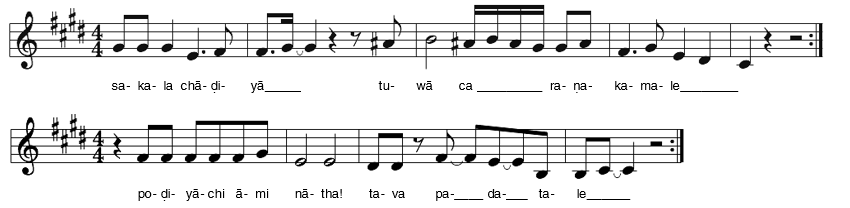
'rādhā-kṛsna' bal bal bala re sobāi
(ei) śikṣā diyā, saba nadīyā,
phirche nece' gaura-nitāi
‘rādhā-kṛsna' bala bala bala—everyone chant, chant, chant, ‘Rādhā-Kṛṣṇa!'; re— oh!; sobāi—everyone; (ei) śikṣā—this teaching; diyā—giving; sab nadīyā—all over the land of Nadia; phirche—wandering around; nece'—while dancing; gaura- nitāi—Lord Caitanya and Lord Nityānanda.
"Everyone chant, chant, chant 'Rādha-Kṛṣṇa!'" Lord Caitanya and Lord Nityānanda are dancing all over the land of Nadīyā, giving this teaching to all.
2 (miche) māyāra baśe, yāccho bhese',
khāccho hābuḍubu, bhāi
(miche)—needlessly; māyāra baśe—under the control of māyā; yāccho bhese'— carried away by the waves; khāccho hābuḍubu—sometimes floating and sometimes sinking; bhāi—O brothers!
O brothers! Needlessly under the control of māyā, you suffer and are carried away by her waves, sometimes floating and sometimes sinking in this ocean of illusion.
3 (jīva) kṛṣṇa-dāsa, e viśvāsa,
karle to' āra duḥkha nāi
jīva—the spirit soul; kṛṣṇa-dāsa—the eternal servant of Kṛṣṇa; e viśvāsa karle—if you have this faith; to'—then; āra duhkha nāi—there will be no more misery.
If you have this faith-that the soul is the eternal servant of Kṛṣṇa-then there will be no more misery.
4 (kṛṣṇa) balbe jabe, pulaka ha'be,
jhorbe āṅkhi, bali tāi
(kṛṣṇa) balbe jabe—when you chant the holy name of Kṛṣṇa; pulaka ha'be—your body will shiver in ecstasy; jhorbe ānkhi—your eyes will shed tears; bali tāi—this is what I say.
And when you chant the holy name of Kṛṣṇa, your body will shiver in ecstasy and your eyes will shed tears in love of God. This is what I say.
5 ('rādhā) kṛṣṇa' bala, saṅge cala, ei-mātra bhikṣā cāi
('rādhā) kṛṣṇa' bala—chant “Rādhā-Kṛṣṇa”; saṅge cala—please join with us; ei- mātra—only this; bhikṣā—request; cāi—do I beg.
Chant "Rādhā-Kṛṣṇa" and always live in the association of devotees. This is the only request I beg of you.
6 (yāya) sakala’ vipada, bhaktivinoda,
bale, yakhana o-nāma gāi
(yāya) sakala’ vipada—all dangers go away; bhaktivinoda bale—Ṭhākura Bhaktivinoda says; yakhana—when; o-nāma gāi—I chant those holy names.
Bhaktivinoda says, "All dangers go away when I sing those holy names of the Lord."
Commentary
Another very instructive song that Prabhupāda used to sing and quote from regularly. Often he quoted, (miche) māyāra baśe, yāccho bhese', khāccho hābuḍubu, bhāi. “O brothers! Needlessly under the control of māyā, you suffer and are carried away by her waves, sometimes floating and sometimes sinking in this ocean of illusion.” Some samples: Śrīmad-Bhāgavatam 7.15.13 – Purport The mind is always agitated by acceptance and rejection, which are compared to mental waves that are constantly tossing. The living entity is floating in the waves of material existence because of his forgetfulness. Śrīla Bhaktivinoda Ṭhākura has therefore sung in his Gītāvalī: miche māyāra vaśe, yāccha bhese', khāccha hābuḍubu, bhāi. "My dear mind, under the influence of māyā you are being carried away by the waves of rejection and acceptance. Simply take shelter of Kṛṣṇa." Jīva kṛṣṇa-dāsa, ei viśvāsa, karle ta' āra duḥkha nāi: if we simply regard the lotus feet of Kṛṣṇa as our ultimate shelter, we shall be saved from all these waves of māyā, which are variously exhibited as mental and sensual activities and the agitation of rejection and acceptance. Lecture on Bhagavad-gītā 1.26-27 – London, July 21, 1973 So this problem, attachment for this material world, gradually we have to cut it. That is the Vedic civilization. If you want to go back to home, back to Godhead, then at the same time, if you remain attached to this material world, so-called society, friendship and love, then it is not possible. So long you will have a pinch of attraction with this material world, there is no possibility of being transferred to the spiritual world. This is the position. Therefore by training, by education, we have to become detached. Detached from this society, friendship and love. We have to understand the falsity of this so-called society, friendship and love. It is just like being carried away by the waves of māyā. Bhaktivinoda Ṭhākura has sung, māyāra baśe, jāccho bhese, khāccho hābuḍubu bhāi. Just like we see sometimes in rainy season, so many plants and creepers and vegetables and so many other things are floating in the river. Similarly, we also, we are all floating in the waves of māyā. Māyāra baśe, jāccho bhese, khāccho hābuḍubu. Sometimes drowned, sometimes on the surface, sometimes on the other shore, sometimes on this shore. This is going on. So long we are in this material world, we are being tossed by different currents, and sometimes I am here as the master of some kingdom, and sometimes I am dog of somebody else. This is my position. The same thing. Very good example, that we are being carried away by the waves of māyā. Sometimes we are gathering together. So many straws and vegetables, they gather together. And sometimes
the same vegetables and straws are thrown asunder. One is there, one is here. So here also, we assemble here as society, friendship and love exactly like that. In the waves of māyā. Then nobody is your father, nobody is your mother, nobody is your sister, nobody. It is simply a māyic, illusory combination. Illusory combination, temporary combination. And we are so much attached to this combination that we are refusing to go back to home, back to Godhead. This is our position. Śrīmad-Bhāgavatam 10.13.58 – Purport We actually do not die. At death, we are merely kept inert for some time, just as during sleep. At night we sleep, and all our activities stop, but as soon as we arise, our memory immediately returns, and we think, "Oh, where am I? What do I have to do?" This is called suptotthita-nyāya. Suppose we die. "Die" means that we become inert for some time and then again begin our activities. This takes place life after life, according to our karma, or activities, and svabhāva, or nature by association. Now, in the human life, if we prepare ourselves by beginning the activity of our spiritual life, we return to our real life and attain perfection. Otherwise, according to karma, svabhāva, prakṛti and so on, our varieties of life and activity continue, and so also do our birth and death. As explained by Bhaktivinoda Ṭhākura, māyāra vaśe, yāccha bhese', khāccha hābuḍubu bhāi: "My dear brothers, why are you being washed away by the waves of māyā?" One should come to the spiritual platform, and then one's activities will be permanent. Kṛta-puṇya-puñjāḥ: [SB 10.12.11] this stage is attained after one accumulates the results of pious activities for many, many lives. Janma-koṭi-sukṛtair na labhyate (Cc. Madhya 8.70). The Kṛṣṇa consciousness movement wants to stop koṭi-janma, repeated birth and death. In one birth, one should rectify everything and come to permanent life. This is Kṛṣṇa consciousness.
Bhajahū re mana
Govinda dāsa Kavirāja
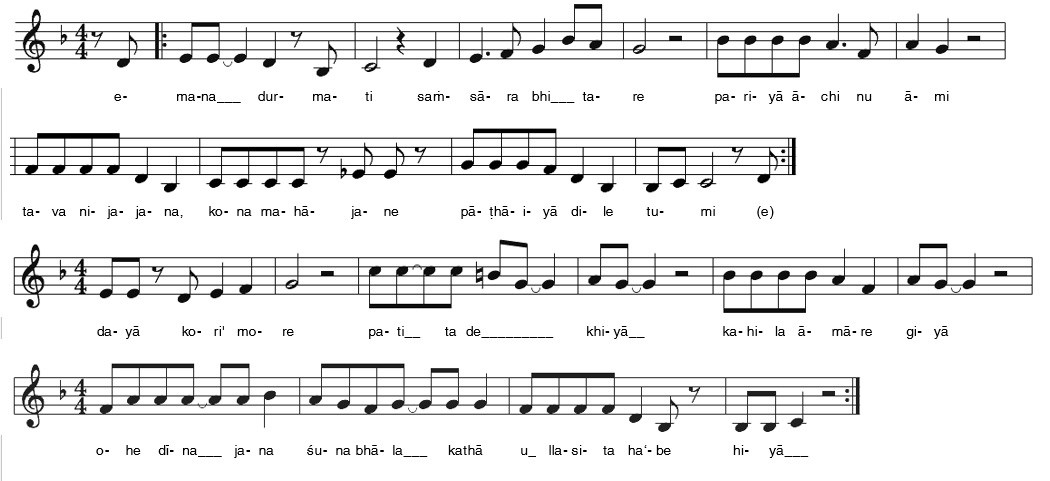
1 bhajahū re mana śrī-nanda-nandana
abhaya-caraṇāravinda re durlabha mānava-janama sat-saṅge taraha e bhava-sindhu re bhajahū—just worship; re—O!; mana—mind; śrī-nanda-nandana—of the son of Nanda; abhaya-caraṇāravinda—the lotus feet which make one fearless; re—O!; durlabha mānava-janama—this rare human birth; sat-saṅge—in the association of saintly persons; taraha—cross over; e bhava-sindhu—this ocean of worldly existence; re—O!
O mind, just worship the lotus feet of the son of Nanda, which make one fearless. Having obtained this rare human birth, cross over this ocean of worldly existence by associating with saintly persons.
2 śīta ātapa vāta variṣaṇa
e dina yāminī jāgi re biphale sevinu kṛpaṇa durajana capala sukha-lava lāgi' re śīta—cold; ātapa—heat; vāta—wind; variṣaṇa—rain; e—this; dina—day; yāminī— night; jāgi—I remain sleepless; re—O!; biphale—uselessly; sevinu—I have served; kṛpaṇa durajana—miserly and wicked men; capala—flickering; sukha-lava—a fraction of happiness; lāgi'—for the purpose of; re—O!
Day and night I can find no sleep, suffering the onslaught of heat and cold, wind and rain. For a bit of flickering happiness I have vainly served wicked and miserly men.
3 e dhana, yauvana, putra, parijana
ithe ki āche paratīti re kamala-dala-jala, jīvana ṭalamala bhajahū hari-pada nīti re e—this; dhana—wealth; yauvana—youthfulness; putra—sons; parijana—family members; ithe—in these; ki āche—what is it?; paratīti—understanding; re—O!; kamala-dala—on a lotus petal; jala—like a drop of water; jīvana—this life; ṭalamala—is tottering; bhajahū—you should always worship; hari-pada—the feet of Lord Hari; nīti—the practice; re—O!
What assurance of real happiness is there in all one’s wealth, youth, sons, and relatives? This life totters like a drop of water on a lotus petal; therefore you should always worship the lotus feet of Lord Hari.
4 śravaṇa, kīrtana, smaraṇa, vandana,
pāda-sevana, dāsya re pūjana, sakhī-jana, ātma-nivedana govinda-dāsa-abhilāṣa re śravaṇa—hearing the glories of Lord Hari; kīrtana—chanting those glories; smaraṇa—constantly remembering Him; vandana—offering prayers to Him; pāda- sevana—serving the Lord's lotus feet; dāsya—serving the Supreme Lord as a servant; re—O!; pūjana—worshiping Him with flowers and incense and so forth; sakhī-jana—serving Him as a friend; ātma-nivedana—and completely offering the
Lord one's very self; govinda-dāsa-abhilāṣa—(these nine processes of devotion are) the desire and great longing of Govinda dāsa; re—O!
Govinda Dāsa longs to hear the glories of Lord Hari, chant His glories, constantly remember Him, offer Him prayers, serve His lotus feet, become His servant, worship Him, serve Him as a friend, and completely offer Him his very self.
Commentary
This is another of Prabhupāda’s favorite bhajanas. He sang it often and also explained the meaning, which he did as early as in the spring of 1966 when there were no initiated disciples even.
Purport to Bhajahū re mana – New York, March 30, 1966 [After singing this song, Prabhupāda explains it.] This is a song which a devotee is praying and asking his mind, bhajahū re mana. Mana means mind. Because, at the present moment, our mind is the driver, and this body is just like a car. In the Bhagavad-gītā also it is stated, bhrāmayan sarva-bhūtāni yantrārūḍhāni māyayā. This body is a car made of this material nature. The living entity, I, I am now seated on this car prepared by nature, and the driver is the mind. And the driver is not in my control. The driver is taking me anywhere he likes. You see? Personally, I am not able to drive. I have engaged one driver, which is called the mind, and this body is the car, and the mind is carrying me like driver anywhere it likes. So therefore the proprietor, I, when I am helpless, I am requesting the driver, "My dear mind, kindly worship Lord Kṛṣṇa who is abhaya-caraṇa." Abhaya-caraṇa means He's the fearless shelter. If we take shelter of Kṛṣṇa, then we become free from all anxieties. Just like a helpless child, when he's taken care of by his parents, he becomes carefree. "Similarly, I am requesting, my dear mind, you do not drive in this way, dangerously. Please worship Lord Kṛṣṇa who is fearless shelter." Bhajahū re mana śrī-nanda-nandana-abhaya-caraṇāravinda re: "His lotus feet is fearless shelter." As the Lord says in Bhagavad-gītā, sarva-dharmān parityajya mām ekaṁ śaraṇaṁ vraja. Now, either you say Kṛṣṇa or you say Superconsciousness... Superconsciousness is impersonal conception of Kṛṣṇa, and Kṛṣṇa is personal conception of Superconsciousness. Because Kṛṣṇa means He's not only superconscious, but He's supreme bliss and supreme knowledge—supreme knowledge means superconsciousness—and eternal, supreme consciousness, supreme bliss. That is the definition of Kṛṣṇa. Purport to Bhajahū re mana – San Francisco, March 16, 1967 And he says also that durlabha mānava-janama. Durlabha means very rare to obtain. Mānava-janma means this human form of life. It comes after a very long rotation. Once chance is given to become Kṛṣṇa conscious so that one may get out of the cycle of birth and death. Therefore he advises that this life, this human form of life, is very important, durlabha. Duḥ means with great difficulty, and labha means obtainable. So foolish people, they do not know how important this human form of life is. They are simply wasting it in sense gratification, like animals. So this is very instructing, that he is training his mind that "You engage in the worship of Lord Kṛṣṇa." Durlabha mānava-janama sat-saṅge. And this training of the mind is possible only in good association, sat-saṅga. Sat-saṅga means persons who are cent percent engaged in the service of the Lord. They are called sat. Satāṁ prasaṅgāt. Without association of devotees, it is impossible to train the mind. It is not possible by the so-called yoga system or meditation. One has to associate with devotees; otherwise it is not possible. Therefore we have formed this Kṛṣṇa consciousness society so that one may take advantage of this association. So Govinda dāsa, poet and devotee, is advising, durlabha mānava-janama sat-saṅge: "You have got this very nice, rare human body. Now associate with devotees and engage your mind on the fearless lotus feet of Kṛṣṇa." He is requesting his mind. Then he is pointing out the frustration of life. What is that? Śīta ātapa bāta variṣaṇa e dina yāminī jāgi re. Śīta means winter. Ātapa means summer, when there is scorching sunshine. Śīta ātapa vāta, cold, variṣaṇa, torrents of rain. So these disturbances are always there. Sometimes it is severe cold. Sometimes it is scorching heat. Sometimes there is torrents of rain. Sometimes this or that is going on. So he says, śīta ātapa bāta variṣaṇa e dina yāminī jāgi re. Whole day and night, people are working very hard without caring, severe cold, severe heat, and torrents of rain, and keeping night, going to the desert, going underneath the sea— everywhere they are so busy. Śīta ātapa bāta variṣaṇa e dina yāminī jāgi re. There is night duty and so many other engagements. So he says, biphale sevinu kṛpaṇa durajana capala sukha-laba lāgi' re. "Now, with all this hard labor, what I have done? I have served some persons who are not at all favorable to my Kṛṣṇa consciousness. And why I have served them?" Capala sukha-laba lāgi' re: "Capala, very flickering happiness. I think if my small child smiles, I will be happy. I think if my wife is pleased, I think I am happy. But all this temporary smiling or feeling of happiness, they are all flickering." That one has to realize. There are many other poets also, similarly have sung that this is..., this mind is just like a desert, and it is hankering after oceans of water. In a desert, if a ocean is transferred, then it can be inundated. And what benefit can be achieved there if drop of water is there? Similarly, our mind, our consciousness, is hankering after ocean of happiness. And this temporary happiness in family life, in society life, they are just like drop of water. So those who are philosophers, those who have actually studied the world situation, they can understand that "This flickering happiness cannot make me happy."
Purport to Bhajahū re mana – Los Angeles, January 7, 1969 Therefore kamala-dala-jala, jīvana ṭalamala. And you do not know how long you shall enjoy this life. Because it is tottering. You are on the tottering platform. Just like there is water on the lily leaf. It is tilting. At any moment it will fall down. So our life is tilting. At any moment it may collapse. We may meet, by chance, any danger, and finished. So don't waste life in that way. Bhajahū hari-pada nīti re. Be always engaged in Kṛṣṇa consciousness. That is the success of your life.
Purport to Bhajahū re mana – Los Angeles, May 27, 1972 And what is Kṛṣṇa consciousness? Śravana, kīrtana, smarana, vandana, pāda- sevana, dāsya re, pūjana, sakhī-jana, ātma-nivedana, the nine kinds of devotional service, govinda-dāsa-abhilāṣa re. So everyone should desire like Govinda dasa. Śravana kīrtana, these are the devotional processes: hearing; chanting; remembering; arcana, worshiping the Deity; vandana, offering prayer. There are nine kinds. So human life is meant for this purpose. By this process, gradually we ignite the fire of Kṛṣṇa consciousness, or spiritual consciousness. Then, by that fire, as by blazing fire the wood itself becomes burnt into ashes, so our, all of our covering — the spirit soul is covered by matter, by ignorance — so this covering and ignorance will be burnt into ashes, and you'll become free and go back to home, back to Godhead. That is the purport of this song.
Dhana, jana, deha, geha
1 dhana, jana, deha, geha kṛṣṇe samarpaṇa
kariyācha śuddha-citte karaha smaraṇa
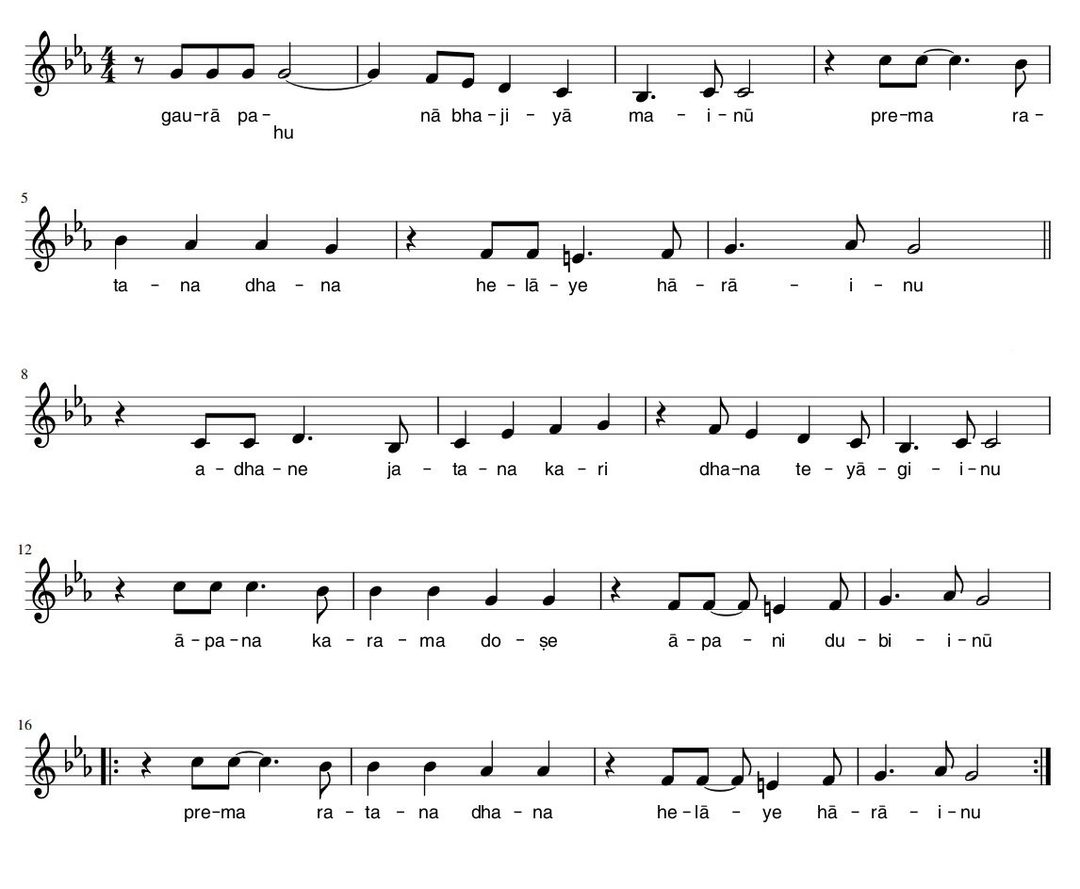
dhana—riches; jana—people; deha—give; geha—home; kṛṣṇe—Kṛṣṇa; samarpaṇa—offering; kariyācha—You have done; śuddha—pure; citte—in the heart; karaha—do; smaraṇa—remembering.
"You have already dedicated all of your wealth, relatives, body and entire household unto Kṛṣṇa, so please just remember this now with a pure heart.
2 tabe kena ‘mama suta’ bali’ kara duḥkha
kṛṣṇa nila nija-jana tāhe tā’ ra sukha
tabe—then; kena—why?; ‘mama—mine; suta’—son; bali’—exclaim; kara—you do; duḥkha—unhappiness; kṛṣṇa—Kṛṣṇa; nila—blackish-blue; nija—own; jana— people; tāhe—from Him; tā’ ra—certainly; sukha—happiness. "Why are you exclaiming, 'my son, my son!' in great sadness? Kṛṣṇa has simply taken His own devotee to suit His own happiness.
3 kṛṣṇa-icchā-mate saba ghaṭaya ghaṭanā tāhe sukha-duḥkha-jñāna avidyā-kalpanā kṛṣṇa—Kṛṣṇa; icchā—desire; mate—in this way; saba—all; ghaṭaya—all; ghaṭanā—events; tāhe—in that respect; sukha—happiness; duḥkha— unhappiness; jñāna—knowledge; avidyā—ignorance; kalpanā—imagination.
"Kṛṣṇa is causing all things to take place according to His own sweet will. In light of that, all your ideas of happiness and distress are merely ignorant mental concoctions.
4 yāhā icchā kare kṛṣṇa tāi jāna bhāla
tyajiyā āpana icchā ghucāo jañjāla
yāhā—whatever; icchā—desire; kare—does; kṛṣṇa—Kṛṣṇa; tāi—that; jāna— people; bhāla—good; tyajiyā—giving up; āpana—own; icchā—desire; ghucāo— give up; jañjāla—inconvenience.
"Whatever Kṛṣṇa’s desire is, you must accept only that to be truly good. Renouncing all of your separate personal desires, relieve yourselves of this unnecessary botheration.
5 deya kṛṣṇa, neya kṛṣṇa, pāle kṛṣṇa sabe rākhe kṛṣṇa, māre kṛṣṇa, icchā kare yabe deya—gives; kṛṣṇa—Kṛṣṇa; neya—takes away; kṛṣṇa—Kṛṣṇa; pāle— maintains; kṛṣṇa—Kṛṣṇa; sabe—all of them; rākhe—protects; kṛṣṇa—Kṛṣṇa; māre—kills; kṛṣṇa—Kṛṣṇa; icchā—desire; kare—does; yabe—when.
"Kṛṣṇa gives everything, Kṛṣṇa takes everything away, Kṛṣṇa maintains everyone or destroys everyone whenever He likes, according to His own fancy.
6 kṛṣṇa-icchā viparīta ye kare vāsanā tāra icchā nāhi phale se pāya yātanā kṛṣṇa—Kṛṣṇa; icchā—desire; viparīta—contrary; ye—someone; kare—does; vāsanā—by the desire; tāra—of Him; icchā—desire; nāhi—there is not; phale—as a result of; se—that; pāya—obtains; yātanā—excessive pain.
"If someone maintains a desire that is contrary to Kṛṣṇa's desire, then such a wish does not become fruitful. Indeed, one only gets trouble and anguish.
7 tyajiyā sakala śoka śuna kṛṣṇa-nāma parama ānanda pā' be pūrṇa ha' be kāma tyajiyā—givin up; sakala—all; śoka—lamentation; śuna—violence; kṛṣṇa— Kṛṣṇa;nāma—name; parama—supreme; ānanda—pleasure; pā'be—you will get; pūrṇa—complete; ha' be—there is; kāma—desire.
"Therefore, giving up all of your lamentation, just listen to the ecstatic chanting of Kṛṣṇa's holy name which is going on now out in the courtyard. From this you will get the topmost transcendental bliss, and all of your wishes will be fulfilled."
8 bhakativinoda māge śrīvāsa-caraṇe

ātma-nivedana-śakti jīvane maraṇe
bhakativinoda—Bhakativinoda; māge—begs; śrīvāsa—Śrīvāsa; caraṇe—lotus feet, ātma-nivedana-śakti—fully surrender; jīvane—life; maraṇe—in death.
Bhaktivinoda now begs at Śrīvāsa Paṇḍita's lotus feet for the power to completely surrender his soul to Kṛṣṇa in life or in death.
Commentary
This is one of thirteen songs describing Śoka-śātana (The Dispelling of Grief). Bhaktivinoda Ṭhākura published these songs in the form of a small booklet, because they were meant to be sung by the general public, as they describe an incident in Lord Caitanya's pastimes that lead to essential teachings of basic transcendental truths. The episode is mentioned by Vṛndāvana dāsa Ṭhākura in his Śrī Caitanya-bhāgavata, and Bhaktivinoda Ṭhākura expands the description in these songs. The incident can be summarized as follows: Once, during a nocturnal kīrtana in Śrīvāsa Paṇḍita's house, one of the five sons of Śrīvāsa suddenly died due to some disease. All of the household ladies began to cry very loudly in lamentation, which was heard by Śrīvāsa as he was chanting and dancing with Lord Caitanya in the courtyard. Entering the house, Śrīvāsa pacified the distressed ladies with spiritual instructions and then returned to the kīrtana as if nothing had happened. In the morning, Lord Caitanya inquired whether anything was wrong, for He had sensed during the chanting at night that some misfortune had befallen the family. Being informed of the fate of the boy, the Lord became afflicted with loving separation and asked that the body be brought out into the courtyard. The Lord called the departed soul back into the body, and when questioned by the Lord the boy spoke many transcendental truths. Afterwards, Lord Caitanya, accompanied by all the devotees, celebrated the funeral ceremony of the boy in great ecstasy, being joined by the personified Ganges River, Śrī Jahnavī Devī herself.
Kṛṣṇa-bhakti vinā kabhu
1 kṛṣṇa-bhakti vinā kabhu nāhi phaladaya miche saba dharmādharma jīvera upādhimaya kṛṣṇa—Kṛṣṇa; bhakti—devotional service; vinā—without; kabhu—sometimes; nāhi—not; phaladaya—gain (fruit); miche—uselessly; saba—all; dharma— religious principles; adharma—irreligious principles; jīvera—of the living being; upa—more or less, near, next to; adhimaya— There is no profit in a life devoid of devotional service to Kṛṣṇa. Therefore all the so-called religiosity and irreligiosity of a living being who is bewildered by false worldly designations is simply useless.
2 yoga-jāga-tapo-dhyāna, sannyāsādi brahma-jñāna,
nānā-kānḍa-rūpe jīvera bandhana-kāraṇa haya
yoga—mystic yoga; jāga—sacrifice; tapa—austerities; dhyāna—meditation; sannyāsādi—renunciation etc.; brahma jñāna—knowledge of the impersonal Brhaman; nānā—various; kāṇḍa—divisions of spiritual paths; rūpe—form; jīvera— of the living being; bandhana—bondage; kāraṇa—the cause; haya—there is.
Mysticism, performance of Vedic sacrifices, severe austerities, meditation, renunciation of the world, and cultivating knowledge of the impersonal Brahman-although appearing in the forms of various spiritual paths-are all causes of the soul's further bondage to this world.
3 vinodera vākya dhara, nānā kānḍa tyāga kara,
nirupādhi kṛṣṇa-preme hṛdaye deha āśraya
vinodera—Bhaktivinoda; vākya—vibration; dhara—holding; nānā—different kinds; kānḍa— tyāga—renouncement; kara—do; nirupādhi—unconditional; kṛṣṇa— Kṛṣṇa; preme—the love; hṛdaye—in the heart; deha—in the body; āśraya—the shelter.
Please heed this advice of Bhaktivinoda: Give up all these various paths, and just keep pure love of Kṛṣṇa sheltered within your heart, for this alone is transcendental to all mundane designations.
Commentary
This is the first song in Gītāvalī’s section Śreyo-nirṇaya (Ascertainment of Spiritual Welfare). It is based on Śrī Caitanya Mahāprabhu’s instructions to Sanātana Gosvāmī who visited the Lord in Jagannātha Puri and, because of a disease, had the intention to commit suicide (Cc. Antya 4.58):
’bhakti’ vinā kṛṣṇe kabhu nahe ‘premodaya’
prema vinā kṛṣṇa-prāpti anya haite naya
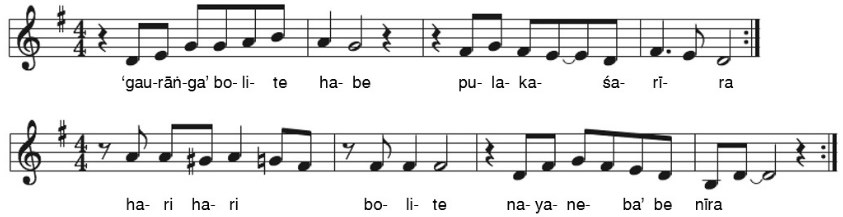
bhakti vinā—without devotional service; kṛṣṇe—unto Kṛṣṇa; kabhu—at any time; nahe—is not; prema-udaya—development of dormant love for Kṛṣṇa; prema vinā—without love of Kṛṣṇa; kṛṣṇa-prāpti—attaining Kṛṣṇa; anya—anything else; haite—from; naya—is not possible.
“Unless one discharges devotional service, one cannot awaken one’s dormant love for Kṛṣṇa, and there is no means for attaining Him other than awakening that dormant love.
In the summary of this chapter, Prabhupāda writes: The Fourth Chapter is summarized by Bhaktivinoda Ṭhākura in his Amṛta- pravāha-bhāṣya as follows. Śrīla Sanātana Gosvāmī came alone from Mathurā to Jagannātha Purī to see Lord Caitanya. Because of bathing in bad water and not getting enough food every day while traveling on the path through Jhārikhaṇḍa (Jharkhand) Forest, he developed a disease that made his body itch. Suffering greatly from this itching, he resolved that in the presence of Śrī Caitanya Mahāprabhu he would throw himself under the wheel of Jagannātha’s car and in this way commit suicide. When Sanātana Gosvāmī came to Jagannātha Purī, he stayed under the care of Haridāsa Ṭhākura for some time, and Śrī Caitanya Mahāprabhu was very happy to see him. The Lord informed Sanātana Gosvāmī about the death of his younger brother, Anupama, who had great faith in the lotus feet of Lord Rāmacandra. One day Śrī Caitanya Mahāprabhu said to Sanātana Gosvāmī, “Your decision to commit suicide is the result of the mode of ignorance. One cannot get love of God simply by committing suicide. You have already dedicated your life and body to My service; therefore your body does not belong to you, nor do you have any right to commit suicide. I have to execute many devotional services through your body. I want you to preach the cult of devotional service and go to Vṛndāvana to excavate the lost holy places.” After having thus spoken, Śrī Caitanya Mahāprabhu left, and Haridāsa Ṭhākura and Sanātana Gosvāmī had many talks about this subject.
Āra kena māyā-jāle
1 āra kena māyā-jāle paritecha, jīva-mīna nāhi jāna baddha ha' ye ra've tumi cira-dina āra—still now; kena—why?; māyā—of māyā; jāle—into the net; paritecha—you are plunging; jīva—living entity; mīna—fish; nāhi—not; jāna—your realize; baddha ha' ye—having been entrapped, caught, imprisoned; ra've—will remain; tumi— cira-dina—perpetually, forever.
O fish-like soul, why have you fallen into the entangling nets of Māyā? You have not understood that by being bound up by those nets you will have to remain in this material world for a long, long time.
2 ati tuccha bhoga-āśe, bandī ha' ye māyā-pāśe rahile vikṛta-bhāve danḍya yathā parādhīna ati—utterly; tuccha—insignificant; bhoga—for enjoyment; āśe—with a desire; bandī ha' ye—having benn imprisoned; māyā—illusion; pāśe—in the trap, snare; rahile—you remained; vikṛta—perverted, corrupted; bhāve—in a condition; danḍya—punished; yathā—like; parādhīna—dominated by another, subjugated.
After becoming a captive in Māyā's snare due to the influence of desires for very insignificant enjoyments, you remain transformed in a spiritually diseased condition, punishable as a disobedient servant or dependent.
3 ekhana bhakati-bale, kṛṣṇa-prema-sindhu-jale
krīrā kari' anāyāse thāka tumi kṛṣṇādhīna
ekhana—now; bhakati—devotion; bale—on strength; kṛṣṇa—Kṛṣṇa; prema—love; sindhu—ocean; jale—in the waters; krīrā kari'—having sported; anāyāse—freely; thāka—stay, remain; tumi—you; kṛṣṇa—Kṛṣṇa; adhīna—subservient.
Now, on the strength of pure devotion, swim and frolic freely in the ocean of kṛṣṇa-prema, and always remain subservient to and dependent on Lord Kṛṣṇa.
Commentary
This is the second song in Gītāvalī’s section Śreyo-nirṇaya (Ascertainment of Spiritual Welfare). Here Bhaktivinoda Ṭhākura compares the soul to a fish fallen
into the ocean of material existence. Śrīla Prabhupāda uses the same analogy in a lecture given in Bombay in 1975:
“Because we associated the particular type of material modes of nature, we are now entangled. Like the fish is entangled, similarly, we are also entangled. This material world is like a big ocean, bhavārṇava. Arṇava means ocean, and bhava means the situation where repetition of birth and death takes place. This is called bhavārṇava. Anādi karama-phale, pari' bhavārṇava-jale. Anādi karama- phale: "Before creation I had my resultant action of my activities, and somehow or other, I am now fallen in this ocean of bhavārṇava, repetition of birth and death." So as the fish, being entangled, he struggles for existence, how to get out of the net... He's not peaceful. You will find, as soon as caught he's up in the net, "Fut! Fut! Fut! Fut! Fut!" He wants to get out. So that is our struggle for existence, how to get out. We do not know. So to get out of this, only the mercy of Krsna... He can do everything. He can immediately take out from this entanglement. Otherwise how he is almighty? I cannot get out. The fish cannot get out, but if the fisherman wants, he can get him out immediately and throw in the water. Then he gets life again. Similarly, if we surrender to Krsna, we can get out immediately. And He says, ahaṁ tvāṁ sarva-pāpebhyo mokṣayiṣyāmi mā śucaḥ. You simply surrender. As the fisherman is seeing, “Fut! Fut! Fut!” but if the fish surrenders... He wants to surrender, but he does not know the language. Therefore he remains within the network. But if the fisherman likes, he can take it out and throw in the water. Similarly, if we surrender to Krsna... For that surrendering process this human life is meant. In other life, the fish cannot, but I can. That is the difference between the life of the fish and my life.
In another lecture, given 1972 in Hyderabad, Śrīla Prabhupāda also uses the analogy of the fish and the ocean, but in a different way:
The example is given that "I am drop of water. Now I shall merge into the big ocean. Therefore I shall become ocean." This example is generally given by the Māyāvādī philosophers. The drop of water is, when mixed up with the ocean water, they become one. That is only imagination.
Water is made up of molecules. There are so many individual molecular parts. Apart from that, suppose you mix up with the water and merge into the Brahman existence, the samudra, the sea, or the ocean. Then again you'll be evaporated, because the water is evaporated from the ocean and it become cloud, again falls down on the ground, and it goes down again to the ocean. This is going on. This is called āgamana-gamana, coming and again mixing. So what is the benefit?

But the Vaiṣṇava philosophy says that we do not want to mix up with the water; we want to become a fish within the ocean. That is very nice. If one becomes fish—a big fish, or small fish, it doesn't matter—if you go deep into the water, then there is no more evaporation. You remain.
Duṣṭa-mana! Bhaktisiddhānta Sarasvatī Ṭhākura
1 duṣṭa mana! tumi kisera vaiṣṇava?
pratiṣṭhāra tare, nirjanera ghare,
tava 'hari nāma' kevala 'kaitava'
duṣṭa mana—O wicked mind!; tumi—you; kisera vaiṣṇava—what kind of devotee?; pratiṣṭhāra—of prestige; tare—on account of; nirjanera ghare—in a solitary dwelling; tava—your; hari-nāma—chanting of the holy name of Lord Hari; kevala— only; kaitava—cheating.
O wicked mind! What kind of Vaiṣṇava do you think you are? Your pretentious show of chanting Lord Hari's holy name in a solitary place is only for the sake of attaining the false prestige of a worldly reputation-it is nothing but pure hypocrisy.
2 jaḍera pratiṣṭhā, śukarera viṣṭhā, jāna nā ki tāhā 'māyāra vaibhava'
kanaka kāminī, divasa-yāminī, bhāviyā ki kāja, anitya se saba jaḍera—of the material realm; pratiṣṭhā—fame; śukarera—of a pig; viṣṭhā—stool; jāna nā ki—do you not know?; tāhā—that; māyāra—of the illusory material world; vaibhava—potency; kanaka—gold; kāminī—attractive women; divasa yāminī—all day and night; bhāviyā—thinking; ki kāja—what benefit; anitya—temporary; se saba—all those.
Such materialistic prestige is as disgusting as the stool of a hog. Do you not know that it is only a mere illusion cast by the potency of Māyā? What is the value of contemplating day and night your plans for enjoying wealth and women? All these things are only temporary.
3 tomāra kanaka, bhogera janaka, kanakera dvāre sevaha 'mādhava'
kāminīra kāma, nahe tava dhāma,
tāhāra-mālika kevala 'yādava'
tomāra—your; kanaka—gold; bhogera—of enjoyment; janaka—the producer; kanakera dvāre—by wealth; sevaha—please serve; mādhava—Lord Mādhava; kāminīra kāma—lust for beautiful women; nāhe—not; tava—your; dhāma—proper place; tāhāra—its; mālika—owner; kevala—is only; yādava—Śrī Kṛṣṇa, the Lord of the Yadu dynasty.
When you claim wealth as your own, it creates in you ever-increasing desires for material enjoyment. Your riches should be used for serving Mādhava, the Lord of all wealth. Neither is it your proper place to indulge in lust for women, whose only true proprietor is Lord Yādava.
4 pratiṣṭhāśā-taru, jaḍa-māyā-maru,
nā pela 'rāvaṇa' yujhiyā 'rāghava' vaiṣṇavī pratiṣṭhā, tā’ te kara niṣṭhā, tāhā nā bhajile labhibe raurava pratiṣṭhā-āśā—desire for fame; taru—the tree; jaḍa-māyā—of material illusion; maru—the desert; na—not; pela—reached; rāvaṇa—the demon named Rāvaṇa; yujhiyā—fighting; rāghava—with Lord Rāmachandra; vaiṣṇavī—the position of being a vaiṣṇava; pratiṣṭhā—situation; tā’ te—in that; kara niṣṭhā—become fixed; tāhā—that; nā—not; bhajile—if one worships; labhibe—will obtain; raurava—hell.
The demon Rāvaṇa (lust-incarnate) fought with Lord Rāmachandra (love- incarnate) in order to gain the tree of worldly reputation-but that oasis turned out to be but a mirage cast in the desert wasteland of the Lord's illusory material potency. Please cultivate fixed determination to attain only the steady and solid platform whereupon a Vaiṣṇava ever stands. If you neglect worshiping the Lord from this position, then you will ultimately attain a hellish existence.
5 harijana-dveṣa, pratisthāśā-kleśa,
kara kena tabe tāhāra gaurava vaiṣṇavera pāche, pratisthāśā āche, tā' te kabhu nāhe 'anitya-vaibhava'
hari-jana-dveṣa—hatred for the devotees of the Lord; pratiṣṭhā-āśā—desire for fame; kleśa—suffering; kara—you endeavor; kena—why?; tabe—then; tāhāra— its; gaurava—glory; vaiṣṇavera pāche—following behind the devotees; pratiṣṭhā- āśā—desire for spiritual position; āche—there is; tā’ te—in that; kabhu nāhe— never; anitya—impermanent; vaibhava—wealth.
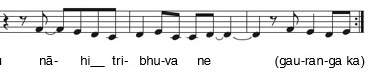
Why do you needlessly suffer the torment of blaspheming the devotees of Lord Hari, attempting to achieve their eminence, thereby only proving your own fruitless foolishness? The desire for spiritual eminence is easily fulfilled when one becomes a devotee of the Lord, for eternal fame automatically follows the heels of a Vaiṣṇava. And that fame is never to be considered a temporary worldly opulence.
6 se hari-sambandha, śūnya-māyā-gandha,
tāhā kabhu naya 'jaḍera kaitava'
pratiṣṭhā-caṇḍālī, nirjanatā-jāli,
ubhaye jāniha māyika raurava
se—that; hari-sambandha—relationship with Lord Hari; śūnya—free from; māyā- gandha—a scent of illusion; tāhā—that; kabhu naya—never; jaḍera—of materialism; kaitava—cheating; pratiṣṭhā—worldy reputation; caṇḍālī—female dog-eater; nirjanatā—solitary living; jāli—the net; ubhaye—in both; jāniha—you should know; māyika—illusory; raurava—hell.
The relationship between a devotee and Lord Hari is devoid of even a trace of worldly illusion; it has nothing to do with the materialistic cheating propensity. The prestige of so-called popularity in the material realm is compared to a treacherous dog-eating witch, and the attempt to live in solitude to supposedly engage in unalloyed bhajan is compared to an entangling network of distraction. Please know that anyone striving in either of these ways verily lives in the hell of Māyā's illusion.
7 kīrtana chāriba, pratiṣṭhā mākhiba,
ki kāja ḍhuriyā tādṛśa gaurava mādhavendra purī, bhāva-ghare curi, nā karila kabhu sadāi jānava kīrtana—chanting the Lord's names; chāriba—I will give up; pratiṣṭhā—worldly reputation; mākhiba—I will besmear myself; ki kāja—what benefit; ḍhuḍiyā— seeking; tādṛśa—that kind of; gaurava—grandeur; mādhavendra purī— Mādhavendra Purī; bhāva-ghare—in the storehouse of perception; curi—stealing; nā karila—he did not do; kabhu—ever; sadāi—always; jānaba—I will remind you.
"I shall give up chanting the Lord's name publicly in kīrtan and retire to solitude, thus smearing myself with worldly honor." Dear mind, what is the good of seeking such so-called glory? I will always remind you that the great soul Mādhavendra Purī never deceived himself in that regard by committing theft in his own storehouse of perception the way you do.
8 tomāra pratiṣṭhā,-'śukarera viṣṭhā',
tāra-saha sama kabhu nā mānava
matsaratā-vaśe, tumi jaḍa-rase, majecho chāriyā kīrtana-sauṣṭava tomāra—your; pratiṣṭhā—popularity; śukarera viṣṭhā—the stool of a hog; tāra- saha—with that; sama—equal; kabhu nā—never; mānava—an ordinary human being; matsaratā—pride; vaśe—under the control of; tumi—you; jaḍa-rase—in the mellows of mundane sense pleasures; majecha—you are sunk; chāriyā—having given up; kīrtana-sauṣṭava—the excellence of the saṅkīrtan movement.
Your cheap reputation is equal to the stool of a hog. An ordinary ambitious man like you can never be equated with a devotee of Mādhavendra Purī's eminence. Under the sway of envy, you have drowned yourself in the filthy waters of material enjoyment after having abandoned the excellent perfection of congregational kīrtan.
9 tāi duṣṭa mana, 'nirjana bhajana,' pracāricha chale 'kuyogī-vaibhava' prabhu sanātane, parama yatane, śikṣā dila yāhā, cinta sei saba tāi—therefore; duṣṭa mana—O wicked mind!; nirjana bhajana—solitary worship; pracāricha—you are preaching; chale—by trick; ku-yogī-vaibhava—the opulence of a false yogī; prabhu—Śrī Chaitanya Mahāprabhu; sanātane—to Sanātana Goswāmī; parama yatane—with great care; śikṣā dila—gave instructions; yāhā— which; cinta—please contemplate; sei saba—all those.
Truly, O wicked mind, the glories of so-called solitary worship are propagated only by false yogīs using unscrupulous means to deceive others. To save yourself from these pitfalls, please contemplate the instructions that the Supreme Lord Śrī Chaitanya Mahāprabhu kindly gave us while addressing Śrīla Sanātana Goswāmī with the utmost care.
10 sei du'ṭi kathā, bhula' nā sarvathā, uccaiḥ-svare kara 'hari-nāma-rava' 'phalgu' āra 'yukta,' 'baddha' āra 'mukta,'
kabhu nā bhāviha, ekākāra saba
sei—these; du'ṭi—two; kathā—topics; bhula' nā—don't forget; sarvathā—in all circumstances; uccaiḥ-svare—in a loud voice; kara—perform; hari-nāma-rava— the sound of chanting the Lord's holy names; phalgu—false; ār—and; yukta— befitting (linked with Kṛṣṇa); baddha—bound in māyā; āra—and; mukta—liberated; kabhu nā—never; bhāviha—consider; ekākāra—one in the same form; saba—all these.
Do not forget for a moment the two most valuable concepts that He taught: 1) the principle of dry, apparent renunciation as opposed to real, appropriate renunciation; and 2) the principle of a soul being trapped in the bondage of matter as opposed to a soul who is liberated. Don't ever make the mistake of thinking that these conflicting concepts are on the same level. Please remember this while engaging yourself in chanting the Lord's holy names as loud as you possibly can.

11 'kanaka-kāminī,' 'pratiṣṭhā-bāghinī,'
chāriyāche yāre, sei ta' vaiṣṇava sei 'anāsakta,' sei 'śuddha-bhakta,'
saṁsāra tathā pāya parābhava
kanaka-kāminī—enjoyment of wealth and women; pratiṣṭhā-bāghinī—the tigress of worldly reputation; chāriyāche—has given up; yāre—who; sei—he; ta'—certainly; vaiṣṇava—a devotee; sei—he; anāsakta—unattached; sei—he alone; śuddha- bhakta—is a pure devotee; saṁsāra—the material world; tathā—in this manner; pāya—gets; parābhava—defeated.
One is truly a Vaiṣṇava who has given up the habit of falling victim to the ferocious tigress of wealth, beauty, and fame. Such a soul is factually detached from material life, and is known as a pure devotee. Someone with this consciousness of detachment has thereby become victorious over the mundane world of birth and death.
12 yathā-yogya bhoga, nāhi tathā roga,
'anāsakta' sei, ki āra kahaba 'āsakti-rahita,' 'sambandha-sahita,'
viṣaya-samuha sakali 'mādhava'
yathā-yogya—whatever is appropriate for survival; bhoga—enjoyment; nāhi—is not; tathā—in that way; roga—the disease (of materialism); anāsakta—detached; sei—he; ki āra—what more; kahaba—shall I say; āsakti-rahita—devoid of attachment; sambandha-sahita—endowed with a relationship; viṣaya-samuha— the multitude of sense objects; sakali—all; mādhava—Lord Mādhava.
One is indeed detached who moderately partakes of worldly things that are deemed necessary for living in devotional service; a devotee acting in that manner does not fall prey to the disease of material infatuation. Thus devoid of selfish attachment, and endowed with the ability to see things in relation to the Lord, all sense objects are then directly perceived as being Lord Mādhava Himself.
13 se 'yukta-vairāgya,' tāhā ta' saubhāgya, tāhā-i jarete harir vaibhava kīrtane yāhāra, 'pratiṣṭhā-sambhāra,'
tāhāra sampatti kevala 'kaitava'
se—this; yukta-vairāgya—renunciation that is connected with Kṛṣṇa's enjoyment; tāhā—that; ta'—indeed; saubhāgya—great fortune; tāhā-i—only that; jarete—in the material world; harir—of Lord Hari; vaibhava—the opulence; kīrtane—in chanting the Lord's names; yāhāra—whose; pratiṣṭhā-sambhāra—heaps of ambition for recognition; tāhāra—its; sampatti—opulence; kevala—only; kaitava— cheating.
This is the standard of befitting renunciation, and one who realizes this is most fortunate indeed. Everything involved in such a devotee's life represents Lord Hari's personal spiritual opulence as manifest in the world of matter. On the other hand, one who engages in chanting the Lord's name with hopes of enhancing his own material reputation finds that all his activities and paraphernalia represent only the riches of hypocrisy.
14 'viṣaya-mumukṣu,' 'bhogera bubhukṣu,'
du'ye tyaja mana, dui 'avaiṣṇava' 'kṛṣṇera sambandha,' aprākṛta-skandha, kabhu nāhe tāhā jarera sambhava viṣaya-mumukṣu—one who desires liberation from the material world; bhogera bubhukṣu—one who desires to enjoy sense gratification; du'ye—both; tyaja— please reject; mana—O mind!; dui—the two; avaiṣṇava—non-devotees; kṛṣṇera— with Kṛṣṇa; sambandha—relationship; aprākṛta-skandha—things belonging to the transcendental realm; kabhu nāhe—never; tāhā—that; jarera sambhava—of material origin.
O mind, please reject the company of two types of persons-those desiring impersonal liberation from the material world, and those who desire to enjoy the pleasure of material sense objects. Both of these are equally non- devotees. The things that are used in relation to Lord Kṛṣṇa are objects belonging directly to the transcendental realm, and thus having nothing to do with matter they cannot be either owned or forsaken by persons interested in mundane enjoyment or renunciation.
15 'māyāvādī jana,' kṛṣṇetara mana, mukta abhimāne se ninde vaiṣṇava vaiṣṇavera dāsa, tava bhakti-āśa, kena vā ḍākicha nirjana-āhava māyāvādī jana—the impersonalist; kṛṣṇetara—opposed to Kṛṣṇa; mana— mentality; mukta abhimāne—proudly considering himself liberated; se—he; ninde—blasphemes; vaiṣṇava—the devotees; vaiṣṇavera dāsa—servant of the devotees; tava—your; bhakti-āśa—devotional desire; kena vā—why then; ḍākicha—you call out; nirjana-āhava—fighting for solitude.
An impersonal philospher is opposed to thinking of Kṛṣṇa as an object of devotion, and thus being puffed up with the false pride of imaginary liberation he dares to criticize the true devotees of the Lord. O mind, you are the servant of the Vaiṣṇavas, and you should always hope for attaining devotion. Why then do you make such a loud commotion by calling to me and trying to prove the supposed supremacy of your practice of solitary worship?
16 ye 'phalgu-vairāgī,' kahe nije 'tyāgī,'

se nā pāre kabhu haite 'vaiṣṇava'
hari-pada chāri', 'nirjanatā bāri,' labhiyā ki phala, 'phalgu' se vaibhava je—who; phalgu-vairāgī—false renunciant; kahe nije—calls himself; tyāgī—an accomplished renunciant; se—he; nā pāre—is not able; kabhu haite—to ever be; vaiṣṇava—a devotee; hari-pada—the lotus feet of the Lord; chāri'—rejecting; nirjanatā bāri—residence in solitude; labhiyā—obtaining; ki phala—what result?; phalgu—false; se vaibhava—that opulence.
One who falsely gives up things that could actually be used in the Lord's service proudly calls himself a 'renunciate,' but unfortunately he can never become a Vaiṣṇava by such an attitude. Abandoning his servitorship to the lotus feet of Lord Hari, and resigning himself to his solitary home-whatever is gained by that exercise can only be the worthless treasure of deception.
17 rādhā-dāsye rahi', chāri 'bhoga-ahi,'
'pratiṣṭhāśā' nahe 'kīrtana-gaurava' 'rādhā-nitya-jana,' tāhā chāri' mana, kena vā nirjana-bhajana-kaitava rādhā-dāsye—in service to Śrī Rādhā; rahi'—remaining; chāri—giving up; bhoga- ahi—the snake of selfish enjoyment; pratiṣṭhā-āśā—ambition for recognition; nahe—is not; kīrtana-gaurava—the glory of congregational chanting; rādhā-nitya- jana—being the eternal servant of Rādhā; tāhā chāri'—rejecting that; mana—O mind!; kena vā—why then; nirjana-bhajana—solitary worship; kaitava—cheating.
Ever engage yourself in the service of Śrī Rādhā, and keep aloof from the vicious snake of materialistic sense gratification. The glory of participating in the Lord's kīrtan is not meant to bolster anyone's ambitions for personal recognition. O mind, why then have you abandoned the identity of being Rādhā's eternal servant in favor of retiring to a solitary place to practice the cheating process of so-called bhajana?
18 vraja-vāsī-gaṇa, pracāraka-dhana, pratiṣṭhā-bhikṣuka tā' rā nahe 'śava'
prāṇa āche tā' ra, se-hetu pracāra, pratiṣṭhāśā-hīna-'kṛṣṇa-gāthā' saba vraja-vāsī-gaṇa—the residents of Vraja; pracāraka—preachers; dhana—the treasure; pratiṣṭhā-bhikṣuka—beggars for worldly fame; tā' rā—they; nahe—are not; śava—a dead body; prāṇa āche—there is life; tā' ra—theirs; se-hetu—for that reason; pracāra—preaching; pratiṣṭhā-āśā-hīna—devoid of ambition for fame; kṛṣṇa-gāthā—songs about Kṛṣṇa; saba—all.
The most valuable treasures amongst the Lord's preachers are the eternal personalities residing in Vraja-dhām. They never occupy themselves with begging for worthless material reputation, which is cherished only by the living dead. The Vraja-vāsīs are truly infused with life, and therefore they preach in order to give life to the walking corpses of the mundane world. All the songs that the Vraja-vāsīs sing about the glories of Lord Kṛṣṇa are devoid of any tinge of desire for fame.
19 śrī-dayita-dāsa, kīrtanete āśa, kara uccaiḥ-svare 'hari-nāma-rava' kīrtana-prabhāve, smaraṇa svabhāve, se kāle bhajana-nirjana sambhava śrī-dayita-dāsa—the servant of Rādhā's beloved Kṛṣṇa (Bhaktisiddhānta Sarasvatī); kīrtanete—for congregational chanting; āśa—desirous; kara—please perform; uccaiḥ-svare—in a loud voice; hari-nāma-rava—the sound of the Lord's holy names; kīrtana-prabhāve—by the power of the chanting; smaraṇa— remembering the Lord's pastimes; svabhāve—in one's own original spiritual mood; se kāle—at that time; bhajana-nirjana—worship in solitude; sambhava—possible.
This humble servant of Rādhā and Her beloved Kṛṣṇa always hopes for kīrtana, and he begs all to loudly sing the names of Lord Hari. The transcendental power of congregational chanting awakens remembrance of the Lord and His divine pastimes in relation to one's own eternal spiritual form. Only at that time does it become possible to go off to a solitary place and engage in the confidential worship of Their Lordships.
Commentary
When Prabhupāda quotes in his books and lectures from this song by his spiritual master, he frequently points out the tendency of immature devotees to engage in solitary bhajana. Śrī Caitanya-caritāmṛta, Madhya-līlā 11.177 – Purport At the present moment we see that some of the members of the International Society for Krishna Consciousness are tending to leave their preaching activities in order to sit in a solitary place. This is not a very good sign. It is a fact that Śrīla Bhaktisiddhānta Sarasvatī Ṭhākura has condemned this process for neophytes. He has even stated in a song, pratiṣṭhāra tare, nirjanera ghare, tava hari-nāma kevala kaitava: “Sitting in a solitary place intending to chant the Hare Kṛṣṇa mahā-mantra is considered a cheating process.” This practice is not possible for neophytes at all. The neophyte devotee must act and work very laboriously under the direction of the spiritual master, and he must thus preach the cult of Śrī Caitanya Mahāprabhu. Only after maturing in devotion can he sit down in a solitary place to chant the Hare Kṛṣṇa mahā-mantra as Śrī Caitanya Mahāprabhu Himself did. Although Śrī Caitanya Mahāprabhu is the Supreme Personality of Godhead, to teach us a lesson He traveled all over India continuously for six years and only then retired at Jagannātha Purī. Even at Jagannātha Purī the Lord chanted the Hare Kṛṣṇa mahā- mantra in great meetings at the Jagannātha temple. The point is that one should not try to imitate Haridāsa Ṭhākura at the beginning of one’s transcendental life. One must first become very mature in devotion and thus receive the approval of Śrī Caitanya Mahāprabhu. Only at such a time may one actually sit down peacefully in a solitary place to chant the Hare Kṛṣṇa mahā-mantra and remember the lotus feet of the Lord. The senses are very strong, and if a neophyte devotee imitates Haridāsa Ṭhākura, his enemies (kāma, krodha, lobha, moha, mada and mātsarya) will disturb and fatigue him. Instead of chanting the Hare Kṛṣṇa mahā-mantra, the neophyte will simply sleep soundly. Preaching work is meant for advanced devotees, and when an advanced devotee is further elevated on the devotional scale, he may retire to chant the Hare Kṛṣṇa mantra in a solitary place. However, if one simply imitates advanced spiritual life, he will fall down, just like the sahajiyās in Vṛndāvana. Śrī Caitanya-caritāmṛta, Madhya-līlā 11.195 – Purport The duty of a pure devotee or a servant of the Lord is to carry out the order of the Lord. Śrī Caitanya Mahāprabhu asked Nityānanda Prabhu to go to Bengal and preach, and He asked the Gosvāmīs, Rūpa and Sanātana, to go to Vṛndāvana and excavate the lost places of pilgrimage. In this case the Lord asked Haridāsa Ṭhākura to remain there at Jagannātha Purī and constantly chant the holy names of the Lord. Thus Śrī Caitanya Mahāprabhu gave different persons different orders, and consequently one should not try to imitate the behavior of Haridāsa Ṭhākura
without being ordered by Śrī Caitanya Mahāprabhu or His representative. Śrīla Bhaktisiddhānta Sarasvatī Ṭhākura condemns such imitations in this way: duṣṭa mana! tumi kisera vaiṣṇava? pratiṣṭhāra tare, nirjanera ghare, tava hari-nāma kevala kaitava. “My dear mind, you are trying to imitate Haridāsa Ṭhākura and chant the Hare Kṛṣṇa mantra in a secluded place, but you are not worth being called a Vaiṣṇava because what you want is cheap popularity and not the actual qualifications of Haridāsa Ṭhākura. If you try to imitate him you will fall down, for your neophyte position will cause you to think of women and money. Thus you will fall into the clutches of māyā, and your so-called chanting in a secluded place will bring about your downfall.” Lecture on Śrīmad-Bhāgavatam 1.2.5 – Vṛndāvana, October 16, 1972 So when you become actually preacher of God consciousness, you cannot make any compromise. You must call a spade a spade. Just like Prahlāda Mahārāja. Prahlāda Mahārāja is one of the mahājanas. Out of the twelve mahājanas, he's one of them. Because he was very bold. He was not afraid of his demonic father. He chastised him in so many ways. But he was never afraid. So just like our people are being persecuted in Australia. You know? They have been put into jail because they are preaching Hare Kṛṣṇa. So this is not very easy thing, easy- going. My Guru Mahārāja, Bhaktisiddhānta Sarasvatī Gosvāmī Mahārāja, he did not like that his disciples would be easy-going, cheap Vaiṣṇava. Cheap Vaiṣṇava. Duṣṭa mana tumi kisera vaiṣṇava. He sang a song, "My dear mind, oh, you are going to be a Vaiṣṇava. And what kind of Vaiṣṇava you are?" Duṣṭa mana tumi kisera vaiṣṇava, pratiṣṭhāra tare, nirjanera ghare, tava hari-nāma kevala kaitava. "You are chanting Hare Kṛṣṇa, imitating Haridāsa Ṭhākura or Rūpa Gosvāmī, in a solitary place... Not solitary place. You are thinking of woman and money. That's all. Mind is filled with dirty things. So this kind of bhajana is simply cheating." He was after preaching. First of all, go door to door. Just like Nityānanda Prabhu did it at the risk of life."
Śrī Godruma-candra-bhajana-upadeśa
(Yadi te hari-pāda-saroja-sudhā)
(1) yadi te hari-pāda-saroja-sudhā- rasa-pāna-paraṁ hṛdayaṁ satatam parihṛtya gṛhaṁ kali-bhāva-mayaṁ bhaja godruma-kānana-kuñja-vidhum yadi—if; te—your; hari-pāda-saroja—the lotus feet of Lord Hari; sudhā-rasa— nectar-mellows; pāna-param—engrossed in drinking; hṛdayam—the heart; satatam—always; parihṛtya—giving up; gṛham—the home; kali-bhāva-mayam— full of the moods of Kali-yuga; bhaja—please worship; godruma—of the island of Godruma-dvīpa; kānana—in the forest; kuñja—of the bower; vidhum—the Moon.
If your heart wishes to be always absorbed in drinking the ambrosial mellows of the lotus feet of Lord Hari, then give up mundane household life, full of Kali-yuga quarrels and strife, and just worship the beautiful Moon of Godruma's forest bowers.
2 dhana-yauvana-jīvana-rājya-sukhaṁ
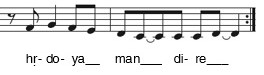
na hi nityam anukṣaṇa-nāśa-param tyaja grāmya-kathā-sakalaṁ viphalaṁ bhaja godruma-kānana-kuñja-vidhum dhana—wealth; yauvana—youth; jīvana—longevity; rājya—of the kingdom; sukham—happiness; na—not; hi—certainly; nityam—permanent; anukṣaṇa—at every moment; nāśa-param—tend to be destroyed; tyaja—please renounce; grāmya-kathā—common gossip; sakalam—all; viphalam—fruitless.
Material riches, youth, a long life, and royal happiness-none of these are certain; at every moment they are being destroyed. Give up all useless mundane conversations and just worship the beautiful Moon of Godruma's forest bowers.
3 ramaṇī-jana-saṅga-sukhaṁ ca sakhe carame bhayadaṁ puruṣārtha-haram hari-nāma-sudhā-rasa-matta-matir bhaja godruma-kānana-kuñja-vidhum ramaṇī-jana—beautiful women; saṅga—the company; sukham—the pleasure; ca—also; sakhe—O friend!; carame—ultimately; bhaya-dam—causes fear; puruṣa-artha—the goal of human life; haram—takes away; hari-nāma—the holy name of Lord Hari; sudhā-rasa—nectar-mellows; matta-matiḥ—intoxicated consciousness.
O friend! The pleasure to be had in the company of beautiful young women ultimately turns to fearfulness, and distracts one from the true goal of human life. With your mind intoxicated by the nectarean mellows of the holy name of Lord Hari, just worship the beautiful Moon of Godruma's forest bowers.
4 jaḍa-kāvya-raso na hi kāvya-rasaḥ
kali-pāvana-gaura-raso hi rasaḥ alam anya-kathādy anuśīlanayā bhaja godruma-kānana-kuñja-vidhum jaḍa-kāvya—worldly poetry; rasaḥ—the taste; na—not; hi—certainly; kāvya- rasaḥ—the actual taste of poetry; kali-pāvana—the savior of the age of Kali; gaura—Lord Gaurāṅga; rasaḥ—the taste; hi—certainly; rasaḥ—is actual taste; alam—useless; anya-kathā—other topics; ādi—and so forth; anuśīlanayā—by the cultivation.
The taste of mundane poetry never provides the sweet taste of actual poetry. The sweet mellows of true poetry are verily found in descriptions of Lord Gaura, the savior of all souls in the Kali-yuga. The diligent study of all other topics is useless! Just worship the beautiful Moon of Godruma's forest bowers.
5 vṛṣabhānu-sutānvita-vāma-tanuṁ yamunā-taṭa-nāgara-nanda-sutam muralī-kala-gīta-vinoda-paraṁ bhaja godruma-kānana-kuñja-vidhum vṛṣabhānu-sutā—the daughter of Vṛṣabhānu (Śrī Rādhā); anvita—endowed; vāma-tanum—the left side of His body; yamunā-taṭa—the bank of the river Yamunā; nāgara—the clever paramour; nanda-sutam—the son of Nanda Mahārāja; muralī—the flute; kala-gīta—soft songs; vinoda-param—engaged in giving pleasure.
His left side enhanced by the daughter of Vṛṣabhānu, Nanda-Suta the transcendental paramour stands on the bank of the Yamunā river absorbed in the pleasure-giving pastime of playing soft, melodious songs on His flute. Just worship Him, the beautiful Moon of Godruma's forest bowers.
6 hari-kīrtana-madhya-gataṁ sva-janaiḥ
pariveṣṭita-jāmbunadābha-harim
nija-gauḍa-janaika-kṛpā-jaladhiṁ bhaja godruma-kānana-kuñja-vidhum hari-kīrtana—congregational chanting of the holy name of Hari; madhya-gatam— in the midst; sva-janaiḥ—by His own associates; pariveṣṭita—surrounded; jāmbunada—gold; ābha—the luster; harim—Lord Hari; nija-gauḍa-jana—His own Gauḍīya devotees; eka—the only; kṛpā-jaladhim—ocean of mercy.
In the midst of hari-kīrtana, surrounded by His loving associates He is the same dark Lord Hari, but now shining with the luster of molten gold. He is the exclusive ocean of mercy for His own Gauḍīya devotees. Just worship the beautiful Moon of Godruma's forest bowers.
7 girirāja-sutā-parivīta-gṛhaṁ nava-khaṇḍa-patiṁ yati-citta-haram sura-saṅga-nutaṁ priyayā sahitaṁ bhaja godruma-kānana-kuñja-vidhum girirāja-sutā—the daughter of the best of mountains (river Gaṅgā, daughter of the Himālayas); parivīta—surrounded; gṛham—the home; nava-khaṇḍa—of the region divided into nine areas; patim—the Lord; yati-citta—the hearts of the renunciates; haram—He who steals; sura-saṅga—the assembly of saintly souls and demigods; nutam—He who is bowed to; priyayā sahitam—along with His beloved wife (Śrīmatī Viṣṇu-priyā).
His island home is surrounded by the river Gaṅgā, daughter of the king of mountains. He is the Lord of the nine-fold islands of Navadvīpa and the stealer of the hearts of the renunciates. Along with His beloved wife Viṣṇu- priyā He is glorified by demigods and saintly persons. Just worship the beautiful Moon of Godruma's forest bowers.
8 kali-kukkura-mudgara-bhāva-dharaṁ hari-nāma-mahauṣadha-dāna-param patitārta-dayārdra-su-mūrti-dharaṁ bhaja godruma-kānana-kuñja-vidhum kali-kukkura—the dog-like personality of the age of Kali; mudgara—a stick; bhāva- dharam—He who possesses the mood; hari-nāma—the holy name of Lord Hari; mahā-auṣadha—the great medicine; dāna-param—who is engaged in administering; patita-ārta—fallen and distressed; dayā-ardra—melted with compassion; su-mūrti-dharam—He who possesses a beautiful form.
His mood is that of wielding a stick for chasing away the mad dog of Kali- yuga. He is absorbed in distributing the holy name of Hari, the great remedy for material existence. His heart is melted with compassion for the fallen souls who are suffering, and His transcendental form is very beautiful. Just worship the beautiful Moon of Godruma's forest bowers.
9 ripu-bāndhava-bheda-vihīna-dayā yad-abhīkṣnam udeti mukhābja-tatau tam akṛṣṇam iha vraja-rāja-sutaṁ bhaja godruma-kānana-kuñja-vidhum ripu-bāndhava—enemies and friends; bheda—the difference between the two; vihīna—completely bereft; dayā—the mercy; yat—that which; abhīkṣnam— constantly; udeti—is arising; mukha-abja-tatau—in His lotus face; tam—Him; akṛṣṇam—not blackish; iha—here; vraja-rāja-sutam—the son of the king of Vraja.
Continually beaming from His lotus face is causeless mercy that makes no distinction between so-called 'friends' or 'enemies.' Although the son of Mahārāja Nanda, He appears here in a form unlike that of Krishna's dark complexion. Just worship the beautiful Moon of Godruma's forest bowers.
10 iha copaniṣat-parigīta-vibhur dvija-rāja-sutaḥ puraṭābha-hariḥ nija-dhāmani khelati bandhu-yuto bhaja godruma-kānana-kuñja-vidhum iha—here; ca—also; upaniṣad—in the Upaniṣads; parigīta—celebrated; vibhuḥ— the all-pervading Lord; dvija-rāja-sutaḥ—the son of the king of the twice-born; puraṭa—gold; ābha—the luster; hariḥ—Lord Hari Himself; nija-dhāmani—in His own abode; khelati—is sporting; bandhu-yutaḥ—along with His boyfriends.
In this world and in the Upaniṣads He is celebrated as the all-pervading Supreme Lord. He appears now as the son of the king of brāhmaṇas and is Lord Hari Himself, with a shining golden complexion. In His own abode He plays eternally with His cowherd boyfriends. Just worship the beautiful Moon of Godruma's forest bowers.
11 avatāra-varaṁ paripūrṇa-kalaṁ para-tattvam ihātma-vilāsa-mayam vraja-dhāma-rasāmbudhi-gupta-rasaṁ bhaja godruma-kānana-kuñja-vidhum avatāra-varam—the best of incarnations; paripūrṇa-kalam—complete in all aspects; para-tattvam—transcendental truth; iha—here; ātma-vilāsa-mayam— fond of enjoying Himself; vraja-dhāma—of the abode of Vraja; rasa-ambudhi—in the ocean of mellows; gupta-rasam—the most confidential mellows.
He is the most excellent of avatāras, and within Him exists the consummate expansions of Godhead. He is the Supreme Truth, enjoying Himself here in great playfulness. He embodies the most confidential mellows flowing within the ocean of rasa in Vraja-dhāma. Just worship the beautiful Moon of Godruma's forest bowers.
12 śruti-varṇa-dhanādi na yasya kṛpā-
janane balavad-bhajanena vinā tam ahaituka-bhāva-pathā hi sakhe bhaja godruma-kānana-kuñja-vidhum śruti—vast learning; varṇa—high birth; dhana—wealth; ādi—and so on; na—not; yasya—whose; kṛpā-janane—in generating the mercy; balavat—powerful; bhajanena—by the worship; vinā—without; tam—Him; ahaituka-bhāva— unmotivated attitude; pathā—on the path; hi—certainly; sakhe—O friend!
O friend! Without the devotional performance of purely intense bhajan, your vast scholarship, noble family lineage, wealth, and so on are completely ineffective for invoking the mercy of the Lord. With a service attitude that is unmotivated, just worship the beautiful Moon of Godruma's forest bowers.
13 api nakra-gatau hrada-madhya-gataṁ
kam amocayad-ārta-janaṁ tam ajam
avicintya-balaṁ śiva-kalpa-taruṁ bhaja godruma-kānana-kuñja-vidhum api—also; nakra-gatau—captured by the crocodile; hrada-madhya-gatam—having entered the lake; kam—indeed; amocayat—released; ārta-janam—the distressed person; tam—Him; ajam—the unborn one; avicintya-balam—of inconceivable strength; śiva—auspiciousness; kalpa-tarum—the desire-tree.
This same Lord once liberated the elephant Gajendra from the crocodile's grasp within the lake. He is the unborn one, possessing inconceivable power, and is truly a desire-tree of pure auspiciousness. Just worship the beautiful Moon of Godruma's forest bowers.
14 surabhīndra-tapaḥ-parituṣṭa-manā
vara-varṇa-dharo harir āvirabhūt tam ajasra-sukhaṁ muni-dhairya-haraṁ bhaja godruma-kānana-kuñja-vidhum surabhi—the surabhī cow; indra—and Lord Indra; tapaḥ—the penance; parituṣṭa- manā—whose mind was very satisfied; vara-varṇa-dharaḥ—who possesses an excellent complexion; hariḥ—Lord Hari; āvirabhūt—has appeared; tam—Him; ajasra-sukham—endless joy; muni-dhairya—the patience of the sages; haram— He who steals.
Being pleased with the penances of Indra and the surabhi cow, Lord Hari has appeared again in this world possessing a superexcellent complexion. He is endless happiness, and He plunders the patience of the learned sages. Just worship the beautiful Moon of Godruma's forest bowers.
15 abhilāṣa-cayaṁ tad-abheda-dhiyam aśubhaṁ ca śubhaṁ tyaja sarvam idam anukūlatayā priya-sevanayā bhaja godruma-kānana-kuñja-vidhum abhilāṣa-cayam—the multitude of aspirations; tat-abheda—the absolute non- difference of the living entities and the Supreme Personality of Godhead; dhiyam— the understanding; aśubham—inauspicious; ca—also; śubham—auspicious; tyaja—please give up; sarvam idam—all of these; anukūlatayā—by the favorable attitude; priya-sevanayā—by endearing service.
The multitude of worldly desires, philosophical meditations on the impersonal oneness of all beings, as well as the relative conceptions of what is auspicious or inauspicious-utterly renounce all of these things. In a favorable mood while rendering loving devotional service, just worship the beautiful Moon of Godruma's forest bowers.
16 hari-sevaka-sevana-dharma-paro
hari-nāma-rasāmṛta-pāna-rataḥ nati-dainya-dayā-para-māna-yuto bhaja godruma-kānana-kuñja-vidhum hari-sevaka—the servants of Lord Hari; sevana—the service; dharma—the occupational duty; paraḥ—fixed; hari-nāma—the holy name of Lord Hari; rasa- amṛta—nectar-mellows; pāna-rataḥ—addicted to drinking; nati—modesty; dainya—humility; dayā—compassion; para—others; māna-yutaḥ—endowed with the offering of respect.

Remaining fixed in the service of Hari's servants, being addicted to drinking the sweet nectar of the holy name of Hari, and endowed with modesty, humility and compassion, offering all respect unto others, just worship the beautiful Moon of Godruma's forest bowers.
17 vada yādava mādhava kṛṣṇa hare
vada rāma janārdana keśava he vṛṣabhānu-sutā-priya-nātha sadā bhaja godruma-kānana-kuñja-vidhum vada—please chant; yādava—O Yādava!; mādhava—O Mādhava!; kṛṣṇa—O Kṛṣṇa!; hare—O Hari!; vada—please chant; rāma—O Rāma!; janārdana—O Janārdana!; keśava—O Keśava!; he—O!; vṛṣabhānu-sutā—of the daughter of Vṛṣabhānu; priya-nātha—O dear Lord!; sadā—always.
Incessantly call out to the Lord, "O Yādava! O Mādhava! O Kṛṣṇa! O Hari!" Chant, "O Rama! O Janārdana! O Keśava!" "O beloved Lord of Vṛṣabhānu's daughter!"-and just worship the beautiful Moon of Godruma's forest bowers.
18 vada yāmuna-tīra-vanādri-pate vada gokula-kānana-puñja-rave vada rāsa-rasāyana gaura-hare bhaja godruma-kānana-kuñja-vidhum vada—please chant; yāmuna-tīra—on the bank of the Yamunā; vana—the forests; adri—and mountains; pate—O Lord!; vada—please chant; gokula-kānana—the groves of Gokula Vrindāvan; puñja—the multitudes; rave—O sun!; vada—please chant; rāsa-rasāyana—the life-giving tonic of the rāsa—dance; gaura-hare—O Gaura-hari!
Please chant, "O Lord of the forests and hills along the banks of the river Yamunā!" Chant, "O brilliant sun of the groves of Gokula!" Chant, "O elixir of life for the rāsa dance!" "O Gaura-hari!"-and just worship the beautiful Moon of Godruma's forest bowers.
19 cala gaura-vanaṁ nava-khaṇḍa-mayaṁ
paṭha gaura-hareś caritāni mudā luṭha gaura-padāṅkita-gāṅga-taṭaṁ bhaja godruma-kānana-kuñja-vidhum cala—please proceed; gaura-vanam—to the forest of Gaura; nava-khaṇḍa- mayam—divided into nine parts; paṭha—please read or recite; gaura-hareḥ—of the Golden Hari; caritāni—the activities; mudā—happily; luṭha—please roll on the ground; gaura-pada-aṅkita—marked with the footprints of Gaura; gāṅga-taṭam— the bank of the river Gaṅgā.
Please go to the forest of Lord Gaura, divided into nine islands. Please read and recite with great joy the pastimes of Lord Gaura-hari. Please roll about in ecstasy on the bank of the river Gaṅgā marked with the footprints of Lord Gaura-and just worship the beautiful Moon of Godruma's forest bowers.
20 smara gaura-gadādhara-keli-kalāṁ bhava gaura-gadādhara-pakṣa-caraḥ śṛṇu gaura-gadādhara-cāru-kathāṁ bhaja godruma-kānana-kuñja-vidhum smara—please remember; gaura-gadādhara—of Gaura and Gadādhara; keli- kalām—amorous arts; bhava—please become; gaura-gadādhara—of Gaura and Gadādhara; pakṣa-caraḥ—one who takes sides; śṛṇu—please hear; gaura- gadādhara—of Gaura and Gadādhara; cāru-kathām—captivating discussions.
Just remember the artistically playful pastimes of Gaura and Gadādhara. Just become a loyal follower of Gaura and Gadādhara's camp. Just listen to the captivating stories of Gaura and Gadādhara-and just worship the beautiful Moon of Godruma's forest bowers.
Commentary
As the title of this song indicates, Bhaktivinoda Ṭhākura gives us instructions for worshiping Lord Caitanya, the Moon of the island of Godruma-dvīpa. He begins by listing all kinds of activities which are only increasing our bondage to this world and should be given up. Then he gives an elaborate description of the wonderful qualities and activities of Śrī Caitanya Mahāprabhu, the beautiful Moon of Godrumadvīpa.
Bhaja bhaja hari
Locana dasa Thakura
1 bhaja bhaja hari, mana dṛḍha kari’, mukhe bala tāṅra nāma vrajendra-nandana gopī-prāṇa-dhana, bhuvana mohana śyāma bhaja bhaja—just worship; hari—Hari; mana—o mind; dṛḍha kari’—with determination; mukhe—with the mouth; bala—chant; tā’ra—His; nāma—name;
vrajendra-nandana—the son of the king of Vraja; gopī-prāṇa-dhana—the life and soul of the cowherd girls; bhuvana—of the whole universe; mohana—the enchanter; śyāma—Śyāmasundara.
O my dear mind, just worship with great determination Hari by chanting His holy names like Vrajendra-nandana, Gopī-prāna-dhana and Śyāmasundara who enchants the whole universe.
2 kakhana maribe, kemane taribe, viṣama śamana ḍāke yāhāra pratāpe, bhuvana kāpaye, nā jāni mara vipāke kakhana—any time; maribe—will die; kemane—how?; taribe—you will be delivered; viṣama—fearsome; śamana—lord of death; ḍāke—calls; yāhāra— whose; pratāpe—by power, domineering influence; bhuvana—the universe; kāpaye—quakes; nā—not; jāni—I know; mara—my; vipāke—predicant.

There is no certainty when your life will finish, and you also never think about your deliverance from the material world. But very fearsome Yamadūtas are standing near you. Bhagavān, whose power causes the three worlds to tremble in fear, You have forgotten. This is your misfortune. Thus, you are suffering in this material world from different kinds of miseries, and now you are about to die.
kula-dhana pāiyā, unmatta haiyā, āpanāke jāna bara śamanera dūte, dhari’, pāye hāte, bādhiyā karibe jaḍa kula—noble birth, aristacracy; dhana—wealth; pāiyā—having attained; unmatta— intoxicated; haiyā—having become; āpanāke—to youself; jāna—you think; baḍa—great; śamanera—of the lord of death; dūte—by the messengers; dhari’— having clutched; pāye—by feet; hāte—by hands; bādhiyā—having bound; karibe—they will render; jaḍa—inert.
You have become intoxicated by your high birth and wealth, thinking yourself very high class. But you have forgotten that one day the Yamadūtas will take you, tying up your hands and feet.
4 kibā yati satī, kibā nīca jāti, yei hari nāhi bhaje tabe janamiyā, bhramiyā bhramiyā, raurava-narake maje kibā—whether; yati—renounced; satī—chaste; kibā—whether; nīca—low; jāti— caste; jei—he who; hari—Śrī Hari; nāhi—not; bhaje—worships; tabe—then; janamiyā—having taken birth; bhramiyā bhramiyā—wondering and wondering; raurava—Raurava; narake—in the hell; maje—drowns.
So whether one is a sannyasi or a very low-caste person, without performing hari-bhajana, one will continue to rotate in the samsara and go to the hell named Raurava.
5 e dāsa locana, bhāve anukṣaṇa, michāi janama gela hari nā bhajinu, viṣaye majinu, hṛdaye rahala śela e—this; dāsa locana—Locana dāsa; bhāve—contemplates; anukṣaṇa—always; michāi—wasted; janama—birth; gela—passed; hari—Śrī Hari; nā—not; bhajinu— I have worshipped; viṣaye—in sense enjoyment; majinu—I have absorbed; hṛdaye—in heart; rahala—pierces; śela—a spear.
Locana dasa says, “I have never done any hari-bhajana, having been absorbed in sense enjoyment. In this way my human form of life has been wasted. And this causes excruciating pain like a thorn piercing my heart.
Commentary
This song by Locana dāsa Ṭhākura is similar to Hari hari! biphale and Bhajahū re mana. He addresses his mind and reminds himself that life in the material world can end at any time. Therefore, we should not waste our valuable human life but worship with determination Hari: bhaja bhaja hari. As Prahlāda Mahārāja points out to his classmates (SB 7.6.1): “One who is sufficiently intelligent should use the human form of body from the very beginning of life—in other words, from the tender age of childhood—to practice the activities of devotional service [bhāgavata- dharma], giving up all other engagements. The human body is most rarely achieved, and although temporary like other bodies, it is meaningful because in human life one can perform devotional service. Even a slight amount of sincere devotional service can give one complete perfection.” Śrīla Prabhupāda explains in the purport:
The Kṛṣṇa consciousness movement is anxious to serve human society by teaching people to perform devotional service, which can save a human being from being degraded again to animal life. As already stated by Prahlāda Mahārāja, bhāgavata- dharma consists of śravaṇaṁ kīrtanaṁ viṣṇoḥ smaraṇaṁ pāda-sevanam/ arcanaṁ vandanaṁ dāsyaṁ sakhyam ātma-nivedanam [SB 7.5.23]. In all the schools, colleges and universities, and at home, all children and youths should be taught to hear about the Supreme Personality of Godhead. In other words, they should be taught to hear the instructions of Bhagavad-gītā, to put them into practice in their lives, and thus to become strong in devotional service, free from fear of being degraded to animal life. Following bhāgavata-dharma has been made extremely easy in this age of Kali. The śāstra says:
harer nāma harer nāma harer nāmaiva kevalam
kalau nāsty eva nāsty eva nāsty eva gatir anyathā
One need only chant the Hare Kṛṣṇa mahā-mantra. Everyone engaged in the practice of chanting the Hare Kṛṣṇa mahā-mantra will be completely cleansed, from the core of his heart, and be saved from the cycle of birth and death.
Avatāra sāra Locana dasa Thakura
1 avatāra sāra, gaura-avatāra
kena nā bhajili tā´re kari' nīre bāsa, gela nā piyāsa āpana karama phere avatāra—incarnation; sāra—best; gaura avatāra—incarnation of Gaura; kena—why?; nā—not; bhajili—you worshiped; tā´re—to Him; kari'—having made; nīre—in waters; bāsa—residence; gela—gone; nā—not; piyāsa—thirst; āpana—your own; karama—activities; phere—in consequence.
O my mind, why don’t you worship Śrī Gaurasundara, the crown-jewel of all incarnations? You always stay in water but your thirst is never satiated due to your own past bad activities.
2 kaṇṭakera taru, sadāi sevili, (mana)
amṛta pāibāra āśe prema-kalpataru, śrī gaurāṅga āmāra, tāhāre bhāvili viṣe kaṇṭakera—of thorns; taru—tree; sadā i—always; sevili—you served; (mana)—O mind; amṛta—nectar; pāibāra—of obtaining; āśe—with desire; prema—divine love; kalpataru—wish-fulfilling tree; śrī gaurāṅga—Śrī Gaurānga; āmāra—my; tāhāre—to Him; bhāvili—you considered; viṣe—as poison.
You always hope to attain sweet, juicy fruits from your worship of thorn trees, but this is not possible. Our Gaurasundara is a desire-tree offering divine love, but you left Him, thinking Him to be poison.

3 saurabhera āśe, palāśa śukili, (mana)
nāśāte paśila kīta
ikṣudaṇḍa bhāvi’, kāṭha cuṣili, (mana)
kemane pāibi miṭha
saurabhera—of sweet fragance; āśe—with desire; palāśa—the palāśa flower; śukili—you smelt; (mana)—O mind; nāśāte—in nose; paśila—entered; kīta— insect; ikṣudaṇḍa—sugar cane; bhāvi’—having considered; kāṭha—wood; cuṣili—you sucked; (mana)—O mind; kemane—how?; pāibi—you will get; miṭha—sweetness. O my mind, searching for some sweet aroma, you smell the beautiful palasa flower (but it has no scent), and instead, an insect from the flower enters your nose. You suck on dry wood, mistaking it for sugar cane, so how can you get any sweet juice?
4 hāra baliyā, galāya parili, (mana)
śamana kiṅkara-sāpa śītala baliyā, āguna pohāli, (mana)
pāili bajara tāpa
hāra—necklace; baliyā—having considered; galāya—on neck; parili—you put on; (mana)—O mind; śamana—the Lord of Death; kiṅkara—servant; sāpa— snake; śītala—cool; baliyā—having considered; āguna—fire; pohāli—you basked; (mana)—O mind; pāili—you got; bajara—excruciating; tāpa—heat.
O my mind, death is like snake which you put around your neck, thinking it to be a garland. You entered fire, thinking it to be cool, and suffered excruciating burning.
5 saṁsāra bhajili, śrī gaurāṅga bhulili,
nā sunili sādhura kathā iha parakāla, du’kāla khāoyāli, (mana)
khāili āpana māthā
saṁsāra—materialexistence; bhajili—you worshiped; śrī gaurāṅga—Śrī Gaurāṅga; bhulili—you forgot; nā—not; sunili—you listened; sādhura— devotee´s; kathā—words; iha—this; parakāla—the hereafter; du’—both; kāla— times (this life and the next); khāoyāli—you lost, tou wasted; (mana)—O mind; khāili—you caused to spoll or ruin; āpana—your own self; māthā—head(from Samsad Bengali dictionary: māthā khāoyā v. (fig.)to ruin. to spoll. (fig.) to deprave.)
O my mind, enjoying material pleasures, you never heeded the devotees’ words and forgot Gaurasundara. Thus, both this world and the next are lost to you.
Commentary
In this song also, Locana dāsa addresses his mind and laments that he has wasted his time in fruitless pursuits of mundane pleasures. There are several songs, like Bhajahu re mana, or Dusta mana, where the devotee addresses his mind urging it to engage in the worship of Kṛṣṇa. As Kṛṣṇa explains in Bhagavad-gītā, the mind can be either our best friend or our worst enemy. In a letter to a prospective disciple, Prabhupāda writes:
“The whole yogic system is to convert the mind from matter to spirit. You can utilize the mind in both ways. When the mind is spiritually trained up it is the best friend of the soul, and when the mind is materially polluted, it is the worst enemy. The Bhagavad-gita states: bandhur atmatmanas tasya yenatmaivatmana jitah anatmanas tu saturve vartetatmaiva satruvat. For those who are grossly materialistic persons, for them the yogic system is recommended, otherwise if the mind is directly engaged at the lotus feet of Krishna, the senses automatically become engaged in Krishna's service; and that is the liberated stage. Chanting of the Hare Krishna mantra is the direct process for curing the mind of all materialistic contamination. Take to this process and be happy.”
Śarīra avidyā-jāla
1 bhāi-re! śarīra avidyā-jāla, jaḍendriya tāhe kāla, jīve phele viṣaya-sāgare tā'ra madhye jihvā ati, lobhamaya sudurmati, tā'ke jetā kaṭhina saṁsāre kṛṣṇa bara dayāmaya, karibāre jihvā jaya, sva-prasāda-anna dila bhāi sei annāmṛta khāo, rādhā-kṛṣṇa-guṇa gāo, preme ḍāka caitanya-nitāi bhāi-re—O brothers; śarīra—material body; avidyā—ignorance; jāla—netwoark; jaḍa-indriya—material senses; tāhe—they; kāla—death; jīve—the soul; phele— throw; viṣaya—of sense enjoyment; sāgare—the ocean; tā’ra—them; madhye— among; jihvā—the tongue; ati lobhamaya—most voracious; su-durmati— uncontrollable; tā’ke—that; jetā—to conquer; kaṭhina—very difficult; saṁsāre—in this material world; kṛṣṇa—Kṛṣṇa; bara—very; dayāmaya—merciful; karibāre—to do; jihvā—the tongue; jaya—control; sva-prasāda-anna—His prasādam; dila—has given; bhāi—O brothers; sei—this; annāmṛta—nectarean food; khāo—let us eat; rādhā-kṛṣṇa-guṇa—the glories of Rādhā and Kṛṣṇa; gāo—let us sing; preme—in love; ḍāka—call out for; caitanya-nitāi—Śrī Caitanya Mahāprabhu and Nityānanda Prabhu.
O brothers, this material body is a place of ignorance, and the senses are a network of paths to death. Somehow, we have fallen into this ocean of material sense enjoyment, and of all the senses the tongue is most voracious and uncontrollable. It is very difficult to conquer the tongue in this world. But Kṛṣṇa is very merciful and has given us such nice prasāda, just to control the tongue. Now, o brothers, let us take this delicious prasādam and glorify Rādhā and Kṛṣṇa and in love call for the help of Lord Caitanya and Nityānanda.
Commentary
This is the first of six songs for the honoring of spiritual food (prasāda-sevāya) from Bhaktivinoda Ṭhākura’s songbook Gītāvalī. In a lecture on Śrīmad-Bhāgavatam 7.6.9, given in New Vrindaban in 1976, Prabhupāda comments on this song as follows:
Ātmānam ajitendriyaḥ, the whole training is to control the senses, and the most powerful sense is the tongue. Sense control begins from the tongue. Bhaktivinoda Ṭhākura has given you the song, tāra madhye jihvā ati lobhamaya sudurmati. Bhaktivinoda Ṭhākura gives a description that śarīra avidyā-jāla jaḍendriya tāhe kāla. This body is the encagement. We are in the prison of this material world. How we are imprisoned? We have been given a material body. This is imprisonment. Śarīra avidyā-jāla. And we are very happy to keep this body very comfortably without knowing the aim of life. That is avidyā-jāla, a network of ignorance. Śarīra avidyā-jāla, and the senses are our greatest enemies. Unless we control the senses, we are put into this avidyā-jāla, network of ignorance. And out of all the senses, Bhaktivinoda Ṭhākura says, tā'ra madhye jihvā—jihvā means tongue—jihvā ati, lobhamaya sudurmati. It is very greedy. To control the senses means to control the tongue. That is also very difficult job. So therefore to control the tongue, best thing is to take kṛṣṇa- prasādam. First of all, offer to Kṛṣṇa and then take. Tā'ra madhye jihvā ati, lobhamaya sudurmati tā'ke jetā kaṭhina saṁsāre. Kṛṣṇa bara-dayāmaya karibāre jihvā jaya. At least if we take it as a vow that "I shall not eat anything which is not offered to Kṛṣṇa," that will help us. Kṛṣṇa bara-dayāmaya, karibāre jihvā jaya svaprasāda ānna dilā bhāi. So with the tongue begins spiritual life. If we restrict our tongue not to talk uselessly, simply talk of Kṛṣṇa or chant Hare Kṛṣṇa, read Kṛṣṇa books, chant Hare Kṛṣṇa, and when you are hungry, take kṛṣṇa-prasādam, then it will be possible, you can control the tongue. And if you can control the tongue, then you can control other senses very easily. Therefore Bhaktivinoda Ṭhākura has given a very easy formula, tā'ra madhye jihvā ati, lobhamaya sudurmati tā'ke jetā kaṭhina saṁsāre, kṛṣṇa bara-dayāmaya, kari... Kṛṣṇa is so kind that from
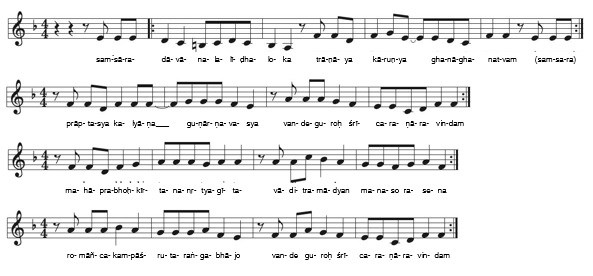
Vaikuṇṭha He has come here in this remote village of America—He's so kind— just to accept your service. Don't think that "Here is a doll." No. Kṛṣṇa. Kṛṣṇa, on the request of devotee, He has come. You should always remember this, that "Here is Kṛṣṇa, personally present." There is confusion whether the correct version is sei annāmṛta khāo or sei annāmṛta pāo. In recent publication, we see more and more pāo. However, in the Upadeśāmṛta, Text 1, Prabhupāda quotes the whole song. There it says sei annāmṛta khāo. That settles it. Another mistake, at least for most of us who don’t speak Bengali, is in kṛṣṇa bara dayāmaya. The word bara means “very”, but the transliteration says baḍa. The dot under the d makes all the difference. But who knows that this ḍ is not pronounced as d but as r? A more detailed explanation can be found in the Pronunciation Guide at the end of the book.
Āmi yamunā-puline
1 (āmi) yamunā-puline, kadamba-kānane,
ki herinu sakhī! āja (āmāra) śyāma vaṁśī-dhari, maṇi-mañcopari, līlā kare' rasa-rāja āmi—I; yamunā-puline—on the bank of the Yamunā river; kadamba-kānane—in a kadamba—tree grove; ki herinu—what have I seen today?; sakhī—O dear girlfriend!; āja—today; āmāra—my; śyāma—dark boy; vaṁśī-dhari—holder of the flute; maṇi-mañca-upari—upon a throne of jewels; līlā kare'—performs His pastimes; rasa-rāja—the King of all transcendental mellows.
O friend! What have I seen today? In a kadamba-tree grove on the bank of the Yamunā river, a beautiful blackish boy holding a long flute named vaṁśī is seated upon a throne of jewels, performing His pastimes as the king of all transcendental mellows!
2 kṛṣṇa-keli sudhā-prasravana (tāra) aṣṭa-dalopari, śrī-rādhā śrī-hari, aṣṭa-sakhī parijana kṛṣṇa-keli—Kṛṣṇa's pastimes; sudhā-prasravana—waterfall of nectar; tāra—their; aṣṭa-dala-upari—upon the eight petals; śrī-rādhā śrī-hari—Śrī Rādhā and Śrī Hari; aṣṭa-sakhī—the eight chief gopīs; parijana—associates.
Kṛṣṇa is performing His pastimes, which are just like a waterfall of nectar. Śrī Rādhā and Śrī Hari are surrounded by Their dearmost attendants, the eight chief gopīs, who are situated upon the eight petals of the jewelled altar.
3 (tāra) sugīta nartane, saba sakhī-gaṇe,
tuṣiche yugala-dhane (takhana) kṛṣṇa-līlā heri', prakṛti-sundarī, vistāriche śobhā vane tāra—their; su-gīta—beautiful songs; nartane—by dancing; saba—all; sakhī- gaṇe—their girlfriends; tuṣiche—give satisfaction; yugala-dhane—to the treasured couple; takhana—then; kṛṣṇa-līlā—Kṛṣṇa's pastimes; heri'—beholding; prakṛti- sundarī—beautiful female energies; vistāriche—expanding; śobhā—splendor; vane—throughout the forest.
By singing sweet songs and dancing nicely, all the gopīs satisfy the treasured divine couple. Thus His beautiful female energies behold Kṛṣṇa's pastimes expanding throughout the splendrous forest.
4 (āmi) ghare nā yāiba, vane praveśiba,
o līlā-rasera tare (āmi) tyaji' kula-lāja, bhaja vraja-rāja, vinoda minati kare'
āmi—I; ghare—to home; nā yāiba—I will not go; vane—in the forest; praveśiba—I will enter; o—that; līlā-rasera tare—on account of the pastime-mellows; āmi—I; tyaji'—giving up; kula-lāja—shyness due to fear of family members; bhaja—just worship; vraja-rāja—the King of Vraja; vinoda—of Bhaktivinoda; minati kare'— makes the humble submission.
For the sake of tasting the mellows of such pastimes, I will not go to my home, but will instead enter the forest. Just worship the King of Vraja, giving up all hesitation due to fear of family members. This is the humble submission of Bhaktivinoda.
Commentary
After a short but enchanting description of Kṛṣṇa’s pastimes in Vṛndāvana, Bhaktivinoda Ṭhākura ends his song with a an advice in the form of a request: “Just worship Vrāja-rāja, Kṛṣṇa, without hesitation. Don’t let your family members be an obstacle. As far as I am concerned, I will therefore not go home, but rather enter the forest.” In this regard, Prabhupāda comments:
Lecture on Śrīmad-Bhāgavatam 6.1.24 – Chicago, July 8, 1975 One who is brāhmaṇa, he would not stay in family life more than fiftieth year. Pañcāśordhvaṁ vanaṁ vrajet. One must go to the forest. Forest means vana, and therefore, one who goes to the forest, from the word vana, it is vāna, vānaprastha. Prastha mean one who has gone. This is regulative life. One has to take leave from this family life and accept the vānaprastha. Vānaprastha means prior to accepting the renounced order of life. The husband and wife go out of home and travel in many holy places to associate with holy men and take their instructions just to prepare for sannyāsa. So when one is fully equipped in knowledge, then he asks his wife to go to home to be taken care of by the elderly children, and he becomes a sannyāsī.” Detachment from material life is only possible when we develop attachment to spiritual life. The descriptions of Kṛṣṇa’s pastimes have this purpose– to awaken our attraction for the Lord and a life with Him. Prabhupāda writes about this in Śrīmad-Bhāgavatam. Śrīmad-Bhāgavatam 4.20.35-36 – Purport “Beyond the planetary systems in the material sky, there is another sky, which is known as paravyoma, or the spiritual sky, where there are spiritual planets. The inhabitants of those planets engage in varieties of loving service unto the Supreme Personality of Godhead, which include different rasas, or relationships, known as dāsya-rasa, sakhya-rasa, vātsalya-rasa, mādhurya-rasa and, above all, parakīya- rasa. This parakīya-rasa, or paramour love, is prevalent in Kṛṣṇaloka, where Lord Kṛṣṇa lives. This planet is also called Goloka Vṛndāvana, and although Lord Kṛṣṇa lives there perpetually, He also expands Himself in millions and trillions of forms. In one of such forms He appears on this material planet in a particular place known as Vṛndāvana-dhāma, where He displays His original pastimes of Goloka Vṛndāvana-dhāma in the spiritual sky in order to attract the conditioned souls back home, back to Godhead.”
Śrīla Prabhupāda on a morning walk in Germany,
in 1974, telling a funny story.