 Spiritual
Glorification of the Lord and His devotees
Dedication to worshipable objects
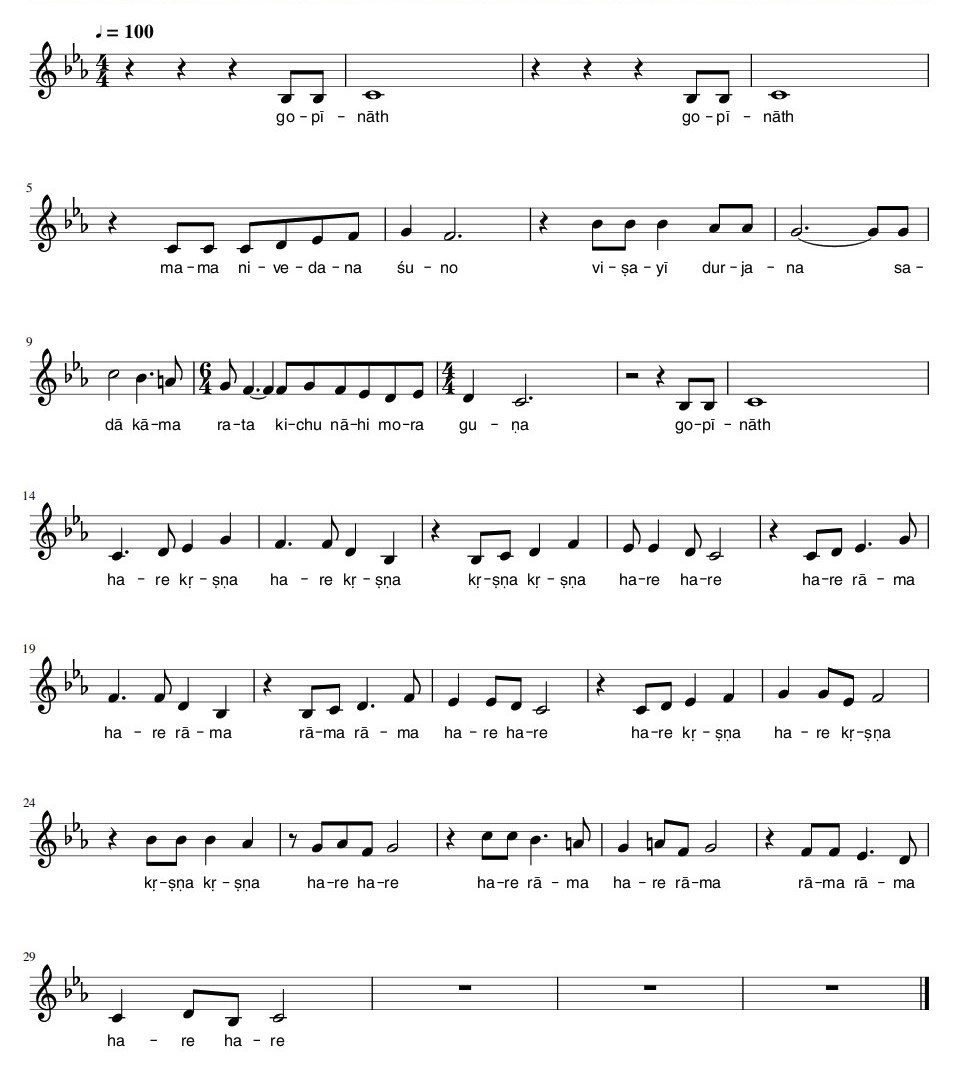
Śrī-guru-vandana 414
Jaya jaya advaita-ācārya 418
Nitāi guṇa-maṇi 419
Akrodha paramānanda 422
Dalalera-gīta 423
Dhana mora nityānanda 428
Nitāi-pada-kamala 430
Gaurāṅgera duṭi pada 434
Śrī-kṛṣṇa-caitanya prabhu 439
Parama karuṇa 443
Jaya rādhe, jaya kṛṣṇa 446
Vṛndāvana ramya-sthāna 450
Śrī Rādhikā-stava 452
Kṛṣṇa-candra guṇera sāgara 456
Śrī-guru-vandana
1 śrī-guru-caraṇa-padma, kevala-bhakati-sadma,
vando mui sāvadhāna mate yāhāra prasāde bhāi, e bhava toriyā yāi, kṛṣṇa-prāpti haya yāhā ha’ te śrī-guru-caraṇa-padma—the lotus feet of our spiritual master; kevala bhakati— pure devotional service; sadma—the abode; vando mui—I bow down; sāvadhāna mate—with great care and attention; yāhāra prasāde—by whose mercy; bhāi—O my dear brothers!; e bhava—this material existence; toriyā yāi—crossing over; kṛṣṇa-prāpti—obtaining Kṛṣṇa; haya—there is; yāhā ha’te—by which.
The lotus feet of our spiritual master are the only way by which we can attain pure devotional service. I bow to his lotus feet with great awe and reverence. By his grace one can cross the ocean of material suffering and obtain the mercy of Kṛṣṇa.
2 guru-mukha-padma-vākya, cittete kariyā aikya,
āra nā kariha mane āśā śrī-guru-caraṇe rati, ei se uttama-gati, ye prasāde pūre sarva āśā guru-mukha-padma—the lotus mouth of the spiritual master; vākya—the words; cittete—with your heart; kariyā aikya—making one; ār—anything else; nā—do not; kariha mane—consider in the mind; āśā—desires; śrī-guru-caraṇe—to the lotus feet of the spiritual master; rati—attachment; ei—this; sei—that; uttama-gati— ultimate goal; ye prasāde—by which mercy; pūre—fulfills; sarva āśā—all desires.
My only wish is to have my consciousness purified by the words emanating from his lotus mouth. Attachment to his lotus feet is the perfection that fulfills all desires.
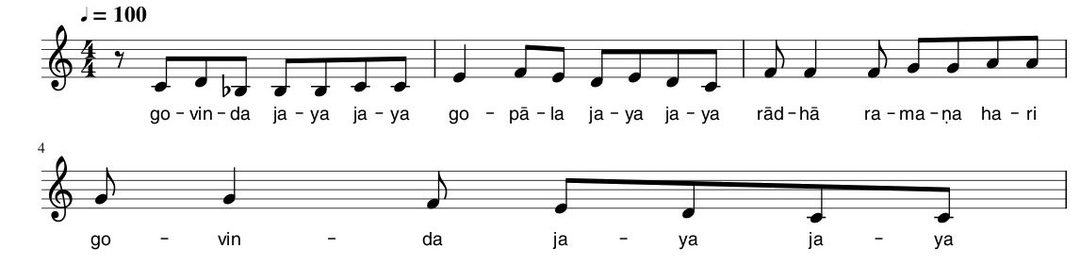
3 cakṣu-dāna dila yei, janme janme prabhu sei,
divya jñāna hṛde prakāśita prema-bhakti yā◊hā hoite, avidyā vināśa yāte, vede gāya yāhāra carita cakṣu-dāna—the gift of transcendental vision; dila yei—who has given; janme janme—birth after birth; prabhu sei—he is my lord; divya-jñāna—divine knowledge; hṛde—in the heart; prokāśito—is revealed; prema-bhakti—loving devotional service; yāhā hoite—by which; avidyā—ignorance; vināśa yāte—is destroyed; vede—in the Vedic scriptures; gāya—is sung; yāhāra carito—whose character.
He opens my darkened eyes and fills my heart with transcendental knowledge. He is my Lord birth after birth. From him ecstatic prema emanates; by him ignorance is destroyed. The Vedic scriptures sing of his character.
4 śrī-guru karuṇā-sindhu, adhama janāra bandhu,
lokanātha lokera jīvana hā hā prabhu kara dayā, deha more pada-chāyā, ebe yaśa ghuṣuka tribhuvana śrī-guru—O spiritual master!; karuṇā-sindhu—O ocean of mercy!; adhama janāra—of the fallen souls; bandhu—the friend; lokanāth—O Lokanātha!; lokera jīvana—the life of all people; hā hā—alas! alas!; prabhu—O master!; koro doyā— please be merciful; deho more—give to me; pada-chāyā—the shade of your lotus feet; ebe—now; yaśa—fame; ghuṣuka—may it be proclaimed; tri-bhuvana— throughout the three worlds.
O spiritual master, o ocean of mercy, friend of the poor and the lord and master of the devotees. O master, be merciful unto me. Give me the shade of your lotus feet. May your fame be spread all over the three worlds.
Commentary
This song by Narottama dāsa Ṭhākura is from the opening section of Śrī Prema- bhakti-candrika entitled Śrī guru-mahimā, the glories of the spiritual master. Śrīla Prabhupāda chose this song to be sung daily in his temples during guru-pūjā. On many occasions he also referred to it when speaking about the importance of taking shelter and whoelheartedly surrendering to Kṛṣṇa’s representative, the spiritual master, accepting his instructions as one’s life and soul. Lecture on Śrīmad-Bhāgavatam 1.16.24 – Los Angeles, July 14, 1974 So if we want to be Kṛṣṇa conscious, we shall fix up our mind on Kṛṣṇa. How to become fixed up, that art will be given to you by the spiritual master. Therefore
Viśvanātha Cakravartī Ṭhākura says in connection with the explanation of the verse vyavasāyātmikā buddhiḥ that vyavasāyātmikā buddhiḥ means to take the words of the spiritual master as life and soul. That is called vyavasāyātmikā buddhiḥ. "Whatever I am ordered by the spiritual master, that is my life and soul. I don't care for liberation. My only business is to serve my spiritual master." And in the song you have just sung, ye prasāde pūre sarva āśā. It means "By his mercy, all our desires are fulfilled." So, this is our process, to depend on Kṛṣṇa. Depend does not mean I shall remain idle. Depend means to work according to the direction of the śāstra. Sādhu-śāstra- guru-vākya, cittete kariyā aikya. Depend does not mean, "Now let me sleep, and Kṛṣṇa will do everything. Depend on Kṛṣṇa." No, not like that. Kṛṣṇa never advised Arjuna that "You sleep on this chariot. (laughter) I'll..." Hare Kṛṣṇa. He never said that. He said, "You must fight." Yudhyasva mām anusmara [Bg. 8.7]. "Fighting you have to do. But you always think of Me." This is success.
Lecture on Śrīmad-Bhāgavatam 6.1.26-27 – Philadelphia, July 12, 1975 You accept the bona fide guru, and what he orders, you carry out. Then your life is successful. Āra nā kariha mane āśā. Do not desire anything else. “My Guru Mahārāja told me, therefore I shall do this." Cittete kariyā aikya, āra nā kariha mane āśā. It is not my pride, but I can say, for your instruction, I did that. Therefore, whatever little success you see, more than my Godbrothers, it is due to this. I have no capacity, but I took the words of my guru as life and soul. So this is fact. Guru- mukha-padma-vākya, cittete kariyā aikya. Everyone should do that. But if youe make addition, alteration, then you are finished. No addition, alteration. You have to approach guru – guru means the faithful servant of God, Kṛṣṇa – and take his word how to serve Him. Then you are successful. If you concoct, "I am very intelligent, more than my guru, and I can make addition or alteration," then you are finished. Śrī-guru-caraṇe rati, ei se uttama-gati. If you want to make real progress, then you must be firmly faithful at the lotus feet of guru. Ye prasāde pūre sarva āśā. Yasya prasādāt bhāgavat prasādo [by his mercy you will get the mercy of the Lord.] This is the instruction in the whole Vaiṣṇava philosophy. So unless we do that, we remain mūḍha. Lecture on Śrīmad-Bhāgavatam 6.1.28-29 – Philadelphia, July 13, 1975 Prema-bhakti yāhā hoite, avidyā vināśa jāte. Avidyā vināśa jāte. Avidyā means ignorance. We are full of ignorance. So guru's duty is to open the eyes, and by opening your eyes he will give you Kṛṣṇa. So this is the process. So you should be very much careful not to cheat Kṛṣṇa, not to cheat guru. Become very sincere and follow. Then it is guaranteed. Guru-kṛṣṇa-kṛpāya pāya bhakti-latā-bīja [Cc. Madhya 19.151]. Two things required. You cannot jump over to Kṛṣṇa, neglecting guru. Then it is finished. If you want to jump over to Kṛṣṇa without favor of the guru, Kṛṣṇa is not so easy. So these things should be very carefully observed. No offense, sincerely follow. Then Kṛṣṇa will protect you, and your progress in Kṛṣṇa consciousness, to go back to home, back to Godhead, will be assured.
Lecture on Śrī Caitanya-caritāmṛta, Madhya-līlā 20.105 – New York, July 11, 1976 So this is the beginning, that if you want to be devotee, then you must approach the spiritual master who has got the power. Śrī-guru-caraṇa-padma, kevala-bhakti- sadma, vando mui sāvadhāna mate. Sāvadhāna means very carefully, not whimsically. … Yāhāra prasāde bhai, ei bhava toriyā yāi, kṛṣṇa-prāpti hoy yāhā hoite. So why one should go to spiritual master? Because yāhāra prasāde bhāi: "My dear brother, if you get the benediction from the spiritual master..." Yāhāra prasāde bhāi, ei bhava toriyā yāi. What is that benediction? The benediction is not that "Cure my disease." People do not know, generally. Therefore they are cheated. The other day in Washington, one lady came with backache. So she came for curing the leg trouble. That is going on. "So you should approach a spiritual master? There is so many doctors, hospital. You go there." "No. Here you show me your miracles." And people are also cheating like that—some miracles and he becomes God. This is going on. But the miracle of spiritual master is yāhāra prasāde bhāi, ei bhava toriyā yāi. This is miracle: no more material existence. Then ei bhava toriyā yāi. So real thing is that one can cross over the ocean of nescience. That is real gain. That is the real favor of spiritual master, not that cure your leg and again walk here and again become, break your leg, and again come. Not like that. … Kṛṣṇa- prāpti hoy yāhā haite. That is spiritual master, one who can give you Kṛṣṇa. Kṛṣṇa se tomāre, kṛṣṇa dite pāra, dhāi tava pāche pāche – Bhaktivinoda Ṭhākura [Ohe! Vaiṣṇava Ṭākura]. "Kṛṣṇa... I am seeking after Kṛṣṇa, Vaiṣṇava Ṭhākura, my spiritual master, so Kṛṣṇa is your property." Kṛṣṇa is not independent. He is the property of the devotee.
Room Conversation – Bhuvanesvara, January 28, 1977 Those who are neophyte, they are always in danger. Therefore their duty is to be guided by sādhu-śāstra-guru. That's all. That is our experience. Now, I'll say from my practical life, it is not pride, everyone knows that my Guru Mahārāja had thousands of disciples. So out of thousands of disciples, practically I am little successful. That everyone knows. Why? Because I firmly believed in the words of my guru. That's all. There may be many other Godbrothers who may be very learned and very advanced, whatever it may be, favored. Everyone claims that "I am the most favorite." And practical point of view... So I think sometimes that "Why this wonderful thing has happened to me?" So I search out. I search out only that I cent percent believe in the words of my spiritual... That's all, nothing else. Guru- mukha-padma-vākya, cittete kariyā aikya, āra nā kariha mane āśā. Don't think of any nonsense. Simply execute what your guru has said. That is success.
In the Vedabase, as well as in some songbooks and signboards in temples, we find the following addition to this song: dui pade loila sarana. “We take shelter of your lotus feet.“ The sentiment, of course, is not wrong, but by adding something in writing, we have changed the song, indirectly implying that it was not complete. That is objectionable. As Prabhupāda pointed out in one of the lectures quoted above: “If you concoct, "I am very intelligent, more than my guru, and I can make addition or alteration," then you are finished.
Jaya jaya advaita-ācārya
1 jaya jaya advaita-ācārya dayāmaya yā’ra huhuṅkāre gaura-avatāra haya jaya jaya advaita-ācārya—all glory to Advaita Ācārya; dayā-maya—very merciful; yā’ra—whose; huhuṅ-kāra—loud vibrations; gaura-avatāra—the incarnation of Lord Śrī Caitanya Mahāprabhu; haya—there is.
All glories to the all-merciful Advaita Ācārya whose roaring plea made Gaura descend to this world.
2 premadātā sītānātha karunā-sāgara yā’ra premarase āilā vrajera nāgara prema-dātā—the giver of love; sītā-nātha—the husband of Sītā Ṭhākurāṇī; karunā-sāgara—the ocean of mercy; yā’ra—whose; premarase—mellow of love; āilā—came; vrajera—of Vraja; nāgara—the hero.
Sītānātha, the lord of Sītā, is an ocean of compassion and distributes freely pure love of God. By His own mellow of pure love He induced the hero of Vraja, Kṛṣṇa, to come.
3 yāhāre karunā kari' kṛpādite cāya premāveśe se-jana caitanya-guṇa gāya yāhāre—anyone who; karunā—compassion; kari'—bestows; kṛpā-dite—gives mercy; cāya—He looks; prema-aveśa—ecstatic love; se-jana—that person; caitanya-guṇa—the qualities of Lord Caitanya; gāya—sings.
Whoever receives His mercy and His kind glance, that person is infused with pure love of God and sings the divine qualities of Lord Caitanya.
4 tāhāra carane yebā lailā śarana se-jana pāila gaura-prema mahādhana tāhāra carane—of His lotus feet; yebā—anyone; lailā—took; śarana—shelter; se-jana—that person; pāila—obtained; gaura-prema—love of Gaura; mahā- dhana—the great treasure.
Anyone who seeks shelter at his feet aquires the great wealth of gaura- prema, pure love for Sri Caitanya Mahaprabhu.
5 emana dayāra nidhi kene nā bhajilu locana bale nija māthe vajara pārilu emana—such; dayāra—of compassion; nidhi—ocean; kene—why?; nā—not; bhajilu—have worshiped; locana bale—Locana says; nija—on my own; māthe—head; vajara—thunderbolt; pārilu—have brought.

Locana says: Why did I not worship such an ocean of mercy? By not worshiping Him I have brought a thunderbolt upon my head.
Commentary
This is one of the few songs dedicated to Advaita Ācārya. Another song glorifying Advaita Ācārya can be found in the Section Aṣṭakas under the title Advaitāṣṭaka. The glories of Advaita Ācārya are described in Chapter 6 of the Ādi-līlā of Śrī Caitanya-caritāmṛta. A summary is given at the beginning of the chapter as follows: “The truth of Advaita Ācārya has been described in two verses. It is said that material nature has two features, namely the material cause and the efficient cause. The efficient causal activities are caused by Mahā-Viṣṇu, and the material causal activities are caused by another form of Mahā-Viṣṇu, known as Advaita. That Advaita, the superintendent of the cosmic manifestation, has descended in the form of Advaita Ācārya to associate with Lord Caitanya. When He is addressed as the servitor of Lord Caitanya, His glories are magnified because unless one is invigorated by this mentality of servitorship one cannot understand the mellows derived from devotional service to the Supreme Lord, Kṛṣṇa.”
Nitāi guṇa-maṇi
1 nitāi guṇa-maṇi āmāra nitāi guṇa-maṇi
āniyā premera vanyā bhāsāila avanī
nitāi—Lord Nityānanda; guṇa-maṇi—the jewel of all good qualities; āmāra—my; nitāi—Lord Nityānanda; guṇa-maṇi—the jewel of all good qualities; āniyā— bringing; premera vanyā—the flood of divine ecstatic love; bhāsāila—has drowned; avanī—the world.
My Lord Nityānanda, the jewel of all virtues, my Lord Nityānanda, the jewel of all virtues, has brought the flood of ecstatic love of God that has drowned the entire world.
2 premera vanyā laiyā nitāi āilā gaura-deśe
ḍubila bhakata-gaṇa dīna hīna bhāse
premera vanyā—the flood of divine ecstatic love; laiyā—bringing; nitāi—Lord Nityānanda; āilā—returned; gaura-deśe—to Bengal; ḍubila—drowned; bhakata- gaṇa—the assembly of devotees; dīna hīna—the fallen nondevotees; bhāse— remained floating.
Bringing this overwhelming deluge of prema when He returned to Bengal from Jagannātha Purī on Lord Caitanya's order, Nitāi has inundated the assembly of devotees. The fallen nondevotees did not drown, however, but remained floating on that ecstatic ocean.
3 dīna hīna patita pāmara nāhi bāche brahmāra durlabha prema sabākāre yāce dīna hīna—those who are sinful and destitute; patita—fallen; pāmara—wretched; nāhi—not; bāche—desiring; brahmāra durlabha—unattainable even for Lord Brahmā; prema—ecstatic love; sabākāre—unto everyone; yāce—He (Lord Nityānanda) offers.
This exalted prema, which is difficult even for Lord Brahmā to attain, was freely offered by Lord Nityānanda even to the fallen and wretched souls who did not desire it.
4 ābaddha karuṇā-sindhu niṭāi kāṭiyā muhāna
ghare ghare bule prema-amiyāra vāna
ābaddha—held back; karuṇā-sindhu—the ocean of mercy; niṭāi—Nityānanda; kāṭiyā—breaking; muhāna—great; ghare ghare—from house to house; bule— splashing; prema-amiyāra—the waves of love of God; vāna—flood.
The ocean of mercy had formerly been sealed tight, but Nitāi cut a channel in its boundary to allow the great flooding waves of nectarean prema to splash from house to house.
5 locana bale mora nitāi yebā nā bhajila
jāniyā śuniyā sei ātma-ghātī hoila
locana bale—Locana dāsa says; mora—my; nitāi—Lord Nityānanda; yebā— whoever; nā bhajilo—has not worshiped; jāniyā—even knowing; śuniyā—and hearing about it; sei—that person; ātma-ghātī—his own killer; hoila—becomes.
Locana dāsa says, “By neglecting to worship my Nitāi or take advantage of this excellent opportunity He offers, a person knowingly commits suicide.”

Commentary
Śrīla Prabhupāda recorded this song and explained its meaning in Los Angeles in 1972. On a morning walk in Bhubaneswar, in January of 1977, he commented: “Śrī Caitanya Mahāprabhu says, janma sārthaka kari' kara para-upakāra. In other countries there is no civilization. In India there is civilization. Just you become civilized and distribute this knowledge. Bhārata bhūmite haile manuṣya janma jāra janma sārthaka kari' kara para-upakāra. [One who has taken his birth as a human being in the land of India [Bhārata-varṣa] should make his life successful and work for the benefit of all other people.] This Kṛṣṇa consciousness movement is that para upakara. They do not know what is civilization. Such broader idea of Caitanya Mahāprabhu. He never said that ‘Sit down in Vṛndāvana and become a bābājī.’ Kara para upakara. That is saṅkīrtana. Ābaddha karuṇā-sindhu niṭāi kāṭiyā muhāna ghare ghare bule prema-amiyāra vāna. [The ocean of mercy had formerly been sealed tight, but Nitāi cut a channel in its boundary to allow the great flooding waves of nectarean prema to splash from house to house.] This is Caitanya Mahāprabhu's preaching. Karuṇā-sindhu, the ocean of mercy, it was blocked. Let it be opened, and distribute throughout the whole world. So if you work vigorously, this is an epoch-making history, how real culture is being distributed for the benefit of the whole human society.” During a room conversation in Jagannatha Purī, in January 1977, Śrīla Prabhupāda said: “Intelligence is developed by association, by hearing, by experiencing. Otherwise very big intelligence, he's also dull. Don't you see the big, big leaders, Gandhi and Radhakrishnan, they have no intelligence. They are misinterpreting the whole..., although they're passing as very big men, intelligent. And if you say to them that ‘You are not intelligent; you are wrongly interpreting Bhagavad-gītā,’ they will be offended. So intelligence is so dull even to such big, big men, what to speak of ordinary men. Big, big demigods, they are intelligence also lacking. Therefore Caitanya Mahāprabhu said kona: ‘Somebody very fortunate, he can understand.’ Kona bhāgyavān. And another place, brahmāra durlabha prema: ‘Even Brahmā cannot understand what is Kṛṣṇa consciousness.’ Manuṣyāṇāṁ sahasreṣu [Out of many thousands among men, one may endeavor for perfection, and of those who have achieved perfection, hardly one knows Me in truth.] These things are there. So this intelligence is not so easy. Na janma-koṭibhiḥ sukṛtair labhyate. Bahūnāṁ
janmanām ante. [After many births and deaths, he who is actually in knowledge surrenders unto Me, knowing Me to be the cause of all causes and all that is. Such a great soul is very rare.] There are so many places that ‘To come to Kṛṣṇa consciousness is not so easy.’ It requires very, very great intelligence. Mercy means there is regular propaganda to give this intelligence.”
Akrodha paramānanda
1 akrodha paramānanda nityānanda rāya
abhimāna śūnya nitāi nagare berāya
akrodha—not angry; paramānanda—supreme bliss; nityānanda rāya—the venerable Lord Nityānanda; abhimāna śūnya—without pride; nitāi—Nitāi; nagare—in the village; berāya—wanders.
The noble Nityānanda Rāy is never angry, for He is the personification of supreme transcendental bliss. Devoid of any concept of false ego, Nitāi wanders about the town.
2 adhama patita jīvera dvāre dvāre giyā
hari-nāma mahā-mantra dena bilāiyā
adhama—wretched; patita—fallen; jīvera—of the souls; dvāre dvāre—door to door; giyā—having gone; hari-nāma mahā-mantra—the great chanting of the Lord's holy names; dena—He gives; bilāiyā—distributing.
Going from door to door in the residences of the most fallen and wretched souls, He freely distributes the gift of the Hari-nāma mahā-mantra.
3 yāre dekhe tāre kahe dante tṛṇa dhari'
āmāre kiniyā laha bhaja gaura-hari
yāre dekhe—whoever He sees; tāre kahe—to them He says; dante—in the teeth; tṛṇa dhari'—holding straw; āmāre kiniyā—purchasing me; laha—please take; bhaja—do worship; gaura-hari—Lord Chaitanya.
He exclaims to whomever he sees while holding straw between his teeth, "Please purchase me by worshipping Gaurahari!"
eta bali' nityānanda bhūme gari jāya
sonāra parvata yena dhūlāte loṭāya
eta bali'—saying thus; nityānanda—Nityānanda; bhūme—on the ground; gari jāya—rolls about; sonāra parvata—a mountain of gold; yena—just like; dhūlāte loṭāya—tumbling in the dust.
Saying thus, Nityānanda Prabhu rolls about on the ground, appearing like a golden mountain tumbling in the dust.
5 hena avatāre yāra rati nā janmila
locana bale sei pāpī ela āra gela
hena avatāre—for such an incarnation; yāra—whose; rati—affection; nā janmila— has not come about; locana bale—Locana Dāsa says; sei pāpī—that sinful person; ela—comes; āra—and; gela—goes (in repeated birth and death).
Locana dāsa says, “Whoever has not experienced the awakening of affection for such an avatār as this, that sinful person simply comes and goes uselessly in the cycle of repeated birth and death.”

Commentary
This song by Locana dāsa Ṭhākura is included in his work Caitanya-maṅgala. He glorifies Nityānanda Prabhu as a person who is always blissful and never angry. The pastime that illustrates this quality best is the encounter with Jagāi and Mādhāi. When Mādhāi hurled an earthen pot at Nitāi and drew blood from His forehead, Śrī Caitanya Mahāprabhu was ready to invoke His śudarṣana-cakra and kill Mādhāi. But Nityānanda Prabhu pleaded for mercy. Even when there was all good reason to become angry, He didn’t. Nityānanda is Balarāma, and Balarāma is known to easily display anger, as He did when the Yamunā river disobeyed His order to come near, but when Balarāma comes as Nityānanda He is akrodha paramananda, never angry and supremely blissful. Such are the inconceivable attributes of the Supreme Lord.
Dālālera-gītā (Bara sukhera khabora gāi)
1 bara sukhera khabora gāi surabhi-kuñjete nāmera hāṭa khuleche / khoda nitāi bara—great; sukhera khabora—news of happiness; gāi—I sing; surabhi-kuñjete— in the grove of Navadvīpa named Surabhi-kuñja; nāmera hāṭa—the marketplace of the holy name; khule āche—is opened up; khoda nitāi—Lord Nityānanda is Himself the owner and manager.
I am singing news of the greatest happiness! At the place known as Surabhi Kuñja in Śrī Navadvīpa, the marketplace of the holy name has now been opened, and Lord Nityānanda Himself is the proprietor.
2 bara mojāra kathā tāya śraddhā-mūlye śuddha-nāma sei hāṭete bikāya bara—great; mojāra kathā—story of the amusing affairs taking place; tāy—there (in that Marketplace); śraddhā-mūlye—for the price of one's faith; śuddha-nām— the pure, original form of the holy name; sei—He (Lord Nityānanda); hāṭete—in the Marketplace; bikāy—sells.
Such wonderful things are going on in that blissful marketplace! Śrī Nityānanda Prabhu is selling the pure holy name wholesale, merely for the price of one's faith.
3 yata bhakta-vṛnda basi' adhikārī dekhe' nāma becche dara kasi'
yata—all; bhakta-vṛnda—the assembly of devotees; basi'—waiting; adhikārī— those having the right to possess; dekhe'—He looks and examines; nāma becche—sells the holy name; dara—the price; kasi'—enforcing His 'fixed-price.'
Seeing the assembly of devotees eagerly waiting to purchase the name, Lord Nityānanda first examines each of them to test their qualification; then He sells them the name by bargaining for His price accordingly.
4 yadi nāma kinbe, bhāi āmāra saṅge cala, mahājanera kāce yāi yadi—if; nāma—the holy name; kinbe—will purchase; bhāi—O brother!; āmāra saṅge—along with me; cala—come on; mahājanera kāche—in the presence of the great soul Nityānanda; yāi—I am going now.
O my dear friends! If you really want to buy this pure holy name, then just come along with me, for I am now going to meet with this Nityānanda Mahājana.
5 tumi kinbe kṛṣṇa-nāma dasturi loiba āmi, pūrṇa ha' be kāma tumi—you; kinbe—will purchase; kṛṣṇa-nāma—the holy name of Kṛṣṇa; dasturi— commission; loiba āmi—I will take; pūrṇa—fulfilled; ha' be—will become; kāma— both of our desires.
Thus, you will finally be able to acquire the pure holy name. I will also take my due commission, and in this way all three of us will fulfill our desires.
6 bara dayāla nityānanda śraddhā-mātra la' ye dena parama-ānanda bara—greatly; dayāla—merciful; nityānanda—Lord Nityānanda Prabhu; śraddhā- mātra—only your faith; la' ye—takes in exchange; dena—gives; parama-ānanda— the topmost divine bliss.
Śrī Nityānanda Prabhu is so extraordinarily merciful – accepting only one's faith in the holy name, He bestows the topmost divine bliss.
7 eka-bāra dekhle cakṣe jala 'gaura' bale' nitāi dena sakala sambala eka-bāra—just once; dekhle—upon seeing; cakṣe—in the eyes; jala—water (tears); 'gaura' bole'—while chanting the name of 'Gaura'; nitāi dena—Lord Nityānanda gives; sakala—all; sambala—support and supply of spiritual opulences.
When Nitāi sees a tear welling in someone's eye upon chanting the name of "Gaura!" He instantly gives His support to that person; indeed, He bestows all divine opulences.
8 dena śuddha kṛṣṇa-śikṣā jāti, dhana, vidyā, bala nā kare apekṣā dena—He gives; śuddha kṛṣṇa-śikṣā—the pure teachings of Lord Kṛṣṇa; jāti— caste by birth; dhana—material wealth; vidyā—mundane knowledge; bala— physical strength; nā kare—does not do; apekṣā—care for.
He gives that person genuine realization of the pure teachings of Śrī Kṛṣṇa as found in the Bhagavad-gītā and Śrīmad-Bhāgavatam. While displaying all this inconceivable mercy, He pays no attention to one's caste, material wealth, mundane knowledge, or physical ability.
9 amani chāre māyā-jāla gṛhe thāka, vane thāka, nā thāke jañjāla amani—spontaneously; chāre—rejecting; māyā-jāla—the network of māyā's traps; gṛhe thāko—just remain at home as a householder; bane thāko—or just remain in the forest as a renunciate; nā thāke—does not exist; jañjāla—troubles.
Now, dear friends, please reject all of māyā's entangling snares. If you are a householder, then just remain at your home; if you are renounced, then just live in the forest. Either way, nothing more will trouble you.

10 āra nāika kalira bhaya ācaṇḍāle dena nāma nitāi dayāmaya āra—any more; nāika—there is not; kalira bhaya—fear of the Age of Kali; ācaṇḍāle—to everyone including the caṇḍālas (uncivilized people); dena—gives; nāma—the holy name; nitāi dayāmaya—Lord Nityānanda, the most merciful.
We no longer need to fear the terrible age of quarrel, for the most merciful Lord Nityānanda gives the holy name to anyone and everyone – even to the lowest among men.
11 bhaktivinoda ḍāki' kaya nitāi-caraṇa binā āra nāhi āśraya bhaktivinoda—the author, Śrīla Bhaktivinoda Ṭhākura; ḍāki'—loudly calling out; kaya—says; nitāi-caraṇa—the feet of Lord Nityananda; binā—except for; āra nāhi—there is no other; āśraya—safe shelter.
Bhaktivinoda loudly calls out and proclaims to all, "Other than the lotus feet of Lord Nityānanda, there is no shelter!"
Commentary
Bhaktivinoda Ṭhākura published this song in 1893. Dālālera-gītā describes how Nityānanda Prabhu opened a marketplace of the holy name at Surabhi-kuñja on the island of Godruma in Navadvīpa. There Bhaktivinoda Ṭhākura had built his residence after returning to Bengal from Orissa. Following in the footsteps of Nityānanda Prabhu, Bhaktivinoda Ṭhākura began to preach the holy name to the general populace in the surrounding areas. His activities are described in a newsletter that he himself published, Godruma Kalapāṭavī. His Holiness Jayapataka Swami translated the five copies that are still available today and published them in a book of the same title: Godruma Kalapāṭavī. In the introduction he writes:
“Written approximately 120 years ago, these Godruma Kalpāṭavī newsletters describe a transcendental market wherein the Lord’s holy names are systematically distributed to faithful customers who are willing to accept such a spiritual product. Based upon the “currency” of one’s faith and devotion for the Supreme Lord, everyone—regardless of cast, creed, color, or religion—is eligible to purchase the holy name. Specific descriptions of roles and duties, as well as cautions and guidelines, are provided by Bhaktivinoda Ṭhākura to his Nāma Haṭṭa “employees,” the distributors of the holy name amongst the general populace. […] “In his explanation of the Nāma Haṭṭa system, Bhaktivinoda Ṭhākura assigned to every member a particular job description—some form of work in the preaching structure. Whether an employee were selling or doing something else, the understanding was that everything was transpiring under the direction of Lord Nityānanda and Lord Caitanya. It is notable that the position of Lord Nityānanda as the chief trader of the transcendental market, and also the role of the traders from Navadvīpa, Vṛndāvana, and Jagannātha Purī, are emphasized. Within this scheme, Bhaktivinoda Ṭhākura maintained a very humble status, placing himself as the sweeper of the marketplace. Notwithstanding one’s social position, all had a role to play in the Nāma Haṭṭa. The instructions in Godruma Kalpāṭavī are certainly pertinent to our ISKCON society, for currently over ninety percent of our members work outside the institution and practice devotional service at home.” […] “In this modern age, it is most practical to apply the Nāma Haṭṭa form of preaching— cultivating people through small groups formed of the congregation. Nāma Haṭṭa groups can begin anywhere, without restrictions, whereas in a temple there are so many restrictions, not only spiritual but also material, in the sense that so many expenses must be met. The Nāma Haṭṭa system starts first with a small group, and then later, when the congregation grows, it is quite natural to establish a temple. In this way things can grow naturally. By that process, many of Bhaktivinoda Ṭhākura’s Nāma Haṭṭas later developed into temples. Although the social situation has since changed—for instance, now people drive in cars whereas in those days they used horse-buggies—the aspect of people working outside and practicing Kṛṣṇa consciousness from their home has not changed. Today we have different kinds of Nāma Haṭṭa programs, such as Counsellor Groups, Bhakti- vṛkṣas, and various other groups, all of which are included in the broad category of the Nāma Haṭṭa.”
If you would like to follow in the footsteps of Bhaktivinoda Ṭhākura and get involved in Nāma Haṭṭa preaching, please contact the ISKCON Congregational Development Ministry.
Dhana mora nityānanda
1 dhana mora nityānanda, pati mora gauracandra
prāṇa mora yugala-kiśora advaita ācārya bala, gadādhara mora kula narahari vilasai mora dhana—wealth; mora—mine; nityānanda—Lord Nityānanda; pati—protector; mora—mine; gauracandra—Lord Gauracandra; prāṇa—life and soul; mora—of me; yugala-kiśora—Rādhā and Kṛṣṇa; advaita ācārya—Śrī Advaita Ācārya; bala— strength; gadādhara—Śrī Gadādhara; mora kula—my family lineage; narahari— Śrī Narahari; vilasai mora—my happiness.
Lord Nityānanda is my wealth, Lord Gauracandra is my protector, the youthful divine couple Rādhā and Kṛṣṇa are my life and soul, Advaita Ācārya is my strength, Gadādhara Paṇḍita is my family heritage, and Narahari Sarakāra is my happiness.
2 vaiṣṇavera pada-dhūli tāhe mora snāna-keli
tarpaṇa mora vaiṣṇavera nāma vicāra kariyā mane bhakti-rasa āsvādane madhyastha śrī-bhāgavata purāṇa vaiṣṇavera—of the vaiṣṇavas; pada-dhūli—the dust of the lotus feet; tāhe—in that; mora—mine; snāna-keli—taking bath; tarpaṇa—offerings of oblations; mora—of me; vaiṣṇavera nāma—the names of the vaiṣṇavas; vicāra—considering; kariyā mane—in my mind; bhakti-rasa—the mellows of devotional service; āsvādane—in order to relish; madhyastha—medium; śrī-bhāgavata purāṇa—Śrīmad- Bhāgavatam.
I enjoy taking bath in the dust of the lotus feet of the Vaiṣṇavas, and chanting the names of the Vaiṣṇavas are my offerings of oblations. I have concluded that to relish the mellows of devotional service, Śrīmad- Bhāgavatam is the best medium.
3 vaiṣṇavera ucchiṣṭa tāhe mora mana-niṣṭha
vaiṣṇavera nāmete ullāsa vṛndāvane cautārā tāhe mora mana-gherā kahe dīna narottama dāsa vaiṣṇavera—of the vaiṣṇavas; ucchiṣṭa—the remnants; tāhe—in that; mora— mine; mana—my mind; niṣṭha—is fixed; vaiṣṇavera—of the vaiṣṇavas; nāmete— chanting the names; ullāsa—happiness; vṛndāvane—in Vṛndāvana; cautārā— courtyard; tāhe—in that; mora mana—my mind; gherā—is attached; kahe—says; dīna—poor; narottama dāsa—Narottama dāsa.
Let my mind be fixed in accepting the remnants of the Vaiṣṇavas, and I will be jubilant to hear the names of the Vaiṣṇavas. “My mind is attached to the courtyard of Vṛndāvana,” says Narottama dāsa.
Commentary
This is Song 35, entitled Śvā-niṣṭha, in Narottama dāsa Ṭhākura’s songbook Prārthana. Prabhupāda quotes from this song in the Śrī Caitanya-caritāmṛta (Ādi 13.124):
Taking on my head as my own property the lotus feet of Śrī Caitanya Mahāprabhu, Nityānanda Prabhu, Ācārya Advaitacandra, Svarūpa Dāmodara, Rūpa Gosvāmī and Raghunātha dāsa Gosvāmī, I, Kṛṣṇadāsa Kavirāja Gosvāmī, have thus described the advent of Śrī Caitanya Mahāprabhu.
PURPORT Śrī Caitanya Mahāprabhu, Nityānanda, Advaita Prabhu, Svarūpa Dāmodara, Rūpa Gosvāmī, Raghunātha dāsa and their followers are all accepted by Kṛṣṇadāsa Kavirāja Gosvāmī. Anyone who follows in the footsteps of Kavirāja Gosvāmī also accepts the lotus feet of the above- mentioned lords as his personal property. For a materialistic person, material wealth and opulence are only illusory. Actually they are not possessions but entanglements because by enjoying the material world a conditioned soul becomes more and more entangled by incurring debts for his present enjoyment. Unfortunately, a conditioned soul considers property for which he is in debt to be his own, and he is very busy acquiring such property. But a devotee considers such property not real property but simply an entanglement in the material world. If Lord Kṛṣṇa is very pleased with a devotee, He takes away his material property, as He states in Śrīmad-Bhāgavatam (10.88.8): yasyāham anugṛhṇāmi hariṣye tad- dhanaṁ śanaiḥ. ”To show special favor to a devotee, I take away all his material property.” Similarly, Narottama dāsa Ṭhākura says:
dhana mora nityānanda, rādhā-kṛṣṇa-śrī-caraṇa
sei mora prāṇadhana
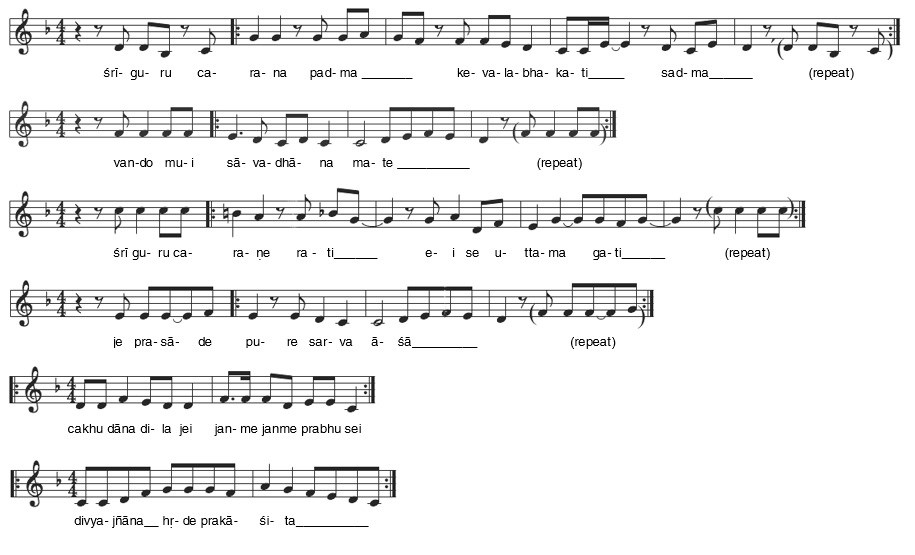
“My real riches are Nityānanda Prabhu and the lotus feet of Śrī Rādhā and Kṛṣṇa.” He further prays, “O Lord, kindly give me this opulence. I do not want anything but Your lotus feet as my property.” Śrīla Narottama dāsa Ṭhākura has sung in many places that his real property is the lotus feet of Rādhā and Kṛṣṇa. Unfortunately, we are interested in unreal property and are neglecting our real property (adhane yatana kari’ dhana teyāginu).
Nitāi-pada-kamala
Narottama dasa Thakura
1 nitāi-pada-kamala, koṭi-candra-suśītala
ye chāyāya jagata jurāya hena nitāi vine bhāi, rādhā-kṛṣṇa pāite nāi dṛḍha kari' dhara nitāiyera pāya nitāi—Lord Nityānanda; pada-kamala—lotus feet; koṭī-candra—millions of moon; suśītala—in its shade; ye chāyāya jagata—the whole world; jurāya—pacified; hena nitāi vine—without Lord Nityānanda; bhāi—O brothers; rādhā—Rādhā; kṛṣṇa— Kṛṣṇa; pāite nāi—cannot be attained; dṛḍha kari—firmly; dhara—hold; nitāiyera pāya—the lotus feet of Lord Nityānanda.
The lotus feet of Lord Nityānanda are a shelter where one will get the soothing moonlight not only of one, but of millions of moons. If the world wants to have real peace, it should take shelter of Lord Nityānanda. Unless one takes shelter under the shade of the lotus feet of Lord Nityānanda, it will be very difficult for him to approach Rādhā-Kṛṣṇa. If one actually wants to enter into the dancing party of Rādhā-Kṛṣṇa, he must firmly catch hold of the lotus feet of Lord Nityānanda.
2 se sambandha nāhi yā' ra, bṛthā janma gela tā' ra sei paśu bara durācāra nitāi nā balila mukhe, majila saṁsāra-sukhe vidyā-kule ki karibe tāra se sambandha—such relationship; nāhi yāra—one who does not develop; bṛthā— useless; janma—birth; gela tā’ ra—spent; sei—such a person; paśu—animal; bara durācāra—most wretched; nitāi—Lord Nityānanda; nā balila—did not chant; mukhe—in the mouth; majila—become absorbed; saṁsāra-sukhe—in material happiness; vidya—education; kule—high birth; ki karibe tā’ ra—what can do.
Anyone who has not established his relationship with Nityānanda Prabhu is understood to have spoiled his valuable human birth. Such a human being is actually an uncontrollable animal. Because he never uttered the holy name of Nityānanda, he has become merged into so-called material happiness. What can his useless education and family tradition do to help him?
3 ahaṅkāre matta hoiyā, nitāi-pada pāsariyā
asatyere satya kari māni nitaiyera karuṇā habe, vraje rādhā-kṛṣṇa pābe dhara nitāi-caraṇa du'khāni ahañkare—with false ego; matta hoiyā—being maddened; nitāi pada—the lotus feet of Lord Nityānanda; pāsariyā—by forgetting; asatyere—temporary; satya—as eternal; kari māni—do accept; nitāiyera—Lord Nityānanda; karuṇā habe—mercy; vraje—in Vraja; rādhā—Rādhā; kṛṣṇa—Kṛṣṇa; pābe—will be achieved; dhara— hold of; nitāi-caraṇa du'khāni—the lotus feet of Lord Nityānanda.
Being maddened after false prestige and identification with the body, one is thinking, "Oh, what is Nityānanda? What can He do for me? I don't care." The result is that he is accepting something false to be truth. If you actually want to approach the association of Rādhā-Kṛṣṇa, you must first achieve the mercy of Lord Nityānanda. When He is merciful toward you, then you will be able to approach Rādhā-Kṛṣṇa. Therefore you should firmly grasp the lotus feet of Lord Nityānanda.
4 nitāiyera caraṇa satya, tāhāra sevaka nitya
nitāi-pada sadā kara āśa narottama bara dukhī, nitāi more kara sukhī rākha rāṅgā-caraṇera pāśa nitāiyera caraṇa—lotus feet of Lord Nityānanda; satya—is eternal; tāṅhāra—His; sevaka—servants; nitya—are eternal; nitāi-pada—lotus feet of Lord Nityānanda; sadā kara—always; āśa—desire; narottama—Narottama dāsa; baḍa duḥkhī— very sad; nitāi—O Lord Nityānanda; more kara sukhī—make me happy; rākha— keep me; rāṅgā caraṇera pāśa—in the corner of Your lotus feet.
The lotus feet of Nityānanda are not illusion; they are a fact. One who engages in the transcendental loving service of Nityānanda is also transcendental. Always try to catch the lotus feet of Lord Nityānanda. This Narottama dāsa is very unhappy, therefore I am praying to Lord Nityānanda to make me happy. My dear Lord, please keep me close to Your lotus feet.
Commentary
This song is found in Narottama dāsa Ṭhākura’s Prārthana under the title Nityānanda-niṣṭha (Firm faith in Nityānanda). There are several recordings of this song by Śrīla Prabhupāda, and he also explained the meaning on different occasions. In the audio collection of 108 songs we have included two versions. One is based on Prabhupāda’s tune and the other is a popular Bengali version in Ektal. Nityānanda Prabhu's Appearance Day - Los Angeles, January 31, 1969 After singing Nitāi-pada-kamala, Prabhupāda explains the meaning of the song: Nitāi-pada-kamala, koṭi-candra-suśītala, je chāyāy jagata jurāya. This is a song by Narottama dāsa Ṭhākura, a great ācārya of the Gauḍīya-vaiṣṇava-sampradāya. He has written many songs about the Vaiṣṇava philosophy, and they are approved as completely corresponding with Vedic instructions. So here Narottama dāsa Ṭhākura is singing that the whole world is suffering under the blazing fire of material existence. Therefore, if one takes the shelter of the lotus feet of Lord Nityānanda, whose birthday is today, 31st, January, 1969... So we should relish this instruction of Narottama dāsa Ṭhākura that in order to get relief from the pangs of blazing fire of this material existence, one should take shelter of the lotus feet of Lord Nityānanda because it is as cooling as the moon rays combined together of millions of moons. That means one will immediately find peaceful atmosphere. Just like a man works whole day and if he comes under the moonshine he feels relief. Similarly, any materialistic man who comes under the shelter of Lord Nityānanda will immediately feel that relief. Then he says, heno nitāi bine bhai, rādhā-kṛṣṇa pāite nāi, dharo nitāi-caraṇa du'khani. “If you are anxious to go back to home, back to Godhead, and become an associate of Rādhā and Kṛṣṇa, then the best policy is to take shelter of Nityānanda.” Then he says, se sambandha nāhi jā'r, bṛthā janma gela tā'r: “One who has not been able to contact Nityānanda, then one should think of himself that he has simply spoiled his valuable life.” Bṛthā janma gela. Bṛthā means “for nothing”, and janma means “life”. Gela tā'r, spoiled. Because he has not made connection with Nityānanda. Nitya means “eternal”. Ānanda means “pleasure”. Material pleasure is not eternal. That is the distinction. Therefore those who are intelligent, they are not interested with this flickering pleasure of material world. Every one of us, as living entity, we are searching after pleasure. But the pleasure which we are seeking, that is flickering, temporary. That is not pleasure. Real pleasure is nityānanda, eternal pleasure. So anyone who has no contact with Nityānanda, it is to be understood that his life is spoiled, se sambandha nāhi jā'r, bṛthā janma gelo tā'r. Sei paśu boro durācāra. Narottama dāsa Ṭhākura uses here very harsh words. He says that such human being is an animal, an uncontrollable animal. As there are some animals that cannot be tamed, so anyone who has not contacted Nityānanda, he should be considered as an untamed animal. Sei paśu boro durācāra. Why?
Because nitāi nā bolilo mukhe: “He never uttered the holy name of Nityānanda.” And majilo saṁsāra-sukhe, “and he has become merged into this material happiness.” Vidyā-kule ki koribe tāra. “That nonsense does not know that what will his education and family and tradition and nationality will help him?” These things cannot help him. These are all temporary things. Simply, if we want eternal pleasure, we must contact Nityānanda. Vidyā-kule ki koribe tāra. Vidyā means “education”, and kula means “family, nationality”. So we may have a very nice family connection or we may have very nice national prestige, but after ending this body, these things will not help me. I'll carry my work with me, and according to that work, I shall have to accept by force another type of body. It may be something other than human body. So these things cannot protect us or give us the real pleasure. So Narottama dāsa Ṭhākura advises that vidyā-kule ki koribe tār. Then he says, ahaṅkāre matta hoiyā. False identification with the body and prestige of bodily relationship, it is called ahaṅkāre matta hoiyā. One is mad after this false prestige. Ahaṅkāre matta hoiyā, nitāi-pada pāsariyā. Due to this false prestige we are thinking, “Oh, what is Nityānanda? What can He do for me? I don't care.” So these are the signs of false prestige. Ahaṅkāre matta hoiyā, nitāi-pada pāsa..., asatyere satya kori māni. The result is that I am accepting something which is false. For example, I am accepting this body. This body, I am not this body. Therefore, with false identification I am becoming entangled more and more. So one who is puffed up with this false prestige, ahaṅkāre matta hoiyā, nitāi-pada pāsa, asatyere satya kori māni, he accepts something wrong as right. Then he says, nitāiyer koruṇā habe, braje rādhā-kṛṣṇa pābe. If you are actually serious about going back to home, back to Godhead, then please seek after the mercy of Nityānanda. Nitāiyer koruṇā habe, braja rādhā-kṛṣṇa pābe, dharo nitāi-caraṇa du'khāni. “Please catch hold of the lotus feet of Nityānanda.” Then he says, nitāiyer caraṇa satya. One may think that as we catch hold of so many shelter, but in this material world later on they prove false, similarly, suppose we catch hold of the lotus feet of Nityānanda; it may also prove false. But Narottama dāsa Ṭhākura assures that nitāiyer caraṇa satya: “It is not false. Because Nityānanda is eternal, His lotus feet is also eternal.” Tāhāra sevaka nitya. And anyone who takes to the service of Nityānanda, they also become eternal. Without being eternal, nobody can serve the eternal. That is the Vedic injunction. Without becoming Brahman, one cannot approach the Supreme Brahman. Just like without being fire, nobody can enter into the fire. Without being water, nobody can enter into the water. Similarly, without being fully spiritualized, nobody can enter into the spiritual kingdom. So nitāiyer caraṇa satya. If you catch nitāiyer, the lotus feet of Nityānanda, then you become immediately spiritualized. Just like if you touch electricity, immediately you become electrified. That is natural. Similarly, Nityānanda is eternal happiness, if you touch Nityānanda some way or other, then you become also eternally happy. Tāhāra sevaka nitya. Therefore one who has in contact with Nityānanda, they have become eternal. Nitāiyer caraṇa satya, tāṅhāra sevaka nitya, dṛḍha kori' dharo nitāir pāy. So just catch Him very tightly. Narottama bara duḥkhī, nitāi more kara sukhī. At the last Narottama dāsa
Ṭhākura, the composer of this song, he is appealing to Nityānanda, “My dear Lord, I am very unhappy. So You please make me happy. And You kindly keep me in corner of Your lotus feet.” That is the sum and substance of this song. Nityānanda Prabhu's Appearance Day – Bhuvanesvara, February 2, 1977 Sambandha nāhi jāra, bṛthā janma tāra. So if you have no connection with Nityānanda Prabhu – nitya means always, ānanda means pleasure. Anyone who has no connection with Nityānanda Prabhu, sei tāra, he's simply wasting time. Bṛthā means useless. Uselessly, he's wasting time. Se paśu bara durācāra. And Narottama dāsa Ṭhākura has used very strong word. “Anyone who has no connection with Nityānanda Prabhu, he's a paśu.” Sei paśu. He's a paśu, animal. So how an animal can get happiness? That is not possible. The dog, from the childhood he's searching after food, searching after food. And cannot get food. Unless a dog has got a master, he's street dog and he's always unhappy. So better to become a dog of Nityānanda Prabhu. Then we shall be happy. Instead of becoming dog of so many other people... Everyone is dog. Everyone is searching after to serve a master. But none of them are satisfied because that is false master. You take real master, Nityānanda Prabhu. You'll be happy. Se paśu boro durācār. He does not know where is happiness. Where I shall become a dog? Śrīmad-Bhāgavatam 7.15.45 – Purport One cannot attain the goal of life without the mercy of Balarāma. Śrī Narottama dāsa Ṭhākura therefore says, nitāiyera karuṇā habe, vraje rādhā-kṛṣṇa pābe: when one receives the mercy of Balarāma, Nityānanda, one can attain the lotus feet of Rādhā and Kṛṣṇa very easily. Se sambandha nāhi yāra, bṛthā janma gela tāra, vidyā-kule hi karibe tāra. If one has no connection with Nitāi, Balarāma, then even though one is a very learned scholar or jñānī or has taken birth in a very respectable family, these assets will not help him. We must therefore conquer the enemies of Kṛṣṇa consciousness with the strength received from Balarāma.
Gaurāṅgera duṭi pada
1 gaurāṅgera duṭi pada, yāra dhana sampada,
se jāne bhakati-rasa-sāra gaurāṅgera madhura-līlā, yāra karṇe praveśilā, hṛdaya nirmala bhela tāra gaurāṅgera duṭī pada—the lotus feet of Lord Caitanya; yāra dhana—whose wealth; sampada—and assets; se jāne—he knows; bhakati-rasa-sāra—the essence of the mellows of devotional service; gaurāṅgera—of Lord Gaurāṅga; madhura-līlā—the sweet pastimes; yāra karṇe—in whose ears; praveśilā—entered; hṛdaya—the heart; nirmala bhela—is purified; tāra—such a person.
Anyone who has accepted the two lotus feet of Lord Caitanya as their only asset knows the true essence of devotional service. If anyone gives submissive aural reception to the pleasing and sweet pastimes of Lord Caitanya, then immediately his heart becomes cleansed of all material contamination.
2 ye gaurāṅgera nāma laya, tāra haya premadaya,

tāre mui jāi balihāri gaurāṅga-guṇete jhure, nitya-līlā tāre sphure, se jana bhakati-adhikārī je—whoever; gaurāṅgera nāma laya—chants the name of Lord Gaurāṅga; tā’ra haya—he becomes; premadaya—ecstatic; tāre—to him; mui—I am; jāya balihārī—I glorify; gaurāṅga-guṇete—by the qualities of Gaurāṅga; jhure—if one appreciates; nitya-līlā—eternal pastimes; tāre sphure—revealed to him; se jana— such a person; bhakati-adhikārī—is eligible for devotional service.
Anyone who simply chants the name of Śrī Kṛṣṇa Caitanya will immediately develop love of Godhead. I offer him all congratulations by saying, "Bravo!" If anyone feels ecstasy and cries by simply hearing the transcendental qualities of Caitanya Mahāprabhu, he at once understands the eternal loving affairs between Rādhā and Kṛṣṇa.
3 gaurāṅgera saṅgi-gaṇe, nitya-siddha kari' māne, se jāya vrajendra-suta-pāśa śrī-gaura-maṇḍala-bhūmi, jebā jāne cintāmaṇi, tāra haya vraja-bhūme vāsa gaurāṅgera—of Gaurāṅga; saṅgi-gaṇe—the associates; nitya-siddha—eternally perfect; kāri māne—considers; se jāya brajendra-suta-pāsa—he goes to the transcendental abode of the son of the King of Vraja; śrī-gaura-maṇḍala-bhūmi— the land of Gaura-maṇḍala (Navadvīpa); jebā—one who; jāne—knows; cintāmaṇi—as made of spiritual touchstones; tāra haya—such a person; vraja- bhūme—in Vṛndāvana; vāsa—resides.
Anyone who has understood that the associates of Lord Caitanya are eternally liberated souls immediately becomes eligible to enter into the abode of Kṛṣṇa, the son of Nanda Mahārāja in Vṛndāvana, in his next birth. If anyone understands that there is no difference between Gaura-maṇḍala, the place in West Bengal wherein Lord Caitanya had His pastimes, and the transcendental abode of Śrī Vṛndāvana-dhāma, then he actually lives in Vṛndāvana.
4 gaura-prema-rasārṇave, śe taraṅge jebā ḍube,
se rādhā-mādhava-antaraṅga gṛhe vā vanete thāke, 'hā gaurāṅga' ba'le ḍāke, narottama māge tāra saṅga gaura-prema-rasārṇave—in the ocean of love of Lord Gaurāṅga; śe taraṅge—in those waves; jebā dube—one who drowns; se—he; rādhā—Rādhā; mādhava— Mādhava; antaraṅga—most confidential; gṛhe—at home; vā—or; vanete—forest; thāke—reside; hā gaurāṅga—O Gaurāṅga; bale ḍāke—he chants; narottama— Narottama dāsa; māge—begs; tāra saṅga—his association.
Anyone who takes pleasure sporting within the waves of the ocean of Lord Caitanya's distribution of love of God immediately becomes a confidential devotee of Śrī Śrī Rādhā-Mādhava. It doesn't matter whether such a devotee is in the renounced order of life or whether he is a householder. If he is actually taking part in Lord Caitanya's saṅkīrtana activities and actually understanding what it is, then such a person is always liberated. Narottama dāsa aspires for his association.
Commentary
This is Song 38 in Narottama dāsa Ṭhākura’s songbook Prārthana. The original title is Sāvaraṇa-śrī-gaura-mahimā (The Glories of the Golden Śrī Gaura). It is another of Prabhupāda’s favorite songs that he sang and recorded on several occasions. He also explained the entire song more than once and quoted from it. Excerpts from different purports: Narottama dāsa Ṭhākura says, gaurāṅgera duṭi pada, jāra dhana-sampada, se jāne bhakati-rasa-sāra. Anyone who has accepted the two lotus feet of Lord Caitanya can understand the true essence of devotional service. Devotional service is very difficult. It cannot be understood by any ordinary man. As it is stated in the Bhagavad-gītā, out of many thousands of persons who are trying to achieve the perfection of human life, only some actually become perfect and realize the self. And out of many thousands of such self-realized persons, only one can understand Kṛṣṇa. Without understanding Kṛṣṇa, how can one engage himself in the service of Kṛṣṇa? Therefore, the devotional service of Kṛṣṇa is not an ordinary thing. But fortunately, if one follows in the footsteps of Lord Caitanya (gaurāṅgera duṭi pada) by following the path shown by Lord Caitanya—the process of simply chanting Hare Kṛṣṇa—he can very easily understand what devotional service is. Therefore, Narottama dāsa Ṭhākura prays that one take shelter of Lord Caitanya and follow in His footsteps, for then one can understand the essence of devotional service. […] All the associates of Caitanya Mahāprabhu are nitya-siddhas, or eternally perfect. Nityānanda Prabhu is Balarāma, the immediate expansion of Kṛṣṇa; Advaita Prabhu is Mahā-Viṣṇu (He is also viṣṇu-tattva); Gadādhara Prabhu is an expansion of Rādhārāṇī; and Śrīvāsa is an incarnation of Nārada. They are nitya-siddha, or eternally perfect. They were never imperfect. They were never in contact with material contamination. We should understand that as Lord Caitanya Mahāprabhu, Kṛṣṇa Himself, is transcendental, similarly His personal associates are also nitya- siddha, or eternally transcendental. Se jāya vrajendra-suta-pāśa. Vrajendra-suta means Kṛṣṇa. Simply by accepting that the associates of Lord Caitanya are eternally free, one can immediately be promoted to the transcendental abode of Lord Kṛṣṇa. Śrī-gaura-maṇḍala-bhūmi. Gaura means West Bengal. Lord Caitanya appeared in West Bengal, Navadvīpa, and He especially flooded that part of the country with the saṅkīrtana movement. That part of the country has special significance, for it is nondifferent from Vṛndāvana. It is as good as Vṛndāvana. Living in Vṛndāvana and living in Navadvīpa are the same. Narottama dāsa Ṭhākura says, śrī-gaura- maṇḍala-bhūmi, jebā jāne cintāmaṇi. Cintāmaṇi means the transcendental abode. Tāra haya vraja-bhūme vāsa. If one simply understands that this land of Navadvīpa is not different from Vṛndāvana, then he actually lives in Vṛndāvana. One should not think that he is living in Bengal or any material country; the places where Lord Caitanya had His pastimes are as good as Vṛndāvana. Lord Caitanya's distribution of this love of God is compared with an ocean (rasa- arṇava). What kind of ocean? Not the salty ocean that one cannot taste. The water of this ocean is so nice that if one drinks even one drop, he will like it more and more. It is not ordinary ocean water of which one cannot taste even a drop. Therefore it is called rasarṇava. In this ocean there are different waves; an ocean does not stand still, for it is not impersonal or void. And as the ocean is always dancing with waves, similarly the ocean of transcendental love of Kṛṣṇa as introduced by Lord Caitanya has constant waves, constant sound. One has to dive deep into that ocean. If one knows the secret and says, "Let me dive deep into the ocean of the transcendental loving movement introduced by Lord Caitanya," he immediately becomes one of the confidential devotees of Rādhā and Kṛṣṇa. Therefore Narottama dāsa Ṭhākura concludes this song by saying, gṛhe vā vanete thāke, 'hā gaurāṅga' ba 'le ḍāke. It is not necessary that one become a mendicant or give up his family life and society. One can remain wherever he finds it suitable, whether as a householder, as a brahmacārī, as a vānaprastha, or as a sannyāsī. Vānaprasthas and sannyāsīs are supposed to live outside of the city. Vanete means "forest." Formerly, those who were in spiritual consciousness used to live in the forest to become free of the turmoil of city life. But that is not possible now. In this age no one can go into the forest. That requires practice, and no one is practiced to that line. Therefore, generally one is recommended to live with his friends, wife, and children. That doesn't matter, but he must take to the process of Kṛṣṇa consciousness as introduced by Lord Caitanya. It is not difficult. The real thing is that one has to accept the movement of Lord Caitanya-chanting, dancing, and eating kṛṣṇa-prasādam. Even if one is in family life, there is no difficulty. He can just sit down, chant Hare Kṛṣṇa, dance nicely, and then take kṛṣṇa-prasādam. Everyone can do this. Those who have renounced this world, sannyāsīs, also can do it; there is no difficulty. Therefore, Narottama dāsa Ṭhākura says that it doesn't matter whether one is a brahmacārī, gṛhastha, or sannyāsī. He says, "If you have taken to these principles of life, I desire your company, because you are a devotee of Lord Caitanya." In this way, Narottama dāsa Ṭhākura finishes the song. Lecture on Śrī Caitanya-caritāmṛta, Ādi-līlā 7.2 – Mayapur, 1974 Navadvīpa is a very glorified place. It is not an ordinary place. Therefore Narottama dāsa Ṭhākura says, gaura maṇḍala bhūmi, yeba jane cintāmaṇi tara haya vrajabhūme vāsa. Anyone who understands gaura maṇḍala bhūmi in Bengal—this Navadvīpa, Navadvīpa-candra, Śrī Caitanya Mahāprabhu—if anyone understands the spiritual value of this land, he lives in Vrajabhūmi, in Vṛndāvana. There is no difference between Vṛndāvana and this Gaura-maṇḍala-bhūmi. That is the verdict of the śāstra. Gaura-maṇḍala-bhūmi yena jane cintāmaṇi tara haya vrajabhūme vāsa. So read Narottama dāsa Ṭhākura's Prārthanā (prayers), Bhaktivinoda Ṭhākura's Prārthanā. They are very, very valuable for advancement of spiritual understanding, especially Narottama dāsa Ṭhākura's Prārthanā. So, by reading them, by understanding them, we can understand Kṛṣṇa very easily. Lecture on Śrīmad-Bhāgavatam 6.1.7 – Honolulu, June 15, 1975 So in this Kali-yuga, especially Caitanya Mahāprabhu's mercy that you are chanting and dancing before Caitanya Mahāprabhu... So He is so merciful that if you continue this process, you are guaranteed that you will never go to the hellish planet. This is Caitanya Mahāprabhu's mercy. Very simple thing. … So He is always in association of His assistants, who are assisting Him in propagating the saṅkīrtana movement. Gaurāṅgera saṅgi-gaṇe, nitya-siddha kari māne. Anyone who is preaching the saṅkīrtana movement, he is associate of Caitanya Mahāprabhu. Just like Advaita Prabhu, Nityānanda Prabhu helped, similarly, anyone, even up to date, who is trying to help the propagation of Caitanya Mahāprabhu's mission, preach this saṅkīrtana movement all over the world, he is also associate of Caitanya Mahāprabhu. Gaurāṅgera saṅgi-gaṇe nitya siddha bali māne. They are not ordinary human being. Nitya siddha, ever-liberated.
Śrī Kṛṣṇa Caitanya Prabhu
1 śrī-kṛṣṇa-caitanya prabhu dayā kara more
tomā vinā ke dayālu jagata-saṁsāre
śrī-kṛṣṇa-caitanya prabhu—O my Lord Śrī Kṛṣṇa Caitanya!; dayā kara–please show mercy; more—to me; tomā vinā—other than You; ke dayālu—who is merciful?; jagata-saṁsāre—in this material world.
My dear Lord Caitanya, please be merciful to me, because who can be more merciful than Your Lordship within these three worlds?
2 patita-pāvana-hetu tava avatāra mo sama patita prabhu nā pāibe āra patita-pāvana-hetu—for the purpose of delivering the fallen souls; tava avatāra— Your incarnation; mo-sama—like me; patita—fallen; prabhu—O Lord!; nā pāibe āra—another cannot be found.
Your incarnation is just to reclaim the conditioned, fallen souls, but I assure You that You will not find a greater fallen soul than me. Therefore, my claim is first.
3 hā hā prabhu nityānanda, premānanda sukhī
kṛpābalokana kara āmi bara duḥkhī
hā hā—alas! alas!; prabhu nityānanda—O Lord Nityānanda!; premānanda—in the bliss of divine love; sukhī—You are delighted; kṛpābalokana—glance of mercy; kara—please cast; āmi bara duḥkhī—I am very sad.
My dear Lord Nityānanda, You are always joyful in spiritual bliss. Since You always appear very happy, I have come to You because I am most unhappy. If You kindly put Your glance over me, then I may also become happy.
4 dayā kara sītā-pati advaita gosāi
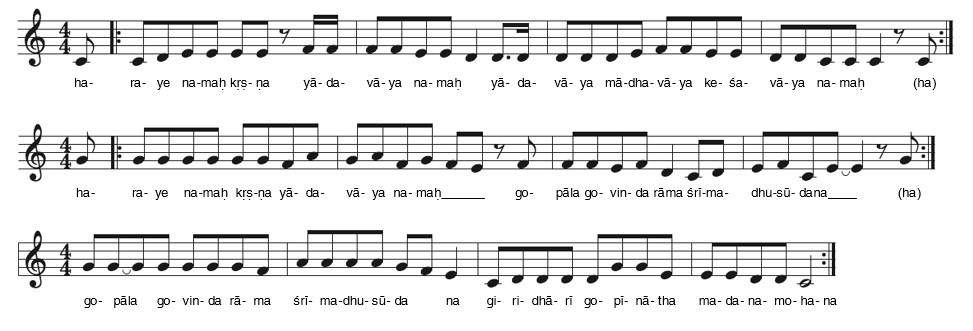
tava kṛpā-bale pāi caitanya-nitāi
dayā kara—please show mercy; sītā-pati—O husband of Sītā Ṭhākurāṇī!; advaita gosāi—O Advaita Ācārya!; tava kṛpā-bale—by the power of your mercy; pāi—I can attain; caitanya-nitāi—Lord Caitanya and Nityānanda.
My dear Advaita Prabhu, husband of Sītā, You are so kind. Please be merciful to me. If You are kind to me, naturally Lord Caitanya and Nityānanda will also be kind to me.
5 hā hā svarūpa, sanātana, rūpa, raghunātha
bhaṭṭa-yuga, śrī-jīva hā prabhu lokanātha
hā hā—alas! alas!; svarūpa—O Svarūpa Dāmodara Gosvāmī!; sanātana—O Sanātana Gosvāmī!; rūpa—O Rūpa Gosvāmī!; raghunātha—O Raghunātha dāsa Gosvāmī!; bhaṭṭa-yuga—O two Bhaṭṭas!; śrī-jīva—O Śrī Jīva Gosvāmī!; hā—alas!; prabhu lokanātha—O my spiritual master, Lokanātha Gosvāmī!
O Svarūpa Dāmodara Gosvāmī, Sanātana Gosvāmī, Rūpa Gosvāmī, Raghunātha dāsa Gosvāmī, the two Bhaṭṭas (Gopāla Bhaṭṭa and Raghunātha Bhaṭṭa Gosvāmī), Jīva Gosvāmī, and Lokanātha Gosvāmī, my beloved spiritual master, Narottama dāsa prays for your mercy.
6 dayā kara śrī-ācārya prabhu śrīnivāsa rāmacandra-saṅga māge narottama-dāsa dayā kara—please show mercy; śrī-ācārya prabhu śrīnivāsa—O Śrīnivāsa Ācārya!; rāmacandra-saṅga—the association of Rāmacandra Kavirāja; māge— begs; narottama-dāsa—this Narottama dāsa.
O Śrīnivāsa Ācārya, successor to the six Gosvāmīs! Please be merciful to me. Narottama dāsa always desires the company of Rāmacandra Cakravartī.
Commentary
The original title of this song found in Narottama dāsa Ṭhākura’s songbook Prārthana is Sāvaraṇa-śrī-gaura-pāda-padme (Prayer to the Lotus Feet of Śrī Gaurāṅga). Prabhupāda quoted from it on several occasions: Ratha-yātrā lecture at The Family Dog Auditorium – San Francisco, July 27, 1969 My dear boys and girls, I thank you very much for joining us on this Ratha-yātrā ceremony. I am going to sing now an Indian song, and then I shall explain it. Even if you don't understand the language of the song, still, if you kindly hear patiently, the sound vibration will act. The song is śrī-kṛṣṇa-caitanya prabhu dayā kara more. (Prabhupāda sings the entire song). The author's name is Narottama dāsa Ṭhākura, he is singing. He had many songs. We are gradually translating them into English, and we will have them in our paper, Back to Godhead. The purport of this song is, śrī-kṛṣṇa-caitanya prabhu, dayā kara more: “My dear Lord Caitanya, please be merciful upon me." Tomā vinā ke dayālu jagat-saṁsāre: “I do not find anyone as merciful as You are.” Yes. Śrī Caitanya Prabhu... You have seen the picture of Lord Caitanya. Yes, it is on the altar, Lord Caitanya dancing. He, the Supreme Personality of Godhead, appeared as a devotee. You have heard the name of Bhagavad-gītā. In that Bhagavad-gītā the last instruction is Kṛṣṇa, the Supreme Personality of Godhead, He is asking everyone, "My dear sons, God is higher." That is accepted in every religion. Especially in your Christian religion, God is the supreme father. … Therefore in the Vedas it is said that the living entities are maintained by the Supreme Lord. That you can understand by your practical experience. There are millions and trillions of living creatures. The human society is only a small portion of this. If you take a portion of a drop of the Pacific Ocean, how many aquatics are there? There are 900,000 species of aquatics. So there are 8,400,000 species of living creatures, and all of them are being maintained by God, the Supreme Lord. We are also being maintained, but because we have become advanced in knowledge, therefore the result is we have forgotten God. This is the result of our education. The more we become advanced in so-called knowledge, you forget your relationship with God. […] Śrī-kṛṣṇa-caitanya prabhu, dayā kara more. So in this age we ask the mercy of Lord Caitanya because we have all forgotten what is our relationship with God. But we have got the dormant love for God. Just like a son and father—the son may forget, he may become a crazy fellow and go out of home, but that does not mean that his relationship with the father is broken. No. That is not possible. Even if I am a crazy fellow, when the father dies the sons have still the right to inherit the property of the father. The relationship is so strong. Similarly, we may try to forget God due to our craziness, but the relationship cannot be broken, and still God is so kind, He comes Himself, He sends His bona fide servants, He sends his son. In so many ways He is always canvassing, "My dear sons, do not suffer in this abominable condition of material existence. Come back to Me. Come back to home. You enjoy life, eternal life, and blissful life, and life of knowledge." … We have developed this human form of life after passing through many millions of lower grades of life, and similarly we have to now develop this Kṛṣṇa consciousness, love of God. If you will take this Kṛṣṇa consciousness movement very seriously, then we have volumes of books to convince you what is your relationship with God, what is your duty, what is your ultimate goal of life—these things are all very nicely explained in the Bhagavad-gītā. But unfortunately, so- called scholars and so-called wise men misinterpret the whole thing. That is why the Lord appeared as Lord Caitanya five hundred years ago to establish the correct principles of Bhagavad-gītā, and He showed that even if you do not understand the processes of religion, you simply chant Hare Kṛṣṇa, Hare Kṛṣṇa, Kṛṣṇa Kṛṣṇa, Hare Hare/ Hare Rāma, Hare Rāma, Rāma Rāma, Hare Hare. And it is practical. Just like when we were chanting Hare Kṛṣṇa, all the members who were assembled here were joining in, but when I am now talking about philosophy, some are leaving. It is very practical to see. The Hare Kṛṣṇa mantra is so enchanting that anyone can take part in any condition. And if he continues to chant, gradually he develops his dormant love of God. His heart will be cleansed of all dirty things, and gradually he will be freed from the material concept of life, and he will be joyful, and he will see everyone as sons of God, and then he will begin his loving transcendental service to Kṛṣṇa. So our only request is that you try to understand this Kṛṣṇa consciousness movement. It is very simple. We are requesting everyone to chant the Hare Kṛṣṇa mantra and take prasādam. When you are tired of chanting, the prasādam is ready. Immediately you can take prasādam. And if you dance, then all of the bodily exercise is Kṛṣṇized, and all of the attempts of the yoga processes are attained by this simple process. So chant, dance, take prasādam. Even if you do not hear at first this philosophy, it will act, and you will be elevated to the highest platform of perfection. Thank you very much. Lecture on Śrīmad-Bhāgavatam 7.9.42 – Mayapur, March 22, 1976 So Prahlāda Mahārāja says that “We are suffering in this way, and we are praying to You to stop this suffering. So it is not very difficult task for You.” Ko nv atra te 'khila-guro bhagavan prayāsa. Suppose if I ask you to do something for me, you may say, “That is very difficult task. I have no time to do this.” So it may be difficult for an ordinary man. Actually it is a very difficult task, because Prahlāda Mahārāja in a previous verse, he prayed, pantheli parācara pipṛhi mūḍham adya. Mūḍham adya: “Give me shelter.” Just like Narottama dāsa Ṭhākura sings that śrī-kṛṣṇa- caitanya-prabhu, dayā kara more: “Lord Śrī Kṛṣṇa Caitanya Mahāprabhu, kindly give me Your mercy.” Dayā kara more. “Why I shall give My mercy to you? You are so sinful. You are so fallen. My mercy is not meant for you.” But Narottama dāsa Ṭhākura reminds, patita-pāvana-hetu, tava avatāra: “Sir, I am the most fallen. There is no doubt about it. But You have specially come to deliver persons like us.” Śrī-kṛṣṇa-caitanya-prabhu dayā kara more, tomā vinā ke dayalu, jagata saṁsāre. Actually we are hankering after favor of some big man and small man. That is going on. That is material world. But if we seek favor from the Supreme Personality of Godhead, so that is very nice. Instead of going here and there, if we... We want favor. There is no doubt. But others cannot favor us. That is the point. They have started so many humanitarian institutes to favor the suffering humanity, but it is not possible. They cannot. They cannot do it. It is false attempt. … Suppose the father and mother, they are always ready to show favor to their children. There is no doubt about it. But does it mean if one has got very good and rich and able father and mother one can be happy, the children can be happy? No. That is not so. Bālasya neha śaraṇaṁ pitarau nṛsiṁha [SB 7.9.19]. That is also Prahlāda Mahārāja's statement, that “Simply because there is kind father and mother, therefore the children will be happy? No. That is not possible.” So actually, if the child is destined to suffer, the good father and mother cannot give him shelter. That is not possible. Nobody can show favor against the will of the Supreme. We can ask favor from anyone, but we must know that nobody can favor us unless it is sanctioned by the Supreme Person. We must always know. Not that because one is very, in a very superior position, he can favor me. No, he cannot favor you unless it is sanctioned by the Supreme.
Parama karuṇa
Locana dasa Thakura
1 parama karuṇa, pahū dui jana
nitāi gauracandra saba avatāra-sāra śiromaṇi
kevala ānanda-kanda
parama—supremely; karuṇa—merciful; pahū—the Lords; dui—two ; jana— persons ; nitāi-gauracandra—Lord Nityananda and Lord Caitanya ; saba—all; avatāra-sāra—the essence of all incarnations; śiromaṇi—the crown-jewels; kevala—purely; ānanda-kanda—the root cause of bliss.
Lord Nitāi and Lord Gauracandra are very merciful. They are the essence of all incarnations. The specific significance of these incarnations is that They introduced a process of chanting and dancing that is simply joyful.
2 bhaja bhaja bhāi, caitanya nitāi
sudṛḍha viśvāsa kari viṣaya chāriyā, se rase majiyā, mukhe bala hari hari bhaja bhaja—worship, worship; bhāi—o brother; caitanya nitāi—Lord Caitanya and Lord Nityananda; sudṛḍha—firm; viśvāsa—faith and conviction; kari—do; viṣaya—sense gratification; chāriyā—give up; se—this; rase—mellow; majiyā— absorb yourself; mukhe—by the mouth; bala—say; hari hari—the holy name of the Lord (Hari, Hari).
My dear brothers, I request that you just worship Lord Caitanya and Nityānanda with firm conviction and faith. If one wants to be Kṛṣṇa conscious by this process, one has to give up his engagement in sense gratification. Become absorbed in worshiping Lord Caitanya and Nityananda, and simply chant “Hare Kṛṣṇa! Hari Hari!” without any material motive.
3 dekha ore bhāi, tri-bhuvane nāi,
emana dayāla dātā
paśu pākhī jhure, pāṣāṇa vidare,
śuni' yā'ra guṇa-gāthā

dekha—just see; ore—o all of you; bhāi—brothers; tri-bhuvane—in the three worlds; nāi—not; emana—like this; dayāla-dātā—the givers of mercy; paśu— animals; pākhī—birds; jhure—weep; pāṣāṇa—stones; vidare—melt; śuni'— hearing; yā'ra—of Their; guṇa-gāthā—narration of qualities.
My dear brothers, just try to examine this. Within the three worlds there is no one like Lord Caitanya or Lord Nityānanda. Their merciful qualities are so great that upon hearing them even birds and beasts cry and stones melt.
4 saṁsāre majiyā, rahili pariyā,
se pade nahila āśa āpana karama, bhuñjāye śamana,
kahaye locana-dāsa
saṁsāre—in the material world; majiyā—absorbed; rahili—I remain; pariyā— falling down; se—those; pade—lotus feet; nahila—there was not; āśa—hope; āpana—my own; karama—fruits of activities; bhuñjāye—makes me eat; śamana— Yamarāja, the lord of death; kahaye—says; locana-dāsa—Locana dāsa.
But I, Locana Dāsa, regret that I am entrapped by sense gratification. I have no attraction for the lotus feet of Lord Caitanya and Lord Nityānanda, and therefore Yamarāja, the superintendent of death, is punishing me by not allowing me to be attracted by this movement.
Commentary
This is a song by Locana dāsa Ṭhākura who was almost a contemporary of Śrī Caitanya Mahāprabhu. Parama karuṇa is probably Locana dāsa Ṭhākura’s best known song and Prabhupāda was very fond of it. When arriving at the temple in Atlanta, he gave an arrival address that lasted only 2 minutes, because while speaking about the supremely merciful nature of Gaura-Nitāi, the presiding Deities of the temple, Prabhupāda became overwhelmed by ecstatic feelings that choked his voice. Arrival address – Atlanta, February 28, 1975 Prabhupāda: So I am very glad to see you, and I am coming first of all Mexico City? Hmm? Śrutakīrti: Yes. Prabhupāda: So Mexico City, then Caracas, then... Śrutakīrti: Miami.
Prabhupāda: Miami. So I see your temple is the best. Devotees: Jaya! Haribol! Prabhupāda: So Caitanya Mahāprabhu is very kind. Parama karuṇa, pahū dui jana. Two Lords, Nitāi-Gauracandra, Nityānanda Prabhu and Śrī Caitanya Mahāprabhu, They are very kind, you see? They have appeared just to reclaim the fallen souls of this age. So They are more kind than Kṛṣṇa. Kṛṣṇa, He is also very kind. He comes to deliver. But Kṛṣṇa demands that first of all surrender. Caitanya Mahāprabhu even does not demand surrender. He is so kind. [voice choking] So take shelter of Śrī Caitanya Mahāprabhu and be happy. Thank you very much. [in choked voice] Devotees: Jaya Śrīla Prabhupāda. In the evening, Prabhupāda spoke again about Locana dāsa Ṭhākura’s song. Here are some excepts: Pahū dui jana. Pahū means prabhu. The shortcut is pahū. Prabhu, lord, or master. So these two prabhus, Caitanya Mahāprabhu and Nityānanda Prabhu. Caitanya Mahāprabhu is addressed as Mahāprabhu, mahā-puruṣa. And others, they are addressed as prabhu. So these two prabhus, Nityānanda Prabhu and Caitanya Mahāprabhu, are very merciful, parama karuṇa. Parama karuṇa means extremely merciful. Extremely merciful because Kṛṣṇa is also merciful, but because He is the Supreme Personality of Godhead in His original feature... Caitanya Mahāprabhu is also Kṛṣṇa, but He is acting as devotee. He is not acting as Kṛṣṇa. He is acting as devotee of Kṛṣṇa. Namo mahā-vadānyāya kṛṣṇa- preme-pradāya te kṛṣṇāya kṛṣṇa-caitanya-nāmne... He is Kṛṣṇa, but at present He has assumed the name of Kṛṣṇa Caitanya. Sārvabhauma Bhaṭṭācārya also appreciated Caitanya Mahāprabhu. He made one hundred verses about Caitanya Mahāprabhu, but Caitanya Mahāprabhu, just to teach us, He destroyed the ślokas: "Oh, it is too much praising Me." So anyway, some of the ślokas were saved. Two of them are mentioned in the Caitanya-caritāmṛta. So one of the verses is:
vairāgya-vidyā-nija-bhakti-yoga-śikṣārtham ekaḥ puruṣaḥ purāṇaḥ śrī-kṛṣṇa-caitanya-śarīra-dhārī kṛpāmbudhir yas tam ahaṁ prapadye
Sārvabhauma Bhaṭṭācārya is offering his obeisances to Lord Caitanya Mahāprabhu, speaking like this, that "You are the same original person, Kṛṣṇa, but You have now assumed the form of Kṛṣṇa Caitanya just to teach vairāgya- vidyā-nija-bhakti-yoga. You have come to teach the mass of people the art of becoming detached from this material world.'' Vairāgya-vidyā. Vairāgya. Rāga means attachment, and virāga means detachment. So we fallen souls, conditioned souls, we are very much attached to this material body, and consequently, material world. This is the disease. This is called bhava- roga, or material disease, to become attached to this body. […]
So Śrī Caitanya Mahāprabhu came to teach us how to become detached from this material world. That is vairāgya-vidyā. Vidyā means vairāgya-vidyā. Vidyā does not mean to become more and more attached to this material world. That is avidyā, illusion, because I will not be able to save this body. This body will change. I will be annihilated. But still, I am very much anxious for this body. This is called illusion, or ignorance (avidyā). So Caitanya Mahāprabhu came to teach us vairāgya-vidyā, how to become detached. He personally showed by His life example. […] So Caitanya Mahāprabhu taught this. And He took sannyāsa. For the benefit of the whole world, He took sannyāsa. He gave up His very opulent position in Navadvīpa, as I have told you, very learned scholar, very beautiful body, very beautiful wife, very affectionate mother, good popularity. There was no scarcity. And He was God Himself. Why there will be any scarcity? There is no question. But in spite of, He took sannyāsa for the benefit of the whole world. That Caitanya Mahāprabhu has come here in Atlanta. So you worship this Caitanya Mahāprabhu. Parama karuṇa, pahū dui jana. They are very, very merciful, and little service will enhance your devotional service to a larger scale. Thank you very much. Devotees: Jaya Śrīla Prabhupāda. [end]
Jaya rādhe, jaya kṛṣṇa
(Śrī Vraja-dhāma-mahimāmṛta)
Kṛṣṇadāsa Kavirāja Gosvāmī
1 jaya rādhe, jaya kṛṣṇa, jaya vṛndāvana śrī govinda, gopīnātha, madana-mohana jaya rādhe jaya kṛṣṇa—all glories to Śrī Śrī Rādhā and Kṛṣṇa; jaya vṛndāvana— glories to the transcendental realm of Vṛndāvana; śrī-govinda gopīnātha madana- mohana—glories to the three presiding Deities of Vṛndāvana : Govinda, Gopīnātha and Madana-mohana.
All glories to Rādhā and Kṛṣṇa and the divine forest of Vṛndāvana. All glories to the three presiding Deities of Vṛndāvana—Śrī Govinda, Gopīnātha, and Madana-mohana.
2 śyama-kunḍa, rādhā-kuṇḍa, giri-govardhana
kālindi yamunā jaya, jaya mahāvana
śyāma-kuṇḍa—glories to the personal lake of Śyāma; rādhā-kuṇḍa—glories to the personal lake of Rādhā; giri-govardhan—glories to Govardhana Hill; kālindī yamunā jaya—glories to the Yamunā river, known as Kālindī, the daughter of the Kalinda mountain; jaya mahāvana—glories to the great forest of Mahāvana, the place of Kṛṣṇa's childhood pastimes.
All glories to Śyāma-kuṇḍa, Rādhā-kuṇḍa, Govardhana Hill, and the Yamunā River (Kālindī). All glories to the great forest known as Mahāvana, where Kṛṣṇa and Balarāma displayed all of Their childhood pastimes.

3 keśī-ghāṭa,vaṁśi-vaṭa, dvādaśa-kānana
yāhā saba līlā kaila śrī-nanda-nandana
keśī-ghāṭa—glories to Keśī-ghāṭa, where Kṛṣṇa killed Keśi, the horse demon; vaṁśī-vaṭa—glories to the Vaṁśī-vaṭa tree, where Kṛṣṇa sits and calls the gopīs with His flute; dvādaśa-kānana—glories to the twelve forests of Vraja; yāhā— where; saba—all; līlā—pastimes; kaila—performed; śrī-nanda-nandana—the son of Nanda Mahārāja.
All glories to Keśī-ghāṭa, where Kṛṣṇa killed the Keśī demon. All glories to the Vaṁśī-vata tree, where Kṛṣṇa attracted all the gopīs to come by playing His flute. Glories to all of the twelve forests of Vraja. At these places the son of Nanda, Śrī Kṛṣṇa, performed all of His pastimes.
4 śrī-nanda-yaśodā jaya, jaya gopa-gaṇa śrīdāmādi jaya, jaya dhenu-vatsa-gaṇa śrī-nanda-yaśodā jaya—glories to Kṛṣṇa's divine mother and father, Nanda and Yaśodā; jaya gopa-gaṇa—glories to the assembly of cowherd boys; śrīdāmādi jaya—glories to the cowherd boy leaders headed by Śrīdāmā; jaya dhenu- vatsa-gaṇa—glories to the herds of cows and calves.
All glories to Kṛṣṇa's divine father and mother, Nanda and Yaśodā. All glories to the cowherd boys, headed by Śrīdāmā, the older brother of Śrīmatī Rādhārāṇī and Anaṅga Mañjarī. All glories to the cows and calves of Vraja.
5 jaya vṛṣabhānu, jaya kīrtidā sundarī jaya paurṇamāsī, jaya ābhīra-nāgarī jaya vṛṣabhānu—glories to Rādhā's father; jaya kīrtidā-sundarī—glories to Rādhā's beautiful mother; jaya paurṇamāsī—glories to the elderly Paurṇamāsī, the personality of Yogamāyā; jaya ābhīra-nāgarī—glories to the cowherd women of Vraja.
All glories to Rādhā's divine father and mother, Vṛṣabhānu and the beautiful Kīrtidā. All glories to Paurṇamāsī, the mother of Sāndīpani Muni, grandmother of Madhumaṅgala and Nāndīmukhī, and beloved disciple of Devarṣi Nārada. All glories to the young cowherd maidens of Vraja.
6 jaya jaya gopīśvara vṛndāvana-mājha
jaya jaya kṛṣṇa-sakhā baṭu dvija-rāja
jaya jaya gopīśvara—glories to the presence of Lord Śiva as Gopīśvara Mahādeva; vṛndāvana-mājha—in the midst of Vṛndāvana; jaya jaya kṛṣṇa- sakhā—glories, all glories to the cowherd boyfriend of Kṛṣṇa; baṭu—Śrī Madhumaṅgala; dvija-rāja—the monarch of the twice-born brāhmaṇas.
All glories, all glories to Gopīśvara Śiva, who resides in Vṛndāvana in order to protect the holy dhāma. All glories, all glories to Kṛṣṇa's funny brahmaṇa friend, Madhumaṅgala.
7 jaya rāma-ghāta, jaya rohiṇī-nandana
jaya jaya vṛndāvana-vāsī yata jana
jaya rāma-ghāṭa—glories to the landing on the Yamunā river where Balarāma sported the rāsa—dance; jaya rohiṇī-nandana—glories to the son of Rohiṇī (Balarāma); jaya jaya vṛndāvana-vāsī—glories, all glories to the inhabitants of Vṛndāvana; yata—all; jana—the people.
All glories to Rāma-ghāṭa, where Lord Balarāma performed His rasa dance. All glories to Lord Balarāma, the son of Rohiṇī. All glories, all glories to all of the residents of Vṛndāvana.
8 jaya dvija-patnī, jaya nāga-kanyā-gaṇa
bhaktite yāhārā pāila govinda-caraṇa
jaya dvija-patnī—glories to the wives of the Vedic brāhmaṇas; jaya nāga-kanyā- gaṇa—glories to the wives of the Kāliya serpent; bhaktite—in devotion; yāhārā—of whom; pāila—attained; govinda-caraṇa—the lotus feet of Govinda.
All glories to the wives of the proud Vedic brāhmaṇas. All glories to the wives of the Kāliya serpent. Through pure devotion they all obtained the lotus feet of Lord Govinda.
9 śrī-rasa-maṇḍala jaya, jaya rādhā-śyāma
jaya jaya rasa-līlā sarva-manorama

śrī-rāsa-maṇḍala jaya—glories to the circular arena of the rāsa—dance; jaya rādhā-śyāma—glories to Rādhā-śyāma; jaya rāsa-līlā—glories to the rāsa-līlā; sarva-manorama—which captures the minds of all.
All glories to the place where the rasa dance of Śrī Kṛṣṇa was performed. All glories to Rādhā and Śyāma. All glories, all glories to the divine rasa dance, which is the most beautiful of all Lord Kṛṣṇa's pastimes.
10 jaya jayojjvala-rasa sarva-rasa-sāra parakīyā-bhāve yāhā vrajete pracāra jaya jayojjvala-rasa—glories to the ujjvala-rasa, the conjugal mellow; sarva- rasa-sāra—the quintessence of all ecstatic mellows; parakīyā-bhāve—in the mood of paramourship; yāhā—which; vrajete pracāra—is visible only in the realm of Vraja.
All glories, all glories to the mellow of conjugal love, which is the most excellent of all rasas and is propagated in Vraja by Śrī Kṛṣṇa in the form of the divine parakīyā-bhāva [paramour love].
11 śrī-jāhnavā-pāda-padma kariyā smaraṇa
dīna kṛṣṇa-dāsa kahe nāma-saṅkīrtana
śrī-jāhnavā-pāda-padma—the lotus feet of Lord Nityānanda's consort, Śrī Jāhnavā-devī; kariyā smaraṇa—remembering; dīna—very fallen and lowly; kṛṣṇadāsa—Kṛṣṇadāsa; kahe nāma-saṅkīrtana—sings the names of the Lord.
Remembering the lotus feet of Lord Nityānanda's consort, Śrī Jāhnavā Devī, this very fallen and lowly servant of Kṛṣṇa sings the saṅkīrtana of the holy name.
Commentary
The original title of this song is Śrī Vraja-dhāma-mahimāmṛta (The Nectarean Glories of the Holy Land of Vṛndāvana). Śrīla Prabhupāda recorded this song during the “Kṛṣṇa Meditation” sessions in Germany in 1974, and he often spoke about the special significance of holy places like Vṛndāvana-dhāma. On one occasion, in England in 1972, while commenting on the sages of Naimiṣāraṇya, he said:
This holy place, that is significant. Just like chanting here in London and chanting in Vṛndāvana, there is difference. There is difference. Because that holy place gives extra stimulus. Prīti tad-vasati-sthale. Therefore one who is advanced in spiritual consciousness, he develops a prīti. Prīti means pleasure, or love—love for living in such holy places like Naimiṣāraṇya, Vṛndāvana, especially Naimiṣāraṇya, Vṛndāvana, Navadvīpa. These are holy places; they are not within this material world. So there is extra stimulus for spiritual advancement if one practices in the holy places. That's a fact. It becomes very favorable. Actually we are seeing in Vṛndāvana that most ordinary class, they come to Vṛndāvana for some ulterior purpose, to solve some economic problem or some other problem, but they become devotee. Holy place. In our Gauḍīya Maṭha, when my spiritual master was living, many men came for many purposes, but they became devotee later on. Here also in our temples, so many, many, they come maybe some other purposes, they become devotee. Therefore holy place has got a special effect. Narottama dāsa Ṭhākura sings, ānande bala hari, bhaja vṛndāvana: chant Hare Kṛṣṇa and worship Vṛndāvana. Hari-guru-vaiṣṇava-pade majāiyā mana: just absorb your mind in hari-guru-vaiṣṇava. Hari means the Supreme
Personality of Godhead; guru, the spiritual master; and Vaiṣṇava, the devotee. Develop your affection for hari-guru-vaiṣṇava, live in Vṛndāvana, chant Hare Kṛṣṇa, and life is successful. That's all. This is civilization. Three things. Any rascal, any rogue can be delivered, simply by this process. Ānande bala hari, bhaja vṛndāvana, hari-guru-vaiṣṇava. But the main principle is hari-guru-vaiṣṇava majāiyā. So we are now constructing very nice temple. Any one of you can go there, in Navadvīpa also, you can go there and live, perpetually chanting Hare Kṛṣṇa. Kṛṣṇa will give you all facilities. Now we have got very, very big temples there, in Bombay also. So we are trying to give you all facilities for developing Kṛṣṇa consciousness. But be careful. Don't fall down; then the chance is missed.
Vṛndāvana ramya-sthāna
Narottama Dāsa Ṭhākura
1 vṛndāvana ramya-sthāna, divya-cintāmaṇi-dhāma,
ratana-mandira manohara āvṛta kālindī-nīre, rāja-haṁsa keli kare, tāhe śobhe kanaka-kamala vṛndāvana—the forest of Vṛndāvana; ramya-sthāna—a place of transcendental beauty; divya—in the spiritual sky; cintāmaṇi-dhāma—an abode made of touchstone; ratana-mandira—temples made of jewels; manohara—that enchant the mind; āvṛta—surrounded; kālindī-nīre—by the waters of the river Yamunā; rāja- haṁsa—royal swans; keli kare—frolic; tāhe—in the midst (of that water); śobhe— splendrously shines; kanaka-kamala—a golden lotus.
The beautiful place known as Vṛndāvana is a transcendental abode in the spiritual world, and is composed entirely of divine touch-stones. There are many enchanting temples bedecked with costly jewels. The royal swans known as rāja-haṁsa frolic in the waters of the river Yamunā, which surrounds that transcendental island. In the midst of that divine river is a beautiful golden lotus of a hundred petals.
2 tāra madhye hema-pīṭha, aṣṭa-dale veṣṭita,
aṣṭa-dale pradhānā nāyikā tāra madhye ratnāsane, va’si āchen dui jane, śyāma-saṅge sundarī rādhikā tāra madhye—in the midst of that lotus; hema-pīṭha—a golden platform; aṣṭa-dale veṣṭita—surrounded by eight petals; aṣṭa-dale—situated upon those eight petals; pradhānā nāyikā—are the eight chief gopīs; tār madhye—in the center of the surrounding petals; ratna-āsane—upon a jeweled throne; vasiyāchen—are seated; dui jane—the two transcendental lovers; śyāma-saṅge—in the company of the dark Lord śyāma; sundarī rādhikā—sits the beautiful Rādhikā.
In the center of that lotus is a golden platform surrounded by eight petals. Situated upon those eight petals are the eight principal sakhīs, headed by Lalitā and Viśākhā. In the center of the surrounding petals the divine couple presides, seated upon a jeweled throne. In the company of Lord Śyāma sits the beautiful Rādhikā.
3 o-rūpa-lāvaṇya-rāśi, amiyā pariche khasi,
hāsya-parihāsa-sambhāṣaṇe narottama dāsa kaya, nitya-līlā sukha-maya, sadāi sphuruka mora mane o-rūpa-lāvaṇya-rāśi—the waves of that beauty and sweetness; amiyā pariche khasi—are falling like showers of nectar; hāsya-parihāsa—a flood of laughing and joking; sambhāṣaṇe—as they address one another; narottama dāsa kaya— Narottama dāsa says; nitya-līlā—these eternal pastimes from day to day; sukha- moy—are full of transcendental pleasure; sadāi sphuruka—may they be ever manifest; mora mane—in my heart.

The waves of their beauty and sweetness are emanating showers of nectar in the form of Their talks, which are filled with a flood of laughing and joking as they address one another. Narottama dāsa says, “May these eternal pastimes overflowing with transcendental joy be ever manifest in my heart.”
Commentary
This is Song 33, entitled Vāsantī-rāsa, in Narottama dāsa Ṭhākura’s songbook Prārthana. At the end of this song, the author expresses the desire to always visualize Kṛṣṇa’s pastimes in his heart which is possible when the heart is purified and love of Kṛṣṇa has arisen. Nārada Muni tells Vyāsadeva about his own experience in this regard in the Śrīmad-Bhāgavatam (1.6.33): “The Supreme Lord Śrī Kṛṣṇa, whose glories and activities are pleasing to hear, at once appears on the seat of my heart, as if called for, as soon as I begin to chant His holy activities.” Śrīla Prabhupāda writes in the purport:
The Absolute Personality of Godhead is not different from His transcendental name, form, pastimes and the sound vibrations thereof. As soon as a pure devotee engages himself in the pure devotional service of hearing, chanting and remembering the name, fame and activities of the Lord, at once He becomes visible to the transcendental eyes of the pure devotee by reflecting Himself on the mirror of the heart by spiritual television. Therefore a pure devotee who is related with the Lord in loving transcendental service can experience the presence of the Lord at every moment. It is a natural psychology in every individual case that a person likes to hear and enjoy his personal glories enumerated by others. That is a natural instinct, and the Lord, being also an individual personality like others, is not an exception to this psychology because psychological characteristics visible in the individual souls are but reflections of the same psychology in the Absolute Lord. The only difference is that the Lord is the greatest personality of all and absolute in all His affairs. If, therefore, the Lord is attracted by the pure devotee's chanting of His glories, there is nothing astonishing. Since He is absolute, He can appear Himself in the picture of His glorification, the two things being identical. Śrīla Nārada chants the glorification of the Lord not for his personal benefit but because the glorifications are identical with the Lord. Nārada Muni penetrates into the presence of the Lord by the transcendental chanting.
Rādhikā-stava
Rūpa Gosvāmī
(Refrain) rādhe jaya jaya mādhava-dayite
gokula-taruṇī-maṇḍala-mahite
(chorus) rādhe—O Rādhā!; jaya jaya—all glories unto You! all glories unto You!; mādhava-dayite—O beloved of Mādhava!; gokula—of Gokula; taruṇī-maṇḍala— by all the young girls; mahite—O You who are glorified.
O Rādhā! O Mādhava’s beloved! O You whom all the young girls of Gokula worship! All glories unto You! All glories unto You!
1 dāmodara-rati-vardhana-veśe
hari-niṣkuṭa-vṛndā-vipineśe
dāmodara-rati—Lord Dāmodara's love and attachment; vardhana—to increase; veśe—O You who dress Yourself in such a way!; hari-niṣkuta—the pleasure grove of Lord Hari; vṛndā-vipina—of Vṛndā Devī's forest; īśe—O Queen!
O You who dress Yourself so as to make Lord Dāmodara love You more and more! O Queen of Lord Hari’s pleasure grove, Vṛndāvana!
2 vṛṣabhānūdadhi-nava-śaśi-lekhe
lalitā-sakhi guṇa-ramita-viśākhe
vṛṣabhānu-udadhi—from the ocean of King Vṛṣabhānu; nava-śaśi-lekhe—O goddess of the newly-arisen moon!; lalitā-sakhi—O friend of Lalitā!; guṇa—due to Your wonderful qualities; ramita-viśākhe—O You who give intimate pleasure to Viśākhā!
O new moon arisen from the ocean of King Vṛṣabhānu! O friend of Lalitā! O You whose virtues delight Viśākhā!
3 karuṇāṁ kuru mayi karuṇā-bharite
sanaka-sanātana-varṇita-carite
karuṇām kuru—please be merciful; mayi—to me; karuṇā-bharite—O You who are filled with compassion!; sanaka-sanātana—by the great sages Sanaka and Sanātana; varṇita carite—O You whose divine characteristics are described!
O most merciful goddess! O You whose divine qualities are sung by Sanaka and Sanātana Kumāras! O most merciful Rādhā, please have mercy on me! O most merciful Goddess! O You whose divine qualities are sung by Sanaka and Sanātana Kumāras! O most merciful Rādhā, please have mercy on me!
Commentary
As far as we know, this is the only song directly describing Śrīmatī Rādhārāṇī that Śrīla Prabhupāda sang. About other songs like Śrīta-kamala, he wrote to Acyutananda who was compiling ISKCON’s first songbook: “Regarding the songs by Jayadeva, "Srita Kamala'' is not approved. Sometimes our Krsnadasa Babaji sings, but it is not approved by Prabhupada [Śrīla Bhaktisiddhanta]. Those songs are for siddha bhaktas, not for us who are sadha bhaktas or learning bhaktas. Lord Caitanya never divulged in public, he enjoyed them in the company of his selected three or four devotees. There is one song by Jayadeva, "Worshiping the Ten Incarnations,'' that song is all right.” Prabhupāda was very cautious when speaking about Rādhā and Kṛṣṇa and Their relationship. But he did on occasions, like in Montreal on Rādhāstami in 1968. There he sang and explained the song Rādhikā-stava by Rūpa Gosvāmī:

“So, Rādhā-Kṛṣṇa philosophy is a very great philosophy. It is to be understood in the liberated stage. Rādhā-Kṛṣṇa philosophy is not to be understood in the conditioned stage. But when we worship Rādhā-Kṛṣṇa in our conditional stage, actually we worship Lakṣmī-Nārāyaṇa. You have seen that picture, this viddhi-mārga and rāga-mārga. Rādhā-Kṛṣṇa worship is on the platform of pure love, and Lakṣmī-Nārāyaṇa worship is on the regulative principle.
So long we do not develop our pure love, we have to worship on the regulative principle. One has to become a brahmacārī, one has to become a sannyāsī, one has to perform the worship in this way, in the morning he has to rise, he has to offer. So many rules and regulations. There are at least sixty-four rules and regulations. So we shall introduce them gradually as you develop. So, in the viddhi-mārga, when you have no love for God, or Kṛṣṇa, we have to follow the regulative principle, and automatically..., they are practicing. When practicing, just like you practice this mṛdaṅga playing, in the beginning it is not in order, but when you become well versed in the practice, the sound will come so nice. Similarly, when we are engaged by regulative principles in the worship of Rādhā-Kṛṣṇa, that is called viddhi-mārga. And actually when you are on the love platform, then that is called rāga-mārga. So without viddhi-mārga, if anyone wants to learn the rāga-mārga immediately, that is foolishness. That is foolishness. Nobody can pass M.A. examination without going through the regulative principles of primary schools and colleges. So therefore I do not, I mean to say, indulge in the discussions of Rādhā and Kṛṣṇa so easily. Rather, go on with the regulative principle at the present moment. Gradually, as you become purified, as you become on the transcendental platform, you'll understand what is Rādhā-Kṛṣṇa. Don't try to understand Rādhā-Kṛṣṇa very quickly. It is a very big subject. If we want to understand Rādhā-Kṛṣṇa very quickly, then there will be so many prākṛta-sahajiyā. In India there are prākṛta-sahajiyā. Just like Rādhā- Kṛṣṇa, Kṛṣṇa is kissing Rādhā, Rādhā is kissing. These are all nonsense. Rādhā-Kṛṣṇa philosophy has to be understood by the liberated person, not by the conditioned soul. So we shall await for the fortunate moment when we are liberated, then we shall understand rādhā-kṛṣṇa-praṇaya-vikṛtir [the loving affairs between Rādhā and Kṛṣṇa (Cc. Ādi 1.5)], because Kṛṣṇa and Rādhā are not on the material field. Try to understand. This is Jīva Gosvāmī's analysis, that Kṛṣṇa is the Supreme Brahman. The Supreme Brahman cannot accept anything material. So Rādhā is not in the material field. Now there is a very nice song. I shall sing, if you can play on the harmonium. Yes. This is a Rūpa Gosvāmī's song. [Sings Rādhikā-stava:] This song was sung by Rūpa Gosvāmī. He is the real person, actual person, to understand Rādhā and Kṛṣṇa. So he says, "All glories to Rādhārāṇī." Rādhe jaya jaya mādhava-dayite. "She's so dear to Kṛṣṇa." Kṛṣṇa, everyone is trying to love Kṛṣṇa, but Kṛṣṇa is trying to love somebody. So how great She is. Just try to understand. Everyone, the whole world, the whole universe, all living entities, they are trying to love Kṛṣṇa, kṛṣṇa-prema. Lord Caitanya describes, prema-pumārtho mahān. And Rūpa Gosvāmī described that "You are distributing kṛṣṇa-prema." So kṛṣṇa-prema is so valuable, but Kṛṣṇa is after Rādhārāṇī. Just see how Rādhārāṇī is great. Just try to understand the greatness of Rādhārāṇī. Therefore She is so great, and we have to offer our respect. Rādhe jaya jaya madhava-dayite. How She is? Gokula-taruṇī-maṇḍala- mahite. Taruṇī, taruṇī means young girls. You'll see the pictures, they are all young girls. But of all the young girls, She is the most beautiful. She is enchanting to the young girls also. She is so beautiful. Gokula-taruṇī- maṇḍala-mahite. Dāmodara-rati-vardhana-veśe. And She always dresses Herself so nicely that Dāmodara, Kṛṣṇa, becomes attracted by Her beauty. Hari-niṣkuta- vṛndā-vipineśe. And She is the only lovable object of Kṛṣṇa, and She is the queen of Vṛndāvana. This queen of Vṛndāvana... You'll find in Vṛndāvana, if you go to Vṛndāvana, everyone is worshiping Rādhārāṇī. Rāṇī means queen. They are always speaking, "Jaya Rādhe!" Rādhārāṇī. All the devotees in Vṛndāvana, they are worshiper of Rādhārāṇī. Hari-niṣkuta-vṛndā-vipineśe, vṛṣabhānudadhi-nava-śaśi-lekhe. And She appeared as the daughter of King Vṛṣabhānu. And Her companions are Lalitā-sakhī and Viśākha-sakhī, and the devotees. So on behalf of the pure devotees of Kṛṣṇa, Rūpa Gosvāmī is praying, karuṇāṁ kuru mayi karuṇā-bharite: "O my worshipable Rādhārāṇī, You are full of mercy. So I am begging of Your mercy because You are so merciful, very easily You offer, bestow Your mercy. So I am begging Your mercy." Karuṇāṁ kuru mayi karuṇā-bharite, sanaka-sanātana-varṇita-carite. Now somebody may say, "Oh, you are so great, learned scholar, you are so great saintly person, and you are begging mercy from an ordinary girl? How is that?" Therefore Rūpa Gosvāmī says, "Oh, this is not ordinary girl." Sanaka-sanātana-varṇita-carite: "This girl's description is possible to be made by great saintly person like Sanaka-Sanātana. She is not ordinary." So the lesson is that we should not treat Rādhārāṇī as ordinary girl or Kṛṣṇa as ordinary man. They are the Supreme Absolute Truth. But in the Absolute Truth, there is the pleasure potency, and that is exhibited in the dealings of Rādhā and Kṛṣṇa. And Rādhā's expansion all the gopīs, and Kṛṣṇa is the Supreme Lord. Thank you very much. Chant Hare Kṛṣṇa.”
Kṛṣṇa-candra guṇera sagara
(Bahirmukha ha' ye)
1 bahirmukha ha' ye, māyāre bhajiye,
saṁsāre hainu rāgi kṛṣṇa dayāmaya, prapañce udaya, hailā āmāra lāgi bahirmukha—a person who has turned his face away from Kṛṣṇa and is very busy tasting material enjoyment; ho'ye—being; māyāre—the material energy; bhajiye— adoring; saṁsāre—material existence; hainu—I have become; rāgi—attached; kṛṣṇa—Kṛṣṇa; dayāmaya—very merciful; prapañce—in the material world; udaya—arisen; haila—has; āmāra—my; lāgi—for.
Becoming inimical towards the Lord, and adoring illusion, I have become madly attached to this material existence. However, Kṛṣṇa is so kind for He has arisen within this material world just for my sake.
2 (sakhī he) kṛṣṇa-candra guṇera sāgara
aparādhī jane, kṛpā vitaraṇe,
śodhite nahe kātara
sakhī he—O friend; kṛṣṇa-candra—moon-like Kṛṣṇa; guṇera—of qualities; sāgara—ocean; aparādhī—offenders; jane—people; kṛpā—mercy; vitaraṇe— distributes; śodhite—purifies; nahe—there are not; kātara—afflictions.
My dear friend! The moon-like Kṛṣṇa-candra is certainly an unlimited ocean of auspicious qualities! He distributes His causeless mercy to all the offenders, not hesitating to purify them and relieve them of their afflictions.
3 saṁsāre āsiyā, prakṛti bhajiyā,
‘puruṣa’ abhimāne mari kṛṣṇa dāya kari', nije avatari', vaṁśi-rave nilā hari'
saṁsāre—material existence; āsiyā—having come; prakṛti—material nature; bhajiyā—adoring; ‘puruṣa’—the enjoyer (male); abhimāne—false conception; mari—dying; kṛṣṇa—Kṛṣṇa; dāya—mercy; kari'—showing; nije—His own; avatari'—descending; vaṁśi-rave—the sound of His flute; nilā—takes; hari'— stealing.
I have come into this false material existence, adoring the material energy as if it is fit for my enjoyment, and I am seized with the false conception that I am a male. But Lord Kṛṣṇa, showing His compassion, descends and forcibly steals away all such false conceptions with the transcendental sound of His flute.
4 emana ratane, viśeṣa yatane,
bhaja sakhī avirata vinoda ekhāne, śrī-kṛṣṇa-caraṇe, guṇe bandha, sadā nata emana—such a; ratane—jewellike person; viśeṣa—specific; yatane—with great care; bhaja—worship; sakhī—O friend; avirata—attention; vinoda—Bhaktivinoda; ekhāne—just now; śrī-kṛṣṇa-caraṇe—Śrī Kṛṣṇa lotus feet; guṇe—qualities; bandha—bound; sadā—always; nata—bows down with awe and reverence.
My dear friend, just worship such a jewel-like person with special care and attention. Now Bhaktivinoda admits that he is helplessly attached to the wonderful qualities of Śrī Kṛṣṇa's lotus feet. Thus, he always bows his head in great awe and reverence before them.
Commentary
This is another song from Bhaktivinoda Ṭhākura’s songbook Kalyāṇa-kalpataru, Third Branch (Overflowing Spiritual Emotions, Ucchvāsa), Part 4, Song 1 – Kṛṣṇa’s Quality of Mercy (Guṇa-kīrtana). Prabhupāda mentions this song in the Śrī Caitanya-caritāmṛta, Madhya-līlā 12.62, where he says in the purport: “Even though Śrī Caitanya Mahāprabhu is the Supreme Personality of Godhead, He placed Himself in the position of a gopī. He also accepted the king’s son directly as the son of Mahārāja Nanda, Vrajendra-nandana Hari. This is perfect vision according to the direction of the Vedic culture, as confirmed in Śrīmad Bhagavad-gītā (5.18): paṇḍitāḥ sama-darśinaḥ. Such acceptance of the Absolute Truth according to Vaiṣṇava philosophy is explained in both the Muṇḍaka Upaniṣad (3.2.3) and the Kaṭha Upaniṣad (1.2.23) in the following words:
nāyam ātmā pravacanena labhyo
na medhayā na bahunā śrutena yam evaiṣa vṛṇute tena labhyas tasyaiṣa ātmā vivṛṇute tanūṁ svām
‘The Supreme Lord is not obtained by expert explanations, by vast intelligence, nor even by much hearing. He is obtained only by one whom He Himself chooses. To such a person He manifests His own form.’ The living entity is entangled in material existence due to his lack of such spiritual vision. Śrīla Bhaktivinoda Ṭhākura has sung in his Kalyāṇa-kalpataru, saṁsāre āsiyā prakṛti bhajiyā ‘puruṣa’ abhimāne mari. When the living entity comes to the material world, he thinks himself the enjoyer. Thus he becomes more and more entangled.” Here we see again how deeply Prabhupāda was immersed in the songs of the Vaiṣṇava ācāryas. This is the only time, he mentions this song anywhere in his works. There is no recording of it, we never heard him sing it, but it comes to his mind while writing this purport. It is a wonderful, positive song, expressing a deep feeling of gratitude for Kṛṣṇa’s quality of causeless mercy that makes Him come again and again to the material world –at different times, in different forms–, just to reclaim the fallen conditioned souls by exhibiting His all-attractive pastimes. In a note attached to this song it says “To be sung in rāga Dhanasri”. The word dhanaśrī is a compound, meaning “fortune and beauty”, a very appropiate designation for this rāga with its upbeat pentatonic scale.