 Spiritual
On the eighth day of the bright fortnight of the month of Kartika (October-November), Gopastami is celebrated, commemorating the day when Krishna transitioned from tending calves to caring for adult cows, thus marking the end of His childhood pastimes.
In the Srimad Bhagavatam, it is described how Krishna, along with Balarama and His cowherd friends, began to take the cows to graze in the forests of Vrindavan, performing wonderful pastimes. On that day, Nanda Maharaja and the adult cowherds recognized that Krishna was no longer a small child and should take on greater responsibilities, so they allowed Him to tend the cows along with the calves.
While the gopas tended the cows and roamed freely through the forests, the gopis generally stayed at home, engaged in activities such as churning butter, milking, and cooking.
In the Srimad Bhagavatam (10.15.1), in the purport, it is explained:
As Lord Krishna’s spiritual body had apparently grown somewhat in age and strength, the elder men of Vrindavan, headed by Nanda Maharaja, decided to promote Krishna from the task of herding calves to the position of an ordinary cowherd boy. Now He would take charge of the cows, bulls, and oxen. Out of great affection, Nanda Maharaja had previously considered Krishna too young and immature to tend adult cows and bulls.
In the Karttika-mahatmya section of the Padma Purana, it is stated:
“The eighth lunar day of the bright fortnight of the month of Karttika is known by authorities as Gopastami. From that day onward, Lord Vasudeva served as a cowherd, whereas previously He tended to the calves.”
Krishna blessed the Earth by walking upon it, leaving the imprints of His lotus feet in the dust of Vrindavan. The Lord wore no shoes or any other footwear but walked barefoot through the forest, causing great anxiety to the maidens of Vrindavan, who feared that His soft lotus feet might be injured.
Srimati Radharani and Her intimate friends, the sakhis, always longed to be with Krishna during His herding pastimes. Thus, when Krishna graduated from tending calves to caring for cows, He began to venture deeper into the forests of Vrindavan. This meant that the gopis could no longer see Him as easily as before. To resolve this, Srimati Radharani, Lalita, Visakha, and the others devised a bold plan: they disguised themselves as gopas, wearing turbans, dhotis, and carrying herding sticks. Thus disguised, they managed to meet Krishna in the forest without being discovered.
To this day, Gopastami is celebrated in many temples and sacred towns like Vrindavan. On this day, the Deity of Srimati Radharani is dressed as a gopa. Processions are held in which cows are led with great respect, worshipped, adorned, and offered prasadam. This day also honors the importance of go-seva (service to cows), as they are dear to Krishna and essential in Vedic culture.
 On such a special day as Gopashtami, Dhira was born.
It was November 9, 2005. The birth took place during the night, so in the morning, when the cowherd arrived, he found Dhira standing beside Tilaka, her mother, with her beautiful tail brushing the ground. He immediately ran out to ring the neighbor’s gate bell as loudly as he could, filled with euphoria and joy. The whole valley heard the call, and soon Dhira was receiving congratulations and blessings from all the devotees of New Vrajamandala. The signs surrounding her birth already hinted that she would be a very special cow.
Dhira means courage, steadiness, wisdom, or serenity. It is used to describe a person who possesses bravery, patience, and discernment—someone especially capable of remaining calm and determined in difficult situations.
A music group led by Tirtha Kirti had just been formed and was named “Dhira.” As a gesture of gratitude and support for the band, Alberto decided to give the same name, “Dhira,” to the beautiful calf that had just been born.
Dhira’s childhood was very well cared for. After Balarama’s accident, Alberto decided to build a fence to prevent any other fall into the river. Every day he would take the little calf in his arms and carry her to the enclosed field so she could walk around. When Dhira became heavier, he began leading her with a rope to keep her from running away. Very soon Dhira gained weight and strength, so there were no more worries—if she fell into the river, she would be able to stand up and get out by herself without difficulty.
Dhira was fearless and brave. When she set her mind on going somewhere, no obstacle could stop her. She was adventurous, commanded respect, and watched attentively everything happening around her. When someone new arrived at the goshala, she would not allow anyone to touch her horns and sometimes got upset with visitors. However, as the herd grew, she became more sociable.
A Milk Cow Without a Calf
The way Dhira came to allow herself to be milked despite not having a calf is a surprising story told by Alberto:
“While I was milking the other cows, I kept walking past her stall again and again, carrying the bucket, the stool to sit on, and the cloth to clean the udders. I went back and forth, and she kept watching me. She looked at me and kept looking at me continuously.
At one point, I stopped in front of her and observed her. When I saw her big, attentive eyes, I wondered: Why is she looking at me like that? Could it be that she wants me to milk her too?
So one day I started brushing and caressing her. Little by little, I moved my hand down to her udders, touched them, and pressed gently. A liquid came out that seemed neither milk nor water, but it was there. I ran to the room where I kept the buckets and took a small container. When I came back to the stall, she looked at me and moved away. I tried to get closer to milk her again, but she moved away once more.
Then I thought and said to her, “Do you want to be like the others?” And in her bright eyes, I saw the answer: yes.
I quickly went back to the room, took the bucket, the stool, and the cloth, and returned to the stall. This time, she stood still and allowed me to milk her.”
In the first days, what she produced did not look like milk but rather a thick whitish liquid. However, after fifteen days, the consistency had changed, becoming denser and more substantial.
The devotees decided to test its quality by boiling it three times and confirmed that it was good, since it did not curdle and maintained its uniformity.
 On the first day, Dhira gave less than 100 ml. After fifteen days, she was producing half a liter, and when it was confirmed that her milk was good, we began to mix it with that of the other cows. Little by little, her production increased. Although her daily average was about two and a half liters, she once produced as much as nine liters in a single day. It was not a significant amount compared to a dairy cow — which can yield up to forty liters a day — but for a cow without a calf, it was quite an extraordinary volume.
Dhira would allow herself to be milked only by Alberto, and that became a problem because he was soon to travel to India, and there was no one else who could milk her in his absence. So Dina Sharana decided to embark on this adventure to help him. Milking her was very difficult because she moved a lot, and Alberto had to stay inside the stall repeating: “Dhira, stay still,” “Dhira, do not move,” “Dhira, here,” “Dhira, there.” In this way, little by little, Dina Sharana managed to milk her. However, that did not completely solve the problem, because Alberto still had to be present. Thus they came up with a plan:
While Dina Sharana was milking Dhira, Alberto, who stood beside her, began calling the other cows that still had not come in—especially Radharani, who was always the last.
“Dhira, stay still, I’m going to call Radharani!”
“Radharaniiii!” Alberto shouted.
They continued like this for several days until Dhira got used to it.
The next step was for Alberto to call the cows from outside Dhira’s stall. So he would step out and call again, “Radharani, come…” As always, Radharani would arrive, enter her stall, and Alberto would return to Dhira to make sure she did not move.
After a few days, he kept up the same routine, but each time going a little farther away—until he eventually went out into the field to look for Radharani and then came back to Dhira’s side.
Meanwhile, Dina Sharana was milking her and soon won Dhira’s trust and affection.
Soon after, Alberto no longer entered Dhira’s stall. Later, he even hid so she would not see him, and finally the day came when she could not hear him either. In the final test, Alberto stayed hidden and silent, neither calling the cows nor looking for Radharani. Thus, Dhira could neither see nor hear him.
This was how Dina Sharana succeeded in milking her when no one else could. And Alberto, happy and at ease, was able to travel to India, since the plan had worked.
When Alberto returned from India, he managed to get Dhira to allow even the children who came to the goshala to milk her. But everything changed when her friend Radhe died.
 “Dhira had the last stall from the entrance. Right next to her had been Radhe, who had recently left her body. So that stall was now empty. The people who came to milk Dhira found it difficult because she moved around a lot and was very restless. In the end, I went myself to show them, thinking I was the experienced cowherd—but Dhira was moving from side to side even with me. I said to her, “What is wrong with you? Why are you moving so much?” Then I thought, “I’ll move Radharani, who is in the first stall by the entrance, to Radhe’s stall, and I’ll put Dhira in Radharani’s stall.” I told her, “Now you’re going to behave well, because all the children who come in here, the first little cow they see is you, right?” From that moment on, she did not move again, and milking her became a joy—even for the very youngest children.” —Alberto
Dhira Radhe
After some time, Dina Sharana and Damodara Priya noticed some problems with her udders. They suspected it might be mastitis and called the veterinarian, who confirmed their suspicion. The veterinarian diagnosed her with chronic mastitis and suggested they dry her off. After discussing it, they decided to do so. Dhira responded very well to the treatment and indeed dried up completely, so they stopped milking her. No one could ha ve imagined that everything would change with the arrival of a little orphaned bull calf.
Dhira Adopts Hanuman
The story of Hanuman, and how Dhira adopted him, once again shows that cows are deeply sensitive beings overflowing with incomparable maternal love.
Eager to learn more about cow care, Damodara Priya and Dina Sharana visited a nearby dairy farm. Upon arrival, at the entrance, they found a small bull calf tied with a short rope. It was midday, and while the other animals were far away, this little calf remained alone, mooing insistently. He was dirty, unable to move from the spot where he also relieved himself. When Damodara Priya looked at him, she felt something special. The calf kept looking at her again and again, mooing as if begging to be rescued.
The whole day passed, and when they were about to leave, the little bull was still there, alone, calling out for help. Seeing this, Damodara Priya gathered the courage to ask the owner why he did not untie him. The man replied that the calf was already one year old and, being male, could impregnate the cows, which was of no interest to them. He also mentioned that they had already decided to send him to the slaughterhouse.
Damodara Priya could not say anything at that moment. She returned home with a heavy heart, and that night she could not sleep—the image of that little calf would not leave her mind. “He is only a year old… still just a baby,” she thought.
The next day she spoke with the leading members of the community, and after several attempts, she managed to convince them to bring the little bull to New Vrajamandala. When the owner was informed of their decision, he seemed surprised:
“What do you want him for? You do not need a bull. He is not smart; he will be of no use to you,” he said.
But for Damodara Priya, those words only strengthened her resolve to save him. That is how Hanuman came to Rupa Goshala. As soon as he was freed, he ran joyfully across the meadows with his tail raised like an antenna, overflowing with happiness. His contagious energy stirred up the whole herd: all the cows began to move more, 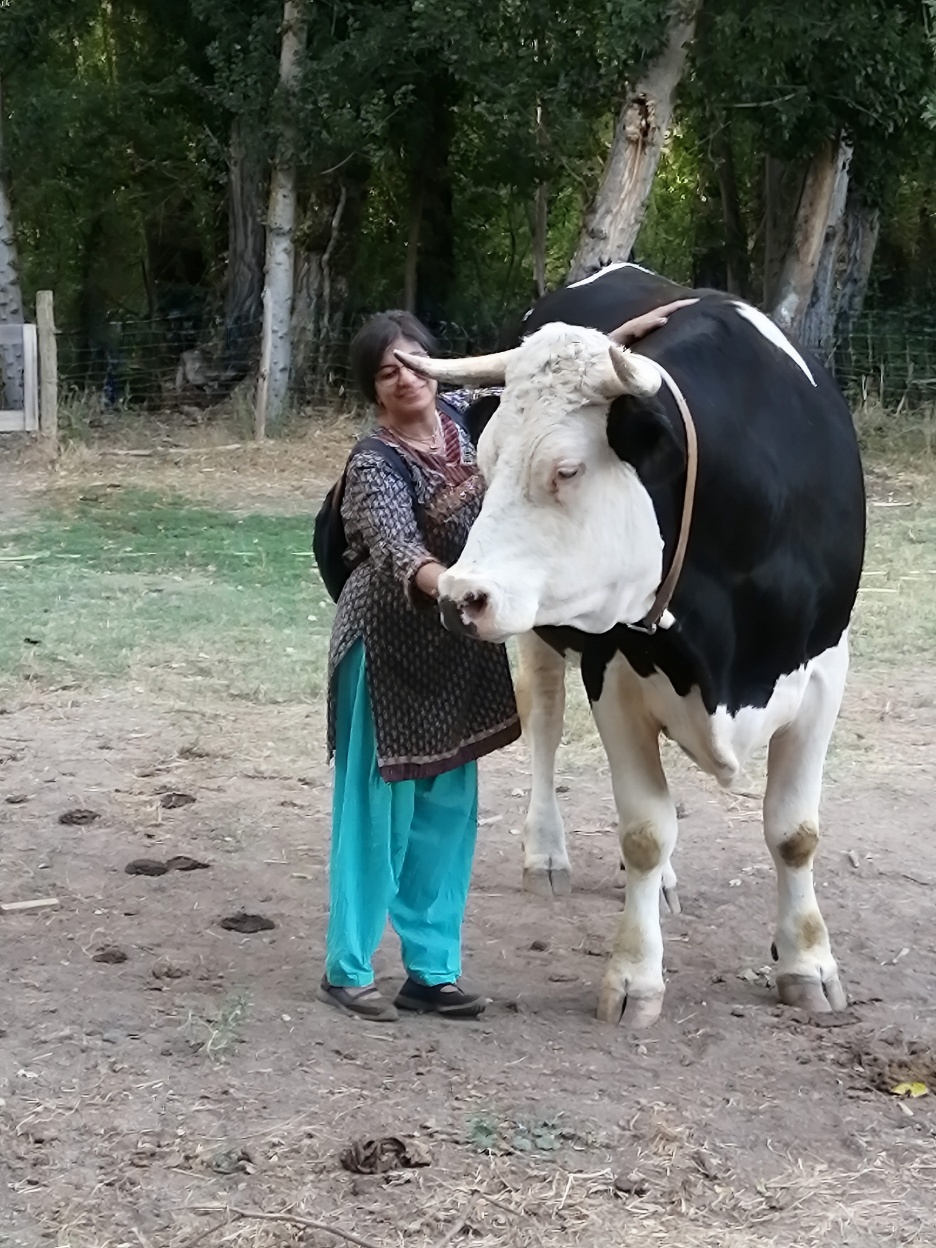 to play, and to enjoy greater exercise.
Damodara Priya with Hanuman Radhe
“When Hanuman arrived at our dairy farm, he was very happy to experience freedom, as he was normally kept tied up to prevent him from getting the cows pregnant. They were planning to sacrifice him because they believed he would be difficult to train and they did not need a bull.” —Damodara Priya
Although they tried to negotiate for his mother as well, who was still nursing him, they could not bring her, as she produced thirty liters of milk a day and the owners refused to sell her.
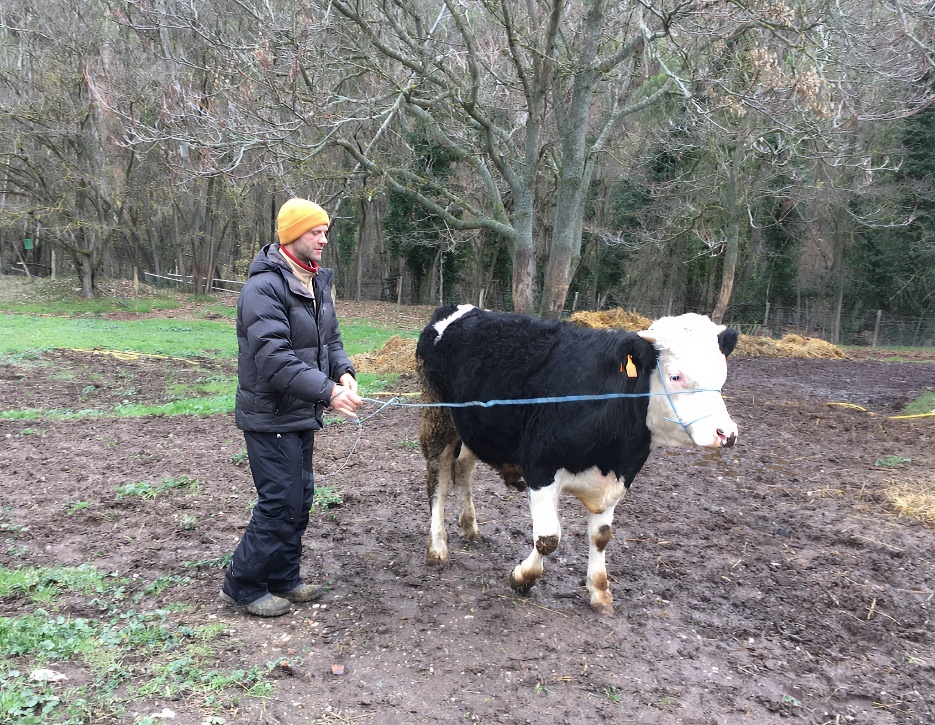
Hanuman’s arrival brought a wave of enthusiasm to the herd. Mischievous and full of energy, he ran after Baladeva and the others, and soon found affection among them. One day, he was seen suckling from Dhira and from Sundari, like a child who once again felt safe and loved.
It was then that, moved by love, Dhira—though already an older, dry cow—adopted him and, astonishingly, began producing milk again, enough to feed Hanuman and also to offer a few liters to the presiding Deities Radha-Govindachandra.
 “We thought that Dhira had already done a lot and that it was time for her to live a more peaceful and relaxed life, but apparently the Deities wanted to continue receiving her milk. In fact, Dhira started giving more milk than before; she got rid of all her previous problems, including mastitis. After a while, Hanuman stopped suckling, but Dhira continued to give milk.” —Damodara Priya
Hanuman being trained by Dina Sharana
 “When Hanuman was a year and a half old, I tried to train him. But he was stubborn and would not obey at all, until one day Dharma pushed him with his horns, as if to say, ‘Behave yourself, you mule!’
Parama Karuna feeding Hanuman Radhe
Hanuman was good-natured, but he also had his temperament. He wanted to do things his own way and would not obey; that is why they did not want him at the other dairy farm — he was a bit difficult. Later, as he got older, he calmed down, and after Dharma gored him, he settled completely; now he is very gentle and well-behaved.”c—Dina Sharana
Parama Karuna describes his first encounter with Hanuman took place and how, little by little, a relationship of trust was forged between them:
“The first time I saw him, I was amazed by his size; he was huge and a bit intimidating, because when he stuck his head out into the corridor of the goshala, where the stalls are, I had to pass under him every time I went back and forth. Later, over time, I got to know him and grew more confident around him; you come to realize that what he has in size, he also has in goodness.
He is curious and does not want to miss anything that happens in the goshala. Because of his size, he can look over the partitions to see what is going on—and also eat the food of the other cows.
Hanuman stands out not only for his size but also for the way he manages his own time. He takes as much time as he wants to come in or go out. He can stand still in the same position for a long time, whether entering or leaving the goshala, blocking the way for the other cows, who have to wait.
Another thing that surprised me is that he loves to look at the river. He can spend the whole morning just watching it.”
Dhira in the Kitchen
Dhira’s passion was food; she loved to eat. However, she did not eat with anxiety or impatience—neither too fast nor too slow—she simply enjoyed every bite calmly. Her expression of pleasure and contentment while eating was, to me, something unique and beautiful to behold.
Dhira would ruminate with her head held high, serene, displaying an unshakable calmness—a simple gesture that revealed her inner peace. When I met her, she was already quite old; it was hard for her to stand up because her hip was misaligned, and she dragged one leg slightly. Yet whenever she heard the sound of the wheelbarrow full of hay or vegetables, she would get up quickly—so much so that by the time the food reached her, she was ready to start chewing.
One cool, rainy morning, Parama Karuna went to milk the cows. He loved that time with them and usually isolated himself completely from the rest of the world. I knew that between 6:30 and 9:00 in the morning, he was not available for anyone. Those hours were his special time of the day. That is why it surprised me when he called: “Madhavi, can you come? Dhira is stuck in the kitchen.”
“Every day when I entered the goshala, I turned on the lights and greeted the cows. When I opened the door to the corridor where the individual stalls were, I was surprised not to see Dhira in her place; since she slept right in front of the entrance, she was always the first to appear. I looked to one side and then the other—she was not there. All the other cows were, except her. Very strange. I greeted the others and went toward the kitchen.
 When I arrived, I found an astonishing scene, almost like something out of a movie. Dhira was wedged inside the small kitchen, with her head over the sink. The faucet was broken, and a stream of water was splashing her face. “She is dead,” I thought. “I cannot believe what I’m seeing.” I panicked within seconds. But suddenly Dhira moved. That gave me a bit of relief—she was alive, though she could not move either forward or backward.” —Parama Karuna
After that brief and urgent call, I quickly ran down to the goshala. When I arrived, the other cows were looking at one another with a mix of concern and innocence, as if to say they had nothing to do with what had happened, yet at the same time they remained serious and attentive.
I entered the kitchen—which, in fact, was not really a kitchen, but a narrow little room where we stored and weighed the milk. There was Dhira, lying down and wedged between the wall, the small refrigerator, the shelf, the sink, and the boxes of milk bottles. With her horns, she had destroyed everything around her, including the faucet, from which a jet of water was still gushing at full pressure.
Her twisted hips were injured from rubbing against the wall; her legs, crossed beneath her body, were pressed against the refrigerator and soaked by the water that had been pouring for who knows how long. She also had cuts from the broken glass bottles, and her dung, mixed with the water, completed that incredible scene.
Parama Karuna and I did not know what to do or where to start. After observing the situation for a bit, it occurred to me to shut off the water valve and begin dismantling the kitchen. We took out everything we could. Some things were easy to move, but others required great effort. Even so, we managed to make it so that at least Dhira was not so tightly wedged in.
However, even though she now had more space, she still could not get up. Without hesitation, we went to ask the devotees for help. Adirasa and Chaita arrived, and later Ugrasena joined them.
They tried to encourage Dhira to stand up, but she could not. Each time she tried, her legs slipped on the wet floor. To help her, they placed straw and soil underneath, but that did not do much either.
Then they dismantled what was left of the kitchen: they removed the door frame, cut down the shelves, and knocked down part of the wall. Dhira now had more room to get out, but even so, she could not move. She was old, tired, and trapped.
The devotees tried to help her by tying ropes around her horns and hips, but that did not work either. I felt sorry to see her like that, so I brought her some food. That was a mistake—she settled down to eat and spent quite a while happily enjoying her meal, as always.
Time went by and the situation did not change, so we decided to
take care of the other cows, who were still watching expectantly. As they left the goshala, some passed by quickly, but the more curious ones lingered, looking at Dhira.
Since we had removed the kitchen items, the most inquisitive cows came closer to explore and poke around the different objects, so we also had to keep an eye on them.
Finally, at midday, Dhira got up with the devotees’ help. It was a collective effort: one used a stick as a lever to lift her tail, another pulled on the rope tied around her hip. When they saw Dhira respond positively, they knew there was hope.
Overjoyed, everyone began encouraging her with shouts of support:
“Come on, Dhira, come on!”
“Stay strong, Dhira!”
“Let’s go, let’s go!”
When she finally managed to stand up, Dina Sharana positioned himself in front to guide her backward. One devotee held the rope tied to her horns, another the one around her hip, and together they led her until she was able to step back and turn toward the corridor.
They had done it!
That moment was a tremendous relief for everyone. Parama Karuna and I will never forget that day.
Later, when we checked the cameras, we discovered what had happened. Dhira had left her stall the previous night at 11:00 p.m. The door had not been firmly closed, and with her left horn, she managed to unhook the latch that barely held it. She opened the door and went down the corridor straight to the kitchen, where there were carrots and cabbages—her favorite delicacies.
We believe she was tempted by those treats and, despite the space being small, uncomfortable, and hard to access, she ventured inside. What she could not do was get back out. She got stuck and, later, lay down.
Dhira Leaves Her Body
Damodara Priya always looked after Dhira with great care, as she was the oldest cow and therefore needed special treatment. During the winter, Damodara Priya covered her with a blanket, bought her fruits and vegetables to keep her strong, brushed her even though her hair was short, gave her massages, and occasionally bathed her so that she would always look beautiful. When Dhira did not have the strength to go out to the field with the others, she was moved to the larger space in the goshala so she could rest peacefully.
Dhira left her body at the age of nineteen. Three days before her departure, she offered her last milk to the Deities and devotees of New Vrajamandala.
Despite her age and the limitations caused by her bone problems, she remained determined and continued grazing every day in the fields. Until two days before her passing, she was still able to stand up, but on the eve of her departure, despite her efforts, she could no longer keep herself on her feet. With the devotees’ help, she was carefully moved throughout the day to ensure her comfort, and on the morning of her passing, they positioned her in a way that allowed her to stretch and relax, offering her a bit of relief.
On her final day, around four in the afternoon, Dina Sharana, Damodara Priya, and Ramanuja understood that her time was near. They offered her Ganges water and began chanting the holy names. That same morning, I had given her charanamrita—the water that had bathed Krishna’s lotus feet—and she drank it gladly.
Before five in the afternoon, Dhira peacefully left her body without difficulty. Immediately afterward, a large group of devotees gathered to bid her farewell with the chanting of the holy names. That day, there were also about seventy Erasmus guests visiting the farm, and thanks to them, together with the members of the community, they were able to carry her out of the goshala. Thus, Dhira received a grand farewell.
“Our wish was to bury her in New Vrajamandala, the sacred land she had been grazing on. But government regulations required that her body be cremated by the authorities. However, due to delays in the collection of the body and the road closures caused by the local bull festival, we obtained a special permit to bury her on our land. I would like to express special gratitude to Pushpa Gopala, whose efforts were decisive in obtaining that permit and giving Dhira a peaceful resting place.
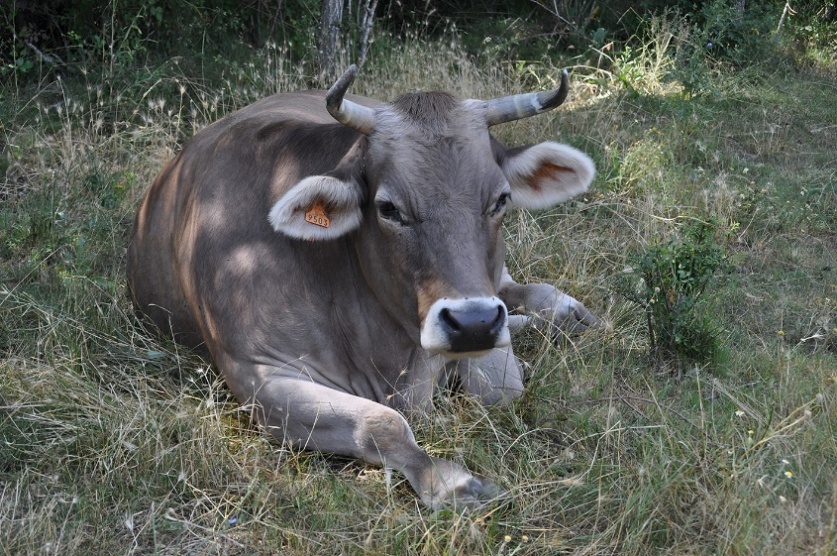 Throughout her life, Dhira showed remarkable courage and determination, grazing in places where other cows did not dare to go. Although she never had a calf, she produced milk for many years and continued to do so until the end of her life. She even lovingly cared for Hanuman, feeding him with her milk when he arrived here at barely a year and a half old. Although we tried to dry her off due to her advanced age, she insisted on continuing to serve, increasing her production up to nine liters in her later years. Even in her final days, she offered 300 ml of milk, demonstrating her devotion until her last breath.” —Damodara Priya
Dhira is an icon of our goshala, a true symbol of what it means to be Krishna’s cow. Among all the special cows of New Vrajamandala, she was the most special one. All of us who knew Dhira closely agree on that. And we all carry her in a special corner of our hearts, for she was a mother who dedicated herself with determination to the service of Radha-Govindacandra.