 Spiritual
Laxmi was a Holstein cow, and Dharma a Brown Alpine bull. From them was born a little calf: Radharani. She was able to drink as much milk as she wanted for as long as she pleased—in fact, she nursed from Laxmi for more than a year.
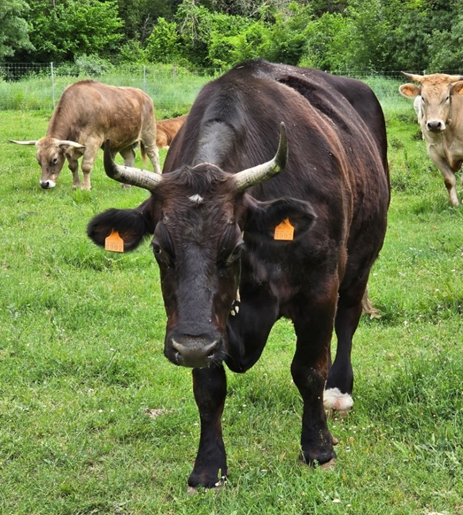 "Radharani was born on October 1, 2008. Her father was the noble Dharma, and her mother was Laxmi, a Holstein cow given to me by Krishna Devi Dasi when her father closed his dairy farm upon retiring.
From a young age, Radharani was independent, clever, and mischievous—just like her mother. At four months old, she was already nibbling on grass and tasting the feed, and by six months she was eating like the adult cows, though she continued nursing for more than a year." —Anadi
Today Radharani is a large black cow. She has slender horns that curve toward the sky, big beautiful eyes with long, even eyelashes. Her legs are strong and elegant, her build graceful, and her gait smooth and dignified.
Her size and character command respect. She is always the last to enter the stalls, and when she does, the other cows step aside from the corridor. Sometimes you can even see a few lowering their heads as she passes. She is the queen of Rupa Goshala.
Though mischievous, Radharani was also gentle but very reserved. It is not easy to approach her; she does not like to be touched unless she feels enough trust to allow it. To build a relationship with Radharani requires much patience and affection. Winning her heart is not so simple.
Over time and through daily interaction, we can see how cows respond to us. They’re not like dogs—a dog, with just a bit of bread, quickly trusts you and follows you. With cows it is different: you can give them orders, make them go in or out, but forming a close relationship is another matter. Paul recalls how he came to build his bond with the queen of the goshala.
“Radharani was very sensitive—you could not touch her. Every time I tried to get closer to her, hoping to connect, she would not allow it. My daily routine was that after milking and brushing the cows, I took them out to the field one by one. Before they went out, I would caress each one—the eyes, the face, the fringe, the belly, the neck—and then open the door for her to leave. That is how it was with the first, the second, with all of them. But when it came to Radharani’s stall, no. I simply opened the door and she went out. She would not let me show her any affection; it was the same every day.
Almost four months went by until one day I opened the door and she did not want to go out. She lowered her head in front of me, and I understood instantly: ‘Is she asking me to caress her too?’ From that moment on, she allowed me to stroke her belly, behind her ears, everywhere… and then she would go out to the field. From that day on, she accepted me.
From this experience, I drew a conclusion: for more than three months, she had been watching, watching, watching… She observed my every move, how I treated the others. Every being has its own rhythm for allowing us to come close. With time and daily care, both we and they lose our fears. Many cows have suffered traumas that take time to overcome.” —Paul
Radharani went through two traumas that were difficult to bear. The first occurred when she and Sundari were moved from Anadi’s goshala to Rupa Goshala, located barely a kilometer away. It was a very difficult transfer, as both cows, newly pregnant, did not want to leave. The second trauma happened during childbirth, when she gave birth to a stillborn calf. Anadi recalls:
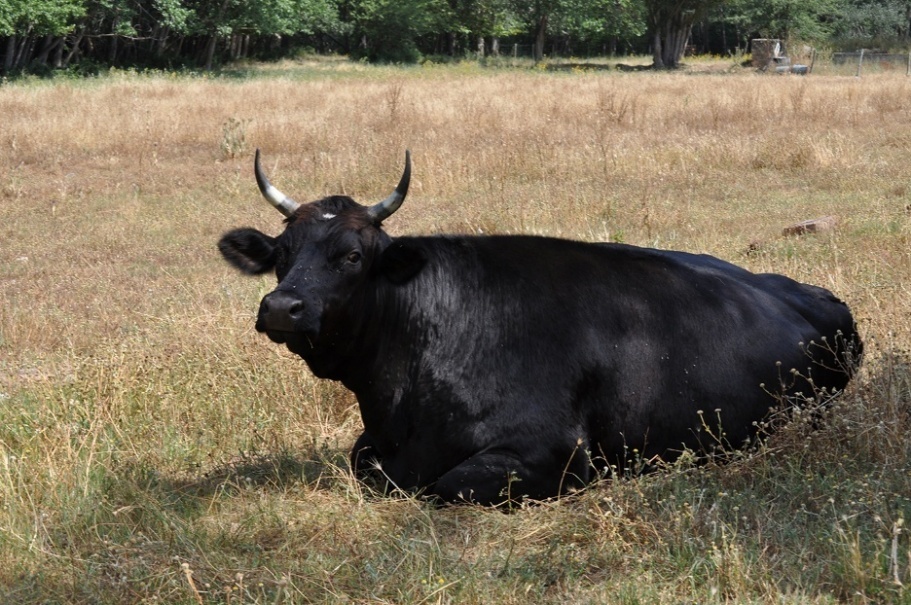
“In May 2012, I gave Radharani and Sundari to the temple’s goshala. At that time, I had nine cows and two bulls, while the temple had only four, as several cows and an ox had recently died. The transfer was traumatic; both cows were three months pregnant, and Radharani lost her calf during birth. She also suffered from being separated from her mother and her companions, becoming more distant. Even so, she continued giving a few liters of milk each day, and thanks to the loving daily care of her keepers, her temperament gradually changed over time.”
The two shocks Radharani endured were so severe that their effects lasted quite some time. However, through the patience and affection of the cowherds, she gradually overcame them. In time, she became gentler and more trusting, allowing herself to be loved by those who inspired her confidence.
“When Radharani and Sundari reached the edge of the fenced area where they lived, they refused to continue walking along the road. There was no way. We were a group of devotees trying to get them to move, pulling them with a rope, but they would not budge. In the end, a tractor came; we tied them and slowly dragged them forward because they dug their hooves into the ground, resisting every step. One of them fell and hurt her knee. It was a mess. It took us a long time to get from one goshala to the other. Then, helping them get used to the new place was not easy either. At first, they slept outside; later we managed to get them into the larger area, at least to eat, because they had not yet integrated with the other cows. Both were pregnant. Sundari gave birth without problems to Jagannatha, an ox who is still with us today. He was born on Ratha-yatra day, and it was a very beautiful story. But Radharani had complications during childbirth. By Krishna’s grace, Prema Murti, who has experience with cows, was there to help me. We made a tremendous effort, but when we finally pulled the calf out, it was already dead.” —Alberto
For more than a decade, Radharani faced these challenges with introspection, courage, and resilience. Her gaze changed and became more solitary, yet she always remained calm and peaceful. Still, milking her after the loss of her calf was a great challenge. The cowherds who accompanied her and still serve her today had to develop new skills in order to handle her.
Alberto recounts that milking her was extremely difficult because she kicked fiercely—it was necessary to tie her legs, and even then it remained dangerous. Over time, as she got to know the cowherds, she gradually became more gentle.
“Once, Alberto went away for two weeks and I was left in charge of the cows. He had already taught me everything, but there was one cow, Radharani, whom only he could milk. It was very difficult for me; I tried, but she would not let me. Even so, I did not lose patience... I kept getting to know her, speaking to her kindly, and treating her well. As the days went by, we connected, and she let me touch her.
One day, when I started milking her, a family arrived with their children, full of happiness. I also felt very happy. While all this was happening, Alberto arrived too, radiating joy. I have those moments etched in my heart: Radharani, Alberto, the family, and I, all sharing a transcendental happiness." —Ratnanga
“Prema Murti and Alberto trained Radharani well, so she always goes to her place on her own when we milk her. In the beginning, she gave only half a liter of milk per day because of the small size and delicacy of her udders. However, after the herd expanded and she had time to rest inside the goshala, her production increased to three liters a day.
Radharani has several sponsors who help with her upkeep. One of them is the brahmacari Rasananda Sankirtana, who spent a long time with us caring for the cows. With great enthusiasm, he cleaned the stalls and had a very special affection for Radharani, whom he always lovingly called ‘Radha,’ and he milked her every day. Now, even from his brahmacari ashram, he continues to send monthly support for her.
Another devotee and dear friend of ours, Sahadeva, visited the cows daily during his long stay at New Vrajamandala and became a great admirer of Radharani, so he also contributes.
Radharani has also inspired Ana and her mother, devotees who live in Lisbon. They have grown very fond of her and faithfully help each month to cover the expenses of her care. They always ask about her well-being. When they come to visit, Ana goes to the village to buy carrots especially for her and for the whole herd. With great devotion, she also offers direct service to all the cows.” —Damodara Priya
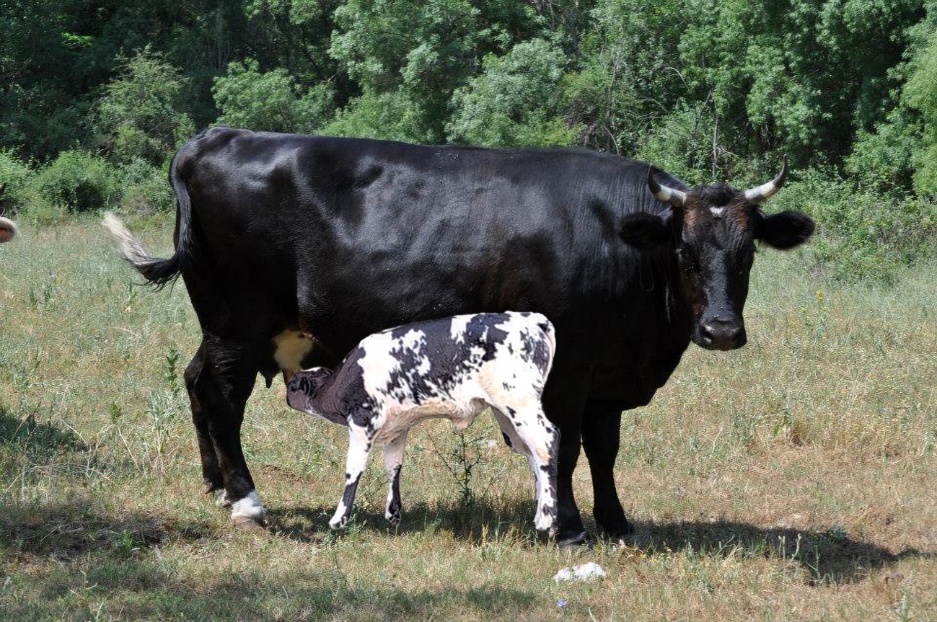 Yamuna-mayi, daughter of Parvati, is a very sweet calf who has the peculiarity of not only suckling from her own mother but also from other cows, including Radharani. In this way, Radharani, who has not had the experience of being a mother, could finally see her wish fulfilled. When Yamuna-mayi suckles from her, Radharani feels so much satisfaction that she closes her eyes and can be seen looking very happy.
Radharani and Yamuna-mayi
"Nowadays, Radharani is much more affectionate and has overcome her trauma. Some cows take a long time to heal, even with good treatment and love from their caretakers. Now she allows us to pet her and shows her gratitude for the attention she receives, being much more integrated into her herd. The day we decided to put a collar around her neck, her eyes shone and her behavior changed. It was as if she felt special..." —Damodara Priya
The story of Radharani invites us to reflect on the sensitivity of cows and the importance of learning with humility from those who have more experience and have already formed a bond with them. We must be fully aware of how we treat them, for they teach us to awaken our own sensitivity.
Cows possess an innate goodness, a purity that we humans often lack. They always remain in the mode of goodness and cannot go to a lower mode. Human beings, on the other hand, fluctuate between goodness, passion, and ignorance. Sometimes, out of impatience or frustration, we expect cows to adapt to our emotional state—but that will never happen. We may hurry them, shout at them, or even mistreat them, but none of that benefits anyone.
The real task is to transform ourselves—to rise to the level of goodness so that we can relate to them with respect and love. Cows do not respond to fear or violence; they respond only to affection. With just our voice, we can convey authority, gratitude, or tenderness. They understand these subtleties and, in return, offer us their protection and unconditional devotion.
Radharani is the beloved black cow of Radha-Govindachandra. She lovingly serves Them with her milk every day, even though she was never able to raise her calf. Today she is 17 years old, 13 of which she has spent offering her milk to Their Lordships.