 Spiritual
I offer my obeisances again and again to Krishna,
the Supreme Lord, who is the protector
and benefactor of the cows and the brahmanas.
He is the well-wisher of the entire human society
and the world. To Him, Govinda, I offer my obeisances.
This verse from the Vishnu Purana describes Krishna as the protector and benefactor of the cows, and in many artistic representations we see Him surrounded by cows. We may wonder: Why? What is so special about this animal?
From the Brahma-samhita we understand that God has unlimited transcendental forms. Being supreme and all-powerful, He is the original and oldest person, and at the same time, a charming youth whose favorite pastime is to care for cows in abodes made of spiritual gems. For this reason, He is known as Govinda (the one who gives pleasure to the cows) and Gopala (the one who protects the cows); His abode is known as Goloka (the planet of the cows), and His companions are known as gopas (cowherd boys) and gopis (cowherd girls).
In the Bhagavad-gita (18.44), Krishna recommends go-raksya (cow protection) as an essential principle for a truly advanced human society.
The Founder-Acharya of the International Society for Krishna Consciousness, His Divine Grace A. C. Bhaktivedanta Swami Prabhupada, taught that the world can live in peace only with a spiritually reformed social structure. The highest form of such a society is one based on cultivation of the land, protection of the cow, and care for the environment.
In the Vedic tradition, the cow is considered a mother and the bull a father, because the cow provides milk and the bull helps produce grains by plowing the land. Therefore, followers of the Vedic way of life hold cows and bulls in great respect and would never harm them, much less kill them for their flesh.
In the West, however, the notion that cows should be respected and protected is often considered somewhat naïve, if not outright absurd, leading to the use of the term “sacred cow” to deride anything considered inappropriately untouchable. Consequently, some Western observers complain that in India cows roam freely on streets and roads, creating what they regard as a nuisance, when in their view it would be better to use them to feed the poor.
Therefore, part of the mission of the Krishna consciousness movement is to propagate the philosophical basis for the protection of cows and establish cow shelters where cow protection is practiced and its benefits are demonstrated. Rupa Goshala, in New Vrajamandala, the Hare Krishna rural community in central Spain, is an excellent example of this philosophy in practice.
Cows are very sensitive and can perceive when they will not be slaughtered. They respond to the affection of their caretakers so much that at Rupa Goshala there have been and are today several cows producing milk even without ever having had a calf. Their amazing stories are told in this book.
The cow care center of New Vrajamandala has existed for over 40 years. During this time, thousands of visitors have had a unique experience with happy, well-cared-for cows, who often passed on their good mood to those who were receptive enough.
In fact, in recent years cow cuddling has become more than just a passing wellness fad. With immense benefits for mental health, the practice has gained increasing worldwide appeal, once again showing that cows are not ordinary animals but unique beings. It is therefore not surprising that they are Krishna’s favorite pets.
Consequently, those who treat cows with respect and love, attend to their needs, and teach others how to appreciate these wonderful creatures will experience countless blessings, both from the cows themselves and from their supreme protector, Gopala Govinda Himself.
Bhakti Gauravani Goswami
Gopastami Puja
November 9, 2024
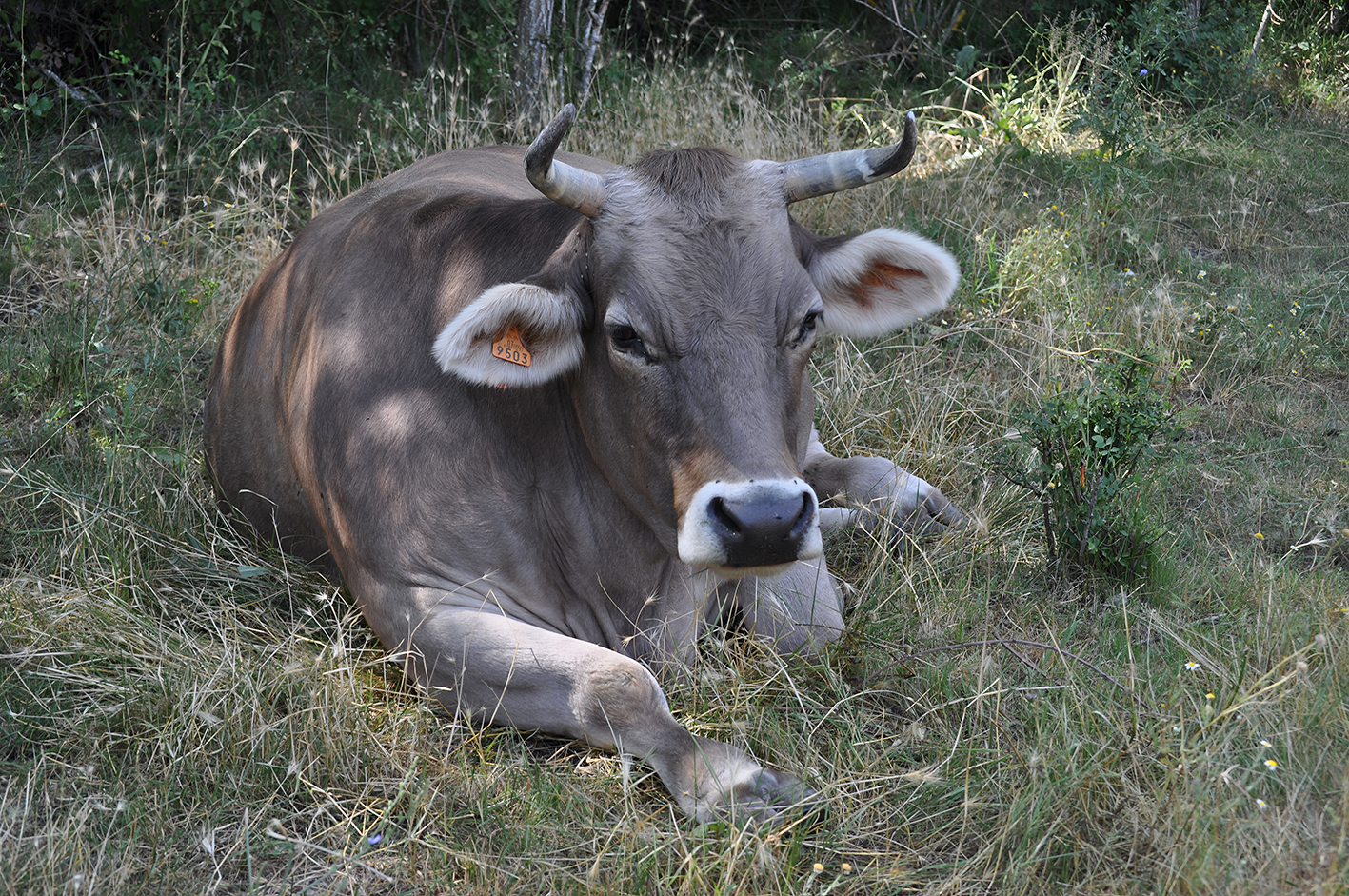
Dhira