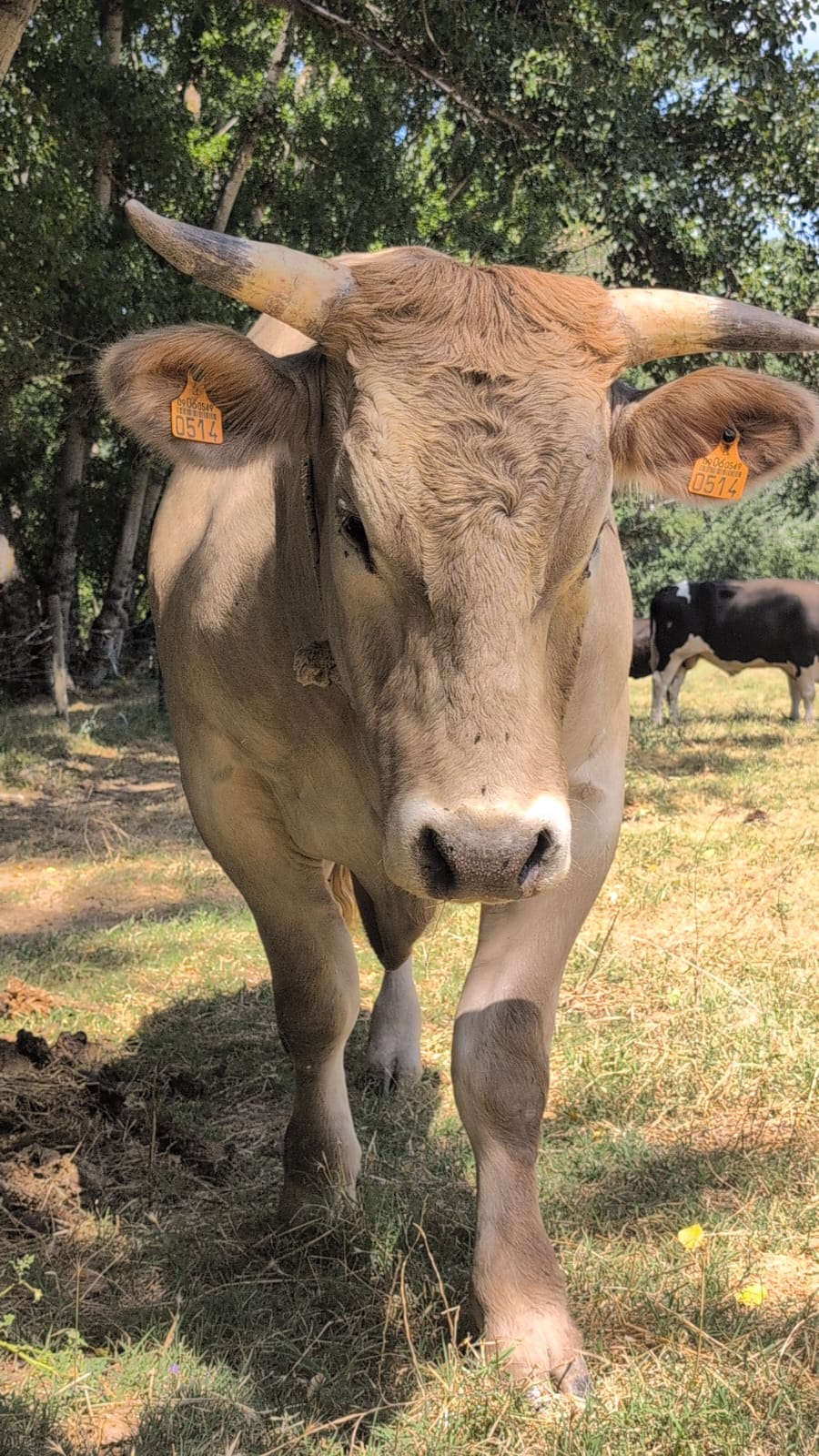
Krishna’s Cows in New Vrajamandala

Introduction

In these pages, the reader will come closer to a world where everyday simplicity becomes an offering, and the life of seemingly ordinary animals reveals an unsuspected spiritual depth. Krishna’s Cows in New Vrajamandala is not just a book about cows: it is an invitation to look with new eyes at the relationship between the human, the natural, and the divine.

The Vaishnava tradition teaches that cows are very dear to Krishna, the cowherd boy of Vrindavan. They are not regarded merely as a source of food or sustenance, but as companions in life, symbols of abundance, and emblems of a culture founded on compassion. In New Vrajamandala, a spiritual community located near Brihuega, in Spain’s province of Guadalajara, that vision becomes tangible: there the devotees have endeavored to care for the cows as an essential part of their devotional service to Krishna. This book captures that spirit and offers it to the reader with tenderness and clarity.

A central place in this account belongs to Alberto, known in the community as “Alberto ‘il’ vaquero”, Albert the cowherd, and today as Arjuna Dasa. For two decades he dedicated his life to caring for Krishna’s cows with patience, devotion, and love. It was he who, aware of the value of that experience and the need to preserve it, asked Madhavi Devi Dasi to put it into writing. Without his testimony and initiative, this book would never have come to light. His voice resonates in these pages like that of a caring guardian, who turned daily work into sacred service.

AŌer his time, since 2017, Dina Sharana Dasa and Damodara Priya Devi Dasi have continued that mission with the same spirit of dedication. For more than eight years this devotee couple has cared for the cows in an exemplary way, keeping the legacy alive and adding their own loving and excellent service. Thanks to them, New Vrajamandala has been able to continue offering the cows the care and respect taught by the Vaishnava tradition.

At the same time, this book is also a collective homage. Throughout the history of New Vrajamandala, from late 1979 to the present day, numerous cowherds—men and women—, have, with greater or lesser visibility, served Krishna’s cows with dedication. Their names may not all be recorded here, but their effort and devotion form an essential part of this history. Likewise, special recognition is due to all those who have contributed their material and spiritual support: from large and small donations to the generous sponsorship of members of the Hindu community, devotees, and friends whose hearts value this service so dear to Krishna and so beneficial to humanity.

At the same time, this book is a mosaic of voices. Members of the community have shared here their memories, anecdotes, and extraordinary experiences with the cows. Some of those stories verge on the magical: moments when the presence of these animals revealed a mystery or a lesson that went beyond the ordinary. By gathering these experiences, the text becomes a choral chronicle that preserves the living memory of New Vrajamandala.

Reading this book is not reserved only for practitioners of the Vaishnava tradition. Anyone who approaches these pages with an open heart can discover in them universal values: care for nature, reverence for living beings, the possibility of living in harmony with what surrounds us. In times when hurry and disconnection define modern life, texts like this remind us that there is another way to live in this world.

I invite the reader to walk through these pages as one who strolls unhurriedly through a meadow at dawn, listening to the serene lowing of the cows and breathing the fresh air that carries with it the promise of a new day. May this book inspire us to recognize in every creature the divine spark and to understand, as Krishna’s devotees well know, that the loving care of cows is a special form of service to the Supreme.

Thanks to the sensitivity and dedication of Madhavi Devi Dasi, this testimony has not been lost in the memory of a few, but now opens to the world as a written legacy. She has gathered the voice of Arjuna, Dina Sharana, and Damodara Priya, as well as other devotees, and has interwoven them with her own vision. The result is a book that is at once a homage, a chronicle, and a devotional offering.

Yadunandana Swami
President of New Vrajamandala
September 2, 2025