 Spiritual
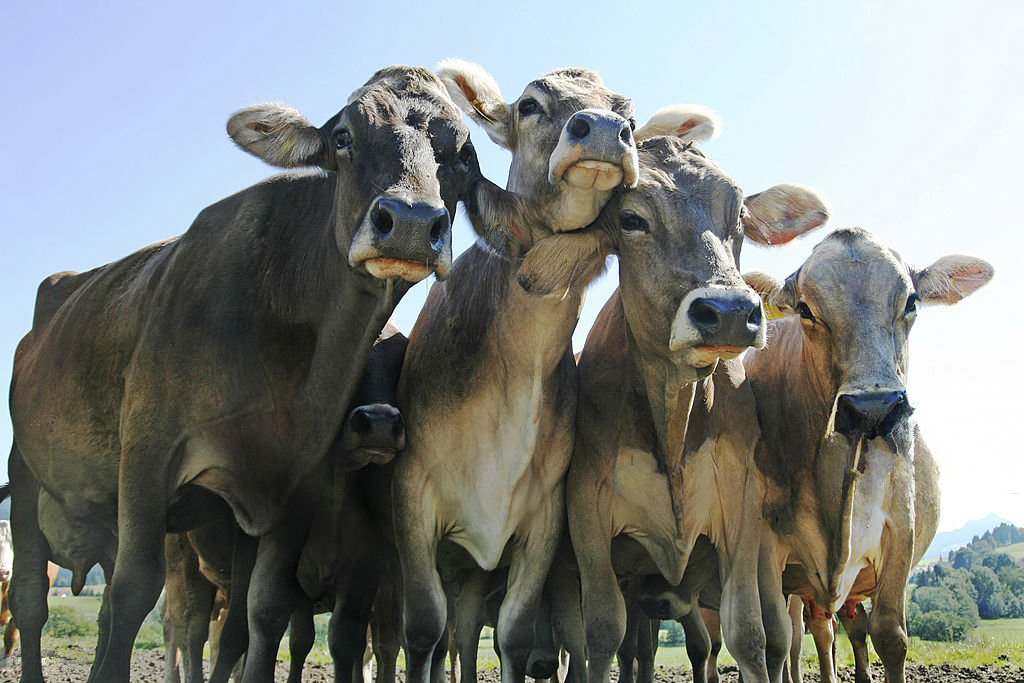
“A person who serves the cow and cares for her in every way receives from her the rarest blessing. Do not feel envy toward the cow, not even in your mind. Always try to please her and serve her as much as possible. Offer her respect and worship her. A human being who gladly serves the cow daily becomes fit to receive great prosperity.”
 Vishnu-dharmottara II, Sacred Cow
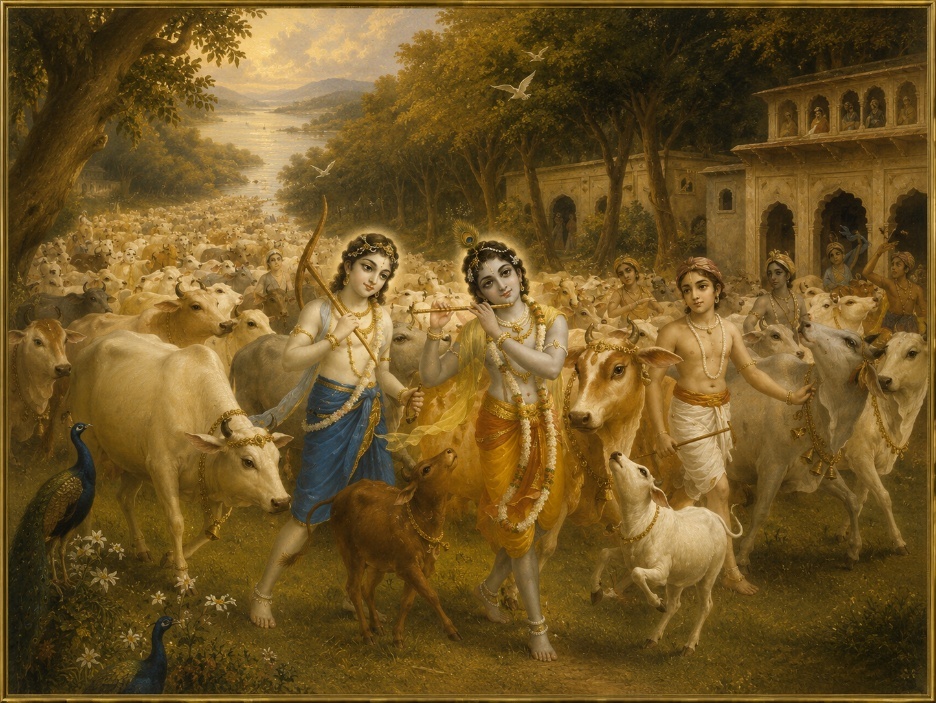
Krishna’s cowherd boy friends in Goloka Vrindavan, the gopas, spend their days in the beautiful pastures of Vraja. They usually wear silk garments, adorned with ribbons and flowers gathered from the forest. Often they wear flower garlands, bracelets, and turbans. And, just like Krishna, their sweet faces radiate innocence and joy. The gopas spend their days running, singing, dancing, and playing with Krishna. They have boundless energy and a contagious laughter, dedicating themselves to caring for cows and calves by taking them to the greenest pastures and allowing them to drink fresh water from the rivers.
They love to play hide-and-seek, tug-of-war, or simply run and jump among the trees. They often share their lunches, enjoying the food lovingly prepared by their mothers. This is how Krishna and the cowherd boys maintain a relationship full of love, friendship, laughter, and complicity, where challenges and difficulties only serve to strengthen their loving bond even more.
The cowherds of New Vrajamandala live a lifestyle deeply connected to the Vaishnava tradition and culture, though they also know how to adjust to the changes of modern times. Their daily lives may be different from those of the cowherd boys who tended cows with Krishna in His transcendental pastimes, but still, they maintain a special bond with the cows, considered sacred in Vedic culture.
Our cowherds, dressed in simple clothes and wearing tulasi wood beads around their necks, continue to care for the cows: taking them to graze, hand-milking them, treating them when they are sick, giving them fresh water and abundant food. They also process the milk to produce yogurt and fresh cheese, butter and ghee, clean the goshala, welcome visitors, manage the economy, and make decisions about new projects they seek to carry out to improve the establishment—these, among many other tasks.
“Taking care of the cows is not just a service, it is a mission. Being a cowherd does not only mean coming to milk, graze the cows, and feed them. No. Being a cowherd is like being a firefighter: we have to be alert 24 hours a day to what is happening with the cows. We must always be ready to protect them and help them out of difficulties. They are our family, our mothers, and we must always be available for them.” – Dina Sharana
The cowherds, being devotees of Krishna, regard the cows as members of their household. They listen to and chant the holy names of Krishna while caring for them, keeping the spiritual tradition alive. But this does not mean that only Krishna’s devotees can be good 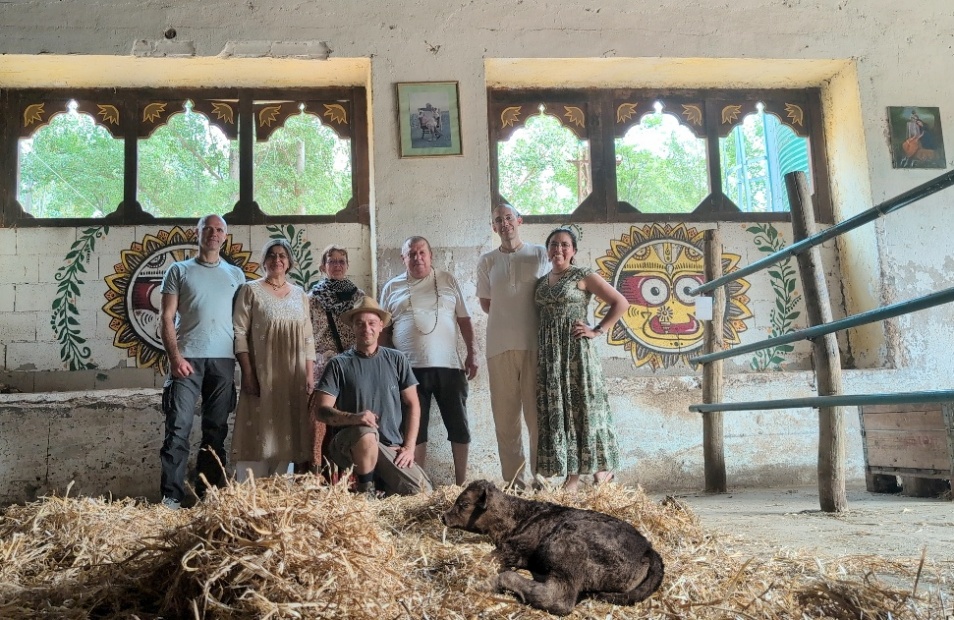 cowherds.
From left to right: Dina Sharana, Damodara Priya, Pushpa Gopal, Paul, Arjuna, Parama Karuna and Madhavi, with Krishnachandra
My grandparents, for example, were also cowherds but they knew nothing about Krishna consciousness. Nevertheless, they cared for their cows and other animals with love and dedication. When a cow grew old, some neighbors would suggest sending her to the slaughterhouse, but my grandfather was completely against it. He would say, “How can you do that? After she has given you so much! Let her die at home, peacefully.”
They, among many others, are examples that to lovingly care for cows it is not necessary to become a devotee of Krishna. It is enough to become a little more conscious and do what we can from our own position. However, being a cowherd and a devotee at the same time is an ideal combination, because the devotee can feel Krishna more deeply, and Krishna will manifest a special favor toward him.
In Rupa Goshala we can point to many cowherds who have dedicated time and sacrifice to the care of the cows: Jitendriya Dasa, Anadi Krishna Dasa, Mahalaksmi Devi Dasi, Venudhara Dasa, Parama-dhama Dasa, Adirasa Dasa, Haridvar Dasa, Gauracandra Dasa, Prithu Dasa[1], Surabhi Dasa, Pushpa Gopala Devi Dasi, Alberto (Arjuna Dasa), Vanamali Dasa, Vraja-jana-ranjana Dasa, Ratnanga Dasa, Víctor, Carlos, Paul, Dina Sharana Dasa, Damodara Priya Devi Dasi, Parama Karuna Dasa… among many others, to whom we are deeply grateful.
To them, and to so many more, we owe our respect and sincere appreciation, for they have carried out a service that, in many cases, no one else was willing to take on. Not everyone is ready to rise early every day, regardless of whether it is New Year’s Day or Christmas, whether it rains or snows, whether they are healthy or ill. Every morning and every evening, they were there, because the cows were waiting for them.
Many of them were not cowherds in the beginning; they knew nothing about cows, but they dared to try. That courage which arose in their hearts, inspired by the desire to please Krishna, has borne such fruit that even the most experienced cowherds—those coming from generations dedicated to caring for cattle—are astonished and admire them.
An example is Arjuna Dasa, formerly known as “Alberto ‘il’ vaquero,” the son of Italian parents, who came to know the devotees and Krishna consciousness in Amsterdam in the early 1980s. Later, during a vacation in Spain, he met the devotees again and visited New Vrajamandala for the first time. Arjuna remembers:
“In the following years I would go back and forth from Italy. Sometimes I stayed two or three months at the farm, once even six months. Finally, in December 1998, I returned again and began going down to the goshala every day. I had always liked animals, so I would bring fruit and vegetables to the cows and I learned to brush them.
At that time, Adirasa was taking care of the cows, and one day he taught me how to milk. Afterward he asked me if I could stay a month to do this service, because he wanted to go out to distribute books during the sankirtan marathon. Before leaving, he told me: ‘Do not worry if at first they do not give much milk, because they do not know you. The important thing is to milk them twice a day.’ By Krishna’s mercy, there was no problem. On the contrary: within a few days the 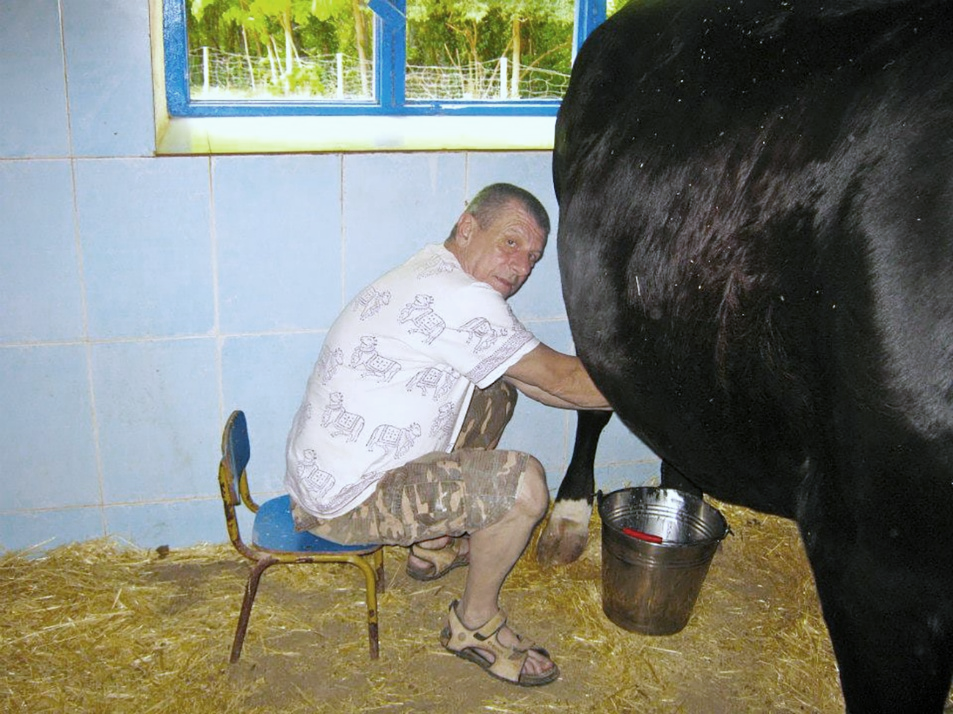 cows gave more milk than expected.”
Arjuna milking Radharani
“The following year I came back again and, since Adirasa wanted to change his service, Yadunandana asked me to stay on as head of the goshala. Without thinking twice, I accepted, and thus began my wonderful adventure with the cows.”
Damodara Priya and Dina Sharana also had no experience with a life dedicated to caring for animals on a farm. Dina Sharana explains:
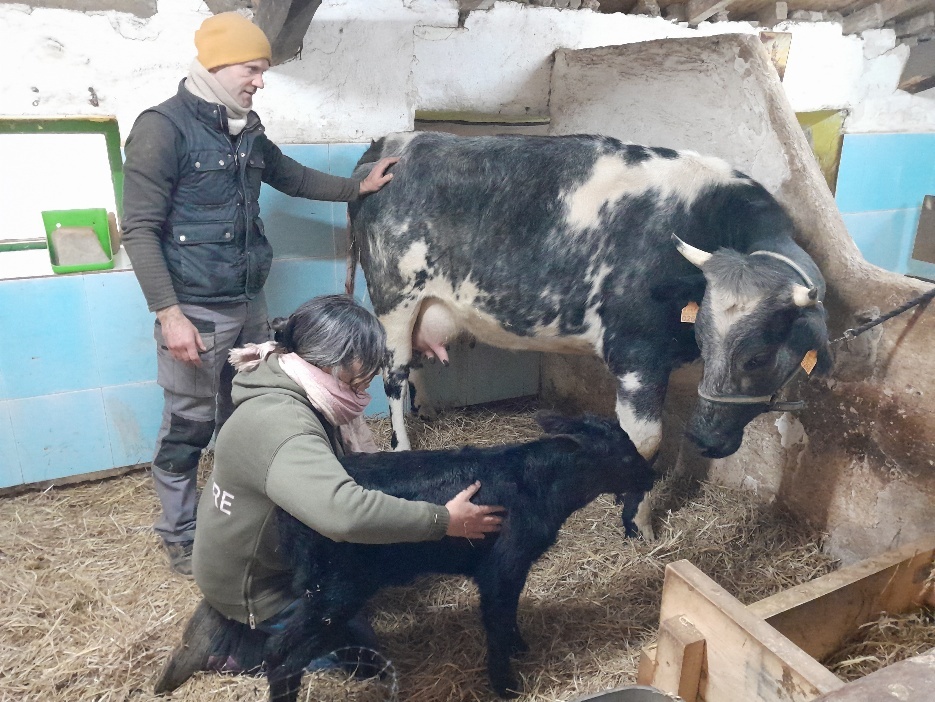 “We had never lived in the countryside, always in cities, with our own business… but we came to New Vrajamandala to care for the cows and, truly, now our entire inner life has changed. Being with them, we live more in goodness, in peace, and in love. This cowherd life is the best I have had so far, and I will continue here with the cows. As Srila Prabhupada says: cows are not just animals, they are mothers, they are full of love and they transmit that love to everyone. We can feel it, and they still have more to offer to all who wish to come and visit them.”
Dina Sharana and Damodara Priya with Parvati and her calf Ganesh Radharani
Both Arjuna and Dina Sharana, as well as Damodara Priya, agree that being cowherds is the best thing in their lives. Their lives changed completely.
 Another example is Paul who is from Transylvania, a region of Romania. At the age of 19 he came to Spain and, after living a year in Madrid, he met a devotee. Paul was already searching for meaning in his life and, after listening repeatedly to the devotee’s explanation of the Kṛṣṇa conscious philosophy, Paul felt that Krishna consciousness was what he had been looking for.
Paul with Yamuna-mayi and Krishnachandra
When he arrived shortly afterward at New Vrajamandala, he soon began going regularly down to the goshala, where he met Alberto, who taught him how to milk and perform other services for the cows.
He also helped at Anadi’s goshala, where he learned many things and began to recall his childhood, since his father had kept some cows.
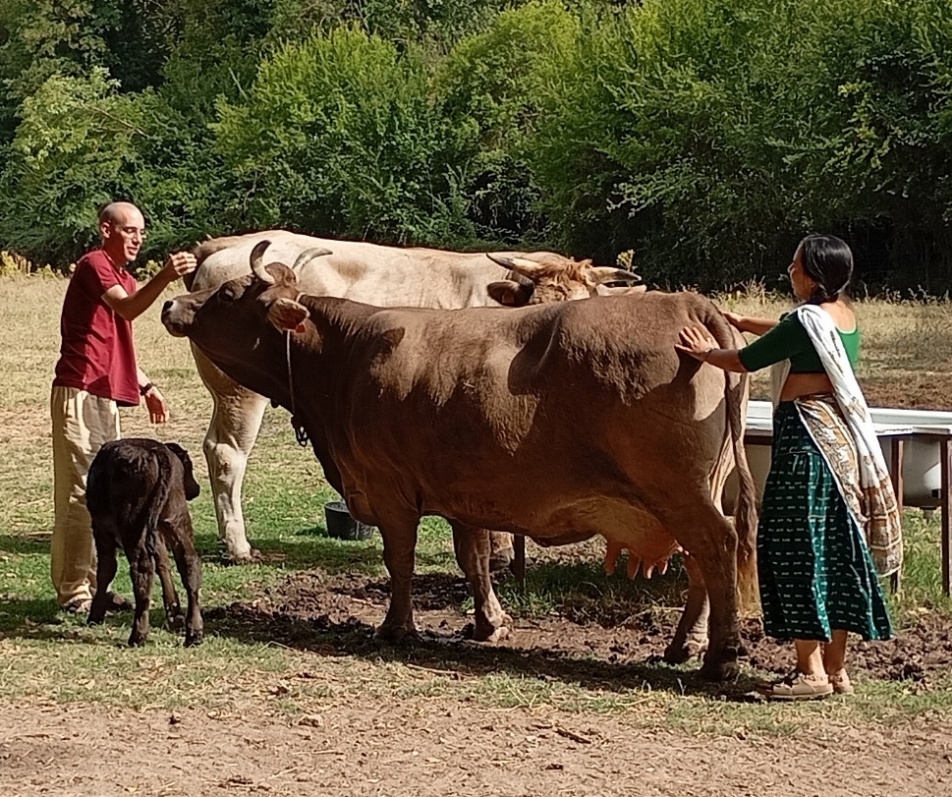
Parama Karuna and Madhavi with Madhurya and her calf Krishnachandra
As for my husband, Parama Karuna, and myself, although our experience as cowherds is very short, we can also say that our lives have completely changed since we decided to dedicate ourselves to this service.
 Serving the cows offers the opportunity to experience what “simple living and high thinking” truly means, because with cows we cannot be any other way. With them we must be simple; we cannot live an extravagant or complicated life, as that is incompatible. Pushpa Gopal Devi Dasi tells us:
“The stories we live as cowherd girls shape our relationship with the cows. So many anxieties we sometimes have to go through… There are many tests that arise in Kali-yuga. In these times it is not easy to be a cow, and it is not easy to be a cowherd girl and care for her either, because the truth is that real protection can only be provided by Krishna. Even if you are a good devotee or a good cowherd girl, you are not exempt from challenges and obstacles. We depend on Krishna’s mercy, and if Krishna wants something to happen, then it will happen. We cannot change the Lord’s decision.”
When we see a painting of Krishna with the cowherd boys and cows, we may develop in our minds a picturesque image or a happy idea. But when we cowherds live the day-to-day reality, we do not always see that joy reflected as it appears in the paintings of the sacred books. In my short time as a cowherd girl, I've learned that serving Krishna’s cows involves crucial moments where there is no time to think—moments that demand action in the immediate now, without time for reflection. In those seconds I fully felt how Krishna was arranging to give inspiration within the heart through His form as the Supersoul. Many times I believed myself incapable of doing things that I finally ended up doing. I know those accomplishments happened because Krishna Himself is taking care of His cows. He is looking after them and using us as instruments. So, although my experience is small, for me it is very meaningful.
Arjuna Dasa says that he lived many such stories, in which at first he did not understand how something comes that you do not expect—those ideas, that inspiration that some higher power sends from above:
“It is very nice to be a cowherd, but to be honest: it is also nice when it is over. Now I receive much mercy for having cared for the cows—such as my trips to India or my initiation. But being a cowherd every day… it is, of course, a rewarding service, but it is also very demanding. Because you have to be there every day, morning and evening. And for a long time I was alone, with no help, no one else to milk or clean. But somehow I managed to do it.
Later I realized that I was never alone. Within me is Krishna, who gives me strength—a strength that is not mine, that I never had. I have always been a bit lazy. But not in the goshala: there I had a strength and an inspiration that came from within. Sometimes I would get there in the morning and find some situation and did not know what to do… At that moment you do not think, because Krishna directly takes charge and you do not even know how.
In the past, there were times when only very few devotees lived here on the farm. Not like now, when being among so many devotees is normal. Before, it was very hard, but we fulfilled our duty. Because Krishna loves the cows very much. Krishna never allowed His cows to go without food. If we do the service properly, with affection and love, Krishna takes 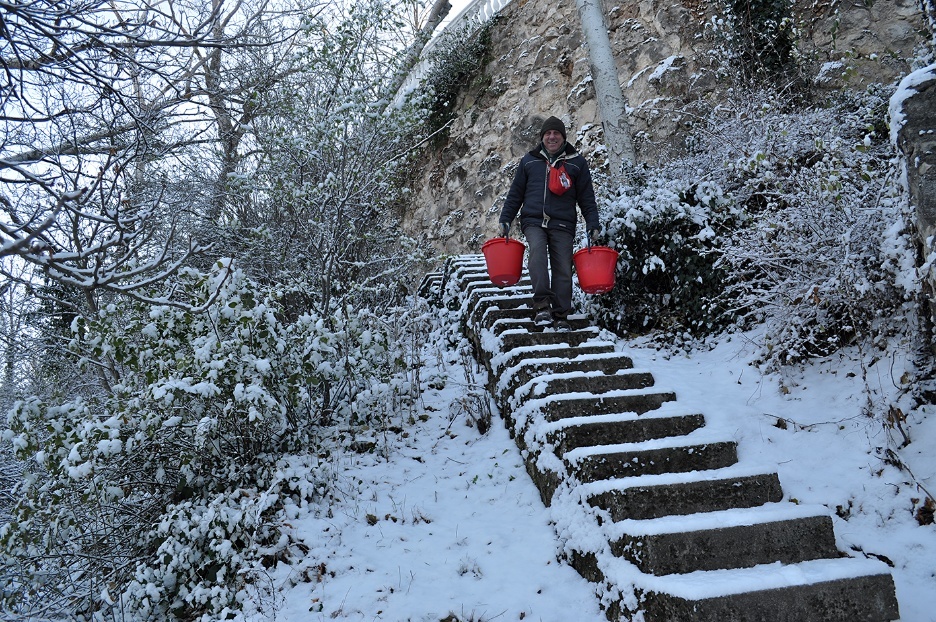 care of the rest. There is no need to worry.”
Alberto taking milk to the kitchen
Arjuna Dasa was not called by this name when he was a cowherd. He received it gloriously from his spiritual master, Purusatraya Swami. His name means “servant of Arjuna,” the greatest of warriors and Krishna’s most intimate friend. Before that, Arjuna was known as Alberto, the name his parents gave him at birth. But after dedicating himself to the process of Krishna consciousness and serving the cows for so many years, his consciousness showed the signs of firm and established faith, and thus he surrendered to his spiritual master and received initiation.
 For his part, Arjuna attributes all this merit to his beloved cows and says that any blessing he may receive is due to Krishna’s high regard for the service he performed as a cowherd. Although Arjuna Dasa is no longer Alberto, I decided to tell these stories using his former name, to preserve the originality of the accounts.
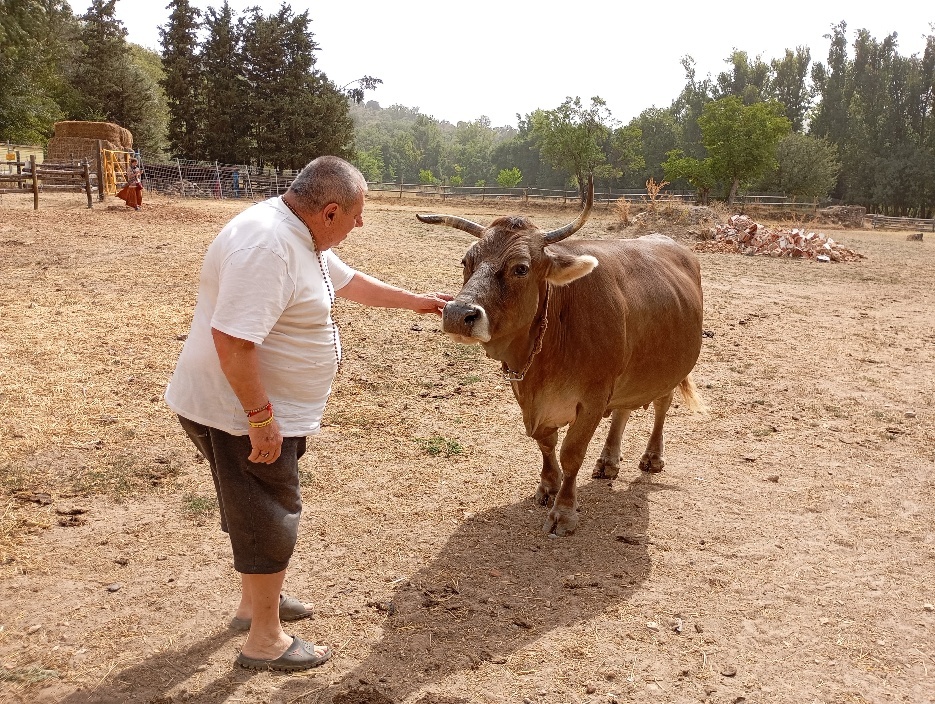
Arjuna with Rasa