 Spiritual
Pushpa Gopal and Godruma-pati had long cherished the desire to offer more milk to the Deities. At that time, among the four cows they had, only about three liters of milk were obtained daily. There were not many cows, and Alberto, after serving them for so long almost on his own, was not ready to take on the responsibility of bringing in more animals.
But when Dina Sharana and Damodara Priya arrived, they assessed the situation together with Alberto and, with the help and goodwill of Pushpa and Godruma-pati, decided to buy two more cows for Rupa Goshala. One would be donated by Pushpa Gopal and Godruma-pati, and the other would be sponsored by a great friend of the cows, Oleg Ulyanov.
Alberto knew where to buy them—from a dairy farm near Madrid—because he had prior experience and personally took charge of speaking with the owner. He asked if there were any pregnant cows, and the owner said yes. Then he told the others, “It is better to buy pregnant cows; that way, later on, we’ll have four instead of two.”
However, Damodara Priya was concerned. She agreed with expanding the herd but felt her experience was not yet enough to go so quickly from four to eight cows. Then Yadunandana Swami said to her, “Do not worry—Krishna always helps.”
Thus, Damodara Priya surrendered to the will of Krishna and the devotees, trusting that she would be able to do it. That faithful surrender was a very important step, for later, together with her husband Dina Sharana, she would come to care for a herd of seventeen animals—including cows, oxen, a bull, calves, a donkey named Ramanya, and several sheep.
It was winter, and when the devotees organized the trip to Madrid, it was cold, raining, and in some areas there was snow. Even so, they went, and there they met the cowherd—a man who cared for his cows as if they were part of his family. It was clear that he was fond of them: he took them out to pasture every day; they were well cared for and looked healthy and beautiful. However, the man could not afford to keep them all and was forced to part with some. It was very sad.
The devotees had to choose only two among the twenty-five cows there. It was very difficult, because they were all beautiful. Pushpa Gopal recalls:
“I thought, I’m going to bring prasadam. If I offer them prasadam, they’ll come to eat, and that way we’ll know… the one who likes it must be a devotee.
But there was one in particular who loved it. She eagerly looked for more and always wanted another piece. She even became a bit restless from excitement. That cow’s name was Margarita. We chose her, but the owner did not want to sell her because she was pregnant and close to giving birth.”
Dina Sharana was convinced that she had to be the one, because she had accepted the prasadam with such enthusiasm. It was an excellent sign. Determined, he went to speak with the owner and, after some time, managed to persuade him. That is how Margarita came to our goshala.
We gave her the name Madhurya (“the Sweet One”), because what most distinguishes her is her splendid temperament—her sweetness, love, and gentleness. There is no other cow in Rupa Goshala with those qualities. Moreover, her life so far has been very peaceful; she has never suffered from any problems or trauma.
But aside from Madhurya, there was another cow who also stood out for her appetite: Rasa. She ate and ate—she never stopped! So, in the end, they brought the two cows who had been the most excited about the empanada-prasadam.

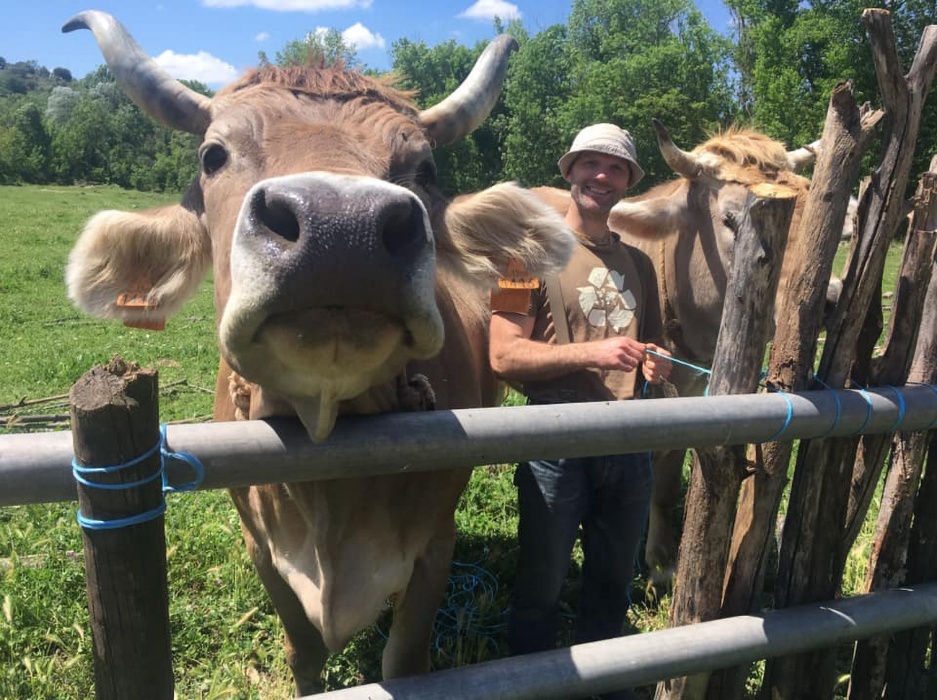
Rasa receiving prasadam from Godruma-pati
Madhurya and Dina Sharana

 Frankly, they could have taken them all, because every one of them was beautiful. But those two, besides their fondness for prasadam, also showed excellent physical and anatomical form. Godruma-pati recalls:
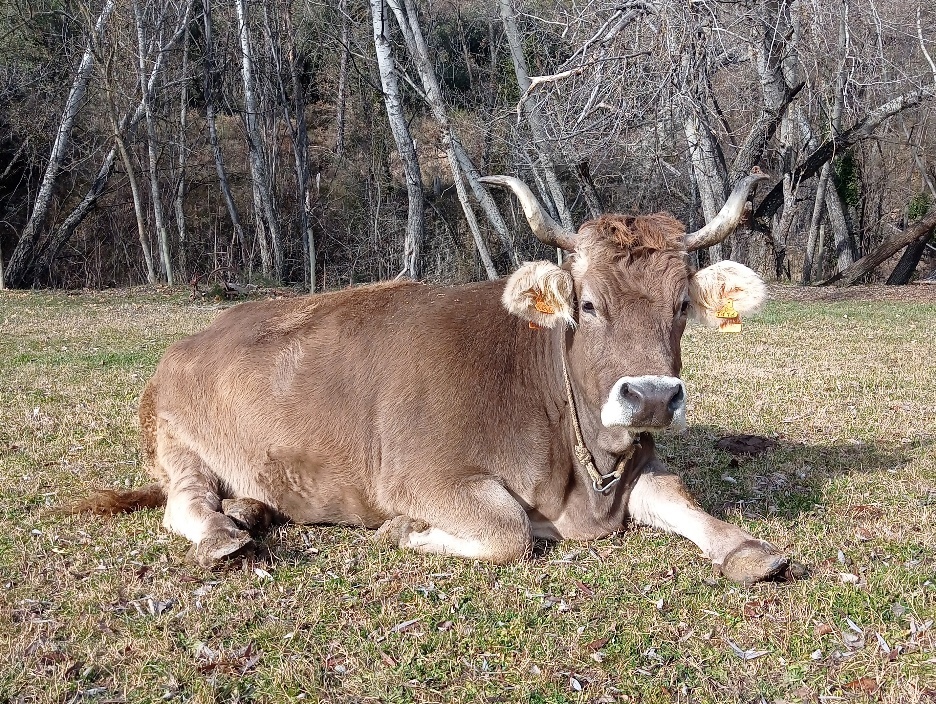
Madhurya digesting prasadam
Rasa waiting for prasadam
“Among all the cows, Rasa caught my attention because from the very beginning she allowed herself to be petted and enjoyed that affectionate contact with the devotees. It was as if, with her tender and loving gaze, she was saying, ‘Choose me, take me with you.’ In the end, we chose this cow as well and decided to name her ‘Rasa’ because of her sweet and loving nature, which she always shows to everyone.”
Both cows were pregnant, and soon after they gave birth without any complications. Madhurya gave birth to Baladeva, and twenty days later, Rasa had Subhadra.
Baladeva — The Fearless Saint
Baladeva was born on June 24, 2018. The birth had some complications, as he seemed reluctant to leave his mother Madhurya’s womb. Since the time had come, the cowherds had to pull him out by his legs.
Madhurya is a very traditional mother, like mothers of old, always keeping her calf well under control. Even after her son Baladeva grew up and became a large ox, she continued to care for him and stayed close by his side.
From the very beginning of his life, Baladeva was always surrounded by his caretakers. He received plenty of affection and love, especially from Damodara Priya and Dina Sharana.
He grew up happy and always trusting toward people. Having never suffered mistreatment, to this day he allows everyone to pet him; he loves being brushed and shown affection.
Baladeva is quite adventurous. Sometimes he crosses the river to graze on a small island. And although he is calm and tame, he enjoys rough play—especially with his friend, the ox Hanuman, and lately also with the new ox Arjuna.
 Once, when Baladeva was six months old, he was grazing near the edge of the canal. He did not notice Hanuman coming up behind him, and Hanuman pushed him. Baladeva fell into the water.
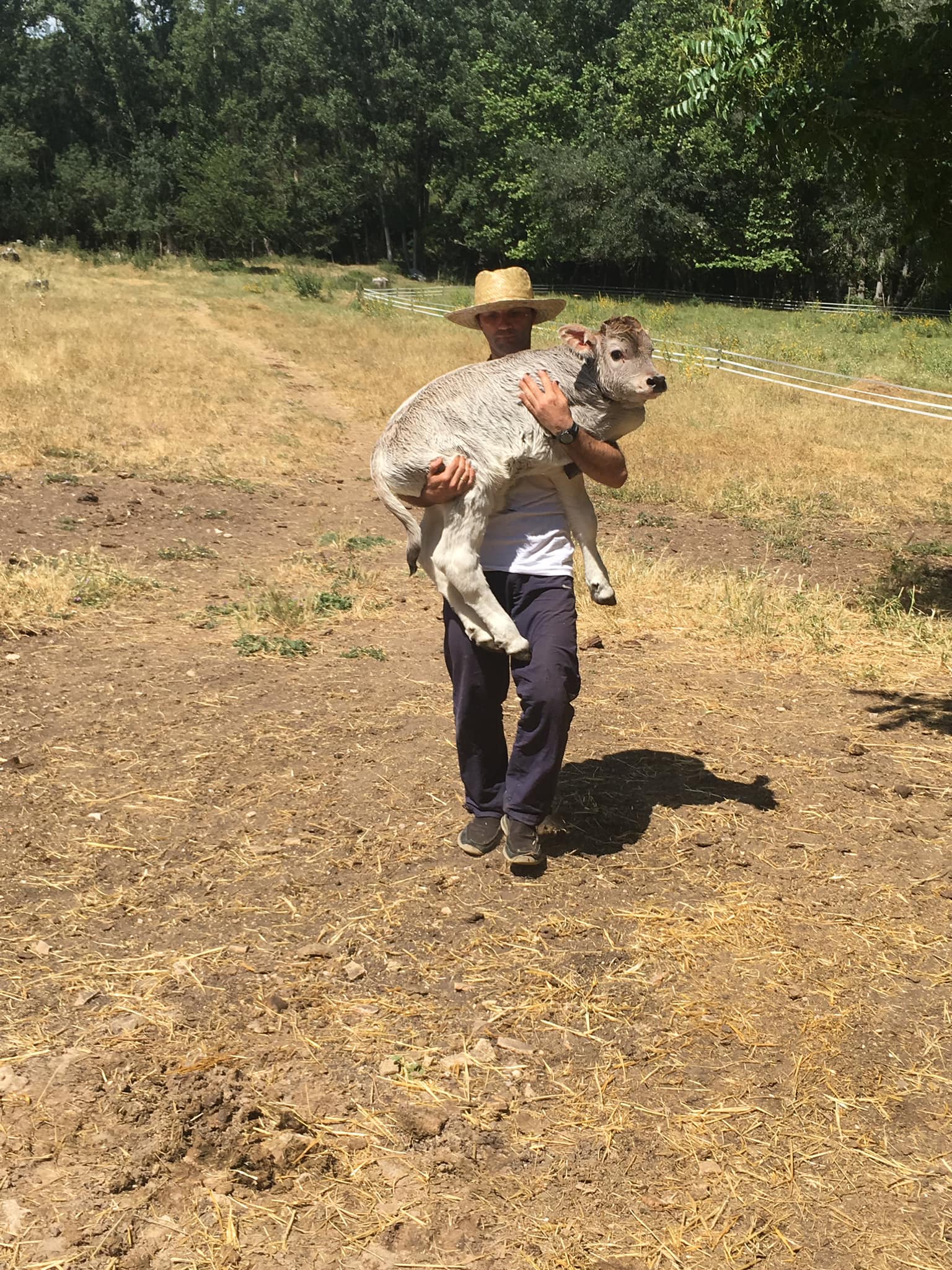
Dina Sharana carrying newborn Baladeva
“It was December, and the water was freezing. When Damodara Priya saw Baladeva in the canal, she let out a loud scream, and all the cows—his mother leading the way—came running. Subhadra came quickly too, because Subhadra is like a sister to Baladeva. She always worries about him. His mother came to protect him and see what was happening.
So I had to get into the canal to try to pull him out. Since the canal is very narrow and deep, he could not get out by himself. When he managed to place his front legs on the edge, he could not lift his hind legs, so I had to help him.
I had to submerge myself and push him up from underneath, lifting him from behind, but even then, he could not make it—he was already very heavy.
I guided him through the water to a shallower spot, but we still could not get him out. So we called for help; someone else came, we tied a rope around his little horns, and while one person pulled the rope to keep him from sliding backward, the other pushed from behind and upward to lift him out of the canal.
 Finally, we managed to pull him out. The whole ordeal lasted nearly an hour, and the two of us were left there, freezing, shivering from the cold.” —Dina Sharana
Baladeva with his mother Madhurya
“I have an experience with Baladeva and all the cows that filled my heart. Once I was out in the field with them, and Baladeva—who was not as big back then, maybe half his current size—stepped on my foot. He did it in such a way that, besides stepping on me, he also slipped to one side. Of course… I screamed. It was such a loud scream that it echoed through the whole valley. And because I screamed so loudly, all the cows came running toward me. Can you imagine?
Even Radharani—yes, even Radharani—came.
They had all been lying down, some in one field, some in another… and they all came. I can still picture Rasa’s face, alarmed, as if asking, ‘What happened?’ I still have that image in my mind.
Before I knew it, they were all there, worried.
It was a moment that filled me with love… I felt so good seeing them there with me. I realized that while we take care of them, they also take care of us.” —Damodara Priya
 “Baladeva is the kindest, calmest, and most approachable—the sweetest, most loving, and saintly of all. He is trusting, he loves people, petting, and brushing. So much so that if you brush him out in the field, he’ll follow you around so you do not stop, and he won’t let you brush any other cow. Baladeva is so tolerant that you can do anything to him, and he’ll just stand there, undisturbed.” —Parama Karuna
Baladeva in his youth
Baladeva likes to challenge Arjuna to see who is stronger. They lock horns and begin to push. Baladeva is enormous—one of the most impressive oxen you have ever seen. Arjuna, on the other hand, is still a young and growing ox, smaller but full of spirit. It might seem that Baladeva takes advantage by facing such a young rival. But Arjuna, though smaller, is pure muscle, pure strength.
Madhurya, for her part, also has her own character: she is quite steady in her habits—she always does the same things and sticks to them. I always see her the same way, in the same mood.
The only time I saw her different was when she was in heat. During those days, she did not want to come into the goshala and preferred to stay out in the field. She showed a deep longing to be a mother, so I was overjoyed when I found out she was pregnant. It seems her greatest happiness is motherhood.
Krishnachandra — The Mellow One
When Madhurya gave birth to Krishnachandra, the atmosphere in the goshala changed instantly, filled with the euphoric energy of love radiating from her. It was an incredible experience—just crossing the threshold, everyone could feel a wave of joy sweep through the air.
But the birth itself was a dramatic and suspenseful event.
 Krishnachandra was born on August 14, 2025, just two days before the most auspicious day on the Vaiṣṇava calendar—Janmastami, the appearance day of Krishna. He is black, with curly hair, clearly inheriting the features of his father, Ganesh.
The delivery was complicated because the calf was breech, coming out hind legs first. Normally, calves are born with their front legs and head first. The cowherds had to intervene.
At two in the afternoon, Madhurya began to release the amniotic fluid. Dina Sharana and Paul stayed alert, waiting for the delivery to progress. Three hours passed with no advancement. They called several veterinarians, but none were able to come. The situation was urgent, so they decided to act themselves.
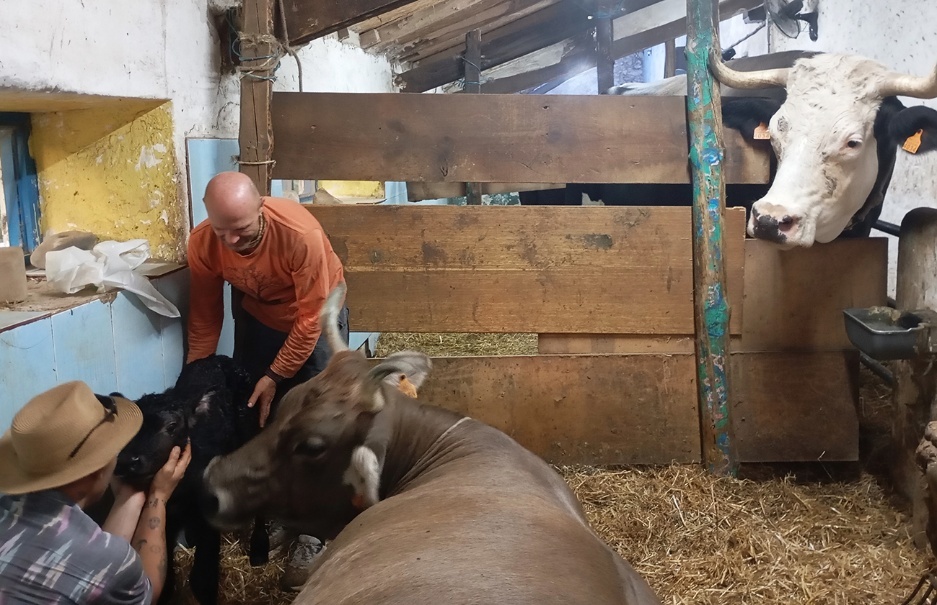 Dina Sharana inserted his hands into the birth canal and quickly located the calf’s legs. They tied them with a soft cloth and began pulling gently. While Paul pulled, Dina Sharana widened the passage and adjusted the body. That is when they realized the calf was upside down. Working together, they slowly repositioned and delivered him.
Paul and Dina Sharana hold newborn Krishnachandra
while Hanuman observes the scene with curiosity
Madhurya, at fourteen years old, had little strength left. She remained standing, trusting and surrendered to her caretakers—her life and her son’s were in their hands. Gradually, with careful effort and coordination, Paul pulled while Dina Sharana guided. Meanwhile, Madhurya, sensing her son’s scent, was frantically searching for him,
 unaware that he was still inside her womb.
Yadunandana Swami greets
the new member of the community
Finally, with one last effort, the little calf fell into Dina Sharana’s arms. Seeing him motionless, Dina grew alarmed and gave him a few gentle taps on the face. Then Krishnachandra began to breathe.
The cowherds stepped back and burst into tears of joy. Dina Sharana recalls the experience:
 “There is no cow—and there will prohably never be another—like Madhurya. When it was all over, we were covered with her saliva and blood. She looked at us and began to lick us clean, just as she did with her newborn calf.”
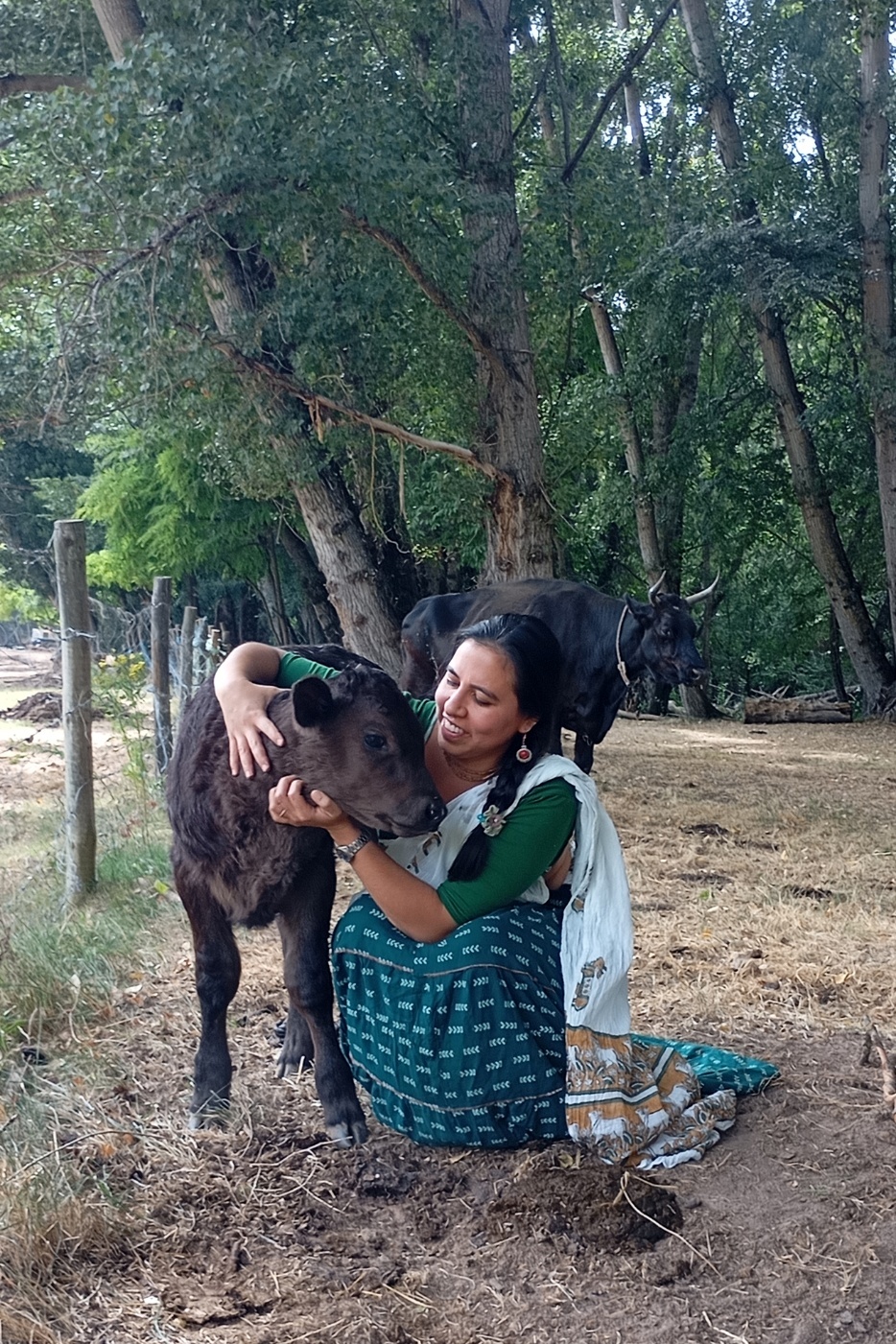
Madhavi fondling Krishnachandra
The delivery had lasted nearly three hours. While the cowherds did everything possible to bring out the calf, the devotees had gathered and were chanting the holy names of the Lord. One group went to pray before an image of Nrisimhadeva kept in the goshala, while another group chanted the Hare Krishna mantra around the stall where the birth was taking place. Yadunandana Maharaja was also present to give blessings and to suggest the name for the black calf—Krishnachandra.
When the delivery ended and it was clear that everything had gone well, they announced his birth by blowing the conch shell, and the chanting became even more joyful and exuberant.
The presence of Krishna in that chanting once again showed how the Supreme Lord personally cares for His cows.
Today, Ganesh—the father of young Krishnachandra—is the fiercest and most rebellious of the goshala, while Madhurya is the sweetest and most loving. Their temperaments are complete opposites, and everyone is eager to see what kind of disposition Krishnachandra will have. In these first days, he already shows quick learning: he plays with Yamuna-mayi and longs for his mother’s affection, which she never tires of giving.
Two weeks later, some aspects of little Krishnachandra’s personality were already evident. He is gentle and kind like his mother and his brother Baladeva. He is very trusting and enjoys human company. He loves being touched and petted.
Krishnachandra has a favorite teat and always tries to nurse from the same one. Sometimes Damodara Priya stays with him and hides that teat so he will nurse from the others, but his mother Madhurya notices and protests in her own way.
Although Krishnachandra is still very young, he is growing fast and healthy—and he promises to be a great treasure for Rupa Goshala.
***
We now continue with the story of the other exceptional mother: Rasa.
As soon as her daughter Subhadra was born, Rasa began producing an abundance of milk—so much that it was not only enough for her calf but could also be brought to the kitchen and shared among the families of the community.
 Rasa is the most intelligent cow of the herd. She is attentive, perceptive, and very sensitive. She responds well to instructions and understands everything happening around her.
“When Madhurya and Rasa were pregnant, I was also pregnant—with Jay Gopal. When Baladeva and Subhadra were born, the cowherds shared some of their colostrum with me, that first, highly nutritious milk, so Jay Gopal received a boost of superfood while still in the womb.” —Gauranga-lila
“I really like the cows’ milk because it is very tasty and sweet. When it is heated, it forms a delicious cream on top.” —Jay Gopal
“One day, Rasa was looking for her daughter Subhadra. She could not see her, so she started calling and searching everywhere. Finally, she came up to me and looked straight at me. I told her, ‘Rasa, Subhadra is over there with Damodara Priya, walking in the field.’ She looked at me as if to say, ‘Ah, okay,’ and then went off in that direction. That day I realized how intelligent these animals are—how they seek us out, how they expect responses. Taking care of them is not something mechanical. The relationship with them is deeply personal. They’re attentive to what we do and want to see that we’re doing things properly.” —Pushpa Gopal
***
Subhadra was only a few weeks old when the provincial government veterinarian came to conduct a tuberculosis inspection. After checking all the cows, he said, “Rasa is questionable.”
The test had not come back negative, but because of a mark on her neck, the vet suspected she might be infected. The devotees explained the origin of the mark and requested a second test. The veterinarian was not convinced and said he would return in a few weeks. If the next test result was still “uncertain” or turned positive, he would take her away to be put down.
Those words caused great fear. Just the thought that Rasa could be taken away brought tears to more than one of the cowherds. Action was taken immediately: Pushpa Gopal and Godrumapati sponsored fresh vegetables—beets, carrots—and she was given charanamrita, the water that had washed Krishna’s lotus feet, and everything possible was done to strengthen her immune system. They also acquired an ozonizer to purify the water and oxygenate her body. All the devotees in the community contributed in their own way, even some who were far from New Vrajamandala..
“Many devotees got involved, each in their own way. Some searched for information, Pushpa sent lots of food, everyone helped however they could, everyone went to see her…” —Damodara Priya
“I was in Mayapur, and the thought that they might take Rasa made me tremble. I went to the altar of Nrisimhadeva and prayed: ‘Please, O Lord, protect Rasa from these people, because they do not know what they’re doing. Help us—the situation is serious. The government has sent a veterinarian, and they’re taking the cows away. Many times these tests are not reliable.’” —Pushpa Gopal
Rasa was not the only one in danger. Many cattle owners in the area reported that cows were being sent to the slaughterhouse without justification. Some veterinarians claimed tuberculosis when it was not true. The medical tests used had an accuracy rate of barely forty percent. Because of this, the results were often unreliable, and based on them, healthy cows were taken from their owners and killed. These cases were later confirmed when autopsies showed that there had been no tuberculosis at all.
When Rasa was labeled “suspect,” the veterinarian ordered that she be separated from the herd. It was a devastating blow. She was taken away from her daughter, and Subhadra was not allowed to drink her milk. They were separated by a fence. Rasa, distressed and deeply affected, stopped eating. She paced restlessly, desperate because she could not be with her calf. Subhadra, on the other side of the field, kept looking for her, calling out, and waiting to nurse, as she always had.
Until Rasa could not take it anymore.
“The fence that separated the fields was about a meter and a half high, but Rasa jumped over it to reach her daughter. I saw her lift her legs to cross to the other side—first the front ones, then the back. When I saw that, I said to Damodara Priya, ‘This is torture for Rasa—let them be together.’” —Pushpa Gopal
It was six weeks of anxiety and deep concern.
“On one hand, we were thinking about how to help Rasa and prevent her from being taken away, but at the same time the question arose: ‘What if she really does have tuberculosis?’ In that case, the most prudent thing would be to keep her isolated from the others. I was very worried, since I was feeding Subhadra milk. What if she got infected too? It was a huge responsibility.
But after much investigation, we found out that these tests react to other substances as well. Moreover, the veterinarian had performed the test on Rasa’s neck, right where she had dermatitis. So we also thought that could have been the cause of the initial positive result.” —Damodara Priya
When the waiting period finally ended, the veterinarian returned to perform a new test. All the devotees heard about it and went down to the goshala. The whole community was present—watchful, engaged, and emotionally invested in the outcome. This time, it was the devotees who were observing and evaluating the veterinarian as he examined Rasa.
A few minutes before he arrived, the cowherds rubbed Rasa’s neck with clove powder, because this natural remedy could interfere with the test result, ensuring that it came out negative. A simple trick, but also a way to show just how unreliable those tests really were.
The diagnosis of bovine tuberculosis can be done using four different methods, each with varying degrees of complexity, accuracy, and cost. Of course, the higher the accuracy, the greater the expense. That is why many veterinarians preferred the cheapest and fastest method, even at the cost of an animal’s life.
After massaging Rasa, everything was ready for the veterinarian to repeat the test. The result came back negative—no tuberculosis. The relief and joy were immense. The threat, the fear, the tension, and the sense of helplessness all vanished. The atmosphere filled with happiness and celebration.
This episode will always serve as a reminder that unity among devotees is essential—especially when facing rigid, impersonal, and unjust opposition. The veterinarian was ready to send a healthy cow to the slaughterhouse, but through faith, collective determination, prayer, intelligence, and ultimately Krishna’s mercy, Rasa was saved. For it is Krishna who truly protects His cows.
***
Cows are exceptional mothers. They care not only for their own calves but also for others when needed. Rasa’s love for Subhadra is unique and special, and it has shown itself on many occasions.
Once, the goshala’s veterinarian had to examine Subhadra, who was already five years old at the time. They decided to keep her inside while the other cows went out to the field. But Rasa, who had been left outside, began to moo loudly, pacing back and forth, looking through the windows and calling for her daughter until Subhadra was finally let out. Since then, whenever the veterinarian examines Subhadra, Rasa stays inside as well—so that her daughter feels calm and can see that everything is fine.
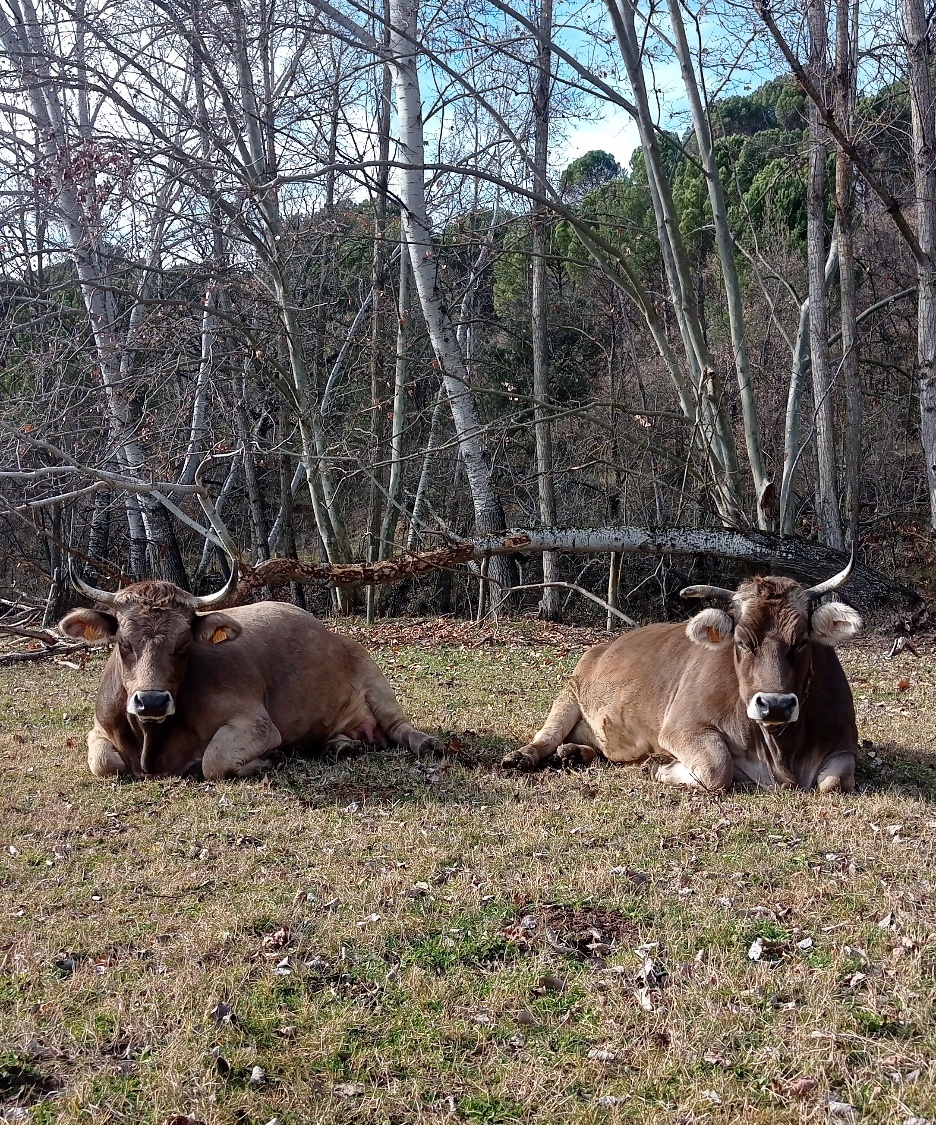 That is Rasa—she always gets what she wants.
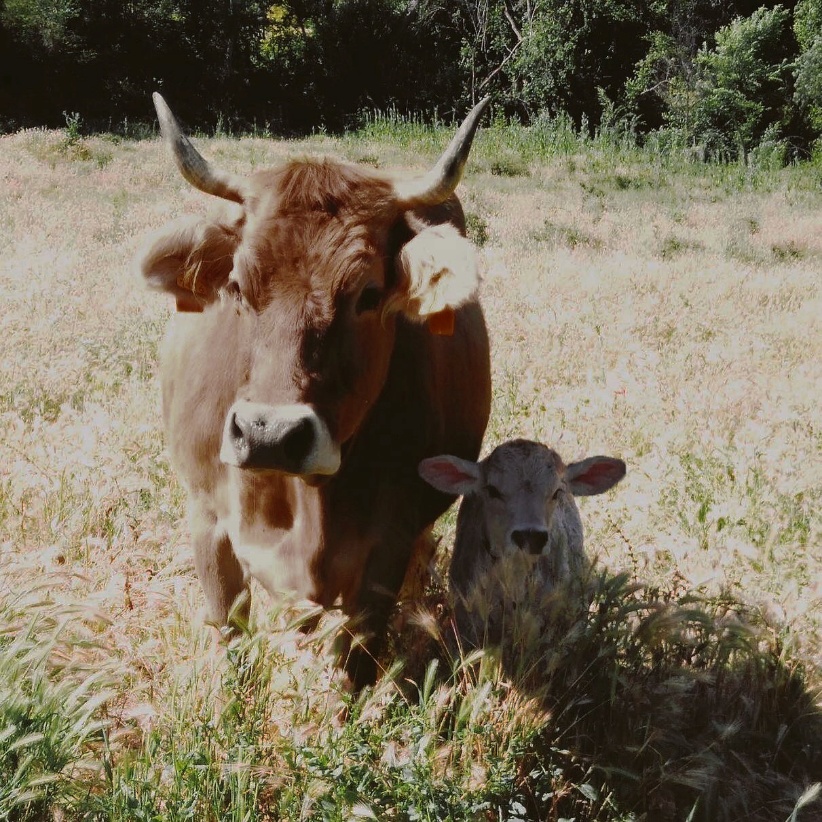
Subhadra Rasa
Subhadra Rasa
Subhadra — The Brave Beauty
Subhadra was born on July 4, 2018, a hot summer day. Before noon, Rasa went into labor. She hid among the trees so that the other cows would not disturb her, and there, calmly and quietly, in the cool shade, she gave birth to the beautiful Subhadra.
“At that time, at two in the afternoon, we would call all the cows to come and rest inside the goshala. So they all came—except Rasa. We wondered, why is Rasa not coming? So we went to check the field, but we could not find her. Dina Sharana went to see what was going on. Back then, the field was not properly fenced, and sometimes the cows escaped. Could it be that Rasa had gotten out?
 Finally, he found her near the canal, well hidden. I think she had been there for quite some time, so the other cows would not bother her. When Dina Sharana found her, he shouted from afar, ‘She is born!’ and when I got closer, Subhadra was already nursing.” —Damodara Priya
Subhadra playing with Baladeva
“I was walking near the canal, where there were lots of blackberry bushes, and suddenly a calf came running out of there. At first, I thought it was a little bull, but no—it was a little cow! From the moment she was born, she already had the strength to run, and she grew up to be a fearless cow.” —Dina Sharana
Rasa and Subhadra stayed hidden among the trees until Damodara Priya and Dina Sharana invited them to come into the goshala. But Rasa did not want to leave; she did not want to abandon that place. So the cowherds went to fetch a large blanket. They laid the newborn Subhadra on it and carried her like a palanquin—one holding each side. Behind them came Rasa, watchful and a bit nervous, as if saying, “Why are you doing this to my daughter?”
Thus, the four of them arrived at the goshala. They placed Rasa and her daughter in their stall, and as soon as they settled in, Subhadra began nursing again.
Subhadra had a very happy childhood alongside Baladeva, the little calf who had been born just twenty days earlier to Madhurya. We believe they were half-siblings, since Madhurya and Rasa came from the same farm, both pregnant—probably by the same bull—which would explain why Subhadra loved Baladeva’s company so much. She always followed him everywhere. When everyone went out to graze, she would wait for Baladeva so they could go together and play. Sometimes Baladeva ignored her, but she followed him anyway.
“One of her first adventures was when we put up an electric fence in the field. The idea was to let the calves graze on one side and the cows on the other. Baladeva approached the electric fence and got a shock. When Subhadra did the same and received a shock too, she got really angry and completely tore down the offending fence.
From that moment on, she proved to be a cow who fears nothing. You cannot yell at her or scold her—she is not afraid. But at the same time, she is a very special cow.” —Dina Sharana
 Subhadra grew up joyful and healthy among the other cows in the herd, drinking all the milk she wanted. Even as a young cow, her strong character was evident—she was determined and fearless. Over time, her delicate and graceful features became more and more pronounced, making her increasingly beautiful. Even today, when we visit her, we can see those traits that make her a true “beautiful lady.”
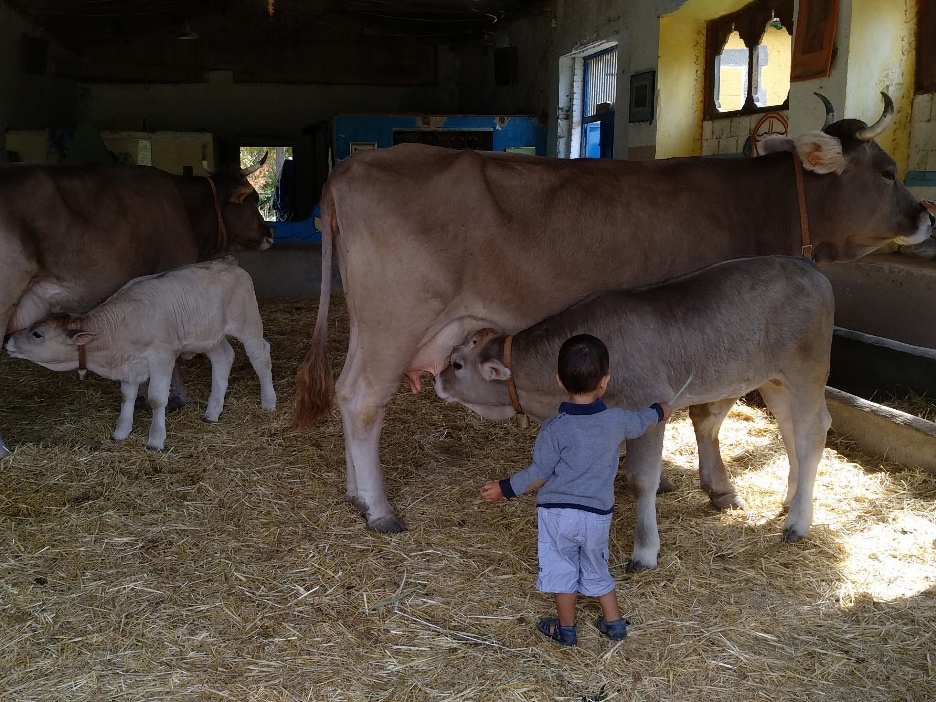
Baladeva and Subhadra nursing
while Thiago touches Subhadra carefully with a straw
When Subhadra turned one year old, she expressed her happiness and gratitude in a gesture that took everyone by surprise.
“Subhadra was out in the field, and I noticed some milk dripping from her udder. At first, I did not think it could really be milk. She was only one year old and was still nursing, so I wondered whether she might have an injury or something might be wrong.
Then I got closer and saw that it truly was milk flowing from her udder. I called Dina Sharana, and he confirmed it. So he took a small bucket and started milking her. That first time he got about 300 ml. Later it became 500 ml, then a bit more. The amount kept increasing. She was giving between five and six liters, and now she gives ten.” —Damodara Priya
Subhadra was still small, still nursing, yet she was already being milked. In the beginning, Dina Sharana would milk her while she nursed from Rasa. Since Subhadra was busy drinking her mother’s milk, she did not resist. It was a brief but beautiful moment—Dina Sharana milking her while she nursed from her mother.
Over time, Subhadra stopped nursing, and milking her without Rasa nearby became a little more difficult. Still, she felt comfortable with Dina Sharana. He would hold her hind legs with one hand while milking with the other. Eventually, Damodara Priya also tried. It took her a bit of time, but with love, patience, and dedication, she too managed to milk Subhadra. Finally, Parama Karuna wanted to try as well. He recounts his experience with Subhadra:
At first, only Dina Sharana milked her. I tried a few times myself, but mostly as an adventure—because as soon as she saw anyone approaching, she would start moving, and the moment you touched her udder, she would lean her body to the side and kick. Over time, I figured out a way to do it: I would give her a little food and feed her spoonfuls of barley. While she was busy eating—and after securing her with the neck chain—I would begin milking.
Her teats were very small, and because of the size of my hand, it was quite difficult to milk her. I could only use two fingers, which made the process rather long, especially since she kept moving and kicking from time to time.
As time passed, we developed a more personal bond. Although she has her own temperament and does not like too much touching or closeness, Subhadra is gentle, and gradually she allowed me to milk her more easily. Once, I even forgot to tie her up, but she neither moved nor got upset. In fact, as time went by, when milking time came, she would settle herself and shift her hind leg slightly so I could work more comfortably.
Subhadra continues to give plenty of milk because she feels good.
It is no coincidence—it is because she is happy.