 Spiritual
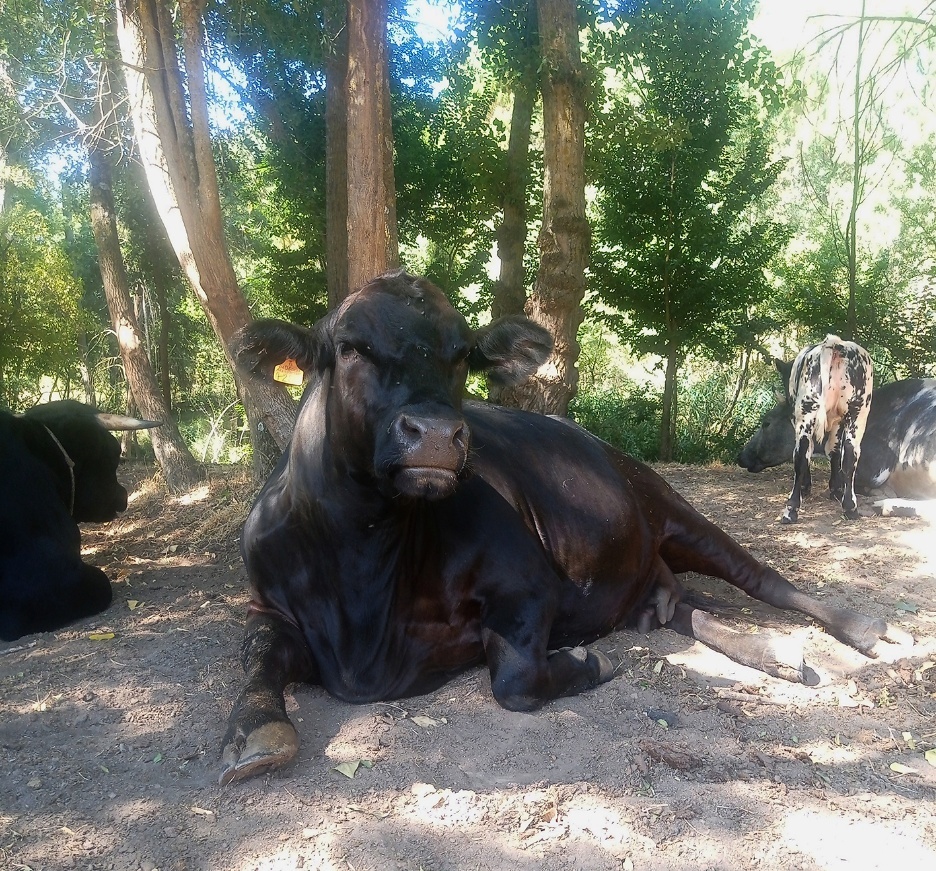
Kunti is a black cow without horns, which makes her stand out among the others—most of whom are light-colored and proudly display their large, curved horns. She is the only one without them, yet she never seems to need or even want any. Kunti is authentic—she does not try to be like the others, nor does she care to.
She came from Cantabria with her newborn calf, and since she produced more milk than he could drink, she needed to be milked.
“When she arrived at the farm with her calf, the cowherds asked the gurukula children to give him a name. We called him Arjuna. Then they also wanted to give a name to the mother, and we chose Kunti.” —Madhava
When Kunti enters the goshala, she does it quickly—one of the first to come in—and it is as if she is parading down the aisle. Her entrance is confident; she knows exactly where her stall is and never makes a mistake. She walks with a graceful sway of her hips, and the sound of her black hooves echoes on the floor with a steady clack, clack, clack, clack.
When I first met Kunti, I found her a very cheerful cow. Sometimes in the afternoon I would cut fresh grass from the field, bring it in a bag, and hand out a little to each cow. Of all of them, Kunti was the one who waited for me most eagerly. When she saw the green grass peeking through the zipper of the bag, she’d get excited, stretch her head out of the stall, and start moving about restlessly. She would follow the bag wherever it went. She was extremely enthusiastic about food—always alert to hay, grain, fruit, or anything edible. She ate well, and fast. Everything she did, she did with intensity and joy.
“It was very difficult because she had to be milked, and blood would come out. From the pain, she kicked a lot. Kunti does not have horns, since she is an Angus breed, so instead she managed to give me a headbutt right in the chest that knocked me flat on the ground. This breed is not really meant for milking; normally, it only produces enough milk for its calf.
 In the beginning, Arjuna would drink as much as he wanted, and then we would milk the rest. We had to distract her with food; she could only be milked for a short time, as long as the feed lasted. She allowed milk to be taken from three teats—the fourth was strictly for her calf. Milking her was complicated because she kept moving and kicking constantly.
Kunti and Yamuna-mayi behind her
Now Kunti is much gentler. We started brushing her before milking, and she began to stay still, even though she no longer ate—she was too alert to everything happening around her. Lately, Kunti has become more relaxed and calm; now she even chews a little hay while we milk her. It is so nice to milk Kunti now—so easy. She does not kick at all anymore.” —Damodara Priya
Another difficult situation with Kunti happened a few years ago, when she gave everyone quite a scare. Damodara Priya recalls that during the installation of the new irrigation system in the pasture, the entire edge of the canal—covered with bushes for years—was cleared. That made it much easier to lay the irrigation pipes, but it also left the canal completely exposed. From the pasture, the opening was not clearly visible, which made it dangerous.
“Kunti was grazing nearby and, without realizing it, fell into the canal. Dina Sharana was right there setting up the pipes and saw everything. By Krishna’s mercy, Kunti managed to get out on her own, with an agility that amazed us all. Her strong and flexible body helped her push herself up and escape the canal without any injuries. It was a great blessing, especially since her calf Arjuna had just been born, and we were worried that something might happen to his mother.
After that day, we decided to urgently fence the entire canal to protect the cows. And so, with the help of the devotees and Krishna’s guidance, both the irrigation system and the much-needed fencing were completed.” —Damodara Priya
Parama Karuna recalls his first steps as a cowherd and his experience with Kunti…:
“At first, I did not milk Kunti; I worked with Rasa and Dhira, who were gentler and easier to handle. But as I gained experience, strength, and speed, one day it was my turn to milk Kunti, following Dina Sharana’s instructions.
Kunti has very large teats—broad, long, and soft—quite comfortable for the hands. But there were two important things to keep in mind when milking her: she needed plenty of food, and you had to be very fast.
All the cows were given two spoonfuls of ground barley each morning, but Kunti got half a bucket—about three kilos, four times more than the others. The technique was as follows: while Kunti grew impatient for her feed, we tied her collar with a rope, and then I would quickly jump into the stall with the bucket and the water to wash her udder.
I had to milk her as fast as possible, because the time she spent eating was the time I had to finish. And Kunti ate very quickly. When she finished, she would start kicking and moving—that was the sign that the milking had to end. So I had to focus completely and give it my all in those few minutes.
Kunti had a lot of milk, and with such large teats, milking her was easy but exhausting—it required great strength and speed in a very short time. In those few minutes, she could give up to eight liters.
Another special detail was that one of the four teats could not be milked. The rear one, on the left side, was untouchable—that one she reserved exclusively for her son Arjuna. No one else could touch it. If anyone tried, Kunti reacted immediately—kicking, moving, and protesting.
While I milked the other three teats, Arjuna, already two years old, ate his barley. And as soon as he finished, he went straight to drink the milk his mother had kept for him in that special teat.”
Arjuna — The Herculean One
From a young age, Arjuna already looked like a very strong little bull, but when he first arrived at Rupa Goshala, the change of environment frightened him, and more than once the cowherds had to go looking for him because he was hiding.
“Arjuna looks like a miniature Schwarzenegger. At first, he was scared of us and would run away, but little by little, with love and gentle touches, he began to let us approach and started getting close to the people who came to visit him, to feed him, and to show him affection. They would hug him, spend time with him… That is how he began to trust.” —Dina Sharana
Kunti and Arjuna still live together, enjoying the open fields, the company of the herd, and the care of those who look after them. They arrived together and have remained together, free to enjoy each other’s presence.
Arjuna is growing strong and healthy, surrounded by the herd that has always accepted him naturally. He is now in his adolescence—somewhat more obedient, but still overflowing with energy.
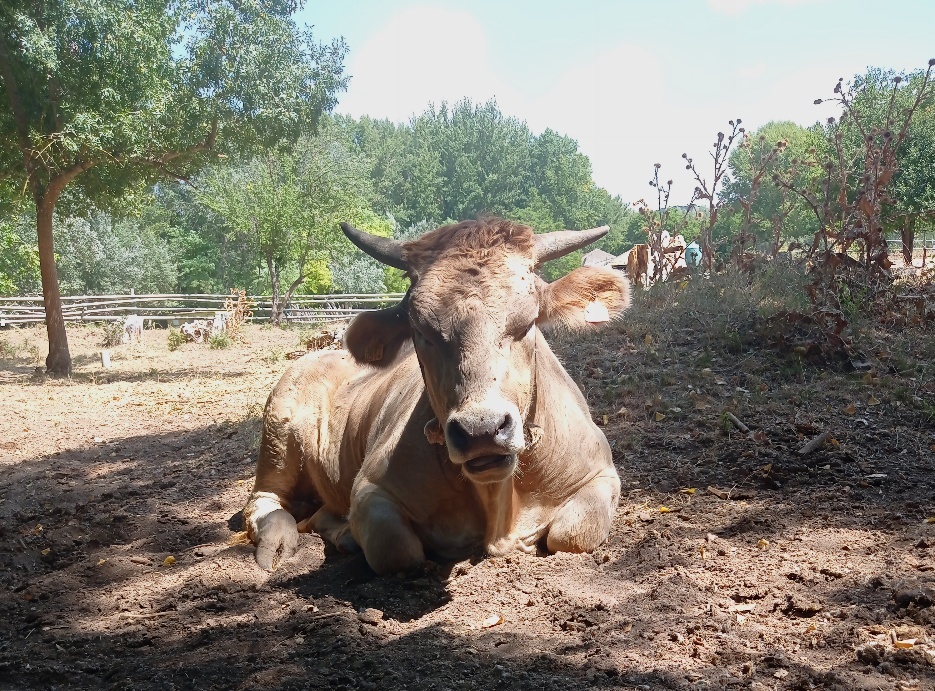 He learned from Parvati how to climb up onto the feeding troughs, so whenever he hears any sound in the goshala, he jumps up to see what is going on. Maybe someone is arriving, maybe it is feeding time… or maybe they’re coming with a brush to scratch his beautiful golden curls.
Arjuna is the favorite ox of Madhava and Jay Gopal, the sons of Gauranga-lila and Chaitanyachandra. They love giving him his favorite treats—apples and carrots..
“Since we’ve been living in New Vrajamandala—we arrived in September 2017—Madhava and Jay Gopal have been drinking milk from the cows almost every day for breakfast.” —Gauranga-lila
Jay Gopal: “Sometimes we go to the goshala to feed the cows. They love it when we bring carrots, apples, and bananas.”
Madhava: “Especially Arjuna. He is a big ox, and he stands right in front of everyone to eat everything himself.”
 Jay Gopal: “He is really handsome with his curls—and so strong.”
Madhava feeding apples to Arjuna
Madhava: “When I was little, Alberto once sat me on top of Arjuna when he was still small too. And Alberto showed me how to milk the cows. I milked several—Dhira, Rasa, Kunti, and Parvati among them. The milk would come out in a strong stream, making a sound as it hit the bucket. Once or twice they even let me drink a bit of that warm, delicious milk.”
Arjuna has a lot of strength. Furthermore, he is very agile and fast. Recently, high up on the mountain of hay bales, he saw one that stood out. He climbed up, reached the top, and from there, with his horns, pushed it down. Arjuna is young, full of vitality and beauty. He will continue to grow and, surely, live many more adventures among the fields of New Vrajamandala.
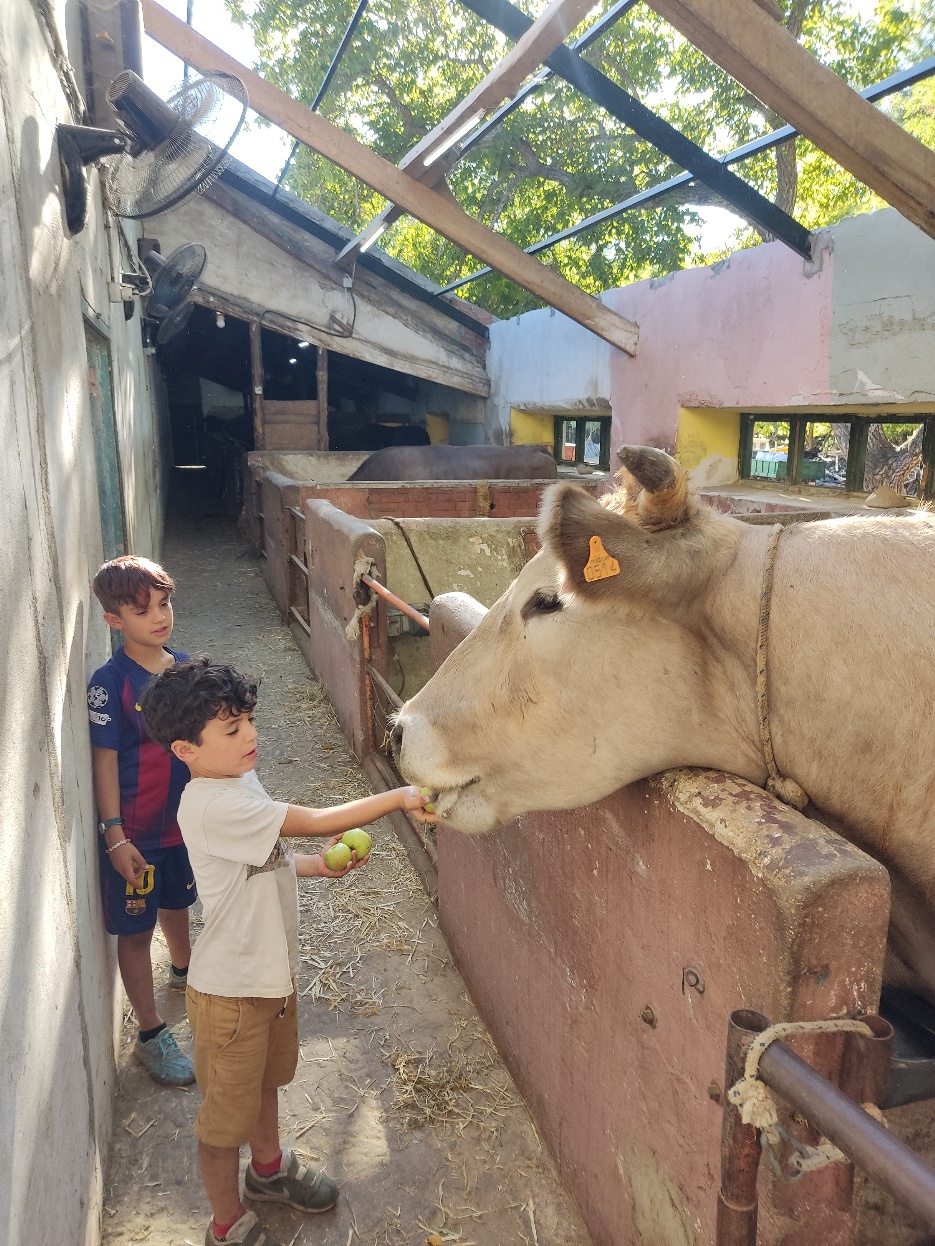
Arjuna receiving more apples from Jay Gopal