 Spiritual
An idea to promote care and appreciation for our mother cow was the creation of “The Cow Festival.” This celebration became a warmly received event, full of activities designed so that everyone could offer their talents in service to the cows.
“The idea of organizing a Cow Festival came to me as a way to make things more joyful and to invite people from the nearby villages to come and get to know the goshala. The festival went like this: it began with a welcome breakfast for everyone, and later in the afternoon we would bring the murti of Srila Prabhupada down to the goshala in procession. We had prepared a seat for him made of hay bales, which the devotees decorated with cloths and flowers. The celebration continued with a performance by the children—something I always loved to include—either a play or songs. Then there were traditional Indian dances performed by professional dancers, which people were always amazed to see.
We continued with other activities that changed from year to year. I remember I wanted the Deities to visit the cows too, so I prepared a swing just their size, and we began to swing Them right there in the goshala. These were things never done before, and which I found very beautiful, because the devotees became enthusiastic and helped me bring these ideas to life.
Finally, the musical group Cows in Love closed the festival. When they began singing the maha-mantra, everyone started jumping with joy—singing and dancing together. Especially the visitors, most of whom were not devotees, enjoyed it immensely, just like we did.
It was a very joyful festival and a great success. We organized the Cow Festival for sixteen years.” —Alberto
Cows in Love was not just the finale of the event—it was the moment when everyone, no matter where they came from, joined together in a single chant. That shared joy around our beloved cows became a project that carried Rupa Goshala beyond the limits of its fence.
Cows in Love was a Spanish musical band active in the early 2000s. Led by Tirtha Kirti, the group included members from the bands Undrop and Dhira, who, together with other devotees, released their debut album Happy Cows in 2003—a fusion of tropical rhythms, electronic sounds, and chill-out atmospheres. The band also appeared on television programs such as Los conciertos de Radio 3 on RTVE’s La 2, where they performed songs from their first album.
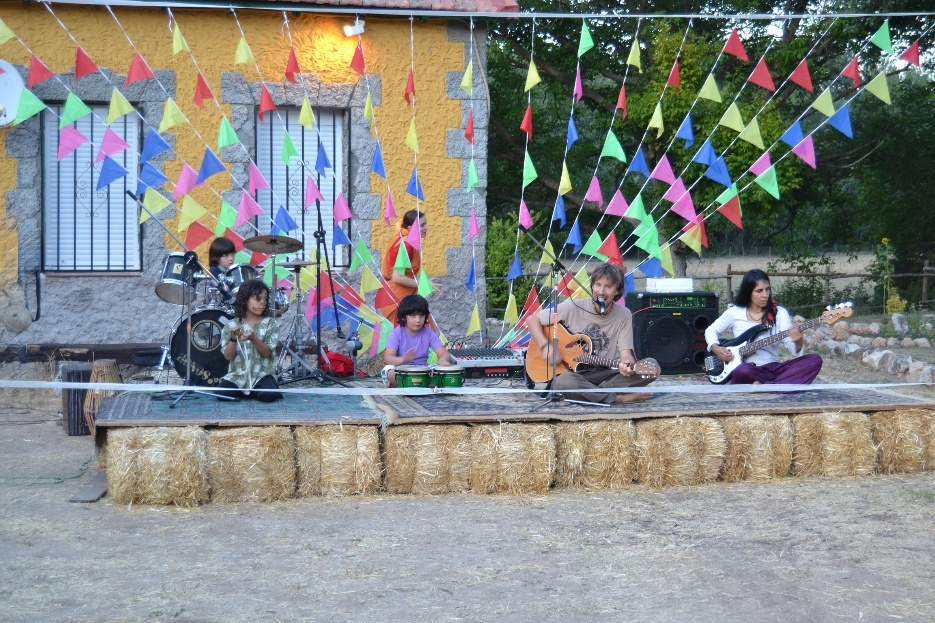 In 2007, they released their second and final album, Terminal Goloka, performed at several concerts across Spain, and were invited by Indradyumna Maharaja to play at Woodstock Poland—one of the largest Hare Krishna festivals in Europe.
Their live performances featured the Bharatanatyam dancer Katyayani, whose classical movements contrasted with the break-dance style of the rapper Michi.
This musical project was inspired by our non-violent dairy farm, Rupa Goshala, and together they brought greater awareness and energy to the cause of animal protection—especially the care and reverence for cows.
“We must maintain the animals throughout their entire lives. We should make no plans to send them to the slaughterhouses. This is the true way to protect the cows. Krishna Himself taught us to give full protection to the cows by His own example. This service is the most important activity on our Hare Krishna farms. Vrindavan is also known as Gokula—the place of the cows. Therefore, the main feature of our Hare Krishna farms should be cow protection. Milking the cows means extracting the religious principles in liquid form; the great sages lived only on milk. No one has the right to deprive another living entity of its life; every living being is equally valuable. We must use our time to elevate ourselves in Krishna consciousness.” —Hanumat Presaka Swami, in the song Rupa Goshala Jam from the first album Happy Cows.
The cows of Rupa Goshala, together with the enthusiasm of the herdsman Alberto, inspired the devotees to become more involved in caring for the cows—cleaning them, brushing them, feeding them, visiting them whenever they could, and helping financially. Every small action to support this service is deeply appreciated, especially by Krishna. We all have different skills and talents, and according to our individual psychophysical nature, these qualities can be offered in Krishna’s service—in this case, in service to Krishna’s cows.
While preparing “The Cow Festival,” among many other things, Alberto designed a PowerPoint presentation to show during the celebration. As he worked on it, he thought, “I’d like it to have a little background music.”
So, without hesitation, he asked for help from a visitor who “happened” to be spending a few days in New Vrajamandala.
For several summers, Justo Bagüeste, a well-known Spanish musician and composer, spent about a month vacationing on the farm. He loved the place and had formed a close friendship with the devotees, so he was delighted by the idea and immediately created “the little piece of music,” which turned out to be a genuine work of art.
The collaboration with Justo sparked a creative flame. That simple melody not only accompanied the slideshow images but, combined with Alberto’s contagious enthusiasm, began to transform the spirit of the community. When Tirtha returned from India and encountered this new energy surrounding the cows—nourished by Bagüeste’s musical sensitivity and Alberto’s dedication—new ideas began to emerge almost naturally.
“When Alberto arrived at the goshala, he completely transformed the atmosphere and inspired a deep appreciation for the cows and all the auspiciousness they represent. Our return from India coincided with Narayani’s—she was also coming back from Vrindavan, filled with the same enthusiasm. So, the idea of making an album dedicated to the cows was born immediately.” —Tirtha Kirti
Together they set up a small studio in front of the temple and began recording. That is where the first Cows in Love album came to life—an eclectic production with clear messages about cow protection and musical styles ranging from Cuban changüí to reggae.
“We formed a band with artists like Zángano (Antonio, the bassist) from Undrop, Justo on saxophone, Narayani, Bhaktidevi, and other musicians. We played live with a great response from the audience. We performed on Los Conciertos de Radio 3 on Spanish TV (TVE) and organized a big release event in an old concert hall in Madrid, featuring guests like ‘El Muñeco,’ percussionist for Amparanoia and Ojos de Brujo. With the support of a booking agency, we played at festivals and events all over Spain, always spreading the message of nonviolence—ahimsa.” —Tirtha Kirti
Later they recorded their second album, Terminal Goloka, a concept album centered on a mystical journey represented by a comet-shaped cow, with photos taken in Terminal 3 of Madrid Airport by Samantha. Artists such as Zángano, Deva, Jhanavi, Narayani, Michi, and Laksmana took part in the project. They recorded real sounds from the goshala; thus even the rhythm of milking became a musical beat. One recurring track included the names of all the cows, serving as a kind of leitmotif.
The entire production was handcrafted at the farm. Mastering was done by Peter de Beu in Stockholm, a well-known professional. They even had to drive to meet a delivery person and pick up the master themselves in order to meet the deadlines and press the CDs on time. The result was an excellent album, sold mainly at concerts and at the goshala itself.
“The project kept growing over the years. We made a documentary using music from the first album, with real scenes filmed in the
goshala. Even our children joined in—like Gauranga and later Shyam. They grew up close to the cows, learning to milk from a very young age. That living connection with the animals left a deep impression on them, reconnecting them with a simple, meaningful way of life.” —Tirtha Kirti
The Cows in Love project became a recurring presence every year, every summer, at each Cow Festival. People from the nearby village would come down to the goshala—people who, if not for the festival, might never have visited. And suddenly they were there, dancing, appreciating this initiative from New Vrajamandala, grateful to have been invited.
“I remember every Cow Festival—it was a fixture. I was always touring in the summer, but I’d always find a way to be there. Even if I had not slept much, I’d arrive straight from a concert and head right over. We’d set everything up… and start playing. I always ended the day with a deep sense of satisfaction—playing for the cows, seeing everyone full of enthusiasm, dancing like crazy. That always filled me with joy. It was a shared experience and a collaborative effort, where we simply spent an amazing time together in an incredible place.” —Tirtha Kirti
Living and Serving Among Cows
This section presents a series of testimonies, words of appreciation, and expressions of gratitude from a wide range of devotees—both young and old—who, at some point in their lives, maintained a close bond with Rupa Goshala.
Laksmana:
I want to express my gratitude, because the years I spent near the goshala were the most beautiful and happiest of my life.
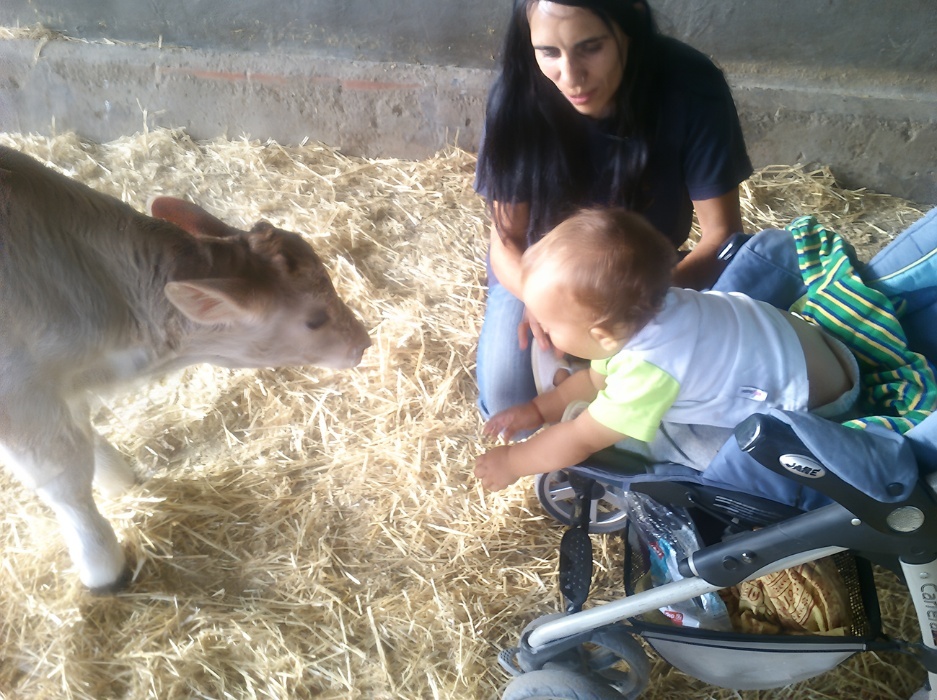 Who would have told me that I would have two wonderful children like Shyam and Gauraṅga, and that their childhood would unfold in a beautiful valley, surrounded by nature, rivers, a temple, and cows?
Laksmana with her baby Shyam and newborn Jagannatha
In the afternoons, we would run to milk them, and when we arrived, a kind cowherd was waiting for us. We also ran through the fields gathering little flowers to offer along with incense.
It sounds like a fairy tale, but it was real. It was a blessing to have grown up among Gopi, Rupa, Jagannatha, Dhira, Radhe, Yamuna, Tilaka…
Thank you for this wonderful gift of life.
Gopal:
 I arrived at the farm when I was very young, and it was Alberto, the cowherd, who taught me how to milk for the first time.
Alberto watching Gopal milk Tilaka
Later, when I was already in school, I went there with all my classmates.
As time went by and I kept growing, Alberto continued teaching me, my friends, and other devotees who lived on the farm.
Years later, I moved away and stopped living there, but I returned several times—with my partner, my sister, some friends… And every time I came back, the same atmosphere, the same love, was still there.
The cowherd would once again teach us how to milk, because I had forgotten, as had those who came with me.
For me, the goshala has been a place of transformation.
I sincerely believe we are very fortunate to have such a place in Spain—and in the world—a place where one can learn, grow, and evolve.
I have always felt that everything on the farm was based on love: love for the devotees, love for the cows, love in general.
That is why I want to thank Alberto for the great work he has done, continues to do, and will undoubtedly keep doing.
And I also want to send him a big hug, for being, above all, a great friend.
Vraja-lila:
I’m grateful to the cowherd, Alberto, because I do not know if he realizes how important his welcoming attitude was for me. It was vital.
Thanks to him and to the cows, I was able to climb out of the abyss I was in; I could emerge from that lonely upbringing I had been living among single and monastic people.
Both my baby and I were embraced by the mother cow, and I came to understand that my capacity for comprehension cannot grasp the mysticism that cows possess.
So I thank him for sharing and providing a space that allowed me to live this experience.
Lilesvari:
So many things come to mind when I remember the goshala and my life on the farm…
From our room we could see Alberto, the cowherd. It was freezing cold, and there he was, going to milk and take care of his cows. Everything was covered in snow, but he too was there calling them: “Bolo, bolo, bolo!”
In the summer, forty degrees under the sun: “Bolo, bolo, bolo!”
I used to tell Abhay: “Do you know what perseverance is? That—what the cowherd does.”
Because he knows exactly what he is doing, and that is why he remains there, year after year, taking care of his cows, who give him so much mercy. How fortunate the cowherd is!
I remember when a calf was born. It was winter, there was snow, and I was very worried. We went down there, and the cowherd put his hand inside the cow and pulled the calf out.
It was deeply impressive to me—it was the first time I had ever seen something like that.
And so many other memories… the cow festivals… the children milking…
These are tender memories, for which I feel deeply grateful and fortunate to have lived them.
Yoga:
Going to the goshala was my moment of peace, of calm. It gave me strength—both physical and mental.
Shouting “bolo bolo” and watching the cows come was an experience in itself…
Witnessing the stages of life—the birth and death of the cows—made me feel serene. It was my moment of meditation, of being with myself.
I felt great satisfaction listening to classical music or mantras, and sensing the patience and good energy that Alberto radiated.
The innocent game of guessing how many liters we had milked and then proudly writing it on the board…
Receiving the goshala key as a birthday gift—that gives you a sense of pride as a teenager.
Thank you for those beautiful moments.
I often remember Víctor “the Russian” and Vanamali, two other people with whom I had the pleasure of sharing wonderful times in the goshala.
And those small privileges, like always receiving a bit of maha-prasadam as gratitude for our effort and dedication.
Ambarisa:
I have a very special memory of the goshala: my wedding with Ingrid—an event where I had the great mercy of getting married in that sacred place. The devotees were there, along with family and friends… Mahalaksmi performed the ceremony. It was beautiful.
The cow is the mother, and she must be treated as such. She must never be mistreated. I encourage people to take care of their mother. Krishna is Govinda, and Govinda is He who gives pleasure to the cows. If the Supreme Personality of Godhead cares for them, we should do the same—or at least respect them.
So I encourage everyone to visit the goshala of New Vrajamandala, to live a deeply rewarding experience. I have many fond memories there.
Parama Karuna:
When we returned from India, after being away from New Vrajamandala for three months, we went to greet the cows. As soon as we entered, we came across Rukmini and Baladeva. I immediately threw myself on Baladeva to pet him, hug him, and tease him a little. He is such a loving ox—the gentlest one in the goshala.
Right beside him was Rukmini, drinking water. From afar, I looked at her, but she did not come closer. So I greeted her, saying, “Hey, Rukmini! Have you already forgotten me?”
Rukmini is a very beautiful cow—sweet-looking, but with a strong character, difficult to approach and show affection to. Always distant, always demanding respect. She was always a challenge for me to milk.
She glanced at me sideways, and after a little while she came closer and greeted me with her head. Despite the tension I felt—thinking she might butt me at any moment—I understood it as a greeting. So, from the other side of the fence, I reached out my hand and waited to see if she would accept it. She came closer and let me touch her face and her tuft of hair. I brushed it gently and withdrew my hand. But she stayed there, so I realized she wanted a bit more affection. After that, she walked away, and we went back to our usual, respectful distance.
 That moment showed me that they carry love in their hearts and never forget the years we’ve spent together—the many moments shared day after day. It was a beautiful moment, one of my fondest memories of the goshala.