 Spiritual
(An adaptation of Bhaktivinoda Ṭhākura’s Anādi karama phale)
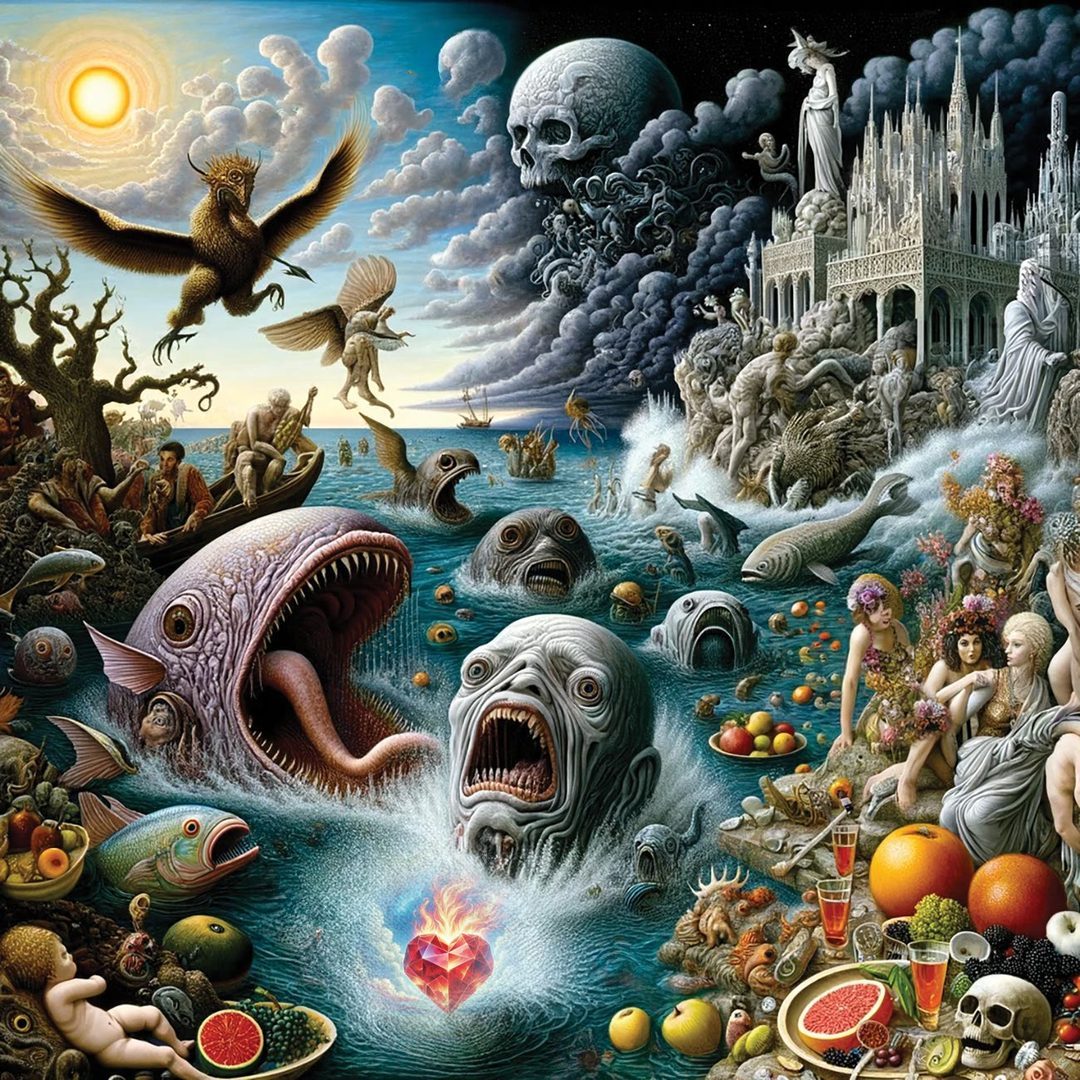
Tasting the fruits of my acts beyond past, I’m plunged into the ocean of nescience so vast. Day and night my troubled heart is ablaze in the poisonous fire of sensual craze. My mind is in anguish and cannot see how to find relief and peace, and be happy.

My hundreds and thousands of plans for happiness have ended in suffering and mental distress. I'm tossed and carried by the worldly tide, lust, anger and greed are like thieves by my side. Envy, illusion and madness they sow, life slips away, fear continues to grow.

Plunged into the ocean of nescience so vast, I am lost in its waves surging up from the past. Day and night my troubled heart is ablaze in the poisonous fire of sensual craze.

Jñāna and karma, these two thugs have cheated me and finally threw me into the ocean of misery. O Kṛṣṇa, ocean of mercy, You are my friend, I have no strength to leave this predicament. I pray to You and hope for Your helping hand to lift me out of this dire ocean of torment.

Plunged into the ocean of nescience so vast, I am lost in its waves surging up from the past. Day and night my troubled heart is ablaze in the poisonous fire of sensual craze.

Kindly place this fallen servant at Your lotus feet, as a particle of dust—that is all I plead. Bhaktivinoda says: “I am Your servant eternally, but now Māyā’s alluring network has captured me. Somehow or other, I forgot You, O Lord; now please pick me up and keep me close to Your heart. Please pick me up and keep me close to Your heart.
Commentary
The Ocean of Nescience (Anādi-karama-phale) is based on Verse 5 of the Śikṣāṣṭaka Prayers, where Śrī Caitanya Mahāprabhu pleads with Kṛṣṇa, the son of Nanda, to lift Him from the ocean of birth and death and to place Him as a particle of dust at His lotus feet. Bhaktivinoda Ṭhākura elaborates on this theme in four stanzas, focusing on the soul’s entrapment in material existence and the need for the Lord’s intervention to attain liberation.
Self-Imposed Suffering
The first stanza begins with a description of the living entity’s precarious position after having fallen into the vast ocean of material existence. Bhaktivinoda Ṭhākura acknowledges that the cause is not some external force but his own doing which Śrīla Prabhupāda often characterizes as “our misuse of independence.” Bhaktivinoda Ṭhākura uses the expression anādi-karama-phale which means “the fruit (phala), or result, of an action (karma) that occurred before the beginning of time (anādi).” Consequently, nobody can trace the history of when the soul began to live in a material body, and because we cannot trace the history of when we became conditioned, the living entity in the material world is called nitya-baddha (eternally conditioned), in contrast to the nitya-siddhas, the eternally perfect and liberated souls living in the spiritual world. Bhaktivinoda Ṭhākura describes the jīva’s situation in the ocean of material existence in graphic terms: “Tasting the fruits of my acts beyond past, I’m plunged into the ocean of nescience so vast. Day and night my troubled heart is ablaze in the poisonous fire of sensual craze. My mind is in anguish and cannot see how to find relief and peace, and be happy.”
The metaphor of a poisonous fire of sensual craze may sound exaggerated, but it is not. Kṛṣṇa tells Arjuna in the Bhagavad-gītā (3.39): Thus the wise living entity's pure consciousness becomes covered by his eternal enemy in the form of lust, which is never satisfied and which burns like fire. The nature of fire is that it is insatiable. No matter how much fuel is supplied, it will want more and more. And the more fuel supplied, the higher the flames rise. Our senses are like that. No matter how much food, drink, sex, or any other pleasure is given, they always demand more. Due to the natural limitations of the physical body, a point of satiation is usually reached after a short while, but after a period of regeneration, the sensual demands awaken again, often hungrier than before. Nevertheless, despite this experience, we conditioned souls try repeatedly to achieve happiness and satisfaction by pleasing the senses, including the mind, but the final result is always saturation and frustration. As Bhaktivinoda Ṭhākura observes in this song: “My hundreds and thousands of plans for happiness have ended in suffering and mental distress.”
The Six Enemies and Fear
He then enumerates six main enemies that torment the conditioned soul: lust, anger, greed, illusion, madness, and envy (kāma, krodha, lobha, moha, mada, mātsarya). When one succumbs to any of these tendencies— whether individually or several at once—fear inevitably arises. Fear (bhaya) is, along with eating, sleeping, and mating, one of the four fundamental aspects of material existence, signifying its unavoidable presence. All living beings in this impermanent world experience constant anxiety, as the threat of losing possessions or even the body looms persistently over their lives.
Attachment to bodily relationships—such as family, friends, wealth, and social status—further intensifies mental disturbances. These attachments cloud spiritual clarity and lead to anxiety about outcomes, as individuals cling to fragile aspects of life, distressed by the prospect of loss. In contrast, pure devotional service (bhakti) to the Supreme Personality of Godhead dispels these fears. As Śrīla Jīva Gosvāmī explains, bhakti-yoga is exceptionally powerful. Even in the early stages of sādhana-bhakti—where devotion is cultivated through discipline and regulated practices—a practitioner can experience a state of fearlessness as a divine gift from the Lord. This initial taste of fearlessness strengthens the devotee’s determination and diminishes attachment to the temporary. As devotion matures, the Supreme Lord reveals Himself more fully, deepening the devotee’s experience of security and peace. In this mature state, the devotee reaches a point of complete fearlessness, residing on the eternal, undisturbed spiritual plane of Vaikuṇṭha, free from anxiety and insecurity.
The Deception of Karma and Jñāna
In the third stanza, Bhaktivinoda Ṭhākura speaks of two paths that people in this world generally pursue to achieve success and satisfaction: karma and jñāna (fruitive action and cultivation of knowledge). The great majority of human beings simply pursue the fruits of karma. Karma is therefore translated as “fruitive activities.” As the term implies, most people work to obtain a fruit they can enjoy. In the past, these fruits were agricultural goods in the form of grains, vegetables, and fruits, or natural products like fibers, wood, metals or jewels. Today, the most common fruit is money which allows its owner to buy various products that provide pleasurable sensations to the senses. Jñāna, the pursuit of knowledge, operates
on a more subtle level, but the final goal is the same: to obtain a fruit that is relishable. Bhaktivinoda Ṭhākura compares these two ways of life to thugs who cheat the living entity and finally throw it into an ocean of misery. The meaning of this simile is that both karma and jñāna promise happiness but fail to deliver it. Because the living entity is a spiritual being, no amount of material happiness produced by fruitive work or the accumulation of material knowledge can satisfy its thirst for joy. In another song of this cycle, The Learned Ass, also composed by Bhaktivinoda Ṭhākura, the deceptive nature of worldly knowledge is described in more detail.
The Lord’s Lotus Feet as the Ultimate Shelter
To conclude his song, Bhaktivinoda Ṭhākura implores the Lord to help him out of his predicament and shelter him at His lotus feet. In other words, to be fixed at the lotus feet of the Lord, even “only” as a tiny particle of dust, is more desirable and valuable—and more satisfying—than any amount of gross or subtle pleasure in the material world. Once again, the lotus feet of the Lord are mentioned as the only shelter, and again we quote a verse from the Tenth Canto of Śrīmad-Bhāgavatam (10.2.30) where the demigods pray to Lord Kṛṣṇa in the womb praising His lotus feet: O lotus-eyed Lord, by concentrating one's meditation on Your lotus feet, which are the reservoir of all existence, and by accepting those lotus feet as the boat by which to cross the ocean of nescience, one follows in the footsteps of great saints, sages and devotees. By this simple process, one can cross the ocean of nescience as easily as one steps over the hoofprint of a calf.
Śrīla Prabhupāda comments on this verse as follows: The true mission in life is to cross the ocean of nescience, of repeated birth and death. Those in the darkness of ignorance, however, do not know this mission. Instead, being carried away by the waves of material nature (prakṛteḥ kriyamāṇāni guṇaiḥ karmāṇi sarvaśaḥ [Bg. 3.27]), they are undergoing the tribulations of mṛtyu-saṁsāra-vartmani [Bg. 9.3], repeated birth and death. But a person who has achieved knowledge by the association of devotees follows the mahājanas (mahatkṛtena). Such a person always concentrates their mind upon the lotus feet of the Lord and executes one or more of the nine varieties of devotional service (śravaṇaṁ kīrtanaṁ viṣṇoḥ smaraṇaṁ pāda-sevanam [SB 7.5.23]). Simply by this process, anyone can cross the insurmountable ocean of nescience.
The Original Song
Anādi karama-phale
Bhaktivinoda Ṭhākura
anādi' karama-phale, pari' bhavārṇara jale, taribāre nā dekhi upāya ei viṣaya-halāhale, divā-niśi hiyā jvale, mana kabhu sukha nāhi pāya anādi’—beginningless (from time immemorial); karama—activities; phale—fruitive; pari’—I have fallen into; bhava—of birth and death; arṇava—of the ocean; jale— the waters; taribāre—of deliverance; nā —no; dekhi—I see; upāya—means; ei—of these; viṣaya—acts of sense gratification; halāhale—the poison; divā—day; niśi— night; hiyā—my heart; jvale—burns; mana—my mind; kabhu—at any time; sukha— happiness; nāhi—does not; pāya—attain.
Due to my past fruitive activities, I have fallen into this great ocean of nescience, and I do not find any means of getting out. Day and night my heart burns from the poison of acts for sense pleasure, and as a result my mind is not at all happy.
āśā-pāśa-śata-śata, kleśa deya avirata, pravṛtti-ūrmira tāhe khelā kāma-krodha-ādi chaya, bāṭapāḍe deya bhaya, avasāna haila āsi' belā āśā—plans for happiness; pāśa—ropes; śata-śata—hundreds and thousands; kleśa—pain; deya—giving; avirata—constantly; pravṛtti—materialism; ūrmira—the waves; tāhe—in that (ocean of nescience); khelā—pastimes; kāma—lust; krodha— anger; ādi—and so on; chaya—six; bāṭapāḍe—thieves and rogues; deya—giving; bhaya—fear; avasāna—the end (of my life); hoilo—is; āsi’—coming; belā—soon. I am always making hundreds and thousands of plans to become happy, but all these plans give me pain twenty-four hours a day. Indeed, I am being tossed again and again by the waves of the ocean of materialism. Furthermore, there are many thieves and rogues, of whom six are prominent: lust, anger, greed, envy, illusion, and madness. They are causing me great fear, and in this way my life is coming to an end.
jnāna-karma-ṭhaga dui, more pratārīya laya, avaśeṣe phele sindhu-jale e hena samaye, bandhu, tumi kṛṣṇa kṛpā-sindhu, kṛpā kari' tolo more bale jnāna—mental speculation; karma—fruitive activity; ṭhaga—cheaters or thugs; dui—two; more—me; pratārīya—misleading; laya—are taking; avaśeṣe—finally; phele—throwing; sindhu-jale—into the ocean of misery; e—this; hena—such as; samaye—time; bandhu—friend; tumi—You; kṛṣṇa—O Kṛṣṇa; kṛpā—of mercy; sindhu—ocean; kṛpā—mercy; kari’—having shown; tolo—pick up; more—me; bale—by Your strength. The two thugs of mental speculation and fruitive activity have cheated me, misled me, and finally thrown me into the ocean of misery. Under the circumstances, my dear Kṛṣṇa, O ocean of mercy, You are my only friend. I have no strength to get out of this ocean of nescience, so I pray to Your lotus feet that You will be kind and by Your strength lift me out of this ocean of suffering.
patita-kiṅkare dhari', pāda-padma-dhuli kari', deha bhaktivinoda āśraya āmi tava nitya-dāsa, bhuliyā māyāra pāśa, baddha ha'ye āchi dayāmaya patita—fallen; kiṅkare—servant; dhari’—having held up; pāda—feet; padma— lotus; dhuli—particle of dust; kari’—having fixed; deho—give; bhaktivinoda— Bhaktivinoda; āśraya—shelter; āmi—I am; tava—Your; nitya—eternal; dāsa— servant; bhuliyā—having forgotten; māyāra—of māyā; pāśa—network; baddha— bound up; ho’ye—being; āchi—I am; dayāmaya—kindly save me. Kindly lift up this fallen servant of Yours and fix me as one of the particles of dust at Your lotus feet. Please give Bhaktivinoda shelter at Your lotus feet. I am Your eternal servant, but somehow or other I forgot You and have now fallen into this entangling network of māyā. Kindly save me.