 Spiritual
Poems and songs have been integral to human culture for thousands of years, with early examples emerging from ancient India, Egypt, China, Greece, and Rome. While most poems and songs focus on worldly affairs, there are also examples of profound philosophical and religious expression, especially notable in the bhakti tradition of India. Among the most renowned philosophical song-poems are the Bhagavad-gītā (The Song of Bhagavān), the Brahma-saṁhitā (The Hymn of Brahmā), the Śrīmad-Bhāgavatam (The Beautiful Story of Bhagavān), and the Sāma Veda (a collection of hymns and chants). When Śrīla Prabhupāda visited England in 1969, he met with John Lennon and George Harrison of The Beatles, one of the most influential music groups of their time. George Harrison had met Prabhupāda’s disciples earlier that year and had produced a record with them, featuring various Vaiṣṇava songs and, most notably, the Hare Kṛṣṇa mantra. The album, titled The Radha Krishna Temple, was well received by Western audiences, and the track Hare Krishna Mantra reached number one in many countries. Consequently, Prabhupāda encouraged John and George to spread the message of Kṛṣṇa consciousness through their music, saying, “You have got a very good talent—music. Na vidyā saṅgīta uttamam (there is no knowledge higher than music). The Vedic mantras were all through music. The Sāma Veda is full of music.” He then quoted a verse from the Twelfth Canto of ŚrīmadBhāgavatam (12.13.1), where the sage Sūta Gosvāmī says: Unto that personality whom Brahmā, Varuṇa, Indra, Rudra and the Maruts praise by chanting transcendental hymns and reciting the Vedas with all their corollaries, pada-kramas and Upaniṣads, to whom the chanters of the Sāma Veda always sing, whom the perfected yogīs see within their minds after
Introspection xii
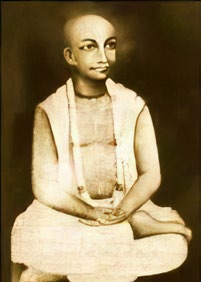

fixing themselves in trance and absorbing themselves within Him, and whose limit can never be found by any demigod or demon — unto that Supreme Personality of Godhead I offer my humble obeisances. He explained, “Sāma-gāḥ means the followers of the Sāma Veda. Gāyanti means they are always absorbed in music. Through musical vibration, they are approaching the Supreme. Vedic mantras are sung. The Bhagavad-gītā and Śrīmad-Bhāgavatam can be sung very nicely. And it is Vedic mantra chanting. Just by hearing the vibration, people will benefit, even if they do not understand.” According to Vedic teachings, transcendental sound is so potent that its vibration impacts listeners even if they are unaware of its meaning—what to speak of its effects if they understand the message. The effect on a person’s consciousness can be truly transformative. For this reason, many spiritual teachers composed songs in regional languages, making them accessible to common people who did not know Sanskrit, the language of the Vedas. The poems of the Vaiṣṇava ācāryas differ from ordinary poetry, which often deals with mundane, ephemeral subjects. Vaiṣṇava songs carry a deep philosophical message; they are not meant for mere fleeting entertainment but aim to uplift both singers and listeners to the spiritual dimension of life, which is eternal. Since many of Śrī Caitanya Mahāprabhu’s followers were born in Bengal, most Vaiṣṇava songs are composed in Bengali. As Śrīla Prabhupāda noted regarding Narottama dāsa Ṭhākura’s compositions, the language is simple enough for even uneducated people to understand, yet sublime and fully aligned with the conclusions of the Vedic scriptures. Narottama dāsa Ṭhākura, a prominent ācārya of the late 16th and early 17th centuries, played a crucial role in spreading Gauḍīya Vaiṣṇava philosophy to the masses through his captivating poetry and songs. He presented Vaiṣṇava teachings through devotional xiii songs and lyric poems set to familiar melodies and rhythms, making them easy to learn and sing for both the young and the old. His compositions skillfully integrated stories and historical narratives, enhancing their cultural relevance and accessibility. Because his works transcended social barriers, they gained immense popularity among all classes of society, from villagers to kings. Narottama’s songs were preserved and passed down orally through generations, facilitating the spread of Gauḍīya Vaiṣṇava philosophy. His major works, Prāthanā (Prayer) and Prema-bhakticandrikā (Rays of the Moonlight of Loving Devotional Service), form the basis of five songs in the collection presented in this book. Notably, the majority of these songs are short, consisting typically of only four to six verses, making them easy to memorize and sing. Despite their brevity, their content is powerful enough to inspire spiritual awakening in listeners. Another prominent ācārya of the 16th century was Locana dāsa Ṭhākura. He also composed numerous devotional songs that emphasize the chanting of the holy name, surrender to the Lord, and the importance of associating with devotees. His songs are deeply imbued with emotional longing (viraha-bhāva) and are often sung in Vaiṣṇava communities. In the 19th century, Bhaktivinoda Ṭhākura, a prolific writer and translator of bhakti literature, wrote over 300 songs which he presented in different songbooks. The collection Introspection features ten of his reflective songs. Introspection may be best described as a song cycle, a term derived from the German word Liederkreis, popularized in the 19th century, where composers would present a series of poems connected by a similar theme. Beethoven and Schubert, for example, wrote music for poems by Goethe and Schiller. The songs in Introspection are based on poems by prominent saints and devotees. A recurring theme in their poetry is the nature
Introspection xiv
of conditioned life in the material world and the aspiration to overcome detrimental character traits and attachments in the pursuit of spiritual perfection. In many songs, the author adopts the perspective of an ordinary conditioned soul, depicting the struggle with adversaries such as lust, anger, and greed, and lamenting the inability to resist the illusory allure of temporary relationships and material objects. To the unacquainted reader, these reflections may seem like expressions of negative thinking, but they should be understood as catalysts for character improvement, urging recognition of the true nature of life in the material world. As Devahūti beseeched Kapiladeva: “My dear Lord, please describe in detail, both for me and for people in general, the continual process of birth and death, for by hearing of such calamities, we may become detached from the activities of this material world.” Śrīla Prabhupāda favored songs of this nature, among them Bhajahū re mana, Hari! Hari! biphale, Amāra jīvana, and Anādi karama phale, which he sang, recorded, and explained to his followers on various occasions. When I compiled and published the songbook Sacred Song Symphony, I included over 100 of the most popular Vaiṣṇava songs, most of which were written in Bengali. Since Prabhupāda introduced these songs in early 1969, many devotees have learned to sing them in their original Bengali language. However, because many do not speak Bengali, they often struggle to remember the meaning while singing, even for daily prayers like the Gurvāṣṭaka, or Guru-vandana. To address this, Bhaktivinoda Ṭhākura suggested that devotees outside Bengal translate his songs into their native languages and accompany them with traditional instruments. Similarly, since most Bengalis do not speak English, Prabhupāda created an English translation of the Bhagavad-gītā As It Is and adapted it into a Bengali poetic edition called Gītār Gān. In a 1976 conversation with his disciples, it was suggested that Gītār Gān could xv be translated into many languages, and Prabhupāda added that it could also be chanted or sung. Nearly 20 years latter, his disciple Bhakti Charu Swami produced a musical presentation of Gītār Gān for the Śrīla Prabhupāda Centennial Celebration. In the Introduction, Bhakti Charu Mahārāja noted, “His Divine Grace was very emphatic about popularizing his Gītār Gān among the Bengali-speaking people. I realized what an impact this musical rendition would have on the music-loving Bengalis if it were professionally produced. It will undoubtedly go a long way toward turning them on to the message of Bhagavad-gītā.” This principle reaches beyond the Bengali-speaking community to resonate with people across the globe, as music has the extraordinary power to transcend cultural, national, and linguistic boundaries, connecting people through shared emotional and spiritual experiences. Even infants show a preference for consonant sounds and rhythmic patterns, which are elements common to all musical traditions. Thus, melody and rhythm form the foundation of the universal language of music. When I first conceived of the project, another consideration was the recognition that reading poems is not a widely practiced activity in society, whereas listening to songs, which are essentially poetry set to music, is far more prevalent. Our ācāryas recognized the profound impact of combining music with philosophy, composing many poems and prayers that could easily be set to music and sung. From the Śrīmad-Bhāgavatam, we learn that this practice is not confined to the material world but is an everyday occurrence in the spiritual realm. For instance, at the beginning of the damodara-līlā (SB 10.9.1-2), it is described that Kṛṣṇa’s mother, while churning butter, remembered her son’s childish activities and, in her own way, composed and sang songs to herself about all those activities. In the purport, Śrīla Prabhupāda elaborates:
Introspection xvi
While churning butter, Mother Yaśodā was singing about the childhood activities of Kṛṣṇa. It was formerly a custom that if one wanted to remember something constantly, he would transform it into poetry or have this done by a professional poet. It appears that Mother Yaśodā did not want to forget Kṛṣṇa's activities at any time. Therefore she poeticized all of Kṛṣṇa's childhood activities, such as the killing of Pūtanā, Aghāsura, Śakaṭāsura and Tṛṇāvarta, and while churning the butter, she sang about these activities in poetical form. This should be the practice of persons eager to remain Kṛṣṇa conscious twenty-four hours a day. This incident shows how Kṛṣṇa conscious Mother Yaśodā was. To stay in Kṛṣṇa consciousness, we should follow such persons. Throughout the history of the bhakti tradition, many great devotees have composed poetry about Kṛṣṇa’s pastimes, among them Vidyāpati, Jayadeva, and Caṇḍīdāsa. Prabhupāda describes their contributions in his purport to Cc. Ādi-līlā 13.42: Vidyāpati was a famous composer of songs about the pastimes of Rādhā-Kṛṣṇa. He was an inhabitant of Mithilā, born in a brāhmaṇa family. It is calculated that he composed his songs during the reign of King Śivasiṁha and Queen Lachimādevī, in the beginning of the fourteenth century of the Śaka Era, almost one hundred years before the appearance of Lord Caitanya Mahāprabhu. The twelfth generation of Vidyāpati’s descendants is still living. Vidyāpati’s songs about the pastimes of Lord Kṛṣṇa express intense feelings of separation from Kṛṣṇa, and Śrī Caitanya Mahāprabhu relished all those songs in His ecstasy of separation from Kṛṣṇa. Jayadeva was born during the reign of Mahārāja Lakṣmaṇa Sena of Bengal, in the eleventh or twelfth century of the Śaka Era. His father was Bhojadeva, and his mother was Vāmādevī.
For many years he lived in Navadvīpa, then the capital of Bengal. His birthplace was in the Birbhum district, in the village Kendubilva. In the opinion of some authorities, however, he was born in Orissa, and still others say that he was born in southern India. He passed the last days of his life in Jagannātha Purī. One of his famous books is Gīta-govinda, which is full of transcendental mellow feelings of separation from Kṛṣṇa. The gopīs felt separation from Kṛṣṇa before the rāsa dance, as mentioned in Śrīmad-Bhāgavatam, and the Gīta-govinda expresses such feelings. There are many commentaries on the Gīta-govinda by many Vaiṣṇavas. Caṇḍīdāsa was born in the village of Nānnura, which is also in the Birbhum district of Bengal. He was born of a brāhmaṇa family, and it is said that he also took birth in the beginning of the fourteenth century, Śakābda Era. It has been suggested that Caṇḍīdāsa and Vidyāpati were great friends because the writings of both express the transcendental feelings of separation profusely. The feelings of ecstasy described by Caṇḍīdāsa and Vidyāpati were actually exhibited by Śrī Caitanya Mahāprabhu. He relished all those feelings in the role of Śrīmatī Rādhārāṇī, and His appropriate associates for this purpose were Śrī Rāmānanda Rāya and Śrī Svarūpa Dāmodara Gosvāmī. These intimate associates of Lord Caitanya Mahāprabhu helped the Lord very much in the pastimes in which He felt like Rādhārāṇī. Recognizing the enduring appeal of music, I have taken the initiative to render some Vaiṣṇava songs into English poetry and accompany them with contemporary musical arrangements. I took utmost care to faithfully preserve the original intention of the ācāryas. Translating poetry is a complex task that involves balancing the song’s essence, rhythm, and style while making it accessible and pleasing in another
Introspection xviii
language. To enhance the appeal, I also wanted to include a visual experience, so I illustrated each verse. Thus this book includes 140 unique color images that accompany the 18 songs. As it is said, “A picture is worth a thousand words,” an adage based on the Chinese expression “Hearing something a hundred times isn’t better than seeing it once,” indicating that a single still image can effectively convey complex or multiple ideas, often more powerfully than a verbal description. In this audiovisual project, I have therefore combined three elements—words, music, and images—to convey age-old messages in an engaging way. If this presentation helps deepen the understanding of the spiritual truths for even one soul, I
consider my efforts successful.
Bhakti Gauravani Goswami
Bhaktivinoda Ṭhākura’s Appearance Day
16 September 2024
Introspection
Life in the Shadow of Time
Bhaktivinoda Ṭhākura
Narottama dāsa Ṭhākura
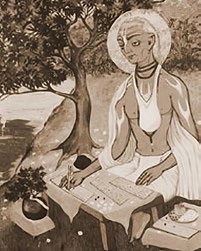
Govinda dāsa Kavirāja

Locana dāsa Ṭhākura
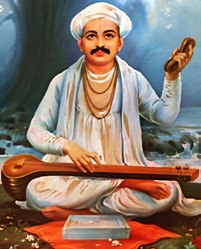
Vidyāpati Ṭhākura 18 songs by vaiṣṇava poets