 Spiritual
(An adaptation of Bhaktivinoda Ṭhākura’s Kena Hare Kṛṣṇa)

Why does the bird of my heart not cry
while singing Kṛṣṇa’s holy name?
Why no ecstatic emotions arise,
no change of heart—who is to blame?

Why does the bird of my heart keep silent, not chanting the name, letting moments slip by? Offenses are said to be the cause of this ailment of not being able to chant and cry.

O forest bird, I have a gift for you kept within the temple of my heart— the holy name as sweet as pure golden honey. If you were taught to chant, you could master the art.

A bird can learn all kinds of names,
why my mind’s bird refuses to sing?
Why does my heart not melt in the flames
of spiritual bliss evoked by chanting?

O bird! Let's go to the spiritual world, the land of everlasting beauty, where beings of mere thought will never come and go, where life is real, not fleeting imagery.
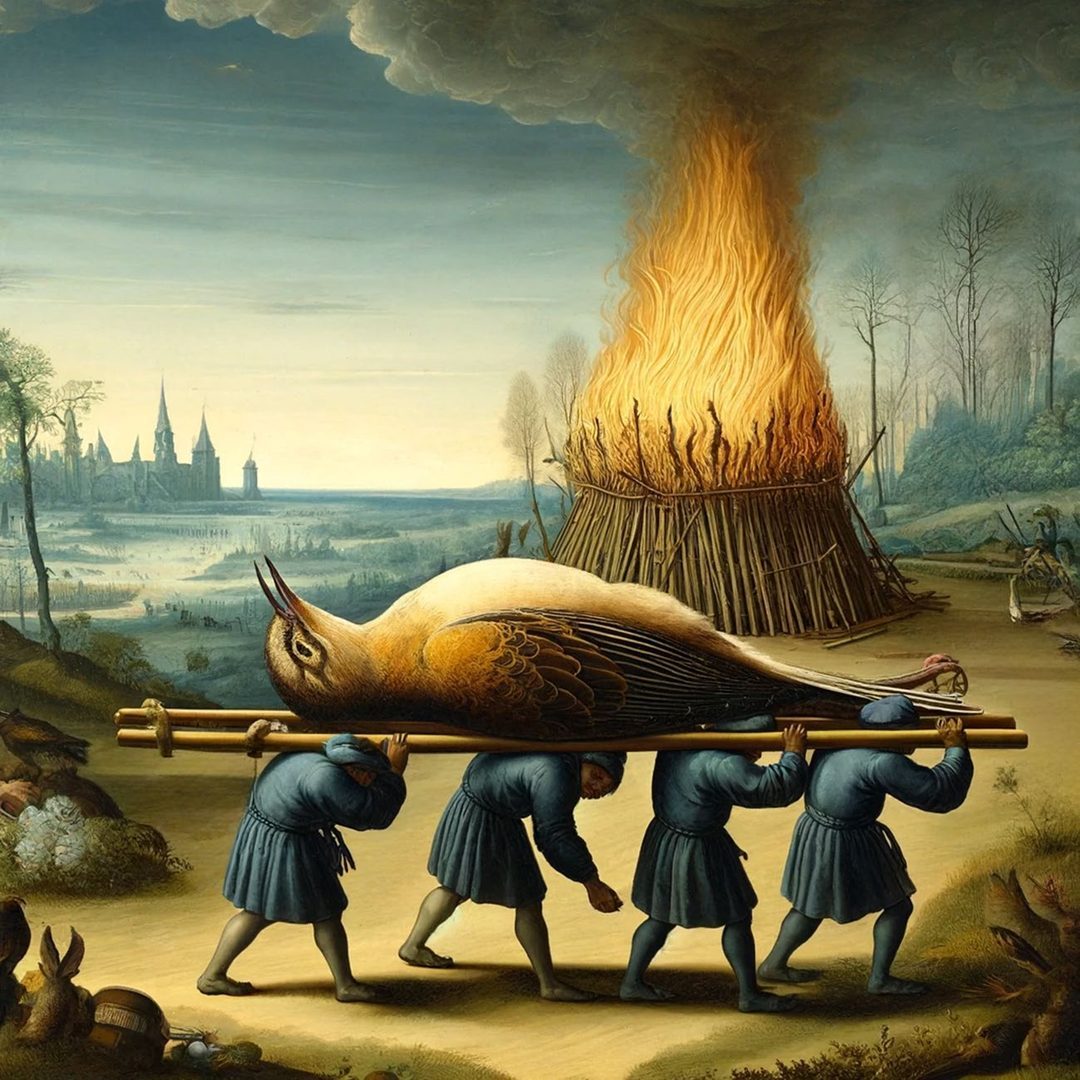
O bird, remember well your earthly fate, laid on a deathbed by time’s ruthless hand, carried to fires that consume and devastate your tongue to silence now condemned.
7a Then it’s too late to chant the Lord’s holy names. O bird of my heart, don’t miss this chance.

7b
Before your tongue is eaten by the flames,
praise the Lord, sing His name and dance.
Commentary
In this song, Śrīla Bhaktivinoda Ṭhākura captures with poetic intimacy one of the most painful and perplexing experiences in spiritual life: the heart's indifference, or even resistance, to divine sound. Despite externally producing the transcendental vibration of the holy names—Hare Kṛṣṇa, Hare Kṛṣṇa, Kṛṣṇa Kṛṣṇa, Hare Hare / Hare Rāma, Hare Rāma, Rāma Rāma, Hare Hare—the heart does not feel the corresponding flood of devotion but remains unmoved. Bhaktivinoda Ṭhākura does not dismiss or explain away this disappointing and painful situation—he questions it: mana prāṇa kāṅde nā. “Why does my heart not weep?”
We encounter the term mana-prāṇa in the Caitanya-caritāmṛta (Antya 2.99) where in the synonyms it is translated as “mind and life,” and in the translation as “heart and life.” Here mana-prāṇa refers to the inner faculties of mind (mana) and vital energy or life-breath (prāṇa). Together, these represent the psychological and emotional self—the part of us that should become soft, receptive, and moved by the holy name. In devotional poetry, mana-prāṇa is often rendered simply as “heart”, since the heart is understood to be the seat of feeling, thought, and inner vitality. This is not a technical term but a poetic condensation of the full inner experience.
Mind, Heart, and Bird: On Poetic Language in Bhakti
In the second verse, Bhaktivinoda Ṭhākura shifts from this abstract expression to a more vivid metaphor, introducing the bird (pakṣi) who personifies the same inner being—the reluctant, dormant self that should sing the names of Kṛṣṇa but refuses due to past offenses or conditioning. This bird of the heart is not a different entity from mana-prāṇa, but rather its poetic embodiment. Thus, when the song speaks first of the “heart” and then of the “bird,” it is not changing topics but deepening the emotional picture. The bird is Bhaktivinoda’s way of giving life and voice to the silent, unmoved heart—inviting it to awaken and sing. This kind of transition is common in bhakti literature. Even Śrīla Prabhupāda uses in his translations of texts like the Śikṣāṣṭaka “mind” and “heart” interchangeably. For instance, in rendering the famous phrase ceto-darpaṇa-mārjanam, he translates ceto as “heart” in one place and “mind” in another. This reflects not inconsistency, but the fact that Sanskrit and Bengali describe the inner life with a fluid and interrelated vocabulary. Words like mana, hṛdaya, citta, and prāṇa each have technical distinctions, but in poetic or experiential settings, they are allowed to overlap. The goal is not to label the parts of the inner self, but to awaken it. In this song, Bhaktivinoda invites us to engage our entire inner being in the act of chanting—not just the lips, but the mind, the breath, the life, and the heart. He is speaking not from the viewpoint of theoretical understanding but from the lived territory of sādhana, where the inner self must be both confronted and awakened. So when he speaks of mana and prāṇa that do not cry, and then of a bird who refuses to chant, we are witnessing the same spiritual struggle through two lenses: one psychological, the other poetic. And both lead us toward the same devotional lament: “Why do I not yet respond to Kṛṣṇa’s name with my whole being?”
The Bird Within
The central metaphor of the song Keno hare kṛṣṇa is the bird—a restless, reluctant being dwelling within the poet’s heart, refusing to sing and chant with feeling. This “bird” echoes the ancient Vedic metaphor of the two birds on a tree, seen in the Śvetāśvatara Upaniṣad. There, one bird represents the individual soul engaged in enjoying the sweet and bitter fruits of karma, and the other bird, the Paramātmā, silently witnessing.
But Bhaktivinoda’s bird is different. It is not the pure soul, but the conditioned living entity, covered by mental conceptions; it is that inner faculty which mediates between the spirit soul and the world, and which must be trained to cooperate with the soul’s innate longing for Kṛṣṇa. In the Bhagavad-gītā (6.5–6), Kṛṣṇa states that the mind can either be a friend or an enemy, it can either elevate or degrade the soul’s progress. Bhaktivinoda Ṭhākura expands on this theme. His soul is ready—it wants to chant. But the mind is not cooperating. He suspects some hidden offense or impurity blocks its response. Thus, the bird remains still. Silent. Dry.
The Soul’s Reluctance to Chant
The author wonders why his heart remains indifferent to the allauspicious sound vibration of the holy name. As described in the Vedic scriptures, “The holy name of Kṛṣṇa is transcendentally blissful. It bestows all spiritual benedictions, for it is Kṛṣṇa Himself, the reservoir of all pleasure.” It is therefore only natural and expected that a jīva who comes in contact with the transcendentally blissful name will also become blissful, and manifest ecstatic symptoms like trembling, shedding tears, and crying. Consequently, Bhaktivinoda Ṭhākura asks himself, “Why does the bird of my heart not cry while singing Kṛṣṇa’s holy name? Why do no ecstatic emotions arise, no change of heart—who is to blame?” Putting himself in the position of an ordinary person, he wonders what the reason could be for not feeling ecstasy while chanting Kṛṣṇa’s name.
Devotees Developing Kṛṣṇa-prema
It is noteworthy that Bhaktivinoda Ṭhākura, in his novel Jaivadharma, describes several devotees who develop kṛṣṇa-prema—love of God—and experience ecstatic symptoms while chanting the Hare Kṛṣṇa mantra after only a short time of practice, sometimes within a matter of days. Unless we dismiss these descriptions as exaggerations or fantasy, we can conclude that the fruits of chanting can indeed be tasted very quickly if the right conditions are met. In other words, certain conditions foster the development of kṛṣṇaprema, while others inhibit or slow the process. Just as in science, experiments in physics or chemistry require specific conditions to yield the desired result; otherwise, the experiment is likely to fail. Controlled variables such as proportions of ingredients, room temperature, and atmospheric moisture are crucial. Similarly, the process of bhakti-yoga can be considered scientific because it, too, requires the right conditions to produce the desired fruit. For example, basic conditions include observing the regulative principles and regularly chanting the mahā-mantra while avoiding the ten offenses. Additional conditions that accelerate advancement on the path include humility and tolerance.
The Reality of Today’s Devotional Practice
As of 2025, many devotees who have been chanting the mahāmantra for decades may still find themselves in a situation similar to that described in this song: no ecstatic emotions arise. Those initiated by Śrīla Prabhupāda have chanted the holy names Kṛṣṇa and Rāma over 250 million times in the past 50 years. Yet, they may still be waiting for the miracle—the moment when the heart finally cries out while chanting Kṛṣṇa’s name. But alas, no tears come to the eyes, no shivering arises in the body, and no hairs stand on end. According to śāstra, the most likely reason for this condition is aparādha, or offense.
The Role of Offenses
The Sanskrit word aparādha literally means moving away from what is proper. It implies acting in a way that obstructs success, and is often translated as “fault,” “mistake,” or simply “offense.”
When Śrīla Prabhupāda gave initiation, he generally explained the ten offenses that should be avoided while chanting the holy name. To the degree that these offenses are being committed, the heart does not change and the pure name does not appear. As stated in the Śrī Caitanya-caritāmṛta (Ādi-līlā 8.16): If one is infested with the ten offenses in the chanting of the Hare Kṛṣṇa mahā-mantra, despite his endeavor to chant the holy name for many births, he will not get the love of Godhead that is the ultimate goal of this chanting. From this verse it seems that although chanting for 30 or 50 years may appear to be a long time, actually it is not. The Bengali text says, bahu janma—many births, not years. Thus one may be chanting for hundreds or even thousands of years, but still, the result of chanting will not manifest because of offenses. Even one offense is enough to block one’s progress, and one will not achieve the treasure of love of God (nā pāya kṛṣṇa-pade prema-dhana). However, this seemingly dire scenario should not discourage us. We, conditioned souls, have been rotating in the cycle of birth and death since time immemorial, with no hope of escape. Now, by Kṛṣṇa’s causeless mercy, we have come in contact with a pure devotee and received the seed of devotional service, the bhakti-latābīja. Even if we do not attain perfection in this lifetime, we should not become depressed and give up the process. As long as we continue on the right path, it is simply a matter of time—and time is eternal. Mukunda Datta’s example can serve as encouragement. He was an intimate devotee of Śrī Caitanya Mahāprabhu but was known to occasionally associate with impersonalist philosophers, which displeased the Lord. One day, when Mukunda tried to join a gathering of Lord Caitanya and His devotees, he was refused entry. Heartbroken, Mukunda pleaded with the devotees to ask the Lord if he would ever again be granted His mercy. When the question was relayed, Śrī Caitanya Mahāprabhu replied, “Tell him he will see Me after ten million births.” Upon hearing this, Mukunda was overjoyed and began to dance, exclaiming, “I will see Him again, even if after ten million births!” Seeing Mukunda’s sincere joy and determination, the Lord immediately called him back, forgave him, and accepted him into His circle. To be admitted into the Lord’s inner circle is not so easy; one must be qualified. In this regard, Śrīla Prabhupāda said about becoming a Vaiṣṇava: “It is not a cheap thing.” However, although it may not be easy, it is not impossible. If we endeavor with enthusiasm, patience, and determination, it is likely that we won’t have to wait ten million births.
A Hard Heart as a Result of Offenses
Regarding offenses as an obstacle on the path, in Chapter 8 of the Ādi-līlā, it further says: There are offenses to be considered while chanting the Hare Kṛṣṇa mantra. Therefore simply by chanting Hare Kṛṣṇa one does not become ecstatic. If one’s heart does not change, tears do not flow from his eyes, his body does not shiver, and his bodily hairs do not stand on end as he chants the Hare Kṛṣṇa mahā-mantra, it should be understood that his heart is as hard as iron. This is due to his offenses at the lotus feet of the Lord’s holy name. If one chants the exalted holy name of the Lord again and again and yet his love for the Supreme Lord does not develop and tears do not appear in his eyes, it is evident that because of his offenses in chanting, the seed of the holy name of Kṛṣṇa does not sprout.
Inattentiveness as the Main Culprit
In his treatise Bhaktyāloka (Illuminations on Bhakti), Bhaktivinoda Ṭhākura explains the reasons behind this unfortunate situation, pointing to one factor in particular as the main culprit: inattentiveness. He writes: In Śrī Hari-bhakti-vilāsa, carelessness is listed as one of the offenses against the holy name. There the word pramāda is translated as “inattentiveness”. Śrī Hari-nāma-cintāmaṇi has further divided inattentiveness into three types: apathy, inactivity, and distraction. Until one is free from these three types of inattentiveness, one cannot perform pure devotional service. Even if one gives up all other nāma-aparādhas, if one is inattentive, attraction for the holy name will not arise. If one has enthusiasm at the beginning of devotional service, and that enthusiasm does not grow cold, one will never become apathetic, lazy, or distracted in chanting the holy names. Therefore, enthusiasm is the only support for all types of devotional service. By enthusiastically performing devotional service, one can give up aniṣṭhitā (unsteady) service in a very short time and thus attain niṣṭhā (steadiness).
The Importance of Niṣṭhā
In the stages of developing love for God described by Rūpa Gosvāmī, niṣṭhā comes before ruci (taste), which means that we cannot attain nāma-ruci (taste for the holy name) unless we attain niṣṭhā. Regarding aniṣṭhitā (unsteady) devotional service, Bhaktivinoda Ṭhākura quotes Viśvanātha Cakravartī Ṭhākura, who describes this stage in Madhurya-kadambinī: When the sādhaka (spiritual practitioner) attains the stage of firm faith, he engages in niṣṭhitā (fixed) devotional service.
Until he attains this fixed devotional service, his service remains flickering. In this unsteady stage, there are six symptoms: utsāha-mayī (false confidence), ghana-taralā (sporadic endeavor), vyūḍha-vikalpā (indecision), viṣayasaṅgarā (struggle with the senses), niyamākṣamā (inability to uphold vows), and taraṅga-rangiṇī (enjoying the facilities offered by bhakti).
The Sweetness the Mind Refuses
Another striking image in the song is that of the holy name smeared with honey and placed with care inside the heart, yet rejected. Bhaktivinoda Ṭhākura’s description reflects both disappointment and deep faith. He knows the name is sweet. He knows it is the Lord Himself. But his mind is reluctant to taste it. It is like a bird surrounded by pools of nectar but unwilling to drink. Yet the tone here is not fatalistic—it is hopeful. “If taught, it can learn,” he writes. The mind can be trained. Through saintly association, attentive chanting, the avoidance of aparādhas (offenses in the chanting of the holy name), and the cultivation of humility, the mind’s resistance can be softened, and the bird will begin to sing.
Time Is Passing
In the latter verses of the song, Bhaktivinoda Ṭhākura introduces a sudden, stark shift in tone. The powerful image of the bird being carried to the cremation ground is not meant to invoke morbidity but to awaken urgency. In the tradition of memento mori (remember that we have to die), Bhaktivinoda Ṭhākura reminds the listener that the opportunity to chant the holy name is temporary—limited to this rare human life. When the body dies, the tongue—instrument of nāmasaṅkīrtana—will be burned on the funeral pyre, and speech will cease.
This graphic moment is meant to jolt the heart: “You have a voice now. Use it. Don’t wait for spiritual feeling to come. Cry out now, while you still can.” In Kṛṣṇa consciousness, death is not feared but used as a spiritual checkpoint: “Are you using your human birth for what matters most?” Bhaktivinoda Ṭhākura’s use of cremation imagery here is both poetic and pedagogical, designed to shake the soul from slumber.
Toward the Land of Beauty
The final verses are not grim, but visionary. Bhaktivinoda invites the bird to fly with him to rūpera deśe—“the land of beauty,” a poetic term for the spiritual world, free of false identities, mental constructs, and the cycles of coming and going. He writes, “Let us go to that land where the imaginary man of the mind never again comes and goes.” This “imaginary man” is the egoic persona—the false identity built from mind and matter. Bhaktivinoda’s aspiration is clear: not merely release from suffering, but entrance into a place where the soul can live in its original form and function—as a loving servant of Kṛṣṇa.
The Song Will Rise
This song is not merely devotional poetry. It is a window into the inner life of a sādhaka. Bhaktivinoda Ṭhākura does not hide behind theory. He does not pretend that chanting always brings bliss. He shows us the raw and honest terrain of spiritual practice, where the soul calls to the mind, the mind resists, and the practitioner laments, pleads, and patiently persists. In doing so, he teaches us how to relate to our own inner bird— with compassion and with firmness. He reminds us that although the soul is naturally inclined to love Kṛṣṇa, the mind must be trained, purified, and surrendered for that love to awaken in expression.
We chant. Sometimes, the heart responds. Sometimes, it does not. But if we persist, as Bhaktivinoda Ṭhākura did, then gradually the bird will learn. The tears will come. The song will rise. And the holy name, already waiting within us, will flood the heart at last.
Final Reflection — The Song That Rises from the Soul
The song of Bhaktivinoda Ṭhākura is a journey into the heart of the devotional practitioner —from confusion to clarity, from inner numbness to deep yearning, from silence to crying out. It begins with the bitter realization that the heart does not respond to the holy name and concludes with the firm hope that one day that very heart —that inner bird— will rise and sing. This progression is not merely literary but deeply spiritual. It reflects the path that many sincere devotees follow: initial enthusiasm confronts mental hardness, the expected fruits do not appear, and disillusionment becomes a test. Yet through patience, proper guidance, humility, and persistent practice, something begins to shift. The bird —a symbol of the inner self— can learn. It can awaken. The metaphors used by Bhaktivinoda Ṭhākura —the reluctant bird, the honey of the holy name, the tongue burned on the pyre, the land of beauty— appeal not only to the intellect but touch the fibers of the soul. They open a space where the reader can recognize themselves, find inspiration, and receive comfort. In the end, what remains is an open invitation: to keep chanting, to keep calling out, and not to give up. For even if the mind does not yet join in fully, the holy name is already present —waiting to flood the heart when the moment is right.
The Original Song
Kena hare kṛṣṇa
Bhaktivinoda Ṭhākura
(Refrain) kena hare-kṛṣṇa-nāma hari bale mana prāṇa kāṅde nā kena—why?; hare kṛṣṇa nāma—the names Hare Kṛṣṇa; hari bale—chanting the name Hari; mana prāṇa—my inner heart; kāṅde nā—does not weep. Oh, why—despite chanting the holy names "Hare Kṛṣṇa" and "Hari"—does my inner heart not cry? pakṣi nā jāni kona aparādhe mukhe hare-kṛṣṇa-nāma bala nā pakṣi—the bird (my heart); nā jāni—I do not know; kona aparādhe—by some offense; mukhe—with the mouth; hare kṛṣṇa nāma—the names of Hare Kṛṣṇa; bala nā—does not chant. The bird of my heart does not know what offenses it has committed to cause this inability to chant Hare Kṛṣṇa properly. vanera pakṣi re dhare rāklām hṛdaya mandire madhu mākhā ei hari-nāma pakṣi re śikṣaile śikṣe vanera pakṣi—a bird of the forest; re—O!; dhare—holding; rāklām—I have kept; hṛdaya mandire—in the temple of my heart; madhu mākhā—smeared with honey; ei—this; hari nāma—name of Lord Hari; pakṣi re—O bird!; śikṣaile—upon being instructed; śikṣe—learns. O forest bird! I have kept something for you very carefully within the temple of my heart—the holy name of Lord Hari, which is overflowing with pure sweet honey. O bird, you could learn the chanting of this name if you were taught. pakṣi sakala nāma balte para kena hare-kṛṣṇa-nāma bala na pakṣi—a bird; sakala nāma—all names; balte para—is able to speak; kena—why?; hare kṛṣṇa nām—the names Hare Kṛṣṇa; bala na—does not chant. A bird can learn to say so many names—why then will this bird of my heart not chant "Hare Kṛṣṇa"? cala pakṣi rūpera deśe jāi ye deśete manera mānuśa āsā jāoyā nāi cala—please go; pakṣi—O bird!; rūpera deśe—to the land of true beauty; jāi—I go; ye deśete—at which place; manera mānuśa—the mentally-imagined man; āsā jāoyā—comes and goes (as in repeated birth and death); nāi—not. Come, O bird, let us go to that land of true and everlasting beauty, where the imaginary man of the mind no longer comes or goes—free from the cycle of birth and death. ye pakṣi re tora maraṇa kālete carabi vāter dolāte ore cāri janete kandhe kare laye yābe śmaśāna ghāṭete ye—that; pakṣi re—O bird!; tora—your; maraṇa kālete—at the time of death; carabi—you will be placed; vāter—made from bamboo; dolāte—on the funeral stretcher; ore—oh!; cār janete—by four persons; kandhe kare—placing on the shoulder; laye—carrying; yābe—will proceed; śmaśān ghāṭete—to the cremation Ghat. O bird! When the time of death arrives, your body will be placed on a bamboo stretcher, lifted by four men, and taken to the cremation ground.
ore o tora mukhe āguna jihve tule ki karabi tāi bala nā ore o—alas!; tora—your; mukhe—in the mouth; āguna—fire; jihve—the tongue; tule—obliterate; ki karabi—what can you do?; tāi—at that; bala nā—you do not speak. Alas! Fire will enter your mouth and consume your tongue. Then what will you do? You’ll no longer be able to speak!