 Spiritual
(An adaptation of Govinda dāsa Kavirāja’s Bhajahū re mana)
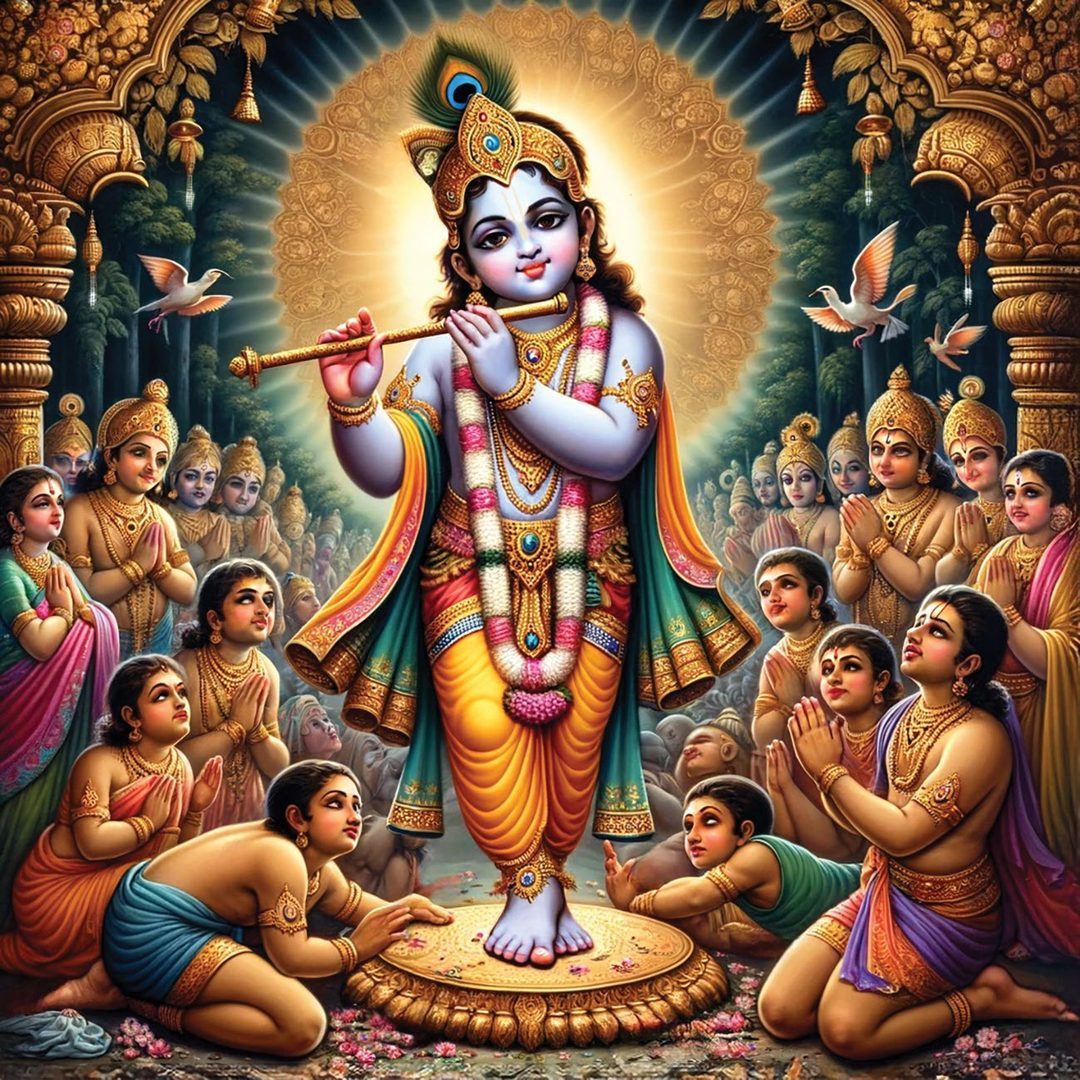
O Mind, just worship the lotus feet
of Nanda’s son, Śrī Nanda-nandan,
His feet are the only shelter
of fearlessness for everyone.

Having obtained this rare human birth,
seek saintly association,
and cross the ocean of birth and death,
thus ending transmigration.
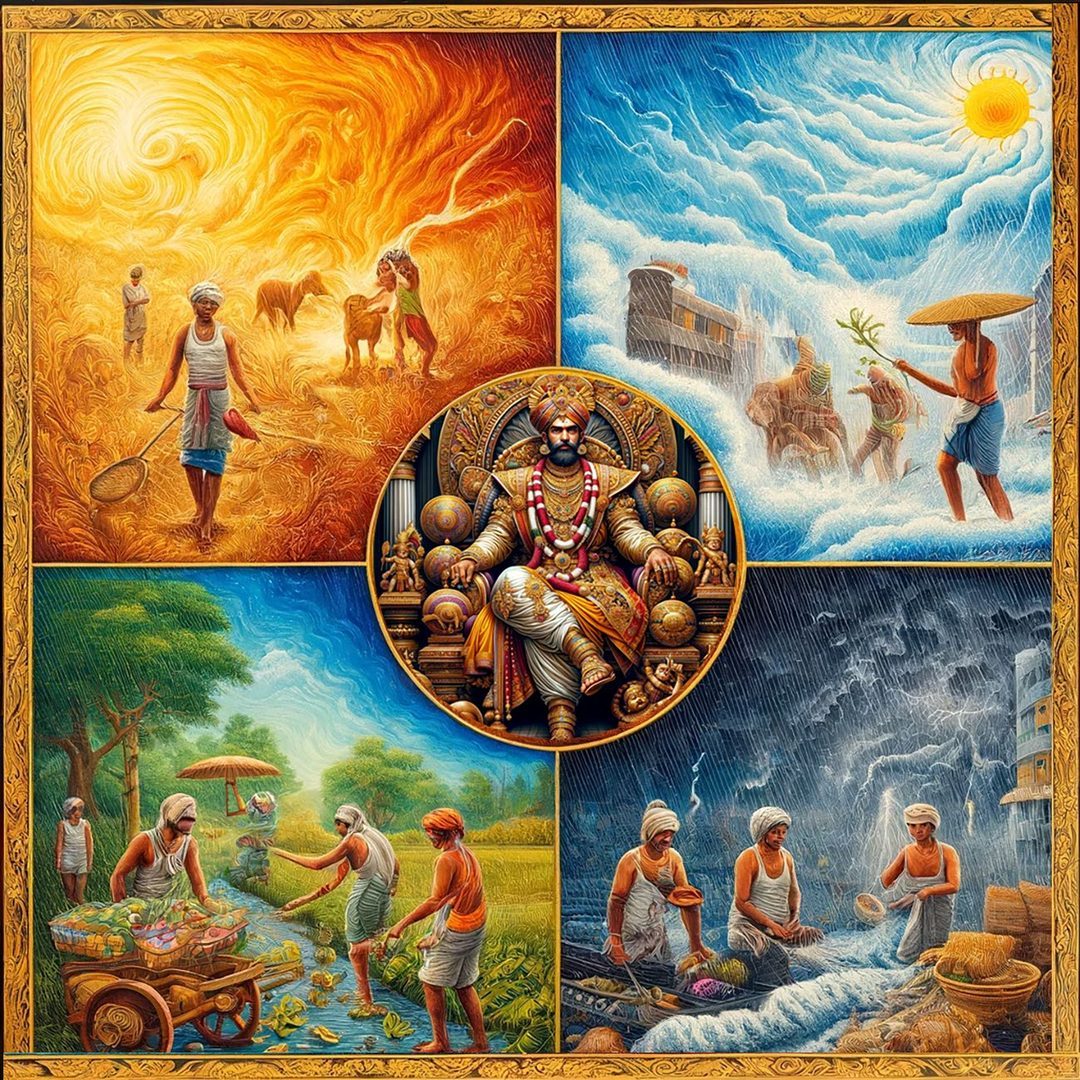
I’ve toiled in heat, cold, wind and rain, sleepless nights my only gain. I’ve served the miserly, wicked and heartless for tiny bits of fleeting happiness.

4a Wealth, youth, sons and relatives, what true satisfaction or bliss they can give?

4b Like a drop of water on a lotus leaf, life is tottering—therefore take shelter of Hari’s feet.

To hear and chant about Hari,
remember Him, pray with sincerity,
serve His lotus feet, become His servant,
worship Him and be His friend.

Offer your very self at His feet,
surrender your life and soul.
Govinda dāsa has this longing,
desires to attain this goal.
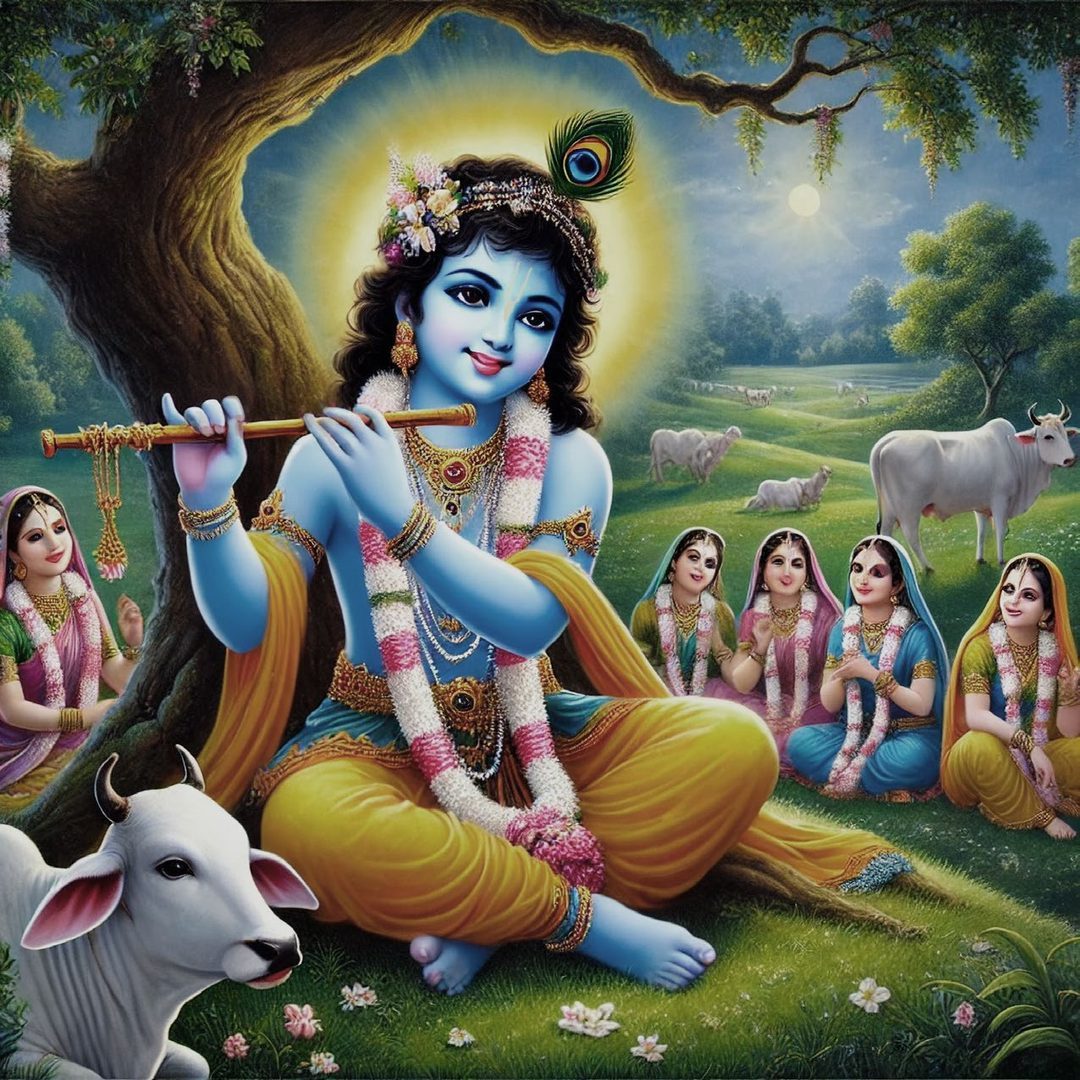
O Mind, just worship the lotus feet
of Nanda’s son, Śrī Nanda-nandan,
His feet are the only shelter
of fearlessness for everyone.
Commentary
Bhajahū re mana, which is presented in this collection as Free From Fear, is one of the more popular songs in Vaiṣṇava circles. In this song, Govinda dāsa Kavirāja offers a method to overcome fear.
The Universal Principle of Fear
Nobody likes to live in fear, but life in the material world is characterized by constant fearfulness. Every living entity—including birds, beasts, and insects, and even higher beings like the demigods— lives in an atmosphere of uncertainty, not knowing what will happen in the near or distant future. Therefore, bhaya (fear, anxiety) is one of the four basic universal principles that all living entities have in common: āhāra, nidrā, bhaya, and maithuna—eating, sleeping, fearing (defending), and mating. Out of these four, three we pursue and one we try to avoid. Every creature, including birds and bees, likes to eat, sleep and mate; however, nobody likes to live in fear. But fear is unavoidable. As long as we live within a body composed of destructible material elements, and identify with it, thinking that the body is the self, we are accompanied by anxiety due to the transient nature of our perceived existence. Since there is no guarantee that we will still be alive tomorrow, such uncertainty generates anxiety and fear.
How to Overcome Fear
Govinda dāsa recommends taking shelter of Kṛṣṇa as the best means to overcome fear. Because fear is generated in the mind, he addresses his mind: “My dear mind, just worship the lotus feet of Nanda-nandana, Kṛṣṇa, the son of Nanda Mahārāja. In this way, you will become fearless.” One may wonder, what is so special about the Lord’s feet that they offer such protection?
Kṛṣṇa’s Lotus Feet
In the Śrīmad-Bhāgavatam (3.5.39-40), the demigods pray: O Lord, Your lotus feet are like an umbrella for the surrendered souls, protecting them from all the miseries of material existence. All the sages under that shelter throw off all material miseries. We therefore offer our respectful obeisances unto Your lotus feet. O Father, O Lord, O Personality of Godhead, the living entities in the material world can never have any happiness because they are overwhelmed by the three kinds of miseries. Therefore they take shelter of the shade of Your lotus feet, which are full of knowledge, and we also take shelter of them. When the demigods felt distress because of the demon Vṛtrāsura, they sought shelter of the Lord’s lotus feet prayed to Him for relief. In the purport (SB 6.9.43) Prabhupāda says: One need only seek shelter of the shade of the Lord's lotus feet. Then all the material tribulations that disturb him will be subdued, just as when one comes under the shadow of a big tree, the disturbances caused by the heat of the scorching sun are immediately mitigated, without one's asking for relief. Therefore the whole concern of the conditioned soul should be the lotus feet of the Lord. The conditioned soul suffering from various tribulations because of existing in this material world can be relieved only when he seeks shelter at the Lord's lotus feet. The concept of the Lord’s or pure devotee’s lotus feet, along with the dust or washwater from such feet, holds profound symbolic and spiritual significance in Vedic culture, deeply embedded in its social etiquette, religious practices, and philosophical teachings. Reverence towards feet, especially the act of touching or surrendering to a saintly person’s feet, reflects respect, humility, and the acknowledgment of spiritual superiority. As the feet are the lowest part of the body and make direct contact with the ground, it is natural they collect dust, especially when walking barefoot—a common practice in ancient India. To take the dust from someone’s feet symbolizes surrendering the ego and one’s false prestige to receive blessings, instructions, and protection. It's an act of devotion, indicating the devotee's readiness to follow the spiritual path laid out by the guru or to receive the Lord's grace.
In Śrīla Prabhupāda’s books, we find many statements about the relationship between an aspiring devotee and the Lord’s or spiritual teacher’s lotus feet. Here are some illustrative examples: The Ganges water is celebrated because it emanates from the lotus feet of the Supreme Personality of Godhead. Similarly, those who are directly in touch with the lotus feet of the Supreme Personality of Godhead and who are absorbed in the chanting of His glories are freed from all material contamination. Such unalloyed devotees are able to show mercy to the common conditioned soul. (SB 4.24.58) Bali Mahārāja said to Lord Vāmanadeva: “O son of a brāhmaṇa, today the fire of sacrifice is ablaze according to the injunction of the śāstra, and I have been freed from all the sinful reactions of my life by the water that has washed Your lotus feet. O my Lord, by the touch of Your small lotus feet the entire surface of the world has been sanctified.” (SB 8.18.31) The devotee's love for the Supreme Personality of Godhead is so intense that he wants to kiss the lotus feet of the Lord constantly, and he wants to touch the tips of the toes of the Lord and constantly embrace His lotus feet. (SB 4.9.3) Since the Supreme Lord is all-powerful, He can do things that seem wonderful for a common man. Similarly, a devotee who
has taken shelter at the lotus feet of the Lord can also do wonderful things unimaginable to a common man, by the grace of the dust of those lotus feet. Caitanya Mahāprabhu therefore teaches us to take shelter of the Lord's lotus feet. (SB 5.1.35)
Sādhu-Saṅga and Spiritual Progress
In the second part of the first stanza, the author points out that association of saintly persons (sādhu-saṅga) is the recommended means to cross over the ocean of birth and death. Śrī Caitanya Mahāprabhu told Sanātana Gosvāmī (Cc. Madhya 22.49, 83): By associating with a sādhu, one awakens his faith in devotional service to Kṛṣṇa. Because of devotional service, one’s dormant love for Kṛṣṇa awakens, and thus one’s material, conditioned existence comes to an end. The root cause of devotional service to Lord Kṛṣṇa is association with advanced devotees. Even when one’s dormant love for Kṛṣṇa awakens, association with devotees is still most essential. Śrīla Prabhupāda explains in the Upadeśāmṛta that he formed the International Society for Krishna Consciousness to give people the opportunity to associate with devotees. However, he did not intend for this to be an ordinary “coming together” to talk about mundane topics and enjoy a social life. For this reason, he translated the word sādhu in the above verse as “advanced devotees.” Advanced sādhus have no interest in mundane conversations, which are regarded, in the words of Nārada Muni in the Śrīmad-Bhāgavatam (1.5.10), as a place of pilgrimage for crows. Rather, advanced devotees are only interested in kṛṣṇa-kathā, which can purify, enliven, and change the heart.
Kapiladeva describes the effects of such sādhu-saṅga as follows (SB 3.25.25): In the association of pure devotees, discussion of the pastimes and activities of the Supreme Personality of Godhead is very pleasing and satisfying to the ear and the heart. By cultivating such knowledge one gradually becomes advanced on the path of liberation, and thereafter he is freed, and his attraction becomes fixed. Then real devotion and devotional service begin.
The Common Worker’s Struggle
In the third stanza, Govinda dāsa Kavirāja reflects on the situation of a common fruitive worker in this world: I’ve toiled in heat, cold, wind and rain, sleepless nights my only gain. I’ve served the miserly, wicked and heartless for tiny bits of fleeting happiness To make money, people are willing to work under awkward, unhealthy and hazardous conditions, sometimes even risking their lives. As a consequence, stress, anxiety and depression in the workplace are growing global concerns. According to the World Health Organization (WHO), as of 2024, over 1 billion people were suffering from mental health issues, and the numbers are rising. It should be noted, however, that this situation is not a new phenomenon. Govinda dāsa Kavirāja wrote this song almost 500 years ago, and even if it had been written 5,000or 5000,000 years ago, the conclusion would remain the same. His observations are timeless. The material world is by nature a place of suffering, as Kṛṣṇa points out in the Bhagavad-gītā (8.15): duḥkhālayam aśāśvatam. It is a temporary place full of miseries. And as if external conditions, like severe heat or cold, weren’t enough, often a person has to work
under mean and abusive superiors adding mental distress to physical suffering.
The Pursuit of Happiness Amid Life’s Hardships
Why would a person tolerate such conditions? The answer is to obtain happiness. The American Constitution even recognizes the pursuit of happiness as an essential human inclination and, therefore, a fundamental human right. Actually, it is the soul’s natural tendency, expressed in all species of life. Every living entity wants to obtain pleasure and avoid pain. But, to obtain pleasure, a certain amount of pain is often accepted. In the face of this imperfect reality, the phrase “C’est la vie” (That’s life) has been coined. However, transcendentalists counter that this is not life, not real life. They look at this so-called reality from a different angle. They propose that one should limit the pursuit of material or worldly happiness to a minimum and invest one’s time and energy mainly in the pursuit of spiritual happiness. As Ṛṣabhadeva explains in the Fifth Canto of the Śrīmad-Bhāgavatam, the pursuit of spiritual happiness involves a certain amount of austerity, or discomfort, but the acceptance of such undesirable conditions is worthwhile because the end result is brahma-saukhyaṁ tv anantam—unending spiritual happiness— while material happiness has a beginning and an end. Spiritual happiness continues even after one gives up the present body, whereas material happiness ends when the body is finished.
The Illusion of Security in Family and Comforts
The next stanza describes in detail what material happiness means for most people: wealth, youth, children, and family. Family, in particular, is often the most important part of their lives. Many are willing to do anything, even sacrifice their own well-being, for the sake of family. Yet, even if one is fortunate enough to have a wonderful family where all members enjoy good health, harmonious relationships, and financial stability, such happiness can change in an instant. There are countless examples of sudden misfortune—a disaster may strike at any time, whether through accident, illness, or external forces like earthquakes, hurricanes, or floods.
A Drop of Water on a Lotus
Govinda dāsa Kavirāja captures this precarious condition with an apt analogy: a drop of water on a lotus leaf. In the sunlight, a droplet glistening on a lotus looks beautiful, yet with the slightest movement, it can slide down and vanish into the water. Our life in this world is just like that: it may end at any moment. A water droplet cannot stay long on a lotus leaf, as the leaf’s waxy surface repels water, causing the droplet to bead up and easily roll off. Life in the material world is equally fragile.
Overcoming Life’s Dangers
This delicate situation is expressed by Brahmā in his prayers to Kṛṣṇa as padaṁ padaṁ yad vipadam—a place where danger exists at every step. In this prayer, found in the Śrīmad-Bhāgavatam (10.14.58), Brahmā recommends taking shelter of the Lord’s lotus feet as a means to escape such a perilous situation: For those who have accepted the boat of the lotus feet of the Lord, who is the shelter of the cosmic manifestation and is famous as Murāri, the enemy of the Mura demon, the ocean of the material world is like the water contained in a calf's hoofprint. Their goal is paraṁ padam, Vaikuṇṭha, the place where there are no material miseries—not the place where there is danger at every step.
In the last stanza, Govinda dāsa Kavirāja enumerates the nine processes of devotional service, as described by Prahlāda Māhārāja in the Śrīmad-Bhāgavatam (7.5.23-24): Hearing and chanting about the transcendental holy name, form, qualities, paraphernalia, and pastimes of Lord Viṣṇu, remembering them; serving the lotus feet of the Lord; offering the Lord respectful worship with sixteen types of paraphernalia; offering prayers to the Lord; becoming His servant; considering the Lord one's best friend, and surrendering everything unto Him (in other words, serving Him with the body, mind and words)—these nine processes are accepted as pure devotional service. One who has dedicated his life to the service of Kṛṣṇa through these nine methods should be understood to be the most learned person, for he has acquired complete knowledge.
The Mind as Friend or Enemy
These are instructions to the mind, which is likened to the driver of a car-like body. We, the living entities, are the passengers, ideally guiding the driver on where to take us. Unfortunately, however, the driver often acts independently and recklessly. This is the situation for the majority of conditioned souls in the material world. As Kṛṣṇa explains to Arjuna in Chapter 6 of the Bhagavad-gītā, an uncontrolled mind is our worst enemy. We are advised to bring it under control and make it our friend. This is the message Govinda dāsa Kavirāja wishes to convey: “Dear mind, be my friend by worshiping the lotus feet of Kṛṣṇa, for in this way, we can both become fearless and cross over the ocean of material suffering to reach the shore of the spiritual realm, where life is eternal and blissful.”
The Original Song
Bhajahū re mana
Govinda dāsa Kavirāja
bhajahū re mana śrī-nanda-nandana abhaya-caraṇāravinda re durlabha mānava-janama sat-saṅge taraha e bhava-sindhu re bhajahū—just worship; re—O!; mana—mind; śrī-nanda-nandana—of the son of Nanda; abhaya-caraṇāravinda—the lotus feet which make one fearless; re—O!; durlabha mānava-janama—this rare human birth; sat-saṅge—in the association of saintly persons; taraha—cross over; e bhava-sindhu—this ocean of worldly existence; re—O! O mind, just worship the lotus feet of the son of Nanda, which make one fearless. Having obtained this rare human birth, cross over this ocean of worldly existence by associating with saintly persons. śīta ātapa vāta variṣaṇa e dina yāminī jāgi re biphale sevinu kṛpaṇa durajana capala sukha-lava lāgi' re śīta—cold; ātapa—heat; vāta—wind; variṣaṇa—rain; e—this; dina—day; yāminī— night; jāgi—I remain sleepless; re—O!; biphale—uselessly; sevinu—I have served; kṛpaṇa durajana—miserly and wicked men; capala—flickering; sukha-lava—a fraction of happiness; lāgi'—for the purpose of; re—O! Day and night I can find no sleep, suffering the onslaught of heat and cold, wind and rain. For a bit of flickering happiness I have vainly served wicked and miserly men.
e dhana, yauvana, putra, parijana
ithe ki āche paratīti re
kamala-dala-jala, jīvana ṭalamala
bhajahū hari-pada nīti re
e—this; dhana—wealth; yauvana—youthfulness; putra—sons; parijana—family members; ithe—in these; ki āche—what is it?; paratīti—understanding; re—O!; kamala-dala—on a lotus petal; jala—like a drop of water; jīvana—this life; ṭalamala—is tottering; bhajahū—you should always worship; hari-pada—the feet of Lord Hari; nīti—the practice; re—O! What assurance of real happiness is there in all one’s wealth, youth, sons, and relatives? This life totters like a drop of water on a lotus petal; therefore you should always worship the lotus feet of Lord Hari. śravaṇa, kīrtana, smaraṇa, vandana, pāda-sevana, dāsya re pūjana, sakhī-jana, ātma-nivedana govinda-dāsa-abhilāṣa re śravaṇa—hearing the glories of Lord Hari; kīrtana—chanting those glories; smaraṇa—constantly remembering Him; vandana—offering prayers to Him; pādasevana—serving the Lord's lotus feet; dāsya—serving the Supreme Lord as a servant; re—O!; pūjana—worshiping Him with flowers and incense and so forth; sakhī-jana— serving Him as a friend; ātma-nivedana—and completely offering the Lord one's very self; govinda-dāsa-abhilāṣa—(these nine processes of devotion are) the desire and great longing of Govinda dāsa; re—O! Govinda dāsa longs to hear the glories of Lord Hari, chant His glories, constantly remember Him, offer Him prayers, serve His lotus feet, become His servant, worship Him, serve Him as a friend, and completely offer Him his very self.