 Spiritual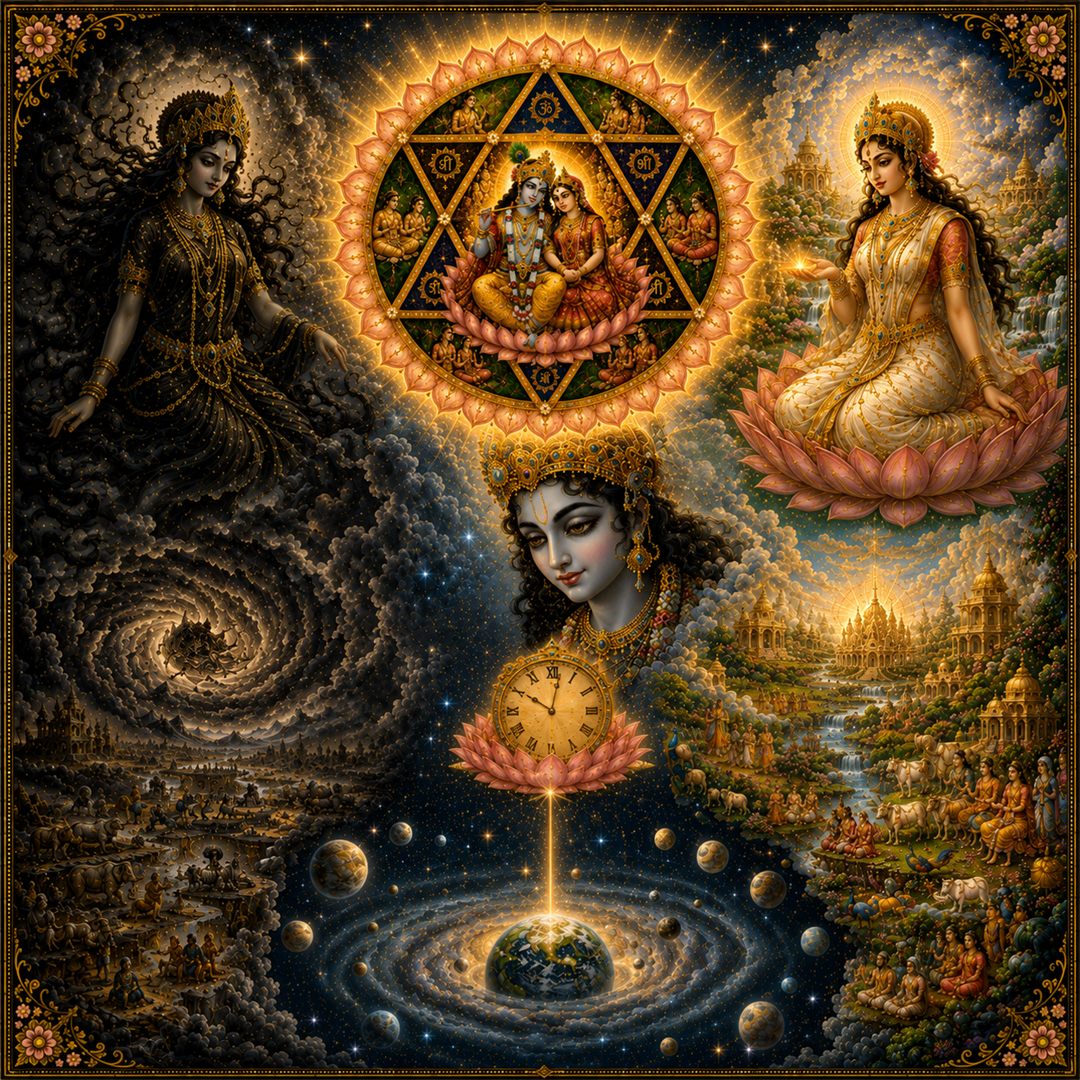
माययारममाणस्य न वियोगस्तया सह ।
आत्मना रमया रेमे त्यक्तकालं सिसृक्षया ॥ ७ ॥
māyayāramamāṇasya na viyogas tayā saha
ātmanā ramayā reme tyakta-kālaṁ sisṛkṣayā
Although the Puruṣa does not sport with Māyā, He is not separated from her. Desiring to create, He sported with Ramā, His own intrinsic potency, having sent forth time.
māyayā— with Māyā; aramamāṇasya—of Him who does not sport or enjoy; na viyogaḥ—there is no separation; tayā saha—from her; ātmanā ramayā—with Ramā, His own intrinsic potency; reme—He sported, enjoyed; tyakta-kālam—having sent forth time; sisṛkṣayā—with the desire to create.
Dig-darśinī-ṭīkā
Jīva Gosvāmī
Now Brahmā explains that the Puruṣa, who is the indwelling self of the material manifestation and an expansion of Govinda, is not entirely without relation to Māyā in the same way as Govinda is. Thus the verse begins with māyayā.
Even during the material dissolution, Māyā dissolves into Him, as indicated by statements such as: yasyāṁśāṁśāṁśa-bhāgena.
One may then object: “Would He not thereby become affected by her like an ordinary jīva and consequently cease to be the supreme controller?”
In reply it is said: ātmanā ramayā reme. “He enjoys with Ramā, His intrinsic potency, who abides within Him.” The meaning is that He enjoys only with His intrinsic potency, while Māyā serves Him externally.
Thus Brahmā says in the Śrīmad-Bhāgavatam (3.9.23):
eṣa prapanna-varado ramayātma-śaktyā
yadyat kariṣyati gṛhīta-guṇāvatāraḥ
“This Lord, who bestows blessings upon the surrendered souls, performs whatever He does through Ramā, His intrinsic potency, even when He assumes an avatāra associated with the material modes.”
And Arjuna prays in the First Canto of Śrīmad-Bhāgavatam (1.7.23) to Kṛṣṇa:
māyāṁ vyudasya cic-chaktyā kaivalye sthita ātmani
“Having cast aside Māyā by Your spiritual potency, You remain situated in Your own self in absolute spiritual independence.”
One may then ask: “Without His impelling her, how can creation take place?”
Therefore the verse says sisṛkṣayā, “with the desire to create,” and tyakta-kālam, indicating that time was sent forth by Him for the purpose of creation.
The reading tyakta-kālaḥ in the nominative case is also straightforward.
The meaning is that creation is accomplished by that very time, which is the form of His power. Thus Scripture states: prabhāvaṁ pauruṣaṁ prāhuḥ kālam eke yato bhayam. “Some describe time as the power of the Supreme Person, from which fear arises.”
In the Third Canto of the Śrīmad-Bhāgavatam (3.5.26), Maitreya says:
kāla-vṛttyā tu māyāyāṁ guṇa-mayyām adhokṣajaḥ
puruṣeṇātma-bhūtena vīryam ādhatta vīryavān
“Through the agency of time, the powerful Lord Adhokṣaja placed His generative potency within material nature, composed of the modes, by means of the Puruṣa, His own expansion.”
Brahma-saṁhitā-prakāśinī
Bhaktivinoda Ṭhākura
Verse 7
The Puruṣa does not directly unite with Kṛṣṇa’s external potency, nor does He enjoy with Māyā. Nevertheless, there is no absolute separation between Māyā and that Supreme Being. Desiring to create the material universe, the Puruṣa sports with Ramā, His spiritual potency. His connection with Māyā occurs only indirectly through His glance in the form of the time potency.
Kṛṣṇa’s relation with the māyā-śakti is not direct but indirect. Through the Puruṣa-avatāra Kāraṇārṇavaśāyī,1 an expansion of Mahā-Saṅkarṣaṇa of Vaikuṇṭha, the abode of His divine pastimes, He casts His glance upon Māyā.
Even in that act of glancing, there is no direct contact with Māyā, because Ramā, His spiritual potency, who is inseparably present within Him and acts entirely according to His will, performs that act of glancing.
External Māyā, serving as the maidservant of Ramā, serves the expansion of Bhagavān who sports with Ramā. Time is the active agency through which Ramā carries out the work of creation and manifestation. From that agency arises the generative potency underlying creation
Annotations
Bhakti Gauravani Gosvāmī
This verse emphasizes the transcendental position of Govinda, who, although He is sarva-kāraṇa-kāraṇam, the cause of all causes, remains aloof from the process of material creation. Even the Puruṣa-avatāra, through whom creation proceeds, does not directly unite with Māyā. He acts through His intrinsic spiritual potency, while Māyā serves externally and receives His creative impulse through the time factor.
Śrīla Prabhupāda gives the example of a king who remains in his palace, enjoying the company of his family and friends, while the affairs of the kingdom are overseen by ministers, secretaries, and other government servants.
***
A brief note concerning the use of māyā and Māyā, and of puruṣa and Puruṣa: When māyā refers to the external potency or to the principle of illusion, it is written in lowercase. When Māyā refers to the personified external energy, it is capitalized.
Similarly, when puruṣa is used as a general philosophical term, it is written in lowercase. When it designates the divine Puruṣa, the personal expansion of the Lord associated with creation, it is capitalized.
The need for this distinction becomes especially important in passages where the Puruṣa and Māyā are described as two personalities interacting with one another.
Notes
- Another name for Kāraṇodakaśāyī Viṣṇu, or Mahā-Viṣṇu. ↩