 Spiritual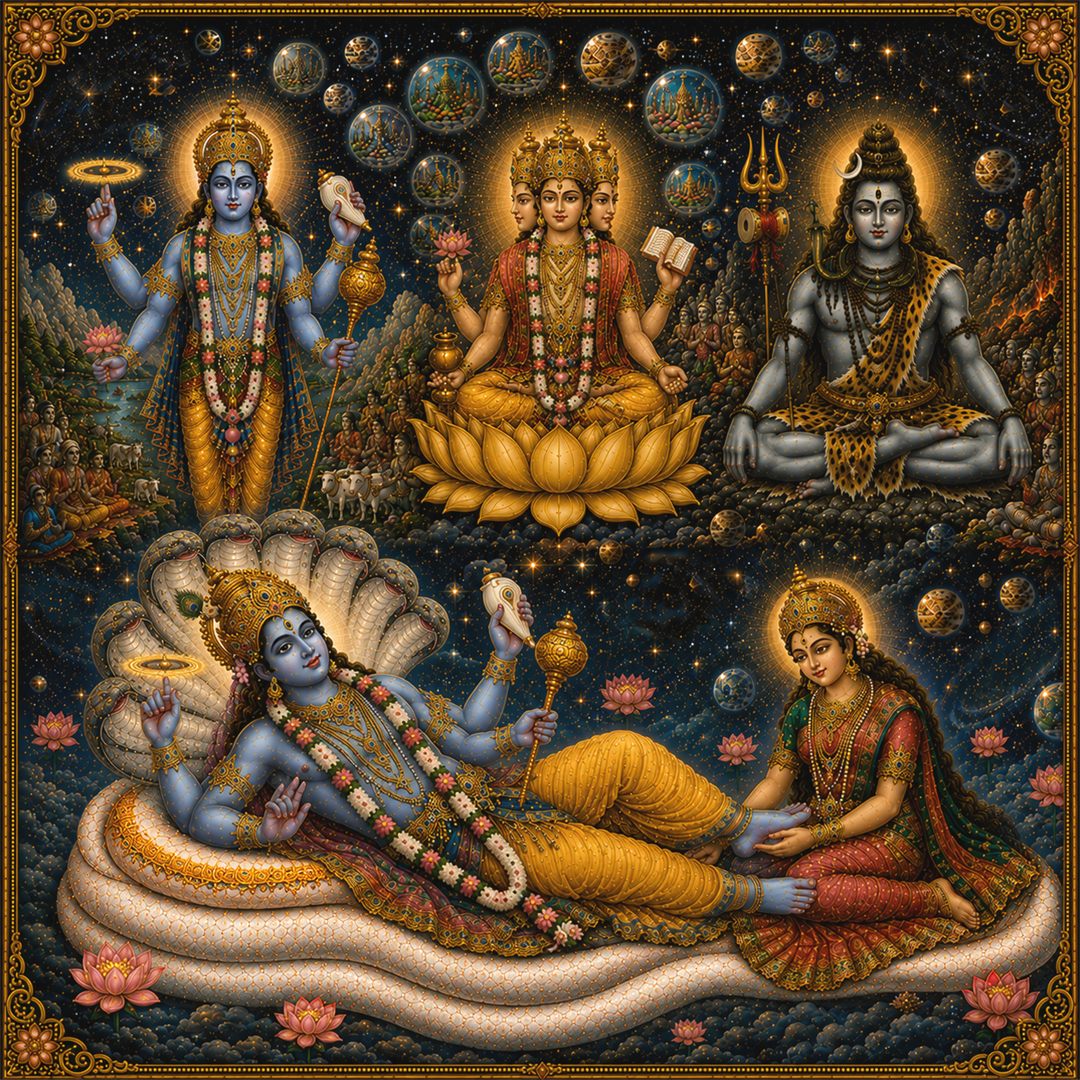
अथ तैस्त्रिविधैर्वेशैर्लीलामुद्वहतः किल ।
योगनिद्रा भगवती तस्य श्रीरिव सङ्गता ॥ १७ ॥
atha tais tri-vidhair veśair līlām udvahataḥ kila |
yoga-nidrā bhagavatī tasya śrīr iva saṅgatā
Then, while He carries out His pastimes through those three forms, the divine Yoga-nidrā remains associated with Him, just as Śrī does.
atha—then; taiḥ tri-vidhaiḥ veśaiḥ—through those three kinds of forms; līlām udvahataḥ—of Him who performs His pastimes; kila—indeed; yoga-nidrā—Yoga-nidrā; bhagavatī—the divine goddess; tasya—of Him, with Him in this construction; śrīḥ iva—like Śrī; saṅgatā—associated, united.
Dig-darśinī-ṭīkā
Jīva Gosvāmī
The verse now describes the pastimes of the Lord who has entered the universes in those respective forms.
Taiḥ tri-vidhaiḥ veśaiḥ: “Through those three kinds of corresponding forms,” namely Viṣṇu, Prajāpati, and Śambhu situated within each universe.
Līlām udvahataḥ: “While performing His līlā,” referring to the Puruṣa within each universe who carries out maintenance and the other cosmic functions there.
Yoga-nidrā is a partial manifestation of the previously described Mahā-Yoga-nidrā. This divine goddess consists of absorption in the bliss of the Lord’s own nature (svarūpānanda-samādhi) and contains all divine opulences within herself. She remains associated with Him.
Śrīr iva saṅgatā: “Associated like Śrī” means that, just as Śrī accompanies Him through a portion of herself, Yoga-nidrā also accompanies Him through a partial manifestation.
Brahma-saṁhitā-prakāśinī
Bhaktivinoda Ṭhākura
Verse 17
Thereafter, Bhagavān assumes the three forms of Viṣṇu, Prajāpati, and Śambhu within the universes and performs the pastimes of maintenance, creation, and destruction. These pastimes belong to the sphere of material māyā and are therefore of little significance. Viṣṇu, who represents Bhagavān’s own essential being, remains associated with the divine Yoga-nidrā, a partial manifestation of His spiritual potency who consists of absorption in the bliss of His own nature.
Prajāpati and Śambhu, who belong to the category of separated expansions (vibhinnāṁśa), possess a sense of separateness from Bhagavān. They therefore sport with their respective inferior potencies, Sāvitrī and Umā, who are particular shadow manifestations of the spiritual potency.
Bhagavān Viṣṇu alone is the husband of Ramā, or Śrī, who is the embodiment of the internal spiritual potency.