 Spiritual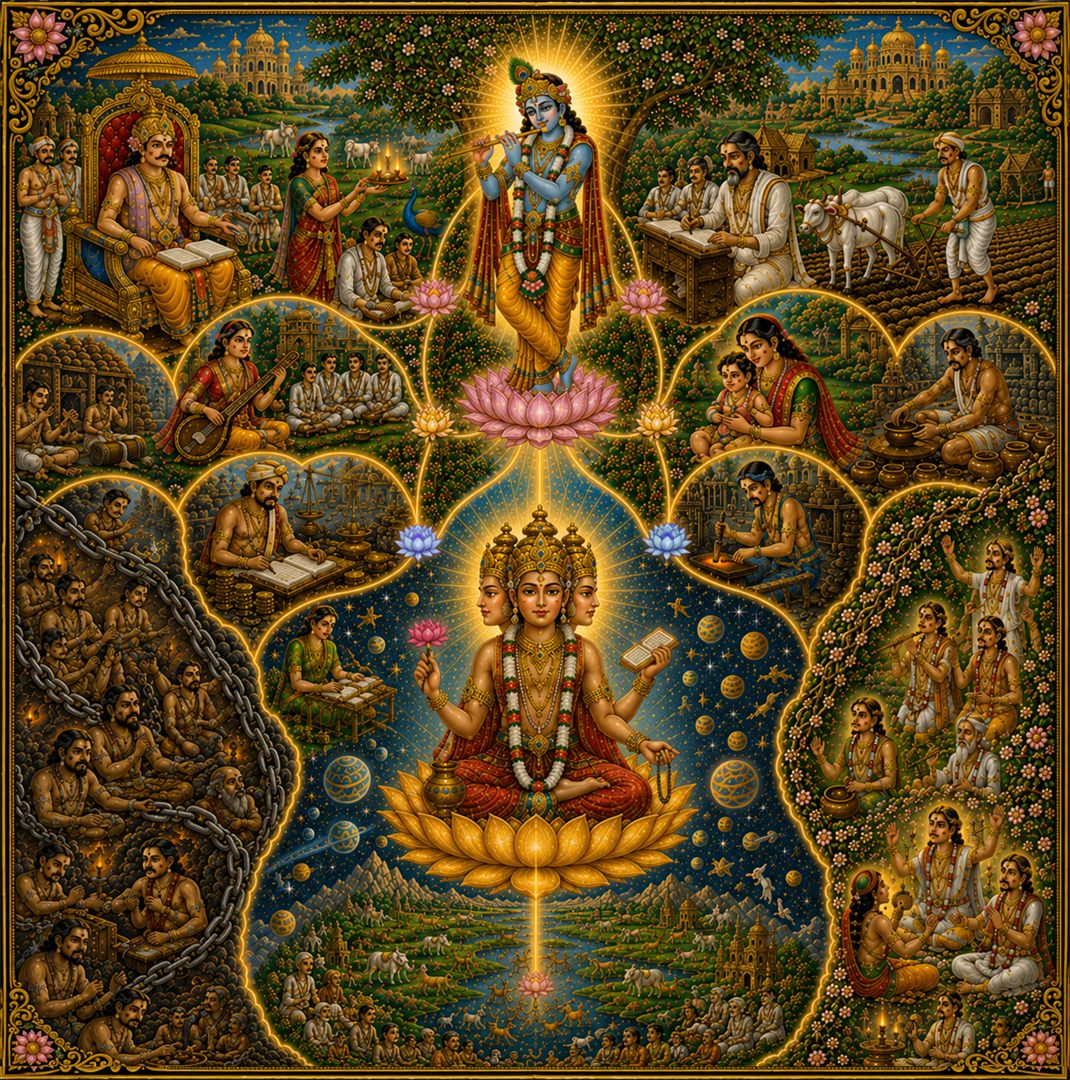
धर्मानन्यान्परित्यज्य मामेकं भज विश्वसन् ।
यादृशी यादृशी श्रद्धा सिद्धिर्भवति तादृशी ।
कुर्वन्निरन्तरं कर्म लोकोऽयमनुवर्तते ।
तेनैव कर्मणा ध्यायन्मां परां भक्तिमिच्छति ॥ ६१ ॥
dharmān anyān parityajya mām ekaṁ bhaja viśvasan
yādṛśī yādṛśī śraddhā siddhir bhavati tādṛśī
kurvan nirantaraṁ karma loko ‘yam anuvartate
tenaiva karmaṇā dhyāyan māṁ parāṁ bhaktim icchati
Abandoning all other forms of dharma, worship Me alone with faith. According to the nature and degree of one’s faith, the corresponding perfection is attained. This world continues while people constantly perform their activities; by meditating upon Me through those very activities, one should seek supreme bhakti.
dharmān—forms of dharma; anyān—other; parityajya—abandoning; mām—Me; ekam—alone; bhaja—worship; viśvasan—with firm conviction; yādṛśī—of whatever nature; yādṛśī—of whatever degree; śraddhā—faith; siddhiḥ—perfection; bhavati—arises, is attained; tādṛśī—corresponding to that; kurvan—performing; nirantaram—constantly; karma—work; lokaḥ—the world; ayam—this; anuvartate—continues, proceeds; tena—by that; eva—alone; karmaṇā—activity; dhyāyan—meditating; mām—upon Me; parām—supreme; bhaktim—devotional service; icchati—desires.
Dig-darśinī-ṭīkā
Śrī Jīva Gosvāmī
Again, reinforcing pure sādhana-bhakti, the Lord declares that even those who possess various other desires should practice such devotional service alone. As it is said in the Śrīmad-Bhāgavatam (2.3.10):
akāmaḥ sarva-kāmo vā mokṣa-kāma udāra-dhīḥ
tīvreṇa bhakti-yogena yajeta puruṣaṁ param
“Whether one is free from all desires, full of all desires, or desirous of liberation, a broad-minded person should worship the Supreme Person through intense devotional service.”
Brahma-saṁhitā-prakāśinī
Śrīla Bhaktivinoda Ṭhākura
Verse 61
Abandon all other forms of dharma and worship Me alone with faith. According to the nature and degree of one’s faith, corresponding perfection is attained. While continually performing one’s duties in this world, one should meditate upon Me through those very activities and thereby attain supreme devotion characterized by divine love (prema-bhakti).
Pure devotional service (śuddha-bhakti) alone is the true dharma of the jīva; it is the soul’s eternal function (nitya-dharma). All other forms of dharma are merely circumstantial, imposed duties (aupādhika-dharma).
Among these are:
• the path of Brahman realization aimed at liberation (nirvāṇa),
• the path of aṣṭāṅga-yoga aimed at oneness (kaivalya),
• the ritualistic path aimed at material enjoyment,
• the path of jñāna-yoga, consisting of the conjunction of action and knowledge,
• and the path of dry renunciation.
The Lord says: “Abandoning all such secondary forms of dharma, one should take shelter of devotional service grounded in faith and worship Me alone. Exclusive faith in Me is called viśvāsa (firm conviction). As that faith matures, it develops successively into niṣṭhā (steadiness), ruci (taste), āsakti (attachment), and bhāva (spiritual emotion). As faith becomes more developed, perfection arises proportionately.”
One may object by arguing:
“If one remains constantly engaged in striving for devotional perfection, how will bodily maintenance and ordinary worldly affairs continue? And if the body cannot be maintained, how can one continue practicing devotional service?”
To dispel this doubt, the Lord explains that people in this world are always engaged in activity. Therefore one should transform those activities into meditation upon Him, thereby destroying their karmic character and establishing their devotional character.
Human life is maintained through three kinds of activity:
1. Bodily activities—eating, sitting, traveling, sleeping, cleansing, clothing oneself, and similar acts.
2. Mental activities—thinking, remembering, contemplating, perceiving objects, and experiencing happiness and distress.
3. Social activities—marriage, relations between rulers and subjects, family relationships, sacrificial assemblies, charitable works, maintaining one’s household, hospitality, social dealings, and honoring others appropriately.
When these activities are performed for one’s enjoyment, they are called karma-kāṇḍa, but when they are performed to facilitate the cultivation of knowledge, they are called karma-yoga or jñāna-yoga, according to their particular orientation.
When they are made favorable to the cultivation of devotional service, they are called secondary devotional service (gauṇa-bhakti-yoga).
Only activities directly characterized by worship of the Lord are called direct devotional service (sākṣād-bhakti).
By practicing direct devotional service at appropriate times and secondary devotional service in one’s ordinary dealings with the world, one remembers and meditates upon the Lord in every activity. In that condition, although one continues to act, one does not become turned away from Him. Rather, such activity fosters inwardness toward Him.
As stated in the Īśopaniṣad, Text 1:
īśāvāsyam idaṁ sarvaṁ yat kiñca jagatyāṁ jagat
tena tyaktena bhuñjīthā mā gṛdhaḥ kasyasvid dhanam
“Everything animate or inanimate that is within the universe is controlled and owned by the Lord. One should therefore accept only those things necessary for himself, which are set aside as his quota, and one should not accept other things, knowing well to whom they belong.”
The commentator explains: tena īśa-tyaktena visṛṣṭena—“by that which has been allotted by the Lord.” The essential meaning is that whatever one accepts should be accepted as the Lord’s bestowed prasāda, His mercy. Then activity loses its karmic nature and becomes devotional.
Therefore the Īśopaniṣad also declares in the next verse:
kurvann eveha karmāṇi jijīviṣec chataṁ samāḥ
evaṁ tvayi nānyatheto ‘sti na karma lipyate nare
“One may aspire to live for hundreds of years if he continuously goes on working in that way, for that sort of work will not bind him to the law of karma. There is no alternative to this way for man.”
From the standpoint of knowledge, these two mantras teach renunciation of the fruits of action. From the standpoint of devotional service, they teach accepting everything as the Lord’s mercy through surrender unto Him.
Thus one should perform the duties of worldly life while maintaining meditation upon and worship of the Lord.
Brahmā desired to create the universe. If that desire is fulfilled while meditating upon the execution of the Lord’s command, then it becomes an act of surrender unto the Supreme Lord and thus a secondary duty that nourishes devotional service.
Therefore this instruction is entirely appropriate for Brahmā.
For one who has already attained bhāva and has naturally developed detachment from everything unrelated to Kṛṣṇa, this instruction is no longer required in the same way.
Annotations
Bhakti Gauravani Goswami
This verse is in the same spirit as Kṛṣṇa’s final instruction to Arjuna in the Bhagavad-gītā (18.66): sarva-dharmān parityajya mām ekaṁ śaraṇaṁ vraja. “Abandon all varieties of dharma and surrender unto Me alone.”
In his commentary, Bhaktivinoda Ṭhākura explains how ordinary life can be spiritualized. For most people, the solution is not to abandon bodily, mental, and social responsibilities, but to transform them by dovetailing them in devotional service to Kṛṣṇa.
Activities performed for personal enjoyment generate karma, but the same activities, when offered to Kṛṣṇa and performed for His satisfaction, become favorable to bhakti. In this way, the devotee gradually transforms his life into constant remembrance of the Lord.