 Spiritual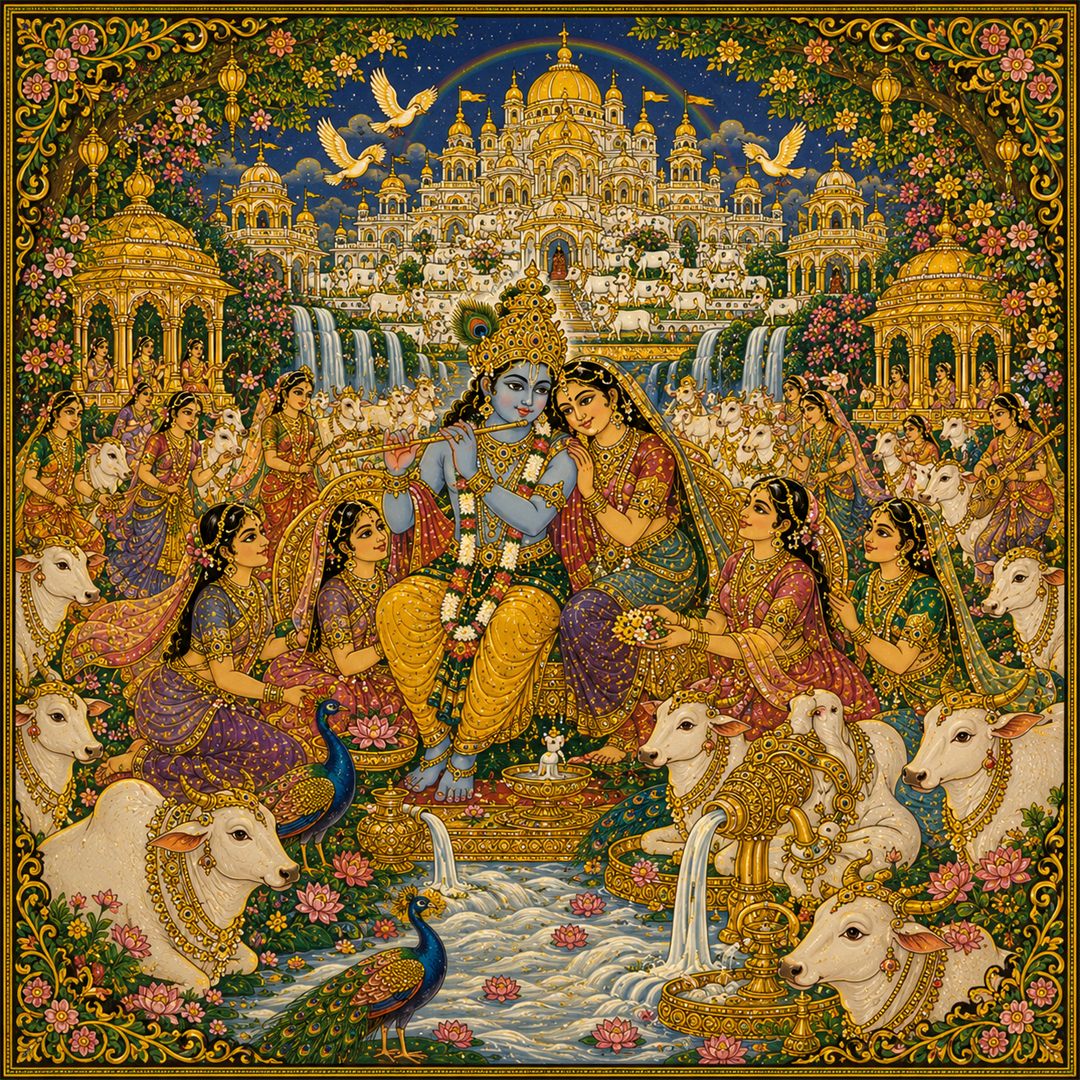
श्रियः कान्ताः कान्तः परमपुरुषः कल्पतरवो ।
द्रुमा भूमिश्चिन्तामणिगणमयी तोयममृतम् ।
कथा गानं नाट्यं गमनमपि वंशी प्रियसखी ।
चिदानन्दं ज्योतिः परमपि तदास्वाद्यमपि च ।
स यत्र क्षीराब्धिः स्रवति सुरभीभ्यश्च सुमहान् ।
निमेषार्धाख्यो वा व्रजति न हि यत्रापि समयः ।
भजे श्वेतद्वीपं तमहमिह गोलोकमिति यं ।
विदन्तस्ते सन्तः क्षितिविरलचाराः कतिपये ॥ ५६ ॥
śriyaḥ kāntāḥ kāntaḥ parama-puruṣaḥ kalpa-taravo
drumā bhūmiś cintāmaṇi-gaṇa-mayī toyam amṛtam
kathā gānaṁ nāṭyaṁ gamanam api vaṁśī priya-sakhī
cid-ānandaṁ jyotiḥ param api tad āsvādyam api ca
sa yatra kṣīrābdhiḥ sravati surabhībhyaś ca su-mahān
nimeṣārdhākhyo vā vrajati na hi yatrāpi samayaḥ
bhaje śvetadvīpaṁ tam aham iha golokam iti yaṁ
vidantas te santaḥ kṣiti-virala-cārāḥ katipaye
śriyaḥ—the goddesses of fortune; kāntāḥ—beloved consorts; kāntaḥ—the beloved Lord; parama-puruṣaḥ—the Supreme Person; kalpa-taravaḥ drumāḥ—the trees are desire trees; bhūmiḥ—the ground; cintāmaṇi-gaṇa-mayī—composed of clusters of wish-fulfilling gems; toyam—the water; amṛtam—nectar; kathā—speech; gānam—song; nāṭyam—dance; gamanam api—even walking; vaṁśī—the flute; priya-sakhī—a dear companion; cid-ānandam—spiritual bliss; jyotiḥ—effulgence; param api—supreme also; tat āsvādyam api ca— and that also is relishable; saḥ yatra—where; kṣīra-abdhiḥ—an ocean of milk; sravati—flows; surabhībhyaḥ ca—from the surabhi cows; su-mahān—exceedingly vast; nimeṣa-ardha-ākhyaḥ vā—even what is called half a blink; vrajati na hi—does not pass; yatra api samayaḥ—where even time does not proceed; bhaje— I worship; śvetadvīpam—Śvetadvīpa; tam aham—that I; iha—here, in this world; golokam iti yam—which they know as Goloka; vidantaḥ—knowing; te santaḥ—those saintly persons; kṣiti-virala-cārāḥ—rarely moving upon the Earth, rarely found upon the Earth; katipaye—a few.
I worship that Śvetadvīpa, which the few saintly persons found upon this Earth know as Goloka. There the goddesses of fortune are beloved consorts, and the Supreme Person is their beloved. The trees are wish-fulfilling trees, the ground is composed of clusters of cintāmaṇi gems, and the water is nectar. Speech is song, walking is dance, and the flute is the beloved companion. The effulgence is conscious bliss itself, both the supreme illuminating principle and the supreme object of relish. There a vast ocean of milk flows from the surabhi cows, and time does not pass, even in the measure of half a blink.
Dig-darśinī-ṭīkā
Śrī Jīva Gosvāmī
Having thus glorified his worshipable Lord as the supreme object of worship, Brahmā now glorifies that Lord’s abode in the two verses beginning with śriyaḥ kāntāḥ.
The word śriyaḥ refers to the beautiful gopīs of Vraja, for they are universally described in the mantras and meditations relating to that realm.
Although they are unlimited in number, they have only one beloved—the Supreme Person: kāntaḥ parama-puruṣaḥ. By this, the greatness of that realm is shown, surpassing even the abodes of Nārāyaṇa and other forms of the Lord.
The trees are called kalpa-taravas because every one of them fulfills all desires. Similarly, the ground and everything else there possess the same nature. The earth itself grants all cherished desires; what then need be said of jewels such as the Kaustubha? The water is nectar-like in sweetness; what then need be said of actual nectar?
The phrase vaṁśī priya-sakhī indicates that the flute is Kṛṣṇa’s beloved companion because it proclaims everywhere Śrī Kṛṣṇa’s state of happiness.
Why say more?
Everything there is composed of conscious bliss.
Even the light, manifesting as sun, moon, and other forms, is itself of the nature of spiritual consciousness and bliss. Thus the two Gautamīya-tantras describe Vṛndāvana as “the place where sun and moon rise together.” Because the moon there is eternally full, this statement is appropriate. That same spiritual light is both the supreme illuminator and the supreme object of enjoyment.
Since everything there consists of the Lord’s internal potency (cit-śakti), everything is relishable.
As stated in the Tenth Canto: darśayām āsa lokaṁ svaṁ gopānāṁ tamasaḥ param. “He revealed to the cowherd men His abode beyond darkness.”
The ocean of milk flows from the surabhi cows because of their ecstatic absorption caused by the sound of Kṛṣṇa’s flute and other such stimuli.
The statement that time does not pass there means that the inhabitants, absorbed in ecstasy, are unaware even of the passage of time. Or, alternatively, it means that the defects of material time do not exist there. As stated in the Śrīmad-Bhāgavatam (2.9.10): na ca kāla-vikramaḥ. “There is no influence of time.” Therefore that realm is called Śvetadvīpa. Śveta means “pure,” and dvīpa indicates an island separated from all other associations.
The Gopāla-tāpanī Upaniṣad explains that just as a lotus stands upon water while remaining distinct from it, so that realm exists in this world while remaining untouched by it.
Finally it says kṣiti-viralacārāḥ, which means that only a few rare saints wandering this Earth truly know this abode.
As Indra declares in the Harivaṁśa: yaṁ na vidmo vayaṁ sarve pṛcchanto ‘pi pitāmaham. “Even after questioning Pitāmaha (Brahmā), none of us knows that realm.”
Brahma-saṁhitā-prakāśinī
Śrīla Bhaktivinoda Ṭhākura
Verse 56
I worship that supreme abode known as Śvetadvīpa, where the spiritual goddesses of fortune are beloved consorts, and the Supreme Person, Kṛṣṇa, is the only beloved; where every tree is a spiritual wish-fulfilling tree, every particle of land is a spiritual touchstone, every drop of water is nectar, every word is song, every movement is dance, and the flute is the dear companion of the Lord; where all effulgence is composed of spiritual bliss and consciousness, and everything there is relishable; where from millions of surabhī cows flows an endless ocean of spiritual milk; and where spiritual time exists in an eternal present, free from the divisions of past and future, so that not even half a moment is touched by temporal decay. Very few saintly persons within this material world know that supreme realm as Goloka.
That abode which is attained by living beings through the highest cultivation of devotional rasa is completely spiritual, yet it is not devoid of variety.
Through anger, fear, and delusion one may attain the impersonal Brahman realm. Devotees, however, attain either the Vaikuṇṭha planets of the spiritual sky according to their particular rasa, or Goloka, which lies beyond them. Because that abode is supremely pure, it is called Śvetadvīpa, the White Island.
Those rare souls in this material world who attain the highest perfection of devotional rasa perceive that very Śvetadvīpa-tattva within Gokula-Vṛndāvana and Navadvīpa manifested in this universe, and therefore call it Goloka.1
In that Goloka there eternally exist spiritual beloved consorts and the beloved Lord, spiritual trees and creepers, spiritual land (together with mountains, rivers, and forests), spiritual water, speech, movement, flute music, moon and sun, objects of enjoyment and the enjoyment itself (that is, the inconceivable wonders of the sixty-four arts), spiritual cows, oceans of milk flowing with nectar, and eternally present spiritual time.
The Vedas, Purāṇas, and Tantras describe Goloka in many places. The Chāndogya Upaniṣad states:
sa yāvān vā ayam ākāśas tāvān eṣo ‘ntar-hṛdaya ākāśaḥ;
ubhe asmin dyāvāpṛthivī antar eva samāhite,
ubhāv agniś ca vāyuś ca sūryācandramasāv ubhau vidyun nakṣatrāṇi,
yac cāsyehāsti yac ca nāsti sarvaṁ tad asmin samāhitam.
“As vast as this external space is, so vast is the space within the heart. Within it both heaven and Earth are contained; both fire and air; both the Sun and the Moon; lightning and the stars. Whatever exists here and whatever does not exist here—all of it is contained within that inner space.”
The essential meaning is that whatever varieties are seen within this material world exist in the spiritual realm as well, together with many more varieties beyond our present experience.
The varieties of the spiritual world are harmonized and integrated, whereas the varieties of the material world are unharmonized and therefore become sources of both happiness and distress. The harmonized varieties of the spiritual world are fully manifest and composed of spiritual bliss and consciousness.
Through pure devotional absorption, the Vedas and the saintly devotees who follow them perceive that abode by means of their spiritually awakened consciousness. By Kṛṣṇa’s mercy, their minute spiritual consciousness becomes capable of entering into the limitless spiritual reality, where they attain equal participation in the bliss of loving exchanges with Him.
The phrase param api tad āsvādyam api ca contains a profound meaning.
By param api it is indicated that among all manifestations of spiritual bliss and consciousness, Śrī Kṛṣṇa alone is supreme.
By tad āsvādyam api is indicated that He Himself becomes the object of relish. When Kṛṣṇa relishes (1) the glory of Śrī Rādhā’s love, (2) the sweetness that Śrī Rādhā experiences in Him, and (3) the happiness She derives from that experience, He appears as Gaura.
Thus the bliss experienced by those who participate in this revealed mystery of divine love through loving service to Śrī Gaurāṅga is also eternally present in Śvetadvīpa.
Notes
- Bhaktivinoda Ṭhākura here identifies the eternal Śvetadvīpa-Goloka with Gokula-Vṛndāvana and Navadvīpa as they appear within this universe. These earthly manifestations are not mere symbolic representations, but direct revelations of the eternal spiritual reality, visible according to the degree of spiritual realization. ↩