 Spiritual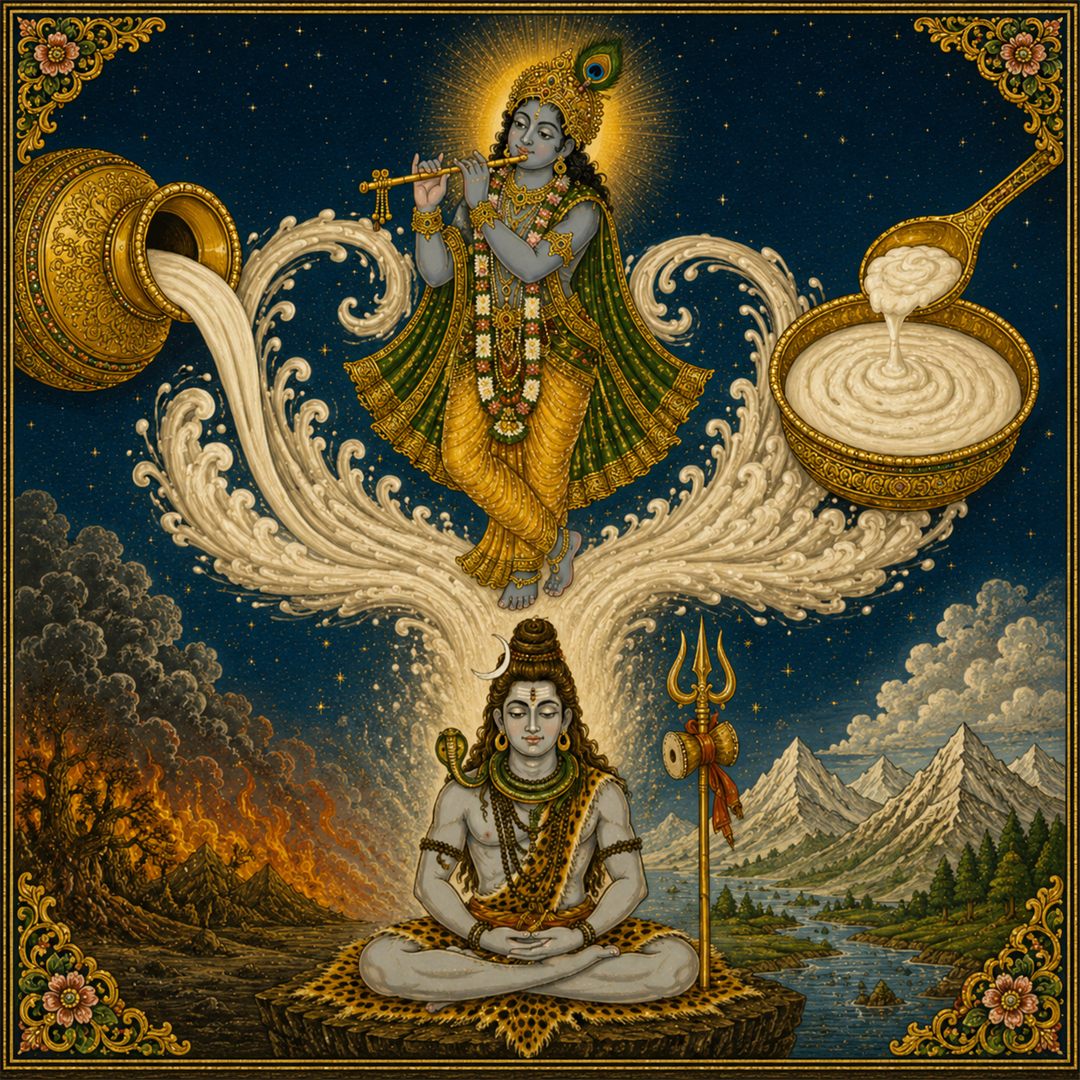
क्षीरं यथा दधि विकारविशेषयोगात् सञ्जायते न हि ततः पृथगस्ति हेतोः ।
यः शम्भुतामपि तथा समुपैति कार्याद् गोविन्दमादिपुरुषं तमहं भजामि ॥ ४५ ॥kṣīraṁ yathā dadhi vikāra-viśeṣa-yogāt
sañjāyate na hi tataḥ pṛthag asti hetoḥ
yaḥ śambhutām api tathā samupaiti kāryād
govindam ādi-puruṣaṁ tam ahaṁ bhajāmi
I worship Govinda, the primeval Lord, who, for the sake of a particular function, assumes the state of Śambhu, just as milk becomes yogurt through a particular transformation, though yogurt is not a reality separate from milk, its cause.
kṣīram—milk; yathā—just as; dadhi—yogurt; vikāra-viśeṣa-yogāt—through a particular transformation; sañjāyate—comes into being; na hi—indeed not; tataḥ—from that; pṛthak asti—exists separately; hetoḥ—from its cause; yaḥ—who; śambhutām api—even the state of Śambhu; tathā—similarly; samupaiti—assumes, attains; kāryāt—for the sake of a particular function; govindam—Govinda; ādi-puruṣam—the primeval Lord; tam—Him; ahaṁ bhajāmi—I worship.
Dig-darśinī-ṭīkā
Śrī Jīva Gosvāmī
Now, in due sequence, Brahmā explains Maheśvara, Śiva.1 Thus the verse begins: kṣīram yathā dadhi... This analogy applies only to the aspect of cause and effect. In the subject being illustrated, the cause undergoes no transformation. Rather, by His inconceivable potency, Govinda remains established as the cause and also as the effect beginning with Śambhu, just as a wish-fulfilling gem produces various effects without undergoing change.
The Śruti declares:
eko ha vai puruṣo nārāyaṇa āsīn na brahmā na ca śaṅkaraḥ
sa munir bhūtvā samacintayat tata ete vyajāyanta
viśvo hiraṇyagarbho ‘gni-varuṇa-rudrendraḥ
“In the beginning there was only the one supreme person, Nārāyaṇa. There was neither Brahmā nor Śaṅkara. Nārāyaṇa contemplated, and from Him arose Viśva, Hiraṇyagarbha, Agni, Varuṇa, Rudra, and Indra.”
And elsewhere:
sa brahmaṇā sṛjati rudreṇa nāśayati so ‘nutpatti-laya
eva hariḥ kāraṇa-rūpaḥ paraḥ paramānandaḥ
“Through Brahmā He creates; through Rudra He destroys. Hari alone remains beyond creation and dissolution, the supreme cause and supreme bliss.”
That Śambhu is likewise an effect is shown by his association with the material modes of nature. As stated in the Tenth Canto, in two non-contiguous half-verses (SB 10.88.5 and 10.88.3)::
harir hi nirguṇaḥ sākṣāt puruṣaḥ prakṛteḥ paraḥ
śivaḥ śakti-yutaḥ śaśvat tri-liṅgo guṇa-saṁvṛtaḥ
“Hari is situated beyond the material qualities; He is the Supreme Person beyond material nature.”
“Śiva, eternally united with his śakti, is associated with the threefold material designation and enveloped by the guṇas.”
This is precisely what is meant by vikāra-viśeṣa-yogāt, “through association with a particular transformation.”
If scriptural passages sometimes speak of Śiva as different from Nārāyaṇa, those statements are also reconciled by understanding that there is ultimately no separation from the cause. Thus it is said in the Nārāyaṇa section of the Ṛg-veda-śiras:
atha nityo nārāyaṇaḥ
brahmā ca nārāyaṇaḥ śivaś ca nārāyaṇaḥ
śakraś ca nārāyaṇaḥ kālaś ca nārāyaṇaḥ
diśaś ca nārāyaṇaḥ adhaś ca nārāyaṇaḥ
ūrdhvaṁ ca nārāyaṇaḥ antar bahiś ca nārāyaṇaḥ
nārāyaṇa evedaṁ sarvaṁ jātaṁ jagatyāṁ jagat
“Nārāyaṇa is eternal. Brahmā is Nārāyaṇa, Śiva is Nārāyaṇa, Indra is Nārāyaṇa, Time is Nārāyaṇa, the directions are Nārāyaṇa, below is Nārāyaṇa, above is Nārāyaṇa, within and without is Nārāyaṇa. All this—whatever has come into being in the moving universe—is indeed Nārāyaṇa.”
And Brahmā himself says in the Śrīmad-Bhāgavatam (2.6.32):
sṛjāmi tan-niyukto ‘haṁ haro harati tad-vaśaḥ
viśvaṁ puruṣa-rūpeṇa paripāti tri-śakti-dhṛk
“I create by His command; Hara destroys under His control; and He, bearing the three potencies, preserves the universe in the form of the Puruṣa.”
Brahma-saṁhitā-prakāśinī
Śrīla Bhaktivinoda Ṭhākura
Verse 45
I worship that primeval Lord Govinda, who assumes the state of Śambhu for a particular function, just as milk becomes yogurt through a specific transformation, yet yogurt is not a reality separate from the milk that is its cause.
(The nature of Śambhu, previously described as the presiding deity of Maheśa-dhāma, is now being established.)
Śambhu is not another, independent god separate from Kṛṣṇa. Those who hold such a conception commit an offense against the Supreme Lord. The lordship (īśvaratva) of Śambhu is subordinate to the lordship of Govinda. Therefore, in principle, the two are non-different. The characteristic of this non-difference is illustrated by the example of milk and yogurt. Just as milk, by undergoing a particular transformation, becomes yogurt, so the Lord assumes a distinct form through a specific transformation. Yet that form remains dependent, it has no independent existence.
A particular transformation arises through the combination of (1) the mode of ignorance of māyā, (2) the minute nature of the marginal potency, and (3) the cognitive aspect, saṁvit, of the spiritual potency mixed with a slight portion of hlādinī. The reflection of the Lord’s plenary expansion associated with that transformation is the effulgent Śambhu-liṅga known as Sadāśiva, from whom Rudra subsequently manifests.
For the purpose of creation, Śambhu functions as the principle underlying the material ingredients; for the purpose of maintenance, he destroys certain demons; and for the purpose of dissolution, Govinda assumes the form of Śambhu, a vibhinnāṁśa invested with the status of a svāṁśa, and thus acts as the guṇāvatāra associated with the mode of ignorance.
Śambhu has also been identified as Kāla-puruṣa, the personification of time. The scriptural evidences for this are cited in the commentary.
The significance of the Bhāgavata statement vaiṣṇavānāṁ yathā śambhuḥ, “Among vaiṣṇavas, Śambhu is the greatest,” is that Śambhu, through his power of time, acts in conjunction with Durgā-devī according to the will of Govinda.
In the Tantras and many other Scriptures, he teaches various forms of religious practice according to the qualifications of different living beings, thereby providing progressive stages leading ultimately toward devotion.
According to Govinda’s will, he also propagates Māyāvāda and certain fabricated scriptures for the protection and preservation of pure devotion.
Śambhu possesses, in an abundant measure, the fifty qualities found in the jīva, and in addition possesses partially the five great qualities that ordinary jīvas do not possess.
Therefore Śambhu cannot be classified as a jīva. He is an īśvara. Yet he belongs to the category of a vibhinnāṁśa manifestation.
Annotations
Bhakti Gauravani Goswami
Śambhu is neither jīva-tattva nor viṣṇu-tattva, but occupies a unique category distinct from both. He possesses the fifty qualities of the jīva in abundant measure and additionally, in a partial measure, five great qualities not found in the jīva:
1. Sadā-svarūpa-samprāptaḥ—always situated in his spiritual identity; never covered by ignorance as conditioned souls are
2. Sarvajñatā—extraordinary all-knowing capacity, knowledge extending far beyond the capacity of any jīva
3. Nitya-nūtanaḥ—ever-freshness in his manifestation
4. Sac-cid-ānanda-sāndrāṅgaḥ—possessing a form composed of concentrated eternity, knowledge, and bliss
5. Sarva-siddhi-niṣevitaḥ—served by all mystic perfections and endowed with all siddhis
The analogy of milk and yogurt should not be interpreted beyond the specific understanding intended by Brahmā and Jīva Gosvāmī. Milk actually undergoes transformation, whereas Govinda does not. Jīva Gosvāmī explicitly states that the comparison applies only to the relationship between cause and effect. Unlike milk becoming yogurt, the Supreme Lord remains completely unchanged while, by His inconceivable potency, Śambhu manifests for the purpose of a particular cosmic function. Thus the analogy illustrates dependence upon the original cause, not an actual transformation of the Supreme Lord Himself.
***
Bhaktivinoda Ṭhākura states that Śambhu is also understood as Kāla-puruṣa, the personification of time, and remarks that the scriptural evidence for this has been cited in the ṭīkā. At this point, the reader may naturally wonder which citation he is referring to, since Jīva Gosvāmī does not explicitly identify Śambhu as Kāla-puruṣa in his ṭīkā. Rather, he cites a series of passages from Scripture describing Śambhu's relationship to Govinda, the modes of nature, and the work of creation, maintanence and destruction of the universe. Bhaktivinoda Ṭhākura appears to regard these citations collectively as providing the theological basis for understanding Śambhu's function as Kāla-puruṣa, rather than as containing an explicit statement to that effect.
Notes
- who is also known as Śambhu, Śaṅkara, Mahadeva, Rudra, and Āśutoṣa ↩