 Spiritual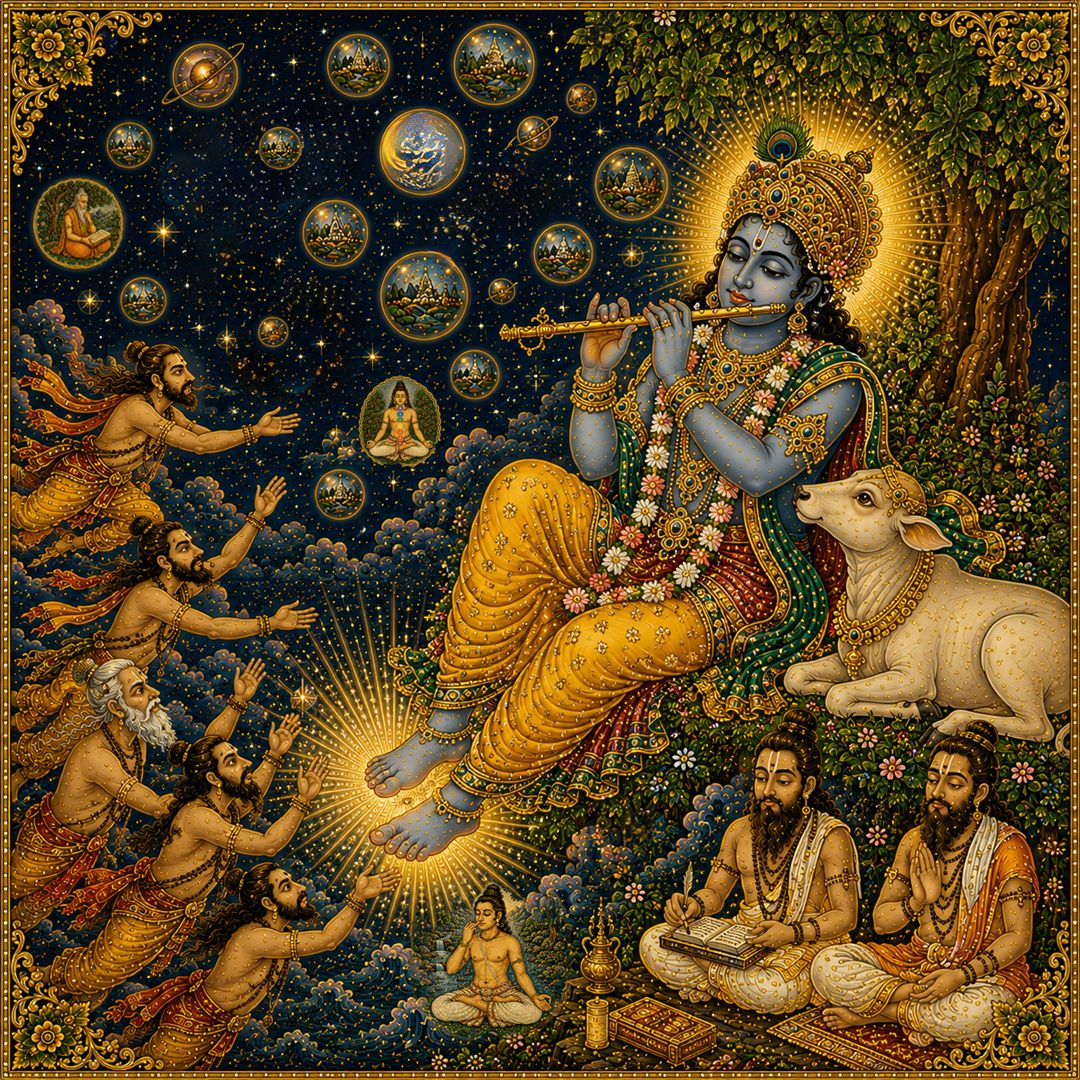
पन्थास्तु कोटिशतवत्सरसम्प्रगम्यो वायोरथापि मनसो मुनिपुङ्गवानाम् ।
सोऽप्यस्ति यत्प्रपदसीम्न्यविचिन्त्यतत्त्वे गोविन्दमादिपुरुषं तमहं भजामि ॥ ३४ ॥
panthās tu koṭi-śata-vatsara-sampragamyo
vāyor athāpi manaso muni-puṅgavānām
so ‘py asti yat-prapada-sīmny avicintya-tattve
govindam ādi-puruṣaṁ tam ahaṁ bhajāmi
I worship Govinda, the primeval Lord. Even the path traversed for a billion years by the foremost sages at the speed of the wind, or even of the mind, reaches only the outermost boundary of His lotus feet, whose reality is inconceivable.
panthāḥ—the path; tu—indeed; koṭi-śata-vatsara-sampragamyaḥ—to be traversed for a billion years; vāyoḥ—of the wind; atha api—or even; manasaḥ—of the mind; muni-puṅgavānām—of the greatest sages; saḥ api—even that; asti—exists; yat-prapada-sīmni—at the boundary of whose lotus feet; avicintya-tattve—in the inconceivable reality; govindam—Govinda; ādi-puruṣam—the primeval Lord; tam—Him; ahaṁ bhajāmi—I worship.
Dig-darśinī-ṭīkā
Śrī Jīva Gosvāmī
The verse beginning with panthās tu is now explained. The phrase yat-prapada-sīmni means “at the tips of His lotus feet.”
Thus Nārada says in the Śrīmad-Bhāgavatam (10.69.2):
citraṁ bataitad ekena vapuṣā yugapat pṛthak
gṛheṣu dvy-aṣṭa-sāhasraṁ striya eka udāvahat
“How astonishing! With a single form, He simultaneously and separately married sixteen thousand wives in their respective palaces.”
And the Gopāla-tāpanī Upaniṣad states:
eko vaśī sarvagaḥ kṛṣṇa īḍyaḥ
eko ‘pi san bahudhā yo vibhāti
“Kṛṣṇa is the one controller, all-pervading and worshipable. Though one, He manifests in many forms.”
The siddhānta (conclusion) is expressed by the phrase avicintya-tattve, “whose reality is inconceivable.”
Thus the Third Canto states: ātmeśvaro ‘tarkya-sahasra-śaktiḥ. “The Supreme Lord possesses thousands of powers beyond the reach of logic.”
And the Skanda Purāṇa and the Mahābhārata declare:
acintyāḥ khalu ye bhāvā na tāṁs tarkeṇa yojayet
prakṛtibhyaḥ paraṁ yac ca tad acintyasya lakṣaṇam
“Those realities that are inconceivable should not be subjected to mundane logic. That which is beyond material nature is the characteristic of the inconceivable.”
And the Brahma-sūtra states: śrutes tu śabda-mūlatvāt. “But [the inconceivable reality is known] from Śruti, because revealed sound is the source of such knowledge.”
And the Bhāṣya explains: acintyo hi maṇi-mantra-mahauṣadhīnām prabhāvaḥ. “The potency of jewels, mantras, and great medicinal herbs is indeed inconceivable.”
The meaning is that Govinda’s nature and powers are not known through reasoning, but through revealed Scripture.
Brahma-saṁhitā-prakāśinī
Śrīla Bhaktivinoda Ṭhākura
Verse 34
I worship Govinda, the primeval Lord. The path of breath-control followed by yogīs engaged in prāṇāyāma, who desire to approach that reality beyond material thought, or the path of cultivating knowledge followed by the foremost sages who search for undifferentiated Brahman by rejecting all that is not that, may be pursued for a billion years, yet it reaches only the front boundary of His lotus feet.
Attaining Govinda’s lotus feet means relishing pure devotional service (śuddha-bhakti).
The practitioners of aṣṭāṅga-yoga may, through the process of samādhi over one billion years, attain kaivalya, the state of nondual oneness. Similarly, the foremost nondualistic sages may spend an equally vast period discriminating between spirit and matter, rejecting one material object after another with the understanding, “Not this, not this,” and ultimately merge into the undifferentiated Brahman beyond material illusion.
Yet that attainment is merely the region lying outside the tips of Kṛṣṇa’s lotus feet; it is not the lotus feet themselves.
The essential point is this: Kaivalya and absorption into Brahman constitute only the boundary between the material world and the spiritual world. Until one passes beyond those states, one cannot experience the variety within spiritual reality (cid-viśeṣa).
Such attainments represent merely the absence of suffering arising from material existence; they are not happiness. Even if one is willing to call that absence of suffering a kind of happiness, it is exceedingly slight and insignificant. The mere destruction of material existence is not the ultimate goal. Real attainment consists in the soul becoming established in its spiritual condition.
That state can be attained only by the mercy of devotional service, whose nature is spiritual consciousness. It cannot be attained through the dry path of intellectual speculation.
Annotations
Bhakti Gauravani Goswami
Commenting on this verse, Śrīla Prabhupāda writes in Teachings of Queen Kuntī, Chapter 14:
Space is unlimited, and the Brahma-saṁhitā (5.34) suggests: Suppose one travels by spacecraft for millions of years at the velocity of the wind or even the speed of mind. Everyone knows that the mind is so swift that in even one ten-thousandth of a second it can take us millions of miles. If we have seen something millions of miles away, the mind can go there immediately. But even if we can travel at that speed on a spacecraft manufactured by muni-puṅgavānām, the greatest scientists and most thoughtful men, will that be perfection? No. The Brahma-saṁhitā says, so ‘py asti yat-prapada-sīmny avicintya-tattve: Still this creation will remain inconceivable to our understanding. And Kṛṣṇa has created all these things, so how can we study Kṛṣṇa? If we cannot understand the things Kṛṣṇa has created, how can we understand Kṛṣṇa? It is not possible at all.