 Spiritual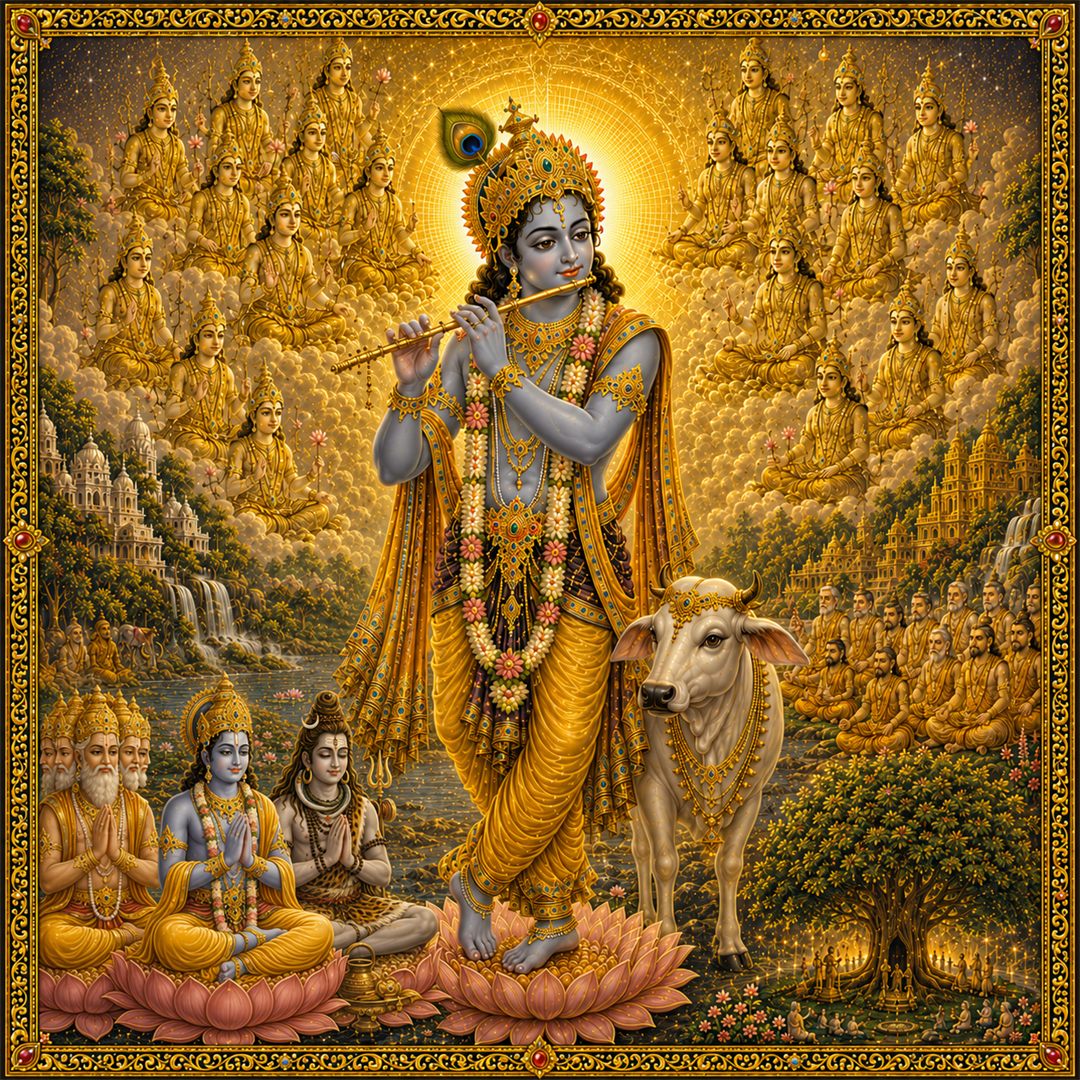
ईश्वरः परमः कृष्णः सच्चिदानन्दविग्रहः ।
अनादिरादिर्गोविन्दः सर्वकारणकारणम् ॥ १ ॥
īśvaraḥ paramaḥ kṛṣṇaḥ sac-cid-ānanda-vigrahaḥ
anādir ādir govindaḥ sarva-kāraṇa-kāraṇam
Kṛṣṇa is the supreme controller. His form is eternity, consciousness, and bliss. He is Govinda, without beginning, the origin of all, and the cause of all causes.
īśvaraḥ—the controller; paramaḥ—supreme; kṛṣṇaḥ—Kṛṣṇa; sac-cid-ānanda—of eternity, consciousness, and bliss; vigrahaḥ—whose form; anādiḥ—without beginning; ādiḥ—the origin; govindaḥ—Govinda; sarva-kāraṇa—of all causes; kāraṇam—the cause.
Dig-darśinī-ṭīkā
Jīva Gosvāmī
Maṅgalācaraṇa
(Auspicious Invocation)
I offer my humble obeisances unto Śrī Śrī Rādhā and Kṛṣṇa.
May the glory of the form of Śrī Kṛṣṇa, by whose mercy I desire to explain the Brahma-saṁhitā, become magnified within my heart.
Even a statement of a sage that is difficult to construe reveals its coherent meaning through careful deliberation. But as I undertake this deliberation, may that Sage who is the refuge of all sages be my guide. Although this Saṁhitā consists of one hundred chapters, still, because this chapter is in the form of aphorisms, it has attained the status of comprising all the limbs of that work.
That which is seen by those of pure intelligence in Śrīmad-Bhāgavatam and other vaiṣṇava-śāstras, that very same thing is described here. Therefore my mind is delighted.
Whatever has been elaborately ascertained in my Śrī Kṛṣṇa-sandarbha, that same subject is here again reconsidered, and I now endeavor to explain it.
In the Śrīmad-Bhāgavatam (1.3.28) it is stated: ete cāṁśakalāḥ puṁsaḥ kṛṣṇastu bhagavān svayam. “All these are plenary portions or portions of plenary portions of the Supreme Person, but Kṛṣṇa is Bhagavān Himself.” This very same point is first declared here in this verse with the word īśvaraḥ.
Explanation of the name Kṛṣṇa
Here, Kṛṣṇa is the principal subject qualified by all the other terms. That very name is primary. This is established by the widely known declarations of great authorities such as Śrī Śuka, as in “the festival of Kṛṣṇa’s descent” (kṛṣṇāvatārotsava), and also because in the Sāmopaniṣad, the phrase “to Kṛṣṇa, the son of Vasudeva, the delight of Devakī” (kṛṣṇāya vāsudevāya devakīnandanāya) is first understood. Furthermore, Garga Muni explicitly uttered that name while revealing the syllables of the mantra. And because, according to the principle that “one fills a pot with milk”, meaning the primary substance named first defines the whole, the foremost name mentioned in a sequence is regarded as the original form, this name is primary. Thus it is said in the Prabhāsa-khaṇḍa of the Padma Purāṇa, in the dialogue between Nārada and Kuśadhvaja, spoken by Bhagavān Himself: “The foremost among all My names is the name Kṛṣṇa, O scorcher of enemies.”
Therefore also, in the hymn of one hundred and eight names of Kṛṣṇa spoken in the Brahmāṇḍa Purāṇa, it is said: “The merit obtained by reciting a thousand sacred names three times is attained simply by uttering once the name Kṛṣṇa.”
Here specifically the name Kṛṣṇa alone is mentioned. Here, Kṛṣṇa is the principal subject qualified by all the other terms. Thus, by the force of usage and primacy, the adjectives beginning with īśvaraḥ apply specifically to Him alone.
Garga Muni’s Statement
Now this is also seen through His qualities. While speaking with Nanda Mahārāja, Garga Muni states in the Śrīmad-Bhāgavatam (10.8.13-15),: “In every age your son assumes forms of different colors—white, red, and yellow—and now He has appeared in a dark complexion. Your son has many names and forms according to His qualities and activities. I know them, though common people do not.”
The meaning is: Of Him who is now visible as Kṛṣṇa, who manifests various avatāra-forms in every age, the three colors beginning with white previously became manifest. Now, at the time of this appearance, He has assumed a dark hue. All those forms are included within this very Kṛṣṇa-form.
Therefore, because Kṛṣṇa is the one who manifests these forms and is supreme above all, Kṛṣṇa is His principal name. Thus Garga says, “many”; those forms belong to Him alone. Therefore, through His qualities also, the preeminence of the name Kṛṣṇa is indicated.
Etymological Meaning of Kṛṣṇa
Even according to etymological derivation, His nature is obtained: “The syllable kṛṣ means ‘existence,’ and ṇa means ‘bliss.’ The combination of these two syllables indicates the Supreme Brahman, Parabrahman, which is called Kṛṣṇa.” Thus even by etymological interpretation, this meaning is obtained. And this verse does not refer to anyone else.
In the Gautamīya-tantra, in the explanation of the eighteen-syllable mantra (aṣṭādaśākṣara-mantra-vyākhyāyām), a nearly identical verse is found:
kṛṣi-śabdaś ca sattārtho ṇaś cānanda-svarūpakaḥ
sukha-rūpo bhaved ātmā bhāvānandamayas tataḥ
“The word kṛṣ means ‘existence (sattārthaḥ),’ and ṇa is of the nature of bliss (ānanda-svarūpakaḥ). The self (ātmā) becomes of the nature of happiness (sukha-rūpaḥ), and then full of the bliss of love (bhāvānanda-mayaḥ).”
Thus the meaning is as follows: “From Him all entities come into being.” This is the meaning of the verbal root bhū, just as in the word bhāva. And here this meaning belongs specifically to the root kṛṣ, “to attract.”
Even though in the Gautamīya the word bhū signifies existence, still the meaning of the root itself is “existence” alone. Since the word “pot” cannot stand in apposition with that which it denotes, a figurative identification through causal relation must be understood. This indeed implies “attraction.” When it is said “pot-ness (ghaṭatva) signifies existence,” what is understood is the existence of the pot itself, not the existence of cloth, nor generic existence.
Nirvṛti means “bliss.” Their unity is expressed through grammatical apposition. That which is the Supreme Brahman, the greatest of all realities and the source of the expansion of everything, is called Kṛṣṇa. Another reading says “is proclaimed.”
However, because the root kṛṣ merely indicates attraction, and because the syllable ṇa cannot literally stand in apposition with bliss as the thing denoted, a figurative identification of non-difference between cause and effect must be accepted. This is done in order to express the fullness and predominance of His attractive power, just as in the expression “ghee is long life” (āyur ghṛtam).
Explanation of Paraṁ brahma
The meaning of the words paraṁ brahma (Parabrahman) is explained in the Viṣṇu Purāṇa (1.12.57): “Because of greatness and because of causing growth, that which the wise know as supreme (paramaṁ) is Brahman.”
And also in the Śruti, in the Taittirīya Upaniṣad, it is said: “Brahman grows (bṛṁhati) and causes growth (bṛṁhayati).”
Similarly, it is said in the Bṛhad-Gautamīya: “The word kṛṣ indeed means ‘existence,’ and ṇa means ‘of the nature of bliss.’ From the union of existence and bliss, that Supreme Brahman is designated.”
Refutation of Advaita Interpretation
Even those who propound the doctrine of nondual Brahman (advaitavādinaḥ) must understand existence and bliss in this way. Grammarians perceive them as possessing distinct denotations. And by the word “existence” here is meant that supreme existence which is the cause of the functioning of all existing things, as declared in the Śruti (Chāndogya Upaniṣad 6.2.1): sadeva saumyedam agra āsīt. “O good student, only existence was here in the beginning.”
If they were completely identical in denotation, then—like in the statement “a tree is a tree” (vṛkṣaḥ taruḥ)—they could not function as qualifier and qualified, and one of them would be redundant.
The previously cited verse from the Gautamīya should therefore be understood thus: In the first half (kṛṣi-śabdaś ca sattārtho ṇaś cānanda-svarūpakaḥ), Kṛṣṇa is the blissful self endowed with the power to attract everything. In the second half (sukha-rūpo bhaved ātmā bhāvānandamayas tataḥ), because He is thus of the nature of all-attracting happiness, therefore the self and the living entity become of the nature of happiness in Him. The reason is that bhāva means prema, because such bliss consists of that love.
Thus it should be understood that the word kṛṣṇa denotes the supreme greatest, all-attracting bliss, characterized by both intrinsic nature and qualities. And this word is conventionally established specifically in relation to the son of Devakī.
That He alone gives bliss to all is seen in the Vāsudeva Upaniṣad: “The son of Devakī gives bliss to the entirety of existence.”
And the bliss here is without transformation and not dependent on anything else. Therefore this word cannot properly be transferred to another object. As Bhaṭṭa1 says: “Usage that has attained its own nature overpowers the etymological meaning. A merely imagined meaning does not attain its own nature because the etymological meaning is obstructed.”
And Kṛṣṇa’s status as the Supreme Brahman is declared in the Bhāgavatam (7.10.48): “The hidden Supreme Brahman in human form,” and also: “That friend who is supreme bliss, the eternal complete Brahman.”
In the Śrī Viṣṇu Purāṇa (4.11.2) it is said: “That Supreme Brahman named Kṛṣṇa descended in human form.”
In the Gītā (14.27) Kṛṣṇa says: “I am the foundation of Brahman.”
And in the Gopāla-tāpanī Upaniṣad we find: “That Supreme Brahman is Gopāla.”
Explanation of Īśvara, Parama, Ādi, Anādi, Sarva-kāraṇa-kāraṇam
Now let us follow the root text. Because the word kṛṣṇa signifies such a being, therefore He is īśvaraḥ, the supreme controller of all. This is also indicated in the Bṛhad-Gautamīya through another explanation of the word kṛṣṇa: “Because Bhagavān draws toward Himself (karṣayet) the entire universe of moving and nonmoving beings in the form of time (kṛṣṇa kāla-rūpeṇa), therefore He is called Kṛṣṇa.” The word kāla means: “He calculates (kalayati) and regulates (niyamayati) everything.”
Thus in the Śrīmad-Bhāgavatam (3.2.21), Uddhava gives his conclusive determination about Him as follows:
You alone are without equal or superior, O master of threes (tryadhīśaḥ), having attained all desires through the wealth of sovereignty. The helmets of the eternal guardians of the worlds strike against Your foot-rest as they bow in tribute.
In the Bhagavad-gītā (10.42) Kṛṣṇa proclaims: “Sustaining this entire universe with but one portion of Myself, I remain.” And in the Gopāla-tāpanī Upaniṣad (1.19) it is said: “The one controller, all-pervading Kṛṣṇa, is worthy of worship.”
Because He is such an īśvara, therefore He is paramaḥ, the supreme—the one in whom the supreme (parāḥ) potencies (mā), the Lakṣmīs, most exalted of all potencies, reside (parā-māḥ). Thus it is said in the Śrīmad-Bhāgavatam (10.59.43): “He sported with the goddesses of fortune, fully immersed in His desires.” And also (SB 10.47.60): “O dear one, this favor is not easily obtained even by Lakṣmī,” and further (SB 10.32.10): “Bhagavān, the son of Devakī, shone exceedingly among them.” Later in this very text (Brahmā-saṁhitā, Verse 56) it will be said: “The goddesses of fortune are His beloveds, and He is the supreme person.” And the Gopāla-tāpanī Upaniṣad (1.3) confirms: “Kṛṣṇa indeed is the supreme divinity.”
Because He is such a supreme being, therefore He is also the origin, ādiḥ. Thus in the Tenth Canto (SB 10.72.15) it is said: “Hearing of Jarāsandha, Hari contemplated the king’s situation and immediately spoke the very strategy that Uddhava had proposed.” And the commentary says: “The original Hari (ādyo hariḥ) is Śrī Kṛṣṇa.” In the Eleventh Canto (SB 11.29.49), both His supremacy and primacy are declared together: “I bow to that primal supreme person known as Kṛṣṇa.”
Nor is this primacy dependent upon His avatāras. Rather, He is anādiḥ, one who Himself has no beginning. Thus in the Gopāla-tāpanī Upaniṣad, after stating “The one controller, all-pervading Kṛṣṇa,” it is said: “The eternal among eternals.”
Because He is thus the origin, therefore He is sarva-kāraṇa-kāraṇam—the cause of all causes, even the cause of the puruṣa who creates the mahat-tattva.
Thus Devakī prays to Him in the Tenth Canto (SB 10.85.31):
“By a portion of a portion of a portion of You, the creation, maintenance, and dissolution of the universe take place. O Soul of the universe, I have taken shelter of You, the original refuge.”
Śrīdhara Svāmī’s explains in his commentary Bhāvārtha-dīpikā:
“The puruṣa is a portion of Him; māyā is a portion of the puruṣa; and the guṇas are portions of māyā. By a portion of these—that is, by an infinitesimal fragment the size of an atom—the creation of the
universe and its other functions take place. ‘I have taken shelter of You’ means, ‘I have accepted You as my refuge.’”
Similarly, Brahmā says in his prayers (SB 10.14.14): “Nārāyaṇa is Your limb (aṅgam), because the waters arise from nara, the primeval Lord (nara-bhū-jalāyanāt).” And: “The wise know the elements born from the primeval Lord to be called nārāṇī. Since they were formerly His resting place (ayana), He is remembered as Nārāyaṇa.” By this, Nārāyaṇa is described as His expansion, while He is the possessor of that expansion (tvam punar aṅgī). In the Gītā (10.42), Kṛṣṇa says: “Sustaining this entire universe with but one portion of Myself, I remain.”
Thus the etymological meaning of the word kṛṣṇa has also been established. And those who explain the word kṛṣṇa merely as supreme bliss through the syllables kṛṣ and ṇa must still admit within that bliss the inherent potency indicated by qualifiers such as īśvaraḥ. Otherwise, since there can be no second reality separate from Him, and since He is the cause of all causes, no external power can be superimposed upon Him.
Thus the Śruti (Taittirīya Upaniṣad 2.7.1) says: “Bliss is Brahman.” And: “Who could breathe or live if this bliss were not present in the sky?” And: “From bliss all beings are born.” And (Śvetāśvatara Upaniṣad 6.8): “He has neither work nor any instrument.”2 And: “No one equal or greater than Him is seen.” And: “His supreme potency is heard of as manifold, natural (svābhāvikī) knowledge, strength, and action.”
Objection and Answer Regarding Vigraha
Someone may object: “According to your view and the etymological interpretation, since Kṛṣṇa is described as all-attracting, the supreme greatest bliss, it is understood that He is formless (avigraha eva), because bliss is not understood to have a form (vigraha).”
True. But His form is wonderful, unprecedented reality: an eternally perfected form of bliss (pūrva-siddha-ānanda-vigrahaḥ). Therefore it says: sac-cid-ānanda-vigrahaḥ. “He whose form is characterized by eternity, consciousness, and bliss.”
Similarly, Brahmā says in the Tenth Canto (SB 10.14.22): “Your body is eternal happiness and knowledge” (tvayy eva nitya-sukha-bodha-tanau). And in the Tāpanī and Hayasīrṣa-pañcarātra it says: “I offer my obeisances unto Kṛṣṇa, whose form is eternity, consciousness, and bliss, and whose actions are effortless.”
And in the Brahmāṇḍa Purāṇa, in the hymn of one hundred and eight names, it is stated: “He delights the inhabitants of Nanda’s Vraja, and His form is eternity, consciousness, and bliss.”
Explanation of Sat
The intended meaning is this: Sat means “unfailing existence.” And His possession of such a nature is clearly expressed in statements by Brahmā and others in the Tenth Canto, such as (SB 10.2.26): “He whose vow is truth, whose nature is truth, who is the threefold truth” (satya-vrataṁ satya-paraṁ trisatyam). And in Devakī’s words (SB 10.3.25) in her prayers to Kṛṣṇa:
naṣṭe loke dvi-parārdhāvasāne mahā-bhūteṣv ādi-bhūtaṁ gateṣu
vyakte ‘vyaktaṁ kāla-vegena yāte bhavān ekaḥ śiṣyate ‘śeṣa-saṁjñaḥ
“At the end of two parārdhas, when the cosmos is destroyed, when the gross elements enter their subtle cause, and when the manifest enters the unmanifest under the force of time, You alone remain, known as Ananta Śeṣa.”
She continues (SB 10.3.27):
martyo mṛtyu-vyāla-bhītaḥ palāyan lokān sarvān nirbhayaṁ nādhyagacchat
tvat pādābjaṁ prāpya yadṛcchayādya susthaḥ śete mṛtyur asmād apaiti
“No one in this material world has become free from the four principles birth, death, old age and disease, even by fleeing to various planets. But now that You have appeared, My Lord, death is fleeing in fear of You, and the living entities, having obtained shelter at Your lotus feet by Your mercy, are sleeping in full mental peace.”
Brahmā prays (SB 10.14.18): “You alone existed in the beginning.”
And: “Then this nondual Brahman alone remains.”
In the Gītā (14.27, 15.18), Kṛṣṇa says: “I am the foundation of Brahman. Because I transcend the perishable and am evrn higher than the imperishable, I am celebrated in the world and in the Vedas as the Supreme Person.”
And in the Gopāla-tāpanī Upaniṣad we find: “He is beyond birth and old age, steadfast and indestructible. He dwells in the land of Vṛndāvana near the Yamunā (saurye), among the cows and the cowherds, and He protects the cows.” Here saurye means “Vṛndāvana, the region situated near the Yamunā, who is called Saurī because she is the daughter of Sūrya, the sun-god.”
And it also says there: “Death fears Govinda.”
Explanation of Cit
The Lord’s conscious nature consists in self-luminosity and the power to illuminate all else. This is declared by Brahmā in his prayers (SB 10.14.23): “You alone are the Self” (ekas tvam ātmā) and “self-luminous” (svayaṁ jyotiḥ).
And in the Gopāla-tāpanī Upaniṣad (1.26) it is stated: “Kṛṣṇa, who formerly instructed Brahmā and imparted spiritual knowledge to him, protects the cows. The seeker of liberation should take shelter of that divine being who reveals the functions of the self by its own nature.”
As the Śruti (Muṇḍaka Upaniṣad 3.2.4) says: “One does not see His form with the eyes. He is attained only by one whom He chooses. To such a person He reveals His form.”
Explanation of Ānanda
His blissful nature (ānanda-rūpatva) means that He is the abode of supreme love without any limitation and in all respects. This is clearly revealed just after Brahmā’s prayers in the Tenth Canto (SB 10.14.49–55), in the exchange between King Parīkṣit and Śukadeva Gosvāmī. Mahārāja Parīkṣit asks (SB 10.14.49):
brahman parodbhave kṛṣṇe iyān premā kathaṁ bhavet
yo ‘bhūta-pūrvas tokeṣu svodbhaveṣv api kathyatām
“O brāhmaṇa, how could the cowherd women have developed for Kṛṣṇa, someone else’s son, such unprecedented pure love—love they never felt even for their own children? Please explain this.”
And Vasudeva also experienced this (SB 10.3.13): “My Lord, You are the Supreme Person, beyond material existence, and You are the Supersoul. Your form can be perceived by transcendental knowledge, by which You can be understood as the Supreme Personality of Godhead. I now understand Your position perfectly.”
As another Śruti says: “Bliss is the form of Brahman.”
Thus, once it is established that Kṛṣṇa’s form is eternity, consciousness, and bliss, it follows that His form itself is His self, and His self itself is His form (vigraha evātmā, ātmā eva vigrahaḥ). Therefore it is concluded that He does not possess a body in the way ordinary living beings do.
As Śrī Śuka says to Mahārāja Parīkṣit (SB 10.14.55):
kṛṣṇam enam avehi tvam ātmānam akhilātmanām
jagad-dhitāya so ‘py atra dehīvābhāti māyayā
“You should know Kṛṣṇa to be the original soul of all living entities. For the benefit of the whole universe, He has, out of His causeless mercy, appeared as an ordinary human being. He has done this by the strength of His internal potency.”
The meaning is that His embodied pastimes are enacted solely due to His being moved by compassion. The Viśva-prakāśa states: “Māyā means both deception (dambha) and mercy (kṛpā).”
Explanation of Govinda
Thus, since His form possessing these characteristics is established as Śrī Kṛṣṇa Himself, and since He is absorbed in both types of pastimes, He is sometimes seen as the chief of the Vṛṣṇis and sometimes as Govinda.
Thus Sūta says in the Twelfth Canto (SB 12.11.25): “O Śrī Kṛṣṇa, O friend of Arjuna, O chief of the Vṛṣṇis, O annihilator of the enemies of the saintly kings, whose heroic power grants liberation; O Govinda, whose glories are sung by the cowherd women, the people of Vraja, and Your servants, hearing of You sanctifies the hearer, please protect Your servants.”
Because He is endowed with His desired form, pastimes, and associates, He employs the name Govinda as His worshipable form. As it will later be
praised here: “In abodes built of cintāmaṇi gems, surrounded by millions of wish-fulfilling trees...”
And in the Tenth Canto (SB 10.27.23), at the beginning of Govinda’s coronation, the surabhi cow says: “O Lord of the universe, please become our Indra.” And after the coronation it is said: “She addressed Him as Govinda.”
At the conclusion of that section Śrī Śuka prays: “May the Lord of the cows be pleased with us.”
Because He is the Lord of the cows (gavendratva), and since the cows are the shelter of all (gavāṁ sarvāśrayatvāt), His status as the Lord of all (sarvendratva) is established.
Nor should this be considered inferior. For the Go-sūkta states: “From cows all sacrifices proceed; from cows the gods arise; from cows the Vedas with their six aṅgas and pada-kramas are proclaimed.”
Even granting that these cows descended from the supreme Goloka, His lordship over them—and through them, lordship over all—is fully established. And in the Tāpanī, Brahmā himself reveals the object of his worship: “I continually worship Govinda, whose form is eternity, consciousness, and bliss, seated beneath the kalpa-vṛkṣa tree, together with the hosts of gods.”
Likewise in the Tenth Canto (SB 10.14.34) Brahmā says: “How greatly fortunate is birth in this forest of Gokula...”
And this fortune is obtained specifically because He is the son of Nanda. Therefore Brahmā prays (SB 10.14.1): “I bow to You whose complexion is like a raincloud and whose garments flash like lightning...” and specifically: “to the son of the cowherd chief.”
Thus the full significance of names such as Govinda, rich with supreme majesty, is also accepted by Him.
The Gautamīya-tantra on the Ten-Syllable Mantra
Accordingly, after reiterating His status as Īśvara and Parameśvara, the Gautamīya-tantra, in bringing its explanation of the meaning of the revered ten-syllable mantra to its conclusion, states:
Gopī should be understood as prakṛti, and jana as the aggregate of tattvas. Īśvara is the support of both, because He pervades them and is their cause. By the word vallabha He is described as the supreme effulgence of condensed bliss.
Alternatively, gopī is prakṛti, and jana is the circle of her expansions. Their vallabha is said to be the master, the Lord named Kṛṣṇa. Therefore the Śrutis sing of Him as the Lord of both cause and effect.
Or, He is the husband of the gopīs who have attained perfection through many births. He is known as the son of Nanda and increases the bliss of the three worlds.”
Here prakṛti means the potency called māyā, the causal power of the universe. “The aggregate of tattvas” means the mahat-tattva and the principles beginning with it.
“The support of both” is Īśvara, the supreme effulgence of condensed bliss, who is expressed by the word vallabha. The reasons for His being Īśvara are that He pervades them and is their cause.
In the alternative explanation, prakṛti means the potency intrinsic to His own nature, beyond māyā, known as Mahālakṣmī and manifest in Vaikuṇṭha and elsewhere. “The circle of her expansions” means the triad beginning with Saṅkarṣaṇa.3
In the phrase “the gopīs who have attained perfection through many births,” the intended meaning is a beginningless succession of births, as indicated by the statement of the Bhagavad-gītā (4.5): “Many births of Mine and yours have passed, O Arjuna.”
Thus here also He is intended specifically as the son of Nanda.
Garga Muni likewise says (SB 10.8.14): “Formerly this son of yours was born as the son of Vasudeva.”
And this is appropriate. For even in the case of Śrī Vāsudeva, the son of Vasudeva, His sonship is understood only as His manifestation within
Vasudeva’s mind, as stated in the Śrīmad-Bhāgavatam (10.2.16): “He entered the mind of Ānakadundubhi by a portion of Himself.”
The same was true for the king of Vraja, for such manifestations are seen everywhere immediately preceding the appearance of Bhagavān.
Yet even when He manifests within a person, the determining cause of His appearing as that person’s son is pure, great love imbued with the mood of fatherhood. Just as when Varāhadeva appeared from Brahmā, neither Brahmā nor the world considered Brahmā to be His father.
But such pure love existed fully only in the king of Vraja. In Vasudeva there remained an obstruction in the form of knowledge of opulence (aiśvarya-jñāna-pratibandha). Therefore Garga Muni rightly said: “Formerly this son of yours was born as the son of Vasudeva.”
Thus even in the application of the sacred ten-syllable mantra, He is seen as being absorbed in that mood (tanmaya eva dṛśyate).4
Brahma-saṁhitā-prakāśinī
Bhaktivinoda Ṭhākura
Verse 1
Govinda Kṛṣṇa, whose form is eternity, consciousness, and bliss, is the Supreme Lord. He is without beginning, the origin of all, and the cause of all causes.
Śrī Kṛṣṇa alone, with His eternal name, eternal form, eternal qualities, and eternal pastimes, is the Supreme Lord eternally existing above all. The name Kṛṣṇa itself is His eternal name, the signifier of the supreme reality (parama-sattā) characterized by the power to draw forth love (premākarṣaṇa-lakṣaṇa). His eternal form is the two-armed, dark-hued, beautiful form of Śyāmasundara, the flute-player, who is the very condensation of eternity, consciousness, and bliss.
By the power of His inconceivable spiritual potency, although He possesses omnipresence, His supreme personhood, endowed with transcendental qualities and senses that wonderfully attract all beings while He remains in a form of human proportions, is manifest with perfect harmony within that eternal form. Existence, consciousness, and bliss are fully condensed and beautifully present within Him. The aspect of that original form which manifests in relation to the worlds is known as “Paramātmā,” “Īśvara,” or “Viṣṇu.” Therefore Kṛṣṇa alone is the one Supreme Lord.
Although His infinite transcendental senses and qualities are distinct from one another, by the arrangement of His inconceivable potency each is perfectly and harmoniously disposed in its proper place, and they are eternally manifest as one supremely beautiful, incomparable spiritual form. That
divine form itself is Kṛṣṇa’s very self, and Kṛṣṇa’s self is that very form. The concentrated principle of eternity, consciousness, and bliss is that divine form itself. Therefore the impersonal, formless Brahman, which is merely the diffuse condition of the principle of eternity, consciousness, and bliss, is only the effulgence emanating from the limbs of that condensed supreme being. The condensed form of Kṛṣṇa composed of eternity, consciousness, and bliss is the original form without beginning and is the source of both Brahman and Paramātmā.
Kṛṣṇa, served by Śrī, and manifest through His pastimes as the Lord of the cows, the Lord of the cowherds, the Lord of the cowherd girls, the Lord of Gokula, and the Lord of Goloka, is Govinda. He alone is the cause of all causes, including puruṣa and prakṛti.
His inferior potency gives birth to the material world after being impelled by the glance of His plenary expansion, the Paramātmā Puruṣa-avatāra. The rays manifested from the marginal potency (taṭastha-śakti) of that Paramātmā are the innumerable living entities (jīvas).
This work, the Brahma-saṁhitā, establishes that Kṛṣṇa alone is the Supreme Person; therefore the utterance of His name itself constitutes the auspicious invocation of this text.
Annotations
Bhakti Gauravani Goswami
Īśvaraḥ paramaḥ kṛṣṇaḥ… is arguably the most important verse in the Brahma-saṁhitā, because it establishes Kṛṣṇa’s identity from the beginning and thus leaves no doubt that the Supreme Absolute Truth is personal, and not an impersonal “something.”
For this reason, Jīva Gosvāmī’s very first words in his commentary are: śrī kṛṣṇa-rūpa-mahimā mama citte mahīyatām. “May the glory of Kṛṣṇa’s form be magnified within my heart.”
He then dedicates a substantial portion of his commentary to refuting the Māyāvādī misconception that the Absolute Truth is impersonal. Counteracting this false idea is the special mission of all Vaiṣṇava ācāryas.
Bhaktisiddhānta Sarasvatī Ṭhākura was well known for his strong preaching against impersonalism. Śrīla Prabhupāda, then known as Abhay Charanaravinda, recognized this essential quality in his spiritual master and immortalized it in one of his Vyāsa-pūjā offerings:
Absolute is sentient
Thou hast proved.
Impersonal calamity
Thou hast removed.
This gives us a life
Anew and fresh.
Worship thy feet
Your Divine Grace.
Here he describes the conception that the cause of all causes is an impersonal substance as a calamity leading to spiritual death. The idea that ultimately reality is void of qualities and that all personal interactions are illusions deprives the jīva of the possibility to experience the highest form of joy that comes from loving relationships. Premā pumartho mahān. According to Śrī Caitanya Mahāprabhu, the highest perfection of life is to revive our lost loving relationship with the Supreme Personality of Godhead. Consequently, impersonalism is the greatest obstacle to achieving this goal.
To counteract this tendency is the mission of every devotee who claims to be a follower of Śrī Caitanya and the previous ācāryas. It is so vital that Prabhupāda immortalized it for all his followers in his second praṇāma prayer which he composed himself in the early days of ISKCON:
namas te sārasvate deve gaura-vāṇī-pracāriṇe
nirviśeṣa-śūnyavādi-pāścātya-deśa-tāriṇe
“Our respectful obeisances unto you, O spiritual master, servant of Sarasvatī Gosvāmī. You are kindly preaching the message of Lord Caitanyadeva and delivering the Western countries, which are filled with impersonalism and voidism.”
In the Śrī Caitanya-caritāmṛta (Ādi 10.84), he therefore writes:
As members of the Kṛṣṇa consciousness movement we belong to the family, or disciplic succession, of Sarasvatī Gosvāmī, and thus we are known as Sārasvatas. Obeisances are therefore offered to the spiritual master as sārasvata-deva, or a member of the Sārasvata family (namas te sārasvate deve), whose mission is to broadcast the cult of Śrī Caitanya Mahāprabhu (gaura-vāṇī-pracāriṇe) and to fight with impersonalists and voidists (nirviśeṣa-śūnyavādi-pāścātya-deśa-tāriṇe).
***
Jīva Gosvāmī says at the end of his commentary: “Thus even in the application of the sacred ten-syllable mantra, He is seen as being absorbed in that mood (tanmaya eva dṛśyate).”
One may raise the question: “What is that mood Kṛṣṇa is seen to be absorbed in?” The implied meaning is that, although Garga Muni’s words could be taken to acknowledge Vasudeva’s claim as father, Kṛṣṇa, even in the true application of the sacred ten-syllable mantra, is understood to remain immersed in that same mood of pure parental love found only in Nanda.
The reasoning is that Kṛṣṇa’s “sonship” is caused by love, not biology. He appears as a son wherever there exists pure, unobstructed parental love. Such love draws Him to manifest that way, just as Varāha appeared from Brahmā without Brahmā being His actual father.
Nanda’s love was completely pure in the sense that it was not mixed with the awareness that he was raising God.
Vasudeva’s love was also real, but it was not unobstructed in that same sense, because it was affected by knowledge of Kṛṣṇa’s divine opulence (aiśvarya-jñāna-pratibandha). He knew, on some level, that this child was the Supreme Lord, and that awareness gets in the way of simple, unselfconscious parental intimacy.
The conclusion is that the specific relishing of pure parental love that the ten-syllable mantra of the Gautamīya-tantra points to, namely Kṛṣṇa fully immersed in being someone’s beloved child, is realized only with Nanda Mahārāja and his wife Yaśodā. Only in Vraja does Kṛṣṇa get to simply be someone’s son, without that relationship being shadowed by His parent’s awareness of who He is.
Notes
- Jīva Gosvāmī refers here to Kumārila Bhaṭṭa, the most famous proponent of the Pūrva Mīmāṃsā school of philosophy, which focuses on the exegesis and interpretation of the Vedas. He quotes him because the Mīmāṃsā school was accepted as the supreme authority in the philosophy of language and scriptural interpretation. ↩
- Instrument (karaṇa) refers not only to external “tools” but also to the senses, mind, and all means of action and perception. Unlike conditioned souls, Bhagavān does not depend upon any external factor to know, act, or create. ↩
- The familiar catur-vyūha consists of Vāsudeva, Saṅkarṣaṇa, Pradyumna, and Aniruddha. In this passage, however, Kṛṣṇa Himself is the Lord designated by vallabha, and thus Vāsudeva is represented by Him. The “circle of expansions beginning with Saṅkarṣaṇa” therefore refers to the remaining three members of the catur-vyūha—Saṅkarṣaṇa, Pradyumna, and Aniruddha—who are here referred to as a triad. ↩
- See Annotations for a detailed clarification of the meaning. ↩