 Spiritual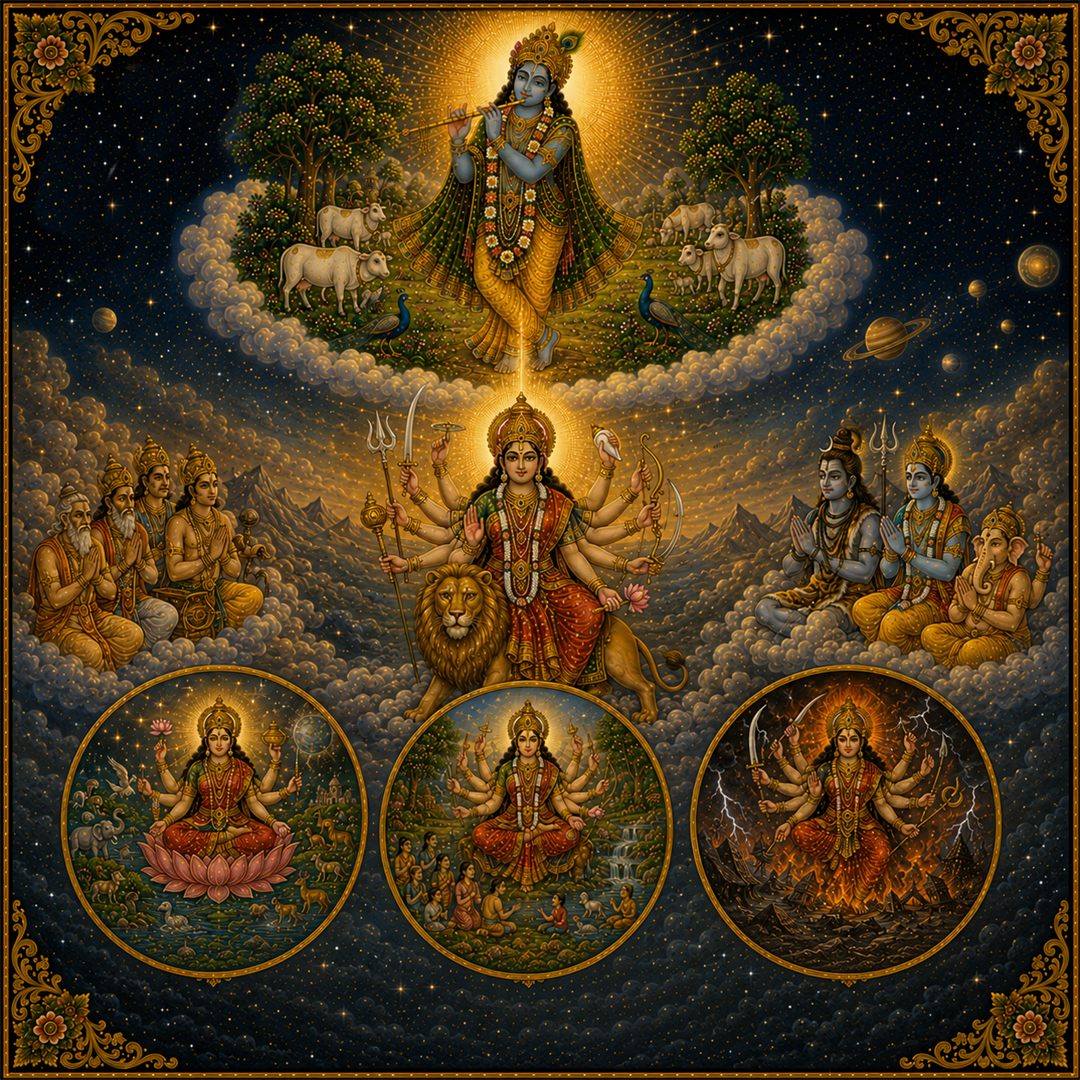
सृष्टिस्थितिप्रलयसाधनशक्तिरेका छायेव यस्य भुवनानि बिभर्ति दुर्गा । इच्छानुरूपमपि यस्य च चेष्टते सा गोविन्दमादिपुरुषं तमहं भजामि ॥ ४४ ॥
sṛṣṭi-sthiti-pralaya-sādhana-śaktir ekā
chāyeva yasya bhuvanāni bibharti durgā
icchānurūpam api yasya ca ceṣṭate sā
govindam ādi-puruṣaṁ tam ahaṁ bhajāmi
I worship Govinda, the primeval Lord, whose one potency, Durgā, like His shadow, accomplishes creation, maintenance, and dissolution, sustains all the worlds, and acts according to His will.
sṛṣṭi—creation; sthiti—maintenance; pralaya—dissolution; sādhana-śaktiḥ—the potency that accomplishes; ekā—one; chāyā iva—like a shadow; yasya—of whom, whose; bhuvanāni—the worlds; bibharti—bears, sustains; durgā—Durgā; icchā-anurūpam—according to the desire; api—indeed; yasya—of whom, whose; ca—and; ceṣṭate—acts; sā—she; govindam—Govinda; ādi-puruṣam—the primeval Lord; tam—Him; ahaṁ bhajāmi—I worship.
Dig-darśinī-ṭīkā
Śrī Jīva Gosvāmī
Previously it was shown that the realms of Devī, Maheśa, and Hari are subordinate realms beneath His abode. Now Brahmā demonstrates that this arrangement is appropriate, since those realms rest upon Him as their foundation. Thus the verse begins: sṛṣṭi-sthiti-pralaya...
In the Śruti it is stated:
tvam akaraṇaḥ svarāḍ akhila-kāraka-śakti-dharaḥ
tava balim udvahanti sama-danty-ajayā nimiṣāḥ
“You are without material instruments, self-sovereign, and the possessor of all operative powers. Even the unconquered demigods bear tribute to You.”
Brahma-saṁhitā-prakāśinī
Śrīla Bhaktivinoda Ṭhākura
Verse 44
I worship that primeval Lord Govinda, whose māyā-śakti, the shadow of His svarūpa-śakti or cit-śakti, accomplishes the creation, maintenance, and dissolution of the material world and is worshiped throughout the worlds as Durgā, acting according to His will.
(Brahmā now describes the presiding deity of the previously mentioned Devī-dhāma.)
The world in which Brahmā resides while offering prayers to the Lord of Goloka is the fourteen-world system known as Devī-dhāma. The presiding deity of that realm is Durgā. She possesses ten arms, representing ten kinds of activities (daśa-karma). Because she is established in heroic power and majesty, she rides a lion. Because she subdues sin, she is known as the slayer of the demon Mahiṣāsura. She is characterized by two children: Kārttikeya, who represents beauty and splendor, and Gaṇeśa, who represents perfection and success. Situated between Lakṣmī and Sarasvatī, who represent material opulence and material knowledge, she bears twenty weapons, symbolizing the many Vedic religious principles employed for the suppression of sin. Adorned with serpents, she is associated with the power of time. Such is Durgā in her various forms.
The word durga means a fortress or prison. When the living beings, who originate from the marginal potency, turn away from Kṛṣṇa, they become confined within the prison of material existence. That prison is Durgā’s fortress. Within that prison, the cycle of karma serves as punishment. This work, consisting of a corrective system for the outward-turned living beings, is Govinda’s action according to His will, and Durgā continually carries it out.
When, by good fortune and the association of saintly devotees, the conditioned souls become free from their aversion to Kṛṣṇa and develop an inward orientation toward Him, then Durgā herself, again acting according to Govinda’s will, becomes the cause of their liberation.
Therefore one should endeavor to satisfy Durgā, the superintendent of the prison, by showing an inward orientation toward Kṛṣṇa and thus obtain her genuine mercy.
The blessings of wealth, food grain and the health of one’s children should be understood as Durgā’s deceptive mercy.
The same Durgā, in the form of the ten Mahāvidyās, unfolds various material activities and subordinate religious practices for the souls who remain turned away from Kṛṣṇa.
The jīva is by nature a particle of spiritual consciousness. As soon as he becomes averse to Kṛṣṇa, he is scattered by the attractive power of Māyā. The moment the jīva becomes thus bewildered, Durgā binds him within a gross body composed of the five gross elements, the five subtle sense objects, and the eleven senses, just as a prisoner is dressed in prison clothing, and casts him into the wheel of karma.
There the living being revolves, experiencing happiness and distress, heaven and hell, and various other conditions.
In addition to the gross body, Durgā provides a subtle body composed of mind, intelligence, and false ego. Upon abandoning one gross body, the living being takes shelter of another gross body through this subtle, liṅga body.
Until liberation is attained, the subtle body, composed of ignorance and material impressions, does not disappear. When it is finally removed, the soul bathes in the Virajā River and proceeds to Hari-dhāma.
All these activities are carried out by Durgā according to the will of Govinda.
Thus the Bhāgavatam (2.5.13) states:
vilajjamānayā yasya sthātum īkṣā-pathe ‘muyā
vimohitā vikatthante mamāham iti durdhiyaḥ
“The illusory energy of the Lord cannot take precedence, being ashamed of her position, but those who are bewildered by her always talk nonsense, being absorbed in thoughts of “It is I” and “It is mine.”
This verse describes Durgā’s relationship with the conditioned souls who have turned away from the Lord. The Durgā worshiped in the material world is this very Durgā. However, the Mantra-mayī Durgā mentioned as guarding the boundary of the Lord’s spiritual abode is a spiritual servant of Kṛṣṇa, and the shadow-Durgā who functions within this world acts as her servant.1
A detailed explanation of Durgā’s role is given in the commentary on Verse 3 of the Brahmā-saṁhitā.
Notes
- Bhaktivinoda Ṭhākura refers back to the commentary on Verse 3, where Durgā is mentioned in connection with the mantra-pīṭha of the Lord’s abode. Jīva Gosvāmī explains there that this Durgā is not the Durgā who is a portion of Māyā, but Kṛṣṇa’s own svarūpa-śakti bearing the name Durgā. ↩