 Spiritual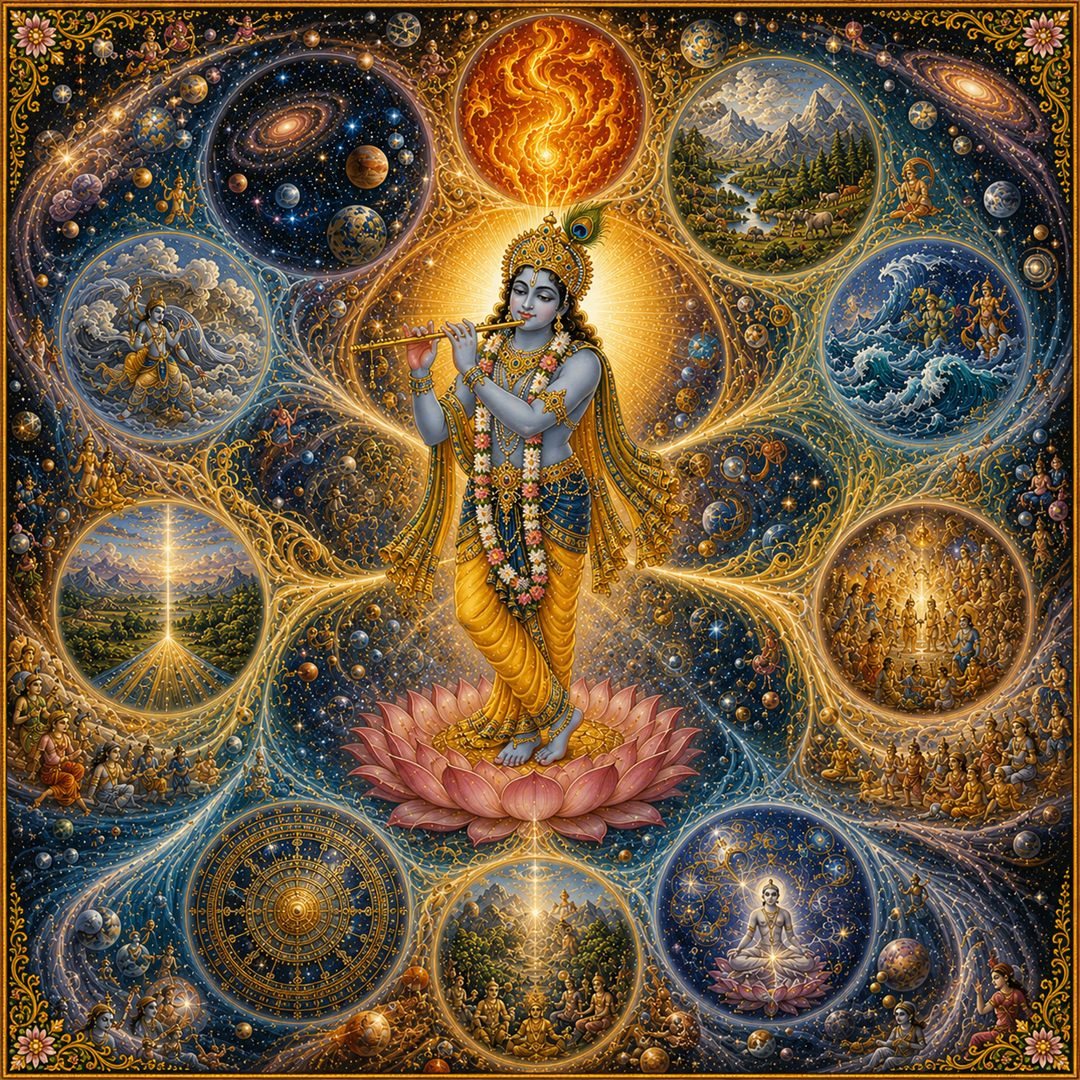
अग्निर्मही गगनमम्बु मरुद्दिशश्च कालस्तथात्ममनसीति जगत्त्रयाणि ।
यस्माद्भवन्ति विभवन्ति विशन्ति यं च गोविन्दमादिपुरुषं तमहं भजामि ॥ ५१ ॥
agnir mahī gaganam ambu marud-diśaś ca
kālas tathātma-manasīti jagat-trayāṇi
yasmād bhavanti vibhavanti viśanti yaṁ ca
govindam ādi-puruṣaṁ tam ahaṁ bhajāmi
I worship Govinda, the primeval Lord, from whom arise the three worlds composed of fire, earth, ether, water, air, the directions, time, the individual self, and the mind; in whom they are sustained; and into whom they again enter at dissolution.
agniḥ—fire; mahī—earth; gaganam—ether; ambu—water; marut—air; diśaḥ ca—and the directions; kālaḥ—time; tathā—also; ātma—the individual self; manas—the mind; iti—thus; jagat-trayāṇi—the three worlds; yasmāt—from whom; bhavanti—arise; vibhavanti—are sustained, remain manifest; viśanti—enter; yam ca—and into whom; govindam—Govinda; ādi-puruṣam—the primeval Lord; tam—Him; ahaṁ bhajāmi—I worship.
Dig-darśinī-ṭīkā
Śrī Jīva Gosvāmī
That this is appropriate is stated in the verse beginning agnir mahī. Everything is clear.
Brahma-saṁhitā-prakāśinī
Śrīla Bhaktivinoda Ṭhākura
Verse 51
I worship that primeval Lord Govinda, from whom arise the three worlds composed of these nine principles—fire, earth, ether, water, air, the directions, time, the self, and the mind. In Him they remain after their creation, and into Him they enter again at the time of dissolution.
Beyond the five gross elements (pañca-bhūtas), the directions (dik), time (kāla), the individual soul (jīvātmā), and the mental principle consisting of mind, intelligence, and false ego, which forms the subtle body (liṅga-deha) of the conditioned soul, nothing else exists within the three worlds.
The ritualistic workers (karmīs) offer oblations into fire in sacrifice. The souls turned away from the Lord know nothing beyond this visible world composed of these nine principles.
The dry speculators (jñānīs) search for the state of self-satisfaction (ātmārāmatā), yet the self they seek is simply the jīva itself.
What the followers of Sāṅkhya call prakṛti, and what they designate as the self (ātmā), are also included within these categories.
In other words, the principles identified by the various schools of philosophical inquiry are contained within these nine categories.
Śrī Govinda alone is the source, sustenance, and resting place at dissolution of all these principles.
Annotations
Bhakti Gauravani Goswami
When reading Jīva Gosvāmī’s very brief comment, one may wonder, “What is he referring to when he says, ‘That this is appropriate is stated in the verse’? What does he mean by ‘this’?” The Sanskrit pronoun tat refers back to the conclusion established in the preceding verse: Gaṇeśa’s capacity to remove obstacles throughout the three worlds is not independent but is derived from his worship of Govinda’s lotus feet.
Verse 51 explains why this conclusion is appropriate. The entire three worlds, represented here by nine constituent principles—fire, earth, sky, water, air, the directions, time, the self, and the mind—arises from Govinda, subsists through Him, and ultimately enters back into Him. Thus the principal purpose of Verse 51 is not merely to define what is meant by “the three worlds.” It establishes that the total cosmic order, together with all the powers operating within it, rests entirely upon Govinda. Gaṇeśa may exercise authority throughout the three worlds, but both the sphere of that authority and the power by which he acts have their source in the primeval Lord
***
Bhaktivinoda Ṭhākura’s commentary emphasizes that all attempts to understand reality within the material universe ultimately revolve around the nine principles listed in this verse: the five gross elements (earth, water, fire, air, and ether), together with directions, time, the individual self (jīva), and the mental tattva comprising mind, intelligence, and false ego.
Different philosophical systems may analyze these categories in different ways and may assign them different names, but according to Bhaktivinoda Ṭhākura they remain confined within the same field of material and conditioned existence, even when discussing the individual self, which, though spiritual by nature, is considered here in relation to the material cosmos.
The karmīs concern themselves primarily with the gross material elements and their manipulation for obtaining objects of sense enjoyment.
The jñānīs focus on the nature of the self and seek liberation through knowledge and self-realization. The followers of Sāṅkhya analyze matter and consciousness through categories such as prakṛti and puruṣa. Yet all such inquiries remain within the framework of these nine principles.
With this verse, Brahmā reminds us that however extensive human knowledge of and control over the universe may become, all the principles described in this verse ultimately arise from Govinda, are sustained by Govinda, and finally return to Him at the time of cosmic dissolution. The Supreme Lord alone transcends the entire system while simultaneously remaining its source, sustainer, and ultimate resting place.