 Spiritual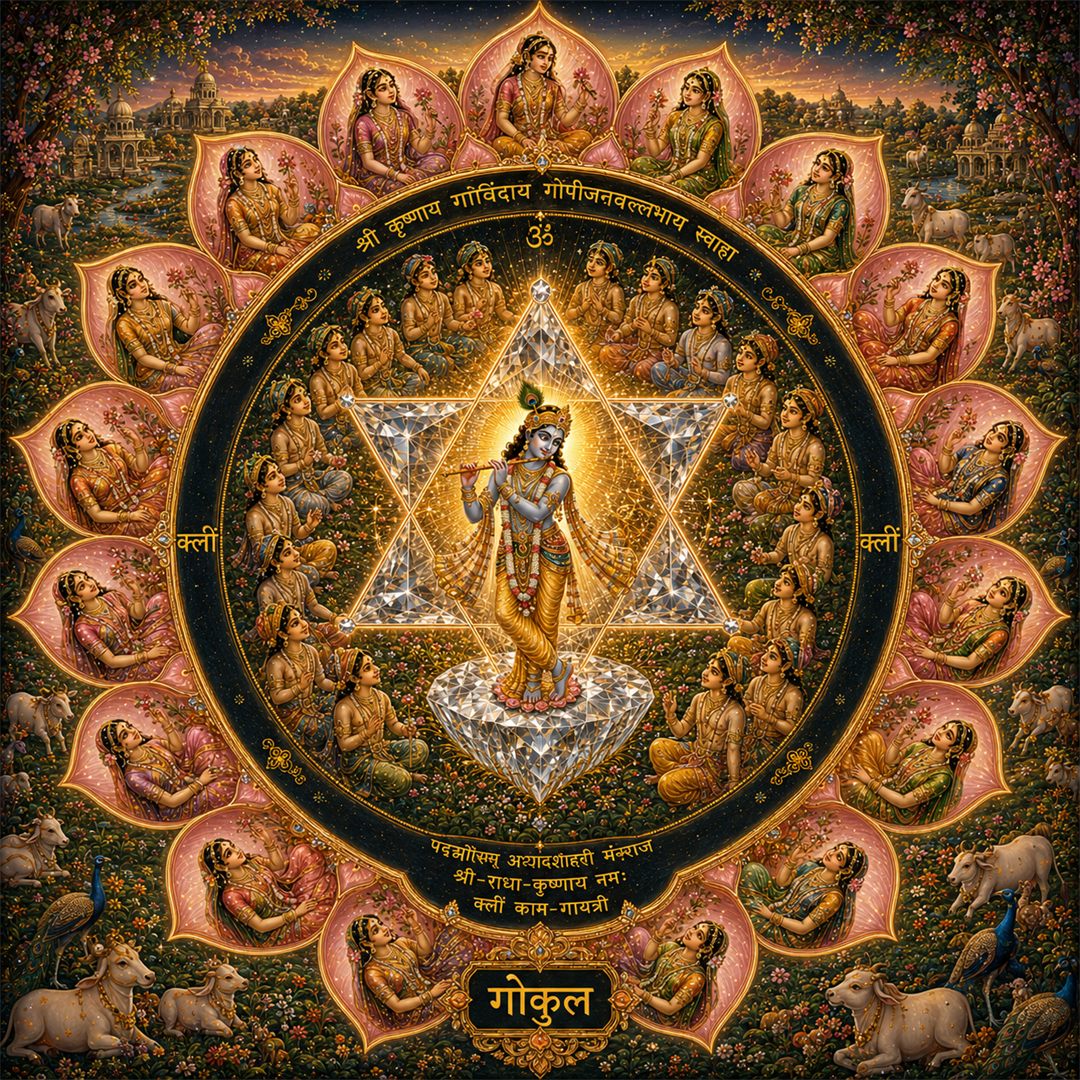
कर्णिकारं महद्यन्त्रं षट्कोणं वज्रकीलकम् ।
षडङ्गषट्पदीस्थानं प्रकृत्या पुरुषेण च ॥
प्रेमानन्दमहानन्दरसेनावस्थितं हि यत् ।
ज्योतीरूपेण मनुना कामबीजेन सङ्गतम् ॥ ३ ॥
तत्-किञ्जल्कं तद्-अंशानां तत्-पत्राणि श्रियाम् अपि ॥ ४ ॥
karṇikāraṁ mahad-yantraṁ ṣaṭ-koṇaṁ vajra-kīlakam
ṣaḍ-aṅga-ṣaṭ-padī-sthānaṁ prakṛtyā puruṣeṇa ca
premānanda-mahānanda-rasenāvasthitaṁ hi yat
jyotī-rūpeṇa manunā kāma-bījena saṅgatam
tat-kiñjalkaṁ tad-aṁśānāṁ tat-patrāṇi śriyām api
3
karṇikāram—the pericarp, the central portion of that thousand-petaled lotus which is the heart of Vraja; mahad-yantram—a great and unique mystical diagram; ṣaṭ-koṇam—having six corners; vajra-kīlakam— having a diamond-like pivot; ṣaḍ-aṅga-ṣaṭ-padī-sthānam—the seat of the six-limbed, six-part mantra; prakṛtyā—by prakṛti, here denoting Śrī Kṛṣṇa Himself in His aspect as the causal ground of the mantra; puruṣeṇa ca—and by puruṣa, here denoting Śrī Kṛṣṇa as the presiding deity of the mantra; premānanda—of the bliss of pure spiritual love; mahānanda—of supreme transcendental joy; rasena—by the mellow, the concentrated spiritual flavor; avasthitam—pervaded and established; hi yat—that which indeed; jyotī-rūpeṇa—in the form of self-luminous effulgence; manunā—in the form of mantra; kāma-bījena—by the kāma-bīja; saṅgatam—endowed, accompanied.
4
tat-kiñjalkam—the filaments of that lotus; tad-aṁśānām—of His portions, the intimate associates who are of His own nature; tat-patrāṇi—the petals of that lotus; śriyām api—belong to the divine consorts of Śrī Kṛṣṇa, headed by Śrī Rādhā.
The pericarp of that transcendental lotus—the innermost heart of Gokula—is a great mystical yantra of six points, whose central pivot is diamond-like and situated in the form of the seed. In that six-pointed realm, the seat of the six-limbed, six-part mantra is established, presided over by Śrī Kṛṣṇa Himself as both prakṛti and puruṣa. The entire abode is established in the rasa of premānanda and mahānanda, and is endowed with the self-luminous mantra together with the kāma-bīja. The filaments of that lotus are the abodes of Kṛṣṇa’s intimate associates, who possess supreme love and are of His nature. The petals of the lotus belong to the divine consorts headed by Śrī Rādhā.
Dig-darśinī-ṭīkā
Jīva Gosvāmī
In these two verses beginning with karṇikāram, Brahmā describes the principal seat of the great king of mantras known as the glorious eighteen-syllable mantra1, which is served by all groups of mantras.
Mahad-yantram means that its representation alone is everywhere drawn in the form of a yantra for the purpose of worship. He describes its nature as ṣaṭkoṇaṁ vajra-kīlakam. Ṣaṭkoṇam means that it has six angles. Vajra-kīlakam means that the pericarp is adorned with a diamond-like pivot in the form of the seed. And within the mantra, the four-syllabled kīlaka, indicated by the syllable ca, should be understood as being of the nature of the pivot.
Next he explains the purpose of the six-cornered form: ṣaḍ-aṅga-ṣaṭpadī-sthānam prakṛtyā puruṣeṇa ca. This means that the yantra is the seat of the glorious eighteen-syllable mantra, which possesses six limbs. Prakṛti refers to Śrī Kṛṣṇa Himself in the form of the abode of the mantra, because He is of the nature of the cause. Thus it is stated in the remembrance of the ṛṣi and the others: “Kṛṣṇa is prakṛti.” And puruṣa also refers to Him. He Himself exists as the presiding deity of that mantra. Thus that yantra is established and presided over by both of these.
Kṛṣṇa is understood in four ways: as the cause of the mantra, as the collection of syllables constituting the mantra, as the presiding deity of the mantra, and as the worshipable form.
Previously He was described as the worshipable Lord in the statement: īśvaraḥ paramaḥ kṛṣṇaḥ. Later He will be described in the form of syllables beginning with: kāmaḥ kṛṣṇāya. As stated in the Hayaśīrṣa Pañcarātra: “O brāhmaṇa, knowers of truth declare the identity of the deity and the mantra, as the relationship between that which is denoted and that which denotes.”
And in the Gopāla-tāpanī Upaniṣad it is said:
“Just as the one air, entering the world, assumes corresponding forms according to each form, so also Kṛṣṇa, though one, appears in fivefold form through sound for the welfare of the universe.”
In some places Durgā is described as the presiding deity because the intention is to express the non-difference between the potency and the possessor of potency. Thus it is said in the Gautamīya-kalpa:
“Nārada is said to be its ṛṣi, and the meter is remembered as virāṭ. Śrī Kṛṣṇa is its deity, and Durgā is its presiding deity. He who is Kṛṣṇa is indeed Durgā, and she who is Durgā is indeed Kṛṣṇa. One who sees difference between these two is never liberated from material existence.”
Thus Śrī Kṛṣṇa Himself, in the form of His intrinsic potency, is there called Durgā. Therefore this Durgā should not be understood to be a manifestation of Māyā. And the etymological explanation here is this: “She is known and understood only through great effort, difficult worship, and much endeavor.”
Thus also in the Śrī Nārada Pañcarātra, in the dialogue between Śruti and Vidyā, it says:
She alone, the supreme beloved, knows Him. She herself is Durgā, being of His very nature. She is the supreme transcendental potency, having the very nature of Mahā-Viṣṇu (mahā-viṣṇu-svarūpiṇī). By knowledge of Her alone, attainment of the Supreme Lord of lords occurs within but a moment and not otherwise. She alone, whose nature is the entirety of divine love, is Gokuleśvarī, the Lady of Gokula. Through Her the original Lord, the Lord of all, is easily known. Bhakti, the wealth of worship, worships the beloved. She is known only with extreme difficulty; therefore She is called the prakṛti of the Lord. Saintly persons describe Her as Durgā, the beloved of indivisible rasa. The covering potency of this Lord of all is Mahāmāyā. By Her the entire world, whose inhabitants identify with their material bodies, is bewildered.
Similarly, in the Sammohana Tantra, Durgā says:
yan nāmnā nāmni durgāhaṁ guṇair guṇavatī hy aham |
yad-vaibhavān mahālakṣmī rādhā nityā parādvayā ||
“It is by His name that I am known as Durgā, and by His qualities that I possess all qualities. By His splendor I exist as Mahālakṣmī and as Rādhā, the eternal and supreme nondual reality.”
Furthermore, the premānanda and mahānanda rasas mentioned in Brahmā’s verse are of the nature of prema and differ according to degrees of maturation.
Jyotīrūpeṇa means “by self-luminous effulgence,” and manunā means “in the form of mantra.” Although the kāma-bīja is included within the root mantra, it is nevertheless mentioned separately because in some contexts it is regarded independently.
Having thus described that abode, Brahmā now describes its surrounding features with the half verse (4):
tat-kiñjalkaṁ tad-aṁśānāṁ tat-patrāṇi śriyām api
The filaments (kiñjalkāḥ) of that pericarp-like abode are rows of elevated peaks forming encircling ramparts. And these belong to His portions; they are the abodes of those intimate associates who possess supreme love and are of His kind. By the very use of the name Gokula, their similarity of nature to Him has already been indicated.
Thus Śrī Bādarāyaṇi himself says: “Having slain the demon Kakudmī, and being praised by His own people, Kṛṣṇa entered the cowherd settlement together with Balarāma, delighting the eyes of the gopīs.”
Therefore the petals of that lotus are the abodes in the form of groves belonging to the beloveds of Śrī Kṛṣṇa, namely Śrī Rādhā and the other gopīs. Their identity as gopīs is indicated by the mantra itself through their names. Their identity as Rādhā and the others is established by statements such as this from the Bṛhad-gautamīya: “Rādhikā, the supreme goddess, is said to be wholly pervaded by Kṛṣṇa. She embodies all Lakṣmīs, all beauty, and the supreme power of enchantment.” And by this fragment of the Matsya Purāṇa: “Rādhā in the forest of Vṛndāvana…” And by this one from the Ṛk-pariśiṣṭa: “By Rādhā, Mādhava is radiant; and by Mādhava, Rādhikā…”
At the junctions where the raised tips of the petals meet, pathways should be understood to exist, and beyond those junctions are the cowherd settlements. Because the entire lotus is itself Gokula, and because those settlements are included within Gokula, they too are of the same nature.
Another text states:
sahasrāraṁ padmaṁ dala-tatiṣu devībhir abhitaḥ
parītaṁ go-saṅghair api nikhila-kiñjalka-militaiḥ
kavāṭe yasyāsti svayam akhila-śaktyā prakaṭita-
prabhāvaḥ śrī-parama-puruṣas taṁ kila bhaje
“I worship that Supreme Person whose thousand-petaled lotus is surrounded on all sides by goddesses situated upon its rows of petals, and also by groups of gopas gathered among all the filaments. Within its inner gate, the glory of that Supreme Person is directly manifested through all potencies.”
Here the reading go-saṅghaiḥ (“with groups of gopas”) is more appropriate. The word gosaṅkhyāḥ means “cowherds,” as stated in the Amarakośa2: gopā gopāla-gosaṅkhya-godhug-ābhīra-vallavāḥ. “Gopā, gopāla, gosaṅkhya, godhuga, ābhīra, and vallava are synonyms.”
Kavāṭe means “within the gate,” in the central region of the pericarp. The meaning is that the Supreme Person, Śrī Kṛṣṇa, manifests His glory there through all His potencies.
Annotations 1
Bhakti Gauravani Gosvāmī
The Absolute Truth is understood as consisting of two inseparable aspects: the śaktimān, the possessor of potencies, and the śakti, the potency itself. Just as fire cannot be separated from heat, or the Sun from its light, the Supreme Lord cannot be separated from His energy. Because His energy proceeds entirely from His own being and exists as His inherent potency, it is considered non-different from Him.
Vaiṣṇava philosophy distinguishes two principal expressions of the Lord’s potency. The first is Mahāmāyā, the external material potency, which governs the world of matter and keeps the conditioned soul bound within the cycle of birth and death. The second is Yogamāyā, the internal spiritual potency, which governs the Lord’s transcendental pastimes and is accessible only to those who have received Kṛṣṇa’s grace. These two are never to be confused: Mahāmāyā binds, while Yogamāyā liberates and serves.
Here the name “Durgā” appears in both contexts. In the popular and scriptural usage familiar to most readers, Durgā is associated with Mahāmāyā, the governing power of material creation, maintenance, and dissolution. In this aspect she carries out the will of the Supreme Lord within the material universe, acting on His behalf as the divine energy described in the Bhagavad-gītā (7.14): daivī hy eṣā guṇa-mayī mama māyā duratyayā. “This divine energy of Mine, composed of the three modes of nature, is very difficult to overcome.”
However, as Jīva Gosvāmī explains here, the name “Durgā” carries a deeper esoteric meaning in the context of these verses. Here it functions as a designation for the supreme internal potency of the Lord—the hlādinī-śakti, the potency of divine bliss, whose fullest personal expression is Śrī Rādhā. She is called “Durgā,” meaning that which is reached only with great difficulty, because the mystery of Her pure divine love is utterly beyond the reach of persons whose consciousness is conditioned by material conceptions. This is not the Durgā who governs matter, but the supreme transcendental potency who governs the Lord’s innermost pastimes of love.
As the original source of all spiritual energies and expansions, She is completely one in essence with the Supreme Lord Himself; at the same time, She is eternally distinct for the sake of loving exchange (rasa), yet absolutely non-different in essence and reality (tattva).
Brahma-saṁhitā-prakāśinī
Bhaktivinoda Ṭhākura
Verse 3
The central portion of that spiritual lotus is the pericarp, the abode of Kṛṣṇa. It is a particular mystical diagram consisting of a hexagon and presided over by prakṛti and puruṣa. In the middle is situated the pivot in the form of kṛṣṇa-tattva, endowed with spiritual potency and shining like a diamond. The eighteen-syllable great mantra is manifested there as the seat of the sixfold, six-part arrangement, being situated in six divisions and six limbs.
Kṛṣṇa’s pastimes are of two kinds: manifest and unmanifest. The Vṛndāvana pastimes visible to the eyes of ordinary men are the manifest Kṛṣṇa pastimes, and those Kṛṣṇa pastimes which cannot be perceived by material eyes are the unmanifest ones. In Goloka, the unmanifest pastimes are always manifest, and in Gokula the unmanifest pastimes become manifest to worldly eyes when Kṛṣṇa so desires.
In the Kṛṣṇa-sandarbha, Śrī Jīva has said: “The manifest pastimes are the manifestation arising from the unmanifest pastimes.” In other words, the manifestation of the unmanifest pastimes constitutes the manifest pastimes. Again, in the Kṛṣṇa-sandarbha he has said: “Goloka is a special manifestation of Śrī Vṛndāvana. That manifestation which appears as the sphere accommodating the manifest pastimes in the material world is properly to be understood as Goloka.” This means that the interval beyond the manifest pastimes in the material world, wherein the pastimes appear in an unmanifest manner, is the Goloka pastimes. Therefore the statement of Śrī Rūpa in the Bhāgavatāmṛta resolves this matter: “That which is known by the name ‘Goloka’ is the glory of Gokula; and its greatness lies in the magnificence of that self-same identity.” The meaning is that the glory of Gokula’s own identical nature is the enhancement of its magnificence. Therefore Goloka is merely the opulence of Gokula. Although all the pastimes of Śrī Kṛṣṇa are unmanifest in Gokula, they are eternally manifest in Goloka-dhāma. In relation to conditioned souls, the manifestation in Goloka of those unmanifest pastimes—Goloka being the opulent expansion of Gokula—is of two kinds: one consists of mantra worship, and the other consists of spontaneous relish.
Śrī Jīva has said that one type is fixed in a particular place and consists of meditation on a particular mantra. Meditation on the mantra remains fixed in the place appropriate for one specific pastime; that manifestation of Goloka perceived in meditation is the pastime consisting of mantra worship.
The pastime that extends through many places in diverse playful movements is manifold and spontaneous; therefore it is called svārasikī. Both meanings are present in this verse.
One meaning is that within the eighteen-syllable līlā-mantra, the words of the mantra are placed in various positions, thereby revealing one specific pastime of Kṛṣṇa. For example: klīṁ kṛṣṇāya govindāya gopījana-vallabhāya svāhā. This mantra is called the sixfold, six-part mantra:
(1) kṛṣṇāya
(2) govindāya
(3) gopījana
(4) vallabhāya
(5) svā
(6) hā
When these six limbs and six divisions are successively placed, the arrangement of the mantra becomes manifest. The great hexagonal mystical diagram is of this kind, with the seed, the kāma-bīja “klīṁ”, situated internally as the pivot of the diagram.
By drawing such a diagram and continuously contemplating spiritual truth, realization of tattva arises like the crescent moon gradually appearing.
In the Gautamīya-tantra the following instruction is given: “By the word svā is indicated the knower of the field, and by hā the supreme spiritual nature.”
According to the opinion of the Śrī Hari-bhakti-vilāsa: “From the word govindāya are understood the surabhi cows and the cowherd community. From the word gopījana are understood the fourteen branches of knowledge. From the word vallabha...” and so forth.
By meanings of this kind there arises realization of the pastime situated in one place and consisting of mantra worship. This is the purport of mantra worship.
The general purport is this: One who has an intense desire to enter Kṛṣṇa’s spiritual pastimes should establish service to Kṛṣṇa according to his own spiritual identity, together with deliberation upon knowledge of relationship generated from devotional rasa.
Through realization of the following forms, relationship is established: (1) the nature of Kṛṣṇa, (2) the nature of Kṛṣṇa’s spiritual Vraja pastimes and enjoyments, (3) the nature of His associates, the gopīs, (4) the nature of surrendering oneself to Kṛṣṇa in the mood of following those beloved gopīs, (5) the conscious nature of the pure soul, and (6) spiritual nature itself, the disposition for service to Kṛṣṇa.
When realization of these forms awakens, relationship is established. Thereby, through steadfastness in the practice whose nature is union with the self, one comes to understand Śrī Kṛṣṇa, the supreme shelter in the form of the puruṣa, and the “I” in the form of prakṛti as the maidservant of Śrī Rādhā. The bliss of serving Bhagavān alone constitutes true rasa. This is the meaning.
In the stage of practice, the pastimes of Goloka and Gokula are approached through meditation and mantra worship; in the perfected state, the unrestricted relishing of those pastimes arises. This is the condition of Goloka or Gokula, and it will gradually become manifest.
The meaning of the words jyotī-rūpeṇa manunā is this: as the spiritual meaning of the mantra becomes manifest, one joins with it pure kṛṣṇa-prema in the form of transcendental desire and continues to render service. In this way, one becomes established in the rasa of premānanda and mahānanda. Such eternal pastimes eternally shine forth in Goloka.
Verse 4
The pericarp of that eternal abode named Gokula is the six-pointed land of Kṛṣṇa’s residence. Its kiñjalka, meaning its filaments or petals, are the abodes of the gopas, who are expansions of Kṛṣṇa’s self and are pure devotees possessing supreme love, being of the same nature as Kṛṣṇa. They shine forth like a surrounding rampart. The expanded petals of that lotus are the special bowers belonging to Śrī Rādhikā and the other beloved consorts of the Lord.
The spiritual Gokula is lotus-shaped. Its central pericarp is six-pointed in form. Within it, the essence of the eighteen-syllable mantra, namely the truth of Śrī Rādhā-Kṛṣṇa (rādhā-kṛṣṇa-tattva), is situated at the center, and in accordance with that, the personal bodily expansions (kāya-vyūha) manifested from His intrinsic potency are present. The seed (bīja) is Rādhā-Kṛṣṇa.
The Gopāla-tāpanī Upaniṣad states:
tasmād oṁkāra-sambhūto gopālo viśva-sambhavaḥ
klīm oṁkārasya caikatvaṁ paṭhyate brahma-vādibhiḥ
“Therefore Gopāla, the source of the universe, is manifested from oṁkāra. The knowers of Brahman declare that klīṁ and oṁkāra are one.”
Oṁkāra signifies both the potency and Gopāla, the possessor of potency. Since the word klīṁ signifies that same oṁkāra, the kāma-bīja, the seed-syllable klīṁ, denotes the tattva of Rādhā and Kṛṣṇa.
Annotations 2
Bhakti Gauravani Gosvāmī
The vajra-kīlaka, the diamond-like pivot at the center of the six-pointed yantra, should not be understood merely as a geometric form. Jīva Gosvāmī describes it as a diamond-like pivot situated in the pericarp of the lotus, while Bhaktivinoda Ṭhākura further explains that it is established there in the form of kṛṣṇa-tattva, endowed with spiritual potency. Thus the central pivot symbolizes Śrī Kṛṣṇa Himself, the supreme reality upon whom the entire structure of Gokula rests.
In Vaiṣṇava understanding, the symbol, the mantra, the divine principle (kṛṣṇa-tattva), and Kṛṣṇa, the Supreme Person, are spiritually non-different, though understood separately according to their respective modes of manifestation.
For this reason, in the illustration of these verses Kṛṣṇa is shown standing upon the diamond-like center of the yantra, visually expressing Him as the fixed spiritual center of all existence.