 Spiritual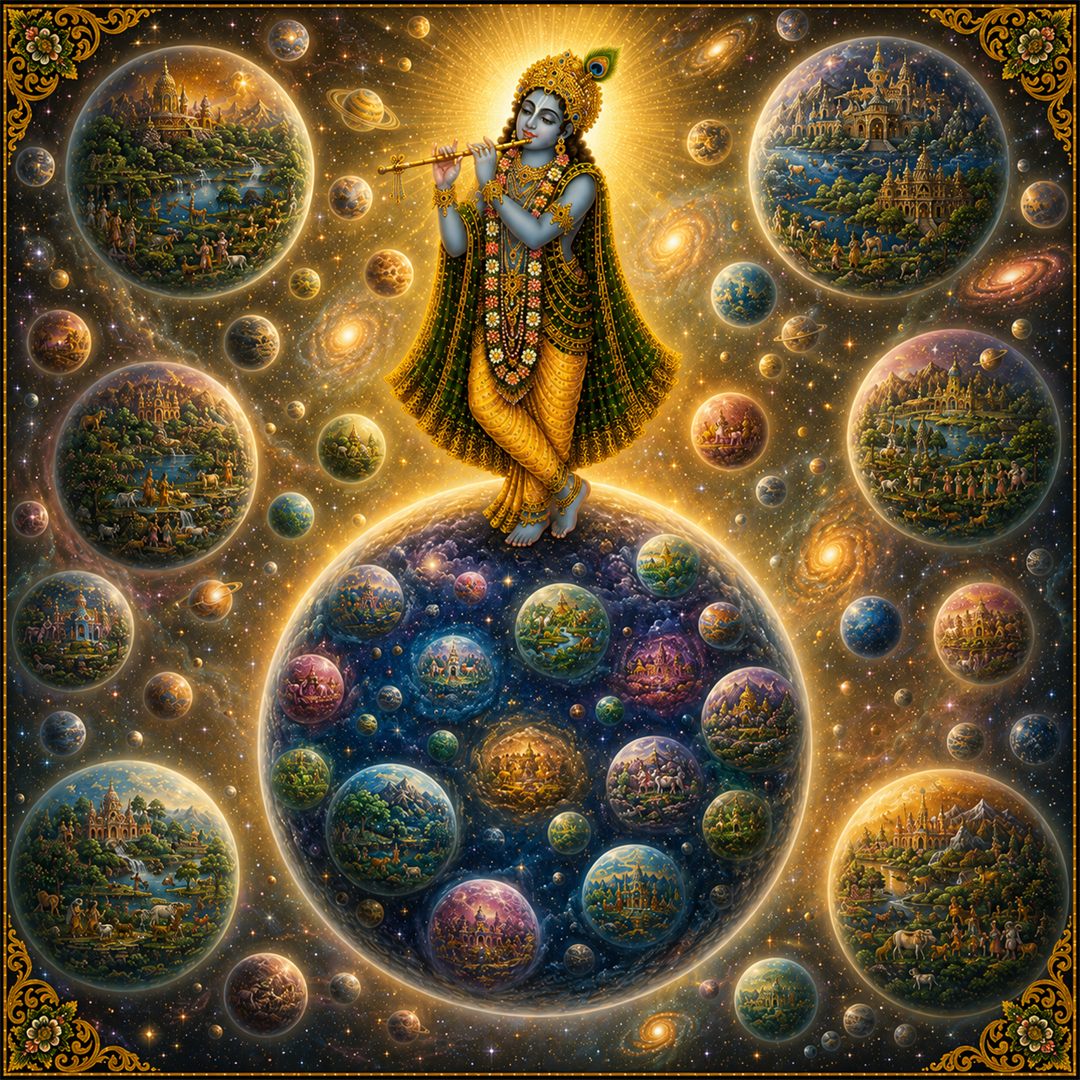
यस्य प्रभा प्रभवतो जगदण्डकोटि- कोटिष्वशेषवसुधादि विभूतिभिन्नम् ।
तद्ब्रह्म निष्कलमनन्तमशेषभूतं गोविन्दमादिपुरुषं तमहं भजामि ॥ ४० ॥
yasya prabhā prabhavato jagad-aṇḍa-koṭi-
koṭiṣv aśeṣa-vasudhādi-vibhūti-bhinnam
tad brahma niṣkalam anantam aśeṣa-bhūtaṁ
govindam ādi-puruṣaṁ tam ahaṁ bhajāmi
I worship Govinda, the primeval Lord, whose effulgence is that Brahman—indivisible, infinite, and all-pervading—which is diversified by the innumerable planets and other opulences present within millions upon millions of universes.
yasya—whose; prabhā—effulgence; prabhavataḥ—of the powerful Lord, or, of Him from whom all proceeds; jagad-aṇḍa-koṭi-koṭiṣu—within millions upon millions of universes; aśeṣa-vasudhā-ādi-vibhūti-bhinnam—diversified by innumerable opulences beginning with planets; tat brahma—that Brahman; niṣkalam—without parts; indivisible; anantam—infinite; aśeṣa-bhūtam—all-pervading, or, existing without limit; govindam—Govinda; ādi-puruṣam—the primeval Lord; tam—Him; ahaṁ bhajāmi—I worship.
Dig-darśinī-ṭīkā
Śrī Jīva Gosvāmī
Having thus established Govinda’s completeness as the source of all avatāras, Brahmā now describes Him in relation to His essential nature, beginning with yasya prabhā prabhavato jagad-aṇḍa-koṭi.
Although Govinda and Brahman are one reality, because Śrī Govinda manifests with specific distinction, He has the status of the dharmī, the possessor of the characteristic, whereas Brahman, because it manifests without specific distinction, has the status of the dharma, the characteristic. Thus Govinda occupies the position of the luminous orb and Brahman the effulgence. For this reason, Kṛṣṇa says in the Bhagavad-gītā (14.27): brahmaṇo hi pratiṣṭhāham. “I am the foundation of Brahman.”
Similarly, in the Eleventh Canto (SB 11.16.37), while enumerating His manifestations, Kṛṣṇa includes Brahman among them:
pṛthivī vāyur ākāśa āpo jyotir ahaṁ mahān
vikāraḥ puruṣo ‘vyaktaṁ rajaḥ sattvaṁ tamaḥ param
“I am earth, air, sky, water, fire, the mahat-tattva, transformation, the puruṣa, the unmanifest, passion, goodness, darkness, and the param.”
The commentary explains that param means the Supreme Brahman.” Likewise, Lord Matsya says in the Eighth Canto of the Śrīmad-Bhāgavatam (8.24.38) to King Satyavrata:
madīyaṁ mahimānaṁ ca paraṁ brahmeti śabditam
vetsyasy anugṛhītaṁ me sampraśnair viditaṁ hṛdi
“You will be thoroughly advised and favored by Me, and because of your inquiries, everything about My glories, which are known as the Supreme Brahman, will be manifest within your heart. Thus you will know everything about Me.”
For the same reason Dhruva Mahārāja prays in the Fourth Canto (SB 4.9.10):
yā nirvṛtis tanu-bhṛtāṁ tava pāda-padma-
dhyānād bhavaj-jana-kathā-śravaṇena vā syāt
sā brahmaṇi sva-mahimany api nātha mā bhūt
kiṁ tv antakāsi-lulitāt patatāṁ vimānāt
“My Lord, the transcendental bliss derived from meditating upon Your lotus feet or hearing about Your glories from pure devotees is so unlimited that it is far beyond the stage of brahmānanda, wherein one thinks himself merged in the impersonal Brahman as one with the Supreme. Since brahmānanda is also defeated by the transcendental bliss derived from devotional service, then what to speak of the temporary blissfulness of elevating oneself to the heavenly planets, which is ended by the separating sword of time? Although one may be elevated to the heavenly planets, he falls down in due course of time.”
Even the self-satisfied sages are said to be attracted by His qualities:
ātmārāmāś ca munayo nirgranthā apy urukrame
kurvanty ahaitukīṁ bhaktim ittham-bhūta-guṇo hariḥ
“Those who take pleasure in the self, though freed from all kinds of material bondage, desire to render unalloyed devotional service unto the Supreme Lord. This means that His wonderful qualities attract everyone.” (SB 1.7.10)
If a more detailed inquiry into this subject is desired, one should consult the Śrī Bhagavat-sandarbha. Further elaboration here would be excessive.
Brahma-saṁhitā-prakāśinī
Śrīla Bhaktivinoda Ṭhākura
Verse 40
I worship that primeval Lord Govinda, from whose effulgence arises the undifferentiated Brahman spoken of in the Upaniṣads. Distinct from the planets and other opulences contained within millions of universes, that Brahman is perceived as indivisible, infinite, and unlimited reality.
The multitude of universes produced by māyā constitutes but one-quarter (eka-pāda-vibhūti) of Govinda’s opulence. Beyond that lies the undifferentiated Brahman. That Brahman is a particular effulgence situated at the outer boundary of the spiritual world, which constitutes Govinda’s three-quarters opulence (tri-pāda-vibhūti).
It is niṣkala, without divisions or constituent parts, and therefore is perceived as ekam eva advitīyam (“one alone, without a second”). It is infinite and an undifferentiated reality.
Annotations
Bhakti Gauravani Goswami
Jīva Gosvāmī uses the terms dharmī and dharma in the sense of “the possessor of a characteristic” and “the characteristic by which the possessor is known.” The Sanskrit says: śrī-govindasya dharmī-rūpatvam. “Govinda has the status of the dharmī.” And: brahmaṇo dharma-rūpatvam. “Brahman has the status of the dharma.” Here dharma means the intrinsic nature or characteristic by which an entity is known, just as sweetness is the dharma of sugar, or heat is the dharma of fire.
Jīva Gosvāmī’s point is not that Brahman is separate from Govinda or less real than Govinda. Rather, Brahman is the undifferentiated spiritual effulgence emanating from Govinda, who is the complete personal reality from whom Brahman proceeds.
Śrīla Prabhupāda translated this verse in several places. The following rendering helps illuminate the relationship between Govinda, Brahman, and the cosmic manifestation:
I worship Govinda, the primeval Lord, who is endowed with great power. The glowing effulgence of His transcendental form is the impersonal Brahman, which is absolute, complete and unlimited and which displays the varieties of countless planets, with their different opulences, in millions and millions of universes.” (SB 5.11.13–14 pp)