 Spiritual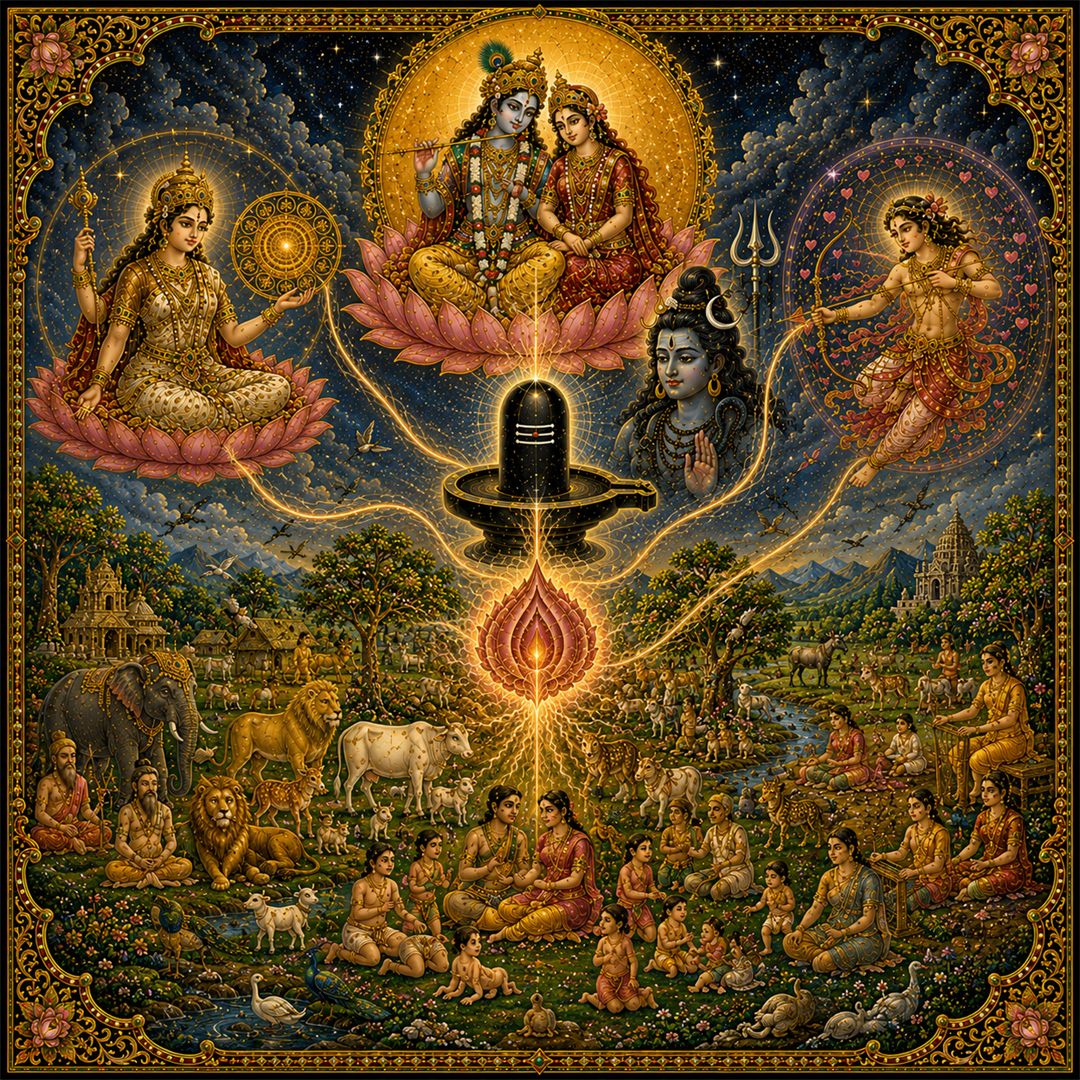
लिङ्गयोन्यात्मिका जाता इमा माहेश्वरीप्रजाः ॥ ९ ॥
liṅga-yony-ātmikā jātā imā māheśvarī-prajāḥ
These progeny of Maheśvarī have arisen as constituted of the liṅga and yoni principles.
liṅga—consisting of, or characterized by, the liṅga and yoni principles; jātāḥ—have arisen, have been born; imāḥ—these; māheśvarī-prajāḥ—the progeny of Maheśvarī, the potency and consort of Maheśvara.
Dig-darśinī-ṭīkā
Jīva Gosvāmī
Therefore, even the Scriptures of the followers of Śiva appear to proceed independently only because the particular distinctions involved are not properly discerned. In reality, however, their intended conclusion is the same as that previously established. Thus the text states in this half verse: liṅga-yony-ātmikā jātā imā māheśvarī-prajāḥ. “These progeny of Maheśvarī have arisen as constituted of the liṅga and yoni principles.”
The expression māheśvarī-prajāḥ means “the progeny of Maheśvarī.”
Brahma-saṁhitā-prakāśinī
Bhaktivinoda Ṭhākura
Verse 9
All the progeny of Maheśvarī within this world are constituted of the liṅga and yoni principles.
The Supreme Lord’s complete opulence is described as fourfold. Of this, the three-quarter manifestation, which is free from sorrow, death, and fear, is the opulence of Vaikuṇṭha, Goloka, and the other spiritual realms. Within this illusory world, however, the demigods, human beings, all other creatures, and all the planetary systems are particular manifestations of the one-quarter opulence belonging to Māyā’s domain. All entities here are constituted, according to the distinction between material and instrumental causes, of the liṅga and yoni principles and arise through their union.
Whatever knowledge has been obtained through material science confirms this principle. Trees, creepers, and even inert objects manifest this nature of union—the interaction of active and receptive principles, or of puruṣa and prakṛti.
The essential point is this: Although terms such as liṅga and yoni may be regarded as vulgar in ordinary social usage, within scientific and philosophical discourse they are highly meaningful and indispensable expressions of fundamental principles. Vulgarity is merely a social attribution. Neither material science nor spiritual science can deny reality merely to conform to social convention.
Therefore, when explaining that the root principle underlying material manifestation is the material kāma-bīja, the use of such terminology becomes unavoidable. By these expressions one should understand the masculine potency as the active, initiating principle and the feminine potency as the receptive, productive principle.
Annotations
Bhakti Gauravani Goswami
Maheśvarī is the feminine counterpart and divine consort of Maheśvara, and the compound māheśvarī-prajāḥ means “the progeny of Maheśvarī.” Just as Śiva bears many names according to his qualities and activities, including Maheśvara, his consort likewise appears under many names, among them Satī, Pārvatī, Durgā, Kālī, Umā, and Maheśvarī.
As mentioned in the Annotations to the previous verse, the terms liṅga and yoni refer here to universal structural principles underlying material creation, not merely to their anatomical manifestations as the male and female generative organs.
Bhaktivinoda Ṭhākura recognizes that ordinary usage readily associates liṅga and yoni with the male and female generative organs, but he insists that their philosophical significance should not be reduced to vulgar associations arising from mundane perception.
The error arises when material sexual union is regarded as the ultimate and sufficient cause of life and the universe. The Bhagavad-gītā (16.8) identifies this as an atheistic conclusion:
asatyam apratiṣṭhaṁ te jagad āhur anīśvaram
aparaspara-sambhūtaṁ kim anyat kāma-haitukam
“The demons say that this world is unreal, with no foundation, no God in control. They say it is produced of sex desire and has no cause other than lust.”
According to the atheistic conception, material sexual union is treated as a sufficient explanation of life, without any higher conscious cause, whereas devotees understand biological generation as a material expression of deeper causal principles governed by divine will.
A similar confusion appears in some modern movements that present themselves under the name of “tantra,” in which sexual techniques are promoted as a direct means to spiritual awakening, transcendence, or union with the divine. Such practices should not be confused with the diverse historical Tantric traditions, nor should the metaphysical symbolism of liṅga and yoni be reduced to a spiritual endorsement of sexual experience. When material sexuality itself is elevated to the status of transcendental realization, the reflection is mistaken for the original reality. From the Vaiṣṇava perspective, material desire is not transformed into prema merely by being ritualized or described in spiritual language; consciousness must be purified and desire redirected toward loving service to Bhagavān.
Nevertheless, although it is only a material reflection, sexual attraction functions within conditioned existence as the strongest binding force, impelling the living entity to continue within the cycle of birth and death. As Ṛṣabhadeva explains to his sons (SB 5.5.8–9):
The attraction between male and female is the basic principle of material existence. On the basis of this misconception, which ties together the hearts of the male and female, one becomes attracted to his body, home, property, children, relatives and wealth. In this way one increases life’s illusions and thinks in terms of “I” and “mine.”
When the strong knot in the heart of a person, implicated in material life due to the results of past action, is slackened, one turns away from his attachment to home, wife and children. In this way, one gives up the basic principle of illusion [I and mine] and becomes liberated. Thus one goes to the transcendental world.
Thus the same polarity that serves as an instrument of material generation also becomes, under the influence of false identification, the knot binding the conditioned soul to the conceptions of “I” and “mine.”