 Spiritual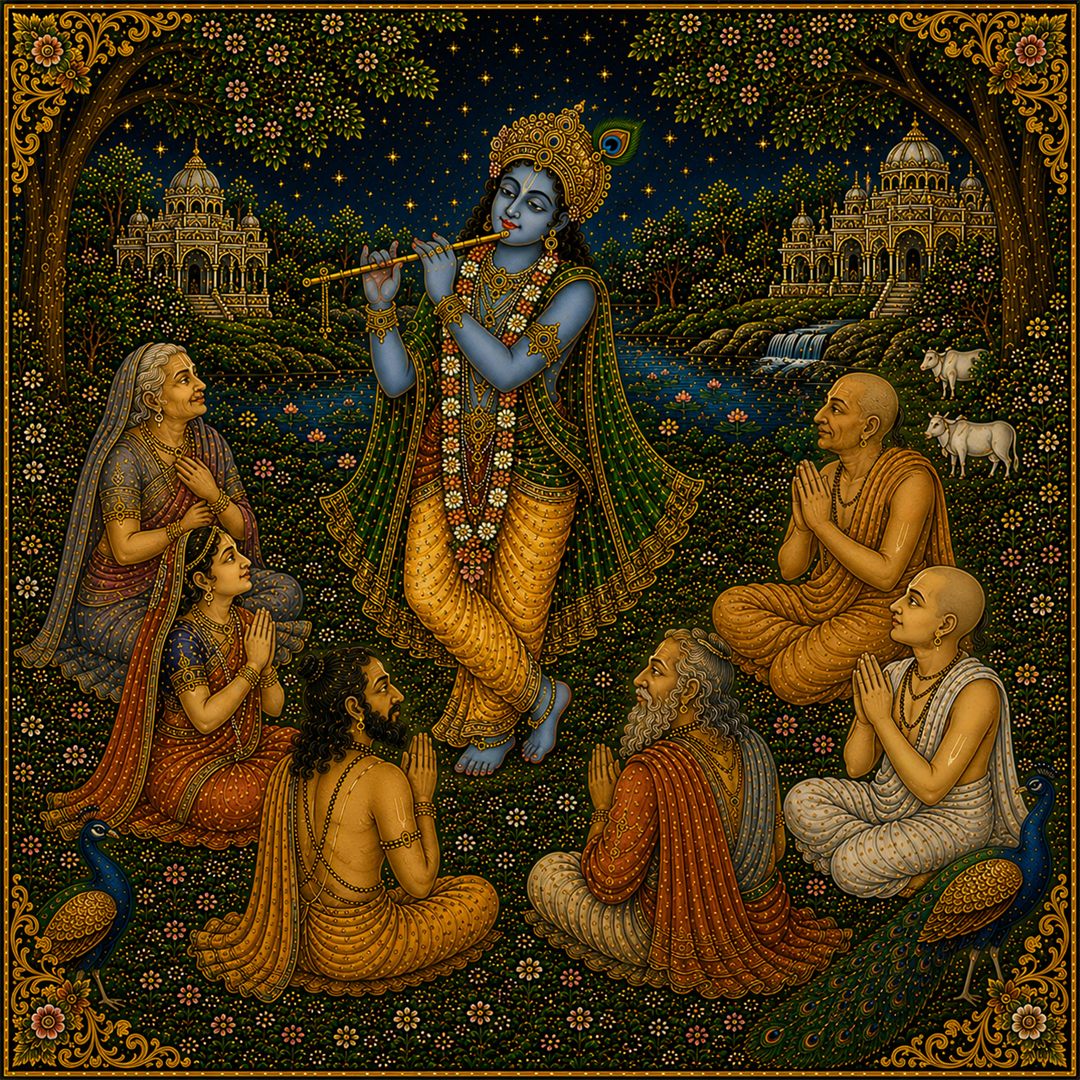
प्रेमाञ्जनच्छुरितभक्तिविलोचनेन सन्तः सदैव हृदयेषु विलोकयन्ति । यं श्यामसुन्दरमचिन्त्यगुणस्वरूपं गोविन्दमादिपुरुषं तमहं भजामि ॥ ३८ ॥
premāñjana-cchurita-bhakti-vilocanena
santaḥ sadaiva hṛdayeṣu vilokayanti
yaṁ śyāmasundaram acintya-guṇa-svarūpaṁ
govindam ādi-puruṣaṁ tam ahaṁ bhajāmi
I worship Govinda, the primeval Lord, Śyāmasundara, whose very form consists of inconceivable qualities and whom the saints constantly behold within their hearts through the eye of devotion anointed with the salve of divine love.
prema-añjana-cchurita—anointed with the ointment of divine love; bhakti-vilocanena—by the eye of devotion; santaḥ—saintly devotees; sadā eva—always; hṛdayeṣu—within their hearts; vilokayanti—behold; yam—whom; śyāmasundaram—Śyāmasundara; acintya-guṇa-svarūpam—whose very form consists of inconceivable qualities; govindam—Govinda; ādi-puruṣam—the primeval Lord; tam—Him; ahaṁ bhajāmi—I worship.
Dig-darśinī-ṭīkā
Śrī Jīva Gosvāmī
Although Govinda eternally resides in Goloka, He is nevertheless seen by the saints within their hearts. The añjana, salve, referred to here is prema, divine love. The meaning is that the eye in the form of devotion becomes brilliantly illuminated, as though richly anointed with that salve of divine love, and by means of such vision the saints behold Him directly: premāñjana-cchurita-bhakti-vilocanena… The phrase acintya-guṇa-svarūpam means “whose very form consists of inconceivable qualities.”
Brahma-saṁhitā-prakāśinī
Śrīla Bhaktivinoda Ṭhākura
Verse 38
I worship that primeval Lord Govinda, Śyāmasundara Kṛṣṇa, whose qualities are inconceivable and whom the saintly devotees, whose eyes have been anointed with the salve of love (prema), behold within their hearts through the vision of devotion.
Śyāmasundara is Kṛṣṇa’s inconceivable form in which apparently contradictory characteristics, such as possessing both specific attributes and transcendence beyond all attributes, exist simultaneously. Saintly devotees behold that form within their hearts through devotional absorption (bhakti-samādhi).
His dark-blue complexion (śyāma) is not a material hue. Rather, it is an eternally blissful spiritual color, belonging to the variegated beauty of the spiritual realm. Material eyes cannot perceive it.
If one considers Vyāsa’s vision in samādhi, described in the words (SB 1.7.4): bhakti-yogena manasi samyak praṇihite ‘male apaśyat puruṣaṁ pūrṇam, “With his mind fully fixed and purified through bhakti-yoga, he beheld the complete Supreme Person,” it becomes evident that Śrī Kṛṣṇa, the complete Supreme Person, manifests within the devotee’s heart, which serves as the seat of devotional trance.
When Kṛṣṇa’s earthly Vraja pastimes were manifest, both devotees and nondevotees saw Him with their eyes. Yet only the devotees cherished the Kṛṣṇa who resided in Vraja as the supreme treasure of their hearts.
At present, although devotees do not obtain such direct vision with their eyes, they nevertheless behold Kṛṣṇa in Vraja through hearts imbued with devotion.
The eyes of the living being’s pure spiritual form are the eyes of devotion (bhakti-cakṣu). To the degree that these eyes open through the cultivation of devotional service, to that degree pure vision of Kṛṣṇa’s form is obtained.
When devotional practice (sādhana-bhakti) attains the stage of bhāva, then, by Kṛṣṇa’s mercy, the ointment of love (prema) is applied to the eyes of that devotee. At that point direct perception takes place.
The expression “within the heart” means that Kṛṣṇa is seen within the heart according to the degree of devotional qualification possessed by each devotee.
The essential point is this: Śyāmasundara, the supreme dancer, the flute-bearing Lord, whose form is gracefully bent in three places, is not an imagined form. He is perceived by the eye of spiritual trance (samādhi-cakṣu).
Annotations
Bhakti Gauravani Goswami
“Can you show me God?” is a familiar challenge raised by materialistic people who ridicule the belief of devotees in a personal supreme being whom, materialists claim, “nobody has seen.”
When Prabhupāda was faced with this challenge, he used to respond in two ways: 1. What is your seeing power? Even material things can be seen only under certain conditions, namely when there is light. And 2. What is your qualification to see God? Even in ordinary life, you cannot see the president of the country unless you are qualified and invited into his presence.
On the other hand, Prabhupāda also turned around the challenge by asking, “What is the difficulty?” God is visible by śāstra-cakṣu, the eyes of Scripture. Kṛṣṇa says in the Bhagavad-gītā (7.8) that He is the taste of water; therefore every time we drink water, we can “see” Kṛṣṇa. He is the light of the Sun and the Moon. “That is the way of perceiving the Supreme,” says Prabhupāda in the purport to this verse. It should be understood, however, that the ability to perceive Kṛṣṇa through śāstra-cakṣu is not imaginary or symbolic. It is a genuine form of perception based on revealed knowledge, although indirect when compared with the direct realization described in this verse of the Brahma-saṁhitā. Santaḥ sadaiva hṛdayeṣu vilokayanti describes a more direct form of spiritual perception. Beyond seeing through śāstra-cakṣu, the eyes of knowledge revealed by Scripture, the devotee beholds the Lord through samādhi-cakṣu, the inner eye purified by divine love.