 Spiritual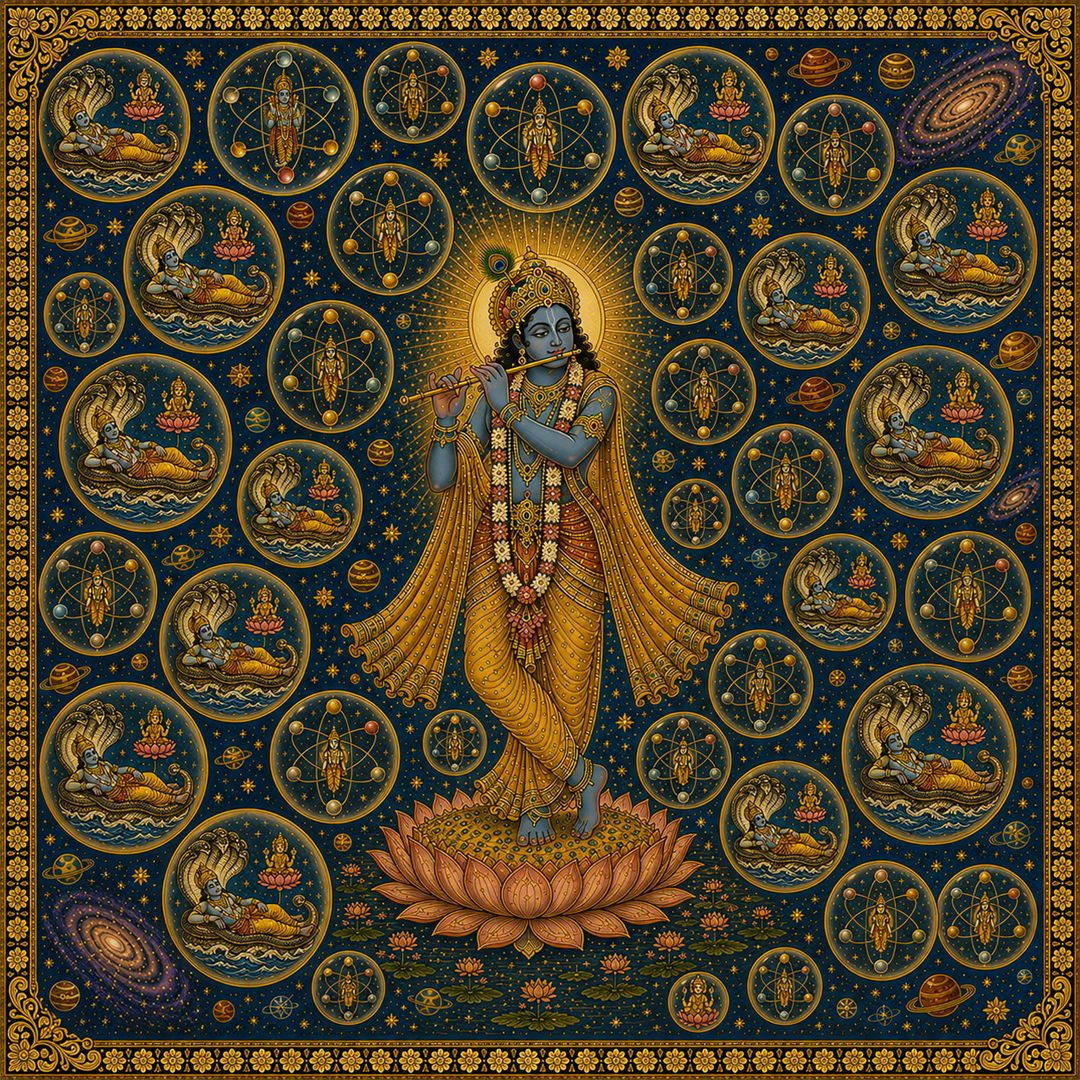
एकोऽप्यसौ रचयितुं जगदण्डकोटिं यच्छक्तिरस्ति जगदण्डचया यदन्तः । अण्डान्तरस्थपरमाणुचयान्तरस्थं गोविन्दमादिपुरुषं तमहं भजामि ॥ ३५ ॥
eko ‘py asau racayituṁ jagad-aṇḍa-koṭiṁ
yac-chaktir asti jagad-aṇḍa-cayā yad-antaḥ
aṇḍāntara-stha-paramāṇu-cayāntara-sthaṁ
govindam ādi-puruṣaṁ tam ahaṁ bhajāmi
I worship Govinda, the primeval Lord. Although He is one, He has the potency to create millions of universes. Multitudes of universes exist within Him, and He is present within every universe and within every atom.
ekaḥ api—although one; asau—He; racayitum—to create; jagad-aṇḍa-koṭim—millions of universes; yat-śaktiḥ asti—who possesses the potency; jagad-aṇḍa-cayāḥ—the multitudes of universes; yat-antaḥ—within whom; aṇḍa-antara-stha—situated within each universe; paramāṇu-caya-antara-stham—situated within every aggregate of atoms; govindam—Govinda; ādi-puruṣam—the primeval Lord; tam—Him; ahaṁ bhajāmi—I worship.
Dig-darśinī-ṭīkā
Śrī Jīva Gosvāmī
The verse beginning eko ‘py asau is explained by the following account in the Tenth Canto of the Śrīmad-Bhāgavatam (10.13.46):
tāvat sarve vatsa-pālāḥ paśyato ‘jasya tat-kṣaṇāt
vyadṛśyanta ghana-śyāmāḥ pīta-kauśeya-vāsasaḥ
“Then, while Brahmā was watching, all the cowherd boys and calves immediately appeared as dark-blue forms dressed in yellow silk.”
This occurred because within those very cowherd boys and calves were included the presiding puruṣas together with the complete arrangements of innumerable universes.
The phrase jagad-aṇḍa-cayāḥ, “the aggregates of universes”, is supported by statements such as na cāntar na bahir yasya, “for Him there is neither inside nor outside.” And by the Śruti: aṇor aṇīyān mahato mahīyān. “Smaller than the smallest, greater than the greatest.”
In the Tāpanī Upaniṣad it is said: yo ‘sau sarveṣu bhūteṣv āviśya bhūtāni vidadhāti sa vo hi svāmī bhavati. “He who enters all beings and sustains them is indeed your Lord.” And: yo ‘sau sarva-bhūtātmā gopāla eko devaḥ sarva-bhūteṣu gūḍhaḥ. “That Gopāla, the one Supreme Being, is the self of all beings, hidden within all beings.”
Brahma-saṁhitā-prakāśinī
Śrīla Bhaktivinoda Ṭhākura
Verse 35
I worship Govinda, the primeval Lord. Because potency and the possessor of potency are nondifferent, He is one truth. His potency is inseparably present in the work of creating millions upon millions of universes. All universes exist within Him, and at the same time He is fully present within every atom.
There is yet another quality present in Kṛṣṇa, the supreme spiritual being (cit-vastu-śreṣṭha), which is altogether unlike anything found in material existence.
By His inconceivable potency and according to His will, He creates unlimited universes. The entire world is a transformation of His potency.
His mode of existence is likewise beyond worldly experience, for the entire world of spirit and matter exists within Him, and at the same time He is fully present throughout that world, indeed within every atom.
The quality of omnipresence is merely one aspect of Kṛṣṇa’s majesty. Yet although He is all-pervading, His being fully present everywhere while remaining in His medium-sized form is His transcendental spiritual opulence.
By this reasoning, the doctrine of simultaneous inconceivable difference and non-difference (acintya-bhedābheda-tattva) is established, and all erroneous doctrines such as Māyāvāda are refuted.
Annotations
Bhakti Gauravani Goswami
In the purport to Śrīmad-Bhāgavatam 10.13.47, Śrīla Prabhupāda explains:
All the Viṣṇu forms had four arms, with conchshell and other articles, but these characteristics are also possessed by those who have attained sārūpya-mukti in Vaikuṇṭha and who consequently have forms exactly like the form of the Lord. However, these Viṣṇu forms appearing before Lord Brahmā also possessed the mark of Śrīvatsa and the Kaustubha gem, which are special characteristics possessed only by the Supreme Lord Himself. This proves that all these boys and calves were in fact directly expansions of Viṣṇu, the Personality of Godhead, not merely His associates of Vaikuṇṭha. Viṣṇu Himself is included within Kṛṣṇa. All the opulences of Viṣṇu are already present in Kṛṣṇa, and consequently for Kṛṣṇa to demonstrate so many Viṣṇu forms was actually not very astonishing.
In a later purport (Verse 57), Prabhupāda says:
Brahmā was mystified about Kṛṣṇa’s opulence (nija-mahimani) because this opulence was atarkya, or inconceivable. With one’s limited senses, one cannot argue about that which is inconceivable. Therefore the inconceivable is called acintya, that which is beyond cintya, our thoughts and arguments. Acintya refers to that which we cannot contemplate but have to accept. Śrīla Jīva Gosvāmī has said that unless we accept acintya in the Supreme, we cannot accommodate the conception of God. This must be understood. Therefore we say that the words of śāstra should be taken as they are, without change, since they are beyond our arguments. Acintyāḥ khalu ye bhāvā na tāṁs tarkeṇa yojayet: “That which is acintya cannot be ascertained by argument.” People generally argue, but our process is not to argue but to accept the Vedic knowledge as it is. When Kṛṣṇa says, “This is superior, and this is inferior,” we accept what He says. It is not that we argue, “Why is this superior and that inferior?” If one argues, for him the knowledge is lost.