 Spiritual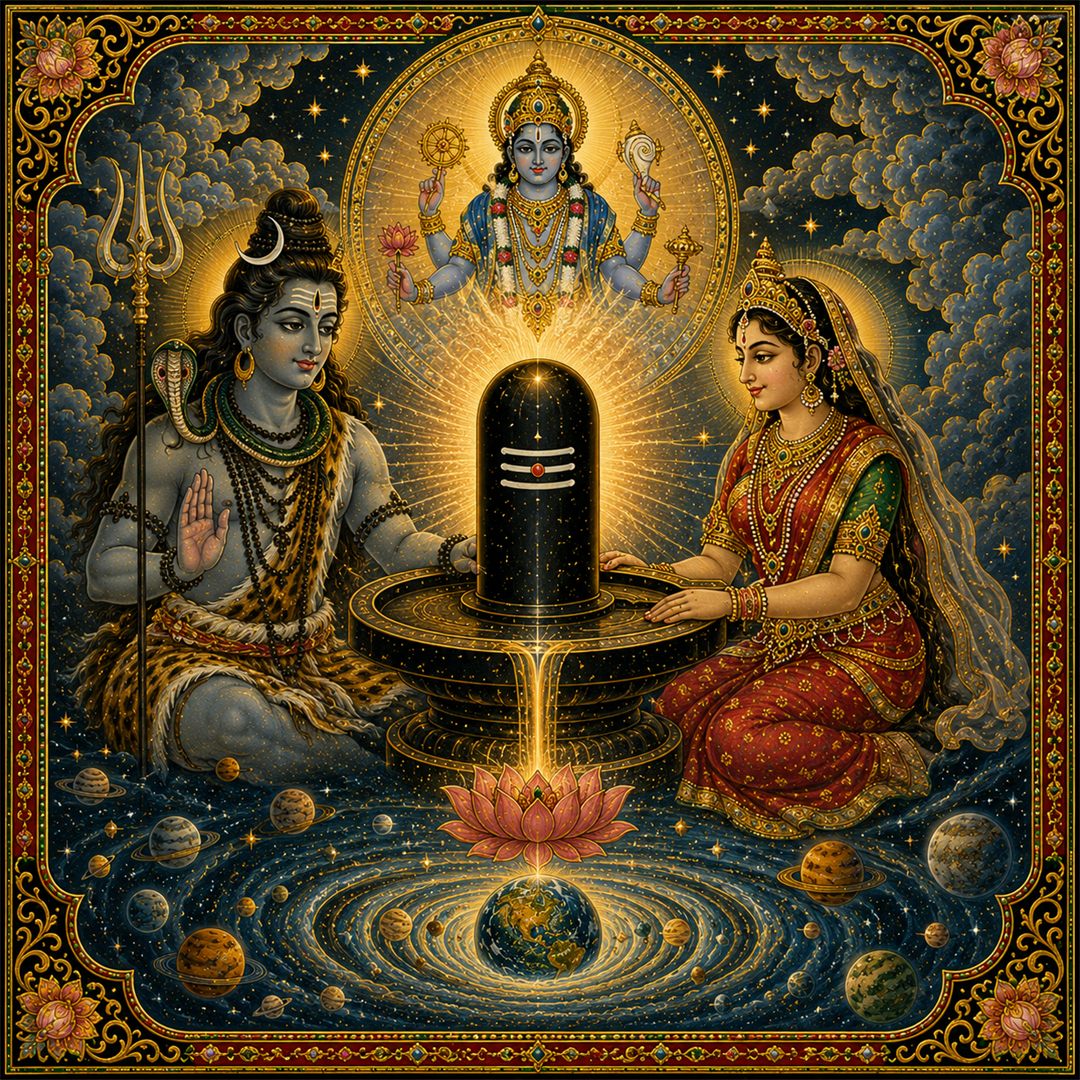
शक्तिमान्पुरुषः सोऽयं लिङ्गरूपी महेश्वरः ।
तस्मिन्नाविरभूल्लिङ्गे महाविष्णुर्जगत्पतिः ॥ १० ॥
śaktimān puruṣaḥ so ‘yaṁ liṅga-rūpī maheśvaraḥ
tasminn āvirabhūl liṅge mahā-viṣṇur jagat-patiḥ
This potent Puruṣa, endowed with potency, is Maheśvara in the form of the liṅga. Within that liṅga, Mahā-Viṣṇu, the Lord of the universe, became manifest.
śaktimān— endowed with potency; puruṣaḥ—the Puruṣa; saḥ ayam—that very one; liṅga-rūpī—assuming the form of the liṅga, the generative principle; maheśvaraḥ—Maheśvara; tasmin liṅge—within that liṅga; āvirabhūt—became manifest; mahā-viṣṇuḥ—Mahā-Viṣṇu; jagat-patiḥ—the Lord of the universe.
Dig-darśinī-ṭīkā
Jīva Gosvāmī
In the first half of this verse, beginning with śaktimān, the same point is restated. Then, in the second half, beginning with tasmin, Brahmā explains that within that liṅga the previously described unmanifest form reappears in manifest form. Therefore, even that portion of Him which assumes the form of the liṅga and produces the material world is called the puruṣa endowed with potency, Maheśvara.
Thereafter, when that liṅga has developed as far as the subtle elements, Mahā-Viṣṇu Himself, of whom that liṅga is a portion, appears within it in manifest form. For He alone is the Lord of the universe, the master of all worlds and of all living beings, higher and lower.
Brahma-saṁhitā-prakāśinī
Bhaktivinoda Ṭhākura
Verse 10
Śambhu, Maheśvara in the form of the liṅga and the Puruṣa embodying the material cause, is endowed with potency in the form of Māyā, the instrumental cause.1 Mahā-Viṣṇu, the Lord of the universe, manifests within him through the aspect of His glance.
In the supreme spiritual sky, which is predominated by spiritual opulence, Śrī Nārāyaṇa, who is non-different from Kṛṣṇa, eternally resides. Mahā-Saṅkarṣaṇa, belonging to His vyūha manifestation, is likewise a portion of Śrī Kṛṣṇa’s vilāsa-vigraha, His pastime form.
By the power of His spiritual potency, He eternally reclines in one of His portions within the Virajā River, the boundary between the spiritual and material worlds. At the time of creation, He casts His glance from there upon the distant, shadow-like māyā-śakti.2
At that time, Śambhu—the lord of pradhāna, composed of material potency, appearing as Rudra, and forming a reflected semblance of that spiritual glance—associates with Māyā, the instrumental cause. Yet without the influence of Mahā-Viṣṇu, Kṛṣṇa’s direct spiritual power, he can accomplish nothing.
Therefore, only when Mahā-Viṣṇu, the original avatāra, a portion of Kṛṣṇa through Mahā-Saṅkarṣaṇa, bestows His favor does the mahat-tattva arise through the combined activity of māyā, the instrumental potency, and pradhāna, the material cause.
By the favor of Mahā-Viṣṇu, Śiva-śakti gradually produces false ego, the five gross elements beginning with ether, the subtle sense objects, and the material senses of the living beings.
The living entities are particles of the rays emanating from Mahā-Viṣṇu. This will be explained later.
Annotations
Bhakti Gauravani Goswami
In this verse, Jīva Gosvāmī carefully distinguishes between Śambhu and Mahā-Viṣṇu. Śambhu functions as the liṅga-principle involved in material creation, but he is not independent. Mahā-Viṣṇu remains the immediate source of the potency by which creation takes place. Thus the ācāryas describe Śambhu as participating in the creation of the material world, while simultaneously affirming that the creative energy originates in Mahā-Viṣṇu. Śambhu acts, but it is Mahā-Viṣṇu who empowers his actions.
Bhaktivinoda Ṭhākura further explains that Śambhu represents the material cause (upādāna-kāraṇa), while Māyā represents the instrumental cause (nimitta-kāraṇa). Material creation unfolds through the interaction of these two principles, yet neither can function apart from the influence of Mahā-Viṣṇu. The appearance of the mahat-tattva, the first stage of cosmic manifestation, occurs only when Mahā-Viṣṇu casts His glance upon material nature. A detailed explanation of this process is given in the Śrī Caitanya-caritāmṛta, Ādi-līlā, Chapter 6, Verses 14–17.
Notes
- See Annotations for further clarification. ↩
- On one side of the river Virajā is the effulgence of Brahmaloka and innumerable Vaikuṇṭha planets, and on the other side is this material world. It is to be understood that this side of the Virajā River is filled with material planets floating in the Causal Ocean. (Cc. Madhya 15.172, pp) ↩