 Spiritual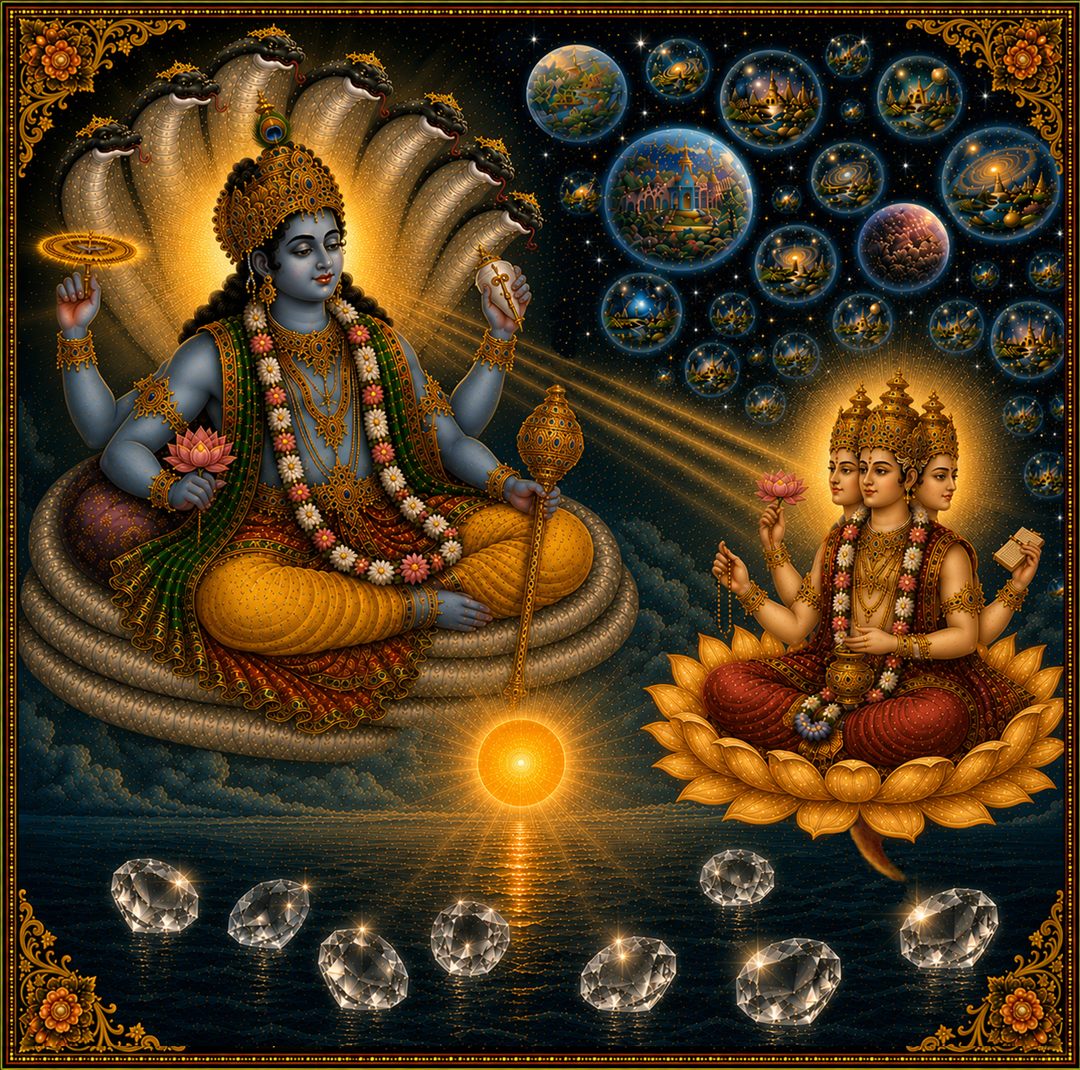
भास्वान्यथाश्मशकलेषु निजेषु तेजः । स्वीयं कियत्प्रकटयत्यपि तद्वदत्र ।
ब्रह्मा य एष जगदण्डविधानकर्ता । गोविन्दमादिपुरुषं तमहं भजामि ॥ ४९ ॥
bhāsvān yathāśma-śakaleṣu nijeṣu tejaḥ
svīyaṁ kiyat prakaṭayaty api tadvad atra
brahmā ya eṣa jagad-aṇḍa-vidhāna-kartā
govindam ādi-puruṣaṁ tam ahaṁ bhajāmi
I worship Govinda, the primeval Lord, who manifests a small portion of His splendor in this Brahmā, the engineer of the universe, just as the Sun manifests a portion of its light in sūryakānta gems.
bhāsvān—the Sun; yathā—just as; aśma-śakaleṣu—in fragments of stone; nijeṣu—belonging to itself; tejaḥ svīyam—its radiance; kiyat prakaṭayati—manifests to a small degree; api—indeed; tadvat atra—similarly here; brahmā—Brahmā; yaḥ eṣaḥ—this one who; jagad-aṇḍa-vidhāna-kartā—the engineer of the universe; govindam—Govinda; ādi-puruṣam—the primeval Lord; tam—Him; ahaṁ bhajāmi—I worship.
Dig-darśinī-ṭīkā
Śrī Jīva Gosvāmī
Having thus shown that Durgā and the others depend upon Govinda, Brahmā now turns, in due sequence, to his own position and clearly establishes that he is a jīva, entirely distinct from the Lord. Thus the verse begins: bhāsvān iti. Just as the radiant Sun manifests a small measure of its own light in a precious stone known as sūryakānta, traditionally associated with the Sun, and through that concentrated light produces effects such as burning, so Govinda manifests a small measure of His splendor in a particular jīva1
By means of that manifested portion of divine power, the Lord acts through Brahmā as the engineer of a universe, the creator of the secondary creation (vyaṣṭi-sṛṣṭi).
Alternatively, Mahā-Brahmā himself may be the one described here, and Mahā-Śiva should also be understood as indicated by him.
Therefore it is entirely appropriate that they are described as creators of the universes.
Although Māyā, known as Durgā, acts as the servant of Kāraṇārṇavaśāyī Viṣṇu, and although Brahmā, Viṣṇu, and the others are avatāras of Garbhodakaśāyī Viṣṇu, they are nevertheless counted as dependent upon Govinda because He is the support of all.
The same principle should be understood in the verses that follow.
Brahma-saṁhitā-prakāśinī
Śrīla Bhaktivinoda Ṭhākura
Verse 49
I worship that primeval Lord Govinda, from whom Brahmā, a separated expansion (vibhinnāṁśa), receives his power and thereby arranges the affairs of the universe, just as the Sun manifests a portion of its own brilliance within sūryakānta gems and similar jewels.
There are two kinds of Brahmā. In some creations, when a suitable jīva receives an empowerment (āveśa) of the Lord’s potency, that jīva becomes Brahmā and carries out the work of universal creation.
In some kalpas, when no such qualified living being is available and the Brahmā of the previous creation has attained liberation, Kṛṣṇa Himself creates Brahmā, the guṇāvatāra presiding over the mode of passion, through a division of His potency.
In principle, Brahmā is superior to ordinary living beings, but he is not directly the Supreme Lord. Śambhu, described previously, possesses a greater measure of lordship (īśvaratva) than Brahmā.
The essential conclusion is this: Brahmā possesses the fifty qualities found in ordinary living beings in a greater degree, together with a partial manifestation of five additional qualities. In Śambhu those same fifty qualities, along with those five additional qualities, are present in a still greater measure.
Annotations
Bhakti Gauravani Goswami
Generally, Brahmā is an empowered jīva entrusted with the work of secondary creation within a universe. However, when no qualified jīva is available to occupy that post, the Supreme Lord Himself assumes the function of Brahmā. Thus Scripture sometimes describes Brahmā as a jīva and at other times as a direct manifestation of the Lord. The distinction depends upon the particular universe and cosmic cycle under consideration.
Śrīla Prabhupāda explains this in the purport to SB 1.3.5 as follows:
There are guṇāvatāras such as Brahmā, Viṣṇu, and Śiva who take charge of the different modes of material nature.
Lord Viṣṇu is nondifferent from the Personality of Godhead. Lord Śiva is in the marginal position between the Personality of Godhead and the living entities, or jīvas. Brahmā is always a jīva-tattva. The highest pious living being, or the greatest devotee of the Lord, is empowered with the potency of the Lord for creation, and he is called Brahmā. His power is like the power of the Sun reflected in valuable stones and jewels. However, when there is no such living being to take charge of the post of Brahmā, the Lord Himself becomes a Brahmā and takes charge of the post.
Thus Brahmā’s creative power is never independent. Whether the post is occupied by an empowered jīva or, in exceptional cases, by the Lord Himself, the work of creation is ultimately carried out by Govinda’s potency, just as the brilliance of a sunstone is a manifestation of the Sun’s own light.
Notes
- Sūryakānta, literally “beloved of the Sun,” is the traditional sun-crystal, a transparent stone believed to concentrate the Sun’s rays and thereby produce heat or ignite dry tinder. Jīva Gosvāmī describes such stones as “always belonging to the Sun” because their distinctive power becomes manifest through sunlight. ↩