 Spiritual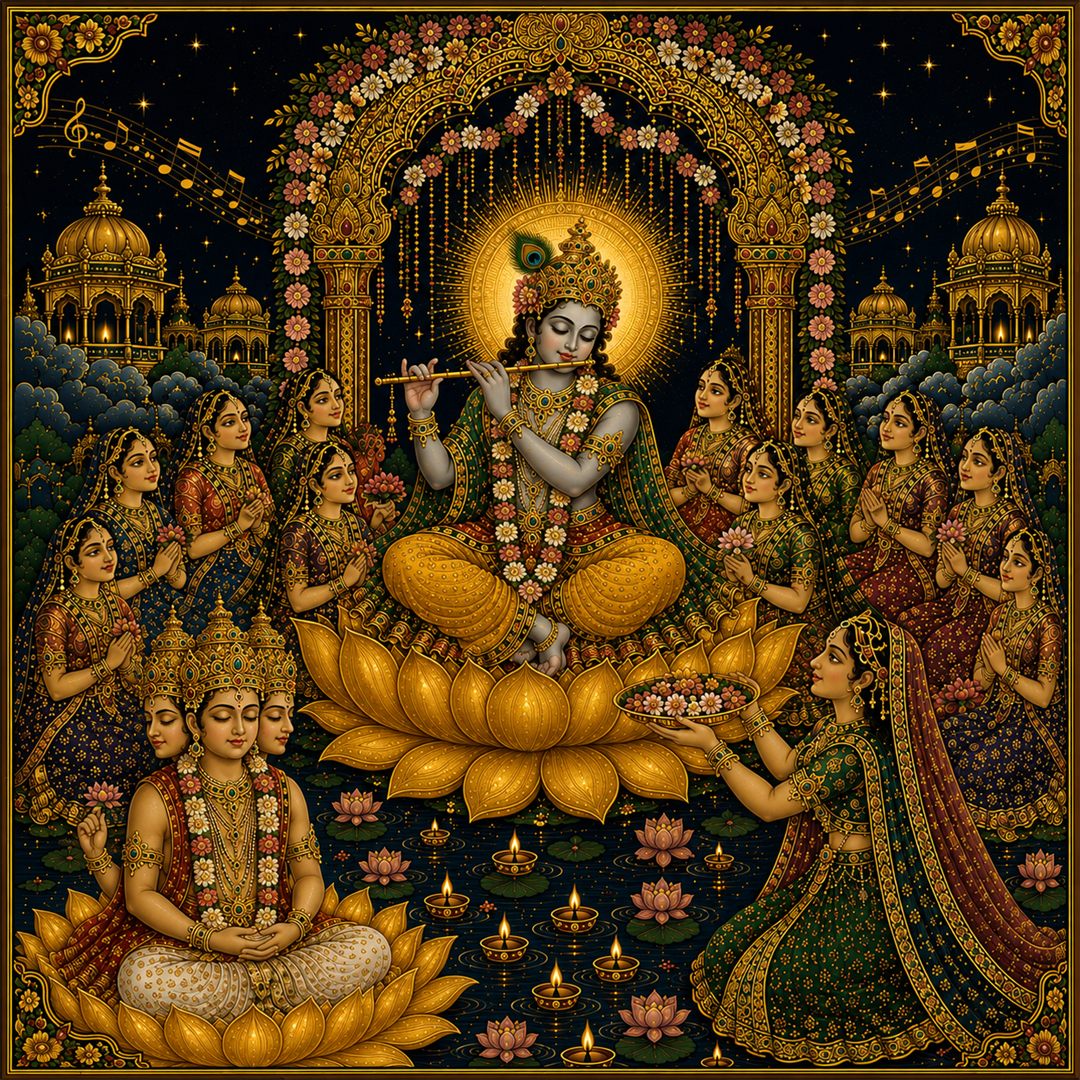
अथ तेपे स सुचिरं प्रीणन् गोविन्दमव्ययम् ।
श्वेतद्वीपपतिं कृष्णं गोलोकस्थं परात्परम् ।
प्रकृत्या गुणरूपिण्या रूपिण्या पर्युपासितम् ।
सहस्रदलसम्पन्ने कोटिकिञ्जल्कबृंहिते ।
भूमिश्चिन्तामणिस्तत्र कर्णिकारे महासने ।
समासीनं चिदानन्दं ज्योतिरूपं सनातनम् ।
शब्दब्रह्ममयं वेणुं वादयन्तं मुखाम्बुजे ।
विलासिनीगणवृतं स्वैः स्वैरंशैरभिष्टुतम् ॥ २६ ॥
atha tepe sa suciraṁ prīṇan govindam avyayam
śvetadvīpa-patiṁ kṛṣṇaṁ goloka-sthaṁ parāt param
prakṛtyā guṇa-rūpiṇyā rūpiṇyā paryupāsitam
sahasra-dala-sampanne koṭi-kiñjalka-bṛṁhite
bhūmiś cintāmaṇis tatra karṇikāre mahāsane
samāsīnaṁ cid-ānandaṁ jyotirūpaṁ sanātanam
śabda-brahma-mayaṁ veṇuṁ vādayantaṁ mukhāmbuje
vilāsinī-gaṇa-vṛtaṁ svaiḥ svair aṁśair abhiṣṭutam
atha—then; tepe—he practiced austerity; saḥ—he, Brahmā; suciram—for a long time; prīṇan—pleasing, seeking to please; govindam—Govinda; avyayam—imperishable; śvetadvīpa-patim—the Lord of Śvetadvīpa; kṛṣṇam—Kṛṣṇa; goloka-stham—situated in Goloka; parāt param—supreme beyond the supreme; prakṛtyā—by material nature; guṇa-rūpiṇyā—whose form consists of the guṇas; rūpiṇyā—personified, possessing form; paryupāsitam—worshiped from all sides; sahasra-dala-sampanne—endowed with a thousand petals; koṭi-kiñjalka-bṛṁhite—adorned and expanded with millions of filaments; bhūmiḥ cintāmaṇiḥ—the ground is cintāmaṇi; tatra—there; karṇikāre—within the pericarp; mahā-āsane—upon a great seat; samāsīnam—seated; cit-ānandam—of the nature of consciousness and bliss; jyotirūpam—whose form is effulgence; sanātanam—eternal; śabda-brahma-mayam—composed of transcendental sound; veṇum—the flute; vādayantam—playing; mukha-ambuje—with His lotus mouth; vilāsinī-gaṇa-vṛtam—surrounded by a company of playful women; svaiḥ svaiḥ aṁśaiḥ—by His own respective expansions; abhiṣṭutam—praised.
Then Brahmā practiced austerity for a long time, seeking to please the imperishable Govinda, the Lord of Śvetadvīpa, Kṛṣṇa, situated in Goloka and supreme beyond the supreme, who is worshiped from all sides by personified material nature, whose form consists of the guṇas.
There, upon a ground of cintāmaṇi, within the pericarp of a lotus endowed with a thousand petals and adorned with millions of filaments, He sat upon a great throne.
Eternal and of the nature of consciousness and bliss, His form composed of effulgence, He played a flute composed of transcendental sound with His lotus mouth. He was surrounded by a company of playful women and praised by His own expansions.
Dig-darśinī-ṭīkā
Jīva Gosvāmī
Through that mantra, and in accordance with his particular desire, Brahmā worshiped Śrī Govinda as endowed with the specific potency required for creation, situated upon the sacred seat known as Gokula, and according to the hymn to be given later. This is described in the four stanzas beginning with atha tepe.
The term guṇa-rūpiṇyā means “whose nature consists of the modes of goodness, passion, and ignorance.” Rūpiṇyā means “possessing a form.” Paryupāsitam means “worshiped from all sides,” referring to personified Māyā, who, remaining outside that realm, worships Him through meditation and other forms of adoration.
Thus the Śrīmad-Bhāgavatam states: māyā parety abhimukhe ca vilajjamānā. “Māyā withdraws, ashamed to appear before Him.” It is also stated: balim udvahanti samadanty ajayānimiṣāḥ. “Together with Māyā, the demigods carry tribute to You and rejoice.”
The word aṁśaiḥ means here “by associates situated in the surrounding enclosures.”
Brahma-saṁhitā-prakāśinī
Bhaktivinoda Ṭhākura
Verse 26
Seeking to please Govinda, Brahmā performed austerity for a long time, meditating upon Kṛṣṇa, Lord of Śvetadvīpa, who resides in Goloka. His meditation was as follows:
Upon a ground composed of cintāmaṇi stands a lotus possessing a thousand petals and adorned with millions of filaments. Within its pericarp stands a great throne. Upon that throne sits eternal Śrī Kṛṣṇa, whose nature is spiritual consciousness, bliss, and effulgence.
At His lotus mouth He plays a flute composed of transcendental sound (śabda-brahma). He is surrounded by playful gopīs and praised by His own associates residing in the surrounding enclosures of His abode. Personified material nature (prakṛti), whose forms consist of the guṇas, worships Him from outside.
Although the object of meditation is entirely spiritual, Māyā, the external potency whose nature is associated with the mode of passion and who assumes forms such as Durgā composed of the three guṇas, worshipfully meditates upon Kṛṣṇa from outside.
As long as material desires remain within the heart, one should worship the Lord whom Māyā-devī herself worships. One should not worship Māyā-devī independently, for her worshipable Lord alone possesses the power to fulfill every aspiration. Thus the statement of the Śrīmad-Bhāgavatam (2.3.10) says:
akāmaḥ sarva-kāmo vā mokṣa-kāma udāra-dhīḥ
tīvreṇa bhakti-yogena yajeta puruṣaṁ param
“Whether free from desire, full of desires, or desiring liberation, an intelligent person should worship the Supreme Person with intense devotional service.”
The meaning is that, although the various demigods, as manifestations of the Lord’s opulence, may bestow particular results, a truly wise person does not worship them independently. He worships the Supreme Lord Himself, who possesses the power to bestow every result.
Accordingly, Brahmā meditated from afar upon Kṛṣṇa, who enjoys His pastimes in Goloka and is the worshipable Lord even of Māyā-devī.
Pure devotional service free from all ulterior desire (anyābhilāṣitā-śūnyā) is called desireless devotional service (niṣkāma-bhakti). The devotional service of Brahmā and others, however, belongs to the category of devotion mixed with desire (sakāma-bhakti). Even within such devotional service, a form of relative selflessness may be present. This subject is explained more fully in the final five verses of the Brahma-saṁhitā. Until the conditioned soul attains realization of its true spiritual identity (svarūpa-siddhi), such worship (bhajana) remains a suitable form of devotional practice.