 Spiritual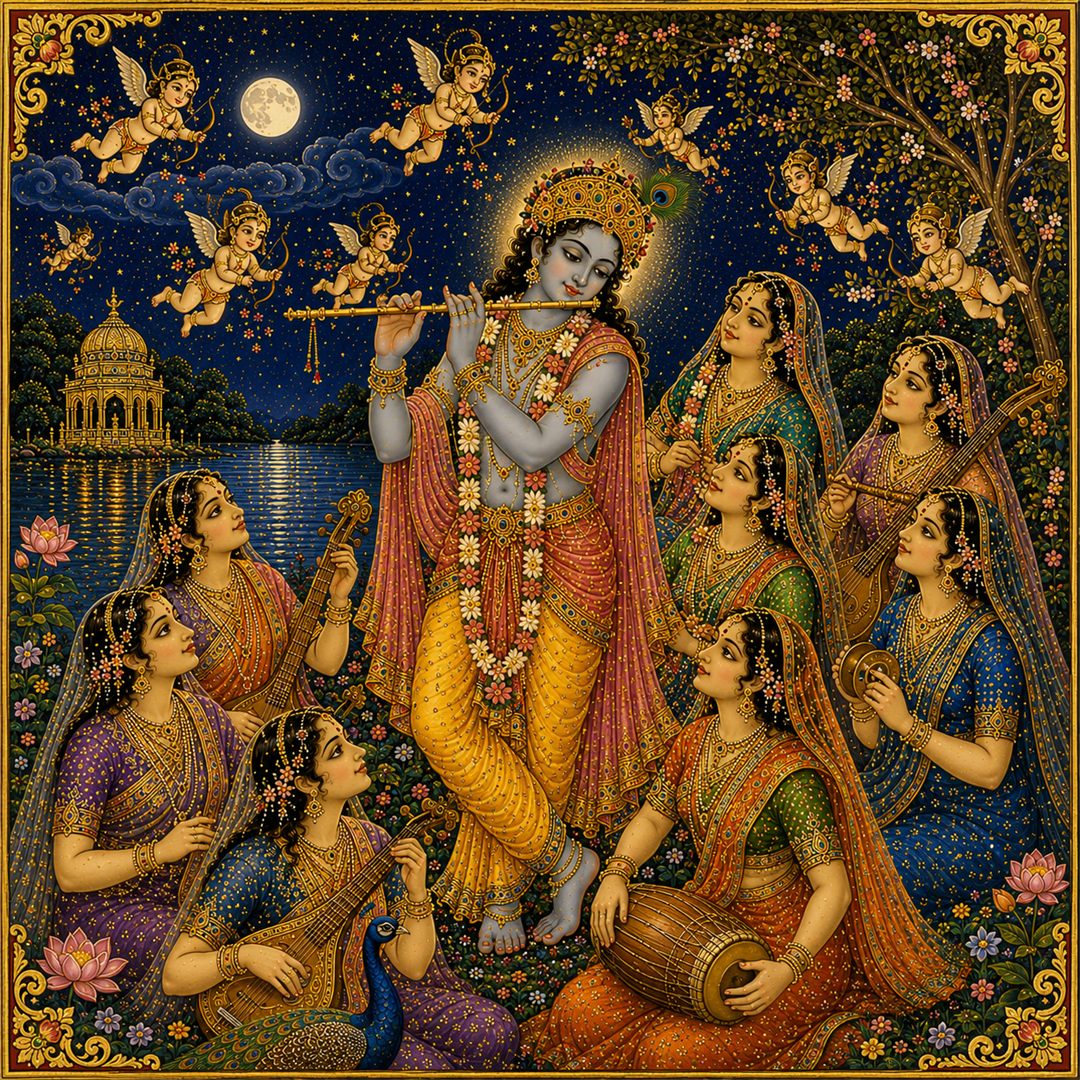
वेणुं क्वणन्तमरविन्ददलायताक्षं बर्हावतंसमसिताम्बुदसुन्दराङ्गम् । कन्दर्पकोटिकमनीयविशेषशोभं गोविन्दमादिपुरुषं तमहं भजामि ॥ ३०॥
veṇuṁ kvaṇantam aravinda-dalāyatākṣam
barhāvataṁsam asitāmbuda-sundarāṅgam
kandarpa-koṭi-kamanīya-viśeṣa-śobhaṁ
govindam ādi-puruṣaṁ tam ahaṁ bhajāmi
I worship Govinda, the primeval Lord, who plays upon His flute, whose elongated eyes resemble lotus petals, whose head is adorned with a peacock feather, whose beautiful form resembles a dark raincloud, and whose unique beauty enchants millions of Kandarpas.
veṇum—the flute; kvaṇantam—playing, causing to resound; aravinda-dala—like the petals of a lotus; āyata—elongated; akṣam—whose eyes; barha—a peacock feather; avataṁsam—whose ornament; asita-ambuda—like a dark raincloud; sundara-aṅgam—whose bodily form is beautiful; kandarpa-koṭi—millions of Kandarpas (Kandarpa, or Kāmadeva, is the Vedic god of love, equivalent to the Western Cupid); kamanīya—charming, enchanting; viśeṣa-śobham—whose beauty is unique; govindam—Govinda; ādi-puruṣam—the primeval Lord; tam—Him; aham—I; bhajāmi—worship, adore.
Dig-darśinī-ṭīkā
Śrī Jīva Gosvāmī
Having described the pastimes situated in the extraordinary abode known as Gokula, composed of cintāmaṇi palaces, in accordance with the statement to be given later, “speech is song and movement is dance,” Brahmā now describes the līlā of the second pīṭha. As described in the Bṛhad-dhyāna and similar meditations, the Lord remains there in one place, without walking or other movement.
In the verse beginning with veṇum, everything is clear.
Annotations 1
Bhakti Gauravani Goswami
Bṛhad-dhyāna, literally “the great meditation,” appears to refer more fully to the Bṛhad-dhyāna-ratnābhiṣeka section of the Krama-dīpikā. Vaiṣṇava authors cite it as an example of mantropāsanāmayī-līlā, a meditative method centered upon a particular mantra and fixed in the place appropriate to a particular pastime.
Jīva Gosvāmī contrasts this manifestation, in which Govinda remains in one place, with the dynamic pastimes of Gokula, where He moves from one place to another. Yet remaining in one place does not mean remaining inactive. Even while Govinda remains there, He is always playing His flute, as indicated by the words veṇuṁ kvaṇantam.
Brahma-saṁhitā-prakāśinī
Śrīla Bhaktivinoda Ṭhākura
I worship Govinda, the primeval Lord, who is absorbed in playing upon His flute, whose eyes resemble fully blossomed lotus petals, whose head is adorned with a peacock-feather ornament, whose beautiful form resembles a fresh raincloud, and whose unique splendor enchants millions of Kandarpas.
(The incomparable beauty of Kṛṣṇa, the supreme beloved of Goloka, is now being described.)
Kṛṣṇa, the infinite conscious reality, possesses an entirely spiritual form by His very nature. His form is not an imagination projected from the beautiful objects of this material world. Rather, Brahmā describes here what he beholds in the spiritual trance of devotion.
Kṛṣṇa is absorbed in flute-playing. The charming sound of His flute steals the hearts of all conscious beings.
Just as lotus petals convey softness, Kṛṣṇa’s two eyes, through which spiritual vision shines forth (cid-dṛṣṭi-prakāśa-rūpa), unfold the boundless beauty of His moonlike face.
The peacock-feather ornament upon His head enhances the spiritual beauty of His form.
Just as a dark raincloud appears pleasing to the eye, Kṛṣṇa’s complexion is transcendently dark and beautiful.
Even if one could behold or imagine the beauty of millions upon millions of Kandarpas within this material world gathered together, Kṛṣṇa’s form would still be more enchanting.
Annotations 2
Bhakti Gauravani Goswami
Having described the spiritual environment of Goloka in the previous verse, Brahmā now turns his attention to the central figure of that realm, Śrī Kṛṣṇa Himself.
It is noteworthy that he does not begin his description by expounding Kṛṣṇa’s power, omniscience, or majesty. Instead, he describes His beauty. This reflects a central conclusion of Gauḍīya Vaiṣṇava philosophy: the most complete and perfect revelation of the Absolute is found not in awe-inspiring greatness, but in supreme sweetness and irresistible charm. Indeed, the name Kṛṣṇa signifies “the all-attractive one.” His unique beauty enchants even millions of Kandarpas, gods of love, who are celebrated throughout the three worlds for their ravishing beauty.
Bhaktivinoda Ṭhākura’s rendering brings out a further nuance. Kṛṣṇa’s beauty does not merely surpass that of Kandarpa, but enchants Kandarpa himself. Kandarpa, also known as Kāmadeva or Madana, is the Vedic demigod associated with amorous attraction and the generative impulse. Kṛṣṇa therefore says in the Bhagavad-gītā (10.28): prajanaś cāsmi kandarpaḥ. “Of causes for procreation I am Kandarpa, the god of love.” Among the forces leading to procreation, Kandarpa represents Kṛṣṇa’s divine potency.
The name Madana literally means “he who intoxicates or bewilders the mind,” because Madana’s influence enchants all embodied beings. But Kṛṣṇa’s beauty is so captivating that it enchants even Madana. Therefore Kṛṣṇa is also known as Madana-mohana, “He who enchants Madana.”
In the Vedic literature Kāmadeva is often depicted carrying a sugarcane bow strung with bees and shooting flower arrows that awaken sensual attraction. A rough Western equivalent is Cupid, who is likewise portrayed carrying a bow and shooting arrows that awaken attraction.
The flute occupies a special place in Kṛṣṇa’s pastimes. Unlike the weapons and emblems borne by Nārāyaṇa—disc, club, conch, and lotus—which express divine majesty, sovereignty, and protection, the flute belongs wholly to the intimate sweetness of Kṛṣṇa’s pastimes in Vṛndāvana. It is purely an instrument of enchantment.
Through the sound of His flute, Kṛṣṇa calls the cows, charms His friends, captivates the hearts of the gopīs, and awakens love for Him within all living creatures. Thus the flute manifests the Lord’s supreme attractive potency, by which He draws all living beings toward a loving relationship with Himself.