 Spiritual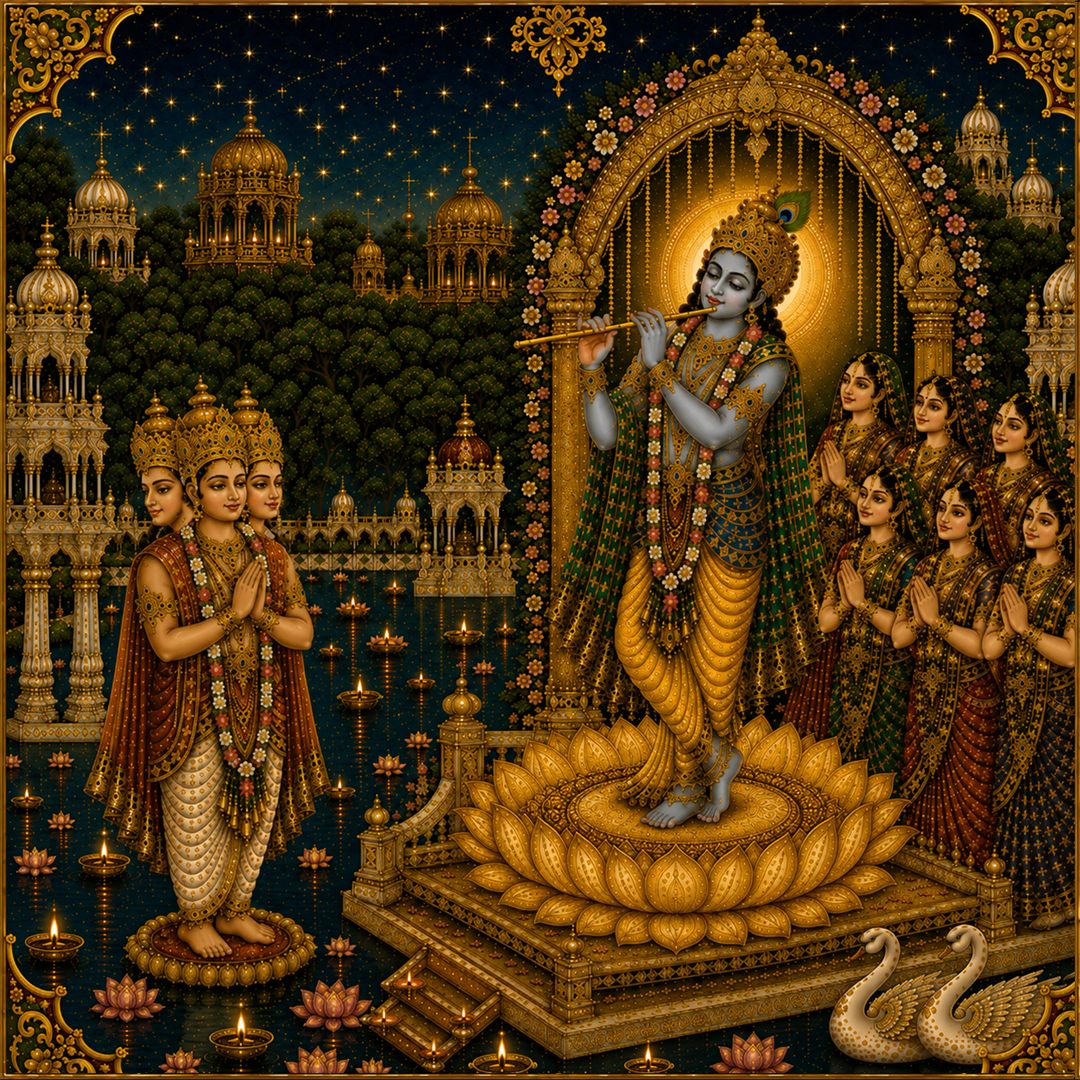
त्रय्या प्रबुद्धोऽथ विधिर्विज्ञाततत्त्वसागरः ।
तुष्टाव वेदसारेण स्तोत्रेणानेन केशवम् ॥ २८ ॥
trayyā prabuddho ‘tha vidhir vijñāta-tattva-sāgaraḥ
tuṣṭāva veda-sāreṇa stotreṇānena keśavam
Then Brahmā, awakened by the threefold Veda and having fathomed the ocean of truth, praised Keśava with the following hymn, the essence of the Vedas.
trayyā—by the threefold Veda; prabuddhaḥ—awakened, enlightened; atha—then; vidhiḥ—Brahmā; vijñāta-tattva-sāgaraḥ—having fathomed the ocean of truth; tuṣṭāva—praised; veda-sāreṇa—constituting the essence of the Vedas; stotreṇa anena—with this hymn; keśavam—Keśava.
Dig-darśinī-ṭīkā
Jīva Gosvāmī
Then, having also received the threefold Veda from Govinda, Brahmā praised Him alone. This is stated in the verse beginning with trayyā. The meaning is clear.
Brahma-saṁhitā-prakāśinī
Bhaktivinoda Ṭhākura
Verse 28
Awakened by remembering that Gāyatrī, the embodiment of the three Vedas, Brahmā fathomed the ocean of truth. He then praised Śrī Kṛṣṇa with this hymn, which is the essence of the Vedas.
By remembering the Kāma-gāyatrī, Brahmā realized: āmi kṛṣṇera nitya-dāsī. “I am Kṛṣṇa’s eternal maidservant.”
Although the further mysteries concerning his identity as Kṛṣṇa’s dāsī had not yet been revealed to him, Brahmā became acquainted with the ocean of truth through inquiry into the nature of the self.
When all the truths of the Vedas became manifest within him, he composed this hymn from those statements that constitute their essence.
Because this hymn fully contains the conclusions of Vaiṣṇava philosophy, Śrī Caitanya Mahāprabhu taught it to His devotees.
Therefore, readers should recite and relish this hymn every day with the greatest care.
Annotations
Bhakti Gauravani Goswami
Verse 28 serves as a bridge between Brahmā’s experience of divine revelation and the celebrated hymn that follows. Up to this point, the text has described how Brahmā received transcendental knowledge through the Gopāla-mantra, Kāma-gāyatrī, and the grace of Śrī Kṛṣṇa. Having become spiritually awakened and established in knowledge of the fundamental truths (tattva), Brahmā now begins his glorification of Govinda.
Bhaktivinoda Ṭhākura emphasizes that the verses which follow constitute the essence of all Vedic revelation (veda-sāra). Just as the Śrīmad-Bhāgavatam is described as the galitaṁ phalam, the ripened fruit of Vedic knowledge, the Brahmā-saṁhitā is described as its essence, veda-sāra. For this reason Śrī Caitanya Mahāprabhu held the Brahma-saṁhitā in such high regard and instructed His followers to study it carefully. The remaining verses are therefore not merely poetic praise but a condensed presentation of Vaiṣṇava philosophy, cosmology, and devotional realization.
Śrīla Prabhupāda was very fond of the Cintāmaṇi Prayers, or Govinda Prayers, as he referred to these verses, all of which end with the line: govindam ādi-puruṣaṁ tam ahaṁ bhajāmi. ”I worship Govinda, the Primeval Lord.”
There are several recordings of Prabhupāda singing Brahmā’s prayers, and he frequently quoted many of the verses in his books and lectures. Two verses in particular, veṇuṁ kvaṇantam... and aṅgāni yasya..., have become among the most widely memorized verses in ISKCON after they were recorded in 1969 by the London devotees, with Yamunā-devī Dāsī leading the chanting and George Harrison arranging and producing the song. Prabhupāda appreciated this recording so much that he instructed his disciples that the song be played in ISKCON temples throughout the world during the morning greeting of the Deities.
To facilitate the singing and memorization of Brahmā’s hymn, I have undertaken the task of rendering all the verses ending in govindam ādi-puruṣaṁ tam ahaṁ bhajāmi into English. Entitled Govinda, the Primeval Lord, this song is presented at the end of the book, accompanied by an illustration for each verse.
The first sentence in Bhaktivinoda Ṭhākura`s commentary deserves clarification. He says that Brahmā, by remembering the Kāma-gāyatrī (klīṁ kāma-devāya vidmahe puṣpa-bāṇāya dhīmahi tan no ‘naṅgaḥ pracodayāt) realized his spiritual identity, his siddha-svarūpa, as an eternal maidservant of Kṛṣṇa: āmi kṛṣṇera nitya-dāsī. This statement should not be interpreted to mean that all vaiṣṇavas, in particular vaiṣṇava ācāryas belonging to the Brahmā-Madhva-Gauḍīya-sampradāya, have a female spiritual identity. Many are understood to possess such an identity, including Bhaktivinoda Ṭhākura himself and the Six Gosvāmīs, but Kṛṣṇa’s entourage is variegated, as Śrīla Prabhupāda pointed out in a lecture given in 1973 in Sweden:
Some spiritual masters are thinking of becoming assistants to the gopīs, some are thinking of becoming assistants to the cowherd boys, some are thinking of becoming assistants to Nanda and Mother Yaśodā, and some are thinking of becoming God’s servants. Some are thinking of becoming flower trees, fruit trees, calves, or cows in Vṛndāvana.
There are five kinds of mellows: śānta, dāsya, sakhya, vātsalya, and mādhurya. Everything is there in the spiritual world.
Cintāmaṇi-prakara-sadmasu. In the spiritual sky, even the land is spiritual. The trees are spiritual, the fruit is spiritual, the flowers are spiritual, the water is spiritual, the servants are spiritual, the friends are spiritual, the mothers are spiritual, the fathers are spiritual, the Lord is spiritual, and His associates are spiritual. It is all absolute, although there are varieties.
Śrī Caitanya Mahāprabhu, who also identified Himself as Kṛṣṇa’s maidservant, -taught the general understanding that we jīvas are all Kṛṣṇa’s servants, using the masculine gender (dāsa). In His teachings to Sanātana Gosvāmī, He said: ‘jīvera svarūpa’ haya—kṛṣṇera ‘nitya-dāsa’. “It is the living entity’s constitutional position to be an eternal servant of Kṛṣṇa.” (Cc. Madhya 20.108). And in His prayers to Lord Jagannātha during the Ratha-yatra festival, He said: gopī-bhartuḥ pada-kamalayor dāsa-dāsānudāsaḥ. “I identify Myself only as the servant of the servant of the servant of the lotus feet of Lord Śrī Kṛṣṇa, the maintainer of the gopīs.“ (Cc. Madhya 13.80)