 Spiritual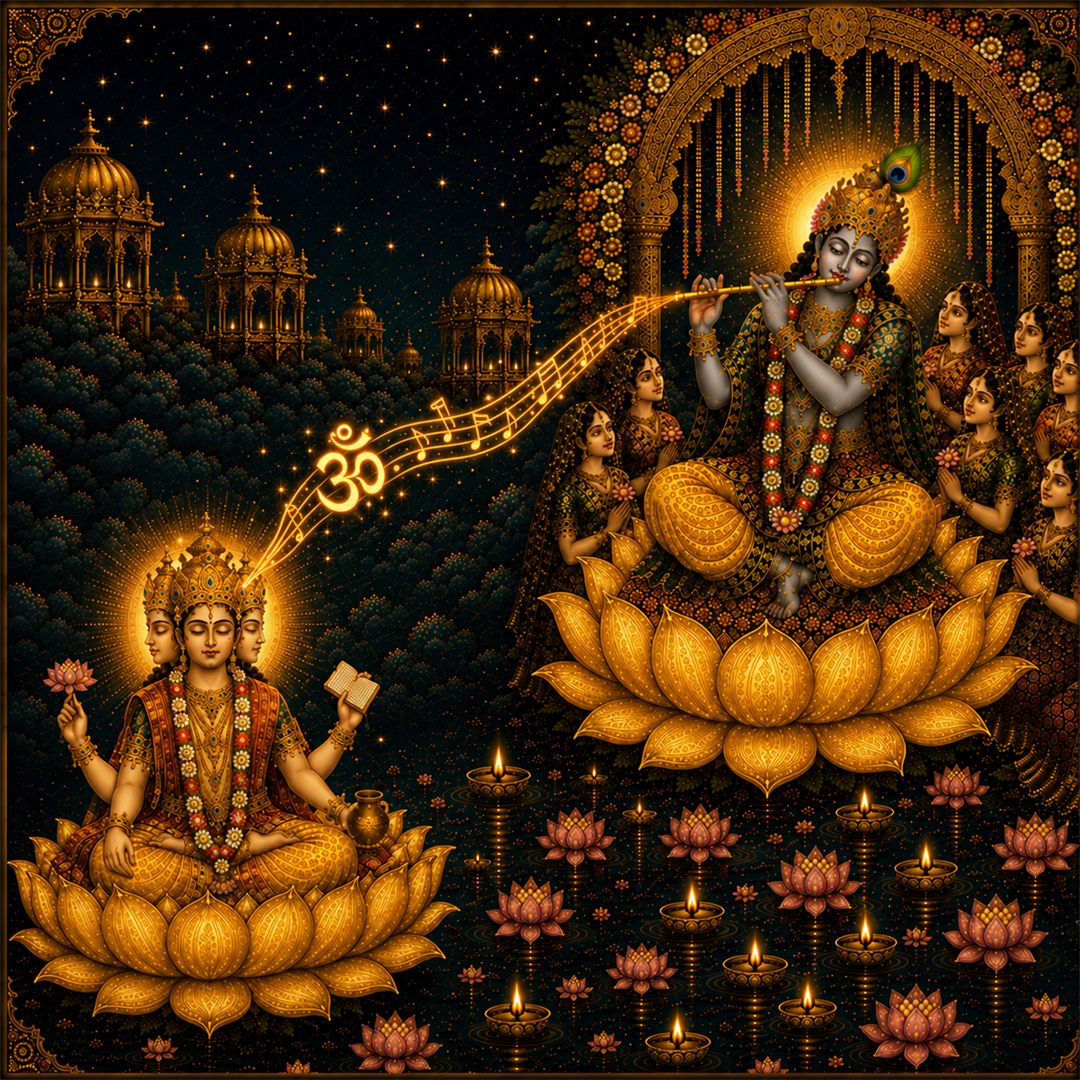
अथ वेणुनिनादस्य त्रयीमूर्तिमयी गतिः ।
स्फुरन्ती प्रविवेशाशु मुखाब्जानि स्वयम्भुवः ।
गायत्रीं गायतस्तस्मादधिगत्य सरोजजः ।
संस्कृतश्चादिगुरुणा द्विजतामगमत्ततः ॥ २७ ॥
atha veṇu-ninādasya trayī-mūrti-mayī gatiḥ
sphurantī praviveśāśu mukhābjāni svayambhuvaḥ
gāyatrīṁ gāyatas tasmād adhigatya sarojajaḥ
saṁskṛtaś cādi-guruṇā dvijatām agamat tataḥ
Then the current of the flute’s sound, embodying the threefold Veda, manifested and swiftly entered the lotus-like mouths of self-born Brahmā. Having received the Gāyatrī from Govinda as He sang it, lotus-born Brahmā was initiated by the original guru and thereafter attained the status of a twice-born.
atha—then; veṇu-ninādasya—of the sound of the flute; trayī-mūrti-mayī—embodying the form of the three Vedas; gatiḥ—the course, current, or flow; sphurantī—manifesting; praviveśa—entered; āśu—swiftly; mukha-abjāni—the lotus-like mouths; svayambhuvaḥ—of self-born Brahmā; gāyatrīm—the Gāyatrī; gāyataḥ—of Him who was singing; tasmāt—from Him; adhigatya—having received, having obtained; saroja-jaḥ—lotus-born Brahmā; saṁskṛtaḥ—sanctified; ca—and; ādi-guruṇā—by the original guru; dvijatām—the status of a twice-born; agamat—attained; tataḥ—thereafter.
Dig-darśinī-ṭīkā
Jīva Gosvāmī
Thus, only after initiation, Brahmā’s consecration as twice-born, like that of Dhruva, came from the presiding deity of the mantra whom he had worshiped. This is stated in the two stanzas comprising Verse 27, beginning with atha veṇu.
The expression trayī-mūrti-mayī indicates that the current of the flute sound consisted of Gāyatrī, the embodied form of the three Vedas. She is the mother of the Vedas, and in the second of these two stanzas she herself becomes manifest.
The word gatiḥ means “course,” “sequence,” or “flow.”
The statement mukhābjāni praviveśa, “it entered the lotus-like mouths,” means that Gāyatrī entered through Brahmā’s eight ears and then appeared in his mouths.
The phrase ādi-guruṇā means “by the original guru, Śrī Kṛṣṇa.”
In the expression sa brahmā saṁskṛtaḥ, “that Brahmā was sanctified,” Brahmā, although nominative in form, is the recipient of the action.
Brahma-saṁhitā-prakāśinī
Bhaktivinoda Ṭhākura
Verse 27
Thereafter, Gāyatrī, embodying the threefold Vedic revelation together with the sacred syllable oṁ, manifested as the melodious sound of Śrī Kṛṣṇa’s flute and swiftly entered Brahmā’s lotus-like mouths through his eight ears.
Receiving that Gāyatrī, which had arisen from Śrī Kṛṣṇa’s flute-song, lotus-born Brahmā was initiated by Bhagavān, the original guru, and thereby attained the status of a twice-born.
The sound of Kṛṣṇa’s flute is a special manifestation of eternal existence, consciousness, and bliss (sac-cid-ānanda); therefore the archetype of all the Vedas is present within it.
Gāyatrī is a Vedic meter containing both meditation and prayer in condensed form. Among all Gāyatrīs, the Kāma-gāyatrī is supreme because its meditation and prayer are entirely composed of transcendental divine pastimes (cid-vilāsa), a nature possessed by no other Gāyatrī.
The Gāyatrī received after the eighteen-syllable mantra is the Kāma-gāyatrī: klīṁ kāma-devāya vidmahe puṣpa-bāṇāya dhīmahi tan no ‘naṅgaḥ pracodayāt. This Gāyatrī indicates complete meditation upon Śrī Gopījana-vallabha, realization of His divine pastimes, and prayer for attainment of the transcendental god of love, Anaṅga.1 Within the spiritual world, no means of attaining love imbued with the highest rasa surpasses this. The moment this Gāyatrī entered Brahmā’s ear, he received the sacrament of second birth (dvijatva-saṁskāra) and began chanting that Gāyatrī.
Whoever truly receives this Gāyatrī in its essential reality likewise attains a second, transcendental birth. The ordinary twice-born status attained according to material lineage and social customs is far inferior to this spiritual second birth, through which the living entity becomes qualified to enter the transcendental realm.
Annotations
Bhakti Gauravani Goswami
A significant theme of this verse is that spiritual knowledge descends through divine sound. Brahmā does not discover the Gāyatrī by intellectual effort; he receives it through Govinda’s flute-sound. This illustrates the principle that transcendental realization arises through receptive hearing of revealed sound (śabda-brahma), not through the ascending process of study or mental speculation.
Jīva Gosvāmī also connects this event with Brahmā’s attainment of true “second birth” (dvijatva). Ordinary social initiation according to family tradition is secondary; the higher birth is the awakening of spiritual consciousness through reception of the transcendental mantra from the Lord, the original guru, or His bona fide representative.
Bhaktivinoda Ṭhākura further emphasizes that the Kāma-gāyatrī directs the soul toward the highest goal of divine love for Śrī Kṛṣṇa in Goloka. Thus the mantra is not merely a ritual formula but a revelation of the supreme object of meditation and devotion.
Regarding how Brahmā received the mantra, it should be noted that the verse literally states that Gāyatrī entered Brahmā’s “lotus mouths” (mukhābjāni), which may be surprising, since mantras and knowledge in general are received through the ears.
Jīva Gosvāmī therefore explains that the expression should be understood as referring to Brahmā’s eight ears (aṣṭabhiḥ karṇaiḥ praviveśa), since Brahmā possesses four heads. Bhaktivinoda Ṭhākura follows this understanding and explicitly states that Gāyatrī entered through Brahmā’s ear apertures and then appeared in his mouth.
This also reflects the fundamental Vedic principle that transcendental knowledge is first received through hearing (śravaṇam) before it is expressed through chanting and glorification (kīrtanam).
Notes
- Anaṅga, literally “the bodiless one,” is a name of Kāmadeva, the god of love. In the Kāma-gāyatrī, the name refers not to the material demigod of desire, but to transcendental Kāmadeva, Śrī Kṛṣṇa as Gopījana-vallabha, whose divine pastimes are the object of the mantra’s meditation and prayer. ↩