 Spiritual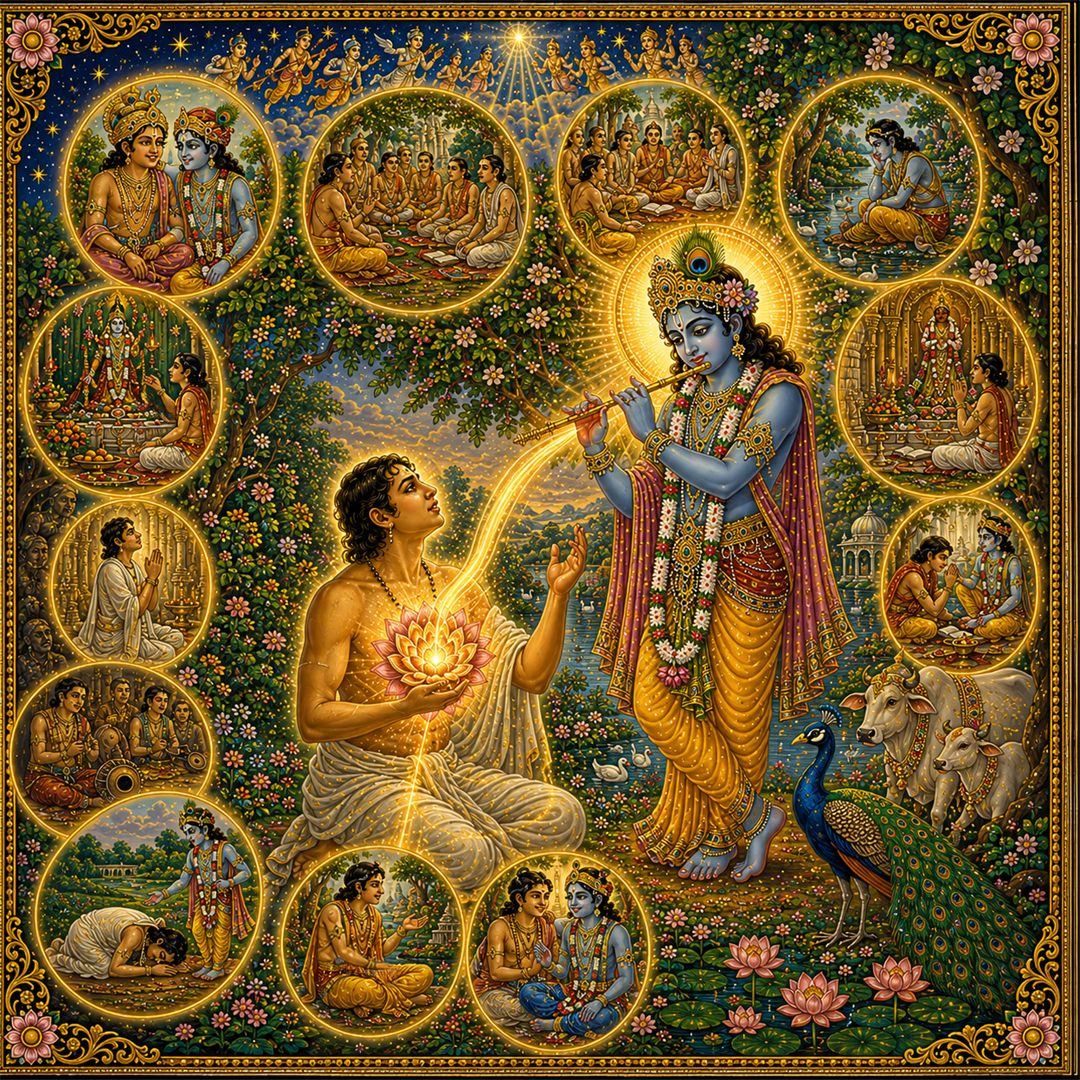
प्रबुद्धे ज्ञानभक्तिभ्यामात्मन्यानन्दचिन्मयी ।
उदेत्यनुत्तमा भक्तिर्भगवत्प्रेमलक्षणा ॥ ५८ ॥
prabuddhe jñāna-bhaktibhyām ātmany ānanda-cinmayī
udety anuttamā bhaktir bhagavat-prema-lakṣaṇā
When the self awakens through knowledge and devotion, there arises unsurpassed devotion, composed of spiritual bliss and consciousness, characterized by love for Bhagavān, the Supreme Personality of Godhead.
prabuddhe—when awakened; jñāna-bhaktibhyām—by knowledge and devotion; ātmani—in the self, when the self is awakened; ānanda-cinmayī—composed of spiritual bliss and consciousness; udeti—arises; anuttamā bhaktiḥ—unsurpassed devotion; bhagavat-prema-lakṣaṇā—characterized by love for Bhagavān, the Supreme Personality of Godhead.
Dig-darśinī-ṭīkā
Śrī Jīva Gosvāmī
Here the Lord begins the Pañca-ślokī, the five-verse teaching bestowed upon Brahmā as an expression of His grace, with the verse beginning prabuddhe.
As stated in the Eleventh Canto:
jñāna-vijñāna-sampanno bhaja māṁ bhakti-bhāvitaḥ
“Endowed with knowledge and realization, worship Me with a heart imbued with devotion.”
Brahma-saṁhitā-prakāśinī
Śrīla Bhaktivinoda Ṭhākura
Verse 58
When spiritual realization awakens through knowledge and devotion, there arises toward Śrī Kṛṣṇa, who is dear to the self, the highest devotion characterized by love for Bhagavān (bhagavat-prema).
Knowledge (jñāna) here means knowledge of one’s relationship (sambandha-jñāna). The truths concerning cit, acit, and Kṛṣṇa, together with their mutual relationships, constitute this knowledge.
The cultivation of impersonal knowledge is not intended here, for such knowledge is opposed to devotional service.
The first seven principles of the Daśa-mūla constitute this sambandha-jñāna.
The practical means (abhidheya-tattva) taught in the Scriptures of devotional service is the cultivation of Kṛṣṇa consciousness through hearing, chanting, remembering, serving the Lord’s feet, worship, offering prayers, servitude, friendship, and complete self-surrender.
A detailed explanation of these practices is given in the Bhakti-rasāmṛta-sindhu. Through such knowledge and devotional service, bhakti characterized by divine love (prema-lakṣaṇā bhakti) awakens.
That is the highest stage of devotion, and that alone is the ultimate goal (sādhya-tattva) of the jīva.
Annotations
Bhakti Gauravani Goswami
The Daśa-mūla (The Ten Foundational Principles) is Bhaktivinoda Ṭhākura's concise summary of the essential teachings of Gauḍīya Vaiṣṇava philosophy. These ten principles are arranged according to the traditional threefold structure of sambandha, abhidheya, and prayojana. The first seven establish sambandha-jñāna, knowledge of the fundamental relationship between the Supreme Lord, the living beings, His energies, and the universe. The eighth principle describes abhidheya, the process of attaining perfection through pure devotional service, while the final two describe prayojana, the ultimate goal of life, namely pure love of Kṛṣṇa (prema). The ten principles are as follows:
1. Kṛṣṇa is the Supreme Absolute Truth.
2. Kṛṣṇa is the possessor of all potencies.
3. Kṛṣṇa is the ocean of all transcendental rasas.
4. The jīvas are Kṛṣṇa's separated expansions (vibhinnāṁśa).
5. Some jīvas are conditioned by the material energy (baddha-jīvas).
6. Some jīvas are liberated from material bondage (mukta-jīvas).
7. The relationship between Kṛṣṇa, His energies, and the universe is one of inconceivable simultaneous oneness and difference (acintya-bhedābheda-tattva).
8. Pure devotional service (śuddha-bhakti) is the means (abhidheya) for attaining Him.
9. Pure love of Kṛṣṇa (prema) is the supreme goal of life (prayojana).
10. The highest perfection is to relish the sweetness of Kṛṣṇa through prema.