 Spiritual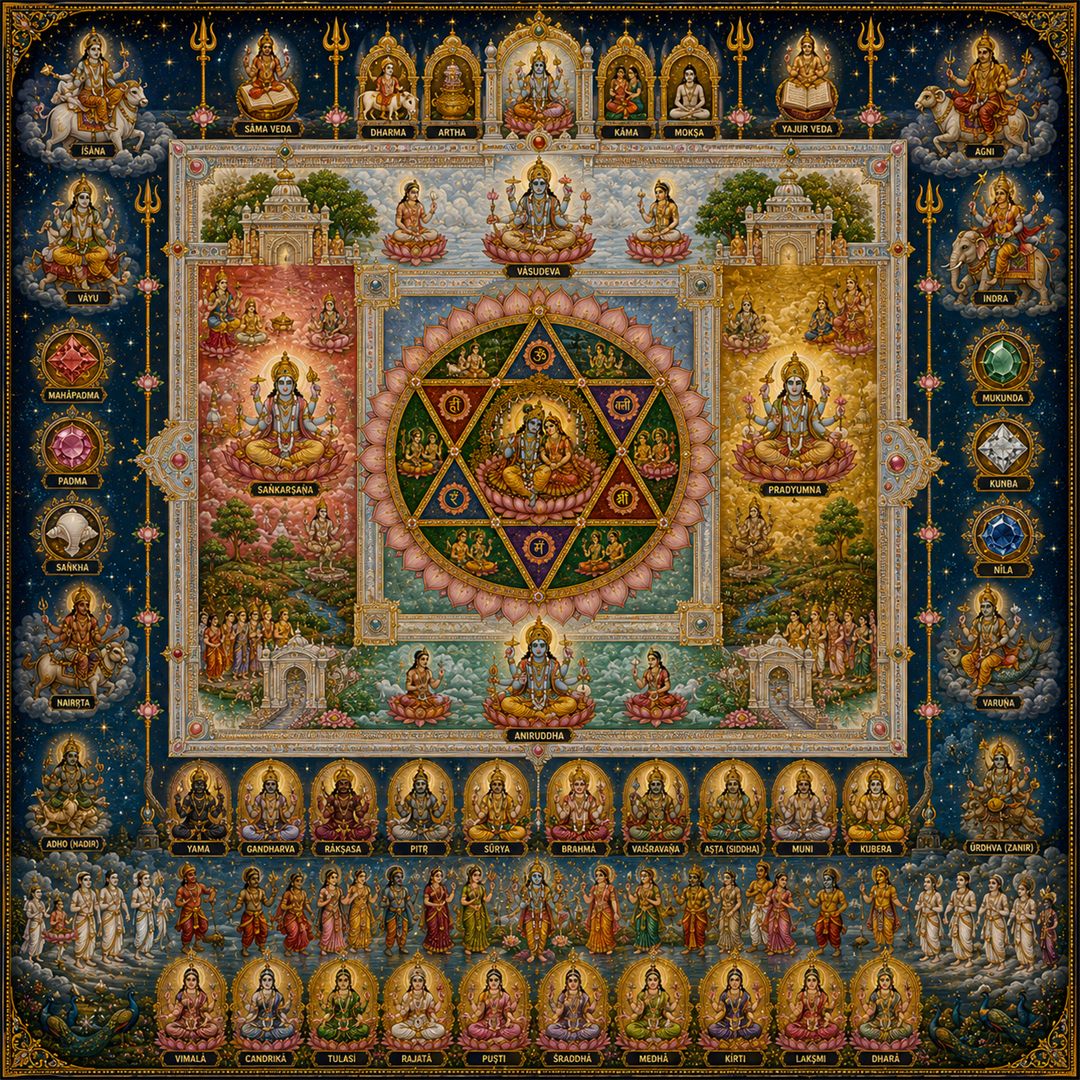
चतुरस्रं तत्परितः श्वेतद्वीपाख्यमद्भुतम् ।
चतुरस्रं चतुर्मूर्तेश्चतुर्धाम चतुष्कृतम् ॥
चतुर्भिः पुरुषार्थैश्च चतुर्भिर्हेतुभिर्वृतम् ।
शूलैर्दशभिरानद्धमूर्ध्वाधो दिग्विदिक्ष्वपि ॥
अष्टभिर्निधिभिर्जुष्टमष्टभिः सिद्धिभिस्तथा ।
मनुरूपैश्च दशभिर्दिक्पालैः परितो वृतम् ॥
श्यामैर्गौरैश्च रक्तैश्च शुक्लैश्च पार्षदर्षभैः ।
शोभितं शक्तिभिस्ताभिरद्भुताभिः समन्ततः ॥ ५ ॥
catur-asraṁ tat-paritaḥ śvetadvīpākhyam adbhutam
catur-asraṁ catur-mūrteś catur-dhāma catuṣ-kṛtam
caturbhiḥ puruṣārthaiś ca caturbhir hetubhir vṛtam
śūlair daśabhir ānaddham ūrdhādho dig-vidikṣv api
aṣṭabhir nidhibhir juṣṭam aṣṭabhiḥ siddhibhis tathā
manu-rūpaiś ca daśabhir dik-pālaiḥ parito vṛtam
śyāmair gauraiś ca raktaiś ca śuklaiś ca pārṣadarṣabhaiḥ
śobhitaṁ śaktibhis tābhir adbhutābhiḥ samantataḥ
catur-asram—four-sided, square; tat-paritaḥ—surrounding that; śvetadvīpa-ākhyam—known by the name Śvetadvīpa; adbhutam—wonderful, astonishing; catur-asram—four-sided, square; catuḥ-mūrteḥ—of the four manifestations of the catur-vyūha, namely Vāsudeva, Saṅkarṣaṇa, Pradyumna, and Aniruddha; catuḥ-dhāma—the four abodes; catuṣ-kṛtam—divided into four parts; caturbhiḥ—by four; puruṣa-arthaiḥ—goals of human life, namely dharma, artha, kāma, and mokṣa; ca—and; caturbhiḥ—by four; hetubhiḥ—causes or means of attainment, identified in the commentaries with the four Vedas; vṛtam—surrounded; śūlaiḥ—by tridents; daśabhiḥ—ten; ānaddham—bound, enclosed; ūrdhva-adhaḥ—above and below; dik-vidikṣu—in the cardinal and intermediate directions; api—also; aṣṭabhiḥ—by eight; nidhibhiḥ—treasures, namely Mahāpadma, Padma, Śaṅkha, Makara, Kacchapa, Mukunda, Kunda, and Nīla; juṣṭam—endowed with; aṣṭabhiḥ—by eight; siddhibhiḥ—mystic perfections, namely aṇimā, laghimā, prāpti, prākāmya, mahimā, īśitva, vaśitva, and kāmāvasāyitā; tathā—likewise; manu-rūpaiḥ—in the forms of mantras; ca—and; daśabhiḥ—by ten; dik-pālaiḥ—guardians of the directions; paritaḥ—on all sides; vṛtam—surrounded; śyāmaiḥ—by dark-blue-complexioned ones; gauraiḥ—by golden-complexioned ones; ca—and; raktaiḥ—by red-complexioned ones; ca—and; śuklaiḥ—by white-complexioned ones; ca—and; pārṣada-ṛṣabhaiḥ—by the foremost associates; śobhitam—adorned, beautified; śaktibhiḥ—by potencies; tābhiḥ—by those; adbhutābhiḥ—wonderful; samantataḥ—on all sides.
Surrounding Gokula on every side is a wonderful quadrangular region known as Śvetadvīpa. It is divided fourfold into the four abodes of the four manifestations of the catur-vyūha.
That fourfold realm is surrounded by the four goals of human life and by their four causes. It is enclosed by ten tridents situated above, below, and in the cardinal and intermediate directions.
It is endowed with eight treasures and surrounded on all sides by the ten guardians of the directions in the forms of their respective mantras.
It is adorned everywhere by the foremost associates, whose complexions are dark blue, golden, red, and white, and by those wonderful divine potencies.
Dig-darśinī-ṭīkā
by Jīva Gosvāmī
Now Brahmā describes the surrounding regions of Gokula.
Outside the central region of Gokula, on every side, lies a square region known as Śvetadvīpa. The name Śvetadvīpa may also designate Gokula itself. Nevertheless, because Gokula contains distinct inner regions, this particular region is separately known by the established name Śvetadvīpa.1 Within this quadrangular realm, however, the inner circular region should be understood to be known as Vṛndāvana. Thus the Svāyambhuva-āgama states:
dhyāyettatra viśuddhātmā idaṁ sarvaṁ krameṇaiva
tan madhye vṛndāvanaṁ kusumitaṁ nānā-vṛkṣair vihaṅgamaiḥ saṁsmaret
“There, the purified soul should meditate upon all this in due sequence. Within it one should remember Vṛndāvana, flowering and filled with many trees and birds.”
In the Bṛhad-vāmana Purāṇa, the personified Vedas pray to Bhagavān:
ānanda-rūpam iti yad vidanti hi purā vidaḥ
tad rūpaṁ darśayāsmākaṁ yadi deyo varo hi naḥ
“O Lord, if You desire to grant us a boon, then show us that form which the sages of old know as bliss personified.”
Hearing this, Bhagavān revealed Gokula, which is beyond material nature, consisting solely of the bliss of direct spiritual experience, imperishable and beyond material limitation. Within it lies the forest named Vṛndāvana, filled with wish-fulfilling trees.
That quadrangular realm is divided into four sections, the four abodes of the four manifestations of the catur-vyūha, namely Śrī Vāsudeva and the others. Because they engage in divine pastimes, they should be understood to reside above that region in divine aerial vehicles.
The phrase hetubhiḥ refers to the means of attaining the respective four goals of human life. The ten guardians of the directions headed by Indra surround that realm in the forms of their respective mantras. The four Vedas beginning with the Sāma Veda are also indicated by these mantra forms.
This realm called Goloka is established in the Śrīmad-Bhāgavatam.
It is adorned everywhere by wonderful potencies beginning with Vimalā, and by the foremost associates whose bodily complexions are dark blue, golden, red, and white.
Thus the nature of that realm is described in the Śrīmad-Bhāgavatam (10.28.10–17) as follows:
nandastv atīndriyaṁ dṛṣṭvā loka-pāla-mahodayam
kṛṣṇe ca sanātibhyo vismito ‘bravīt
te cautsukya-dhiyo rājan matvā gopās tam īśvaram
api naḥ sva-gatiṁ sūkṣmām upādhāsyad adhīśvaraḥ
iti svānāṁ sa bhagavān vijñāyākhila-dṛk svayam
saṅkalpa-siddhaye teṣāṁ kṛpayaitad acintayat
jano vai loka etasminn avidyā-kāma-karmabhiḥ
uccāvacāsu gatiṣu na veda svāṁ gatiṁ bhraman
iti sañcintya bhagavān mahā-kāruṇiko hariḥ
darśayām āsa lokaṁ svaṁ gopānāṁ tamasaḥ param
satyaṁ jñānam anantaṁ yad brahma jyotiḥ sanātanam
yad dhi paśyanti munayo guṇāpāye samāhitāḥ
te tu brahma-hradaṁ nītā magnāḥ kṛṣṇena coddhṛtāḥ
dadṛśur brahmaṇo lokaṁ yatrākrūro ‘dhyagāt purā
nandādayas tu taṁ dṛṣṭvā paramānanda-nivṛtāḥ
kṛṣṇaṁ ca tatra cchandobhiḥ stūyamānaṁ su-vismitāḥ
Nanda Mahārāja, seeing the extraordinary opulence of the guardians of the worlds and their reverence toward Kṛṣṇa, spoke in astonishment to his kinsmen.
O King Parīkṣit, the cowherd men, filled with eagerness and understanding Kṛṣṇa to be the Supreme Lord, thought: “Will He reveal to us our subtle destination?”
Knowing the hearts of His devotees, Bhagavān, who sees everything, mercifully considered how to fulfill their desire. He thought:
“The living entities in this world wander through higher and lower destinations because of ignorance, material desire, and karma, and thus do not know their true destination.
Reflecting in this way, the all-powerful and supremely compassionate Lord revealed to the cowherd men His realm, which is beyond material darkness.
That eternal spiritual effulgence is truth, knowledge, and infinity, and is seen by sages absorbed in meditation when the material modes of nature cease to influence their consciousness.
The cowherd men were taken by Kṛṣṇa to Brahma-hrada, the lake of Brahman. Immersed there and then raised up again by Him, they beheld the spiritual world which Akrūra had formerly seen there.
Seeing that realm, Nanda and the others became filled with supreme bliss, and they saw Kṛṣṇa there being praised by the Vedas.
The term sva-gatim means “their eternal destination,” namely their spiritual abode. The word sūkṣmām means “subtle” or “difficult to understand.” The word jana here specifically refers to the residents of Vraja as Kṛṣṇa’s intimate devotees. This is indicated by Bhagavān’s statement when He was lifting Govardhana Hill (10.25.18):
tasmān mac-charaṇaṁ goṣṭhaṁ man-nāthaṁ mat-parigraham
gopāye svātma-yogena so ‘yaṁ me vrata āhitaḥ
“Therefore I shall personally protect this community of cowherds, which has taken shelter of Me, whose Lord is Me, and which belongs to Me. This is My solemn vow.”
The meaning is that although the residents of Vraja appear within this material world among various embodied conditions, because their true nature is concealed by Kṛṣṇa’s humanlike pastimes, they themselves do not fully perceive their eternal spiritual identity.
Thus it is said in the Śrīmad-Bhāgavatam (10.11.58):
iti nandādayo gopāḥ kṛṣṇa-rāma-kathāṁ mudā |
kurvanto ramamāṇāś ca nāvidan bhava-vedanām ||
“Nanda and the other cowherds joyfully spent their time hearing and speaking narrations of Kṛṣṇa and Balarāma, and thus remained unaware of the sufferings of material existence.”
Because ignorance, desire, and karma possess no power over them, Kṛṣṇa revealed Goloka, their eternal realm, to each of them individually. Since that realm is manifested by His internal potency, it is beyond material nature and therefore inherently composed of eternity, consciousness, and bliss.
How the residents of Vraja, while still physically situated in Vṛndāvana, were able to behold that supreme realm is now explained.
Kṛṣṇa led them to Brahma-hrada, also known as Akrūra-tīrtha. After immersing them there and lifting them out again, He returned them to their previous location, whereupon they saw Goloka, the supreme abode of the Supreme Brahman.
The phrase mūrdhabhiḥ satya-lokas tu brahma-lokaḥ sanātanaḥ is cited from the Second Canto (2.5.39) to establish that Brahmaloka here refers not to the material Satyaloka but to the eternal spiritual Vaikuṇṭha realm.
The phrase svāṁ gatim indicates their personal destination, and the expression gopānāṁ svaṁ lokam establishes that Goloka specifically belongs to the cowherd devotees. By explicitly mentioning Kṛṣṇa Himself in that realm, the text excludes any interpretation that this is merely another Vaikuṇṭha planet and firmly establishes that the realm revealed here is specifically Śrī Goloka.
Therefore, in the Harivaṁśa, Indra declares:
svargād ūrdhvaṁ brahma-loko brahmarṣi-gaṇa-sevitaḥ
tatra soma-gatiś caiva jyotiṣāṁ ca mahātmanām
tasyopari gavāṁ lokaḥ sādhyās taṁ pālayanti hi
sa hi sarva-gataḥ kṛṣṇo mahākāśa-gato mahān
“Above Svarga lies Brahmaloka, served by the hosts of great sages. There is the destination of Soma and of the great luminous beings. Above that is the world of the cows, protected by the Sādhyas. There the all-pervading and supremely great Kṛṣṇa resides within the supreme spiritual sky.”
Therefore any interpretation that this Goloka is merely a material heavenly region cannot be accepted. The description cannot refer to an ordinary celestial world because the Moon and stars do not travel above Dhruvaloka, nor could the Sādhyas govern a realm superior to heaven itself. Moreover, the words sarva-gataḥ (all-pervading) can properly apply only to Bhagavān and His transcendental abode, both of which possess inconceivable potency.
Therefore this Goloka must be entirely distinct from any material or cosmic Goloka. In the Mokṣa-dharma section of the Mahābhārata, Bhagavān declares:
evaṁ bahu-vidhai rūpaiś carāmīha vasundharām
brahma-lokaṁ ca kaunteya golokaṁ ca sanātanam
“O son of Kuntī, in many forms I wander throughout the Earth, and also through Brahmaloka and the eternal Goloka.”
Here the word brahma-lokam refers to the eternal Vaikuṇṭha realm beyond material creation. The personified Vedas, Nārada, Garuḍa, Viṣvaksena, and other eternal associates reside there.
Above even that Brahmaloka lies Śrī Goloka.
The Sādhyas who guard Goloka are either eternal associates of Bhagavān functioning as protectors of the directions, or, according to another interpretation, they are exalted devotees such as the gopas and gopīs who assist qualified souls in attaining that supreme perfection.
Thus Śrī Goloka, though the highest of all realms, is nevertheless all-pervading through its inconceivable spiritual potency, just as Śrī Nārāyaṇa Himself is all-pervading.
Even souls who gradually attain liberation may eventually perceive that realm, just as Brahmā once saw Vaikuṇṭha as described in the Second Canto. Yet the residents of Vraja behold it directly even while situated here within Kṛṣṇa’s earthly pastimes.
Therefore the Scriptures describe Bhagavān there as mahāntaṁ vibhum ātmānam, “the great, all-pervading Supreme Self.”
The words tapo-mayī gatiḥ mean that this destination is not ordinary but composed of unlimited divine majesty and sovereignty. Here tapaḥ means uninterrupted sovereignty, not austerity in the ordinary sense.
Thus Goloka is attained only by those whose minds are completely absorbed in Śrī Kṛṣṇa through pure love and devotion.
Another Vedic passage glorifies that supreme abode as follows:
tā vāṁ vāstūny uśmasi gomadhyai yatra gāvo bhūri-śṛṅgā ayāsaḥ
atrāha tad urugāyasya kṛṣṇaḥ paramaṁ padam avabhāti bhūri
“We long to attain Your abodes, O Kṛṣṇa and Balarāma, where the great-horned cows dwell. There the supreme abode of the all-glorious Kṛṣṇa shines resplendently.”
In this way, the Vedas proclaim the existence of the supreme realm known as Śrī Goloka.
Brahma-saṁhitā-prakāśinī
by Bhaktivinoda Ṭhākura
Verse 5
(The enclosing region of that Gokula is now being described.)
Around Gokula, on all four sides, lies a wondrous quadrangular region called Śvetadvīpa. Śvetadvīpa is divided into four sections, each of which is the abode of one of the four manifestations: Vāsudeva, Saṅkarṣaṇa, Pradyumna, and Aniruddha.
That fourfold realm is enclosed by the four goals of human life—dharma, artha, kāma, and mokṣa—and by the four Vedas—Ṛg, Sāma, Yajur, and Atharva—which, in their mantra forms, serve as the respective means of attaining those goals.
Ten tridents are fixed in the eight directions and also above and below. The realm is adorned with the eight treasures—Mahāpadma, Padma, Śaṅkha, Makara, Kacchapa, Mukunda, Kunda, and Nīla—and with the eight mystic perfections.
The ten directional guardians are present in the ten directions in the forms of their respective mantras. The associates of dark blue, golden, red, and white complexion shine on all sides together with the wonderful potencies headed by Vimalā.2
Gokula is primarily the seat of prema-bhakti, loving devotional service. Therefore Yamunā, Govardhana, Śrī-kuṇḍa (Rādhā-kuṇḍa) and all the other features situated within the earthly Vraja-maṇḍala are present within it. All the opulences of Vaikuṇṭha are also perceived there as pervading all directions, and the four members of the catur-vyūha are present there in their respective places. From those catur-vyūha expansions, the Vaikuṇṭha realm of the spiritual sky becomes manifest and expanded. The mokṣa in Vaikuṇṭha and the dharma, artha and kāma found in the various worlds exist there in Gokula in the form of original seeds. The personified Vedas also are there, engaged in singing the glories of the Lord of Gokula.
Those who attempt to attain Goloka through mental prowess, without the mercy of Kṛṣṇa, are obstructed by the ten tridents situated in the ten directions. Those who approach through the path of yoga or the path of jñāna are pierced by those ten tridents, and thus their pride is defeated. In the Brahman realm, nirvāṇa is considered the desirable attainment; that itself forms the trident-like covering surrounding Goloka. Śūla means trident, and the limitations produced by the three modes of material nature and by past, present, and future constitute this trident.
The aṣṭāṅga-yogīs and the impersonalist knowers of Brahman who rush toward Goloka are cut down by the tridents situated in the ten directions and fall into the pit of despair. Those who approach Goloka through devotional service mixed with reverence become enchanted by the eight mystic perfections such as aṇimā and by the treasures of opulence such as mahāpadma, and thus remain captivated within the Vaikuṇṭha-tattva, which forms the outer covering of Śrī Goloka. Those whose intelligence is still weaker come under the control of the ten directional guardians in the form of mantras and return again to the seven worlds.
Thus Goloka is difficult to conquer and difficult to attain.
The divine manifestations who propagate the dharma of each age eternally remain there solely to bestow mercy upon devotees who arrive through pure loving devotion. They are surrounded by associates corresponding to Their respective complexions. Śvetadvīpa within Gokula is Their abode. For this reason Vyāsadeva described it by saying: śvetadvīpa-nāma, navadvīpa-grāma. “The name Śvetadvīpa refers to the town of Navadvīpa.”3 Within that Śvetadvīpa, the complementary līlā of Gokula, namely navadvīpa-līlā, eternally exists. Therefore Navadvīpa-maṇḍala, Vraja-maṇḍala and Goloka are one indivisible truth; only through endless varieties of loving moods have they appeared as diverse.
There is yet another confidential truth in this matter, understood by the great souls devoted to supreme loving devotional service directly through Kṛṣṇa’s mercy: In the material universe there are fourteen worlds arranged in ascending and descending order. Fruitive workers attached to enjoyment and household life move within the three worlds known as Bhūḥ, Bhuvaḥ and Svaḥ. Great celibates, ascetics and peaceful persons devoted to truth attain Maharloka, Janaloka, Tapoloka and Satyaloka through desireless dharma and yoga. Above these is the realm of the four-faced Brahmā, and above that the Vaikuṇṭha of Kṣīrodakaśāyī.
The sannyāsī paramahaṁsas and the asuras slain by Hari cross beyond the Virajā, which means beyond the fourteen worlds, and attain nirvāṇa characterized by the disappearance of individual self-awareness.
The jñāna-bhaktas, śuddha-bhaktas, prema-bhaktas, prema-para-bhaktas, and premātura-bhaktas who cherish Bhagavān’s supreme opulence attain residence in Vaikuṇṭha, the spiritual sky constituting the transcendental abode of Nārāyaṇa.
Only the vrajānugata-bhaktas, the devotees who follow the mood of Vraja and are devoted to its supreme sweetness, attain Goloka-dhāma.
According to distinctions of rasa, the separate positions of devotees in Goloka are determined by Kṛṣṇa’s inconceivable potency. The pure followers of Vraja reside in Kṛṣṇa-loka, and the pure followers of Navadvīpa reside in Gaura-loka. Those devotees who are established in the unity of Vraja and Navadvīpa attain the happiness of service simultaneously in Kṛṣṇa-loka and Gaura-loka.4
Therefore, in the Śrī Gopāla-campū, Śrī Jīva has said:
yasya khalu lokasya go-lokas tathā go-gopāvāsa-rūpasya
śvetadvīpatayā cānanya-spṛṣṭaḥ parama-śuddhatā-samudbuddha-svarūpasya
tādṛśa-jñānamaya-katipayamātra-prameya-pātrataya
tat-tat-paramatā matā, parama-golokaḥ paramaḥ śvetadvīpa iti
“That realm is called Goloka because it is the abode of cows and cowherd men. It is also called Śvetadvīpa because its nature is manifest as supreme purity untouched by anything else. Since it can be known only by the few who possess realization of that nature, its supremacy under both designations is acknowledged: the supreme Goloka and the supreme Śvetadvīpa.”
The essential purport is this: Although Kṛṣṇa relishes the līlā of Vraja, which is kṛṣṇa-līlā itself, He still does not attain the happiness of tasting the entirety of rasa. Therefore, accepting the mood and golden complexion of Rādhikā, who is the very shelter of kṛṣṇa-rasa, Kṛṣṇa performs the eternal līlā of tasting Himself. For this reason Goloka in the form of Śvetadvīpa is eternally manifest.
This mood is expressed in the following verse:
śrī-rādhāyāḥ praṇaya-mahimā kīdṛśo vā
anayāivāsvādyo yenādbhuta madhurimā kīdṛśo vā madīyaḥ
saukhyaṁ cāsyā mad-anubhavataḥ kīdṛśaṁ veti lobhāt
tad-bhāvāḍhyaḥ samajani śacī-garbha-sindhau harīnduḥ
“What is the greatness of Śrī Rādhā’s love? What kind of astonishing sweetness in Me does She alone relish? And what sort of happiness does She experience by perceiving My sweetness? Out of longing to know these three things, the moonlike Hari took birth in the ocean of Śacī’s womb.”
Thus the confidential intention of Śrī Jīva Gosvāmī becomes manifest.
In the Śrī Caitanya Upaniṣad (4–5), Brahmā says to the sage Pippalāda:
rahasyaṁ te vadiṣyāmi—jāhnavī-tīre navadvīpe golokākhye dhāmni govindo dvi-bhujo gauraḥ sarvātmā mahā-puruṣo mahātmā mahā-yogī tri-guṇātītaḥ sattva-rūpo bhaktiṁ loke kāśyatīti
“I shall tell you a secret. On the bank of the Jāhnavī, in Navadvīpa within the abode called Goloka, Govinda appears as the two-armed Gaura, the self of all, the Supreme Person, the great soul, the great yogī beyond the three guṇas, whose form is purely spiritual, manifesting devotional service in this world.”
Brahmā continues (Verse 6 of the Caitanya Upaniṣad):
eko devaḥ sarva-rūpī mahātmā gaura-rakta-śyāmala-śveta-rūpaḥ caitanyātmā sa vai caitanya-śaktir bhaktākāro bhakti-do bhakti-vedyaḥ
“The one Supreme Lord, the great soul who assumes all forms, appears in golden, red, dark, and white forms. He is consciousness itself and is endowed with spiritual potency. He appears in the form of a devotee, bestows devotional service, and is known through devotional service.”
As established by many scriptural statements such as āsan varṇās trayaḥ, kṛṣṇa-varṇaṁ tviṣākṛṣṇam, yadā paśyaḥ paśyati rukma-varṇam, and mahān prabhur vai, Śrī Gaura, although non-different from Kṛṣṇa, eternally resides in Goloka in the form of eternal Navadvīpa, relishing the rasa of rādhā-kṛṣṇa-līlā in His Gaura form. This is also understood from these Vedic statements.
Just as, by the power of Yogamāyā, Śrī Kṛṣṇa manifests birth and other pastimes in earthly Gokula, similarly, by the power of Yogamāyā, Śrī Gaura manifests His birth from the womb of Śacī and other pastimes in earthly Navadvīpa. This is an independently existing spiritual reality, not an imagination produced by thought dependent upon māyā.
Annotations
Bhakti Gauravani Gosvāmī
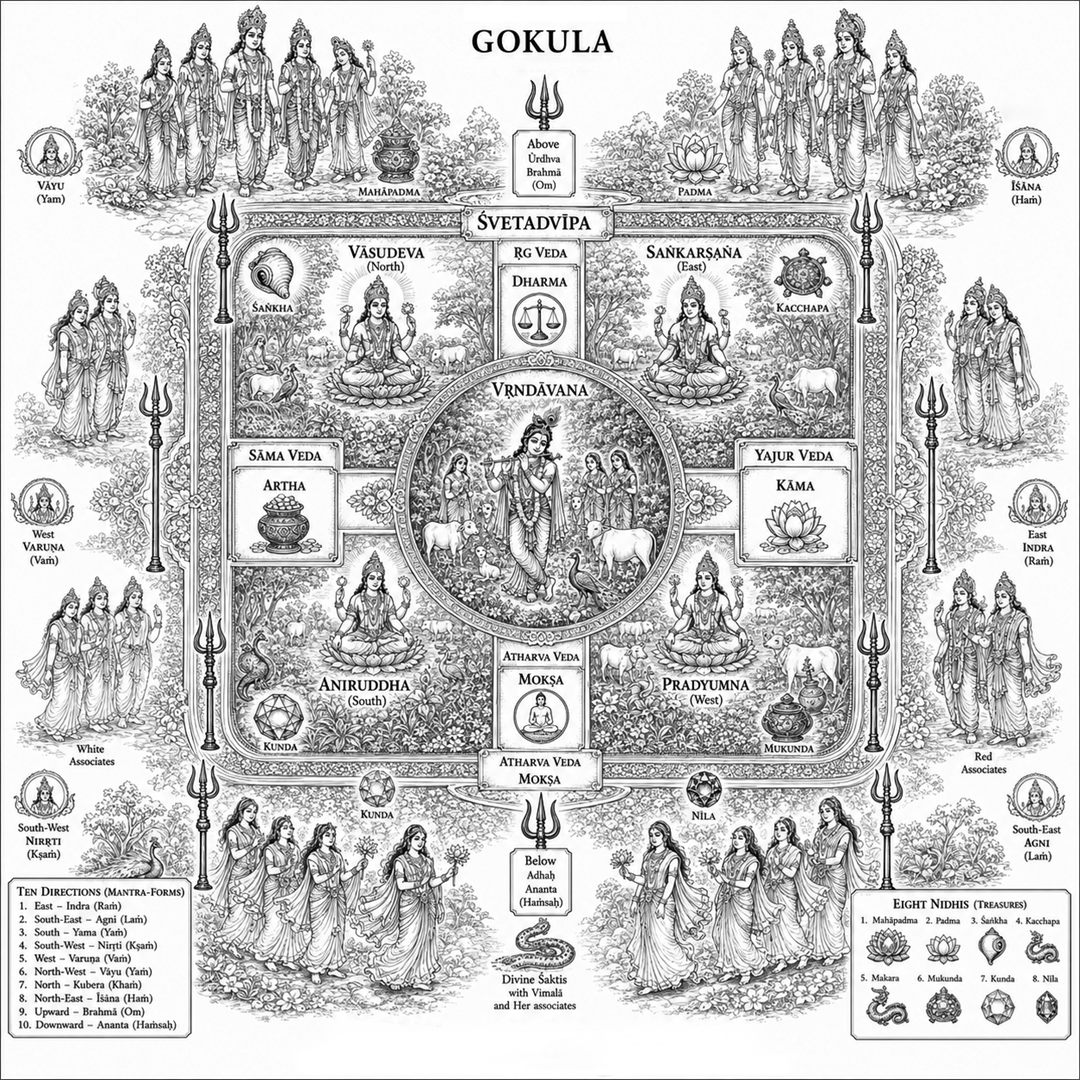
Jīva Gosvāmī’s description of Śvetadvīpa should not be understood as a geographical map of Goloka. Rather, it should be seen as a conceptual diagram based upon Verse 5 and its commentaries. The verse describes a quadrangular region surrounding the central Gokula, yet this Śvetadvīpa is not a separate realm independent of Gokula. Rather, it is a distinct region within the same indivisible spiritual abode. The entire realm may therefore be designated Gokula, while one of its internal divisions is specifically known as Śvetadvīpa.
Within this quadrangular region lies the inner circular domain known as Vṛndāvana, the most intimate setting of Śrī Kṛṣṇa’s pastimes. Thus Gokula, Śvetadvīpa, and Vṛndāvana do not designate unrelated places, but interconnected regions and aspects of the one eternal spiritual reality. Jīva Gosvāmī’s purpose is philosophical rather than geographical: he is explaining how different revealed names designate distinct dimensions of Śrī Kṛṣṇa’s eternal abode.
Bhaktivinoda Ṭhākura accepts Jīva Gosvāmī’s presentation and develops it further by identifying Śvetadvīpa with eternal Navadvīpa, the abode of Śrī Gaurāṅga. In his understanding, Goloka, Gokula, Vṛndāvana, Śvetadvīpa, and Navadvīpa are manifestations of one indivisible spiritual reality, revealed according to distinct moods of divine love and different purposes within the Lord’s eternal pastimes.
Notes
- See Annotations and the diagram for further clarification. ↩
- Bhaktivinoda Ṭhākura’s Bengali rendering of Verse 5 includes information that is implied but not spelled out in the original Sanskrit verse, such as the names of the four forms, the four goals of life and the names of the eight jewels. This is a technique followed by Śrīla Prabhupāda in many translations of verses in the Śrīmad-Bhāgavatam and Śrī Caitanya-caritāmṛta, the reason being to make cryptic texts accessible to an audience not familiar with Sanskrit and the intricate aspects of Vaiṣṇava philosophy. Conversely, Bhaktivinoda Ṭhākura’s rendering also omits something present in the original Sanskrit verse, namely the eight mystic perfections. However, the siddhis are not lost—they reappear in his commentary. ↩
- This statement appears in various Purāṇas and Upaniṣads, including the Śvetāśvatara Upaniṣad and Padma Purāṇa. ↩
- Bhaktivinoda Ṭhākura uses the word yugapat, “simultaneously,” which appears to indicate that devotees participate in both kṛṣṇa-līlā and gaura-līlā at the same time. He does not explain whether this entails two distinct siddha-dehas. Since he describes Kṛṣṇa-loka and Gaura-loka as distinct manifestations of the one indivisible Goloka-dhāma, the precise manner in which such simultaneous service occurs may belong to the inconceivable nature of the spiritual realm. ↩