 Spiritual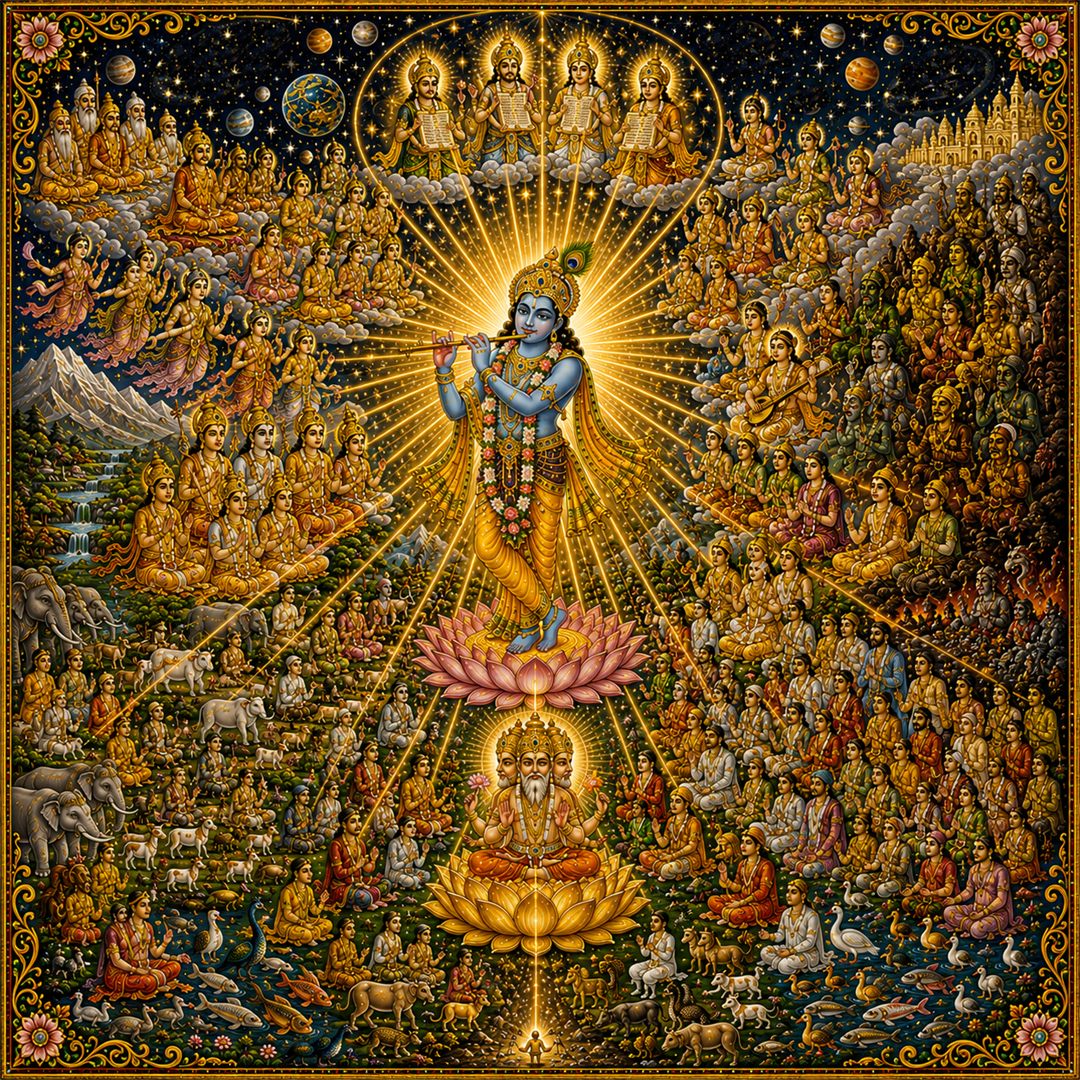
धर्मोऽथ पापनिचयः श्रुतयस्तपांसि ब्रह्मादिकीटपतगावधयश्च जीवाः ।
यद्दत्तमात्रविभवप्रकटप्रभावा गोविन्दमादिपुरुषं तमहं भजामि ॥ ५३ ॥
dharmo ‘tha pāpa-nicayaḥ śrutayas tapāṁsi
brahmādi-kīṭa-patagāvadhayaś ca jīvāḥ
yad-datta-mātra-vibhava-prakaṭa-prabhāvā
govindam ādi-puruṣaṁ tam ahaṁ bhajāmi
I worship Govinda, the primeval Lord, from whom alone religion, the accumulated mass of sins, the Vedas, austerities, and all living beings—from Brahmā down to insects and birds—receive the power to manifest their respective influence.
dharmaḥ—religion, prescribed duty; atha—and also; pāpa-nicayaḥ—the accumulated mass of sins; śrutayaḥ—the Vedas, the revealed Scriptures; tapāṁsi—austerities; brahmā-ādi—beginning with Brahmā; kīṭa-pataga-avadhayaḥ—down to insects and birds; ca—and; jīvāḥ—living beings; yat-datta-mātra-vibhava—by the power bestowed by Him alone; prakaṭa-prabhāvāḥ—whose influence becomes manifest; govindam—Govinda; ādi-puruṣam—the primeval Lord; tam—Him; ahaṁ bhajāmi—I worship.
Dig-darśinī-ṭīkā
Śrī Jīva Gosvāmī
What more need be said?
Thus Brahmā speaks the verse beginning dharmaḥ. As stated in the Bhagavad-gītā (10.8):
ahaṁ sarvasya prabhavo mattaḥ sarvaṁ pravartate
“I am the source of everything; from Me everything proceeds.”
Brahma-saṁhitā-prakāśinī
Śrīla Bhaktivinoda Ṭhākura
Verse 53
I worship that primeval Lord Govinda, by whose bestowed power alone religion, irreligion, the Vedic revelations, austerities, and all living beings from Brahmā down to the smallest insect manifest their respective influence.
By dharma are meant the duties prescribed in the Vedas and elaborated in the twenty Dharma-śāstras, namely varṇa-dharma and āśrama-dharma.
Among these, the natural duties of the four social orders—brāhmaṇa, kṣatriya, vaiśya, and śūdra—constitute varṇa-dharma, while the duties appropriate to the four spiritual orders—brahmacārī, gṛhastha, vānaprastha, and sannyāsī—constitute āśrama-dharma. These two divisions determine the proper conduct for all aspects of human life.
By adharma, or sin, are meant ignorance (avidyā), sinful desires, the great sins (mahā-pātakas), secondary sins (anu-pātakas), ordinary sins (pātakas), and all forms of unauthorized conduct.
By the Śrutis are meant the Ṛg, Sāma, Yajur, and Atharva Vedas, together with the Upaniṣads, which are their crowning ornaments.
By austerities (tapas) are meant all the disciplines undertaken for the sake of religious attainment. Some of these, such as the practice known as pañca-tapā, are exceedingly difficult. The disciplines of aṣṭāṅga-yoga and steadfast cultivation of knowledge of Brahman are also included within this category.
All these are merely various states within the cycle of karma experienced by conditioned souls.
The conditioned living entities wander through the 8,400,000 species of life. They appear in many forms—as devas, dānavas, rākṣasas, humans, nāgas, kinnaras, gandharvas, and others. These living beings, from Brahmā down to the smallest insect, are innumerable varieties of conditioned souls, all situated within the cycle of karma.
Each possesses a particular influence or power and is capable of performing certain functions. Yet none of these powers are self-existent.
The influence possessed by any being is manifested only according to the measure of power and opulence bestowed upon them by Śrī Govinda.
Annotations
Bhakti Gauravani Goswami
Pāpa-nicayaḥ, “the accumulated mass of sins,” refers to the aggregate of offenses classified by the Dharmaśāstras according to their gravity. The mahā-pātakas, or great sins, traditionally include killing a brāhmaṇa, drinking intoxicating beverages, stealing a brāhmaṇa’s gold, having sexual relations with the wife of one’s spiritual master, and knowingly associating with persons guilty of such acts. Anu-pātakas are secondary offenses treated as comparable to one or another of the great sins; examples include reviling or neglecting the Vedic literature, bearing false witness, killing a friend, deliberately eating forbidden food, lying for self-aggrandizement, and falsely accusing one’s superior. Pātaka is the general term for an act that causes moral or spiritual degradation and, within a graded classification, may denote other forms of conduct prohibited by Scripture. The classification of a particular act may vary according to intention, circumstances, and the Dharmaśāstra consulted.
One may wonder why Brahmā places dharma and pāpa side by side, implying that both manifest their influence through power bestowed by Govinda. Does this mean that Govinda fosters wrongdoing or impels living beings toward sin? This is certainly not the intended meaning. Rather, it shows that nothing possesses any independent power to act or produce effects. Even the laws governing vice operate within the cosmic order established by the Supreme Lord.
Bhaktivinoda Ṭhākura explains that, in this context, dharma includes the system of duties prescribed in the Vedic literature, while pāpa encompasses ignorance, sinful desires, and all forms of conduct opposed to divine law. Both function within material existence and bear corresponding results within the cycle of karma.
It is true that any capacity to act by any living entity comes from Govinda, but the Lord does not compel a living entity to misuse that capacity. The jīva, exercising its minute independence, may employ the power it has received either in accordance with dharma or in opposition to it. Thus the Lord is the ultimate source of the power by which actions are performed, while the living entity remains responsible for the manner in which that power is used.