 Spiritual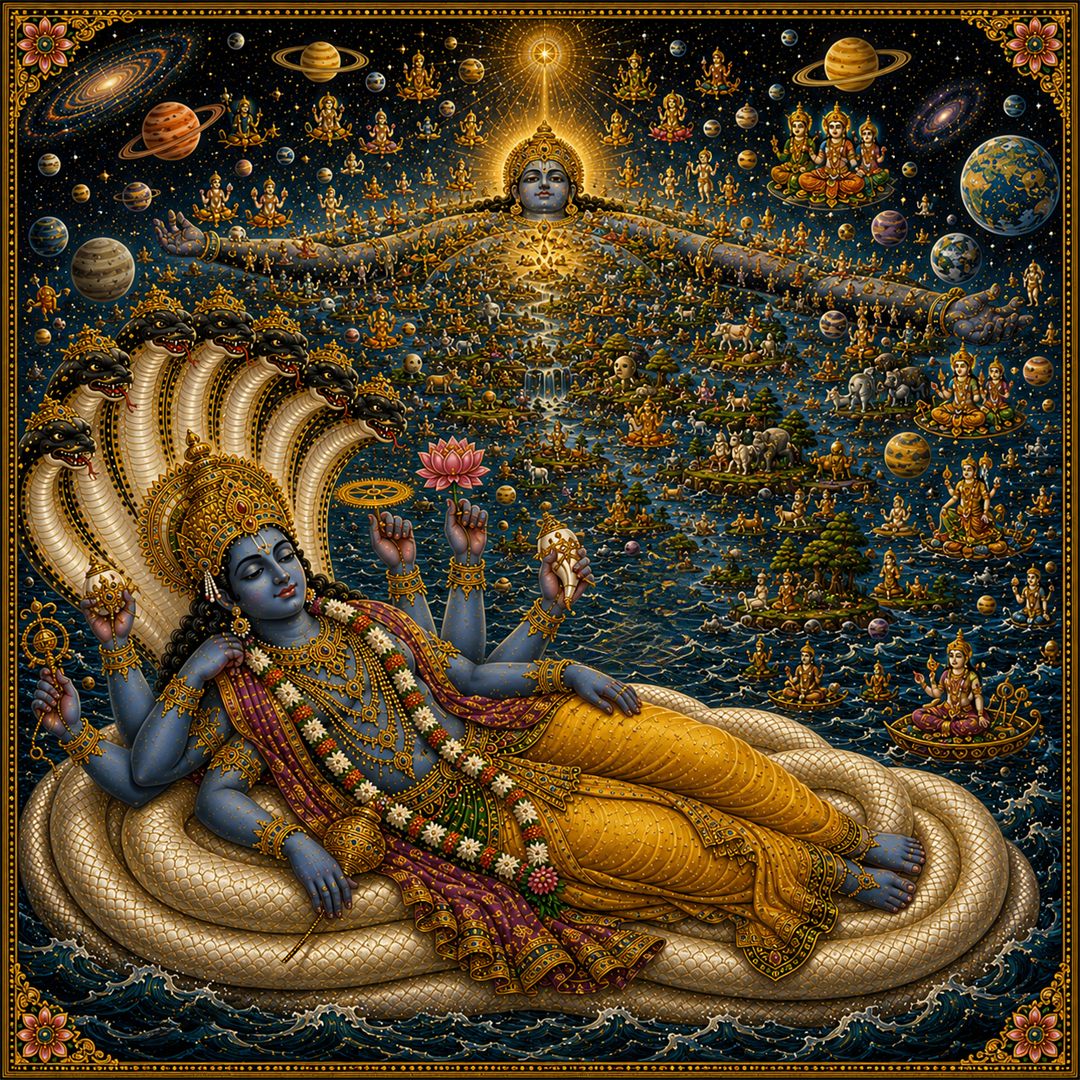
तत्त्वानि पूर्वरूढानि कारणानि परस्परम् ।
समवायाप्रयोगाच्च विभिन्नानि पृथक्पृथक् ॥
चिच्छक्त्या सज्जमानोऽथ भगवानादिपूरुषः ।
योजयन्मायया देवो योगनिद्रामकल्पयत् ॥ १९ ॥
tattvāni pūrva-rūḍhāni kāraṇāni parasparam
samavāyāprayogāc ca vibhinnāni pṛthak pṛthak
cic-chaktyā sajjamāno ‘tha bhagavān ādi-pūruṣaḥ
yojayan māyayā devo yoga-nidrām akalpayat
The material principles, previously manifested as causes, remained mutually separate because they had not yet been combined. Then Bhagavān, the primeval Puruṣa, associating with His spiritual potency, caused them to combine through Māyā and thereafter assumed yoga-nidrā.
tattvāni—the material principles; pūrva-rūḍhāni—previously arisen or established; kāraṇāni—causes, causal principles; parasparam—mutually, with one another; samavāya-aprayogāt—because conjunction had not been applied, due to the absence of combination; ca—and; vibhinnāni—separate; pṛthak pṛthak—each distinct from the others; cit-śaktyā—with His spiritual potency; sajjamānaḥ—becoming associated; atha—then; bhagavān ādi-pūruṣaḥ—Bhagavān, the primeval Puruṣa; yojayan—causing to combine; māyayā—through Māyā; devaḥ—the Lord; yoga-nidrām—yoga-nidrā; akalpayat—assumed.
Dig-darśinī-ṭīkā
Jīva Gosvāmī
To describe the awakening of the collective living being composed of innumerable individual souls, Brahmā now elaborates in three verses upon the process of creation carried out by Kāraṇārṇavaśāyī Viṣṇu, following the account given in the Third Canto. Thus he begins with the word tattvāni.
The present verse describes two stages. Through Māyā, His own potency, Bhagavān causes the material principles to combine with one another. Thereafter, remaining without personal endeavor, He assumes yoga-nidrā.
Annotations 1
Bhakti Gauravani Goswami
The account in the Third Canto of the Śrīmad-Bhāgavatam mentioned by Jīva Gosvāmī refers to the prayers of the demigods at the end of the fifth chapter, where they pray to the Lord for directions and the potency to render their service in the different departments of subsequent creation. In the first ten verses of the next chapter, Maitreya Muni describes the Lord’s reaction as follows:
The Lord thus heard about the suspension of the progressive creative functions of the universe due to the noncombination of His potencies, such as the mahat-tattva.
The Supreme Powerful Lord then simultaneously entered into the twenty-three elements with the goddess Kālī, His external energy, who alone amalgamates all the different elements.
Thus when the Personality of Godhead entered into the elements by His energy, all the living entities were enlivened into different activities, just as one is engaged in his work after awakening from sleep.
When the twenty-three principal elements were set in action by the will of the Supreme, the gigantic universal form, or the viśvarūpa body of the Lord, came into existence.
As the Lord, in His plenary portion, entered into the elements of the universal creation, they transformed into the gigantic form in which all the planetary systems and all movable and immovable creations rest.
The gigantic virāṭ-puruṣa, known as Hiraṇmaya, lived for one thousand celestial years on the water of the universe, and all the living entities lay with Him.
The total energy of the mahat-tattva, in the form of the gigantic virāṭ-rūpa, divided Himself by Himself into the consciousness of the living entities, the life of activity, and self-identification, which are subdivided into one, ten and three respectively.
The gigantic universal form of the Supreme Lord is the first incarnation and plenary portion of the Supersoul. He is the Self of an unlimited number of living entities, and in Him rests the aggregate creation, which thus flourishes.
The gigantic universal form is represented by three, ten and one in the sense that He is the body and the mind and the senses, He is the dynamic force for all movements by ten kinds of life energy, and He is the one heart where life energy is generated.
The Supreme Lord is the Supersoul of all the demigods entrusted with the task of constructing the cosmic manifestation. Being thus prayed to by the demigods, He thought to Himself and thus manifested the gigantic form for their understanding.
These verses from the Śrīmad-Bhāgavatam expand upon the brief account in the Brahma-saṁhitā. They show how the previously manifested material principles become an ordered universe only after the Supreme Lord activates and combines them through His potency.
Brahma-saṁhitā-prakāśinī
Bhaktivinoda Ṭhākura
Verse 19
Before the process of combination (pañcīkaraṇa), the original elements existed separately established in distinct forms because no integration or mutual conjunction had yet taken place.
Then Bhagavān Mahā-Viṣṇu, the primeval Lord, through His association with His spiritual potency (cit-śakti), set Māyā into motion. By applying the process of combination, He united those separate principles and brought the manifested universe into being. Thereafter He remained absorbed in yoga-nidrā, the blissful union with His spiritual potency
In the Bhagavad-gītā (9.10), Kṛṣṇa says: mayādhyakṣeṇa prakṛtiḥ sūyate sa-carācaram. “Under My supervision, material nature produces all moving and nonmoving beings.” The meaning of this statement is as follows: In the beginning, Māyā, the shadow of the spiritual potency (cit-śakti), remained inert and inactive. The aggregate of material ingredients constituting her material aspect likewise existed separately, without mutual connection. By Kṛṣṇa’s will, acting through Mahā-Viṣṇu, Māyā’s instrumental and material aspects became united, and the manifested universe arose as their effect.
Nevertheless, Bhagavān Himself remained fully absorbed in yoga-nidrā through His association with the spiritual potency. The terms yoga-nidrā and yoga-māyā should be understood as follows: The nature of the spiritual potency is illumination and conscious manifestation, whereas the nature of its shadow is inertness and darkness. Whenever Kṛṣṇa desires to manifest something within the inert darkness of the material realm, He brings the influence of His spiritual potency into relation with Māyā, her motionless shadow, and thereby accomplishes that work. This operation is called yoga-māyā.
From this arise two modes of perception: one grounded in Vaikuṇṭha consciousness and the other in material darkness.
Kṛṣṇa, His personal expansions, and the pure living beings perceive these activities through Vaikuṇṭha consciousness, whereas conditioned souls perceive them through consciousness shrouded in material darkness.
In this context, the covering that obscures spiritual perception in conditioned souls is also called yoga-nidrā. It too is a manifestation of the Lord’s potency.
This subject will be discussed more fully later.
Annotations 2
Bhakti Gauravani Goswami
Verse 19 marks the transition from the manifestation of the material principles described in Verses 8–18 to their organization into a functioning universe. The central point is that Bhagavān remains transcendental and absorbed in His spiritual bliss while creation proceeds under His supervision. This accords with the Bhagavad-gītā (9.10): mayādhyakṣeṇa prakṛtiḥ sūyate sa-carācaram. “Under My supervision, material nature produces all moving and nonmoving beings.”