 Spiritual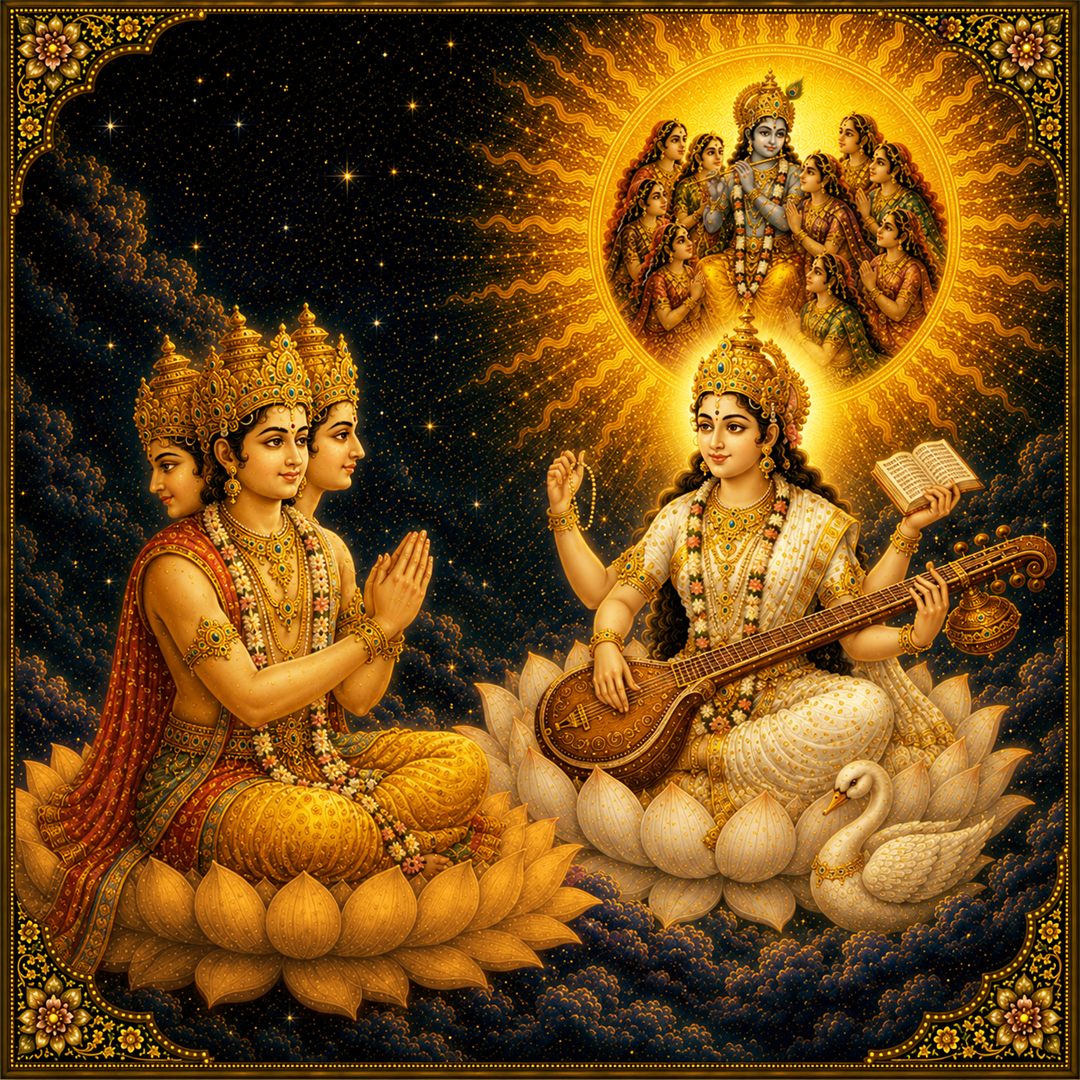
उवाच पुरतस्तस्मै तस्य दिव्या सरस्वती ।
कामः कृष्णाय गोविन्द हे गोपीजन इत्यपि ।
वल्लभाय प्रिया वह्नेर्मन्त्रं ते दास्यति प्रियम् ॥ २४ ॥
तपस्त्वं तप एतेन तव सिद्धिर्भविष्यति ॥ २५ ॥
uvāca puratas tasmai tasya divyā sarasvatī
kāmaḥ kṛṣṇāya govinda he gopī-jana ity api
vallabhāya priyā vahner mantraṁ te dāsyati priyam
tapas tvaṁ tapa etena tava siddhir bhaviṣyati
Then Bhagavān’s divine Sarasvatī spoke to Brahmā:
klīṁ kṛṣṇāya govindāya gopī-jana-vallabhāya svāhā.
“This mantra will bestow your cherished desire.
“Practice austerity by means of this mantra, and you will attain perfection.”
uvāca—spoke; purataḥ—before him; tasmai—to him; tasya—His, of Bhagavān; divyā sarasvatī—the divine Sarasvatī; kāmaḥ—the kāma-bīja, klīṁ; kṛṣṇāya—unto Kṛṣṇa; govinda—Govinda, understood here as govindāya, unto Govinda; he—O; gopī-jana—the gopīs; iti api—and also; vallabhāya—unto the beloved; priyā vahneḥ—the dear wife of Agni, Svāhā; mantram—the mantra; te—for you; dāsyati—will bestow; priyam—what is dear, your cherished desire; tapaḥ—austerity; tvam—you; tapa—practice, perform; etena—by this, by means of this mantra; tava—your; siddhiḥ—perfection; bhaviṣyati—will arise, will be attained.
Dig-darśinī-ṭīkā
Jīva Gosvāmī
Verse 24
Now, in the verse and a half beginning with uvāca, the mercy of Bhagavān that Brahmā had obtained through his previous worship is described.
The meaning is clear.
Verse 25
He connects this same instruction with the account in the Third Canto: sparśeṣu yat ṣoḍaśam ekaviṁśam. “The sixteenth and the twenty-first among the stop consonants.” Thus the present half verse begins tapas tvam, “Practice austerity.” The meaning is clear.
Brahma-saṁhitā-prakāśinī
Bhaktivinoda Ṭhākura
Verse 24-25
At that time, Śrī Bhagavān’s divine Sarasvatī spoke as follows to Brahmā, who saw darkness in every direction: “O Brahmā, this mantra —klīṁ kṛṣṇāya govindāya gopī-jana-vallabhāya svāhā— will fulfill your cherished desire. Practice austerity with this mantra. Then you will attain all perfection.”
The eighteen-syllable mantra, prefixed by the kāma-bīja (klīṁ), is supreme among mantras. It has two functions. The first is to draw the pure jīva toward Śrī Kṛṣṇa, the supreme attractor of the mind, the Lord of Gokula and Lord of the gopīs. This is the highest culmination of the jīva’s spiritual propensity. If the practitioner is free from material desire (niṣkāma), the perfected fruit of this mantra is love for Kṛṣṇa (prema).
Its second function is to fulfill the desires of materially motivated practitioners (sakāma). For them also, this supreme mantra grants the object of their desire.
In spiritual reality, the kāma-bīja is situated within the lotus of Goloka. Its reflected form within the material world fulfills all varieties of material desire.
The meaning of Verse 25 is clear.
Annotations
Bhakti Gauravani Goswami
In the Second Canto of the Śrīmad-Bhāgavatam (2.9.5–8), Brahmā, unable to discover the source of the lotus upon which he had appeared or the means of creation, hears the syllables ta and pa and undertakes austerity for one thousand celestial years. In his purport to Śrīmad-Bhāgavatam 2.9.6, Śrīla Prabhupāda writes:
According to Bhāgavata philosophy, every human being is meant simply for this tapa and for no other business, because by penance only can one realize his self; and self-realization, not sense gratification, is the business of human life. This tapa, or penance, was begun from the very beginning of the creation, and it was first adopted by the supreme spiritual master, Lord Brahmā. By tapasya only can one get the profit of human life, and not by a polished civilization of animal life. The animal does not know anything except sense gratification in the jurisdiction of eat, drink, be merry and enjoy. But the human being is made to undergo tapasya for going back to Godhead, back home.
Being pleased with Brahmā’s austerities, the Supreme Lord revealed His personal spiritual abode to him. The Śrīmad-Bhāgavatam describes this revelation principally in terms of Vaikuṇṭha, while the Brahma-saṁhitā records Brahmā’s realization of the supreme realm of Goloka Vṛndāvana. Brahmā’s hymn occupies Verses 29–56, which all conclude, except for Verse 56, with the refrain govindam ādi-puruṣaṁ tam ahaṁ bhajāmi. “I worship Govinda, the primeval Lord.”
The account in the Brahma-saṁhitā and that of the Second Canto are not contradictory but complementary. The Bhāgavatam emphasizes that Brahmā’s knowledge and empowerment originate from Bhagavān. Bewildered and unable to understand either his origin or the means of creation, Brahmā hears the divine instruction ta-pa, performs austerity, and ultimately receives direct revelation from the Supreme Lord. The Brahma-saṁhitā identifies the specific mantra communicated through divine Sarasvatī and describes Brahmā’s ensuing worship of Govinda.
Sarasvatī should not be understood as a source of transcendental knowledge independent of Bhagavān. She is His divine potency, through whom spiritual knowledge and transcendental sound (śabda-brahma) are communicated. When Sarasvatī reveals the Gopāla-mantra to Brahmā, it is actually Bhagavān who is instructing him through His potency. The revelation therefore originates from Bhagavān and reaches Brahmā in the form of divine sound.
Bhaktivinoda Ṭhākura focuses upon the eighteen-syllable mantra prefixed by the kāma-bīja (klīṁ). He distinguishes its original spiritual function from its reflected operation within the material world. For the desireless practitioner (niṣkāma), the mantra draws the soul toward Kṛṣṇa and culminates in pure love (prema). In its reflected material operation, it fulfills the worldly aspirations of the materially motivated practitioner (sakāma).