 Spiritual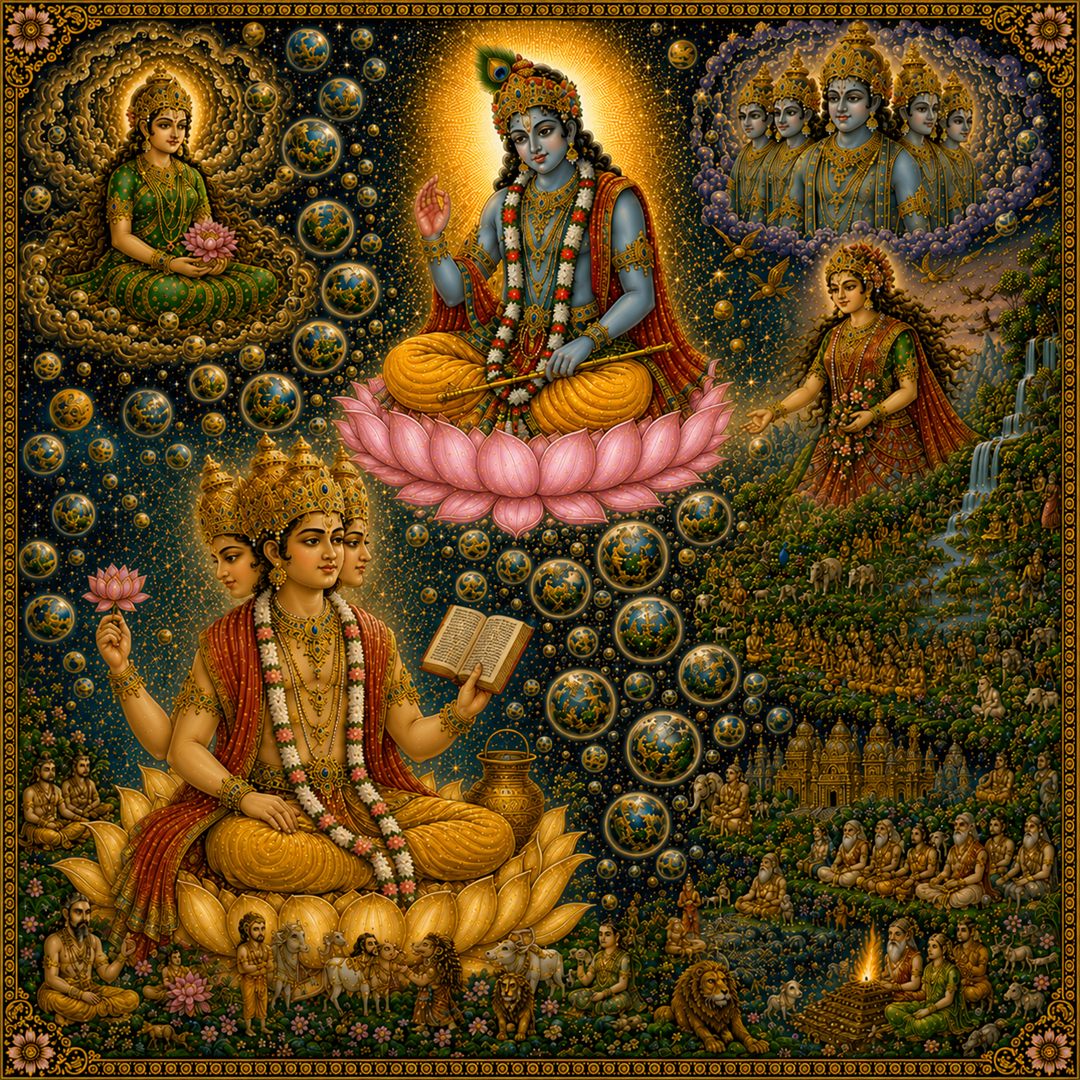
अहं हि विश्वस्य चराचरस्य बीजं प्रधानं प्रकृतिः पुमांश्च ।
मयाहितं तेज इदं विभर्षि विधे विधेहि त्वमथो जगन्ति ॥ ६२ ॥
ahaṁ hi viśvasya carācarasya bījaṁ pradhānaṁ prakṛtiḥ pumāṁś ca
mayāhitaṁ teja idaṁ vibharṣi vidhe vidhehi tvam atho jaganti
For I am indeed the supreme seed of the entire universe, moving and nonmoving; I am also prakṛti, and puruṣa. O Vidhi, you bear this power bestowed by Me; therefore, with that power, create the worlds.
aham—I; hi—certainly; viśvasya—of the universe; carācarasya—consisting of moving and nonmoving beings; bījam—the seed; pradhānam—supreme, primary; prakṛtiḥ—prakṛti, material nature; pumān—the puruṣa, the conscious person; ca—and; mayā—by Me; āhitam—placed, bestowed; tejaḥ—power, potency; idam—this; vibharṣi—you bear, possess; vidhe—O Vidhi, O Brahmā; vidhehi—create; tvam—you; atho—therefore, then; jaganti—the worlds..
Dig-darśinī-ṭīkā
Śrī Jīva Gosvāmī
The Lord now explains, with supporting reasoning, why Brahmā's desire to create will certainly be fulfilled, beginning with the words ahaṁ hi.
Here pradhānam means “supreme”; bījam refers to Bhagavān in His complete form; prakṛtiḥ denotes the unmanifest material nature; and pumān the witnessing person.
In short, the Lord tells Brahmā: “You too bear only the power that I have placed within you. Therefore, O Vidhi, by that power of Mine create all the worlds, both moving and nonmoving.”
Brahma-saṁhitā-prakāśinī
Śrīla Bhaktivinoda Ṭhākura
Verse 62
O Vidhi, I alone am the supreme seed of this entire universe of moving and nonmoving beings. I am pradhāna, I am prakṛti, and I am puruṣa. Even the spiritual splendor (brahma-tejas) that exists within you has been bestowed by Me. Bearing that power, you should create and arrange the universe of moving and nonmoving beings.
Some philosophers conclude: “The undifferentiated Brahman alone appears as the world of variety through vivarta (apparent transformation).”
Others maintain:
“Māyā, in its conditioned state, is the universe, and in its unconditioned state is Brahman.”
Others say:
“Brahman is the original object (bimba) and the universe is merely its reflection (pratibimba).”
Still others hold:
“The entire world is merely the illusion of the individual soul.”
Some think:
“God, the individual soul, and the world, though belonging to one reality, are eternally distinct from one another.”
Others maintain:
“God alone is the substantive reality, while all conscious and unconscious entities are His attributes.”
Others believe:
“By inconceivable power, sometimes non-duality and sometimes duality appear to be true.”
Others conclude:
“A powerless non-dualism is meaningless; therefore Brahman is eternally non-dual but endowed with pure potency.”
All these doctrines have arisen from the Vedas by taking shelter of the Vedānta-sūtras. Although none of them contain the whole truth, each contains some measure of truth.
Leaving aside systems opposed to the Vedic conclusion, such as Sāṅkhya, Patañjali, Nyāya, and Vaiśeṣika, and also the ritualistic schools such as Pūrva-Mīmāṁsā, which accept only the karmic portion of the Vedas, even the previously mentioned schools have arisen while outwardly taking shelter of Vedānta.
[The Lord tells Brahmā:] “Abandoning all these doctrines, you and your pure disciplic succession should accept the supreme truth in the form of acintya-bhedābheda, inconceivable simultaneous oneness and difference. Only then will you be able to become a pure devotee.”
The essential meaning is this. Kṛṣṇa says:
The moving universe is composed of living entities, and the nonmoving universe is composed of matter. Among them, the living entities are manifested by My superior potency through the operation of the marginal potency, and the material world is manifested by My inferior energy.
I am the seed of all these manifestations. Remaining non-different from these various energies, I regulate them through My will. Through the transformations of these energies arise pradhāna, prakṛti, and puruṣa. Therefore, from the standpoint of energy (śakti-tattva), I am pradhāna, prakṛti, and puruṣa; yet from the standpoint of the possessor of energy (śaktimān-tattva), I am eternally distinct from all of them.
This simultaneous oneness and difference exists solely by virtue of My inconceivable potency. Therefore, let this remain the āmnāya-upadeśa, the traditional teaching transmitted through your disciplic succession:
“Through knowledge of the mutual relationship of the jīva, matter, and Kṛṣṇa according to the principle of acintya-bhedābheda, one should attain kṛṣṇa-prema through pure devotional service.”
***
This commentary, entitled Prakāśinī, which reveals the inner intention of the living beings and bestows fearlessness upon them, has been composed by Bhaktivinoda, the resident of Surabhī-kuñja.
Thus ends the Gauḍīya commentary entitled Prakāśinī on the Fifth Chapter, known as the Mūla-sūtra, of the Śrī Brahma-saṁhitā, the compendium of the established conclusions concerning Bhagavān, the Supreme Personality of Godhead.