 Spiritual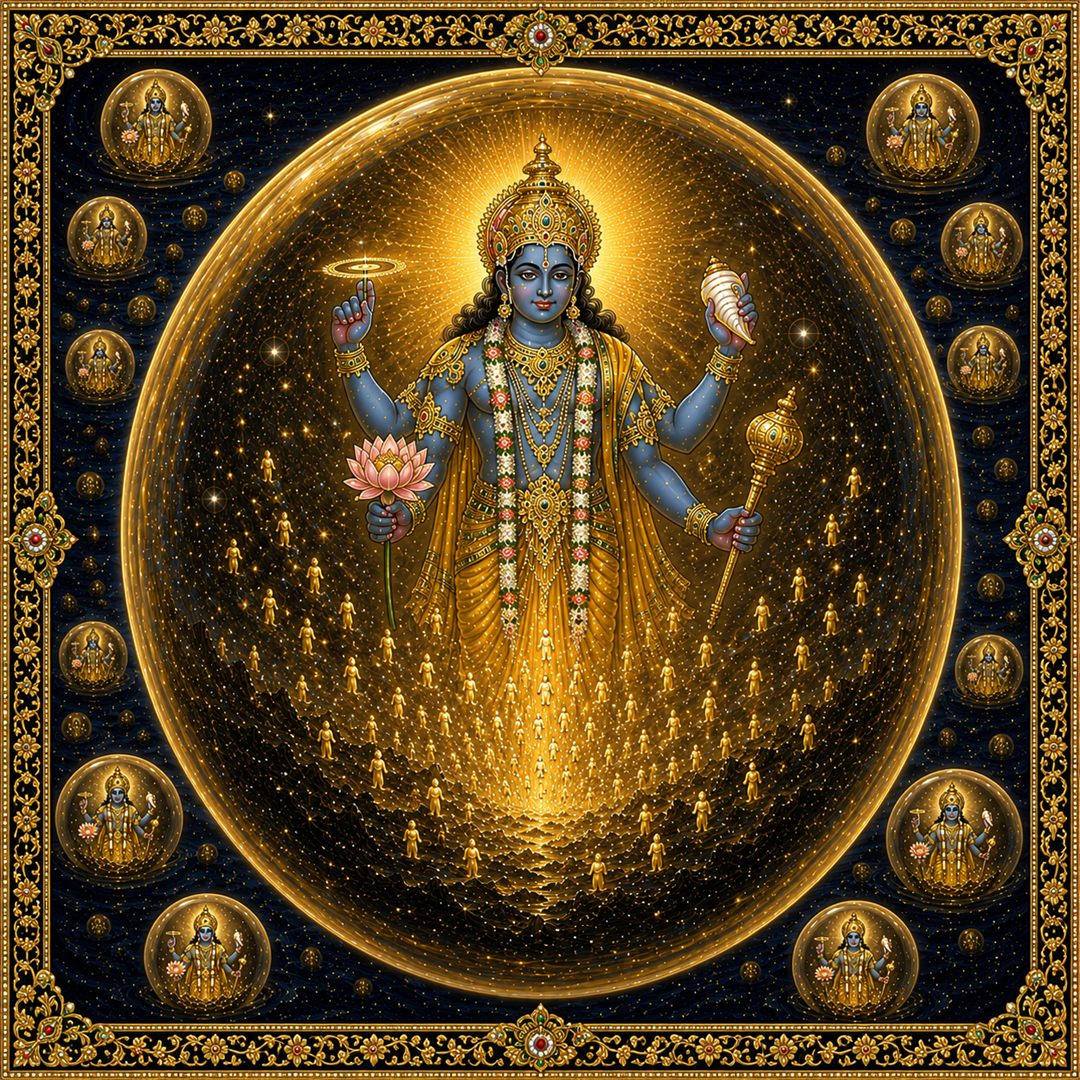
योजयित्वा तु तान्येव प्रविवेश स्वयं गुहाम् ।
गुहां प्रविष्टे तस्मिंस्तु जीवात्मा प्रतिबुध्यते ॥ २० ॥
yojayitvā tu tāny eva praviveśa svayaṁ guhām
guhāṁ praviṣṭe tasmiṁs tu jīvātmā pratibudhyate
Having combined those very elements, He Himself entered the hidden cavity. When He had entered that cavity, the collective living being awakened.
yojayitvā—having combined; tu—then; tāni eva—those very elements; praviveśa—entered; svayam—He Himself; guhām—the hidden cavity, the concealed interior; guhām praviṣṭe tasmin—when He had entered the cavity; tu—then; jīva-ātmā—the collective living being; pratibudhyate—awakens.
Dig-darśinī-ṭīkā
Jīva Gosvāmī
Now comes the third verse, beginning with yojayitvā, “having combined.” The meaning is that this entry occurs between the combination of the elements and His assumption of yoga-nidrā.
As for guhām, it means “into the cavity.”
The virāṭ form awakens; it rises from the sleep of cosmic dissolution.
Brahma-saṁhitā-prakāśinī
Bhaktivinoda Ṭhākura
Verse 20
Having combined those separate elements, He manifested innumerable material universes and then Himself entered into the “cavity,” the interior of each universal form. At that time the living entities, who during the cosmic dissolution had lain dormant in sleep, became awakened once again.
In Scripture, the word guhā, “cavity” or “hidden chamber,” is used in several contexts. In some passages it denotes unmanifest līlā; in others, the dwelling place of the indwelling Puruṣa within the individual living being; and elsewhere, the cave of the living entity’s heart.
In all these usages, guhā denotes a hidden or concealed place.
The living entities referred to here are those who, during the great dissolution at the close of the preceding cosmic cycle, had entered a dormant state within Hari. According to the latent impressions of their previous karma, they again became manifest within the created universe.
Annotations
Bhakti Gauravani Goswami
The word guhā here primarily refers to the interior of the virāṭ form, which the Lord enters after combining the material elements. This “entry” should not be understood as ordinary physical movement. It denotes His manifestation as the indwelling Lord within the cosmic form.
Only after His entry do the dormant jīvas awaken from their condition during pralaya, the annihilation of the universe, and resume activity within the new creation according to their previous karma.
In the Upaniṣads, the term guhā often denotes the “cave of the heart” (hṛdaya-guhā), the hidden inner place where Paramātmā resides within each living entity. In the present sequence, however, it refers specifically to the interior of the cosmic virāṭ form.
Verses 19 and 20 describe four stages: the material principles remain separate, the Lord combines them, He enters the resulting cosmic form, and the dormant living entities awaken.
Creation does not involve the production of new souls. The jīvas exist eternally as manifestations of the Lord’s marginal potency. During cosmic dissolution they remain dormant and unmanifest within Hari; at the beginning of a new creation they again become active according to the impressions of their previous karma.