 Spiritual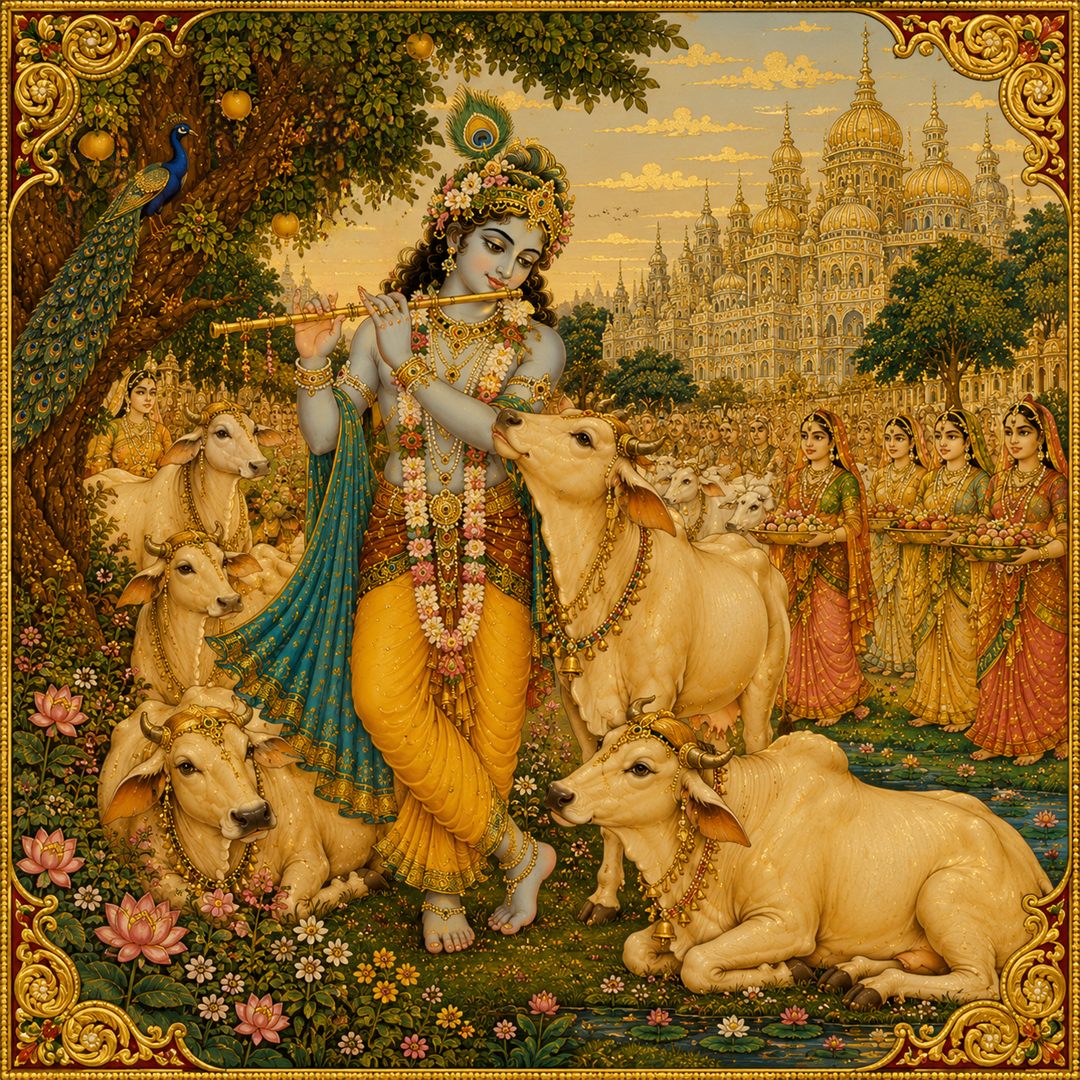
चिन्तामणिप्रकरसद्मसु कल्पवृक्ष- लक्षावृतेषु सुरभीरभिपालयन्तम् । लक्ष्मीसहस्रशतसम्भ्रमसेव्यमानं गोविन्दमादिपुरुषं तमहं भजामि ॥ २९ ॥
cintāmaṇi-prakara-sadmasu kalpa-vṛkṣa-
lakṣāvṛteṣu surabhīr abhipālayantam
lakṣmī-sahasra-śata-sambhrama-sevyamānaṁ
govindam ādi-puruṣaṁ tam ahaṁ bhajāmi
I worship Govinda, the primeval Lord, who tends the surabhi cows within abodes made of cintāmaṇi gems, surrounded by hundreds of thousands of wish-fulfilling trees, and who is served with loving eagerness by hundreds of thousands of Lakṣmīs.
cintāmaṇi-prakara-sadmasu—in palaces made of clusters of cintāmaṇi gems; kalpa-vṛkṣa-lakṣa-āvṛteṣu—surrounded by hundreds of thousands of wish-fulfilling trees; surabhīḥ—the surabhi cows; abhipālayantam—carefully tending and protecting; lakṣmī-sahasra-śata—by hundreds of thousands of Lakṣmīs; sambhrama-sevyamānam—served with great reverence and loving eagerness; govindam—Govinda; ādi-puruṣam—the primeval Lord; tam—Him; aham—I; bhajāmi—worship.
Dig-darśinī-ṭīkā
Śrī Jīva Gosvāmī
Now Brahmā begins his hymn.
Among the many sacred pīṭhas, or spiritual centers, within Goloka—distinguished according to different mantras, different regions, and meditative manifestations such as the Bṛhad-dhyāna and others—there are various seats associated with particular times and modes of worship for a single mantra.
Yet among them all, the foremost and central pīṭha is the one known as Gokula. Therefore Brahmā first glorifies Govinda according to the pastimes appropriate to residence within that principal Gokula-pīṭha.
Thus he says: cintāmaṇi-prakara-sadmasu. The meaning is clear.
The phrase surabhīr abhipālayantam means that He carefully protects and tends the cows in every way, with deep affection, by grazing them in forests, leading them to water, guiding them along pathways, and bringing them to the cowherd settlements
Then Brahmā hints at the Lord’s more confidential activities by saying: lakṣmī-sahasra-śata-sambhrama-sevyamānam. He is served with loving eagerness by hundreds of thousands of Lakṣmīs. As explained previously, lakṣmī here means the beautiful gopīs of Vraja.
Brahma-saṁhitā-prakāśinī
Śrīla Bhaktivinoda Ṭhākura
I worship that primeval Lord Govinda, who tends the surabhi cows, the wish-fulfilling kāmadhenus, in abodes built of clusters of cintāmaṇi gems, surrounded by millions of wish-fulfilling trees, and who is lovingly served by hundreds of thousands of Lakṣmīs.
The word cintāmaṇi here should be understood as a spiritual gem. Just as the illusory energy, māyā-śakti, constructs the material world from the five gross material elements, in the same way the spiritual potency, cic-chakti, creates the spiritual world from spiritual substance in the form of cintāmaṇi. Among these, the cintāmaṇi that constitutes the very substance of Bhagavān’s abode in Goloka is even more rare and valuable than ordinary cintāmaṇi gems.
Ordinary wish-fulfilling trees grant the fruits of religiosity, wealth, sense enjoyment, and liberation. But the wish-fulfilling trees in Kṛṣṇa’s abode bestow unlimited varieties of divine love. Ordinary wish-fulfilling cows give milk only when milked, but the surabhi cows of Goloka constantly pour forth an ocean of milk in the form of a fountain of love, streaming with spiritual consciousness and bliss and dispelling the hunger and thirst of the pure devotees.
The numerical expressions in the verse indicate unlimited numbers. The word sambhrama signifies service performed with a heart overflowing with love and eager regard. The word lakṣmī here refers to the beautiful cowherd girls, the gopīs. The expression ādi-puruṣa, “the primeval Lord,” means He who is the origin of all.
Annotations
Bhakti Gauravani Goswami
The revelation granted to Brahmā after his austerities is also described in Chapter Nine of the Second Canto of the Śrīmad-Bhāgavatam. There the Supreme Lord, pleased with Brahmā’s penance, manifests His personal abode, Vaikuṇṭha, before him.
In the purport to Text 9, Śrīla Prabhupāda explains that the austerities performed by Brahmā were not ordinary penances, but acts of devotional service, because otherwise the Lord would not have revealed His personal abode which is real, not mythical or material as impersonalists believe. Only through bhakti can the transcendental realm of Vaikuṇṭha become visible; no amount of speculation, dry renunciation, or mechanical meditation can grant entrance into the Lord’s eternal abode.
Although austerity, such as the one performed by Brahmā, may involve hardship, the difficulties accepted in bhakti-yoga are spiritual in nature and therefore filled with transcendental happiness from the very beginning. Other forms of severe discipline, when devoid of devotional service to the Lord, ultimately yield only labor and frustration, like beating empty husks without obtaining grain.
Then Prabhupāda makes a remarkable comparison that needs explanation. He writes: “Executing bhakti-yoga is exactly like sitting on the lotus sprouted out of the abdomen of the transcendental Personality of Godhead, for Lord Brahmā was seated there.”
Taken literally, this statement may be confusing because it appears to say: “Since Brahmā sat on the lotus, therefore bhakti is like sitting on a lotus.” But this is not meant as a formal logical argument. The comparison is analogical, not causal. Understood in that way, the lotus functions as a symbol of direct dependence upon and connection with the Supreme Personality of Godhead.
Brahmā’s physical position upon the lotus mirrors the metaphysical position of the devotee practicing bhakti-yoga who is supported by the Lord, connected to the Lord, nourished by the Lord, and ultimately granted entrance by the Lord into His abode. Just as Brahmā attained realization while seated upon the lotus arising from the Lord Himself, so the devotee attains realization by remaining fully dependent upon the Lord’s mercy.
Another important point raised by Prabhupāda is that true self-realization culminates not in an impersonal conception of one’s self, but in perceiving the transcendental personality of both the Lord and His devotees. Such realization is possible only for those who are sva-dṛṣṭavadbhiḥ, those who have realized their true self as spiritual persons and eternal servants of the Lord.
This verse also marks the beginning of Brahmā’s direct description of Goloka Vṛndāvana, the supreme spiritual abode. Rather than describing the Supreme Lord as a majestic ruler surrounded by awe and reverence, Brahmā presents Govinda as a cowherd boy who lovingly tends His surabhi cows amidst forests of wish-fulfilling trees.