 Spiritual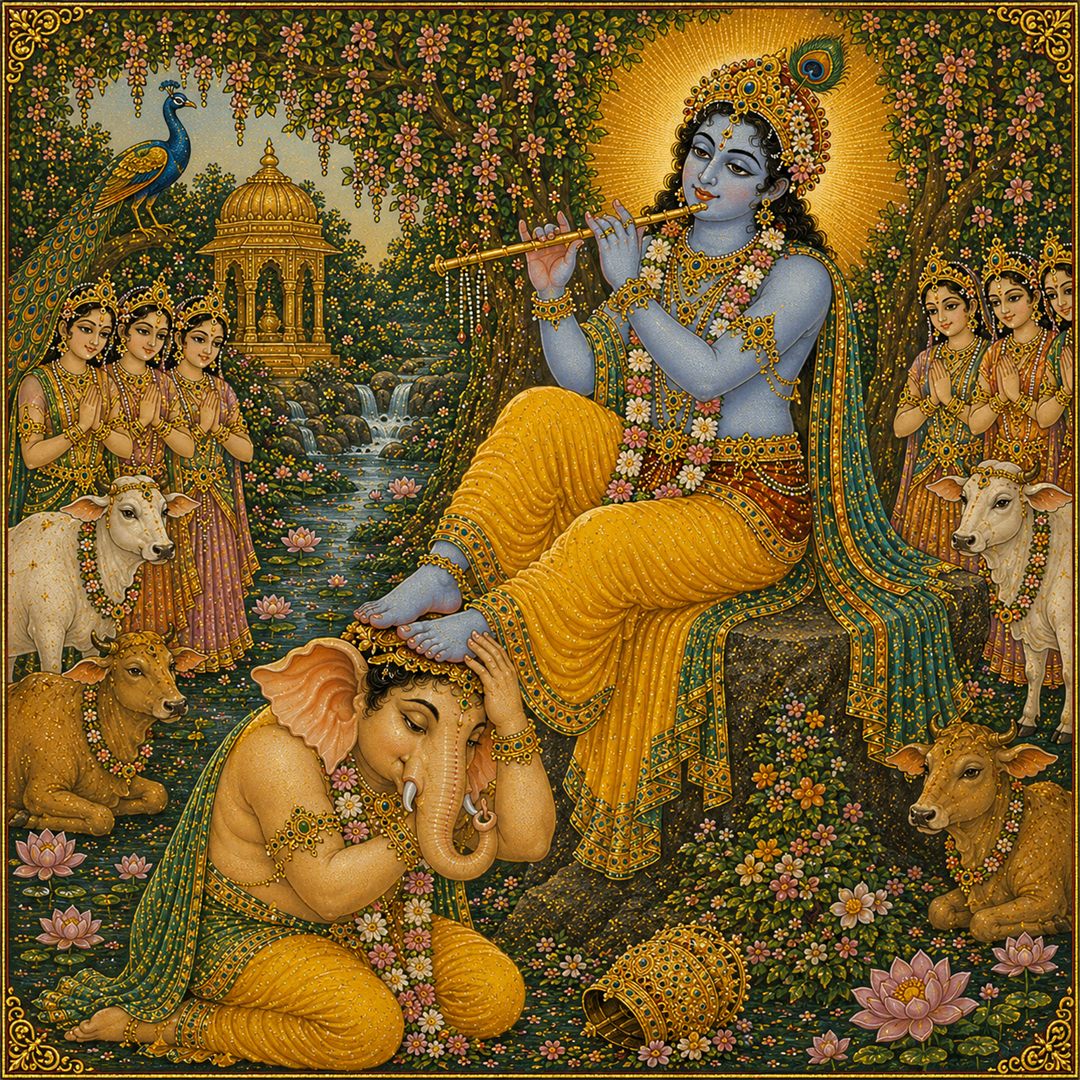
यत्पादपल्लवयुगं विनिधाय कुम्भद्वन्द्वे प्रणामसमये स गणाधिराजः ।
विघ्नान् विहन्तुमलमस्य जगत्त्रयस्य गोविन्दमादिपुरुषं तमहं भजामि ॥ ५० ॥
yat-pāda-pallava-yugaṁ vinidhāya kumbha-
dvandve praṇāma-samaye sa gaṇādhi-rājaḥ
vighnān vihantum alam asya jagat-trayasya
govindam ādi-puruṣaṁ tam ahaṁ bhajāmi
I worship Govinda, the primeval Lord, whose lotus feet Gaṇeśa, the lord of the Gaṇas, places upon the pair of pot-like elevations on his head when offering obeisances. He thereby becomes empowered to remove the obstacles of the three worlds.
yat—whose; pāda-pallava-yugam—pair of tender lotus feet; vinidhāya—placing; kumbha-dvandve—upon the pair of pot-like elevations on his head; praṇāma-samaye—at the time of offering obeisances; saḥ—he; gaṇa-adhi-rājaḥ—the lord of the Gaṇas, Gaṇeśa; vighnān—obstacles; vihantum—to destroy; alam—fully capable; asya jagat-trayasya—of these three worlds; govindam—Govinda; ādi-puruṣam—the primeval Lord; tam—Him; ahaṁ bhajāmi—I worship.
Dig-darśinī-ṭīkā
Śrī Jīva Gosvāmī
One might object: “Since all people worship Gaṇapati first for the removal of obstacles, perhaps he alone is supremely worshipable.” Anticipating this objection, Brahmā replies with the words yat-pāde...: Gaṇeśa possesses the power to remove obstacles only because he worships Govinda's lotus feet.
This conclusion is supported by a kaimutya (“how much more so”) argument based on Lord Kapila’s statement in the Śrīmad-Bhāgavatam (3.28.22): “Lord Śiva became truly auspicious by bearing upon his head the sacred waters of the foremost river flowing from the Lord's lotus feet.”
If even the water that has washed the Lord’s feet bestowed such exalted glory upon Śiva, then how much greater must be the potency obtained by Gaṇeśa, who places those very lotus feet upon his head.
Brahma-saṁhitā-prakāśinī
Śrīla Bhaktivinoda Ṭhākura
Verse 50
I worship that primeval Lord Govinda, whose lotus feet Gaṇeśa eternally places upon the pair of pot-like protuberances of his head in order to obtain the power required for his task of removing obstacles throughout the three worlds.
Gaṇeśa has been entrusted with the authority to remove obstacles. Therefore he is worshiped by those whose undertakings fall within the scope of his jurisdiction.
Indeed, because he is regarded as a worshipable form of Brahman endowed with attributes (saguṇa-brahman), he has even attained a place among the five principal deities (pañca-devatā).
Nevertheless, Gaṇeśa is an empowered administrative demigod (śaktyāveśa ādhikārika-devatā). All his greatness and glory arise solely through the mercy of Govinda.
Annotations
Bhakti Gauravani Goswami
Gaṇeśa, also known as Gaṇapati, is described in this verse as gaṇādhi-rājaḥ, the king of the Gaṇas. According to the Śiva Purāṇa, Lord Śiva’s Gaṇas were a diverse and wild host of beings that were difficult to control. Pārvatī created Gaṇeśa to be her loyal guardian. After a conflict where Gaṇeśa fiercely defended his mother’s privacy, Śiva inadvertently severed Gaṇeśa’s head and replaced it with an elephant’s. However, recognizing his son’s immense courage, loyalty, and strength, Śiva blessed and rewarded him by ordaining that he would be the leader of all of Śiva’s troops. According to the traditional Purāṇic account, he appointed him leader of the Gaṇas, declaring that he would be honored before auspicious undertakings.
As the leader of the Gaṇas, Gaṇeśa presides over numerous subordinate beings and powers involved in the administration of the material world. Because he governs these hosts and the powers under his authority, he has the unique power to either place obstacles in a person’s path or completely remove them. For this reason, Gaṇeśa is worshiped by many people in India, especially business or shop owners, who seek Gaṇeśa’s blessings for success in their undertakings.
He is also associated with intellect, learning, and the arts because he served as the scribe for Vyāsadeva, writing down the Mahābhārata as it was dictated to him.
While Gaṇeśa has been entrusted with authority over obstacles, this verse clarifies that he derives his power entirely from the Supreme Lord by holding Govinda’s lotus feet upon his elephant head. Thus a devotee honors Gaṇeśa not as an independent god, but as a servant of Kṛṣṇa, empowered to remove obstacles on the path of devotional service.
Śrīla Prabhupāda’s instructions on Gaṇeśa worship should be understood in this same light. In The Nectar of Devotion, he notes that Gaṇapati may be honored as one who removes impediments in devotional service. In a 1974 letter, however, he discouraged independent or public Gaṇeśa worship, emphasizing that devotees should simply worship Kṛṣṇa and perform devotional service to Him. Thus Gaṇeśa may be honored according to the principle taught in the Brahma-saṁhitā: not as an independent deity equal to the Supreme Lord, but as a servant empowered by Govinda.
Regarding the worship of the five principal deities (pañca-devatā), Prabhupāda says the following in the Caitanya-caritāmṛta, Ādi-līlā, 7.157:
In the Brahma-saṁhitā there are mantras offering obeisances to Lord Śiva, Lord Brahmā, the sun-god and Lord Gaṇeśa, as well as Lord Viṣṇu, all of whom are worshiped by the impersonalists as pañcopāsanā. In their temples impersonalists install deities of Lord Viṣṇu, Lord Śiva, the sun-god, goddess Durgā and sometimes Lord Brahmā also, and this system is continuing at present in India under the guise of the Hindu religion. Vaiṣṇavas can also worship all these demigods, but only on the principles of the Brahma-saṁhitā, which is recommended by Śrī Caitanya Mahāprabhu. We may note in this connection the mantras for worshiping Lord Śiva, Lord Brahmā, goddess Durgā, the sun-god and Gaṇeśa, as described in the Brahma-saṁhitā (44, 45, 49, 50 and 52).