 Spiritual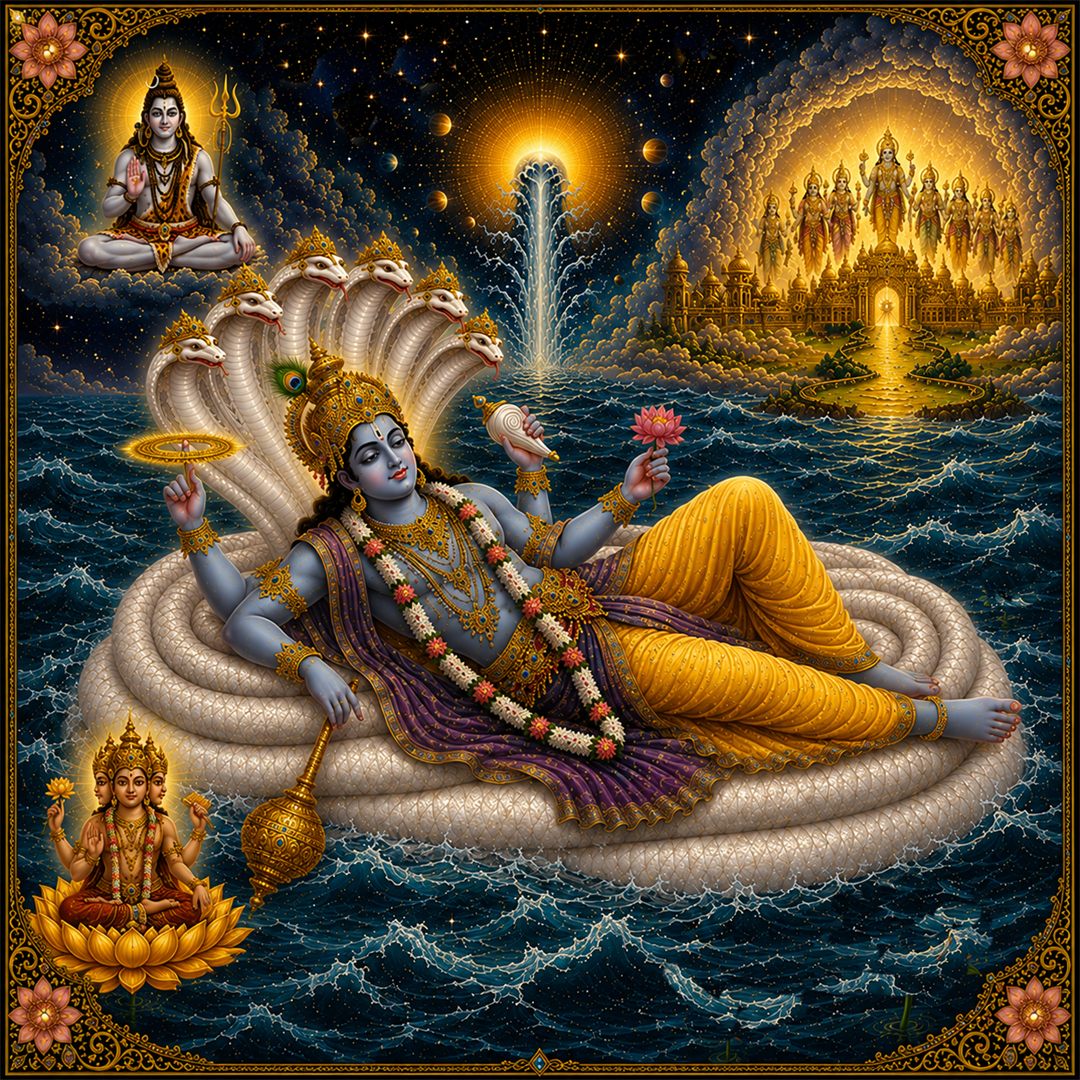
नारायणः स भगवानापस्तस्मात्सनातनात् ।
आविरासीत्कारणार्णोनिधिः सङ्कर्षणात्मकः ॥
योगनिद्रां गतस्तस्मिन् सहस्रांशः स्वयं महान् ॥ १२ ॥
nārāyaṇaḥ sa bhagavān āpas tasmāt sanātanāt
āvirāsīt kāraṇārṇo-nidhiḥ saṅkarṣaṇātmakaḥ
yoga-nidrāṁ gatas tasmin sahasrāṁśaḥ svayaṁ mahān
From that eternal Lord, the waters of the Causal Ocean manifested. Bhagavān Nārāyaṇa, a portion of Saṅkarṣaṇa and Himself the Great Lord possessing innumerable expansions, entered yoga-nidrā upon those waters.
nārāyaṇaḥ—Nārāyaṇa; saḥ bhagavān—that Supreme Lord; āpaḥ—the waters; tasmāt sanātanāt—from that eternal Lord; āvirāsīt—became manifest; kāraṇa-arṇo-nidhiḥ—the oceanic reservoir of causal waters, the Causal Ocean; saṅkarṣaṇa-ātmakaḥ—of the nature of Saṅkarṣaṇa; yoga-nidrām gataḥ—entered yoga-nidrā; tasmin—within or upon that ocean; sahasra-aṁśaḥ—possessing thousands, or innumerable, expansions; svayam mahān—Himself, the Great Lord.
Dig-darśinī-ṭīkā
Jīva Gosvāmī
Brahmā now states that this same Lord is Kāraṇārṇavaśāyī Viṣṇu. From that eternal Lord, the waters themselves manifested as the ocean known as the Causal Ocean. The word saṅkarṣaṇātmakaḥ indicates that this Nārāyaṇa is a portion of Saṅkarṣaṇa, who was previously identified as one of the four members of the catur-vyūha surrounding Goloka.
The verse then describes His pastime: yoga-nidrāṁ gataḥ. “He entered yoga-nidrā.” This means that He entered samādhi in the bliss of His own nature (svarūpānanda-samādhi).
Thus it is said: āpo nārā iti proktā āpo vai nara-sūnavaḥ / tasya tā ayanaṁ pūrvaṁ tena nārāyaṇaḥ smṛtaḥ. “The waters are called nārāḥ, for the waters are indeed the offspring of Nara. Since they were originally His resting place, He is remembered as Nārāyaṇa.”
Brahma-saṁhitā-prakāśinī
Bhaktivinoda Ṭhākura
Verse 12
That Mahā-Viṣṇu is known within the material world by the name Nārāyaṇa. From that eternal puruṣa, the waters of the Causal Ocean have arisen. That Supreme Person, Bhagavān, is a portion of Saṅkarṣaṇa situated in the spiritual sky and Himself possesses innumerable portions. He enters yoga-nidrā and reclines upon those waters.
Samādhi in the bliss of His own nature is called yoga-nidrā. The previously mentioned goddess Ramā herself is this yoga-nidrā in the form of Yogamāyā.
Annotations
Bhakti Gauravani Goswami
It should be noted that the term yoga-nidrā does not mean ordinary sleep or unconsciousness. Rather, it refers to complete absorption in the bliss of His own nature (svarūpānanda-samādhi). Although He appears to sleep, Mahā-Viṣṇu remains fully conscious and fully sovereign.
Bhaktivinoda Ṭhākura further explains that this yoga-nidrā is not an impersonal state. The previously mentioned goddess Ramā, appearing in the form of Yogamāyā, is herself this yoga-nidrā. Thus Mahā-Viṣṇu’s apparent sleep is actually an expression of His eternal spiritual bliss, not a condition of inactivity or ignorance.
The term yoga-nidrā is also used in a different context for Brahmā’s repose during the night of partial cosmic devastation. At that time, Brahmā enters the body of Garbhodakaśāyī Viṣṇu and rests there, as Śrīla Prabhupāda explains in his purport to the Śrīmad-Bhāgavatam 1.6.30:
The duration of a day in the life of Brahmā is 4,320,000,000 solar years. This is stated also in the Bhagavad-gītā. So for this period Brahmājī rests in yoga-nidrā within the body of the Garbhodakaśāyī Viṣṇu, the generator of Brahmā. Thus after the sleeping period of Brahmā, when there is again creation by the will of the Lord through the agency of Brahmā, all the great ṛṣis again appear from different parts of the transcendental body, and Nārada also appears.
This means that Nārada appears in the same transcendental body, just as a man awakes from sleep in the same body. Śrī Nārada is eternally free to move in all parts of the transcendental and material creations of the Almighty. He appears and disappears in his own transcendental body, which is without distinction of body and soul, unlike conditioned beings.
In this passage, yoga-nidrā describes Brahmā’s divinely ordained repose during his night, which, like his day, lasts 4,320,000,000 solar years. Brahmā’s yoga-nidrā, however, should not be equated with that of Mahā-Viṣṇu. The latter is His svarūpānanda-samādhi, which Bhaktivinoda Ṭhākura identifies with Ramā in the form of Yogamāyā.