 Spiritual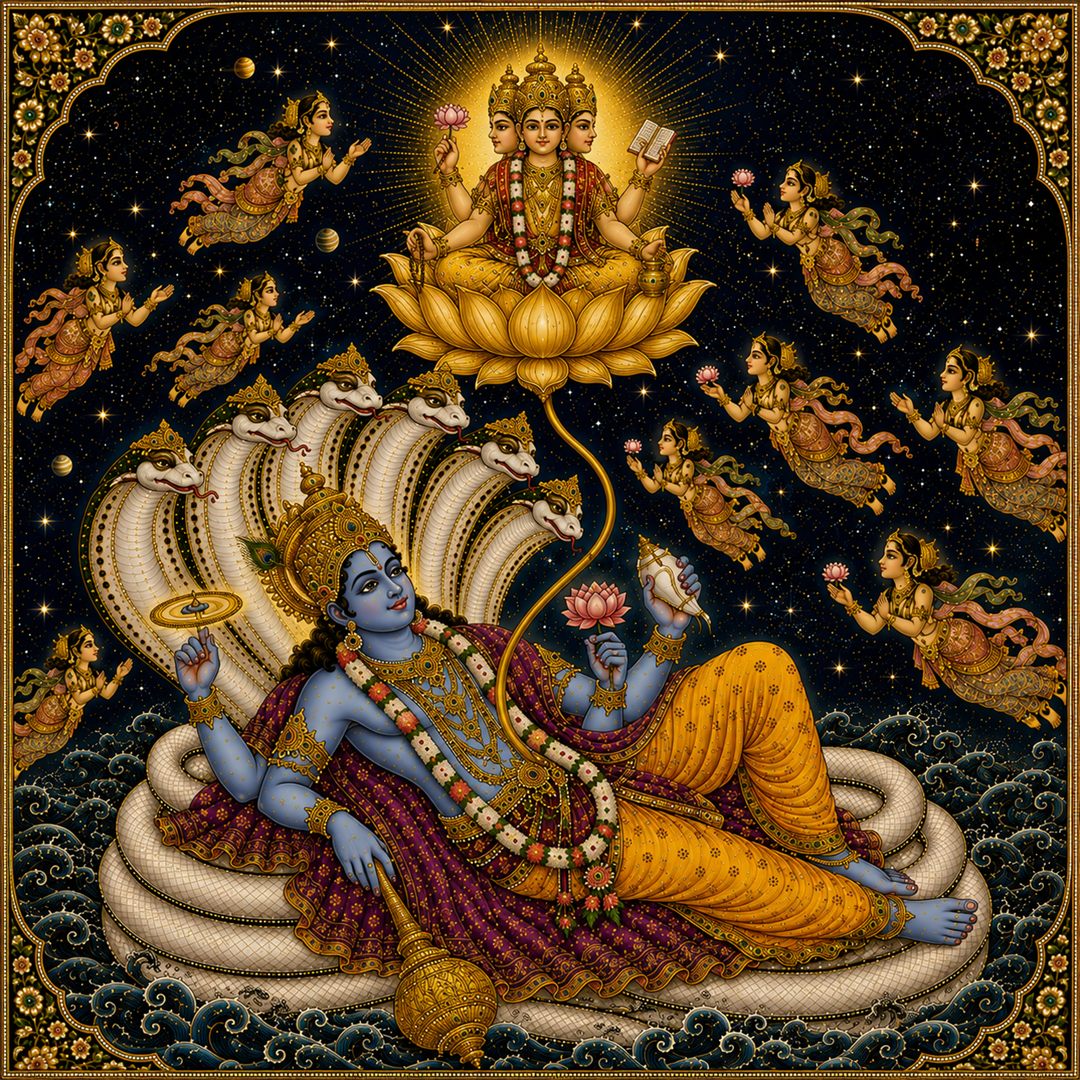
एवं सर्वात्मसम्बन्धं नाभ्यां पद्मं हरेरभूत् ।
तत्र ब्रह्माभवद्भूयश्चतुर्वेदी चतुर्मुखः ॥ २२ ॥
evaṁ sarvātma-sambandhaṁ nābhyāṁ padmaṁ harer abhūt
tatra brahmābhavad bhūyaś catur-vedī catur-mukhaḥ
Thus from Hari’s navel arose the lotus connected with all living beings. Thereafter, four-faced Brahmā, knower of the four Vedas, appeared upon that lotus.
evam—thus; sarva-ātma-sambandham—connected with all living beings; nābhyām—from the navel; padmam—the lotus; hareḥ—of Hari; abhūt—arose, came into being; tatra—there, upon that lotus; brahmā abhavat—Brahmā appeared; bhūyaḥ—thereafter, then; catur-vedī—knower of the four Vedas; catur-mukhaḥ—having four faces.
Dig-darśinī-ṭīkā
Jīva Gosvāmī
With the word evam, “thus,” Brahmā explains that the lotus appropriately serves as the seat of the aggregate of living entities because it arose from the Puruṣa who had entered the cavity.
Then, with the word tatra, he describes the manifestation of the bhoga-vigraha and the other features of four-faced Brahmā from Hiraṇyagarbha Brahmā, who identifies with the aggregate cosmic body (samaṣṭi-deha).
Brahma-saṁhitā-prakāśinī
Bhaktivinoda Ṭhākura
Verse 22
The lotus that arises from the navel region of Viṣṇu is connected with all living beings collectively. Upon that lotus appears the four-faced Brahmā, knower of the four Vedas.
From the Puruṣa who had entered the cosmic cavity (guhā-praviṣṭa-puruṣa) arises the lotus that serves as the seat of the aggregate of living entities (samaṣṭi-jīva-adhiṣṭhāna).
From the original Brahmā in the form of Hiraṇyagarbha, who identifies with the aggregate cosmic body (samaṣṭi-dehābhimānī), the four-faced Brahmā is born in the form of a bhoga-vigraha.
Brahmā is thus established as an appointed deity (ādhikārika-devatā) and as a separated expansion of Kṛṣṇa (vibhinnāṁśa).
Annotations
Bhakti Gauravani Goswami
When Bhaktivinoda Ṭhākura states that Brahmā is born in the form of a bhoga-vigraha, one may wonder what he wants to convey, since bhoga-vigraha literally means “a body for enjoyment.” In this context, however, the term denotes a body suitable for experience and activity—in other words, an individual embodied form through which one performs a particular function.
In this case, it refers to the individual embodied form assumed by the four-faced Brahmā through which he carries out his divinely appointed function of universal creation.
Jīva Gosvāmī distinguishes this personal Brahmā from Hiraṇyagarbha, the cosmic Brahmā identified with the aggregate cosmic body.
Bhaktivinoda Ṭhākura further explains that although Brahmā occupies the office of an ādhikārika-devatā (an appointed presiding deity), he nevertheless remains a vibhinnāṁśa, an individual living being who is a separated expansion of Kṛṣṇa.